Wednesday, 29 April 2015

Necessity & Possibility are Interdefinable


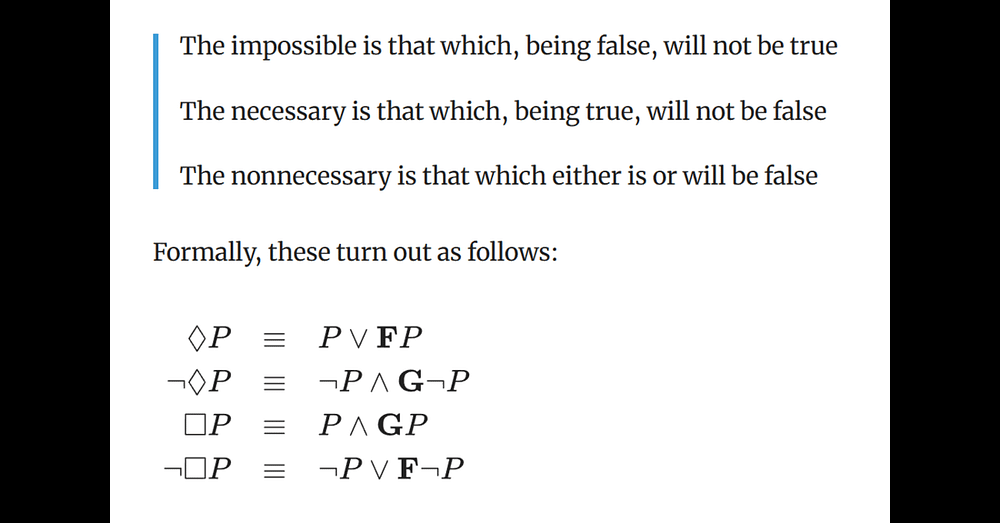
A.N. Prior’s formal account of necessity and possibility within a propositional and modal context. Key: ◇ = possibly, □ = necessarily, ∨ = or, ∧ = and, P = proposition, ≡ = if and only if.

Within modal logic, necessity and possibility are interdefinable. In other words, we can define (or explain) necessity in terms of possibility, and we can define (or explain) possibility in terms of necessity.

To say that something is possible isn’t to say that it’s likely or unlikely, or that it probably will happen some time in the future. In this context at least, what is important about any given x being possible is that its (as it were) non-happeningness isn’t necessary.

So there’s nothing necessary about there being no unicorns or seven-foot-high cats.

Again, there are no unicorns. However, it’s not necessary that there are no unicorns. And there probably couldn’t be seven-foot-high cats. However, it isn’t necessary that there aren’t any, or that there won’t be any in the future.

We can kind of invert this possibility-necessity relation by making it a necessity-possibility relation. So instead of defining possibility in terms of necessity, we can now define necessity in terms of possibility.

Something is necessary if it has to be the case, or if it must happen. In terms of possibility, we can say, “that its failure to happen is not possible”. So if we drop a stone here on Earth, it must fall to the ground (i.e., if there is nothing material stopping it). It’s not possible that it would, or could, just float in the air.

This is natural necessity, and we can oppose it to logical necessity. It’s not logically necessary that a stone must drop to the ground.

Semantic Necessity?

Can we say that it is necessary that all bachelors are unmarried? After all, married bachelors aren’t possible.

However, is this simple semantics?

The word ‘bachelor’ is a synonym for ‘unmarried man’. Thus, if we say that

“John the bachelor is married.”

we’re also saying that

“John the unmarried man is married.”

Thus, with the (as Quine put it) “substitution of synonym for synonym”, we arrive at a straightforward assertion of a logical contradiction. In other words, we’re saying that John can be both unmarried and married at one and the same time. Thus, John’s unmarried status is necessary precisely because he’s a bachelor. Therefore, his being a married bachelor isn’t possible.

To repeat. The necessity of the statement

“John the bachelor is unmarried.”

being true is partly a result of the impossibility of the statement

“John the bachelor is married.”

being true.

[See note.]

From all the above, we (to use another modal term) couldn’t have necessity without possibility (or something’s impossibility). Similarly, we couldn’t have possibility with necessity (or something’s being necessary).


Note:

The American philosopher W.V.O. Quine (1908–2000) critically examined this account of what can be called conceptual (or linguistic) necessity. However, it was worth noting the basics first. [See Quine’s ‘Two Dogmas of Empiricism’.]

There are No Proofs in Science


There are no proofs in science - at least not strictly speaking. There are in mathematics and logic.

In basic terms, why is that?

This is how John Horgan puts it:

The only propositions that can be verified – that is, proved true – are those dealing in pure logic or mathematics.”

Horgan continues:

Such systems are closed, in that all their components are based on axioms that are true by definition.” (202)

In other words, such propositions can be proved because they belong to systems which make it the case that they can be proved. Or, more formally, they can be proved because they are "based on axioms that are true by definition”. That basically means that the propositions or theorems are provable – and sometimes easily so – precisely because they're derived from axioms which are true by definition and which, in turn, belong to systems entirely created by such axioms and the following theorems; as well as by the deductive rules from which the theorems are generated. That means, in essence, that proof is possible because the axioms - which generate the theorems - were designed to be true by definition. That truth-by-definition is passed on (as it were) from the axioms to the theorems/propositions.

In a simple sense, all this makes proof easy. Or at least in makes proof dependent only on systems and their contents – nothing more.

Truths about 'external reality', on the other hand, depend on a whole lot more and that's why they can never be proven. And that's as true of scientific statements as it is of the statements of religion or politics.

However, it's proof that's being spoken of here, not truth itself. Thus some of those scientific statements can be taken to be true – just not provably true. (Indeed since Godel we have known that some 'Godel sentences' within maths and logic are true; though not provably true.)

Thus truth and proof are intimately connected in logic and maths. Though that's not the case with science; if only when taken separately from its mathematical underpinnings.

As for that 'external reality'. Horgan continues by saying that “[n]atural systems are always open”. Moreover,

our knowledge of them is always incomplete, approximate, at best, and we can never be sure we are not overlooking some relevant factors” (202).

In other words, natural systems aren't based on axioms which are true by definition. They aren't human creations. Having said that, numbers and logical relations can be deemed to be platonic/abstract in nature; though the systems themselves are still human creations. It is the abstractions and entities they capture that are – if they are – platonic or mind-independent.