


This essay tackles the author and biologist Rupert Sheldrake’s criticisms of Ricky Gervais. (The former classes the latter as science’s “high priest”.) Then I focus on a long quote from Gervais on science, which Sheldrake dissects in his book The Science Delusion. Following on from that, I too dissect five passages from Sheldrake himself in which he attacks Gervais again. The broad gist of Sheldrake’s position is that Gervais “isn’t an original thinker”: he’s simply someone who parrots “scientific dogma” to serve his atheism and materialism.
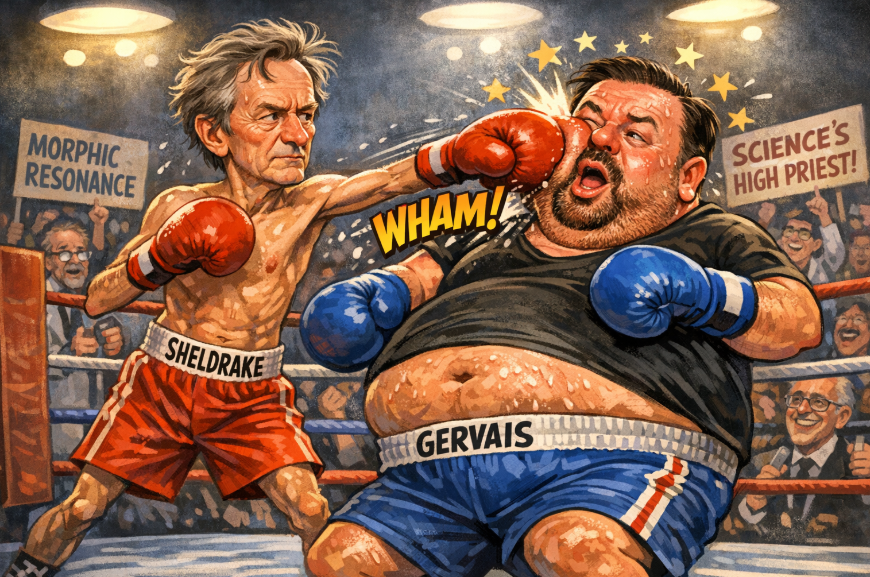
In simple terms, Rupert Sheldrake believes he’s more committed to real science than most scientists, and certainly more so than Ricky Gervais. He says that he “take[s] the ideal of free enquiry seriously”, unlike most scientists who, say, outrightly reject his morphic resonance hypothesis.
Sheldrake also believes that “the spirit of enquiry has liberated scientific thinking from unnecessary limitations”… Therefore, scientists should embrace morphic resonance, purpose, telephony, premonition, prerecognition, disembodied minds, shamanism, religion, etc. More concretely, Sheldrake believes that “the sciences, for all their successes, are being stifled by outmoded beliefs” such as materialism. What isn’t outmoded is Sheldrake’s morphic resonance hypothesis.
Like so many other anti-materialists, Sheldrake has a view on the vulgar and uneducated populace that’s very much like the Marxist notion of false consciousness. He states that “millions of people have been converted to this ‘scientific’ view”. Now here comes the Marxist-like addition: “even though they know very little about science itself”. So let me spoon-feed readers for a moment with this rewording.
Millions of working-class people have been converted to the ideology of capitalism even though they know very little about capitalism itself.
Thus, it’s not surprising that Sheldrake finishes off by saying that these millions of people are “devotees of the Church of Science, or of scientism, of which scientists are the priests”.
The Long Quote: Gervais on Science
Sheldrake supplies his readers with a long quote from Ricky Gervais, which is taken from the article ‘Why I’m an Atheist’. (This was published by the Wall Street Journal.) It goes as follows:
“Science seeks the truth. And it doesn’t discriminate. For better or worse it finds things out. Science is humble. It knows what it knows and it knows what it doesn’t know. It bases its conclusions and beliefs on hard evidence — evidence that is constantly updated and upgraded. It doesn’t get offended when new facts come along. It embraces the body of knowledge. It doesn’t hold onto medieval practices because they are tradition.”
According to Sheldrake “Gervais is an entertainer, not a scientist”. True. He says he isn’t “an original thinker” too. Some would dispute that. In any case, according to Sheldrake, “Gervais’s idealised view of science is hopelessly naïve in the context of the history and sociology of science”. [See endnote on Thomas Kuhn and Bruno Latour.]
Personally, the passage above seems quite a decent account of science. Sure, it’s not the kind of thing that Karl Popper or Bas Van Fraassen would say, and it is indeed slightly naïve. But Gervais isn’t a philosopher of science, and it’s no more naïve than most of the criticisms of materialism and “scientism”.
Gervais finished of by saying that science “doesn’t hold onto medieval practices because they are tradition”. Sheldrake, on the other hand, believes that science is a religion that’s massively conformist. He believes that when “facts come along” scientists shouldn’t “hold onto the materialist worldview just because it’s tradition”. Instead, they should accept Sheldrake’s own morphic resonance hypothesis, etc. and jettison the materialist worldview.
Sheldrake says that this naïve view “portrays scientists as open-minded seekers of truth, not ordinary people”. Yet Gervais didn’t mention “scientists” at all. He mentioned “science”. So the most he can be accused of is treating science as a Platonic form. What’s more, you can be “pro science” at the same time as being very sceptical about individual scientists. Of course, Sheldrake may say that this division is “naïve” too.
More of Sheldrake on Gervais
Apart from the long quote above, I found five other mentions of Gervais by Sheldrake.
The first quote deals with how Sheldrake believes Gervais uses science:
“But in the hands of people like Ricky Gervais, [atheism] becomes a way of saying that science knows there is no God, no purpose, and no soul. This isn’t humility; it’s a belief system pretending to be a lack of belief.”
Basically, Sheldrake is saying that for Gervais, atheism comes first, and then science is simply used in his war against monotheism and religion. Note that Sheldrake says that science “becomes a way of saying that science knows there is no God…” He doesn’t actually quote Gervais on this. Gervais studied philosophy as an undergraduate, so it can be questioned whether he believes that “science knows there is no God”. (Gervais did once claim that he “didn’t really study” and simply read a book similar to Philosophy for Dummies the night before his exam.) Similarly, Gervais may well believe in purpose, just not universal purpose or purpose than runs free of collective or individual minds. Still, these qualifications won’t satisfy Sheldrake. Nothing outside his own worldview would do so.
Sheldrake then makes a classic point against atheists and materialists: that they’re all stuck in the 19th century. This is an odd case, however. Whereas most anti-materialists, spiritual idealists, etc. paint the materialism — of those they take to be contemporary materialists - in 19th century terms, without actually acknowledging that, Sheldrake does mention it. He writes:
“Ricky Gervais portrays himself and other atheists as open-minded seekers of truth, but they are actually followers of a very narrow, 19th-century philosophy called mechanistic materialism. They aren’t open to the evidence for anything that doesn’t fit that machine-like view of the world.”
I watched Gervais in conversation with David Baddiel, and the physicist Brian Cox. They all went into quite some detail on aspects of quantum mechanics, the Big Bang, etc. So I’ll assume that Gervais is not a “follower of a very narrow, 19th-century philosophy called mechanistic materialism”. Of course, Gervais could be as extremely dumb on this matter, as Sheldrake believes he is. But I strongly doubt it. If Sheldrake stopped mentioning “materialists” or “materialism” in every other sentence, perhaps that would help matters. (Sheldrake uses the word “materialists” as Marxists used the word “bourgeoisie”.)
In this next passage, Sheldrake paints Gervais as a “high priest”, just as he paints scientists and God knows who else as “high priests”:
“Entertainers like Ricky Gervais have become the high priests of a secular age. They use comedy to make spiritual questions look ridiculous, but if you look at the ‘science’ they are defending, it’s actually a series of dogmas they’ve never questioned themselves.”
Scientists are “high priests” and entertainers are “high priests”. What is Sheldrake playing at here? He’s displaying the arrogance and elitism he accuses scientists of. (On the word “elitism”. Sheldrake provides much detail on his own scientific background, at least fifteen paragraphs of it.)
The following passage sees Sheldrake reading Gervais’s mind, as well as saying things about his “belief system”:
“[Gervais] says science is humble because it knows what it doesn’t know, yet he seems quite certain that he knows God is an imaginary friend. That’s not humility; that’s the arrogance of a belief system that refuses to look at its own foundations.”
Gervais may well be quite certain that he knows God is an imaginary friend. I, personally, don’t know for sure. But many people are certain about many of the things they believe. Sheldrake is certainly certain that materialism is evil and that Gervais “is not a thinker”. And how does Sheldrake know that Gervais hasn’t looked at the foundations of his own belief system? He doesn’t know that. He’s guessing for rhetorical effect. How do we know that Sheldrake has looked at the foundations of his own belief system? In his book The Science Delusion, there’s little evidence that he has indulged in much self-scrutiny. He spends too much of his time criticising “materialist science” to do so.
Finally, Sheldrake states the obvious, and disparages “most people”:
“Ricky Gervais isn’t a scientist, but he speaks with the authority of science to a mass audience. He’s selling a philosophy, not scientific data, and most people don’t know the difference.”
Readers can assume that Gervais would know that he isn’t offering “scientific data” during his comedy routines, or even in his podcasts and interviews. He’s offering his opinion on science, and on other subjects. Is Gervais “selling a philosophy” then? Possibly. But no more or less than Sheldrake is selling his own philosophy, his morphic resonance hypothesis, and his anti-materialism.
Afterword: Kuhn and Latour
Sheldrake relies on the writings of Thomas Kuhn… Or at least he quotes him. Just before tackling Gervais, he provides a long quote from Bruno Latour too.
Kuhn was accused of portraying science as “mob psychology”. (Many of Kuhn’s supporters strongly deny this.) Latour, at least in the quote, treats scientists as arrogant elitists. All this squares perfectly with Sheldrake’s positions, even though some people may regard Kuhn and Latour to be unlikely allies. (“The enemies of my enemies are my friends.”)

No comments:
Post a Comment