Saturday, 20 December 2025

Does Quantum Mechanics Give Us Our Freedom?

 The following essay will focus on what’s called agent causation. It’s clear that the inspiration for this notion is the widely-accepted view that quantum mechanics is fundamentally indeterministic (e.g., such as in radioactive decay). In other words, it doesn’t abide by the strict causal determinism of classical physics. Many readers will now be able to see the appeal of agent causation when it comes to the debate about free will. That’s for the simple reason that it includes the idea that human actions are neither determined nor random. Instead, the (human) agent has complete control of all his/her actions.
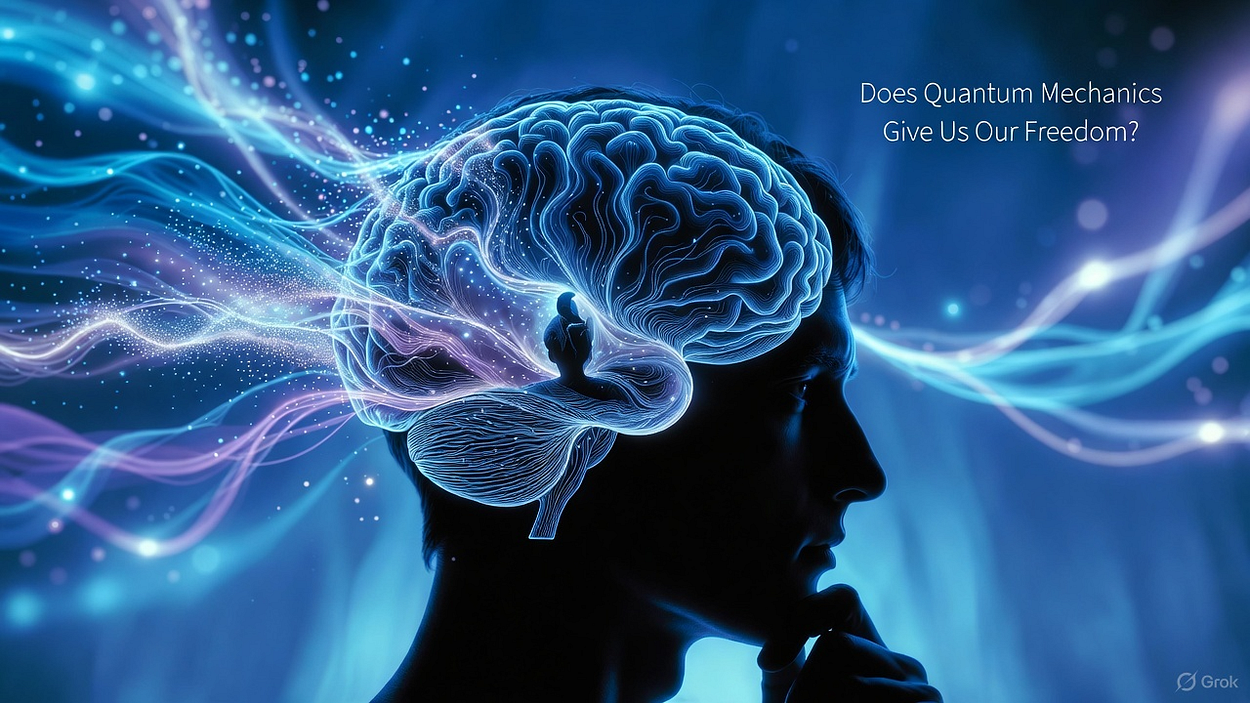
It may seem odd to some readers that quantum mechanics has been used to advance a position for free will. Of course, other people have embraced this reliance on quantum mechanics.

At first, it almost seems as if the argument is that because quantum mechanics is “weird”, then this must (or at least may) explain free will. This parallels the often-quoted position about consciousness. As in:

“Consciousness is a mystery, and quantum physics is a mystery; maybe they’re the same mystery.”

Of course, it will be very easy to tie consciousness and free will together. So no wonder the quote above is relevant here. For a start, you can’t have (human) free will without consciousness. More accurately, you can’t have free will without self-consciousness.

Agent Causation

Quantum mechanics breaks the strict causal determinism of classical physics. And libertarians jump on that. They detect a “gap” between physical determinism and non-physical agent causation.

Another huge factor in that appeal is the fact that those who believe in agent causation are mainly inspired by the requirements of morality. For example, the American philosopher Ned Markosian believes that a person’s actions are caused only by their own agency. Such (free) actions form or shape the moral character of human persons.

Roderick Chisholm’s incompatibilist view is even more clear. He believed that free action originates from the agent alone. (See origination.) In other words, free action is never determined by prior physical events. That said, the agent can be aware — and reason about — prior physical events.

Quantum Randomness!

The first — and most obvious — thing to state is that quantum-mechanical randomness cannot possibly be the basis for free will. How on earth would an action caused by a random quantum fluctuation in the brain be the basis of an agent’s rational choice? However, the libertarian has an answer to that question. As the American philosopher Theodore Sider puts it:

“A libertarian might concede that quantum randomness is not *sufficient* for freedom, but nevertheless claim that quantum randomness *makes room* for freedom, because it makes room for agent causation.”

On the surface, that just seems like a statement of a position, not an argument for it. The idea is, however, that the libertarian acknowledges the nature of quantum randomness. Thus, it only makes room for agent causation.

We must now be given an explanation of what agent causation is, and how it makes room for freedom.

Sider then provides an explanation of this too. He writes:

“After assigning these probabilities, the work of quantum mechanics is complete. According to some libertarians, agent causation now steps in. After quantum mechanics sets the probabilities, Hitler himself chooses, by agent causation, which decision he will in fact make. Physics sets the probabilities, but *people*, by agent causation, ultimately decide what occurs.”

Many readers will realise that this is the same as the first explanation, only with the addition of the name ‘Hitler’ and some extra detail. In other words, the quoted passage above still doesn’t explain what agent causation is. It’s no use saying that agent causation now steps in after quantum probabilities are set if we aren’t given an explanation of what agent causation is.

In the quote above, we have a scenario which is completely scientific in nature. And then, all of a sudden, something that hasn’t been given a scientific explanation — the agent — jumps into that scenario. Indeed, if the agent and its actions haven’t been given a scientific explanation in the first place, then what justifies the second word “causation”?

Nonetheless, certain libertarians believe that their account is not anti-scientific. Their scenario is meant to make science and agent causation exist together. More importantly, it’s meant to make science and human freedom gel together. But, so far, that’s only via stipulation or fiat.

In any case, Sider states that “the coexistence picture makes agent causation a slave to quantum-mechanical probabilities”. In other words, the libertarian thinks that there are two very different things here: quantum probabilities and agent causation. Yet Sider is arguing that the former must in someway determine the latter.

Another way of putting this is to state that there’s no point in accepting the existence of quantum-mechanical probabilities and their relation to agent causation if that precise relation isn’t mapped out. What role do the probabilities play if we can question how the agent can neatly override them?

Sider puts the case in another way. He states that

“[a]gent causation, if it is to be worth anything, must be capable of disrupting the probabilities given by quantum mechanics”.

Thus, something non-physical would need to disrupt something physical (if also probabilistic).

Again, it can be asked why libertarians accept probabilities — or even so much as mention them. In other words, if they painted a picture of free will without any mention at all of probabilities, then what difference would that make?

What is an Agent?

What of this agent, and how does it interact with the physical brain? Is the word “causation” at all justified in this context?

There is at least a partial explanation of what an agent is. Negatively, it is said not to be an event which can cause events. In other words, an agent is an entity of some kind. When we see an agent as an entity, not an event, then agent causation can be distinguished from event causation. The latter is when an event causes another event. (Such as punching someone in the face causes that person to pass out.) In the former case, however, an entity can cause various events.

This position goes back to Scottish philosopher Thomas Reid. He believed that agents are the only entities which/who have a will. Wills, embedded in human persons, can cause events.

Alternatively, perhaps we can get to the agent via the brain.

Many people believe that the complex system that is the brain can exhibit emergent properties. These properties may include intentions, consciousness, and agent causation itself. Thus, just as some see consciousness and intentions as being emergent, so too can the agent be seen that way…

But, again, saying that the agent is emergent doesn’t say what it is or how it brings about any form of causation. Indeed, the non-physical agent would need to be responsible for what’s called “downward causation” on the physical brain…

This is the Cartesian problem of mind-brain interaction all over again.

From the Quantum Scale to the Classical Scale

One phrase readers will often find in this debate is “leveraging quantum effects”. It’s the agent (or brain?) who/which is supposed to do this leveraging. This suggests that agent causation could be a higher-level phenomenon which is compatible with fundamental physics. However, it still wouldn’t be reducible to physics.

Relatedly, in order for quantum effects to influence a macroscopic action (like moving left rather than right), they’d need to be amplified to a classical scale. The American philosopher Daniel Dennett made these points when he picked up on this issue:

“Most biologists think that quantum effects all just cancel out in the brain, that there’s no reason to think they’re harnessed in any way. Of course they’re there; quantum effects are there in your car, your watch, and your computer. But most things — most macroscopic objects — are, as it were, oblivious to quantum effects. They don’t amplify them; they don’t hinge on them.”

It was then that Dennett referred specifically to Roger Penrose, who “thinks that the brain somehow exploits quantum effects”.

This is Dennett’s position again:

Sure, there are quantum happenings in the brain as a whole or in neurons individually. Then again, there are quantum happenings in your car, watch and television.

Against Dennett, it can be said that it may be true that in order for Dennett’s car to be a car, it doesn’t depend on the quantum effects which are occurring inside it. However, why should that also be true of the brain and its relation to free will (or consciousness)? The nature and functioning of a car (or watch) is very different to the reality and functioning of the brain and its relation to free will. A car is (to use Dennett’s word) “oblivious” to the quantum effects inside — though only if it is treated qua car! However, it’s indeed the case that a car can be analysed as a medium of quantum effects.

We’ll now need to know exactly why quantum effects don’t transfer to the brain as a whole. Alternatively, why aren’t quantum effects (to use Dennett’s words) “amplified” and “exploited” by the brain? More specifically, we’ll need to know why such things don’t cause (or bring about) free will (or consciousness). In other words:

Why is there such a sharp dividing line between Dennett’s quantum effects in the brain (or in neurons) and free will (or consciousness) itself?

Surely there can’t be such a neat and tidy cut-off point (a Heisenberg cut) between these two worlds. Then again, it’s not logically absurd to argue that there is such a divide, just not a neat and tidy one.

Physicist Paul Davies's Mysticism


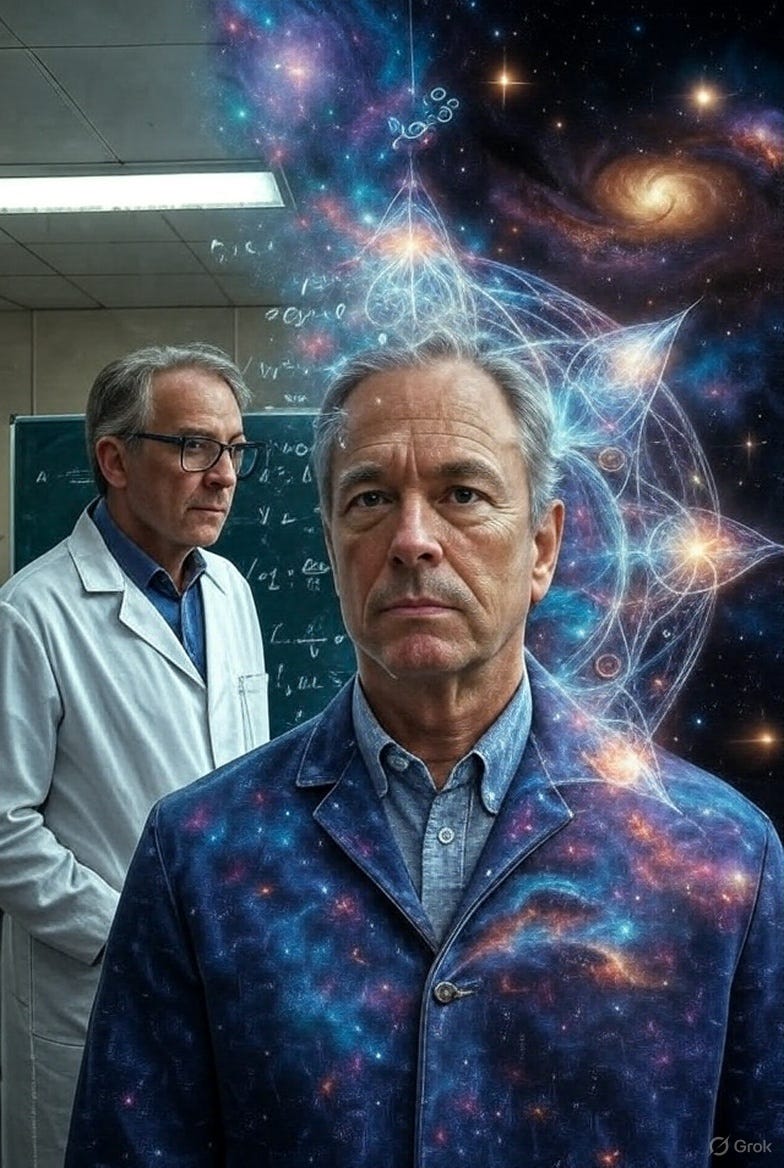
The English physicist Paul Davies deems himself to be so rational that he’s realised that rational thought itself has its limitations. (At least this is how Davies’s views can be interpreted.) That critical position relates to Davies’s fixation on “the meaning of the universe”. He doesn’t believe that “the universe is absurd or meaningless”. Nor does he want to live in an “absurd” universe. However, Davies also believes that science and rational thought cannot show us the meaning of the universe. What can show us its meaning is what “lies outside the usual categories of rational human thought”.

Paul Davies states that the belief that “the universe exists, and exists in the form it does, reasonlessly” is no better than “many metaphysical and theistic theories”. Of course, readers will need to know exactly what Davies means by the word “reasonlessly”. (Davies does go into detail elsewhere.)

What Davies desires is for someone (perhaps himself!?) “to construct a metaphysical theory that reduces some of the arbitrariness of the world”. It seems that such a metaphysical theory must include some kind of mysticism. However, if we don’t construct this theory, then

“[w]e are barred from ultimate knowledge, from ultimate explanation, by the very rules of reasoning that prompt us to seek such an explanation in the first place”.

Davies believes that we are barred partly or even primarily because of the findings of such people as Cantor and Gödel. However, we are not barred if we “embrace a different concept of ‘understanding’ from that of rational explanation”. That different concept is supplied by some kind of mysticism.

All that said, Davies often stresses that he has

“never had a mystical experience myself, but I keep an open mind about the value of such experiences”.

In various of Davies’s books, the statement that “I have never had a mystical experience myself” has been used a few times. Readers may get the impression that it’s important to Davies that he tells his readers that he hasn’t had a mystical experience himself. Why is that? Sceptically, if Davies had mystical experiences, then he’d be one of the mystics he praises so often in his books. That would muddy the water somewhat.

Paul Davies. Wiki Commons. Source here.

For one, Davies wouldn’t be treated seriously by many of his fellow scientists, at least scientists as they’re portrayed by Davies himself. So Davies settles for simply keeping an open mind about the value of such experiences.

To be sceptical again, this may remind some readers of the believers in UFOs, astral travelling, etc. who claim that they have an “open mind”, and that their critics have closed minds. The logic of this type of stance is that the person with the most open mind is the person who believes almost everything. Of course, this is partially unfair to Davies in that he’s a physicist who also provides technical — and sometimes convincing — arguments to back up his metaphysical and mystical positions… unlike most people with open minds.

In any case, Davies believes that mystical experiences may

“provide the only route beyond the limits to which science and philosophy can take us, the only possible path to the Ultimate”.

We can ask questions about the nature of “the Ultimate”, how anyone knows that mystics have discovered it, and many more questions.

The Quick Fixes of Self-Important Mystics

Despite the self-image of many mystics (as well as the devotion they receive from their followers), there’s something self-important about them — or at least about their claims. Davies himself says that “mystics claim that they can grasp ultimate reality in a single experience”. Can they? Who says so? Well, they do. Yet even if they could grasp ultimate reality, how would anyone else know that they have done so?

Davies finished that sentence by saying

“in contrast to the long and tortuous deductive sequence (petering out in turtle trouble) of the logical-scientific method of inquiry”.

Perhaps that gets to the heart of the matter. Mystics (or at least some mystics) don’t want to do the hard work. They don’t want to spend any time on a “long and tortuous deductive sequence”. Instead, Ultimate Reality (whatever that is) is grasped in a single experience.

Of course, not all mystics claim to find Ultimate Reality. According to Davies, some simply find “an inner passionate, joyful stillness that lies beyond the activity of busy minds”.

Mystical Experience and Culture

Here’s something very interesting. Davies happily admits that

“[t]he language used to describe these experiences usually reflects the culture of the individual concerned”.

What Davies doesn’t admit is that the language of the culture may determine the actual content of these experiences too, not only the later descriptions. In other words, Davies might have assumed a languageless and concept-free experience which was only later described in the language of a specific culture. But what if the words, terms, concepts, ideas, etc. of this natural language permeated the actual experience itself? (Add to that the memories of the subject who has the experiences, which were themselves determined by the language of a specific culture.)

Davies tells his readers that “Einstein spoke of a ‘cosmic religious feeling’ that inspired his reflections on the order and harmony of nature”. He then quotes science writer David Peat. The passage goes as follows:

“‘[A] remarkable feeling of intensity that seems to flood the whole world around us with meaning. . . . We sense that we are touching something universal and perhaps eternal, so that the particular moment in time takes on a numinous character and seems to expand in time without limit. We sense that all boundaries between ourselves and the outer world vanish, for what we experiencing lies beyond all are and all attempts to be captured in logical thought.”

Note Peat’s uses of the words “seems” and “we sense”. This is an acknowledgement that Peat may not have touched something universal, and that even though he sensed that all boundaries between himself and the outer world vanished, they may not have actually done so.

The influence of language was mentioned earlier. Carrying on from that, perhaps the passage above simply reflects all the books and pieces on mysticism which Peat has read. It certainly comes across as almost cliched.

Peat’s description also reads like one under the influence of hallucinogenic drugs. Yet even here it can be argued that psychedelic experiences are at least partially determined by what the tripper has previously read about other trips, mystical experiences, what “hippies” in the 1960s have said, etc. (Personally, I once noted that those trippers who had no interest in mysticism, hippy culture, Carlos Castaneda, Ken Wilber, Timothy Leary, Aldous Huxley, Rudy Rucker, etc. didn’t have experiences like the one described above.)

More specifically, take Peat’s statement that “[w]e sense that all boundaries between ourselves and the outer world vanish”. Did Peat have this precise experience because he’d previously read about other people who had experienced all boundaries between themselves and the outer world vanish?

Again, it can be conceded that experiences like this do occur when people trip. Yet that may be because they’ve read about such things. That said, there’s a chicken and egg situation here. In other words, people have read about such things because people have experienced such things. So surely there must have been a time when people experienced these things even before they could have read about such things.

This leads to the possibility that such experiences may occur in cultures without books. Yet they still have an oral culture. So pretty much the same arguments will apply in these cases too.

Davies also quotes Ken Wilber on mystical “Eastern” experiences. The passage goes as follows:

“In the mystical consciousness, Reality is apprehended directly and immediately, meaning without any mediation, any symbolic elaboration, any conceptualization, or any abstractions; subject and object become one in a timeless and spaceless act that is beyond any and all forms of mediation. Mystics universally speak of contacting reality in its ‘suchness’, its ‘isness’, its ‘thatness’, without any intermediaries; beyond words, symbols, names, thoughts, images.”

How did Wilber know all this? More specifically, how did he know that such experiences didn’t involve any symbolic elaboration, any conceptualization, or any abstractions? How did he know that the mystic moved beyond words, symbols, names, thoughts, images?

More strongly, how did Wilber know that Reality is apprehended directly and immediately?

Paul Davies vs Other Scientists

Throughout his many books, Davies often tells his readers what other scientists believe about religion, mysticism and certain metaphysical beliefs. He’s not too happy with what they believe. That said, the following passage isn’t judgemental:

“Most scientists have a deep mistrust of mysticism. This is not surprising, as mystical thought lies at the opposite extreme to rational thought, which is the basis of the scientific method.”

Apart from the first sentence (which would need a survey of some kind to be demonstrated), I couldn’t have put it better myself. In this chapter, Davies is very keen to show us the limitations of rational thought when it comes to both physics and mathematics. He writes:

“My own feeling is that the scientific method should be pursued as far as it possibly can. Mysticism is no substitute for scientific inquiry and logical reasoning so long as this approach can be consistently applied.”

Yet Davies clearly believes that it can’t be consistently applied in such cases. And that’s where he takes a dive into mysticism. Or, it should be said, he takes a dive into “espousing mysticism”.

According to Davies, scientific inquiry and logical reasoning hit a brick wall when it comes to “ultimate questions”. Then “science and logic may fail us”. (At least here Davies isn’t saying that science and logic will fail us.)

Davies relies on the work of Cantor and Gödel to show his readers that there can’t be a literal theory of everything. Gödel’s theorem “is nevertheless full of paradox and uncertainty”. In short,

“[t]here will always be truth that lies beyond, that cannot be reached from a finite collection of axioms”.

This may be a classic example of a person stretching the meaning of Gödel’s theorems beyond their proper boundaries.

Davies then put the cream on the cake when he stated the following:

“And here we encounter once more the Gödelian limits to rational thought — the mystery at the end of the universe. We cannot know Cantor’s Absolute, or any other Absolute, by rational means, for any Absolute, being a Unity and hence complete within itself, must include itself.”

… But we can experience (if not know) the Absolute through mystical means… at least according to Davies.

In terms of Davies himself, he seems to be saying that it isn’t doomed to failure if one takes the mystical route. The mystical route even trumps Stephen Hawking’s “theory of everything”, which isn’t about everything at all. It’s about all the fundamental forces and particles in the universe. The mystical experience of everything, on the other hand, really does include everything. (There are indeed broader theories of everything, and even Hawking himself went further.)

The question is whether these limitations have the consequences Davies believes they have. In addition, it doesn’t follow that even if there are a multitude of limitations to rational thought that this should lead us to mysticism. Indeed, mystics — as well as Davies himself — have it that there actually are no limits to what human persons can achieve. It’s just rational thought that has various limits. Thus, the mystic realises that rational thought has its limits, and then goes beyond it to grasp Ultimate Reality.

Yet most mystics, both today and historically, have “stretched thought to its limits” without practicing science, mathematics or even philosophy. Instead, they taken what Davies himself calls a “short cut”. That’s why Davies is keen to point out those physicists who didn’t take a short cut. He tells his readers that

“many of the world’s finest thinkers, including notable scientists such as Einstein, Pauli, Schrodinger, Heisenberg, Eddington, and Jeans, have also espoused mysticism”.

These scientists were human beings. So it’s not much of surprise that some scientists embraced mysticism, just as many have embraced religion. There’s also a difference between espousing mysticism and actually indulging in mysticism. It’s not clear that all the named scientists above actually experienced any mystical states (unless those two words are interpreted very loosely). Yet they did espouse mysticism in various ways and to various degrees.

Davies Makes the How-Why Distinction

In Davies’s nutshell, science and logic can address the “how questions”, but not the “why questions”. [See note.]

This how-why binary opposition has become a bit of cliché when it comes to the critics of science, so it’s worth unpacking.

Firstly, we have Google AI mode on this subject:

“The criticism of the rigid ‘how-why’ binary opposition in the philosophy of science centers on the argument that it is a false dichotomy and an oversimplification of scientific explanation. Critics contend that ‘why’ and ‘how’ questions are deeply intertwined, with the answers to ‘how’ questions often providing the substance of ‘why’ explanations.
“[ ] Many ‘why’ questions in a scientific context (e.g., ‘Why is the sky blue?’) can be answered by providing a detailed ‘how’ explanation (e.g., how light scatters in the atmosphere). The distinction often depends on the level of analysis or the specific context of the inquiry, rather than an inherent difference in the nature of the questions themselves.”

Now let’s specifically tackle why-questions.

As the American-English philosopher Gordon Park Baker (1938–2002) put it:

“The unexamined question is not worth answering.”

Baker added:

“To accept a question as making good sense and embark on building a philosophical theory to answer it is already to make the decisive step in the whole investigation.”

Another problem is summed up by Gordon Baker:

“Questions, just as much as assertions, carry presuppositions.”

Baker’s questions about questions are partly Wittgensteinian in nature. Thus, readers can certainly note his Wittgensteinian points in the following:

“[T]o suppose that the answers to philosophical questions await discovery is to presuppose that the questions themselves make sense and stand in need of answers (not already available). Why should this not be a fit subject for philosophical scrutiny?”

Indeed, Wittgenstein did have things to say on the nature of many philosophical questions (both in his “early” and “late” periods). His position is partly summed up in this passage from Robert W. Angelo. (This ends with a quote from Wittgenstein himself.) Thus:

“[N]onsense in the form of a question is still nonsense. Which is to say that the question-sign [] can only be rejected, not answered: ‘What is undefined is without meaning; this is a grammatical remark.’ [].”

Another good way of summing up the problem with these philosophical why-questions is also cited by Gordon Baker. He wrote:

“To pose a particular question is to take things for granted, to put some things beyond question or doubt, to treat some things as matters of course.”

One obvious “presupposition” to a question is that there’s an answer to it — or at least a possible answer.

To sum up. Aren’t the askers of these types of philosophical why-questions “taking certain things for granted”? That is, aren’t they taking for granted that their questions are legitimate and that there are answers? Moreover, aren’t these questioners also “put[ting] some things beyond question or doubt”, as well as “treat[ing] some things as matters of course”?


Note:

I’ve commented on why-questions many times throughout the years. The last section, admittedly, is almost a copy-and-paste of previous uses.