The 19th Century (ostensible) split between inductive logic and deductive logic.
In thesecond half of the 19th century many philosophers and (less so) logicians studied the kind of reasoning that’s employed in the experimental sciences. That basically meant that logic wasn’t really seen — by them — as being an autonomous discipline. In other words, they believed that logic was something developed by studying actual examples of reasoning.
There was a reaction against this historical and philosophical trend — if not always a conscious one. That reaction gave rise to mathematical logic and the new —and more rigorous — kinds of deductive logic of the early 20th century. That said, symbolic logic — from the mid-19th century onward — alsoexisted alongside these other trends. In addition, mathematical logic can be dated back to George Boole’s works; some of which were written before the second half of the 19th century.
Inductive Inference and Soundness
What was the classic take on inductive inference?
It was that firstly people observe a finite amount of a given phenomenon. And then they generalise about such a phenomenon. The actual inference itself, therefore, is to as-yet-unobserved phenomena which will — or are hoped to — display the generalised features made about the observed phenomenon or phenomena.
For example, people infer (or did infer) that the next swan they’ll see will be white because they’ve seen many (or only) white swans.
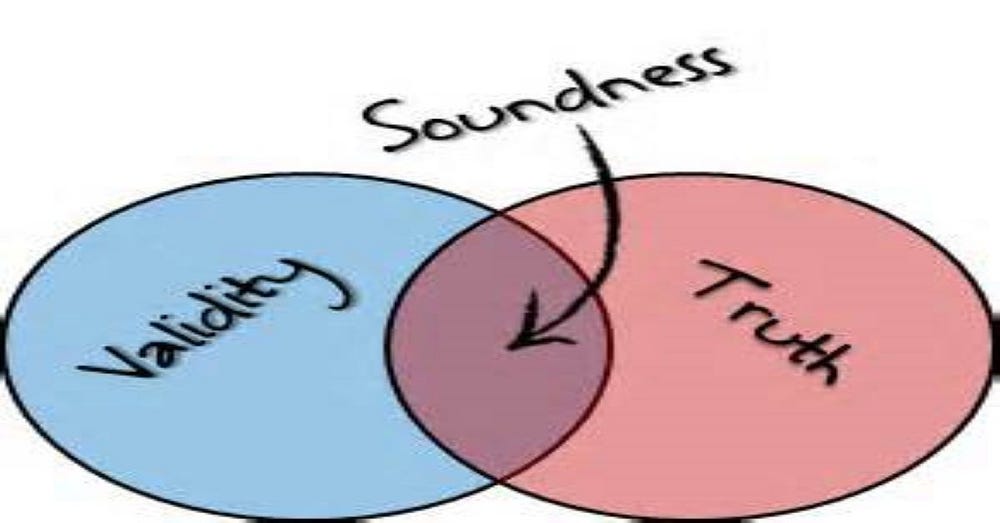
Now there’s an important difference between inductive inference and deductive inference. Inductive inferences aren’t sound; though (correct) deductive inferences are sound.
Firstly, soundness refers to a property of mathematical and logical systems; whereas an individual inference, statement or conclusion is said to be sound.
A sound inference or conclusion is an inference or conclusion which can’t be false given true premises. This means that a purely deductive inference must be sound. However, inductive inferences aren’t sound. Instead, inductive inferences areprobable rather than sound. (It can’t be said that inductive logic is entirely about probabilities. See inductive probability.) So, in a strong sense, with inductive inferences we never have enough knowledge to fully warrant our conclusions. And that’s because no amount of knowledge would render the conclusions sound. Or, as the Dutch computer scientist and Professor of Artificial IntelligencePeter A. Flachputs it (in his ‘Modern Logic and its Role in the Study of Logic’), in inductive reasonings there will always be“missing knowledge”. Thus we must — instead — make “educated guesses” as to the nature of that missing knowledge.
Yet that lack of soundness wasn’t seen as being a big problem by many late-19th century philosophers; especially since soundness isn’t available — even in principle — when it comes to inductive logic. In fact, non-sound logic was still seen as being very useful. And, conversely, sound (deductive) logic was seen as being… well, pretty useless — at least at specific times or in particular situations.
There is a drawback.
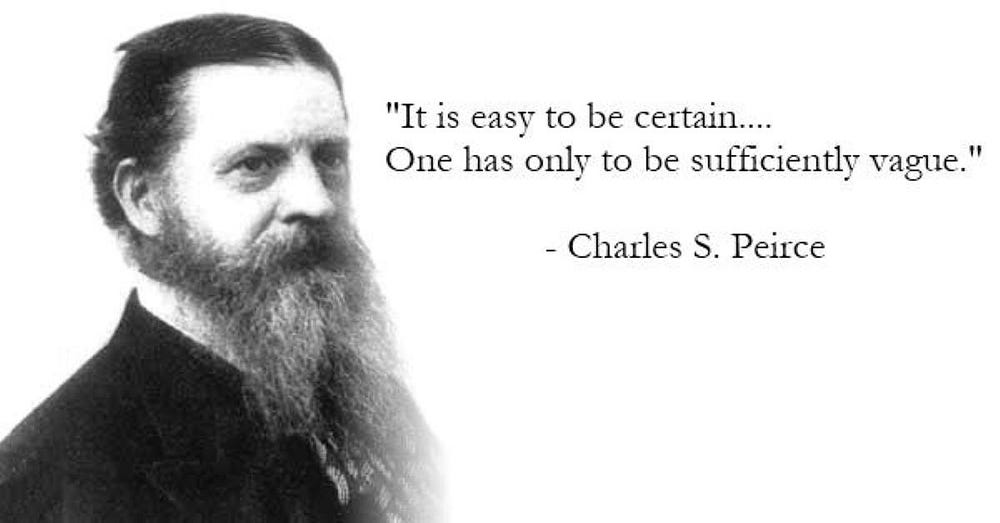
That drawback is is that unsound conclusions may turn out to be (outright) false. Yet even this possibility isn’t so bad when seen in the light of, say, C.S. Peirce’s position of fallibilism. In other words, when we adopt this positionwe accept our own fallibility at the same time as being aware that we’re still making scientific, logical and philosophical progress.
Inductive Logic as the Logic of Truth
Many late-19th-century logicians and philosophers asked themselves the following question:
What truly distinguishes inductive logic from deductive logic?
The answer usually was that inductive logic is a “logic of truth”. Deductive logic, on the other hand, primarily deals with consistency, validity, consequence, soundness, etc. — all of which can exist in perfect isolation from truth. For example, a madman may be a fine deductive logician with a perfectly consistent and coherent world-view. Yet his world-view may well be based on things which are, nonetheless, entirely… false.
More technically, deductive logic can begin with premises which are simply false — and even known to be false! Yet that which is derived from such false premises may still be (internally) valid and consistent.
So why can’t we also say that whereas the premises are false, the deductions or inferences themselves are still true because they’re correctly derived from the premises?
Truth and Correctness in Logic
If the metaphysical notion of truth is so problematic and disparate, then why shouldn’t we call statements that belong to a valid and consistent system true? (Mathematicians do.) Yet all this will entirely depend on what, precisely, we take truth to be.
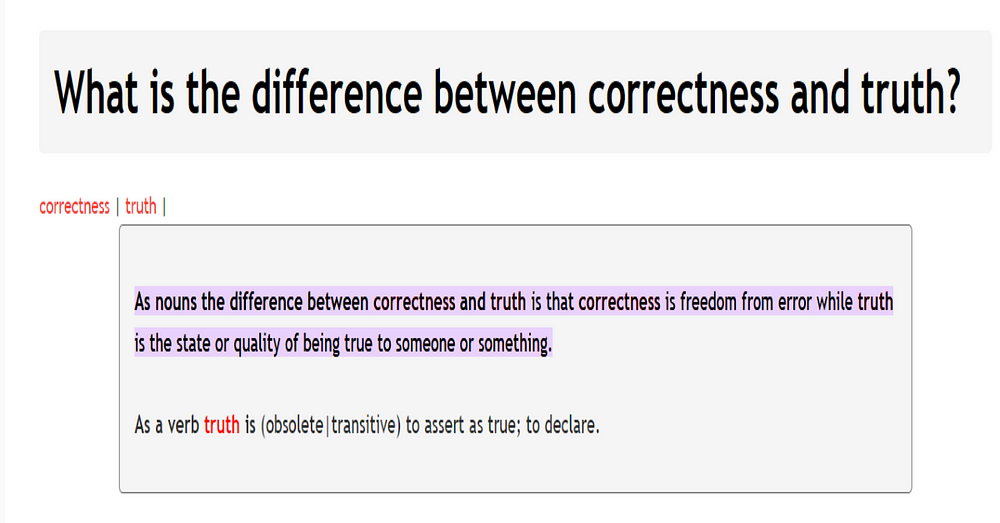
So the distinction between the words “correct” and “true” may be helpful here.
For example, we can say that a correct statement is a particular type of true statement. Alternatively, we can saythat a true statement is a particular kind of correct statement. (These may be differences which don’t really make a difference.) In any case, some truths are determined by empirical realities. Whereas other truths are determined by the fact that they’re correctly derived (or deduced) from given premises, statements or axioms.
Much the same was the case with Ludwig Wittgenstein’s distinctions between statements which are true and statements which are (merely?) correct (see here). More specifically, Wittgenstein believed that certain things are deemed true simply because they conform to conventions, rules and/or norms. (He even applied this position to the “truths” of mathematics.) On the other hand, many people deem other things to be true in spiteof what the community thinks or regardless of conventions, norms or rules.
So why not simply invert these terms in that “truth” becomes “correctness” and “correctness” become “truth”? The point here is that although these distinctions are effective in distinguishing certain types of statements from one another, they’re rarely distinguished from the perspective of metaphysically analysing the nature of truth itself.
So are these distinctions just ones of use and convenience? In other words, do they have any metaphysical or even semantic weight?
Deductive and Mathematical Logic
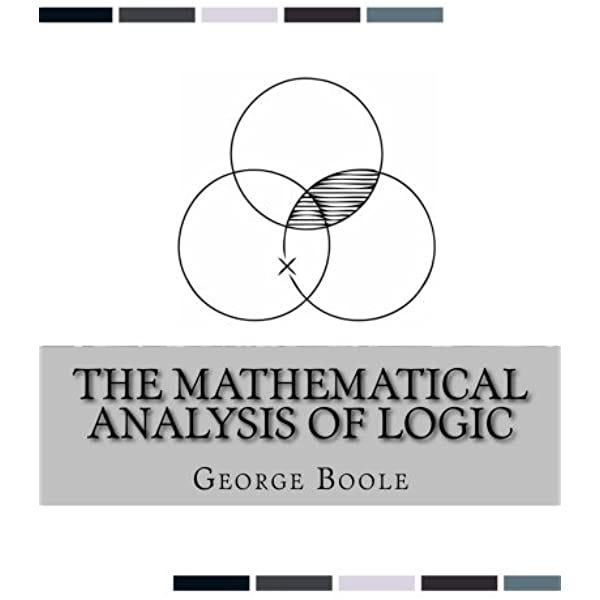
Perhaps mathematical logic all began with George Boole (1815–1864). The book above was published in 1847.
Much of early-20th-century logic developed in isolation from science and everyday reasoning. (Of course it was still believed that such a logic’s findings could — or would — be applicable outside the logic itself.) In simple and broad terms, it can be argued that logic also became less relevant to other areas of discourse in the early 20th century. More specifically, it became less relevant to philosophy and to the experimental sciences.
The simple reason why deductive logic impressed 20th century mathematical logicians and philosophers (see mathematical logic) is that in any deductive system one “moves from truths to further truths”. Ininductive logic, on the other hand, one moves from probabilities to further probabilities. Thus inductive logic isn’t airtight in the manner in which deductive logic is. In the latter case, one essentially accumulates more truth (if “truth” is the correct word here) from a given set of truths (e.g., from premises, axioms, etc.).
Why, exactly, were non-deductive forms of reasoning largely ignored in theFregean (see here) and post-Fregean age of mathematical logic? The answer is that they could provide no help to what’s often been called “foundational research” in mathematics. (See the foundations of mathematics.) And, of course, mathematical systems are often (or always) deductive systems. (Even “mathematical induction” is deemed to be deductive!)
Indeed all this was part and parcel of the rejection of any form of (what was called) psychologism in logic, mathematics and philosophy.
“Pure logic” (to use Edmund Husserl’s term) doesn’t deal with thought processes at all. It is (or was) believed — by many — to deal with timeless logical laws, truths and principles which — arguably — would exist even if no one had thought about (or expressed) them. Inductive reasoning, on the other hand, fundamentally relies on observations. Thus the notion of observation is clearly a psychological one. And the same goes for (to cite a more specific example) C.S. Peirce’stheory of abduction. (Here the abductive act is a psychological phenomenon - even a creative one.)
As hinted at earlier, people don’t really rely that much on deductive logic in their everyday lives. More clearly, both mathematical logic and deductive logic don’t seem to be closely connected to how people actually reason. Now that may be simply be because most people don’t reason correctly. (Consequently, perhaps they should mimic the inferences of deductive logic and mathematical logic.) On the hand, inductive logic is primarily concerned with observations and inferences from those observations.
Consequently, all the words above may make it seem strange that mathematical logic was so important to so many (analytic) philosophers of the first half of the 20th century.
******************************
Note: A Short Digression on C.S. Peirce’s Theory of Abduction
C.S. Peirce’s notion of abduction may seem, at least prima facie, to be indistinguishable from induction.
An abduction somehow explains certain observations. In other words, it’s a hypothesis. Or, the other way around, from such an abductive hypothesis we can know what kind of observations to expect given pre-existing data. However, unlike induction, an abductive argument will begin with some kind of generalisation. Thus:
i) All the beans from this bag are white.
ii) These beans are white.
iii) Therefore, these beans are from this bag.
The second premise moves to the particular. The conclusion, in this case, in a sense fuses the first and second premises. That is, because all the beans in the bag are white, then it’s probable that these particular white beans may be from that bag. In the above example, it’s not yet known where the white beans have come from. The conclusion, given in the first premise, hypothesises the probability that given all the beans in the bag are white, then these particular white beans may be — or are — also be from the bag.
Indeed the first premise (“All the beans from this bag are white”)can itself be seen as the conclusion of a previous inductive argument. That is, from the observations of many particular white beans, it might have been concluded that all the beans in the bag must be white. Or, to use Peter Flach’s terms again, the first premise of the abductive argument gives us the inductive“general rule”. The abductive part of the argument will be the inference that the particular white beans in front of the observer are probably from the bag of white beans. In this instance, abduction takes over where induction left off.
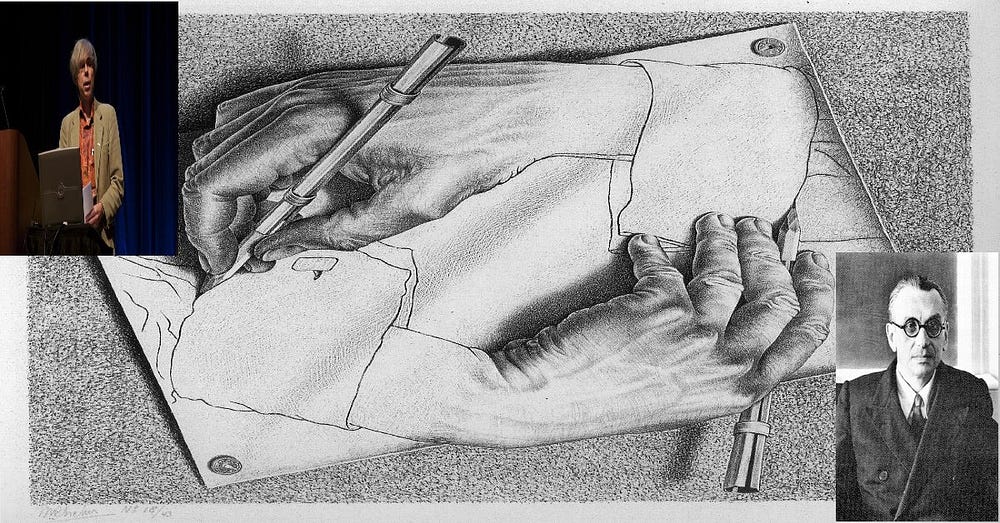
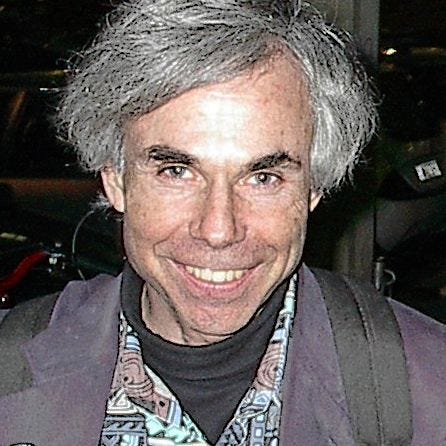
Douglas Hofstadter’s simple reworking of Kurt Gödel's First Incompleteness Theorem.
Left: Douglas Hofstadter. Right: Kurt Gödel. The drawing is by M.C. Escher (1898–1972).
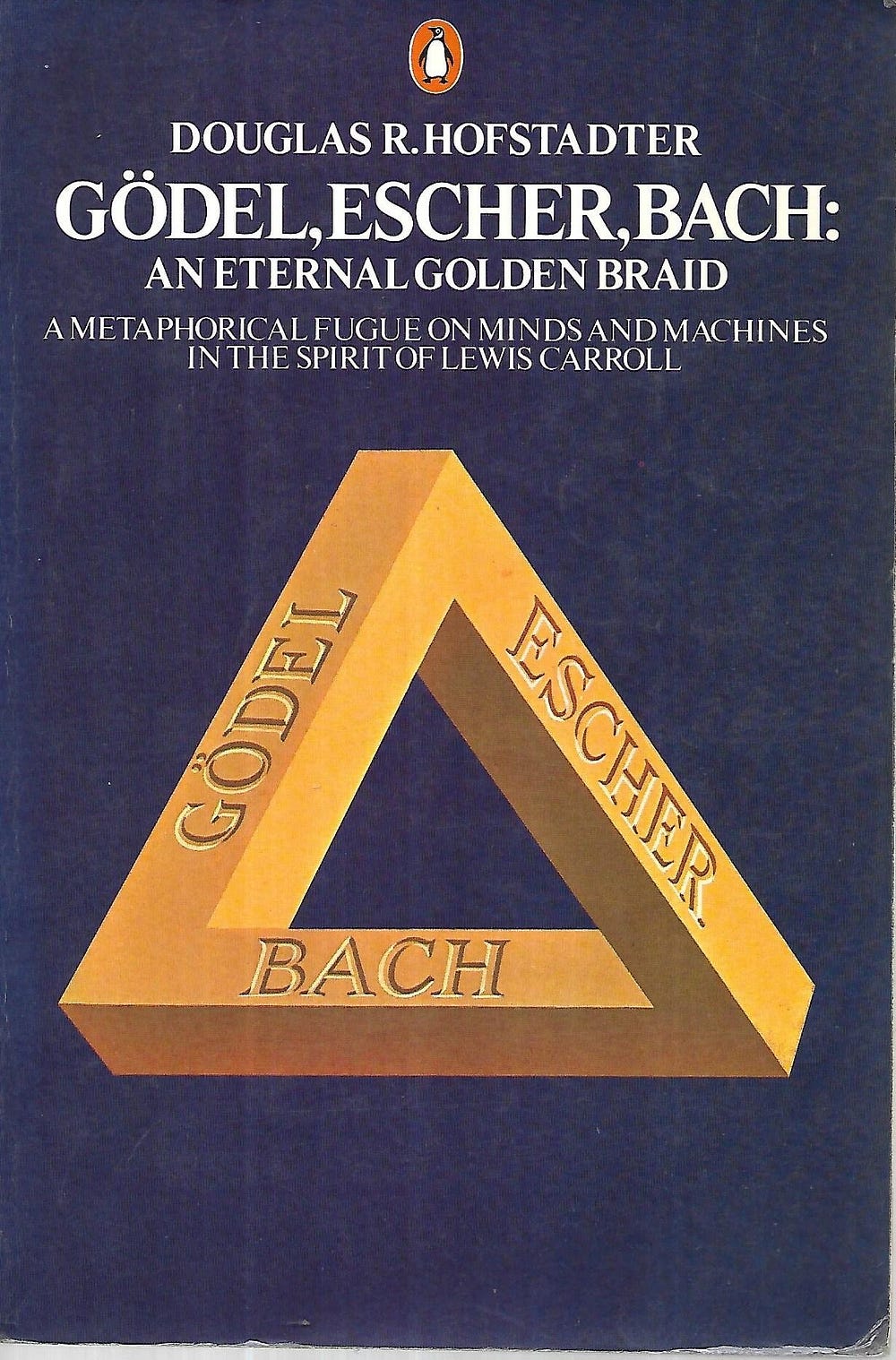
Douglas Hofstadter (who was born in 1945) is an American mathematician, cognitive scientist and physicist who has written on artificial intelligence (AI) and consciousness. He’s primarily known for his book Gödel, Escher, Bach: An Eternal Golden Braid. This book won the Pulitzer Prize and a National Book Award for Science. It’s also the primary source of this essay.
Self-Reference is Everywhere
Douglas Hofstadter’s Gödel sentence G is almost entirely based on Kurt Gödel's very own G — as it’s displayed in the latter’s first incompleteness theorem. (Of course Gödel himself never used the symbol G or the words “Gödel sentence”.)
Hofstadter also picked up on the importance of self-reference when it comes to Gödel's G, mathematical systems and indeed metamathematics as a whole.
It can now be said that the entire enterprise of metamathematics can be seen to be self-referential. Indeed, according to Hofstadter himself, Gödel's main idea was
“to use mathematical reasoning in exploring mathematical reasoning itself”.
Hofstadter concluded by saying that
“perhaps its richest implication was the one Gödel found: Gödel's Incompleteness Theorem”.
In more particular terms and with more direct relevance to this essay, Hofstadter also told us that
“it is in the nature of any formalization of number theory that its metalanguage is embedded with it”.
In broad terms, then, Gödelian metamathematics was a kinda incestuous or nepotistic enterprise. (Analogically, it was a little like getting the police to investigate the police.) Yet this was seen to be a good thing by Gödel and by many others. That’s primarily because what better means of investigation (or analysis) can there be than using mathematics? So, if that’s the case, then why not use mathematics to analyse (or investigate) mathematics itself?
In addition and on a simpler scale: if numbers can code individual symbols and whole statements, then all sorts of juxtapositions (or even games) will be made possible. After all, numbers are the domain of the infinite. And this may also mean that Gödelian number coding will also be the domain of the infinite.
In any case, from maths being applied to maths, we had the consequence of Gödel's First Incompleteness Theorem — which itself introduced statements (or mere“strings”) which referred to themselves. More precisely, we then had self-referential symbols which were actually embedded within the statements they were about. And, in turn, such symbols and statements were assigned a number.
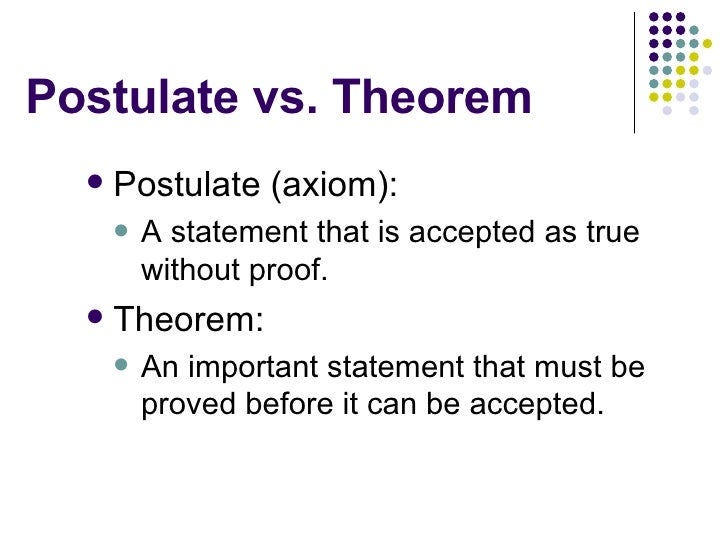
What is a Theorem?
Since the term “theorem” is central to this essay, let Douglas Hofstadter himself tell us what it is. Thus:
“Such strings, producible by the rules [within mathematical systems], are called theorems.”
Hofstadter then made a distinction between two types of theorem.
Firstly, he explained the first (“common”) type of theorem:
“The term ‘theorem’ has, of course, a common usage in mathematics which is quite different from this one. It means some statement in ordinary language which has been proven to be true by a rigorous argument, such as Zeno’s Theorem about the ‘unexistence’ of motion, or Euclid’s Theorem about the infinitude of primes.”
Then, more relevantly to this essay, Hofstadter defines the second type:
“But in formal systems, theorems need not be thought of as statements — they are merely strings of symbols. And instead of being proven, theorems are merelyproduced, as if by machine, according to certain typographical rules.”
The words “merely strings of symbols”strongly and perfectly explain much about self-referential paradoxes and indeed Hofstadter’s own G. That is, such theorems aren’t “thought of as statements” primarily because they contain no semantic content. (Arguably, the very fact that “empty” symbols and strings can be used and manipulated in specific and prescribed ways means that they must indeed have a semantics!) And, because of that, these theorems (such as G itself) “instead of being proven”, are “merely produced” (i.e., “as if by machine, according to typographical rules”).
Thus if these theorems aremerely(?) strings of symbols, then no wonder we can play logical games with them. Like an actual material string, we can tie the theorems and symbols in a multitude of different “knots”. However, if symbols or logical strings were actually meant to mean something, or refer to something outside themselves, then perhaps such logical games wouldn’t be possible.
Douglas Hofstadter’s Sentence G
Douglas Hofstadter cites a (or even the) problem with self-reference — at least when it comes to self-referential sentences or what he calls “strings”. (It’s not clear — at least to me — if Hofstadter himself sees it as a problem.)
Firstly: note that Hofstadter used both the words “if G were a theorem” and “[G] being a theorem”. This must mean that G both is and is not a theorem in Hofstadter’s Typographical Number Theory.
Hofstadter also stated that
“if G were a theorem[of Typographical Number Theory], it would express a truth”.
G would state a truth because, according to Hofstadter, “TNT never has falsities for theorems”.
So the sentence (or what Hofstadter calls a “string”)
G is not a theorem.
must be “a truth”.
G says of itself that it’s not a theorem and that statement is also (taken to be) true.
Yet G is also a theorem (as in Hofstadter’s “[G] being a theorem”) of TNT!
For comparison: in one formal expression of theLiar Paradox, the statement “(A) Statement A is false” turns out to be both false and true. In Hofstadter’s case, on the other hand, G turns out to be both a theorem and not a theorem. And, of course, Hofstadter’s own G also involves the notion (or property) of truth.
Hofstadter put all the above in another way by stating the following:
“By being a theorem, G would have to be a falsity.”
Why is that? Because (again) G says of itself:
G is not a theorem.
And if G is not a theorem, then what status does it have? Hofstadter has already told us that all theorems of TNT must be true. So G is true because it’s a theorem of TNT. Yet it’s also a theorem which states — of itself — that it isn’t a theorem. Basically, then, G must be true in a way that that’s at odds with what Hofstadter calls “common” theorems. And G is so in the sense that it’s true at the same time as saying it isn’t a theorem. Moreover, G’s truth cannot (therefore) be proven within TNT.
So does that also mean that G (as it were) becomes a theorem of TNT by virtue of it saying (of itself) that it “is not a theorem”? That is, by denying its own theoremhood, does G becomes a theorem? Thus “G is not a theorem” must also be true in order for it to be a theorem. Yet, because G says (of itself) that it “is not a theorem”, then that must mean that it is (or at least can be) a theorem of TNT. Thus G’s saying of itself that it isn’t a theorem is also a statement of its (or a) truth. And, by denying its own status as a theorem, G actually becomes a theorem.
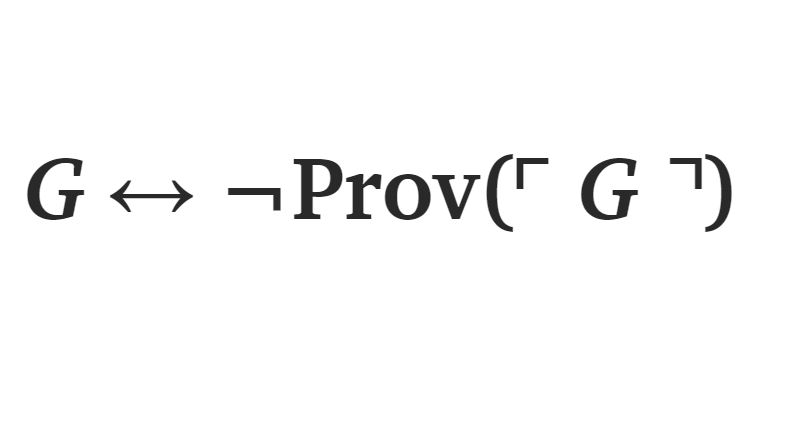
Take the following symbolic representation of Gödel's own sentence G from the logician and philosopher Professor Alasdair Urquhart(as found in his paper ‘Metatheory’):
G ↔ ¬Prov(⌜G⌝)
The above means:
The sentence G is true if and only if it is not provable in system T.
Some readers may wondering about the second use of the symbol G and its surrounding superscripted square brackets.
This is a code number or a Gödel number.
A code numberor Gödel numberis a number which is used to identify something which is not a number. This means that the symbol ⌜ G⌝ is the code number of the Gödel sentence G (i.e., the symbol G without brackets). Furthermore, a Gödel number is a specific kind of code number. In mathematical logic, Gödel numbers are natural numbers which are assigned to statements (as well as to the individual symbols within those statements ) within a given system or formal language.
Now let’s get back to Hofstadter.
Hofstadter’s G Again
Hofstadter himself concluded by saying that
“knowing that G is not a theorem, we’d have to concede that G expresses a truth”.
So Gisn’t — and also is — a theorem of TNT.
All this parallels (as already hinted at) the true but unproven statements in Gödelian systems. In actual fact, this is a simple rewording (or reworking) of Gödel's very own G.
To repeat.
If Hofstadter’s G were a theorem, then it couldn’t be true because it says of itself that it “is not a theorem” (of TNT). So G can only be taken as a truth if it’s also taken not to be a theorem. This, of course, exactly parallels Gödel's own G which is true in a Gödelian system — yet still unproven in that very same system.
Then Hofstadter made the (almost) obvious Gödelian conclusion when he wrote these final words:
“Here is a situation in which TNT doesn’t live up to our expectations — we have found a string which expresses a true statement, yet the string is not a theorem.”
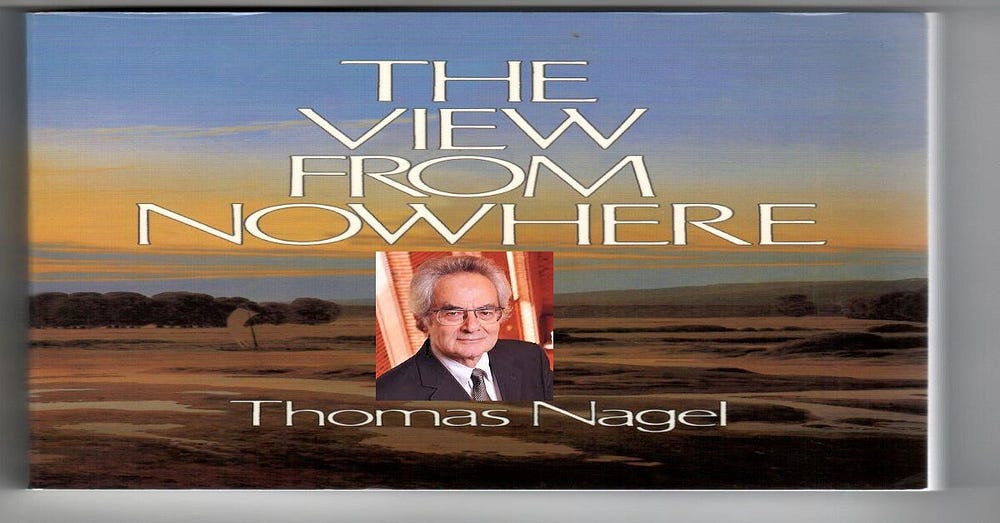
[This essay was written quite some time ago. The style is somewhat rhetorical, literary and (as it were) psychologistic. That said, I still agree with much of its philosophical content. However, if I were to write it today, the style would be a little different. Indeed some (probably many) analytic philosophers would regard this essay as one long ad hominemagainst the American philosopher Thomas Nagel (1937-). Sure; there is an element of the ad hominem in the following. Yet hopefully it will be shown that there’s more to the essay than that.
[In fact I chose to write in a rhetorical and literary style partly in response to the clear and prevalent rhetoric and “psychologising” I found in Thomas Nagel’s own book, The Last Word.
[In addition, the prefix “new” in “new mysterian” is a little dated (i.e., new mysterianism is no longer new) because the term was first coined in 1991by the American philosopherOwen Flanagan (1949-). (See Flanagan’s The Science of the Mind.) What also needs to be said is that I’m using Flanagan’s word “mysterian” more widely and more literally than he does. That is, in Nagel’s case I’m stressing Nagel’s mysterianism and mysticism across the board. Flanagan, on the other hand, only (really?) had mysterian positions on consciousness in mind. That said, the term “new mysterianism” has also been applied to the wider position that there’s far more than one “hard problem” (i.e., the “hard problem of consciousness”). It also includes the belief that science is intrinsically and fundamentally limited in many respects. This is a self-conscious kind of anti-“scientism”.]
**************************
Thomas Nagel on Bad Philosophy
The American philosopherThomas Nagel (1937-) has a high opinion of philosophy itself. Or, it should be said, a high opinion of what he calls “post-positivist” philosophy. Indeed that statement should be qualified too by saying that Nagel has a high opinion of a particular kind of philosophy: i.e., metaphysically realist and ethically realist American philosophy. That is, the kind of philosophy Nagel himself practices.
Yet it’s not only the Derridas, Foucaults and Rortys who don’t match up to Nagel’s high standards: “deflationary metaphilosophical theories like positivism and pragmatism” fail too. This includes the late Wittgenstein, Quine, Putnam, Goodman, Sellars, Churchland…Nagel’s negative list is long!
Of course Nagel could never explicitly say that his brand of analytic philosophy should be both the judge and foundation of all other areas of our culture. However, isn’t that precisely what he does believe (if not state)? And Nagel does so because he believes that others aren’t up to the job. That is, other areas of culture are (to use his own words) “weak”, “decadent” and simply don’t have what it takes — intellectually or morally. Nagel also states that this is the case because of the “extreme intellectual laziness of contemporary culture” in which there is a “collapse of serious argument”.
It has to be said here that in certain sense Quine, Putnam, Sellars, etc. were indeed “deflationary” philosophers. However, did they also lack “serious argument”? And the place where I personally have come across a lack of argumentation is when analytic philosophers like Nagel are talking about Continental and even “deflationary” analytic philosophers. Then the gloves are well and truly off. Indeed Nagel’s book The Last Word is hardly the most argumentatively rigorous book on the market. Nagel also likes the odd burst of what he calls “rhetorical flourish” too. It can also be said that Nagel probably hadn’t read much of Derrida, Foucault and other (what Nagel himself called) “continental usual suspects” when he wrote his last words. (He would have read Rorty, Quine, etc.) That said, he probably had read a few of analytic philosophy’s reviews and criticisms of these philosophers.
Thomas Nagel on Good Philosophy
It would be fair to say that philosophy (at least certain kinds or expression of philosophy) for Thomas Nagel is for all intents and purposes an instinct. That would be a rather innocuous and uncontroversial position if it weren’t for the fact that Nagel also has a very precise idea of what — real? — philosophy actually is. Indeed Nagel believes that there are certain givens of philosophical thought which aren’t culturally or historically variable.
All this seems to be Nagel’s platonic or Cartesian attempt to escape from the contingent and the empirical. Or, less rhetorically, it’s Nagel’s attempt to emphasise necessity and essentiality — a necessity and essentiality that’s been given a hard time (at least according to Nagel) since the works of the logical positivists (e.g., Carnap), late Wittgenstein, Quine and, of course, Nagel’s continental usual suspects.
Nagel also stresses the permanencies of certain philosophical problems and the ahistorical nature of basic concepts and reasonings; along with philosophical “transcendence”.
Nagel often uses the word “transcendence” (see definition here) in both The ViewfromNowhere and The Last Word. It’sNagel’s notion of “transcendence” which makes it clear what drives him: the desire to escape from human finitude (especially as it’s represented in language). The British philosopher and literary critic Christopher Norris (1947 — ) neatly sums up Nagel’s belief and desire (though he didn’t have Nagel in mind) that
“reason can somehow dispense with language and arrive at a pure self-authenticating truth or method”.
And thus such Nagelian philosophy “strives to efface its textual or written character”.
All the above ties in with Nagel’s belief that (what he calls) thought can in fact transcend language.
Conclusion: Nagel’s “Concepts” and His Good Philosophy
It’s understandable that if “concepts” (as construed by Nagel) can float free from the empirical world (or at least are not dependent on it - whatever that could possibly mean), it could easily follow that philosophical contemplation does too. This is Nagel inhis own words:
“[T]he sources of philosophy are preverbal and often precultural, and one of its most difficult tasks is to express unformed but intuitively felt problems in language without losing them.”
Nagel never tells us what these “preverbal and often precultural sources of philosophy” are. He doesn’t’ say what he means by “thoughts” or give us any examples. Or at least he certainly doesn’t do so in his book TheLast Word — which is where most of these quotes come from.It doesn’t help either that he doesn’t expand on enigmatic statements such as
“the content of some thoughts transcend every form they can take in the human mind”.
What Nagel appears to be saying (in the above), then, is that we must make a distinction between the necessary and the contingent. Clearly the words and languages we use to express “the sources of philosophy” are contingent. Yet, to Nagel, these very sources appear to be necessary (almost in a quasi-Kantian sense). In other words, Nagel seems to be claiming that all human beings (as human beings) necessarily have a stock of (to use his own words) “intuitively felt problems”. It can also be deduced from this that Nagel believes that these problems are in no way caused by our conceptual/linguistic and historical heritage — or even by our biology and evolution. Language, therefore, is simply the bodysuit that clothes a stock of thoughts which always remains unchanged.
So Nagel believes that these (or his) “concepts” — these “sources of philosophy” — are what are objective. And if they can be tapped into, expressed or seen (in the language-free platonic sense), then objective truth is possible. In other words, Nagel doesn’t want mere “warranted assertibility”, or instrumental or pragmatic truth. He wants a capitalised Truth which outruns all kinds of justification, consensus and even language itself.
The following is a well-known paradoxical statement:
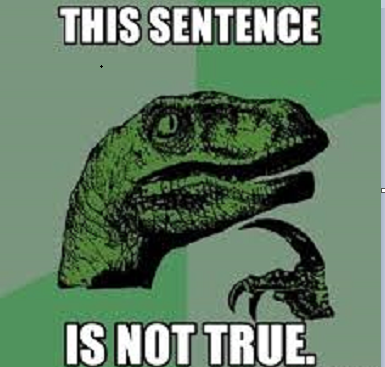
(A) The sentence A is not true.
That is just one — among many — formal expression of the Liar Paradox.
Yet isn’t it the case that statement A above has no semantic content? In other words, perhaps it’s not a real statement (or proposition) at all. Nonetheless, since many logicians and philosophers don’t take this view, let’s take it as they take it — as being a genuine (if paradoxical) statement.
The first thing to say is that A is self-referential. That is, like all expressions of the Liar Paradox, it’s about itself. (Here’s a list of other self-referential paradoxes.)
So we have the sentence “(A) The sentence A is not true” which includes the symbol A. The symbol Awithin the sentence stands for the sentence it is in (i.e., the words which surround it). In other words, a symbol within a sentence refers to the sentence which it is in.
Now is that acceptable? And is A even meaningful?
Statement (A) Has No Semantic Content
(A) The sentence A is not true.
Now what, precisely, “is not true”?
Sentence A is not true, apparently.
What does sentence A say about itself?
It says that it “is not true” — and that’s it. It doesn’t say its subject term (or phrase) “The sentence A” is “not true”: it says that the entire sentence “is not true”.
So if we take out the symbol A from the whole statement, this is what we’re left with:
The sentence [] is not true.
If the symbol A only refers to the sentence itself, then why can’t we take it out? However, if we do, then what are we left with?
It’s already been said that “The sentence A is not true” is without content: so it’s even more the case that “The sentence [] is not true” is without content.
We can boil this down even more.
The symbol A has been removed — and now we can remove the words “is not true” too. After all, thewords“is not true” are supposed to be applicable to something else. So what are the words “is not true” applicable to? That’s right: they’re applicable to the two words, “The sentence”! This means that those two words are meant to be either true or false. Yet how can those two words alone be either true or false when they say almost — or literally — nothing?
Forget all that!
What Logicians Think About Sentence (A)
Let’s restate the sentence again:
(A) The sentence A is not true.
It’s meant to be the case that A couldn’t be true. Like all expressions of the Liar Paradox, it can’t be true because if what it says were true, then it would be false (i.e., “not true”). Yet if it were false, it must be true because A is saying that it’s not true.
On the other hand (or perhaps not), if we take the above to be false, then it must be true. After all, it it is saying that it isn’t true. That must mean, then, that it’s true. So a statement which says of itself that “it is not true”, is true.
Yet, despite all that, statement A can been rejected because it’s a pseudo statement in that it has no content. We can also say that it’s malignly self-referential. Or, more correctly, that truth can’t be applied (or used) self-referentially — especially when the statement has no content in the first place!
What about a sentence which is both (seemingly) self-referential and which doeshave content?
(S) The sentence “Snow is white” is true if and only if snow is white.
The problem here is that the sentence above isn’t really a single sentence (or statement) at all. It is in fact two statements. That is, we have “Snow is white” as well as “This sentence ‘Snow is white’ is true”. Thus it isn’t self-referential at all. The metalanguage’s “The sentence [] is true” is being applied to the object language’s “Snow is white”. The statement “Snow is white” clearly has content and the whole sentence “The sentence ‘Snow is white’ is true if and only if snow is white”isn’t self-referential either because there’s both a meta-sentence and an object-sentence.
Yet, as stated earlier, many logicians and philosophers defend the “The sentence A is not true” paradox for two main reasons:
1) The words “is true” constitute an acceptable English predicate.
2) The whole sentence (A) is grammatically “unassailable”.
So perhaps it isn’t philosophically acceptable. And we can also reject its (everyday) grammar too.
Again, the argument is that we can grammatically assert the sentence A and also grammatically apply the words “is not true” to it. However, all that depends on what’s meant by the words “we can grammatically assert the sentence”. Can we? Grammar, unlike logic, is largely about what is acceptable to say in order to make sense. Now “This sentence” (or “This sentence A is not true”) isn’t grammatically acceptable for precisely the reasons given. It’s roughly equivalent to saying “I walk down” (or “This is”) — and no teacher of English grammar would accept this locution on its own or without any sentential (or semantic) context. (The words “This is” or “I walk down” could be deemed to be elliptical.)
Conclusion
Of course logicians can — and do — treat statements such as “Bricks have a sense of humour” or “The number 2 is blue” logically. That is, they can assign a truth value to such statements and then treat them as pure syntactic strings — from which they can derive further statements and conclusions. Similarly, we can programme the words “The number 2 is blue” into a computer and then that computer can grind out further statements and indeed even a conclusion (i.e., if it’s programmed in the right way).
So we have statement A, which is seemingly grammatical and literally logical. However it has no semantic content. Indeed it can also be said that we can’t really call it a statement at all. Isn’t it simply an arbitrary string of words which obey a logical or grammatical form and which has then had a truth value assigned to it? (Actually, unlike “The number 2 is blue”, A has contradictory truth values assigned to it!) At most, then, statement A is (merely?) a logical string.
It can be concluded, then, that this is why we have the questions and problems which are highlighted by the philosophy of logic. And the philosophy of logicis over and above pure(or formal) logic.
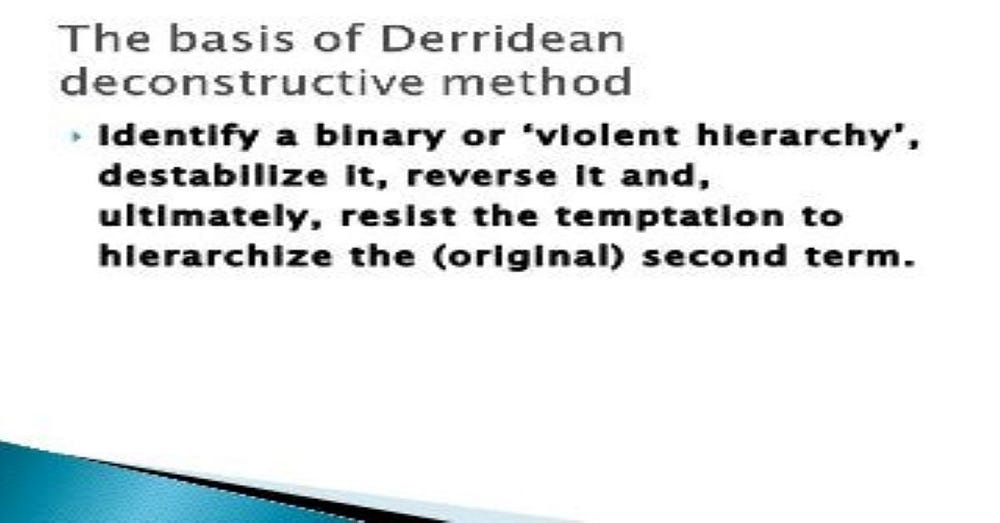
Does Carlo Rovelli simply invert the “violent hierarchy” of objects-over-relations with that of relations-over-objects?
(i) Introduction
(ii) Relations All the Way Down?
(iii) Carlo Rovelli’s Aristotle
(iv) Interactions
(v) Electrons and Photons
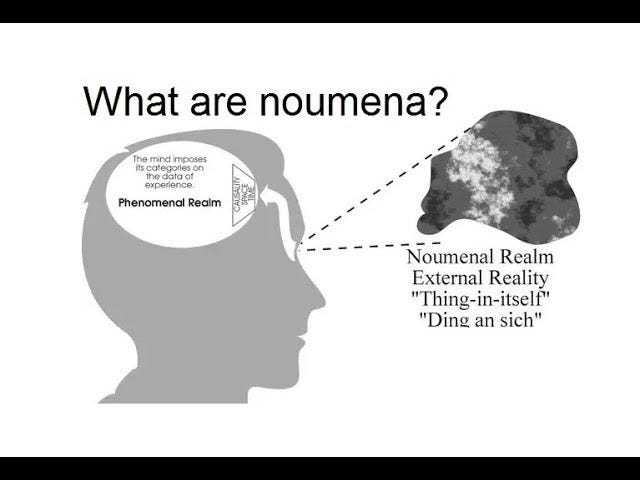
(vi) Kantian Noumena
(vii) Conclusion: Rovelli’s New Hierarchy?
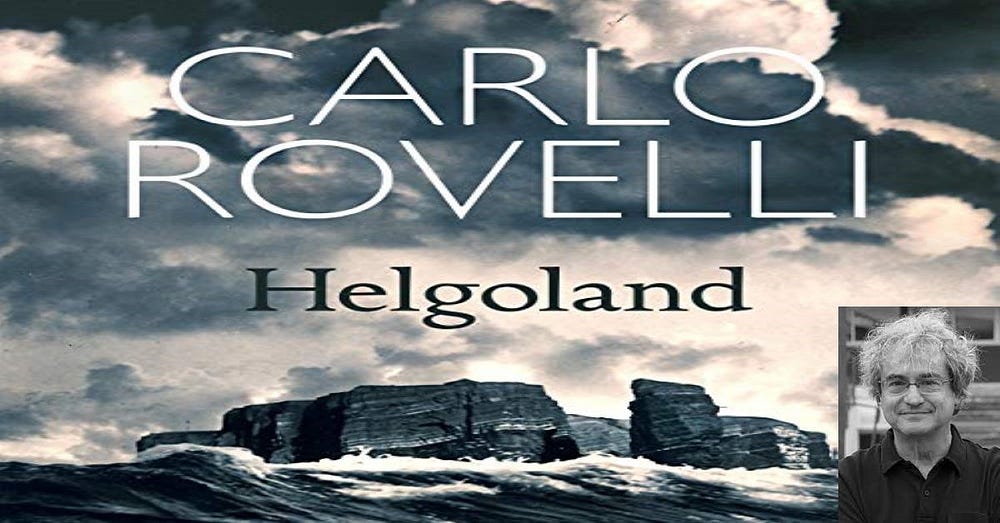
This essay is about Carlo Rovelli’smetaphysical position of relationalism — as it’s defended in his bookHelgoland.(See note at the end: ‘RelationALism or Relationism?’) Rovelli is an Italian theoretical physicist.
At first, Rovelli primarily applied his relationalism to quantum mechanics. However, Rovelli has gone on to apply this metaphysical position to just about every… thing.
Although the following piece is partly sympathetic to relationalism, the primary criticism which remains is that Rovelli appears to be simply inverting the (to use Derrida’s words) “violent hierarchy” that has (according to Rovelli) been set up between objects (or things) and relations in both Western philosophy and in modern physics. In other words, Rovelli has now placed relations — rather than objects — at the top of the pile.
Relations All the Way Down?
Carlo Rovelli puts the most (if prima facie) extreme expression of relationalism (or, in this case, the related structural realism) into the mouths of three philosophers — Michel Bitbol, Laura Candiotto and Giacomo Pezzano. The following is what Rovelli writes about their own position:
“In analytic philosophy, structural realism is based on the idea that relations come before objects [].”
This encapsulation is very helpful because it puts the philosophical position in its boldest and barest form.
Rovelli also has a lot of back up from other physicists when it comes to his (metaphysical) relationalism. That said, it’s of course the case that such physicists have never actually used the term “relationalism” or put things quite as philosophically as Rovelli himself has . However, they still hold similar positions. Moreover,Rovelli also backs up his relationalist position by tracing it back all the way to the ancient Greeks (e.g., to Heraclitus, etc.).
More recently and concretely, Rovelli traces relationalism back to the Danish physicist Niels Bohr (1885–1962). For example, Rovelli believes that the following words capture “Bohr’s intuition”:
“Whereas previously we thought that the properties of every object could be determined even if we overlooked the interactions occurring between this object and others, quantum physics demonstrates that the interaction is an inseparable part of the phenomenon. The unambiguous description of any phenomenon requires the inclusion of all the objects involved in the interaction in which the phenomenon manifests itself.”
Carlo Rovelli’s Aristotle
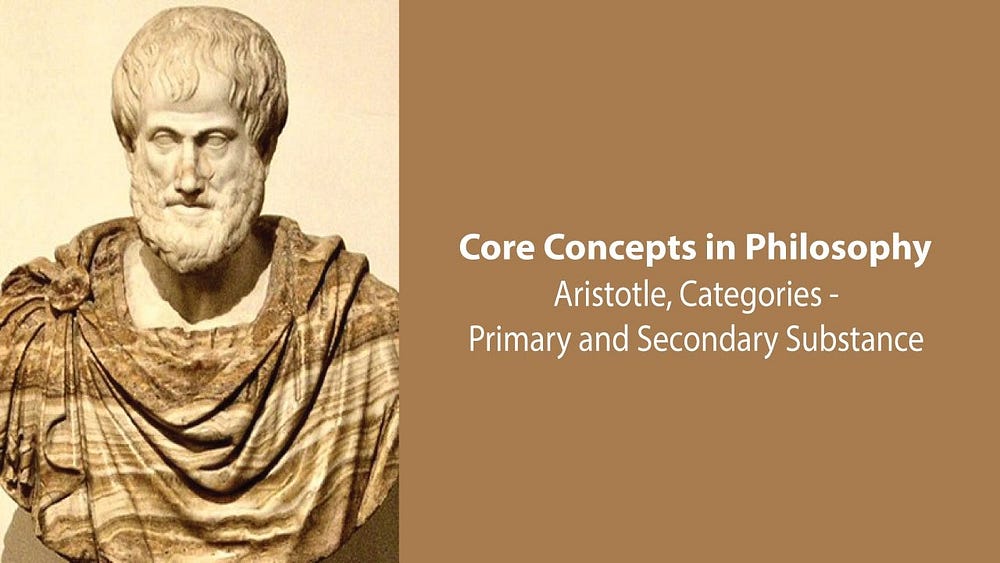
Rovelli allows Aristotle (384–322 BC) to put a position (as paraphrased by Rovelli himself) which seems to be the exact antithesis of his own. Rovelli writes:
“For Aristotle the relation is a property of the substance. It is that belonging to the substance that is towards something else. Among all the categories, for Aristotle, relationality is the one that has ‘least being and reality’. Can we think differently?”
It can be supposed that most laypersons would probably sympathise more with Aristotle’s position than with Rovelli’s own. Indeed isn’t a relation something that has the “least being and reality” when compared to objects or things (if not to “substance”)? What’s more, it’s hard to see a relation as being “a property of the substance” at all. Yet, of course, this issue is largely dependent on how the words “relation” and “object” are defined.
So, again, relations do indeed seem to have the least being and reality in the simple sense that they can’t be observed, touched, smelled, kicked, tested, or experimented upon. The objects which have such relations, on the other hand, might be — or actually are — physical.
Does all that make Rovelli’s relations abstract? Or, if not abstract, then… what?
To move on with Rovelli’s Aristotle.
Where there is (Aristotelian) substance there’s usually an essence — or at least that’s often been the case in Western philosophy. And Rovelli picks up on this too when he writes the following:
“If every metaphysics seeks a primary substance, an essence on which everything may depends [].”
It’s not clear if Rovelli is right to see “substance” and essence” as being (virtual?) synonyms here. Or, if not synonyms, then Rovelli seems to fuse substance and essence together.
Surely there must firstly be a substance in order for it to have any relations whatsoever. Indeed isn’t it the case that there must be objects (if not substances) in order for there to be any relations?
More clearly, surely it can’t be the case that there’s firstly relations and then object O. Surely you first have O itself and then you have its relations. Yet perhaps that’s unless we believe that object O and its relations have always (as it were) belonged together.
That latter possibility is backed up by Rovelli’s own fictional paraphrase of the Indian Buddhist and philosopher Nāgārjuna’s (c. 150 — c. 250 CE) position on structures (i.e., not relations). Rovelli put the following words into Nāgārjuna’s mouth:
“[Structures] are neither precedent to objects; nor not precedent to objects; neither are they both things; nor, ultimately, neither one nor the other thing.”
Thus perhaps there’s never been a time when object O didn’t have any relations. Yet wouldn’t that simply mean that we’d need to take into account all of O’s relations throughout its entire existence? (This is similar to Leibniz's position — see here.)
Of course any given object O will have different relations at different times.
So what of O at all these different times?
What accounts for the very same O having many different relations at many different times?
How do we know, for example, that the same O at t¹ had another set of relations at t²?
Of course we can bite the bullet and argue that O at t² can’t be the same object as ? at t¹. And that would surely mean that we’d need to dispense with the symbol O entirely. Yet taking this nihilist(see metaphysical nihilism) or eliminativistview would also mean that we can’t speak of “the relations of O” either. In other words, relations also need to be factored out if there’s no object O in the first place.
We can move further on Rovelli’s take on Aristotle.
This Aristotelian stress on substance seems to go alongside the stress on the ontological independence of substances or objects — at least according to Rovelli. Indeed Rovelli uses the ideas of the Nāgārjuna again to put his point across. He tells us that Nagarjuna argued that
“it is possible to think of the manifestations of objects without having to ask what the object is in itself, independent from its manifestations”.
That seems plain wrong.
For a start, Rovelli uses the words “the manifestations of objects”. (More specifically, he uses the two words “of objects”.) Clearly objects aren’t factored out of this alternativerelationalistpicture. In other words, if it’s literally all about “manifestations”, then why mention objects at all? So perhaps Rovelli isn’t arguing that it’s literally all about manifestations (or interactions)… Yet it certainly seems that way.
It’s not even clear that many people do believe in the notion of an object “in itself”. Sure, a few (perhaps many) philosophers have done so in the past. However, virtually no laypersons or scientists do so today. Yet Rovelli’s argument is that this way of thinking has been central to all Western thought — not only to the thought of a small group of philosophers. That said, elsewhere Rovelli does state the following:
“In the history of Western philosophy there is a recurrent critique of the notion that ‘entities’ are the foundation of reality. It can be found in widely different philosophical traditions, from the ‘everything flows’ of Heraclitus to the contemporary metaphysics of relations.”
If Rovelli isn’t setting up a straw target here, then we can agree with him and say that it would be difficult — if not impossible — to describe any give object as it isin itself. (That said, I’m sure that some “analytic metaphysicians” could manage it.) Indeed Kantian noumena, for example, are noumena precisely because they can’t be described.
Rovelli then says something similar about the history physics. He writes:
“The discovery that quantities we had thought of as absolute are in fact relative instead is a theme that runs throughout the history of physics. Beyond physics, relational thinking can be found in all the sciences.”
It’s not clear how the words “absolute” and “relative” are being used here. If Rovelli (as a follower of Einstein) is talking about space and time, then he has a strong case. As it is, Rovelli’s not talking exclusively about space and time (or Einstein’s spacetime): he’s talking about literally every… thing.
Interactions
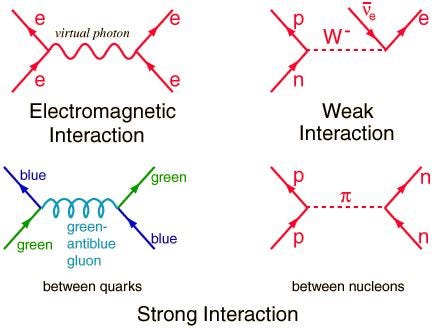
Rovelli stresses what he calls “interactions” as much as he stresses relations. (Interactions can, of course, be seen as a subset of relations.)
Firstly, it can be doubted that any philosopher, physicist or layperson has ever denied the reality — and even importance — of interactions when it comes to what Rovelli calls “individual objects”. Obviously every object (unless it’s an abstract object) interacts with at least something in its entire existence.
So does Rovelli’s stress on interactions (which will be tackled later) somehow play down the nature of objects — or even eliminate them? Perhaps, then, stressing interactions isn’t a means to eliminate objects at all. Perhaps it’s just that — a stress on interactions.
Now let’s requote this earlier passage from Rovelli:
“In analytic philosophy, structural realism is based on the idea that relations come before objects [].”
The simple idea that “relations come before objects” seems obviously false and even outright… impossible.
How can there be relations without something to (as it were) plot the relations? That is, how can there be relations without things (or objects) which have relations to other things (or objects)?
It can be argued, however, that relations only have relations to other relations. But then what point does the (relative?) word “relations” serve?
Alternatively, it can be argued that it is events which have relations, not objects or things. (Rovelli often stresses eventsin Helgoland — see here too.) Yet even here events must ground relations. That is, events surely can’t be deemed to be relations too.
The English philosopher James Ladyman gets around the latter statement by arguing that objects are literally constituted by (their) relations. In Ladyman’s own words:
“There are objects in our metaphysics but they have been purged of their intrinsic natures, identity, and individuality, and they are not metaphysically fundamental.”
Thus, what we take to be an object (or thing) is actually a set (or collection) of relations. And, if that’s the case, then all we really have are relations having relationswith other relationsand nothing (seemingly) to ground those relations… And that’s because (as just stated) the objects (or things) which do the grounding are themselves sets (or collections) of relations…
But what does all that even mean?
What’s more, has anyone ever had a problem with the idea that
“nothing exists in itself, everything exists only through dependence on something else, in relation to something else”.
It depends.
Firstly, if this is an argument for relations all the way down, then the phrases “dependence on something else” and “relation to something else” don’t help very much because one’s first thought is that this something else may well be other objects or things!
In any case, no object (or thing) exists in a literal vacuum. (I’m not sure what physicists would say about this.) Thus every object must have at least some relations with things outside itself. (A human being would certainly cease to exist if there were no other things.) That said, what exactly does the phrase “nothing exists in itself” mean? Does it mean that nothing could be what it is without other…. what?… things or objects?…. also existing? And what kind of “dependence” is Rovelli actually referring to here?
So let’s be more concrete/specific and bring in electrons and photons.
Electrons and Photons
Rovelli puts his own relationalist position at its most pure when he states the following words:
“When the electron does not interact with anything, it has no physical properties. It has no position; it has no velocity.”
One may immediately wonder what physicists will make of Rovelli’s statement. Perhaps most physicists would simply say that such an occasion never occurs… So why worry about it?
In any case, the basic point must be that an electron gains its “physical properties” by virtue of its interactions. That must mean that these properties are (as it were) given to the electron by those things it interacts with — say, forces, fields and other particles. And, in turn, these other forces, fields and particles will be given their properties by yet other forces, fields and particles. (Is this a vicious circle?)
Of course it’s fairly safe to say that there’s never been a case when an electron wasn’t interacting with anything. Indeed it would have needed to be in a literal vacuum for that to have been the case. More accurately, if an electron had been in such a literal vacuum, then it simply wouldn’t have been an electron at all!
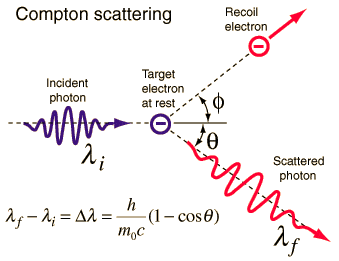
Now take the American theoretical physicist John Archibald Wheeler (1911–2008) saying something similar about a photon.
“An example of the idea of it from bit: when a photon is absorbed, and thereby ‘measured’ — until its absorption, it had no true reality — an unsplittable bit of information is added to what we know about the world, and, at the same time, that bit of information determines the structure of one small part of the world. It creates the reality of the time and place of that photon’s interaction.”
Wheeler seems to be arguing that a photon literally gains its “reality” when it’s “absorbed”. Thus if a particular photon gained its reality only when it was absorbed, then it mustn’t have had any reality before that absorption. Thus surely we must conclude that there simply was no photon before the absorption!
Wheeler also stresses that the reality of absorption can also be seen in informational terms. That is, when Wheeler’s photon was absorbed, then “an unsplittable bit of information is added to what we know about the world”. In other words, only when the photon was absorbed could “we” (i.e., experimental physicists) gain information about it. Before that, the photon had zero reality because we had zero information about it.
It’s also worth saying that Wheeler even uses Rovelli’s favourite word “interaction”. In parallel, Rovelli also stresses the notion of “information”; which is something that Wheeler almost singlehandedly brought into physics (see here).
Kantian Noumena?
In the following passage Rovelli seems to be writing about the possibility of Kantian noumena — i.e., not the possibility of everyday objects. He writes:
“Individual objects are the way in which they interact. If there was an object that had no interactions, no effect upon anything, emitted no light, attracted nothing and repelled nothing, was not touched and had no smell… it would be as good as non-existent. To speak of objects that never interact is to speak of something — even if it existed — that could not concern us. It is not even clear what it would mean to say that such objects ‘exist’.”
Most people either reject such Kantian “objects” or have never give them any thought. And, as stated elsewhere, few would deny the importance of interactions — let alone their reality.
So is Rovelli setting up the straw target of Kantian objects to get his point across?
In other words, how does Rovelli’s position relate to objects which do interact and which are known to interact? Do such objects also have a secondary importance — or even secondary existence/reality — when placed against interactions? And why can’t the following be the rather obvious case? -
We have objects and we also have the interactions of those objects.
All that said, Rovelli does then move on from his focus on Kantian objects to the more concrete objects (that’s if we can call them concrete at all ) of quantum physics. He writes:
“An isolated object, taken in itself, independent of every interaction, has no particular state. At most we can attribute to it a kind of probabilistic disposition to manifest itself in one way or another. But even this is only an anticipation of future phenomena, a reflection of phenomena past, and only and always relative to another object.”
Clearly, if any given object were truly “independent of every interaction”, then we wouldn’t know anything about it. That’s primarily because in order to know something about it the experimental physicist would need to interact with it. And that would therefore mean that this object wouldn’t be independent of every interaction. In other words, such an object would be involved in at least one interaction — an interaction with an experimental physicist.
In addition, it’s not clear how such an object can have
“a kind of probabilistic disposition to manifest itself in one way or another”.
How can it be any kind of object at all in this non-interactive situation? In other words, how can a given x which is both “isolated” and “independent of every interaction” have a “probabilistic disposition” of any kind — or even have any kind of existence? Oddly enough, this “isolated object” has effectively become like the Kantian noumenon Rovelli indirectly referred to earlier.
So, again, what is it, exactly, that may “manifest itself in one way or another”? How has the experimental physicist — or anyone else for that matter — got a grip on this supposedly isolated object that’s independent of every interaction? Yet, according to Rovelli, this strange… thing… is still the subject of an attribution of some “kind of probabilistic disposition to manifest itself in one way or another”.
Conclusion: Rovelli’s New Hierarchy?
Theseeming (to use a term from Ferdinand de Saussure)binary opposition between relations and entities (or objects) is given a scientific and historical reading by Rovelli in his following words:
“But physics has long been asked to provide a firm basis on which to place relations: a basic reality underlying and supporting the relational world. Classical physics, with its idea of matter that moves in space, characterized by primary qualities (shape) that come before secondary ones (colour), seemed to be able to play this role [].”
The very phraseology in the above seems odd. Surely no physicist or scientist would ever have thought in terms of a “relational world” at all. So perhaps that’s precisely Rovelli’s point. That is, there is indeed a relational word andphysicists simply haven’t seen things that way. Yet if physicists haven’t seen things this way, then why were they (according to Rovelli himself) “asked to provide a firm basis on which to place relations”?
The odd thing is that a philosopher, scientist or layperson could accept most of what Rovelli argues and still believe that objects (or things) are important or even vital.
So is Rovelli simply inverting what he sees as the violent hierarchy in which a supreme importance was (supposedly) given to objects in Western philosophy and physics? In other words, is Rovelli now simply putting interactions and relations in the place of objects or entities? And, if he is, then why is this clear and blatant reversal a better philosophical position?
To sum up.
Carlo Rovelli's appears to be simply inverting a hierarchy (or opposition) in whichphysicists and philosophers were supposed to have put objects (or “matter”) at the top of the metaphysical pile. And now here’s Rovelli simply reversing matters by placing relations and interactions there instead.
******************************
Note:
(1) Relationism or RelationALism?
There may be a problem in the essay above with the use of the word “relationalist”. That’s because there are two different terms which are often used within this metaphysical context: “relationism” and “relationalism”. These terms seem to denote two (slightly?) different positions. That said, on analysis the distinctions between them appear to break down — at least in certain respects.
This is one definition of the two terms:
“For relationalism, things exist and function only as relational entities. Relationalism may be contrasted with relationism, which tends to emphasize relations per se.”
Relationism is said to simply emphasise the relations between objects: it doesn’t deny that objects exist. With relationalism (i.e., with an added “al”), on the other hand, “things exist and function only as relational entities”. That is, if there were no relations, then there would be no things. Relationism, again, simply notes the importance of relations between things.
Thus relationalism is like ontic structural realism in that the latter eliminates things (as in “every thing must go”). Relationism, on the other hand, simply places relations in an important position in any metaphysics.
Having said all that, it’s hard not to see the importance of relations even if one also accepts the existence of things. One can also see the vital importance of relations when it comes to physics. Yet, on the other hand, one can’t really see how things (or objects) could be entirely eliminated from physics. (This may ultimately depend on how the word “thing” or “object” is defined.)
On the other hand, relationalism can be read as not actually being eliminativist at all. After all, this metaphysical position may simply have it that things (or entities) aren’t what’s called “self-standing”; which isn’t in itself a denial that things exist. Alternatively, we can say that literally all a thing’s properties are relational. That is, it has no intrinsic properties.
Thus, in a weak (or even strong) sense, if all things only have relational properties (and such properties literally constitute all things), then in one sense things are are indeed eliminated from the metaphysical picture. (This, as stated in the essay, seems to be James Ladyman’sposition.) To put that simply: if a thing’s relations (or relational properties) were eliminated, then it would no longer be that thing. Indeed it would no longer even exist!
Despite all the above, it’s still hard to make sense of the idea, to use Lee Smolin’s words, that “the world is made of relations”. What does that mean? How can the world be made of relations alone? The same goes for Smolin’s claim that “all properties are about relations between things”.
Finally, relations and structures may well be of utmost importance in both metaphysics and physics. Nonetheless, surely there are no relations and structures without things or objects.