Saturday, 18 November 2023

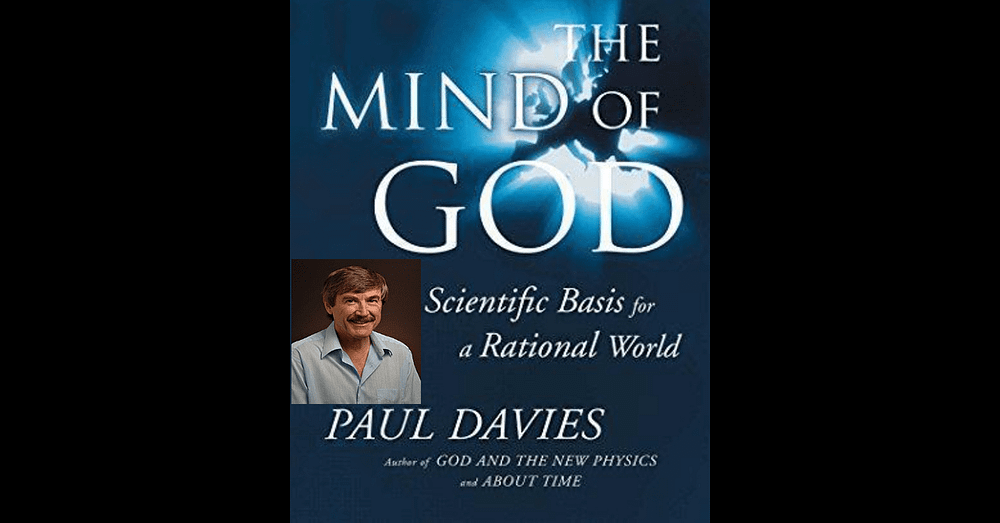
Physicist Paul Davies States: “This universe is either a mystery, or it’s absurd.”

In his popular books, the physicist Paul Davies uses various rhetorical and/or vague words and phrases in philosophically-important contexts. This essay argues that such words and phrases actually help generate and publicise his own theory of cosmic “purpose”. They also help generate the scientific and philosophical problems Davies believes both he and his opponents must tackle.
(i) Introduction
(ii) Pedantry?
(iii) Examples of Paul Davies’s Rhetoric, Etc.
(iv) Our Universe Must Produce Life and Mind?

In basic terms, the main problem with Paul Davies’s claims and positions (or, more particularly, his belief in a cosmic “purpose”) is that he uses various words and phrases loosely, vaguely and/or rhetorically in philosophically-important contexts. These are words and phrases he’d never use in his technical physics papers.

Perhaps Davies would freely admit this. After all, he knows that he’s writing what’s called “popular science”.

In any case, in the books in which Davies discusses (cosmic) “purpose”, it can be assumed that he’d never claim to be doing actual physics. Instead, he may claim to be doing two things:

(1) Writing about physics and cosmology. 
(2) Philosophising
about physics and cosmology.

To spell things out.

Writing about physics isn’t physics. And philosophising about physics isn’t physics either. (Again, there’s a good chance that Davies would accept these statements — at least to some degree.)

So there’s no problem at all with Davies philosophising about physics and cosmology. That’s what (obviously) philosophers also do. Indeed, there’s no problem with scientists themselves doing philosophy either. (The problem often works in the opposite direction when scientists claim — if sometimes implicitly — that there aren’t any philosophical components to their scientific theories and statements at all.)

One other problem is that because Davies is a physicist, then that may mean that many of his readers (especially those who’re sympathetic to his views) will take all the words in his popular books to be actual physics. Yet, again, his books are mainly about physics and physical cosmology. And they also include a certain amount of philosophising about physics and physical cosmology.

So it must be said here that this essay isn’t an attempt to go through Davies’s books looking for rhetoric, vagueness, etc. (I use rhetoric myself.) Instead, the argument here is that such rhetorical, vague and loose words and phrases are vital to Davies’s overall philosophical position.

Pedantry?

It can be freely admitted that there is a problem with focussing too much on the actual (or precise) words Paul Davies uses. Specifically, there’s a danger of being “pedantic”. Worse, there’s a danger of being like those “boring” Oxbridge linguistic philosophers of the 1950s. [See here.]

It also needs to be said that many of those scientists who take diametrically opposed views to Davies’s own also use rhetorical and vague terms and phrases in their popular books. (Again, terms they’d never use in their physics papers.)

Take, for example, the following passage from the American theoretical physicist and Nobel laureate Steven Weinberg (1933–2021):

“It is almost irresistible for humans to believe that we have some special relation to the universe, that human life is not just a more-or-less farcical outcome of a chain of accidents reaching back to the first three minutes, but that we were somehow built in from the beginning [].”

[These words can be found in Weinberg’s book The First Three Minutes. See also my Life and the Universe are Neither Meaningless nor Meaningful’.]

Without spoon-feeding the reader, the relevant words above are “farcical outcome”. Indeed, Weinberg then goes on to state that the universe is “hostile”.

Interestingly enough, the passage above comes immediately before Weinberg expressed his very-often-quoted view that

[t]he more the universe seems comprehensible, the more it also seems pointless”.

Here the relevant word is “pointless”.

So isn’t Weinberg himself falling into the same trap as those religious people he’s arguing against? That is, why accept the binary opposition set up between the universe being “comprehensible” and the universe being “pointless” at all?

Actually, Weinberg inverts the religious argument here.

In other words, the religious argument has it that because the Universe is comprehensible, then surely that must be because God has made it so. More correctly, God is responsible for the (human) minds that do the comprehending.

Alternatively, Paul Davies himself believes that the Universe is comprehensible primarily because it has a “purpose”.

Weinberg, on the other hand, believes that the Universe's comprehensibility makes it (only seem?) pointless

It’s worth saying here that Weinberg explained (in the book Dreams of a Final Theory) his earlier controversial statement in the following way:

“As we have discovered more and more fundamental physical principles, they seem to have less and less to do with us.”

Yet Davies (despite him playing down his own anthropocentrism) wants cosmology to have more and more “to do with us”.

Weinberg, on the other hand, seems to be arguing that physics — even theoretical physics — should do the job of making things less profound and mysterious, not more so.

Weinberg also wrote the following:

“As long as we don’t know the fundamental rules, we can hope that we’ll find something like a concern for human beings, say, or some guiding divine plan built into the fundamental rules.”

However:

[W]hen we find out that the fundamental rules of quantum mechanics and some symmetry principles are very impersonal and cold, then it’ll have a very demystifying effect.”

Ironically, Weinberg referred to the time when Davies received a million-dollar prize for “advancing the public understanding of God and spirituality” from the John Templeton Foundation. [See my ‘Physicist Paul Davies’s Contributions to the Advancement of Religion, As Seen By Father Mariano Artigas Weinberg’.] Weinberg said:

“I was thinking of cabling [Paul] Davies and saying, ‘Do you know of any organization that is willing to offer a million-dollar prize for work showing that there is no divine plan?’”

Anyway, to get back on the track of those loose, vague and/or rhetorical words and phrases.

Examples of Paul Davies’s Rhetoric, Etc.

Surely Paul Davies stating that “the existence of this particular universe is either a mystery, or it is absurd” is a silly binary opposition. That said, if readers do accept this opposition in the first place, then much else of what Davies states may well follow.

(The binary opposition is elsewhere spelled out as the claim that the universe is either “absurd” or it has a “purpose”.)

When talking about the Universe, Davies also says that it is (or it at least it may be) “self-explaining” and a “self-creating system”. Clearly (at least to me), these words don’t belong to physics or to physical cosmology. Indeed, even if one accepts the arguments that Davies has offered his readers, then many of his statements and words still wouldn’t belong to physics and physical cosmology.

Another example from Davies is the statement that “perhaps existence doesn’t get bestowed from the outside”.

This is a very odd reference to existence.

Existence and the nature of existence are usually deemed to be ontological issues. More particularly, you certainly won’t find the word “existence” used in physics papers — at least not in Davies’s philosophically heavy sense.

Here’s another rhetorical statement.

Davies tells us that “some minds are capable of understanding the universe”. He then adds that other people (i.e., his “atheists”) take this understanding to be “yet another fluke”…

Well, that depends.

If the word “fluke” means not by God’s arrangement, then “some minds” understanding the universe surely must be a “fluke”. (That’s the outright monotheistic position.)

However, Davies’s doesn’t believe in what he calls the “Abrahamic God”. So, on his own terms, if such an understanding isn’t the result of some (non-monotheistic) cosmic purpose, then, again, it must be a fluke.

Yet the word “fluke” is very much like Davies’ other rhetorical word (which he uses a lot) “absurd”. (This word has already been mentioned.)

So do the words “fluke” and “absurd” mean “not necessary” in Davies’s eyes?

If that’s the case, then what would it be for “life and mind” to be necessary?

Is it that we have flukes and absurdities by virtue of the fact that there is no God? Alternatively, do we have flukes and absurdities if we don’t accept Davies’s cosmic purpose?

Of course, some physicists have noted the possibility (or reality) that the laws, constants, etc. we have are the only ones that could bring bring about our Universe. [See here.] Indeed, Davies himself speaks about the Universe’s “self-explanation” and “self-creation”. So perhaps it is in these places where we can find the necessity that Davies is looking (or yearning) for.

Let’s go into a little detail here.

Our Universe Must Produce Life and Mind?

Paul Davies states the following words:

“In this theory [actually, Davies accepts this theory], the bio-friendliness of the universe arises from an overarching law or principle that constrains the universe/multiverse to evolve towards life and mind. It has the advantage of ‘taking life seriously’ [].”

There’s a problem with knowing what the words “an overarching law or principle that constrains the universe/multiverse to evolve towards life and mind” mean. Some readers may believe that Davies has gone into detail elsewhere. However, that’s not really the case. (Not that I’ve read everything Davies has written.)

Grammatically, the words “constrains the universe to evolve towards” are problematic or at least vague.

Does they mean that the universe must evolve toward “life and mind”?

Alternatively, could these words mean that the universe is (as it were) free not to evolve toward life and mind? That is, even though the Universe has all the ingredients required to evolve toward life and mind, then it still might not have done so.

Anthropically, the Universe obviously must have all the ingredients required to evolve toward life and mind!

More particularly, even if the Universe does have all these necessary(?) ingredients, then it still needn’t have led to the minds of, specifically(!), Homo sapiens — or even to the minds of any species (or beings) around today.

Similarly with life.

Even if the Universe has always had all the ingredients required to bring about life (which, by definition or anthropically, it must have!), then the life it could have evolved to might have been very different to life as it is.

To repeat. Wasn’t it possible that even if the Universe has always had all the ingredients needed to move toward life and mind, then it still might not have done so?

After all, for over 3 billion years, the Universe hadn’t evolved toward life. As for mind, it took billions of years longer (i.e., at least if life and mind on earth are taken to be unique).

Consequently, doesn’t this (seemingly?) extreme contingency work against any religious interpretation of these facts?

What’s more, these possibilities seem to make Davies’s ideas less highfalutin and grand. And, indeed, surely they should make Davies’s views less appealing to those people who have religious views and proclivities.

To sum up.

If we accept the extreme contingency of life and mind (alongside happily accepting that the Universe must still have had all the ingredients needed for life and mind from the very beginning), then is there still something more to all this? More relevantly, is there still something genuinely purposeful in the Universe or nature?


Note

(1) Paul Davies is not a Christian. He’s not a follower of any other (to use his own words) “conventional religion” either. Indeed, Davies even says that his belief in a “directional principle” is a “far cry from the God of traditional monotheism”. However, Davies is still religious. Thus, Davies’s cosmic purpose may well be a far cry from the Abrahamic God, but it’s not a far cry from other notions of God, or from the beliefs of other religions dating back well over two thousand years. All this must mean that Davies is still betting on a non-Abrahamic horse in the very same religious race. [See my ‘Physicist Paul Davies’s Contributions to the Advancement of Religion, As Seen By Father Mariano Artigas’.]

Wednesday, 15 November 2023

Eric Weinstein’s Defence of “Religious Scientists”

Eric Weinstein’s words have been chosen because they capture the positions of what he himself calls “religious scientists”. He also articulates what these scientists say about their (supposedly) “atheistic” critics. Weinstein also sees these religious scientists as today’s “heretics”. Indeed, he sees himself as a heretic too.

[Eric Weinstein’s words are taken from an interview with Dr Brian Keating on YouTube. I’ve edited various spoken words in order to make them a little easier to read and understand. The video interview is called ‘Richard Dawkins is SUSPICIOUS’.]


(i) Introduction
(ii) Eric Weinstein as a Heretic
(iii) Weinstein on Religious Scientists as Today’s Heretics
(iv) Weinstein on Atheistic Scientists

Eric Weinstein is an American hedge fund director and podcast host. He has a PhD in mathematical physics from Harvard.

One problem for me personally is that Weinstein focuses on both biology (or evolution) and intelligent design in the interview, whereas the religious scientists I’ve previously written about have focused on physics and physical cosmology. Indeed, Paul Davies (who I’ve also written a few essays about) is strongly against intelligent design (at least as it’s taken in biology). [See note 1.]

What’s more, when Weinstein discusses bait fish, mussels, sexual reproduction, etc. it’s hard to tie all that to religious science. It’s even hard to tie it to intelligent design as it’s ordinarily understood. [See note 2.] And that’s one reason why I won’t be commenting on these specific words from the interview. [Extracts from these biology-based sections of this interview can be found at the end of this essay.]

So, instead, I shall focus on Weinstein’s claims that religious scientists are today’s “heretics”.

Eric Weinstein as Heretic

As just stated, Eric Weinstein’s main theme is that today’s religious scientists are what he calls “heretics”.

Weinstein sees himself as a heretic too . If a heretic in physics, rather than in the biology and/or evolutionary theory he focusses upon in this interview with Dr Brian Keating.

In terms of a specific example, we have Weinstein’s very own theory of everything, which he calls ‘Geometric Unity’. [See here too.] Many physicists (at least those who’ve taken note of it) have been sceptical about — and critical of — this theory. [See ‘Weinstein’s theory of everything is probably nothing’, and ‘How to test Weinstein’s provocative theory of everything’.]

Weinstein also coined the term “intellectual dark web”, which was also a place for self-styled heretics.

As it is, I’m not really qualified to offer any wisdom (or any time) on Weinstein’s theory of ‘Geometric unity’.

It’s now worth saying that this isn’t an essay against scientific heresy. (I’m all in favour of scientific heretics.) So it entirely depends on the particular heretic and his particular theories. In addition, later on in this essay it’s argued that those scientists Weinstein deems to be heretics (although he doesn’t name names) aren’t really heretics at all.

[Physicist and mathematician Roger Penrose has been classed as a “heretic” by various commentators, and I much admire him. See note 3.]

But first things first.

A distinction needs to be made between the following:

(1) Those scientists who just happen to be religious.
(2) Those scientists who incorporate their religious views into their actual science.

Two other less-important distinctions can be added here:

(3) Those scientists whose religious views impact on their science with their being aware of it.
(4) Those scientists who deny that their religious views impact on their science even though, arguably, they clearly do.

Weinstein on Religious Scientists as Today’s Heretics

Giordano Bruno being burned at the stake.

Eric Weinstein himself specifically refers to — and defends — the scientists described in (2) above.

Firstly, he asks us these questions:

“If their religion informs their science, [then] what are we to make of that? Should religious scientists live under a cloud of suspicion? Is [their science] contaminated?”

Yet Weinstein also says that

“it’s very important to recognize that there are multiple ways of being a scientist who happens to be religious”.

Here the relevant words are “a scientist who happens to be religious”.

However, it’s clear that Weinstein really has (2) in mind because he immediately goes on to say that he’s

“coming into contact with higher-quality scientists motivated by religion”.

Here the relevant words are “scientists motivated by religion” (i.e., they don’t just happen to be religious).

So let’s firstly take the case of Rupert Sheldrake, who’s an English author and parapsychology researcher with a strong scientific background. (Sheldrake is known for his theory of morphic resonance.) He too sees himself as being a scientific “heretic”.

That word was originally used (very critically) about Sheldrake by someone else. Yet it’s very safe to say that Sheldrake has now happily and clearly adopted this designation for himself. [See here.]

The word “heretic” was used by the theoretical chemist, physicist and science writer John Royden Maddox in response to Sheldrake’s book A New Science of Life, which was published in 1981. (Maddox’s 1981 editorial — in Nature - is called ‘A book for burning?’.)

Since then, the word “heretic” has become very popular with many religious scientists and their defenders. Indeed, seeing religious scientists as heretics strikes many as being supremely ironic. [See my ‘Rupert Sheldrake’s Heretical Caricatures of Scientists and Science’.]

As for Eric Weinstein.

Weinstein goes into rhetorical mode with the following words:

“Galileo’s heresy [] [Religious scientists] are in some sense the heretics of today. And their reputations are burned at the stake.”

Can you really compare Weinstein’s religious scientists to Galileo and what happened to him?

What’s more, are they really heretics?

After all, there’s a big difference between being threatened with being burned alive, and not being threatened with being burned alive. Admittedly, Weinstein does concede this when he says that religious scientists are “not [Giordano] Bruno [ ] burned in 1600 in the square”.

No, contemporary religious scientists certainly are not Giordano Bruno.

Indeed, some of these religious scientists have large audiences and they’ve written best-selling books.

Sure, having huge audiences and writing best-selling books is still not the same as being accepted by Weinstein’s “the union of scientists”. However, it’s not the same what being threatened with being burned alive either.

In any case, simply having a view that other people don’t share doesn’t make you a heretic. Indeed, a scientist having a view that most other scientists don’t share doesn’t make that scientist a heretic either.

If this is the kind of thing that defines what a heretic is, then the world is populated by millions of heretics. Perhaps there’s even more heretics than non-heretics!

Weinstein also tells us that

“going toe to toe with some of these religious scientists is an eye opening experience because they are highly motivated”.

Weinstein does argue against what may be called crude religious scientists, not against sophisticated ones.

He portrays (some) crude religious scientists in the following way:

[] I’m honestly sympathetic with the Dawkins perspective. I cannot stand what I’ve called ‘Jesus smuggling’, where you’re in some very careful argument, and you know you’ve set everything up, and then somebody sort of says, ‘Well, I just believe that God’s love pervades everything.’ You’re like, Oh, brother, I don’t really have to listen to us.”

Yet there’s no doubt that these sophisticated religious scientists are… well, still religious. More relevantly, they’re still (to use Weinstein’s own words) “motivated by religion”.

In more detail.

Weinstein tells us that religious scientists are “going to use the idea of purpose and a personal relationship with God” in their science. Indeed, that personal relationship with God

“give[s] them courage to question things that are essentially unquestionable within the union of scientists [and] that will get you thrown out of the union of scientists very quickly”.

What’s more:

“So what we’re talking about is relatively self-destructive scientists [who are] focused on science [and] who get their courage from religion, and some of their bearings and their focus [from religion].”

Weinstein adds:

“The religious scientists [] are willing to destroy themselves and their careers.”

Not only does God and religion inform the science of these religious scientists, it also informs how they deal with what Weinstein calls “atheistic scientists”.

So are such religious scientists really “self-destructive”?

After all, there are many religious scientists who keep their jobs as scientists, get their books published, become well-known, give seminars, etc. Sure, their ideas and theories are criticised by other scientists. And perhaps their more-explicitly religious science isn’t published in “mainstream” scientific journals. However, does all this really amount to these religious scientists being self-destructive?

Weinstein also tells us that the sophisticated religious scientists constitute “a population of people who agree to the rules of science”. He adds: “They’re not going to cheat on the rules of science because of Jesus [].”

Really?

Do all religious scientists “agree to the rules of science”? Most of them? Many of them? Or only some of them?

So doesn’t it all depend on not only the religious scientist discussed, but also on the actual content of his theories and ideas? Put that way, Weinstein will surely agree with this.

This means that Weinstein does seem to be generalising somewhat (if in a positive way) about religious scientists. Indeed, he generalises just as much as he claims “atheistic scientists” (or those who belong to “the union of scientists”) do when they talk about religious scientists.

As for those atheistic scientists.

Weinstein on Atheistic Scientists

Weinstein not only classes all the critics of the ideas and theories of religious scientists as “atheistic scientists”, he also paints them all as dogmatic, narrowminded and members of the same (rule-bound) “union”.

That position can be seen in the following passage:

“It’s the atheists, according to [religious scientists], who are led into error because they were trying to close the books desperately so as not to leave any gap large enough for a God to be smuggled into the canon of science.”

Weinstein seems to assume that it’s only what he calls “the atheists” who have a problem with the ideas and theories of religious scientists. In other words, Weinstein seems to believe that it’s true by definition that if a scientist has problems with what a religious scientist says (or with his theory), then that scientist must do so simply because he’s an atheist.

Perhaps such scientists have problems with the religious scientist’s ideas and theories without them needing to think too deeply about their own atheism — that’s if they’re atheists in the first place!

Weinstein again focuses on atheists when he says that

“what we have to say is that many of these [religious scientists] are making points that atheists wish would go away”.

Again, are the arguments and scientific details used against the theories and ideas of religious scientist really all down to the atheism of those scientists who offer those arguments against them?

Weinstein makes a similar point when he tells us that

“what do you get from the atheistic science community is - we will have no such discussion”.

He also tells us that

“many of those [religious scientists] are responsible for prying the books open when [Richard] Dawkins and company wished to close them prematurely”.

Weinstein makes it seem (or he hints) that as soon as a scientist finds out that another scientist is religious, then at that immediate point he rejects everything the religious scientist says without any argument, discussion or debate. More importantly, such scientists don’t scientifically analyse the religious scientist’s claims or theories.

Yet that’s simply not true.

There may be some non-religious scientists like that.

However, other scientists have gone into great detail as to why they have problems with the ideas and theories of religious scientists.

It can even be conceded that there are scientists who take their atheism very seriously. However, Weinstein seems to believe that having a problem with the ideas and theories of religious scientists makes a scientist an automatic member of the “atheistic science community” (or an automatic member of “the union of scientists”).

Yet what if atheism is more or less irrelevant to most of the critics of the ideas and theories of religious scientists?

Yes, there are plenty of scientific and philosophical reasons to have problems with intelligent design, cosmic purpose”, etc. which don’t need to be specifically atheistic in nature — or even atheistic at all. Unless, again, this is true by Weinstein’s own definition. That is, does Weinstein believe that a scientific critic of the ideas and theories of religious scientists simply must belong to the atheistic science community?

In any case, there’s no real (or actual) “atheistic science community” in the first place. Sure, there are scientists who just happen to be atheists. Yet, as seen, there are also scientists who just happen to be religious.


Notes

(1) In a subchapter called ‘Intelligent design in biology is magic, not science’ (in the book The Goldilocks Enigma: Why is the Universe Just Right for Life?), Paul Davies writes:

“One of the confusions surrounding the Intelligent Design movement’s propaganda is a failure to distinguish between the *fact* of evolution and the *mechanisms* of evolution. Design proponents often cite squabbles among biologists as signs that ‘Darwinism is in trouble’. [] The point, however, is that the theory has clearly defined and testable consequences, which qualifies it as being a scientific theory; the same cannot be said for Intelligent Design.”

A little later on, Davies states the following:

“Further confusion in the intelligent design discussion often arises from a failure to distinguish between the *evolution* of life and the *emergence* of life — how life got started in the first place. Darwin himself pointedly omitted any reference to life’s origins.”

Interestingly enough, Davies tells us about a classic Intelligent Design example which is very similar to Eric Weinstein’s own (see quotes below). Davies writes:

“A current favourite with the so-called Intelligent Design movement in the United States is the bacterial flagellum, an ingenious-looking device that propels the cell by a rotary action using a little motor. This system is claimed to have irreducible complexity.”

It’s ironic, then, that some scientists have accused Paul Davies of having ID beliefs or proclivities himself. (See ‘Hey, Paul Davies — Your ID Is Showing’.) And on that subject, see my own essays on Davies: ‘A Religious Physics and Cosmology for the 21st Century?’, ‘Physicist Paul Davies’s Deep — or Specious! — Questions About Life, the Universe and Everything’, and ‘Physicist Paul Davies’s Faith in His Idea That Science is Founded on Faith’.

(2) Eric Weinstein does rely (at least in this interview) on two main arguments from intelligent design: irreducible complexity and specified complexity.

Intelligent design is usually tied to the existence of God, but Weinstein appears to reject this. In addition, one can have problems with certain aspects of Darwinian evolution or the “neo-Darwinian synthesis” (as noted by Paul Davies above) and still keep well clear of intelligent design.

(3) Many “mainstream” scientists — including Roger Penrose — are classed as “heretics”. [See here.] This hints that the term has become a cliché.

Eric Weinstein on Darwin and Evolution

These quotes are from the same interview with Brian Keating:

[] Many of these [religious scientists] do not believe that there’s a persuasive case for random mutation as being the major engine of selection. They believe that it is simply improbable [].
[] There is no way you can tell me that that isn’t an intelligently designed system, and it’s the bass that is the intelligence. And the bass is specifically designing its own fooling [and] its own self-deception because the dumber bass have fell for this trick before and smarter bass didn’t fall for it. And that pushes the selective pressures in order to produce this.
[] both of these are systems in which that which is dumber is fooling that which is smarter using the intelligence, the bounded intelligence of the thing being fooled to intelligently design a trap. [] If I make that point and I say, actually intelligent design is all through the animal kingdom, it’s just not what you think.
[] So endogenous intelligent design is essential to Darwinian theory within [the] context of perception mediated selection.
[] It is very clear that when you have various breeds of dog, they are intelligently designed. When you produce a mule from a donkey and a horse, that is not a natural animal. You are producing an intelligently designed animal when you create orchid varieties.
“In some cases, perception-mediated selection is a form of endogenous design, which is intelligent because it is mediated through perception. It’s a good place to study it because the words intelligent design have been made radioactive. And so what we’re arguing about is — should the books have been closed with the neo-Darwinian synthesis, or should they have been left open?”


Thursday, 19 October 2023

The Stanford Encyclopedia of Philosophy’s Unreadable Entries

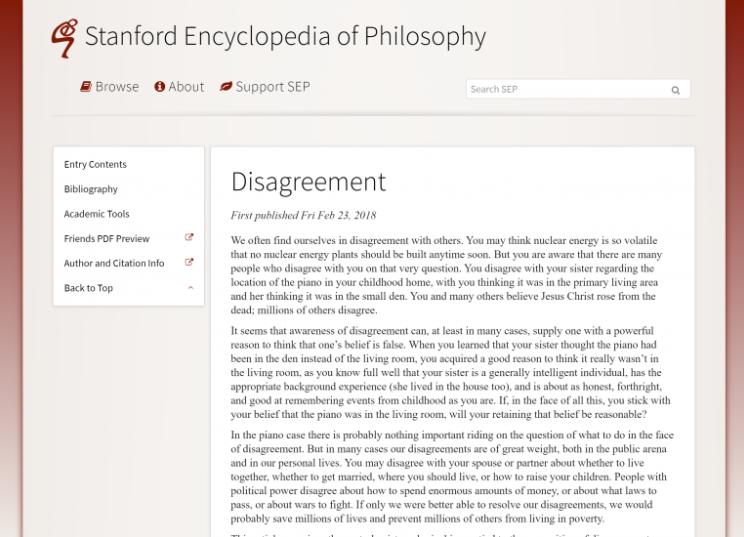
It may seem a little unproductive to have a go at the Stanford Encyclopedia of Philosophy. After all, it presents itself as a free service to academic philosophers. It is. Yet all I can say that after having studied philosophy for over two decades, I still hardly understand the SEP entries I’ve read. This can be best summed up by saying that most entries graphically display extreme and gratuitous academese. This essay is an attempt to make sense of that (admittedly personal) “cognitive deficit”.

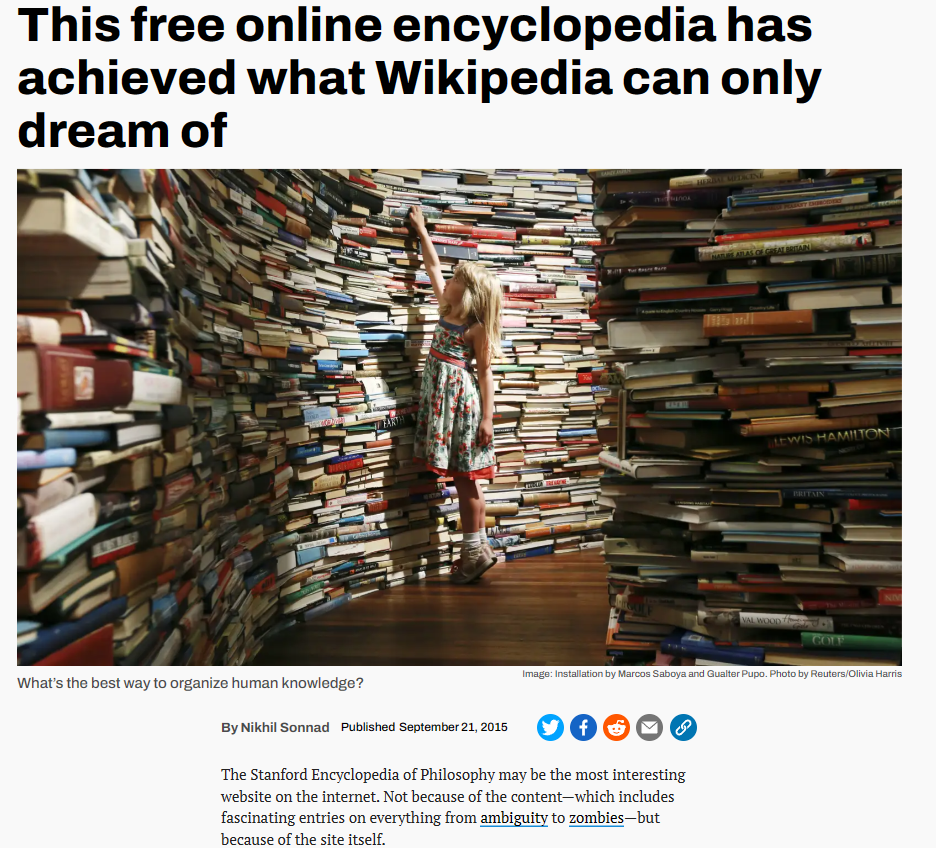
Adjunct professor Nikhil Sonnad (in a piece called ‘This free online encyclopedia has achieved what Wikipedia can only dream of’) states that the Stanford Encyclopedia of Philosophy (SEP) is a “truthful” and “trusted” alternative to the “trashy internet”.

In more detail:

“The story of how the SEP is run, and how it came to be, shows that it is possible to create a less trashy internet — or at least a less trashy corner of it. A place where actual knowledge is sorted into a neat, separate pile instead of being thrown into the landfill. Where the world can go to learn everything that we know to be true. Something that would make humans a lot smarter than the internet we have today.”

The editor of the Daily Nous, Professor Justin Weinberg, sums up Nikhil Sonnad’s very-positive piece on the Stanford Encyclopedia of Philosophy in this way:

“The problem with the internet is that ‘nobody trusts it, yet everybody is referring to it.’ That’s Nikhil Sonnad, a reporter and former philosophy student, in an article at Quartz about how the Stanford Encyclopedia of Philosophy (SEP) is a model for improving the internet.”

… Hold on there!

Nikhil Sonnad’s words are bombastic and far too general

Apart from him categorically dismissing the Internet as an “information landfill”, I would say that in the case of most entries in the SEP, it’s not that (as Sonnad puts it) “the world that can learn everything”, but that 200 (this number, admittedly, is a guess) academic experts can go to learn something. And even in the cases in which laypeople do read SEP entries, I doubt that they ever get much from them…

Sure, I may be speaking only for myself here.

So Sonnad’s complete dismissal of the Internet is neither very smart nor very academic.

For a start, the SEP is itself on the Internet. What’s more, I also found Sonnad’s own criticisms of the Internet on the Internet.

Sonnad gets even more bombastic in the following passage:

“Yet if the goal is to share with people what is true, it is extremely important for a resource to have all of these things. It must be trusted. It must not leave anything out. And it must reflect the latest state of knowledge. Unfortunately, all of the other current ways of designing an encyclopedia very badly fail to meet at least one of these requirements.”

To be sceptical (or cynical) for a moment. It can be suggested that Sonnad is confusing or conflating (to use his own words) “what is true” with academese, or with entries which are written as academic papers. In other words, Sonnad seems to be assuming that something is more likely to be true if it’s written in the style of an academic paper (i.e., with its numerous references, footnotes, particular academic writing style, etc.). So if something is written in, say, the rhetorical style that Sonnad himself prefers, then does that mean that it shouldn’t be “trusted”?

(Sonnad’s article reads like the kind of snarky journalese piece you’d find written by a “rock journalist” at Rolling Stone or something like that.)

Nikhil Sonnad

Since so many of the papers and studies which have been (as it were) caught out for political and other kinds of bias, deceit, shoddy research, etc. have also been written in academese, then we have good reasons to be sceptical of Sonnad’s snooty claims about the Internet, as well as his hyper-positive claims about the Stanford Encyclopedia of Philosophy.

Admittedly, all this stuff about academic bias, shoddy research, etc. is probably far less true when it comes to analytic philosophers. Except, perhaps, when analytic philosophers deal with political subjects. Or at least when they deal with those contemporary political subjects which are also highly controversial, and which also engage their emotions and tribal affiliations.

In any case, the editors of the SEP (Edward N. Zalta is the “principle editor”) chime in with some of Sonnad’s claims. However, they do so, of course, in academese. They write:

“The present information explosion on the World Wide Web poses a problem for the general public and the members of an academic discipline alike, of how to find the most authoritative, comprehensive, and up-to-date information about an important topic.”

To sum up. According to the editors of the Stanford Encyclopedia of Philosophy, the SEP “maintain[s] entries representing the very best scholarship”.

My Take on the Stanford Encyclopedia of Philosophy

The Stanford Encyclopedia of Philosophy isn’t aimed at laypeople.

The SEP isn’t even aimed at people interested in philosophy.

The SEP is aimed at professional philosophers (or Nikhil Sonnad’s “experts”)…

Indeed, even that isn’t entirely accurate.

SEP entries are aimed at experts in the particular subjects each entry discusses.

However, this claim about the SEP being designed for (narrow-ranged) experts is neither positive nor critical. Wikipedia tells us that

[e]ach entry is written and maintained by an expert in the field, including professors from many academic institutions worldwide”.

[Academics generally don’t accept citing — or quoting — Wikipedia. See note 1.]

Thus, at a guess, I would say that each entry is designed to be read by about around 200 experts at most. That said, according to Sonnad again, “[t]he site gets over a million page views per month”.

To be sceptical. That high number of page views (if correct) may simply be down to people searching the Internet and spotting a link to the SEP (say, when they do a Google search on a particular philosophical subject), and then clicking that link. In other words, because there are so many entries on so many subjects in the SEP, then it’s hardly surprising that it gets so many page views.

Indeed, that’s how I was originally taken to the SEP. It’s also how I’ve been taken to it very many times after that. (Sometimes, after being taken to the SEP, I read a paragraph, and then gave up.)

In any case, this isn’t entirely to claim that non-experts won’t actually read the SEP. It’s just that the entries it contains aren’t designed for the curious (as well as educated) people who may well read them.

Of course, the editors of the SEP may not even deny any of this. Or they may deny some of these claims, and accept others.

So, again, the least that can be said is that the SEP is designed for professional philosophers — or for Nikhil Sonnad’s experts.

And that’s why most (almost all) SEP entries are written in extreme academese.

The SEO’s Academese

When it comes to most (perhaps even all) of the SEP entries I’ve read, there’s absolutely no effort at all to make what’s discussed (to use the popular phrase) “as simple as possible, though no simpler”.

In fact, quite the opposite.

Thus, there are numerous references, numerous names of other academics, etc. in nearly all the entries. More particularly, there’s lots of very bad — and very inhuman — writing. Indeed, the writing is often so bad that I find that the entries are very hard to read — even when they’re on subjects I know a lot about!

Now why is the writing in the SEP so unclear?

It’s often because of that situation that if the academic’s ideas were put in the simplest manner possible, then that would show how simple his ideas or arguments are. In other words, that will sometimes show how trite, obvious or dull his ideas or arguments are.

Of course, that may simply display my own cognitive limitations — or my own dumbness.

In any case, all the claims above can only partly be explained in terms of “academic style”.

Academics involved in analytic philosophy will, of course, say — and, to some extent at least, justifiably so — that academese is required for reasons of objectivity (or “intersubjectivity”), clarity, the formal requirements of academic research, stylistic uniformity… or whatever. However, there’s much more to it than all that.

In terms of detail. Even though the entries in the SEP aren’t papers in the usual sense, they’re still written in the style of many of the papers found in analytic philosophy. (They’re also classed as “papers” by commentators and by the editors of the SEP itself.) In fact, according to Wikipedia (again, academics aren’t allowed to reference Wikipedia), the SEP is a “peer-reviewed publication of original papers in philosophy”.

Anyway, isn’t it the case that most professional academic philosophers pride themselves on their “clarity”? It’s certainly the case that such philosophers offer arguments and “conceptual clarifications”. Yet these things don’t — in themselves — bring about clarity. Indeed, they often do the exact opposite.

It can also be said that the notions clarity and “explicit explanation” are only relative to specific analytic philosophers, and what they take these things to mean. In other words, analytic philosophers are often only clear to other (professional) analytic philosophers. And the explicit explanations found in analytic philosophy may only work as explanations for professional analytic philosophers… Indeed, not even all other analytic philosophers will understand the entries in the SEP— just the other experts in the narrow field. This means that those on the outside (including educated and even highly-educated people) won’t appreciate (or even recognise) that supposed clarity, or take the explanations to be explanations.

The other thing that can often be noted is the extremely long paragraphs and a distinct lack of subheadings to be found in most analytic philosophy papers. Admittedly, this is far less true of the SEP entries. And that’s obviously because it’s an encyclopedia.

Generally, most of the writers of SEP entries never move past a rather predictable — and often annoying — academese, with its fetishization of infinite references and footnotes, alongside unhelpful schematic representations, gratuitous symbols, etc. Indeed, all of this is often but a means to signal (for want of a better word) objectivity, academic skill, fairness and a lack of bias, when all it really signals is that any lack of objectivity, bias and fairness there is just happens to be intentionally hidden under the academese.

Other stylistic gimmicks include the gratuitous use of symbols (sometimes they’re peculiar to the academic concerned), schematic representations of positions or arguments, and the many (in my eyes at least) utterly pointless graphs.

Then there’s the superabundance of technical terms.

Sure, in all disciplines technical terms are required. However, they aren’t required in each and every instance.

So sometimes a technical term is used when a everyday term will do the same job just as well. This means that such terms are often used for reasons of pretentiousness, or so the academic can display his academic credentials.

Is This How Most SEP Entries Are Done?

This is what most academics seem to do in their SEP entries.

They comment on what Philosopher A said on subject x, then on what Philosopher B said on subject x, then on what Philosopher C… Sure, each time the academic does that, he’ll offer his own tiny take on what’s just been said by Philosopher A, Philosopher B, Philosopher C, etc. However, there’s still no deep thread of argument because the academic concerned endlessly moves from what one philosopher said to what another philosopher said.

At its most extreme, a SEP entry on problem (or subject) x amounts to no more than commenting on what almost every philosopher under the sun has said on x. And then such an academic will offer a tiny tweak on x.

This approach can be taken to be a display of the academic’s “research skills”. Thus, I presume that it’s also seen as being arrogant, naive and… well non-academic to philosophise for too long without referencing other academics. [See note 2.]

Since the academic concerned is often simply offering an endless citation of other academics’ comments and positions, then he doesn’t have to do much thinking for himself. Nonetheless, he does (as stated) have to do a tremendous amount of research. Indeed, it’s through that research that he can display his academic and professional credentials.

Then, hopefully, all that research will contribute to the academic securing himself continued “academic tenure” (i.e., a well-paid job and career security).

So is all the above really a display of modesty, as well as an adherence to “academic standards”?

Conclusion

Criticising the bad writing and abundant technicalities found in the Stanford Encyclopedia of Philosophy doesn’t mean that all work on the difficult detail of philosophy should be shunned or limited in any way. Of course not. Some papers are bound to be complex and difficult. Thus, they’ll also be a number of unfamiliar technical terms…

Still, the use of technical terms can often be gratuitous. (Although it depends on the academic concerned.)

So don’t get me wrong.

I’m not against academic analytic philosophy. And I’m certainly not keen on unstructured (as it were) stream-of-consciousness philosophy. So surely there must be some kind of happy medium (or more than one kind of happy medium) between the infinite footnotes, references and endless name-doping found in the Stanford Encyclopedia of Philosophy, and, on the other hand, a philosophical free improvisation.


Notes:

(1) According to one source:

“Most academics agree that you shouldn’t cite Wikipedia as a source in your academic writing, and universities often have rules against doing so. This is partly because of concerns about its reliability [].”

(2) Some important and historical analytic philosophy papers don’t even refer to other academics or philosophers. For example, Bertrand Russell’s ‘Existence and Description’, Max Black’s ‘The Identity of Indiscernibles’, David Lewis’s ‘Possible Worlds’, etc.

Four Examples

‘Mereology’:

“All of these uses illustrate the general notion of ‘part’ that forms the focus of mereology, regardless of any internal distinctions. (For more examples and tentative taxonomies, see Winston et al. 1987, Iris et al. 1988, Gerstl and Pribbenow 1995, Pribbenow 2002, Westerhoff 2004, and Simons 2013.) Sometimes, however, the English word is used in a more restricted sense. For instance, it can be used to designate only the cognitively salient relation of parthood illustrated in (1), the relevant notion of salience being determined by Gestalt factors (Rescher and Oppenheim 1955; Bower and Glass 1976; Palmer 1977) or other perceptual and cognitive factors at large (Tversky 2005). Or it may designate only the functional relation reflected in the parts list included in the user’s manual of a machine, or of a ready-to-assemble product, as in (2), in which case the parts of an object x are just its ‘components’, i.e., those parts that are available as individual units regardless of their actual interaction with the other parts of x. (A component is a part of an object, rather than just part of it; see e.g. Tversky 1989, Simons and Dement 1996.) Clearly, the properties of such restricted relations may not coincide with those of parthood understood more broadly, and it will be apparent that pure mereology is only concerned with the latter.”

‘Future Contingents’:

“Strictly speaking, such a claim does not contradict (P5) as mentioned in section 2, although it does in fact contradict a version of (P5) formulated in terms of an exclusive disjunction. However, from a philosophical point of view, such a claim has had no serious role to play in the debate, even though the assumption of all future contingents being true is in fact what holds in the early tense-logical systems, KtK� and KbK�, introduced in (Prior 1967, p. 187) and in (Rescher and Urquhart, p. 68 ff.). The problem is that it is highly counter-intuitive to accept both ‘Tomorrow there will be a sea-battle’ and “Tomorrow there will not be a sea-battle” as true now. It seems that if one of these propositions is true now, then the other has to be false. On these grounds, we shall not consider this possibility any further in this context.”

‘Impossible Worlds’:

“Semantic structures for counterfactual conditionals involving impossible worlds were first introduced by Routley 1989, and have been proposed e.g. by Read 1995, Mares and Fuhrmann 1995, Mares 1997, Nolan 1997, Brogaard and Salerno 2013, Bjerring 2014, Berto et al. 2018. Most of these are natural extensions of Lewis’s 1973 semantics for counterfactuals and capture several intuitions about counterpossible reasoning. The main task for such theories consists in accounting for the concepts of closeness and qualitative similarity between worlds once impossible worlds enter the stage. How to fine-tune these notions is not a trivial matter (for an extensive discussion, see Vander Laan 2004; we will say more in section 4.2).”

‘Holes’:

“Consider: ‘There are as many holes in my cheese as crackers on my plate’; Lewis & Lewis 1970: 207. Can a language be envisaged that contains all the necessary shape predicates? Consider: ‘There are two interlocking toroidal cavities in that piece of cheese’; Casati & Varzi 1994: 180. Can every hole-referring noun-phrase be de-nominalized? Consider: ‘The hole in the tooth was smaller than the dentist’s finest probe’; Geach 1968: 12.)”