Tuesday, 13 May 2025

Gödel’s Logical Proof of God’s Existence Depends on Religious Assumptions

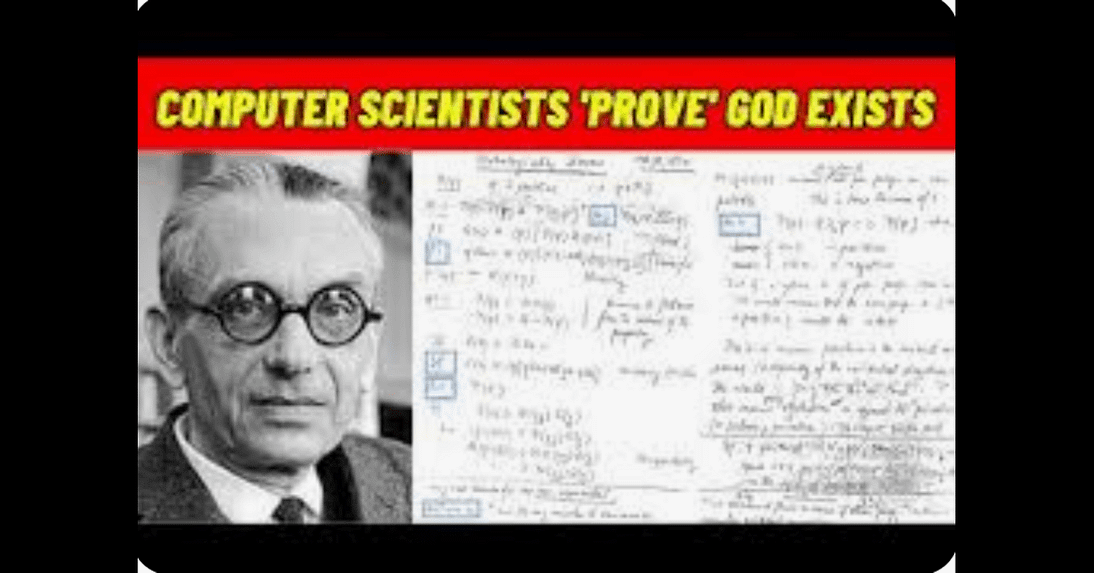
Kurt Gödel’s proof of God’s existence may well work logically. Indeed, it may even be logically flawless. However, it doesn’t actually prove that God exists. Instead, it proves that *if* the axioms are taken to be true, *then* we must conclude that God exists.
(i) Introduction
(ii) The Philosophy and Metalogic of Gödel’s Proof
(iii) Things “Logically Follow” From False and Absurd Axioms
(iv) Is Gödel’s Proof a Language Game?
(v) Gödel’s Theo-logical Proof?
(vi) Conclusion: Gödel’s “Fourteen Points”

The first version of Kurt Gödel’s ontological proof of God’s existence dates back to 1941. However, Gödel didn’t tell anyone about it until 1970, when he believed he was dying.

It’s not entirely clear why Gödel kept his proof to himself. One commentator wrote the following words:

“The shy Gödel feared ridicule. He probably told Einstein about his God Proof, but he told nobody else until 1970, and he never went public.”

And, in 1970, the German mathematical economist Oskar Morgenstern wrote (in his diary) that Gödel wouldn’t publish his proof because he was afraid that other people may think that “he actually believes in God”.

Despite Morgenstern’s words, it’s clear that Gödel believed in both God and the afterlife long before he constructed his ontological proof. Indeed, he actually argued in detail that people should believe in an afterlife. [See here.]

Moreover, the Chinese-American logician and mathematician Hao Wang stated (in his book A Logical Journey: From Gödel to Philosophy) that Gödel’s wife (Adel) said that Gödel

“although he did not go to church, was religious and read the Bible in bed every Sunday morning”.

What did Gödel himself say?

In an answer to a questionnaire, Gödel described his religion as “baptized Lutheran”. He also went on to say that he wasn’t a “member of any religious congregation”. Gödel continued:

“My belief is theistic, not pantheistic, following Leibniz rather than Spinoza.”

The Philosophy and Metalogic of Gödel’s Proof

It’s quite incredible that Gödel provided no arguments as to why the axioms in his ontological argument are true. It seems that he must have taken them to be true primarily because they belong to a long and venerable philosophical tradition of “ontological arguments”. (This tradition involved the philosophers Anselm, Descartes, Spinoza, Leibniz, and many others. [See here.])

Since Gödel’s axioms aren’t argued for, then their embedded terms can be seen to be arbitrary. Indeed, they can even be seen as logical placeholders.

(Here’s some of those embedded terms and axioms: “Godlike”, “positive property”, “A Godlike object exists in every possible world”, “The property of being God-like is positive”, and “God, by definition, is that for which no greater can be conceived”.)

The Australian philosopher Graham Oppy picked up on all this. He argued that

“many other almost-gods would also be ‘proven’ through Gödel’s axioms”.

In other words, if the axioms referred to almost-gods rather than to God, then their existence would also be proven using Gödel’s very own logico-theological (or theo-logical) system.

Similarly, the theoretical physicist Manon Bischoff writes:

“[A]s logicians have shown, it is possible to construct cases where, by Gödel’s definition, there are more than 700 divine entities that differ in essence.”

In terms of the logic of logical systems.

Things “Logically Follow” From False and Absurd Axioms

From the axiom that (to take just one example)

“God, by definition, is that for which no greater can be conceived”

all sorts of things follow.

In simple terms. In logic, if the axioms (or premises) are taken to be true (or simply accepted as they stand), then all sorts of things will follow from them. Indeed, this is why there’s a metalogical distinction made between sound and valid arguments. [See here.]

As one writer put it:

“A proof does not necessitate that the conclusion be correct, but rather that by accepting the axioms, the conclusion follows logically.”

That sentence summarises the point being made here… However, I would dispute the use of the word “correct”. That’s because we should really have the following statement:

A proof does not necessitate that the conclusion be true.

… Unless, of course, this writer is simply using the word “correct” as a synonym for the word “true”.

In detail.

It’s usually the case that the moves in a logical argument (or in a proof) are said to be “correct”, whereas its premises (if not axioms) can be taken to be (or actually are) true or false. Thus, conclusions still “follow logically” from false premises or axioms.

In Gödel’s case, perhaps, conclusions still follow from false (e.g., “Napoleon is alive”) or even absurd (e.g., “The number 4 is happy”) axioms.

Let’s now discuss Gödel’s proof (or system) from a broader metalogical and philosophical point of view.

Is Gödel’s Proof a Language Game?

Perhaps Gödel’s proof constitutes a Wittgensteinian language game.

The term “language game” is used here because all the terms and arguments within Gödel’s ontological proof mutually reinforce each other. Relevantly, that’s without them necessarily having any meaning (or relevance) to anything on the outside of the actual system (or game).

Take Wittgenstein’s discussion of the Liar paradox.

Paradoxes like the Liar were seen — by Wittgenstein — to arise within various language games. At first glance, then, Wittgenstein was perfectly correct to use the philosophical term (his own) “language-game” to refer to the Liar Paradox.

To add to Wittgenstein himself.

The Liar Paradox (as treated by Gödel and others) is internal to a language game which allows a very specific — and very odd — kind of self-reference

But, again, why use the term “language game” here?

Well, in which other language would you ever find the seemingly-empty statement, “This sentence is false”? Indeed, even it’s supposed everyday translation — “I am a liar” — seems somewhat contrived.

Now compare “This sentence is false” to Gödel’s own “The property of being God-like is positive” (or to “A Godlike object exists in every possible world”).

Thus, these kinds of sentence simply don’t belong to everyday languages at all. They all belong to specific (technical) language games.

More specifically, if these statements (e.g., “This sentence is false” and “The property of being God-like is positive”) are scientifically and empirically empty, then perhaps we really don’t need to worry about the possibility of Gödel’s faulty circularity.

Of course, logicians can — and do — use weirder statements such as “Bricks have a sense of humour” or “The number 2 is blue” logically. That is, they can assign a truth value to such statements, and then treat them as pure syntactic stringsfrom which they can derive further statements and conclusions. Similarly, we can programme the words “The number 2 is blue” into a computer, and then that computer can grind out further conclusions or statements (i.e., if it’s programmed in the right way).

To repeat. Wittgenstein didn’t argue that such language games were bogus, or even that they have no value. Instead, he simply saw them as being part of particular (technical) systems. And from that, many other things followed.

To sum up with specific reference to Gödel’s ontological proof.

The whole of Gödel’s proof seems circular in that every term and argument relies on every other term and argument within the system. [See ‘Circular reasoning’.] Thus, if you buy into one of Gödel’s terms (such as “positive property” or “Godlikeness”), then all the other terms and conclusions seem to come along with it.

This is Gödel’s theo-logical package deal.

This is Gödel’s ontological proof.

Gödel’s Theo-logical System?

According to the German philosopher André Fuhrmann, “theology” is actually embedded in Gödel’s logical proof. [See here.]

Well, Gödel’s axioms certainly include the words “positive property”, “God-like”, “Godlikeness”, “essence”, etc. Thus, these terms certainly don’t belong to either science or logic. Indeed, Gödel did take his axiomatic terms as primitives. (Perhaps equivalent to David Hilbert’s “point”, “line”, “plane”, etc.)

Gödel’s axiomatic terms — though not their logical treatment! — are actually theological and aesthetic. Indeed, Gödel himself wrote (as quoted by Dr Thomas Gawlick):

“‘Positive’ means positive in the moral aesthetic sense [ ].”

Of course, all these extra-logical terms and assumptions can still be treated logically.

And Gödel did treat them logically.

But, again, terms like “positive property”, “God-like”, “essence”, etc. don’t belong to logic, even if they can be treated logically.

To sum up. Gödel’s proof may well work logically. It may even be logically flawless. However, it doesn’t actually prove that God exists. Instead, it proves that if the axioms are taken to be true, then we must conclude that God exists.

Conclusion: Gödel’s “Fourteen Points”

The extra-logical basis of Gödel’s proof of God’s existence can be seen in his “fourteen points”. So perhaps the true axioms — even if that term is used loosely here— of Gödel’s overall theo-logical worldview can be found in this set of fourteen points:

(1) The world is rational.

(2) Human reason can, in principle, be developed more highly (through certain techniques).

(3) There are systematic methods for the solution of all problems (also art, etc.).

(4) There are other worlds and rational beings of a different and higher kind.

(5) The world in which we live is not the only one in which we shall live or have lived.

(6) There is incomparably more knowable a priori than is currently known.

(7) The development of human thought since the Renaissance is thoroughly intelligible (durchaus einsichtige).

(8) Reason in mankind will be developed in every direction.

(9) Formal rights comprise a real science.

(10) Materialism is false.

(11) The higher beings are connected to the others by analogy, not by composition.

(12) Concepts have an objective existence.

(13) There is a scientific (exact) philosophy and theology, which deals with concepts of the highest abstractness; and this is also most highly fruitful for science.

(14) Religions are, for the most part, bad — but religion is not.

As stated, these 14 points are sufficient to establish an entire theological worldview. However, any discussion of them will have to wait until another time.

Sunday, 4 May 2025

Did Consciousness Come Before Life?

The anaesthesiologist Stuart Hameroff believes that consciousness predates evolution. Indeed, he believes it predates life itself. Hameroff offers us some science to back up his theory… along with lots of speculations.

“Stuart Hameroff is an American anaesthesiologist and professor at the University of Arizona known for his studies of consciousness and his controversial claim, alongside Sir Roger Penrose, that consciousness originates from quantum states in neural microtubules.”

That’s a short biography which opens a presentation given by the anesthesiologist Stuart Hameroff. The presentation is called ‘Consciousness pre-dates life’.

Stuart Hameroff has spent a lot of time studying (to quote the biography above) “neural microtubules” and tying them to “his studies of consciousness”.

So how does all that tie in with his consciousness-before-life thesis?

Microtubules are a part of living things. In this instance, the clue is in the words “neural microtubules”. On a more fundamental scale, microtubules are biological phenomena.

What do I mean by “biological” here? This:

“[A microtubule is a] narrow, hollow tube-like structure found in the cytoplasm (the fluid inside a cell) of plant and animal cells.”

In more detail, microtubules are

“found in all eukaryotic cells, and they are involved in mitosis, cell motility, intracellular transport, and maintenance of cell shape”.

All the above has nothing to do with consciousness before life.

So what’s missing here?

How does Hameroff move from all that biological stuff, to consciousness existing before both life and evolution?

Roger Penrose

Relevantly, this question raises the issue as to how far Hameroff strays from his colleague Roger Penrose.

Take the following passage from Penrose:

“The question is significantly raised, of course, as to whether a paramecium — or, indeed, an individual human liver cell — might actually possess some rudimentary form of consciousness [].”

Penrose then goes on to partially answer his own question when he states the following:

[I]t must also be the case that the detailed neural organization of the brain is fundamentally involved in governing what form that consciousness must take. Moreover, if that organization were not important, then our livers would evoke as much consciousness as do our brains.”

In that passage, then, Penrose not only stresses “the detailed neural organization of the brain” (i.e., biological complexity), he’s not even sure that a basic biological entity — a paramecium — is conscious. Thus, how do Penrose’s views about single-celled entities tie into Hameroff’s consciousness-before-life thesis?

Microtubules

Despite this consciousness-before-life story, why has Hameroff focussed on microtubules when it comes to advancing his views about consciousness?

The clue is provided by the words above: “Stuart Hameroff is an American anesthesiologist.” In other words, almost everything boils down to the fact that anaesthesiology is Hameroff’s very own discipline.

So perhaps Hameroff can’t see the wood for the trees.

In any case, the following words will provide at least part of Hameroff’s overall story.

Hameroff’s original theory was about when a subject is rendered unconscious by anaesthetics. He believed that changes in the subjects’ microtubules were responsible for that state of unconsciousness. As a consequence, he made a strong connection between microtubules and consciousness.

In basic terms, Hameroff believed that if microtubules can turn consciousness off, then surely they can (or must) turn consciousness on.

Consciousness Before Evolution

One of the very many memes and images which basically advance the same position as Stuart Hameroff, if without the technical science.

In an article called Science Team Argues, Consciousness Came Before Life’, the writer Denyse O’Leary (who “specializes in science news of interest to faith communities”) puts Stuart Hameroff’s position in the following simple way:

In [his] view, then, evolution is not the source of consciousness, but the product of consciousness.”

Denise O’Leary

Indeed, O’Leary actually sees Hameroff’s position to be an “apparent demotion of evolution”.

In Hameroff’s own words:

Life became the vehicle for consciousness.

And in more detail:

Evolution may have worked to optimize, organize, and prioritize more advanced conscious experience involving memory, belief, forecasting, intention and iteration, driven by primitive, and then more advanced forms of pleasure-seeking.

To repeat.

According to Hameroff, firstly there was consciousness, and only then did we have evolution. This means that evolution somehow got to work on a pre-existing consciousness.

I suspect that most readers will find it hard to understand what the words “life became the vehicle for consciousness” could possibly mean. Of course, some readers will already be familiar with this stuff. Thus, this claim will make at least some sense to them.

The word “consciousness” has been bandied around above, so what does that word actually mean?

Six Definitions of “Consciousness” Before Breakfast

“Consciousness clearly proceeds everything else.”

Again, it’s hard to know what the words “[c]onsciousness [ ] proceeds everything else” could mean. At first glance (as well as after), this seems to be a usage of the word “consciousness” that squares perfectly with those Eastern religions in which the notion of “universal consciousness” is prevalent. [See here.]

This is the classic problem, then, of everyone (or at least many of those engaged in debates about consciousness) simply talking past each other. This means that according to Hameroff’s own personal definition of the word “consciousness” (which he may well share with the small number of people in his own philosophical/spiritual camp), whatever it is he’s referring to may well “proceed life” and “everything else”. However, that’s largely because Hameroff isn’t talking about the same thing that most(?), many(?) or some(?) other people are talking about (as we shall see later).

This also means that when it comes to the word “consciousness”, people are given (or they give themselves) a free reign to say just about anything…

And they do!

Thus, it seems that almost anything goes when it comes to consciousness.

What’s more, it gets worse.

If the word “consciousness” is problematic, then what about the words “pure consciousness”?

Pure Consciousness

Supposedly, pure consciousness (or “consciousness [before] everything else”) is consciousness as it is when it’s (in a manner of speaking) unattached to any subject, being, animal, entity, object, event, condition, etc.

But what could that possibly mean?

[There are two senses of the words “pure consciousness”: (1) Consciousness as something “fundamental”, and which predates all life. (2) The pure consciousness which “spiritual people” are supposed to achieve when they meditate, etc. Of course, (1) and (2) are deemed to be related to each other.]

Again, there is some “fundamental” x that’s taken to be pure consciousness. Indeed, it may well be deemed to be equivalent to space, time, spacetime, energy, a “field”, etc.

It is this x that’s also taken to predate life, evolution, animal consciousness, etc.

Yet Hameroff actually offers a level of fundamental consciousness which is (well) far less fundamental than gravity, spacetime, energy, fields, etc. That’s because Hameroff tells us that it already involves (to use Hameroff’s own words) “coherent oscillations, quantum optical superposition effects and triplets-of-triplets”, along with “aromatic rings”“amphipathic molecules”“micelles”, and God knows what else.

All the above is clearly at the level of particles, waves, molecules, etc. In other words, Hameroff’s fundamental consciousness comes after the very early life of the universe.

Thus, in Hameroff’s story, consciousness can’t really be fundamental at all. In that sense, then, his story diverges from all the (other?) notions of universal consciousness.

So why call this inchoate (formless) x “consciousness” at all?

Of course, Hameroff, idealists, spiritual people, etc. are free to use old words in new ways. However, readers should be aware that this is exactly what they’re doing.

The following is another such use of the word “consciousness”:

“All matter appears to hold consciousness and my experiments are highly suggestive that this is the case.”

What is meant by this claim?

Is Richard Gordon — just like Hameroff — using the word “consciousness” in his own, personal idiosyncratic way?

Well, he too is free to use the word “consciousness” in any way he likes… but so too is everyone else.

What’s more, the word “consciousness” has multiple definitions anyway. And this means that the floodgates are already open.

So do we now have a free-for-all when it comes to the word “consciousness”?

Signs of Consciousness?

In terms of science, how could this consciousness-before-life idea ever be established or demonstrated? Alternatively, what evidence could ever work against it? (If there’s already a “problem of other minds”, then consciousness-before-life is a super-problem.)

In very simple terms, the case here is that xy and z occur, and they’re taken to be (what Hameroff calls) “signs of consciousness”. Thus, now we’ll need to know what xy and z are, and whether or not they really are signs of consciousness.

That said, Hameroff may not even be talking about his own version of consciousness here…

Is he talking about “proto-consciousness”?

The Science Behind Hameroff’s Speculations

The following passage is an example of Hameroff offering us (as the common phrase has it) “the science behind” his speculations. He writes:

“In the ancient primordial soup, amphipathic molecules are thought to have formed soap molecule-like ‘micelles,’ which envelope the insoluble, oil-like aromatic rings. These micelles were theorized by Alexander Oparin to have become biological ‘proto-cells,’ developed behaviors for survival, and then become cells and organisms.”

And then come Hameroff’s questions:

“But why would this have happened, long before genes and brains? What would motivate simple creatures’ purposeful behavior to survive?”

Hameroff uses the words “the roots of consciousness”… Yes, not consciousness itself: the roots of consciousness.

Thus, is Hameroff actually talking about what might have been necessary for consciousness to arise? In other words, is he really talking about consciousness “before life”?

Are we even talking about the panpsychist's proto-consciousness here?

(Denyse O’Leary writes: “It will probably survive as a theory because it will sound attractive to panpsychists in science.”)

It seems, then, that despite his scientific credentials, Hameroff is playing fast and loose with his various and many speculations, as well as with his philosophical additions.

Thus, perhaps we aren’t even talking about “the One” or “universal consciousness” here. (Hameroff has had lots of positive things to say about God, religion, spirituality, etc. See here.) Instead, perhaps we’re talking about what is “theorized” to have been necessary (though not sufficient?) for consciousness.

Note also the words “simple creatures” in the quoted passage above. Are even they justified? That is, can we call these things “creatures” at all?

As with the word “consciousness” itself, Hameroff can use any word (including “creatures”) he likes…

And he does.

Moreover, Hameroff also uses the words “pleasure”, “displeasure” and “conscious feelings” in a free-and-easy way in the following passage:

“Some of these would exhibit positive reinforcement, a primitive form of pleasure. Thus, this mechanism could have served as a feedback fitness function for aromatic rings on amphipathic molecules to arrange within micelles for OR events which increase pleasure and avoid displeasure. Thus, the origin of life may have been prompted and driven by conscious feelings right from the start.”

Here again we have (possibly) acceptable and very-technical science being fused with wild speculations — and also with poeticisms and metaphors. And as with the earlier argument that what might have been necessary for consciousness isn’t itself consciousness, so “a primitive form of pleasure” isn’t actually pleasure itself. Alternatively put, “positive reinforcement” simply isn’t pleasure.

Thus, again, it seems that between the uses of legitimately-scientific terms, Hameroff is also playing fast and loose with the terms “consciousness”, “conscious feelings”, “creatures”, “pleasure”, etc. In other words, Hameroff is speculating in a cavalier fashion.

Hameroff also writes:

“[S]ome ‘signs of life’ are pre-conditions for OR and could be detected, e.g. coherent oscillations, quantum optical superposition effects and triplets-of-triplets. If we find such signs of life in a sample, we will expose them to anesthetic gas to see if they are inhibited proportional to anesthetic potency in blocking consciousness in animals and humans. If so, these processes may be considered putative.”

As already stated about another passage from Hameroff, this is a very-technical extract, which is mixed with the vague and broad words “signs of life”.

Let’s spell it out:

Are these signs of life examples of — or even strongly connected to — consciousness?

Again, most of what Hameroff says, and most of his scientific detail, is about what might have been necessary in order for consciousness to arise. Indeed, this isn’t even proto-consciousness in that we aren’t talking about a rudimentary level of consciousness, but what might be necessary for consciousness. And what might have been necessary for consciousness isn’t itself consciousness.

[There are two relevant meanings of the term “proto-consciousness”: (1) The things which are necessary for consciousness, but which aren’t themselves examples of consciousness. (2) Extremely basic levels of consciousness (such as in a electron, rock or single-celled entity) - as often theorised about by panpsychists.]

But, as already stated, Hameroff is perfectly free to class what is necessary for consciousness as “consciousness”. And others are perfectly free to say that the things Hameroff has in mind certainly aren’t examples of consciousness…

Things then get very technical, and seemingly even more scientific, when Hameroff starts to bring in the notion of orchestrated objective reduction (OR).

Orchestrated Objective Reduction

Denyse O’Leary — again — puts Hameroff’s position in the following way:

“The team offers a ‘possible answer’: Some elements of the primordial soup could have reached the threshold of collapse, ‘resulting in sequences of random, disconnected proto-conscious moments.’ Then evolution is invoked, to do the heavy lifting.”

Firstly, let’s explain the words “threshold of collapse”. This is a reference to orchestrated objective reduction (Orch OR). The following passage is O’Leary on that theory:

“Hameroff has collaborated with physicist and philosopher Roger Penrose on the Orch OR theory of consciousness, which forms the basis of the claim. A quantum particle like an electron has no fixed qualities until it is observed (quantum collapse). From that, Penrose argues that the collapse of quantum superpositions into definite states produces consciousness.”

This theory includes a large dose of speculation. Indeed, using the modal phrase “possible answer” is an acknowledgement of that. (The universal set of possible answers may contain infinite members.) There is very little to say about what could be an impossible answer. Similarly, there is very little that can exclude possible answers. Thus, again, is Hameroff indulging in a speculative free-for-all here?

But let me offer some more on Orch OR.

Denyse O’Leary, unlike Roger Penrose, doesn’t mention quantum gravity. Instead, she simply says (to repeat) that a

“quantum particle like an electron has no fixed qualities until it is observed (quantum collapse). From that, Penrose argues that the collapse of quantum superpositions into definite states produces consciousness”.

Penrose’s own stress is different, and he bypasses the need for an observer. He wrote the following words:

“I am not concerned so much with the effects that quantum mechanics might have on our theory (Einstein’s general relativity) of the structure of space-time, but with the reverse: namely the effects that Einstein’s space-time theory might have on the very structure of quantum mechanics.”

… And, more relevantly, Penrose believes that such gravitational “effects” occur in the brain’s microtubules.

Orch OR is essentially a theory about a connection between the very-small scale and the large scale. In Penrose’s view, the brain’s microtubules are linked to fundamental spacetime geometry, and thus also — in his eyes — to quantum gravity. According to Penrose, it’s in the microtubules where quantum states can become “reduced” by gravitational influence.

To put that another way.

The quantum happenings in the microtubules are said to affect the brain as a whole. Thus, microtubules are deemed to be a very important part of the story of consciousness.

Now the main problem shall be noted.

In basic terms, the quantum effects/events/conditions which occur in individual microtubules need to be “coupled” with the quantum effects in other microtubules. Indeed, this coupling is achieved through “quantum coherence” and “quantum superpositioning”.

One may wonder, then, what all this work on microtubules, neurons, synapses, dendrites, the brain, etc. has to do with phenomena which existed (or occurred) long before life and evolution.

So let’s backtrack.

Hameroff has already told us that

“some ‘signs of life’ are pre-conditions for OR and could be detected, e.g. coherent oscillations, quantum optical superposition effects and triplets-of-triplets”.

Note the words “pre-conditions”.

This is about what is necessary for OR: it’s not about OR itself. OR itself is a biological phenomenon. Thus, we need to grapple with the link between non-biological “coherent oscillations, quantum optical superposition effects and triplets-of-triplets”, and such things as they occur in microtubules and in brains generally.

To sum up.

Simply because the quantum phenomena Hameroff now focusses on occurred before life and evolution, that doesn’t also mean that they must have (somehow) instantiated consciousness too. Again, is Hameroff fusing what might have been necessary (though not sufficient) for consciousness, with consciousness itself?