


… of the kind often described by anti-materialists, idealists and religious people.
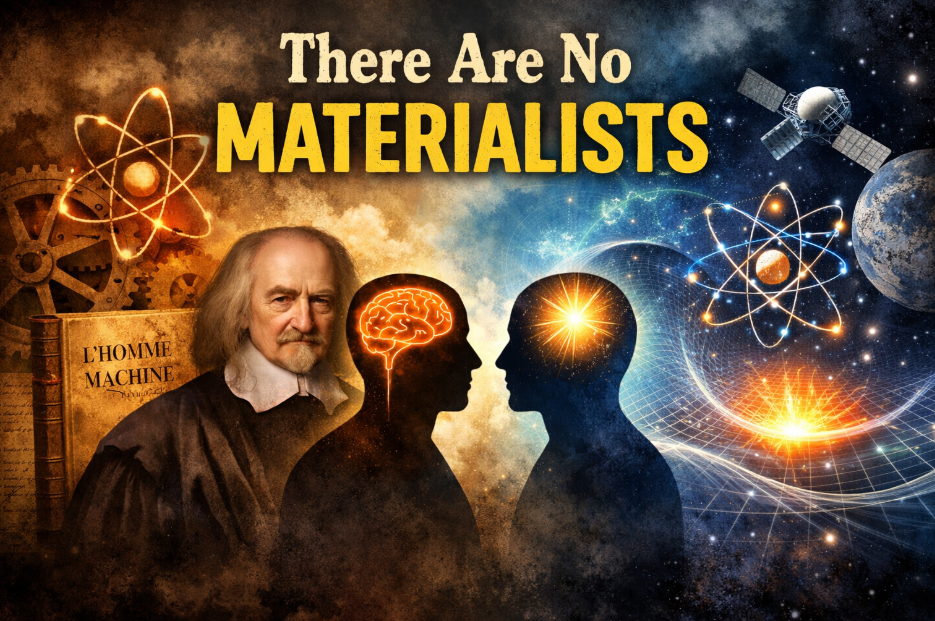
Philosophers often say that all the people in a philosophical debate should put the strongest and most contemporary version of their opponents’ views. This is clearly not happening when it comes to most anti-materialists and idealists. In terms of a concrete example. Spiritual idealists hardly ever cite contemporary physicalists or philosophers of science. It’s as if they’re still debating with Thomas Hobbes or Julien Offray de La Mettrie. Even when they do quote living philosophers they deem to be materialist, their precise arguments aren’t tackled. Usually the quotes take the form of the philosopher supposedly digging his own grave with his own words.
Although some people, including some philosophers, treat the words “physicalism” and “materialism” as synonyms, others don’t. (Philosophers like Daniel Dennett and David Papineau sometimes use these words interchangeably.) The problem is that when critics use the word “materialism”, they have pre-20th century materialism in mind.
Of course, it may well be the case that anti-materialists have just as many problems with physicalism as they do with materialism. And perhaps that partly explains why they often conflate the two terms.
Materialism Before the 19th Century
So what kind of materialism do the idealists and religious critics have in mind? This one:
Materialism is the view that everything that exists is matter.
Thomas Hobbes (1588–1679) is often treated as an early materialist. His view was roughly that everything that exists is body (material substance). All phenomena are matter in forms of motion. Even mental processes are motions in the brain. (According to Hobbes, imagination was deemed to be “decaying sense”, and thus “decaying motion” in the brain.)
We also have Pierre Gassendi, who was a Catholic priest. Then came the 18th-century materialists. Examples include Julien Offray de La Mettrie (author of L’Homme Machine — Man a Machine) and Paul-Henri Thiry d’Holbach.
So if someone wants a target who isn’t made of straw, it is Hobbes and the Enlightenment materialists, not any later materialists and physicalists.
So what is matter in this picture?
Matter is solid stuff which is extended in space, composed of particles, and governed by mechanical laws. Of course, it’s the materialist position on minds, consciousness and human persons that’s really in the driving seat here. After all, old-style materialism had it that minds are material, and thoughts are motions of matter.
What about Isaac Newton and gravity?
Newton’s theory was the first major challenge to the billiard-balls of mechanical philosophy. That’s because gravity acted at a distance without direct collision. That said, his theory didn’t yet introduce fields or energy as fundamental entities; those entities came later with Faraday and Maxwell.
Put simply, Newton’s theory of gravity didn’t immediately overthrow the mechanical worldview. After all, the “clockwork universe” idea was mainly a response to Newton.
19th Century Materialists
I’ve mentioned 19th century materialists. If Michael Faraday, etc. discussed fields in the first half of the 19th century, then the materialist stereotype isn’t even applicable to them!
To Faraday, the field itself is physically real — not merely a mathematical device. Fields aren’t mental. So this shift from particles to fields didn’t overthrow materialism. Instead, it just changed what counted as physical. Fields are still part of the physical ontology — i.e., they’re not mental, supernatural, or immaterial.
What about energy? (This is something that consciousness-first idealists often focus upon in order to prove a point about materialism.)
As with Faraday, we can say something similar about James Clerk Maxwell. He showed that energy resides in the field itself. So physics now had something that occupies space, stores energy, and propagates waves. Clearly, this isn’t matter in the historical sense. However, the fact that energy occupies space, stores energy and propagates waves shows that we’re still talking about something physical.
So, in the 19th century, energy was treated as a universal conserved quantity. Heat, motion and electricity were understood as transformations of energy. Sure, energy isn’t matter (or a material substance) in the historical sense, but it’s still physical (i.e., not mental or supernatural).
What Is Physicalism?
Physicalism is the view that everything that exists is ultimately physical, where “physical means whatever our best physics says exists”. This is a case of philosophers essentially relying on testimony (related to the everyday term, but not identical), which is itself a philosophical notion.
It can even be said that physicalists are committed to the ontology of physics (whatever that turns out to be). In this respect, we can return to Hobbes. A modern materialist could simply say the following about Hobbes:
Hobbes was right that everything is physical. We just now understand physics differently.
What Is Physical?
When anti-materialists ask for a definition of the word “physical”, or ask, “What exactly counts as physical?”, they believe that they’ve played their trump card. Yet, as philosophers have often said, a myriad of other terms both in and out of philosophy create very similar problems. Think about “idealism”, “truth”, “freedom”, “knowledge”, etc.
As stated, physicists now talk about fields, energy, spacetime structures, quantum states, etc. In order to be a stereotypical materialist, the philosopher would need to reject or ignore what physics has to say about these things. No philosopher does ignore all these thing.
Naturalism and Physicalism
Many anti-materialists and religious people will be just as much against naturalism as they are against physicalism. After all, naturalists believe that reality contains no supernatural entities. Having said that, some idealists, for one, may claim that they don’t believe in supernatural entities either. They may even accept that idealism must still be informed by science. Thus, they may argue that they simply interpret the given physics in a way which is at odds with physicalists.
To sum up. Physicalism is a metaphysical thesis about what exists. Ontological naturalism, on the other hand, has it that only natural things exist (hence the name). We also have methodological naturalism, which has it that science is the best way to investigate reality. (A well known early advocate was W. V. O. Quine.)
Non-Reductive Physicalism and Emergentism
Added to all the above we need to factor in the fact that there are non-reductive physicalists, and physicalists and naturalists who believe in weak emergence. Yet here again this is a difference that doesn’t make a different to most idealists and religious critics of materialism because there’s still no room in these pictures for supernatural entities, the soul and consciousness being fundamental
Take John Searle’s biological naturalism. He believes that consciousness is a real biological feature of brains. It isn’t reducible to physics. So Searle is still a naturalist, but not a reductive physicalist.
There are two questions here: (1) Whether these emergent features take us beyond physicalism. (2) Whether supervenience sits comfortably within physicalism.
Of course, these questions need to be answered elsewhere.
Idealists vs Materialists
Idealists believe that the fundamental constituents of reality are mental or that consciousness is fundamental. It’s this fact that’s at the heart of the strong words against materialism. In simple terms, many critics of materialism are idealists.
If materialists still argued that humans are machines made of particles, or that the mind can be reduced to mechanical motion, one can see why idealists and religious people have a problem. As usual, it’s mainly about us. About human persons.
Most physicists most certainly do not believe that the fundamental constituents of reality are mental. So does this mean they are materialists by default? Many idealists would say ‘yes’. (Perhaps others would say ‘no’.)
So, in that sense, it isn’t really a case of anti-materialism vs materialism at all. It’s actually a case of idealism vs materialism.

No comments:
Post a Comment