


Despite the fact that many — even most — people reject the identity stated in the title above, the theoretical physicist Brian Greene believes that’s primarily because of what the neuroscientist Michael Graziano calls our “schematic representations”. Indeed, both believe that thoughts and sensations actually are schematic representations of physical processes.
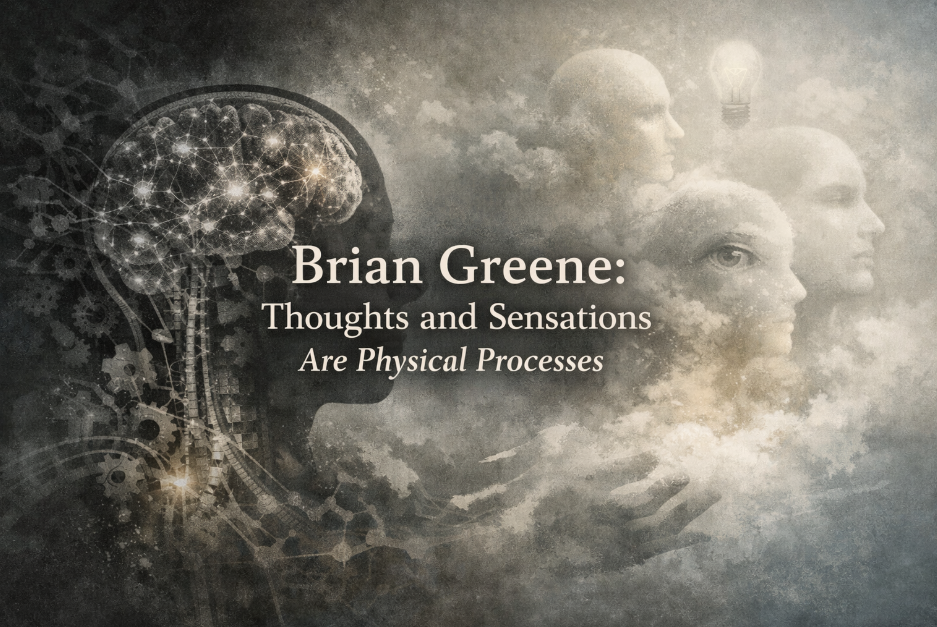
By the mid-1970s, the Identity Theory of Mind (or Type Physicalism) was dead and buried. Why? It was mainly because it took folk-psychological types (such as beliefs, desires, etc.) as reified entities, and attempted to map them onto brain types. However, once you move away from type-type identities and focus on token-token identities, or move away from beliefs and desires entirely, then other types of identity become available. Both Greene and Graziano believe that thoughts and sensations literally are physical processes. And they explain why so many people strongly reject that identity too.
It is often said — very often said — that neurons firing, biochemicals flowing, synapses buzzing, etc. are nothing at all like thoughts and sensations. Thus, the former can’t possibly be identical to the latter.
The neuroscientist Michael Graziano has a theory about this, and Brian Greene explains it in his book Until the End of Time. It all boils down to what Graziano calls “schematic representations”. Greene writes:
“When the brain’s penchant for simplified schematic representations is applied to itself, to its own attention, the resulting description ignores the very physical processes responsible for that attention. This is why thoughts and sensations seem ethereal, as if they come from nowhere, as if they hover in our heads.”
If this passage were to be read on its own, without Graziano’s or Greene’s other examples of schematic representations, it may be hard to grasp, let alone agree with.
Firstly, Graziano argues that thoughts and sensations literally are processes in the brain. What makes this claim seem false to so many people is down to the schematic representations of what’s going on in the brain. The brain simplifies things. It turns physical processes into schematic representations which, in turn, take the form of thoughts and sensations.
This isn’t a self-conscious process in the everyday sense. However, it is an argument for the brain paying attention to itself, without any conscious thought or willing. Thus, although the resulting thoughts and sensations are conscious, the brain processes which lead to them aren’t.
We don’t “see” brain processes. What we do see (i.e., thoughts and sensations) “seem ethereal, as if they come from nowhere”. Thus, it’s the schematic representations which are actually ethereal.
Greene provides an example of a schematic representation which is more down to earth when he continues:
“If your schematic representation of your body were to leave out your arms, the motion of your hands would seem ethereal too.”
In this case, for schematic simplicity, the representation leaves out your arms. (This is just like brain processes being left out, and all we have left are thoughts and sensations.) Obviously, moving hands without moving arms (or any arms at all) would seem odd. The thing is, though, in this instance the human subject would know that the arms have been left out. However, when it comes to thoughts and sensations, many people don’t realise that brain processes have been left, and that they are so for schematic reasons.
All this would explain (if accepted)
“why conscious experience seems utterly distinct from the physical processes carried out by our particulate and cellular constituents”.
Yet it’s our lack of knowledge that our own mental schematic representations are schematic representations which leads, according to Greene’s Graziano, to the hard problem of consciousness. This problem
“seems hard — consciousness seems to transcend the physical — only because our schematic mental models suppress cognizance of the very brain mechanics that connect our thoughts and sensations to their physical underpinnings”.
Note the word “suppress” (as in “mental models suppress cognizance of the very brain mechanics”). This suppression is explained later. Suffice to say that it occurs — or did occur — for evolutionary reasons.
Paul Churchland’s Identities
Graziano’s position (if as expressed by Greene) may seem like the identity theory of mind, a position that most philosophers now regard as being dead and buried. This brings in the philosopher Paul Churchland, who moved beyond the identity theory to his own eliminative materialism.
Let the cognitive scientist Margaret Boden describe Churchland’s position here:
“For Churchland, this isn’t a matter of mind-brain correlation: to have an experience of taste simply is to have one’s brain visit a particular point in that abstractly defined sensory space.”
Here’s Boden again in more detail:
“[Paul Churchland] offers a scientific theory — part computational (connectionist), part neurological — defining a four-dimensional ‘taste-space,’ which systematically maps subjective discrimination (qualia) of taste onto specific neural structures. The four dimensions reflect the four types of taste receptor on the tongue.”
To Churchland himself, “brain processes” and “thoughts” (if not “sensations”) are a question of the following:
“[A] set or configuration on complex states. [ ] figurative ‘solids’ within a four-or five-dimensional phase space. The laws of the theory govern the interaction, motion, and transformation of these ‘solid’ states within that space.”
Churchland even goes into detail about how we may change our vocabulary in the future when it comes to describing our thoughts and sensations:
“Given a deep and practiced familiarity with the developing idioms of cognitive neurobiology, we might learn to discriminate by introspection the coding vectors in our internal axonal pathways, the activation patterns across salient neural populations, and myriad other things besides.”
Despite all that, most people are still very convinced that mental states/events can’t be identical to physical brain states/events. So what’s the problem here? As Peter Carruthers puts it:
“Even if descriptions of consciousness experiences are logically independent of all descriptions of physical states (as the cartesian conception implies) it may in fact be the case that those descriptions are descriptions of the very same things. This is just what the thesis of mind/brain identity affirms.”
Let’s now put Churchland’s position when he states the following:
“For if mental states are indeed brain states, then it is really brain states we have been introspecting all along, though without fully appreciating what they are.”
So when we introspect we “may discriminate efficiently between a great variety of neural states”. However, we may not “be able to reveal on its own the detailed nature of the states being discriminated”.
Our Schematic Representations of a Red Car
The case for thoughts and sensations being mental schematic representations of what’s going on in the brain may seem like a controversial place to start. So what about looking at a red Ferrari? Greene writes:
“[Michael Graziano’s] central thesis is that however heedful of detail you might be, your mental representations are always vastly simplified. Even describing the car as ‘red’ is a shorthand for the many similar but distinct frequencies of light — the many shades of red — that reflect off different parts of the car’s surface.”
Here it’s not clear if Greene is talking about conscious or unconscious simplifications. After all, he does say “even describing the car as ‘red’ is shorthand”. Here it’s said that the conscious self ignores the many shades of red. Yet aren’t we supposed to be discussing unconscious processes in the physical brain? This means that it must be a case of unconscious processes in the brain leading to simplified (conscious) descriptions of the red car.
This latter conclusion is backed up when Greene says that “[y]our mind would reel if it dealt with such an overabundance of detail”. Thus, the brain itself, not the conscious mind, cuts out this overabundance of detail. As a result, the word red becomes “the mind’s welcome, albeit schematic, simplification”. Another way to explain this is to say that the brain can actually deal with the overabundance of detail, but the conscious mind can’t.
The Theory of Mind/Intentional Stance
The theory of schematic representations is then applied to our interactions with other human persons, as well as “interactions” with ourselves. Firstly, other persons:
“Clearly, there is significant survival value in quickly sizing up the nature of our encounters with other life. Researchers call this capacity, refined over generalisations by natural selection, our *theory of mind* (we theorise, intuitively, that living things are endowed with minds that operate more or less like ours), or the *intentional stance* (we attribute knowledge, beliefs, desires, and thus intentions to the animals and humans we encounter).”
Perhaps these applications of the schematic representation theory seem more intuitive than the previous ones.
Evolution and Schematic Representations
This story of schematic representation is then tied to evolution. Greene writes:
“Long ago, brains that may have become distracted by the billowing details of the physical world are brains that would be swiftly eaten. Brains that survived are brains that avoided being consumed by details that lacked survival value.”
The first thing I noted about this passage is how similar it is to Donald Hoffman’s view that seeing “truths” about the world isn’t conducive to survival. Thus, in this case, rather than reality being watered down care of Graziano's schematic representations, reality is completely phased out to be replaced by what Hoffman calls “icons”. Yet, of course, there’s a huge difference between simplifying the world and erasing it. That said, Graziano’s and Hoffman’s theories are indeed broadly similar. But that’s not a surprise because Hoffman’s Fitness Beats Truth theorem icludes feature which are common in cognitive science and evolutionary theory.
Hoffman’s Fitness Beats Truth Idea
As just stated, much of what Graziano says about evolution is similar to Hoffman. For example, in the paper ‘Objects of consciousness’ (2014), Hoffman wrote the following words:
“According to evolution by natural selection, an organism that sees reality as it is will never be more fit than an organism of equal complexity that sees none of reality but is just tuned to fitness. Never.”
Graziano doesn’t go that far. After all, schematisations are schematisations of… something. If human subjects see “none of reality”, then there can’t be any mental schematisations at all.
What is seeing reality in its totality anyway?
Graziano’s theory of schematic representations obviously rules that out. However, Hoffman still targets that idea when he writes:
“When you analyze the equations of evolutionary game theory it turns out that, whenever an organism that sees reality as it is competes with an organism that sees none of reality and is tuned to fitness, the organism that sees reality as it is goes extinct.”
That seems to go even more strongly against Graziano’s position. Perhaps that is simply because Hoffman actually moves beyond animal species in evolution to all human subjects as they exist today. Indeed, Hoffman has moved to philosophical idealism.

No comments:
Post a Comment