Saturday, 10 June 2023

Professor Donald Hoffman: A Prophet of Scientific Idealism or a Charlatan?

This is a response to watching a YouTube video called ‘What is Reality?’, in which Professor Donald Hoffman discusses his commitment to the “spacetime is doomed” idea with the philosophers Philip Goff and Keith Frankish… I was already convinced that there was something deeply suspect about Hoffman’s presentations of his philosophical ideas. However, this video interview convinced me that using the word “charlatan” about him is fully justifiable. Indeed, Hoffman’s stuff about Cantor’s infinities and Gödel was the last straw!

Keith Frankish is lost in a forest of Donald Hoffman’s technical jargon.

This is the introduction to Philip Goff and Keith Frankish’s interview with Donald Hoffman (which was streamed live on YouTube on May 22, 2023):

“Donald Hoffman is a cognitive scientist at UC Irvine and author of ‘The Case Against Reality.’ He believes that the world we experience is an illusion, whilst ultimate reality is composed of networks of conscious agents. Keith and Philip will probe Professor Hoffman’s view from their very different perspectives on the nature of consciousness.”

I’ve never known anyone who uses so much technical jargon (i.e., from mathematics and physics) in such a short space of time as Donald Hoffman. This has been called the “Deepak Chopra phenomenon” by some commentators. (Deepak Chopra is also an idealist and colleague of Hoffman - see here.)

What makes this even worse is that much of Hoffman’s jargon is his own. Indeed, that’s even the case when he uses established technical terms from physics, cosmology and mathematics. That’s because Hoffman often uses such terms in his own particular philosophical (or even spiritual) ways.

Thus, Hoffman luxuriates in technical terms.

[This also explains that extremely large amount of maths in his 2023 paper ‘Fusions of Consciousness’.]

And it’s easy to see why he does so.

If Hoffman were to explain things in plain language, then his entire idealist philosophy would simply go up in smoke.

So it’s odd that so many laypeople (i.e., non-scientists and non-philosophers) are so impressed by Hoffman.

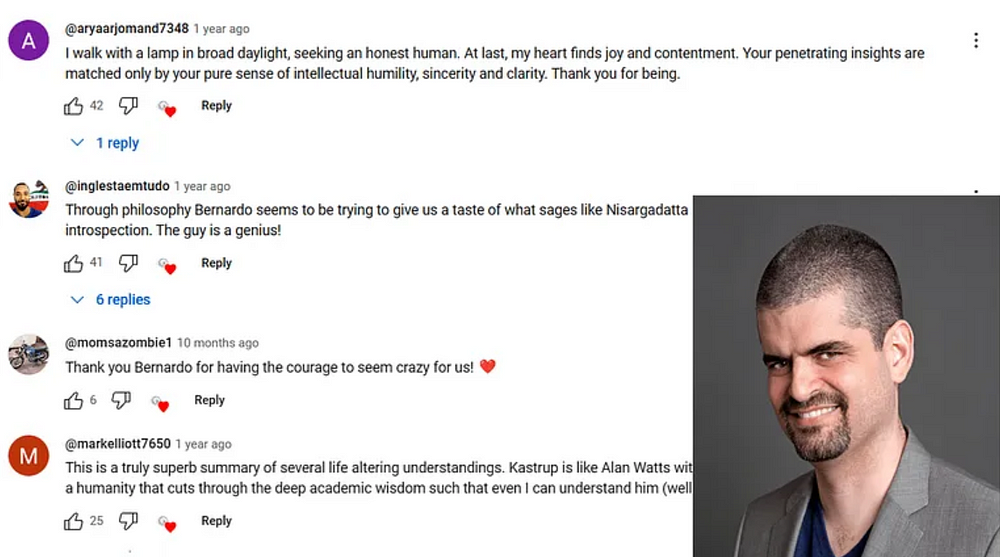
As evidence of this, simply read the copious sycophantic replies after his interviews on YouTube. (I’ve never noted anything like this with other scientists and philosophers, though there’ll be rare exceptions.) Indeed, just like Deepak Chopra and Bernardo Kastrup (also a spiritual idealist), this is because these people are seen as gurus (see here), “spiritual leaders” or even prophets by their many fans.
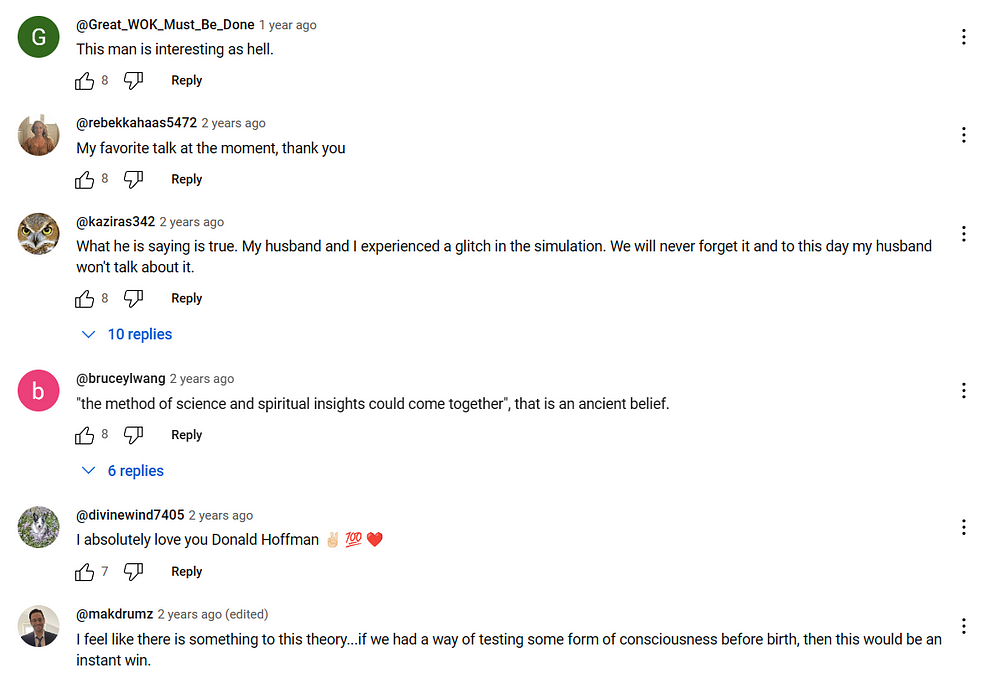
Donald Hoffman’s fans.
Bernardo Kastrup and his fans.

Other laypeople may be in awe of Hoffman precisely because of his excessive use of sexy and titillating jargon from theoretical physics and mathematics (again, just like Deepak Chopra).
Rupert Spira: another “spiritual teacher” and idealist with many adoring fans.

Hoffman is also a godsend to those editors and journalists (of newspapers and magazines) who know how to sniff out sexy and titillating “science stories” (see here). What’s more, interviewers on YouTube are also gobbling this stuff up, despite that fact that almost all them are non-scientists and non-philosophers.

ZDogg MD responding to Donald Hoffman (see here).

So what about Keith Frankish and Philip Goff and their own interview, ‘What is Reality?’?

This is a rare example of an interview of Hoffman that isn’t carried out by an obsequious fan. That may be partly because it’s more of a discussion (or debate) than an actual interview. In other words, unlike most of the other interviews of Hoffman on YouTube, Goff and Frankish don’t simply allow Hoffman to express his categorical and absolute — if also highly technical — claims without any challenge. (I’ve lost count of the many interviews of Hoffman in which the interviewer seems to be starstruck by Hoffman’s technicalese.)

That said, it does seem that both Frankish and Goff (especially Frankish) allow Hoffman far too much leeway. Perhaps that’s because, like so many others, they were partially blinded by Hoffman’s indulgent and gratuitous use of technical terms from mathematics and theoretical physics.

In terms of the interview itself. I would guess that Frankish agrees with me about Hoffman’s verbal flux (although I could be wrong). However, Frankish is too nice a person to express the plain truth about Hoffman. In this particular video, then, Hoffman’s stuff about Cantor’s infinities and Gödel was the last straw for me, and that seemed to be the case for Frankish too. (Frankish laughs when Hoffman inevitably mentions Gödel. See the non-ironic ‘Incompleteness explains everything. Kurt Gödel’s legacy’.)

In any case, there are all sorts of philosophers I disagree with, yet I still largely understand them.

Take Philip Goff himself.

I understand almost everything he says and writes. And I also disagree with much of what he says and writes.

Similarly, both Goff’s take on panpsychism and Frankish’s take on illusionism have been deemed to be extreme theories. However, the point being made about Hoffman isn’t that his brand of idealism is too radical or extreme: it’s that he’s… well, a charlatan.

Think about this.

Before 2022, Hoffman’s main sexy theme was “reality is an illusion. Now it’s “spacetime is doomed”. Of course, Hoffman has managed to splice these two sexy themes together. That said, he only picked up on spacetime being doomed around 2016. Yet he’s been an idealist since at least 1988.

Thus, it’s not surprising that professional philosophers and professional physicists (or scientists generally) — i.e., outside those who actually work with him — don’t take note of Hoffman’s work. (This doesn’t apply to his older books and papers in cognitive psychology.)

**********************************

Viewer Responses to the Hoffman Interview
Anon X (@anonxnor):

“When a cognitive psychologist is talking a lot about fundamental physics to make his argument, it makes me very skeptical.
“Hoffman repeatedly says ‘the physicists,’ but when he is asked, at 1:48:55, whether experts in the relevant fields agree or disagree with him, he admits that most experts disagree with him. Yet he says things like ‘the physicists are telling us that spacetime is doomed’ to justify his views. It would be more honest to say ‘some physicists are telling us that spacetime is doomed.’ By the same token, he shouldn’t say ‘the math tells us that ____’ or ‘evolutionary game theory tells us that ____’ if those claims are based only on his own work, and many relevant experts in the field of evolutionary game theory disagree that the work he has done there is correct.
“He should of course defend his work, but he shouldn’t claim that ‘the math’ tells us anything, instead he should say ‘my math’ tells us something. []
“From an outside perspective, which is the perspective of all of us listening to this, we should assume that the majority of experts is more likely to be correct, than Hoffman, about specific claims he makes within fields of scientific expertise. But I still find his overall view very interesting and worth taking seriously!”

It’s a good thing that someone else has picked up on this.

In another YouTube interview (‘What’s beyond spacetime?’), Donald Hoffman also kept on saying that “physicists” (i.e., in the plural) are saying this and saying that. (Hoffman also keeps on using the definite article — as in “the physicists”.)

Hoffman often means one particular theoretical physicist — Nima Arkani-Hamed. To be careful, perhaps Hoffman also has in mind a handful of other theoretical physicists who fully endorse what Arkani-Hamed has had to say on this highly-technical and abstract field of theoretical physics.

What’s more, even the small number of theoretical physicists who also believe that “spacetime is doomed” don’t do so in precisely the same way in which Arkani-Hamed does.

So when Hoffman uses the word ”physicists” to back up his philosophical idealism, he basically means a small number — or even a single — theoretical physicist.

Anon X:

“The difference between my math and ‘the math’ is that I could have done my math wrong. If experts in relevant fields don’t mostly agree with Hoffman’s math, his math might be wrong.”

In Hoffman’s 2023 paper ‘Fusions of Consciousness’, maths is used in two ways.

(1) As virtual verbatim quotes of the maths of (parts of) standard mathematical physics. (For example, Hoffman uses the mainstream equations of uncertainty in his paper.) 
(2) When Hoffman uses maths to advance his philosophical theories of “conscious agents”, their “interactions”, etc.

Most of (1) is standard stuff, so few would disagree with it. (The maths as it stands and when not connected to Hoffman’s philosophical theories.) As for (2), most mathematicians and theoretical physicists won’t know what Hoffman is doing when he uses maths in discussions about qualia, “conscious agents”, “objective idealism”, “the One”, consciousness, monads, subjective experience, etc.

Hoffman particularly uses Markov models to represent his conscious agents and their interactions (as he also uses the amplituhedron). Many readers may suspect that most physicists won’t understand these applications either. Of course, that doesn’t automatically mean that the applications are wrong. It simply means that this is Hoffman’s very own thing, which only a handful of people will understand, let alone agree with.

It’s also worth noting that although Hoffman is neither a mathematician nor a physicist, his main cowriter, Chetan Prakash, is. Prakash is also an idealist similarly inspired by what Hoffman calls “ancient wisdom”.

danzigvssartre (@danzigvssartre3):

“Physicists are not ‘finding’ these mathematical structures ‘beyond space-time’ the same way someone finds a dollar note down the back of the sofa. They are inventing these structures, ironically by using diagrams that exist in an ‘abstract’ space. Why should some theorist’s abstract mathematical ‘space’ be more real than the space that I move about in?”

This is correct. For one, Donald Hoffman is simply favouring his own reduction — one that ends with these geometrical structures.

In any case, non-physicists can view Nima Arkani-Hamed’s amplituhedron (which Hoffman extensively uses in his updated idealism — as in the 2023 paper, ‘Fusions of Consciousness’) as a geometrical tool which is used by theoretical physicists. It can also be seen as a pure abstraction. (The words “highly abstract” are often used about the amplituhedron.)

Amplituhedron theory provides physicists with a geometric model that is essentially abstract. Indeed, it’s abstract primarily because the geometrical space it offers theoretical physicists is not a physical spacetime. (In that limited sense, the amplituhedron is abstract in the same way that — at least on most readings — the wave function and Hilbert space are.)

So how, exactly, can a geometrical tool which simplifies the calculations of the interactions of particles be tied to Hoffman’s philosophical idealism? (Arkani-Hamed himself has stated that the amplituhedron helps simplify scattering-amplitude calculations.)

Of course, some physicists (almost certainly very few — almost none) may well believe that amplituhedron theory does far more than merely simplify things. They may take it to be an ontological theory about the nature of reality…

Donald Hoffman certainly does.

TheStuffOfStars (@lolroflmaoization):

“I would’ve loved to have a hard-nosed philosopher about the existence of space-time like Tim Maudlin to be present and contribute to the conversation, i think he would’ve had lots of illuminating things to say about the supposed strong reasons Hoffman provides for rejecting the existence of space-time.”

There are two main reasons as to why Donald Hoffman has rejected spacetime:

(1) Hoffman is an idealist who has tied the “spacetime is doomed” idea to his own idealism. 
(2) At present, his position is strongly dependent on the work of the theoretical physicist
Nima Arkani-Hamed — specifically his amplituhedron.

There’s no evidence at all — as far as I can see — that any professional mathematicians or theoretical physicists have actually engaged with Hoffman on his recent ideas, save the “independent” mathematician Chetan Prakash (who cowrites all of Hoffman’s papers).

As for the philosopher Tim Maudlin. I strongly suspect that he’d have no time at all for Hoffman’s “spiritual” brand of idealism, or for Prakash’s use of maths to advance it. (I may be wrong about this.)

pseudospin (@pseudospin3364):

“Very politely done. You pointed out his strawmanning of reductionism (what is his theory of conscious agents purportedly explaining space time, particles, and scattering amplitudes if it isn’t reductionist?), and that space time is not doomed even if it is explained as emergent from something else, but you could have gone harder on his evolutionary argument. [].”

This is exactly right. Donald Hoffman can be seen as a supreme reductionist. Yet Hoffman mentions reductionism negatively a fair few times — as in this YouTube interview itself.

Like spacetime, Hoffman believes that reductionism is doomed too.

So it’s odd that a person who criticises reductionism has carried out what can be seen as the most ultimate reduction imaginable.

In detail. Hoffman believes that he’s reduced (what people take to be) reality down to what he calls “conscious agents” and their “interactions”.

So perhaps Hoffman believes that what he’s doing isn’t a reduction simply because he reduces tables, chairs, neurons, brains, reality, spacetime, human beings, etc. to non-physical — or even “spiritual” — conscious agents and their interactions. However, how does the proposed non-physicality of these things stop it from being a reduction?

Louise (@louisecoutts):

“Great question that you put to Don. However I’m not sure Don was referring to physicists when he answered your question.”

Donald Hoffman certainly is referring to theoretical physicists in his latest 2023 paper, ‘Fusions of Consciousness’. More correctly, it’s — now! — almost all down to the work of Nima Arkani-Hamed and his geometrical tool (or model), the amplituhedron. As it is, I don’t think that there have been any exchanges whatsoever between Arkani-Hamed and Hoffman. Hoffman himself doesn’t refer to any exchanges in his paper and interviews.

[I contacted Arkani-Hamed myself and asked a single-sentence question: “Are you aware of Donald Hoffman’s work on spacetime?” As yet, there’s been no reply.]

Louise Coutts:

[] Donald does generally do this but I meant when he was answering the question in this video. So perhaps he purposefully was skirting the issue when he gave that answer. My feeling is that this is all just due to skepticism of the unknown and perhaps in time these kinds of discussions will start to open up between the different fields.”

Donald Hoffman himself isn’t “sceptical of the unknown”. It’s very clear that he’s absolutely convinced that what he calls “conscious agents” and their “interactions” give rise to (or “project”) what laypersons call “reality”. Thus, Hoffman believes that he knows.

Thus, a distinction needs to be made between the fact that (to use Hoffman’s own words from the YouTube interview) “no scientific theory is ever the last word”, and Hoffman’s own philosophical theory (i.e., idealism) being seen (by Hoffman himself) as the last word.

@smink.youtube:

“It doesn’t matter if Don is right or wrong or even mostly right or wrong. His hypothesis is worth investigating and if it gets us 10 percent closer to his ultimate ideas or concepts, we are calibrating our current ideas.”

Sure. However, does that apply to literally all hypotheses or speculations from anyone and everyone? Surely there isn’t enough time in the day to investigate all of them.

So why should Hoffman’s idealist speculations — which he ties to some theoretical physicists’ claims about “the death of spacetime” — be given any preferential treatment?

@snowpinkblush:

“I think the point is the math says we don’t see truth & that’s mind blowing all on its own.”

How can the “the math say[]” anything about “truth”, reality, consciousness, etc? Sure, maths can be used to advance various — even all — philosophical theories (from Hoffman’s idealism, to materialism, panpsychism and any other philosophical theory). However, maths on its own doesn’t say anything about any of these things.

mario sanguineti (@mairo0sanguineti):

“If the woo woo returns special relativity, quantum theory etc, basically returns Laws of physics which are just Laws of Mind as everything is experienced is through mind, then the “woo woo” cant be “woo woo”, unless your dont undertsand it [].”

I’m not sure if I understood that reply. However, if Sanguineti is saying that special relativity, quantum theory, etc were once deemed to be “woo woo” too, then perhaps he’s right. However, Donald Hoffman may keep on mentioning quantum theory, Relativity, what physicists say, etc. — but he goes way beyond the physics. His theories are philosophical. Hoffman’s conscious realism, along with his words on “conscious agents”, qualia, “the One”, etc., are all philosophical (perhaps also “spiritual”) in nature. Most physicists would either reject them or be perplexed by how he combines stuff from physics with stuff from spiritual idealism.

@patrick764:

“Look up physicist David Gross.”

[See David Gross.]

This reply to the YouTube video is basically saying that Donald Hoffman is (as the cliché has it) simply following the science.

Yet Hoffman has added a whole host of philosophical stuff to what theoretical physicists have written and said on “the death of spacetime”. He has used this work on spacetime to advance something he believed in long before coming across this idea.

Hoffman has been an idealist since at least 1988 (see here). His first academic paper in which he goes into detail about spacetime being “doomed”, on the other hand, is only from this year. That said, he has mentioned it in interviews and elsewhere before. I believe that Hoffman’s first published discussion of spacetime being doomed was in 2017 in the article The Abdication Of Space-Time’.

Hoffman didn’t really branch out of strict work in cognitive psychology until 2002 — see here. (His first article on spacetime, from 2017, can also be seen here.) There are no academic papers at all on the subject of spacetime to be found in his University of California curriculum vitae. However, he does come close in his ‘The Origin of Time In Conscious Agent’ of 2014. However, there’s no discussion of the contemporary physics of spacetime in this paper. What’s more, most of the discussion of the physics of time (i.e., not spacetime) is — as ever — but a means to advance Hoffman’s idealism.

To sum up. Hoffman had views about idealism, “conscious agents”, “universal consciousness”, etc. way before his spacetime-is-doomed (2017 and beyond) period. All this means that Hoffman is using new work in theoretical physics to back up philosophical positions he already held.

Clips and stuff (@clipsandstuff1249):

“‘it’s all mathematics here’ 1:54:23
“no qualia then mathematics can’t capture qualia.”

In his latest 2023 paper, ‘Fusions of Consciousness’, Donald Hoffman attempts to show that mathematics can indeed “capture qualia”. Indeed, he uses a hell of a lot of maths to do so. I personally believe that it is gratuitous, pretentious, and a classic example of someone using maths to sell a philosophical idea. What’s more, the entire article is an attempt to blind readers with a monumental amount of maths. (Hoffman cowrites with the mathematician Chetan Prakash. I suspect that Prakash does nearly all the maths in Hoffman’s papers.)

non_plussed (@ilinx):

“Hoffman doesn’t reject the existence of spacetime. he’s not even talking about his ideas, but about an emerging stance in the contemporary fundamental physics community, which is that we have very good reasons to think that spacetime and quantum physics are emergent, and not fundamental.”

Then perhaps Hoffman shouldn’t use the saleable and sexy words “spacetime is doomed”. And he is talking about his own ideas otherwise there would be absolutely no point in bringing up these abstract and technical theories from theoretical physics.

In other words, Hoffman obviously isn’t doing theoretical physics. He’s not even doing the philosophy of science. Instead, Hoffman is mentioning spacetime, the amplituhedron, decorated permutations, etc. because he believes that he can use these things to advance his very own philosophical idealism.

Philosophical Trials (@PhilosophicalTrials):

“1:19:12 There’s no Godelian phenomenon there. Hoffman brings it up just because it sounds fancy. Also, there’s no ‘Godel limit’ of mathematical descriptions. Finally, there’s no theorem that consciousness ‘transcends’ mathematics (whatever that statement is meant to say). Godel’s First Incompleteness Theorem is a precise metamathematical result that applies to a specific class of formal arithmetics. This is the only context where it makes sense to bring this result up.”

I would hope that mathematicians, metamathematicians and philosophers of consciousness will be disgusted by this gross name-dropping from Donald Hoffman. What’s more, in the part of the interview to which this replier refers (1:19:12), Hoffman virtually indulges in stream-of-consciousness philosophising, as he jumps from jargon to jargon and subject to subject.

As for the words “theorem”. Hoffman seems to invent six new theorems before each breakfast. That is, he’s got new theorems coming out of his ears.

So what on earth does Hoffman mean by “theorem” anyway? And does anyone else (other than his cowriters) take them to be genuine theorems?

Peter Jones (@peterjones65076):

“I suppose we’ll just have to wait until academics catch up with the mystics. Most of these problems go away when we do. Mind you, then we have to get used to the idea that nothing really exists or ever really happens.”

Except that Donald Hoffman is himself a long-standing academic (i.e., since the 1980s), and there may be nothing (much) to “catch up with”. I’m not even sure if Hoffman can be seen as a “mystic”. Instead, it may be best to see him as a… charlatan.

My flickr account and Twitter account.

(*) See my ‘How Professor Donald Hoffman Uses Mathematics: From Idealism to the Amplituhedron’.


Monday, 29 May 2023

Postmodern Physics: Post-Observation, Post-Evidence, Post-Experiment

In the mid-1990s, the science journalist John Horgan interviewed various physicists (including Sheldon Glashow, Edward Witten and Steven Weinberg) who spoke both for and against the strongly speculative (or “nonempirical”) nature of much contemporary physics and cosmology. After Horgan wrote The End of Science, Roger Penrose, Lee Smolin, the writer David Berlinski and Michio Kaku also spoke both for and against (what’s rhetorically called) postmodern physics.

(i) Introduction
(ii) David Berlinski Against Postmodern Physics
(iii) Physicists Against Postmodern Physics
(iv) Physicists Defend Postmodern Physics
(v) Penrose’s Modern Physics and Postmodern Twistor Theory?

[In the following essay, the quotes from Edward Witten, Stephen Weinberg, Sheldon Glashow, Frank Tipler, David Schramm and Howard Georgi all come from John Horgan’s book The End of Science. The quotes from Lee Smolin, David Berlinski, Michio Kaku, Roger Penrose, Brian Greene, Martin Rees and Jim Holt come from various other books, papers and interviews.]

Firstly, the words “postmodern physics” are at least partly rhetorical in nature. Secondly, no physicist classifies his own physics as postmodern. Thirdly, even those physicists who see certain theories — i.e., those offered by other physicists — as being far too speculative (or “nonempirical”) in nature don’t classify them as postmodern.

Another problem with using the words “postmodern physics” is that they can be read in two different ways:

(1) As referring to the “critiques” of physics and science by postmodernist philosophers, sociologists, political activists, etc.
(2) As referring to physics that goes beyond observations, experiments, tests, predictions, etc.

(1) and (2) can be connected to each other. However, this essay will concentrate entirely on (2). The science journalist John Horgan, on the other hand, tackled both (1) and (2) in his book The End of Science.

In the case of (1) above, Horgan wrote:

[O]ne of science’s dirty little secrets is that many prominent scientists harbor remarkably postmodern sentiments. My book provides ample evidence of this phenomenon. Recall Stephen Jay Gould confessing his fondness for the seminal postmodern text Structure of Scientific Revolutions [by Thomas Kuhn]; Lynn Margulis declaring, ‘I don’t think there’s absolute truth, and if there is, I don’t think any person has it’; Freeman Dyson predicting that modern physics will seem as primitive to future scientists as the physics of Aristotle seems to us.”

As it is, I don’t see all of these positions as being particularly postmodern in the sense of (1) above. (Unless, that is, one strictly adheres to Horgan’s particular take on “ironic science”.) However, a couple are postmodern in the sense of (2) above. This means that Horgan used the word “postmodern” both loosely and rhetorically. However, exactly the same can be said about the way the term “postmodern” is used in this essay.

As another example of (1) above, Horgan quoted physicist Robert Lee Park speaking about Horgan’s own book, The End of Science. Park is quoted as stating the following:

“Science has manned the battlements against the postmodern heresy that there is no objective truth, only to discover postmodernism inside the wall.”

So it may well be the case that Horgan’s “ironic science” is a better (or at least a more colourful) term than “postmodern physics”. That said, Horgan uses the word “postmodern” too.

Theoretical physicist Lee Smolin (1955-) also used the words “postmodern physics” in his 2006 book The Trouble With Physics. He wrote:

“The feeling was that there could be only one consistent theory that unified all of physics, and since string theory appeared to do that, it had to be right. No more reliance on experiment to check our theories. That was the stuff of Galileo. Mathematics [alone] now sufficed to explore the laws of nature. We had entered the period of postmodern physics.”

The science writer and author Jim Holt put a fairly similar point in this way:

“For the first time in its history, theory has caught up with experiment. In the absence of new data, physicists must steer by something other than hard empirical evidence in their quest for a final theory.”

Smolin’s description of string theory, and his use of the words “postmodern physics”, aren’t really (or even at all) references to philosophical postmodernism in the sense practised by philosophers like Jean Baudrillard, Jean-François Lyotard, etc. Smolin simply meant after modern physics. (Of course, Smolin must have been aware of the philosophical associations of this term.) More specifically, Smolin believed that this is how physics — at least as carried out by certain physicists — came to be done when string theory arrived on the scene.

In terms of ironic science, this is what Horgan himself had to say about it:

[I]ronic science, science that is not experimentally testable or resolvable even in principle and therefore is not science in the strict sense at all. Its primary function is to keep us awestruck before the mystery of the cosmos.”

Keeping to his literary theme, Horgan also used the term “strong scientists”, which is his variation on “Bloom’s ‘strong poets’”.

[See Horgan’s ‘How Harold Bloom, the Late Literary Critic, Helped Me Write The End of Science’ for Scientific American. See also detail on Harold Bloom’s notion of “strong poets” here.]

Strong scientists are

“those who are seeking to misread and therefore transcend quantum mechanics or the big bang theory or Darwinian evolution”.

Horgan then offered us an example of a strong scientist: Roger Penrose. He wrote:

“Roger Penrose is a strong scientist. For the most part, he and others of his ilk have only one option: to pursue science in a speculative, postempirical mode that I call ironic science.”

It’s ironic, then, that Penrose himself has criticised this “speculative, postempirical” and, therefore, ironic science. (Of course, Penrose himself doesn’t use the words “ironic science”.) That is, Penrose, like Smolin, mainly — or even exclusively — had string theory in mind. (See final section.)

It’s also surprising how widespread Horgan believes ironic science to be. He cites

“such ironic hypotheses as the anthropic principle, inflation, multi-universe theories, punctuated equilibrium, and Gaia”

as examples of ironic science.

Elsewhere, Horgan adds A.I. futurologists (not his term) to this list when he tells us that such people “are not practicing science, of course, but ironic science, or wishful thinking”. He also has qualms about evolutionary psychology (i.e., in these “postempirical” respects).

It’s not only odd that so many scientific theories are deemed to be part of ironic science by Horgan: it’s also odd that some of the upholders of these scientific theories deem other scientific theories (i.e., not their own) to be ironic (or postmodern).

For example, Steven Jay Gould didn’t have any time for Gaia (“a metaphor, not a mechanism”). Many who accept inflation and the multiverse are also critical of the anthropic principle. And, who knows, perhaps Gaia theorists are critical of the human-centred nature of the anthropic principle. (This is often denied by those scientists and philosophers who endorse it.)

Of course, Horgan isn’t on his own when it comes to his account of ironic science. Many religious critics of science, philosophers, sceptical commentators, etc. have noted the speculative nature of contemporary physics and cosmology.

Take the case of David Berlinski.

David Berlinski Against Postmodern Physics

David Berlinski (1942-) is a controversial writer and polemicist. Indeed, some commentators see him as being a mere “contrarian”. (See ‘Ode to the Contrarian’, which features Berlinski.) Berlinski classes himself as a “counter-puncher”.

It’s a little ironic that Berlinski has a position on postmodern physics and cosmology which is very similar to Horgan’s own. However, it can be assumed that Horgan wouldn’t like to be associated with Berlinski because they’re at odds politically, as well as (I believe) on the nature and role of religion. Thus, Berlinski’s and Horgan’s criticisms of postmodern physics and cosmology come from different angles (or starting points).

In more detail. Berlinski comes at postmodern physics and cosmology from a mainly political (as well as contrarian?) angle. He also approaches it from a position which is very defensive of religion. (Berlinski is against “the attack on religious thought”.) However, Berlinski categorically denies being religious himself (see here.) In that sense, then, Berlinski is not that unlike — shock, horror! — Stephen Jay Gould. (See my ‘Stephen Jay Gould on Science and Religion: The Politics of Non-Overlapping Magisteria’.)

Berlinski’s broader perspective on science is best expressed in his book The Devil’s Delusion: Atheism and its Scientific Pretensions (2008). Berlinski is also a signatory to A Scientific Dissent from Darwinism, which was a statement issued by the (“politically conservative”) Discovery Institute in 2001.

Berlinski’s targets are also as wide as Horgan’s own.

In detail. Berlinski rejects — or, perhaps, simply questions — the big bang theory, the theory of evolution, and inflationary theory. He also rejects (or simply questions) the existence of black holes, the multiverse, etc.

In his essay ‘Was There a Big Bang?’ (1998), Berlinski wrote:

“What are discovering is that many areas of the universe are apparently protected from our scrutiny, like sensitive files sealed from view by powerful encryption codes.”

Now the passage above — i.e., at least taken on its own — could actually be about the multiverse theory, the extra dimensions and branes of string/M- theory, and God knows what else…

Yet it must be said here that such critical and sceptical words have also been uttered (as will be shown) by some well-known and high-ranking physicists themselves — even if their prose styles are very unlike Berlinski’s own.

Reading Berlinski’s words, then, it seems that he targets all these scientific theories because none of them adhere to his strict Machian or positivist (or logical empiricist) position on science. The ironic thing here, however, is that Berlinski most certainly wouldn’t see himself as being either a Machian or a positivist, primarily because positivism is strongly associated with scientism and many other (retrospective) sins.

It must also be said that Berlinski does actually cite various examples from contemporary physics and cosmology. He also offers us some technical detail.

For example, Berlinski wrote:

“Unhappy examples are everywhere; absurd schemes to model time on the basis of the complex numbers, as in Stephen Hawking’s A Brief History of Time, bizarre and ugly contraptions for cosmic inflation; universes multiplying beyond the reach of observation; white holes, black holes, worm holes, and naked singularities; theories of every strip and variety, all of them uncorrected by any criticism beyond the trivial.”

Berlinski takes the extreme and (to use a word he often uses) absurd position that all speculation — and indeed all hypothesising — in physics and cosmology is beyond the pail — or, to use the word of this essay, postmodern. Yet if such a position on speculation had ever been (as it were) made law, then that would have destroyed almost all physics from day one.

Berlinski also seems to be ignorant of the history of science (or simply one aspect thereof) when he uses phrases such as “there is no evidence whatsoever in favour of” various contemporary theories in theoretical physics and cosmology. Yet he should — and probably does — know that all sorts of theories which began life as hypotheses — or even straight speculations — were later backed up by observations, tests, experiments, data/evidence, etc.

All this was true of Maxwell’s kinetic theory, Paul Dirac’s postulation of an “anti-electron”, Murray Gell-Mann’s “quark model”, etc. There are, of course, many other examples. Indeed, it can be assumed that physicists themselves could provide a list that’s as long as their collective arm…

Unless, that is, Berlinski rejects all these theories and entities too.

To ask a simple question:

Is Berlinski ruling out —a priori — all future observational and experimental backup for literally all the speculations of theoretical physicists and cosmologists?

So what does Berlinski himself believe?

He believes the following:

“This scrupulousness has been compromised. The result has been the calculated or careless erasure of the line separating disciplined physical inquiry from speculative metaphysics. Contemporary cosmologists feel free to say anything that pops into their heads.”

Are such speculations (i.e., from theoretical physicists and cosmologists) automatically (to use Berlinski’s word) “metaphysics” simply because there’s no observational and/or experimental evidence for them at the present time? Indeed, would the metaphysical status of such speculations automatically be a bad thing if, at least in principle, future findings, tests, observations, experiments, etc. would turn them (as it were) non-metaphysical?

It’s worth stressing here that Berlinski isn’t a scientist. However, Brian Greene, Martin Rees, Sheldon Glashow, David Schramm and Howard Georgi are - and they too recognise the problems with postmodern physics and postmodern cosmology. (Arguably, cosmology actually began life as a postmodern discipline, as Michio Kaku argues later.)

Physicists Against Postmodern Physics

Take as an example theoretical physicist Brian Greene’s words of warning on the idea of a multiverse. He states:

“The danger, if the multiverse idea takes root, is that researchers may too quickly give up the search for such underlying explanations. When faced with seemingly inexplicable observations, researchers may invoke the framework of the multiverse prematurely — proclaiming some phenomenon or other to merely reflect conditions in our own bubble universe and thereby failing to discover the deeper understanding that awaits us.”

In addition, the cosmologist and astrophysicist Martin Rees also said more or less the same thing as Brian Greene in the following:

“If people believed that some features of the universe were not fundamental but just accidents, resulting from the particular way our domain in the meta-universe cooled down, then they’d be less motivated to try to explain them.”

Of course, string theory has been deemed to be the prime — sometimes only — example of postmodern physics. So this is a good place to bring in the American theoretical physicist Sheldon Glashow (1932-).

Glashow argued that string theorists have (as it were) jumped the gun. He said:

“Now, are we so arrogant as to believe we have all the experimental information we need right now to construct that holy grail of theoretical physics, a unified theory? I think not. I think certainly there are surprises that natural phenomena have in store for us, and we’re not going to find them unless we look.”

Thus, in the process of jumping the gun, string theorists were basically indulging in postmodern physics.

Sheldon Glashow and Paul Ginsparg also wrote the following:

“Contemplation of superstrings may evolve into an activity as remote from conventional particle physics as particle physics is from chemistry, to be conducted at schools of divinity by future equivalents of medieval theologians.”

As with Horgan earlier, it can be argued that there may be nothing specifically postmodern about the situation highlighted by Glashow. After all, even though there’s a very large distance between particles physics and the “contemplation of superstrings”, superstring theorists still (as it were) stand upon (even though they believe they supersede) particle physics and the standard model. However, Glashow’s interpretation of this situation paints it as being postmodern. That is, his last clause (i.e., “to be conducted at schools of divinity by future equivalents of medieval theologians”) is clearly putting a interpretation of this situation as being one of postmodern physics… Or, in Glashow’s own terms, theological physics.

Glashow’s next words seal his interpretation of postmodern physics. He continued:

[F]or the first time since the Dark Ages, we can see how our noble search may end, with faith replacing science once again.”

Now for the American astrophysicist David Schramm (1945–1997) on inflation.

Schramm gave a technical explanation as to why inflation is postmodern. He said:

“I like inflation, but it can never be thoroughly verified because it does not generate any unique predictions that cannot be explained in some other way.”

He then compared inflation to the Big Bang:

“You won’t see that for inflation, whereas for the big bang itself you do see that. The beautiful, cosmic microwave background and the light-element abundances tell you, ‘This is it.’ There’s no other way of getting these observations.”

Schramm then moved on to superstring theory with these words:

“Even if somebody comes up with a really beautiful theory, like superstring theory, there’s not any way it can be tested. So you’re not really doing the scientific method, where you make predictions and then check it. There’s not that experimental check going on. It’s more mathematical consistency.”

Now for the American physicist Howard Georgi (1947-) on quantum cosmology.

Firstly, Georgi stated his position in relation to his own discipline:

“A simple particle physicist like myself has trouble in those uncharted waters.”

Georgi’s specific target is quantum cosmology.

After reading various papers on quantum cosmology, Georgi found all the talk about wormholes, time travel and baby universes “quite amusing”. Indeed, he believed it was “like reading Genesis”.

Georgi’s way of putting things is very much like David Berlinski’s.

(Perhaps Berlinski has been strongly dependent — and reliant — upon what these physicist critics of postmodern physics have written and said.)

What about Georgi on inflation (also sneered at by Berlinski)?

Georgi believes that it’s a

“wonderful sort of scientific myth, which is at least as good as any other myth I’ve ever heard”.

Again, Georgi’s words almost exactly chime in with Berlinski’s own. Indeed, Berlinski also uses the word “myth” in his writings.

Now, despite everything that’s just been written, some of the proponents of postmodern physics know exactly what’s going on here.

Physicists Defend Postmodern Physics

Michio Kaku

Take Michio Kaku talking about cosmology in the 1960s.

In his 2004 book Parallel Worlds, Kaku wrote:

[Cosmology] was not an experimental science at all, where one can test hypotheses with precise instrument, but rather a collection of loose, highly speculative theories.”

Kaku also told us how physics used to be before string theory:

“In the past, physics was usually based on making painfully detailed observations of nature, formulating some partial hypothesis, carefully testing the idea against the data, and then tediously repeating the process, over and over again.”

Despite the above being a simplified picture (which Kaku wouldn’t deny) of modern physics, Kaku pits all this against the approach employed by string theorists. He continued:

“String theory was a seat-of-your-pants method based on simply guessing the answer. Such breathtaking shortcuts were not supposed to be possible.”

It’s clear that Kaku and many other string theorists are well aware that string theory has been seen as being postmodern (i.e., even if that precise word isn’t used). So it seems odd (at least prima facie) that a string theorist would admit that string theory was based on “simply guessing”. Then again, guessing (or at least speculation) has always been a part of physics. Thus, string theory isn’t entirely unique in this respect.

Again, even according to a string theorist himself (i.e., Kaku), whereas modern physics involved observations, tests and experiments, postmodern string theory is (to be rhetorical?) all about mathematics… and guessing.

String theory is certainly (to put it mildly) very mathematical.

Indeed, not only is string theory seemingly more dependent on maths than most other areas of physics, it seems that many physicists actually see it as being a branch of mathematics.

Kaku himself doesn’t hide from all this. He quotes a “Harvard physicist” saying as much. In Kaku’s own words:

“One Harvard physicist has sneered that string theory is not really a branch of physics at all, but actually a branch of pure mathematics, or philosophy, if not religion.”

That Harvard physicist was none other than (to use Kaku’s words) “Nobel Laureate Sheldon Glashow”.

Now for the postmodern physicist Edward Witten.

Edward Witten

The American mathematical physicist Edward Witten (1951-) defended the postmodern nature of superstring theory in exactly the same way in which all (or at least most) other superstring theorists had done. He said:

“Even though it is, properly speaking, a postprediction, in the sense that the experiment was made before the theory, the fact that gravity is a consequence of string theory, to me, is one of the greatest theoretical insights ever.”

The upshot here is that although string theory didn’t actually predict gravity, in nonetheless necessarily includes it. To laypersons at least, this may not seem like much of a claim. After all, this isn’t about string theorists doing experimental work on gravity or discovering any new or odd phenomena. Yet string theory still accounts for gravity, as well as its relation to all the forces and particles. More importantly, string theory brings quantum theory and relativity together.

In any case, there must be very good reasons as to why postmodern physicists accept and propagate theories beyond the observational, evidential and experimental.

In response to John Horgan’s doubts, Edward Witten put it this way:

“I don’t think I’ve succeeded in conveying to you its wonder, its incredible consistency, remarkable elegance, and beauty.”

[Perhaps Witten was really talking about his own M-theory here. Witten had first “conjectured” such a theory in 1995, a year before The End of Science was published.]

So what, exactly, displays “incredible consistency, remarkable elegance, and beauty”?

It’s the mathematics embedded in superstring theory.

Witten then elaborates:

“Good wrong ideas are extremely scarce, and good wrong ideas that even remotely rival the majesty of string theory have never been seen.”

Interestingly enough, Michio Kaku quoted the physicist and astrophysicist Joel Primack saying pretty much the same thing about inflation (i.e., not string theory). Primack said:

“No theory as beautiful as this has ever been wrong before.”

Now meet our last postmodern physicist.

Steven Weinberg

Weinberg too defends postmodern physics (without, of course, using those last two words).

In terms specifically of string theory, Weinberg said:

“I agree strings are much farther away from direct perception than atoms, and atoms are much farther away from direct perception than chairs, but I don’t see any philosophical discontinuity there.”

In that sense, then, string theory isn’t (particularly) postmodern at all.

Prima facie, one way string theory isn’t postmodern (at least according to Weinberg) is that if a string theorist posted “the final, correct version of superstring theory on the Internet [and] she got results that agreed with experiment”, then all of us should simply say, “That’s it.”

Thus, at least experiment provides the final word here.

Finally, when critics of postmodern physics and cosmology say that it’s all (purely) speculative in nature, then a postmodern physicist or cosmologist can always respond in the way that the American mathematical physicist and cosmologist Frank Tipler (1947-) responded. He said:

“Secretly, I think of myself as standing in the same position as Copernicus.”

Indeed, this is the kind of response you actually find in the writings of many postmodern physicists.

Now take the case of Roger Penrose, who can be interpreted as offering a midway position between modern physics and postmodern physics.

Penrose’s Modern Physics and Postmodern Twistor Theory?

Despite Roger Penrose’s stress on the fundamental importance of mathematics in physics (which is almost like stressing the obvious), Penrose has still been highly suspicious of string theory.

Although Penrose doesn’t name any names, he warns his readers that if physics is not

“able to be guided in detail by experiment, [it] must rely more and more heavily on an ability to appreciate the physical relevance and depth of the mathematics, and to ‘sniff out’ the appropriate ideas by use of a profoundly sensitive aesthetic mathematical appreciation”.

This squares fairly well with what British science writer and astrophysicist John Gribbin had to say.

Gribbin talked in terms of what he called a “physical model” of “mathematical concepts”. He wrote (in his Schrodinger’s Kittens and the Search for Reality) that a “strong operational axiom” tells us that

“literally every version of mathematical concepts has a physical model somewhere, and the clever physicist should be advised to deliberately and routinely seek out, as part of his activity, physical models of already discovered mathematical structures”.

Yet even in Gribbin’s case, it’s still clear that a “mathematical concept” comes first, and only then is a “physical model” found to square with it.

Penrose’s words on his twistor theory are also relevant here.

Interestingly, just after criticising string theorists for divorcing their mathematics from experiment, prediction, observation, etc, Penrose then freely confesses that he’s — at least partly — guilty of exactly the same sin!

Firstly, Penrose tells us about the “pure mathematics” of his own twistor theory. He writes:

“Yet twistor theory, like string theory, has had a significant influence on pure mathematics, and this has been regarded as one of its greatest strengths.”

After that, there’s this confession from Penrose:

“That is all very well, the candid reader might be inclined to remark with some justification, but did I not complain [] that a weakness of string theory was that it was largely mathematically driven, with too little guidance coming from the nature of the physical world? In some respects this is a valid criticism of twistor theory also. There is certainly no hard reason, coming from modern observational data, to force us into a belief that twistor theory provides the route that modern physics should follow. [] The main criticism that can be levelled at twistor theory, as of now, is that it is not really a physical theory. It certainly makes no unambiguous physical predictions.”

String theory particularly has also often been criticised for not making “unambiguous physical predictions”. Yet here’s Penrose saying exactly the same thing about his very own twistor theory.

So how does Penrose extract himself from all this?

The obvious question to ask here is the following:

What is twistor theory doing right that string theory is doing wrong?

Is the answer to that question entirely determined by which theory is closer to “the nature of the physical world”?

Surely it must be.

However, don’t we only (as it were) get to the physical world through a mathematical theory? Or as Stephen Hawking once put it:

“If what we regards as real depends on our theory, how can we make reality the basis of our philosophy? But we cannot distinguish what is real about the universe without a theory. [] Beyond that it makes no sense to ask if it corresponds to reality, because we do not know what reality is independent of theory.”

So perhaps it’s the case that (as Penrose may believe) the mathematics of twistor theory is superior to the mathematics of string theory.

Finally, there probably never is (to use Penrose’s words) “a hard reason to force” us to believe any physical theory — at least not in the early days of such a theory. This obliquely brings on board the largely philosophical idea of the underdetermination of theory by data. That is, the “modern observational data” which Penrose mentions will never be enough to force the issue as to which theory to accept. This basically means that whatever observational data there is can be interpreted (or theorised about) in many different ways. Alternatively, the same observational data can produce — or be explained by — numerous (often rival) physical theories.

My flickr account and Twitter account.