


This essay is about the British historian Eric Hobsbawm and his various criticisms of the Communist Manifesto, which was first published in 1848. It specifically focuses on Hobsbawm's criticisms of Karl Marx’s historical determinism (or historical materialism), as well as his predictions. However, Hobsbawm did qualify his criticisms. Indeed, at various points, he seemed to deny that Marx was a historical determinist at all.
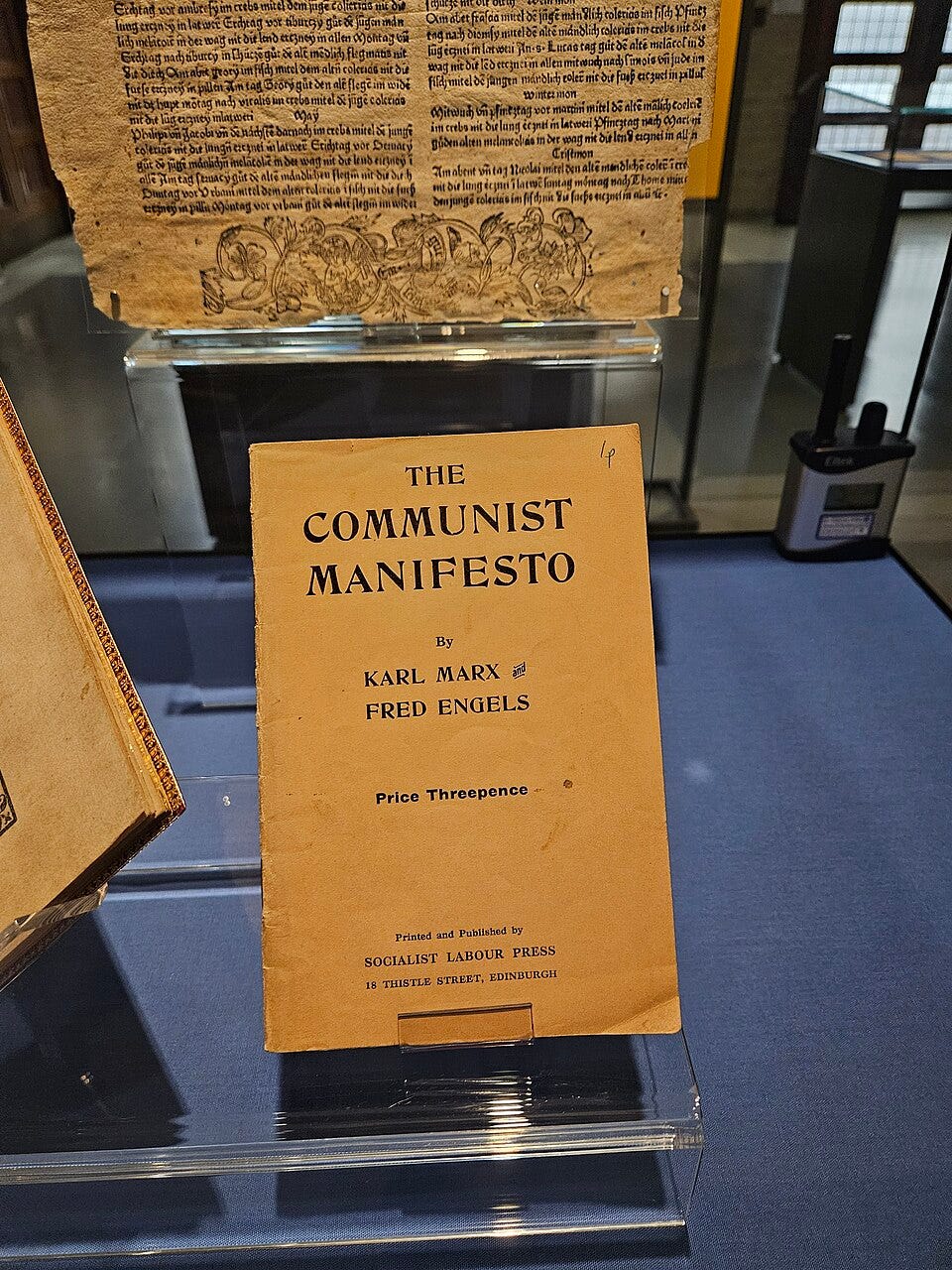
[Most of the quotes in the following come from Eric Hobsbawm’s book How to Change the World: Tales of Marx and Marxism, specifically the chapter ‘On the Communist Manifesto’.]
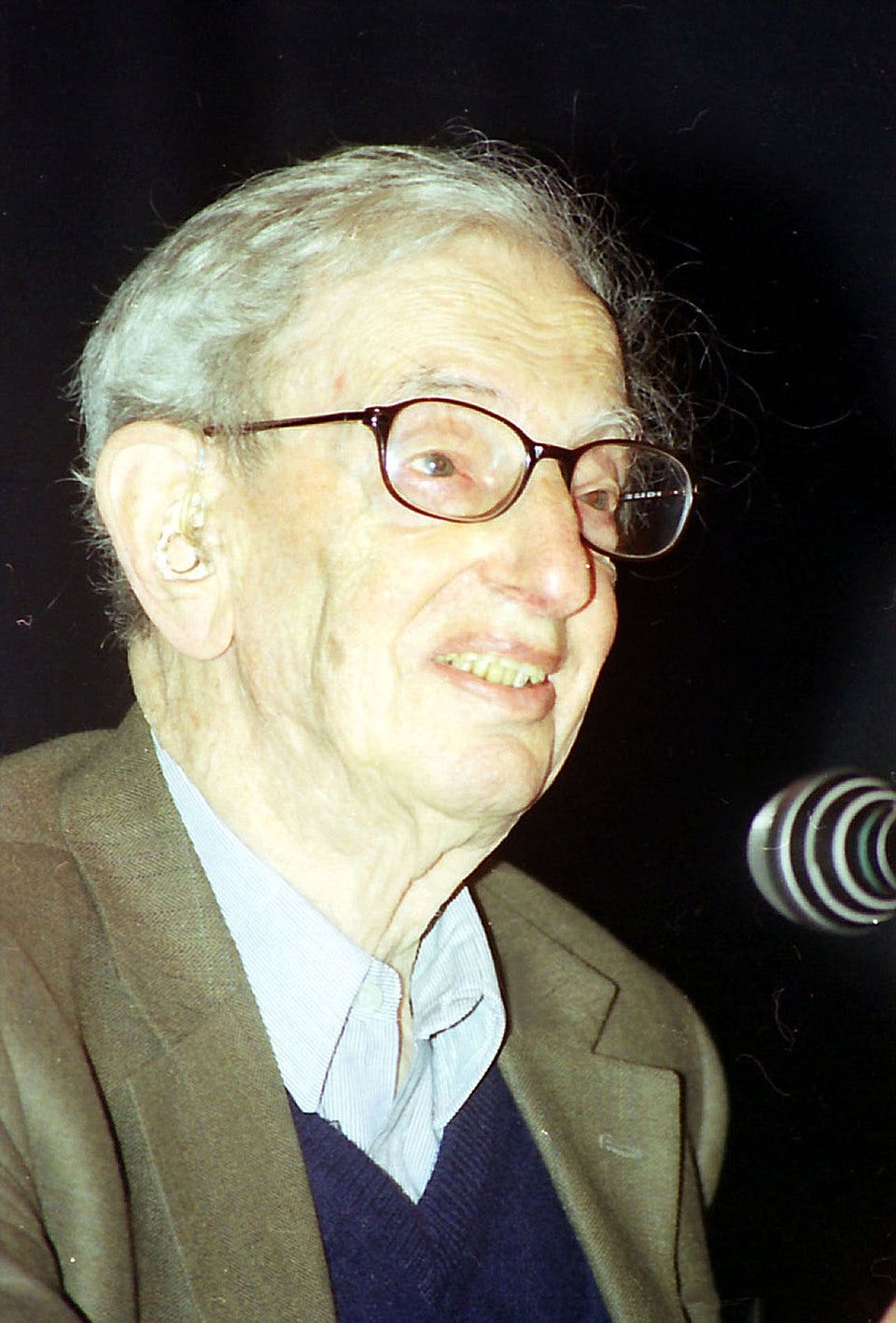
The British historian Eric Hobsbawm certainly had many Marxist and communist credentials. He became a member of the Sozialistischer Schülerbund (Association of Socialist Pupils) in Berlin in 1931, and the Communist Party of Great Britain (CPGB) in 1936. In terms of being a historian, Hobsbawm became a member of the Communist Party Historians Group in 1946. He then became the president of the Socialist History Society.
More broadly, Hobsbawm was described by The Spectator as “arguably our greatest living historian — not only Britain’s, but the world’s”. Niall Ferguson stated that the claim that “Hobsbawm is one of the great historians of his generation is undeniable”. In 2003, The New York Times described him as
“one of the great British historians of his age, an unapologetic Communist and a polymath whose erudite, elegantly written histories are still widely read in schools here and abroad”.
More relevantly, ten years before he died, Hobsbawm wrote that “[t]he dream of the October Revolution is still there somewhere inside me”.
Marx’s Historical Determinism
It’s almost too obvious to state that many of Karl Marx’s predictions turned out to be flat out false. Nonetheless, it’s a little bit more interesting when Marxists themselves state this. (It’s hard to say that a prediction can be either true or false when it’s actually made. [See ‘future contingents’.)
Oddly enough, the following philosophical and political criticisms of the Communist Manifesto don’t really matter in the sense that this pamphlet still has a (as Hobsbawm put it) “biblical force”. Indeed, this is a work that many people believe has a “compelling power as literature”.
Relatedly, Hobsbawm acknowledged that the Manifesto is more about “the confidence it gave its readers” than it is about capitalism’s future. In other words, claiming that “capitalism was inevitably destined to be buried by its gravediggers” was a rhetorical line, not a piece of predictive science.
Hobsbawm also made a distinction between Marx’s “hope” that things would go in one positive direction, and Marx’s actual “analysis” of capitalism itself. In Hobsbawm’s own words:
“Marx’s vision of a proletariat whose very essence destined it to emancipate all humanity and end class society by its overthrow of capitalism represents a hope read into his analysis of capitalism, but not a conclusion necessarily imposed by that analysis.”
Here we have Hobsbawm showing us Marx’s commitment to both essentialism and to prophecy. In stark terms, it’s quite incredible that Marx believed that things would go exactly the way he stated they’d go. This is especially incredible when bearing in mind how many variables needed to be factored into Marx’s predictions, and the fact those variables included human beings and their actions…
Unless, that is, the variables that were human beings were but cogs in the forward movement of history.
Despite all that, some of Hobsbawm’s criticisms of Marx’s futurology are better than many of those offered by anti-Marxists themselves. Take Hobsbawm's brutal question as an example:
“[W]hy was it inevitable that capitalism could not provide a livelihood, however miserable, for most of its working class, or alternatively, that it could not afford a welfare system. That ‘pauperism[in the strict sense] develops even more rapidly than population and wealth’?”
So was Marx and essentialist and a necessitarian hooked into his own deterministic logic? That said, Marx can be defended in the sense that the “welfare system” Hobsbawm referred to wasn’t really on the books in 1848. Thus, there wasn’t really any way that Marx could have foreseen what was to come…
And that’s exactly the point!
Marx couldn’t have foreseen what was to come unless he was a historical determinist of extreme proportions.
The Communist Manifesto
Hobsbawm focused on the Communist Manifesto and a single — if well known — prediction. He wrote:
“[T]here was plainly no adequate ground for the Manifesto’s belief that the moment for the overthrow of capitalism was approaching (‘the bourgeois revolution in Germany can only be the prelude to an immediately following proletarian revolution’) . On the contrary. As we now know, capitalism was poised for its first era of triumphant global advance.”
A couple of pages later, Hobsbawm told his readers the following:
“It is now evident that the bourgeoisie has not produced ‘above all, its own gravediggers’ in the proletariat. ‘It’s fall and the victory of the proletariat’ have not proved ‘equally inevitable’.”
What gave Marx grounds for such a prophetic claim?
It was primarily his belief in “the laws of history”, strongly allied with various both hidden and explicit philosophical assumptions and positions. In simple terms, Marx was expressing a deterministic position as applied to history, social movements, class and revolution. A simple — if controversial — way to put this is to state that human wills and human minds were basically factored out of Marx’s equation.
In retrospect, of course, most Marxists deny all this.
In any case, Hobsbawm drew something else out of the very same passages. The following is what he wrote immediately after the words just quoted above:
“What gives the Manifesto its force is two things. The first is its vision, even at the outset of the triumphant march of capitalism, that this mode of production was not permanent, stable, ‘the end of history’, but a temporary phase in the history of humanity, and, like its predecessors, one due to be superseded by another kind of society.”
Of course, Hobsbawm, writing in 2011, would have had a different view on Marx’s words than a Marxist writing in the 1850s, or even in the 1920s. After all, Hobsbawm knew that Marx’s prediction/s turned out to be false. Thus, he had to make sense of that (inconvenient) fact.
If we return to Hobsbawm's words.
In 1848, did many people (not just capitalists) really believe that capitalism was “the end of history”? That can be doubted. Of course, the phrase “the end of history” is Hobsbawm’s quote taken from Francis Fukuyama. That said, Fukuyama did take his idea of the end of history from Hegel (see here), and Hegel profoundly influenced Marx. Indeed, isn’t Marx’s own classless society an end of history too (see here)?
Hobsbawm’s Defence of Marx’s Predictions
As seen, Hobsbawm picked up on Marx’s historical determinism. However, he also believed that Marx’s determinism wasn’t quite as, well, deterministic as many people may think.
Hobsbawm clearly knew that Marx’s historical determinism was something that many other critics had noted too. Yet, at points, Hobsbawm appears to have denied that Marx’s was a historical determinist completely — or at least he qualified this view. Hobsbawm wrote:
“Yet, contrary to widespread assumptions, inasmuch as it believes that historical change proceeds through men making their own history, it is not a determinist document. The graves have to be dug by or through human action.”
Why can’t there be a historical determinism, and it also be the case that “men make their own history”? A determinist can argue that such men were causally determined to make their own history. Obviously, it was men who had to bring about the revolution because who — or what — else could do that job? Indeed, even if capitalism had turned catastrophic in 1848 (or in the decades after), men would still have needed to react to that catastrophe.
Yet Hobsbawm clearly believed that “human action” could not be squared with historical determinism. Indeed, on many philosophical accounts still held today, it can’t actually be human action if it is (causally) determined.
This ties in with another of Marx’s quotes in which it’s said that “men make their own history, but not in conditions of their own choosing”. (This was quoted by Hobsbawm.) However, what if those conditions completely determine the way men make their own history? After all, on any reading which does stress Marx’s historical determinism, the whole point of it is that conditions (economic and historical) do determine actions — and indeed “consciousness”.
So, yes, men do make history. However, the men who do so have been causally determined to make history in a very specific way. And that adheres to the vision of Marx seen as a historical determinist.
Hobsbawm himself realised all this…
And that’s why he said that “[a] determinist reading of the argument is indeed possible”.
It’s possible to go further than Hobsbawm and argue that Marx’s worldview wouldn’t have been Marx’s worldview if the deterministic elements of it were erased. Moreover, if the deterministic elements of Marx’s position were erased (or even qualified, as Hobsbawm does), then what, exactly, would be left?
Hobsbawm disputed all this. (He spent more time on this issue than most people.) He told his readers that
“[e]ven before Lenin, Marxian theory was not just about ‘what history shows us will happen’, but also about ‘what must be done’”.
This is an odd sentence. Indeed, it appears to be contradictory.
If history shows us what will happen, then whatever is done is done because history has already shown us (or determined) that it will be done. Of course, things are done by men in a revolutionary situation too. But so what. Perhaps they’re done because History-with-a-capital-’H’ has forced them to be done.
One other way in which Hobsbawm got around the problem of Marx’s predictions (or at least his predictions in 1848) was to argue that they were dependent not on what could be shown in 1848, but on what might happen in the future. Obviously, all predictions are about the future. (In this case, post-1848.) However, Marx didn’t argue that such-and-such may happen in the future: he argued that such-and-such will happen in the future. Yes, prophets (unlike scientists) tell us what will happen, not what may happen.
Nonetheless, Hobsbawm still stressed “choices” and “political possibilities”. He stated that
“[b]etween ‘now’ and the unpredictable time when ‘in the course of development’ there would be ‘an association in which the free development of each is the condition of the free development of all’ lies in the realm of political action”.
Clearly, Hobsbawm was playing down historical determinism by stressing “political action” and an “unpredictable time”. Yet there’s still a belief that there will actually be a time in which the free development of each is the condition of the free development of all. That future time was never doubted by Marx. Thus, all Hobsbawm’s qualifications amount to is a historical determinism in which all the precise details and timings about the future can’t be given…
Yet it’s still historical determinism.
Of course, even prophecies may be based on at least some empirical realities or facts. As Hobsbawm put it:
“In the 1840s the conclusion that society was on the verge of revolution was not implausible. Nor was the prediction that the working class, however immature, would lead it. After all, within weeks of the publication of the Manifesto a movement of Paris workers overthrew the French monarchy, and gave the signal for revolution to half Europe.”
So even if Marx had his eyes on some — or even most — of the variables of revolution, he still couldn’t have known what would happen in the future. That didn’t matter. Political prophecies have had — and have been seen to have had — the property of being self-fulfilling.
Marx himself would have had no time for any critics who pointed out that his predictions were not airtight or that they were philosophically problematic. After all, this prophetic habit isn’t only peculiar to Marx. Indeed, each day readers will read and hear politicians and activists making their own large-scale predictions.

No comments:
Post a Comment