


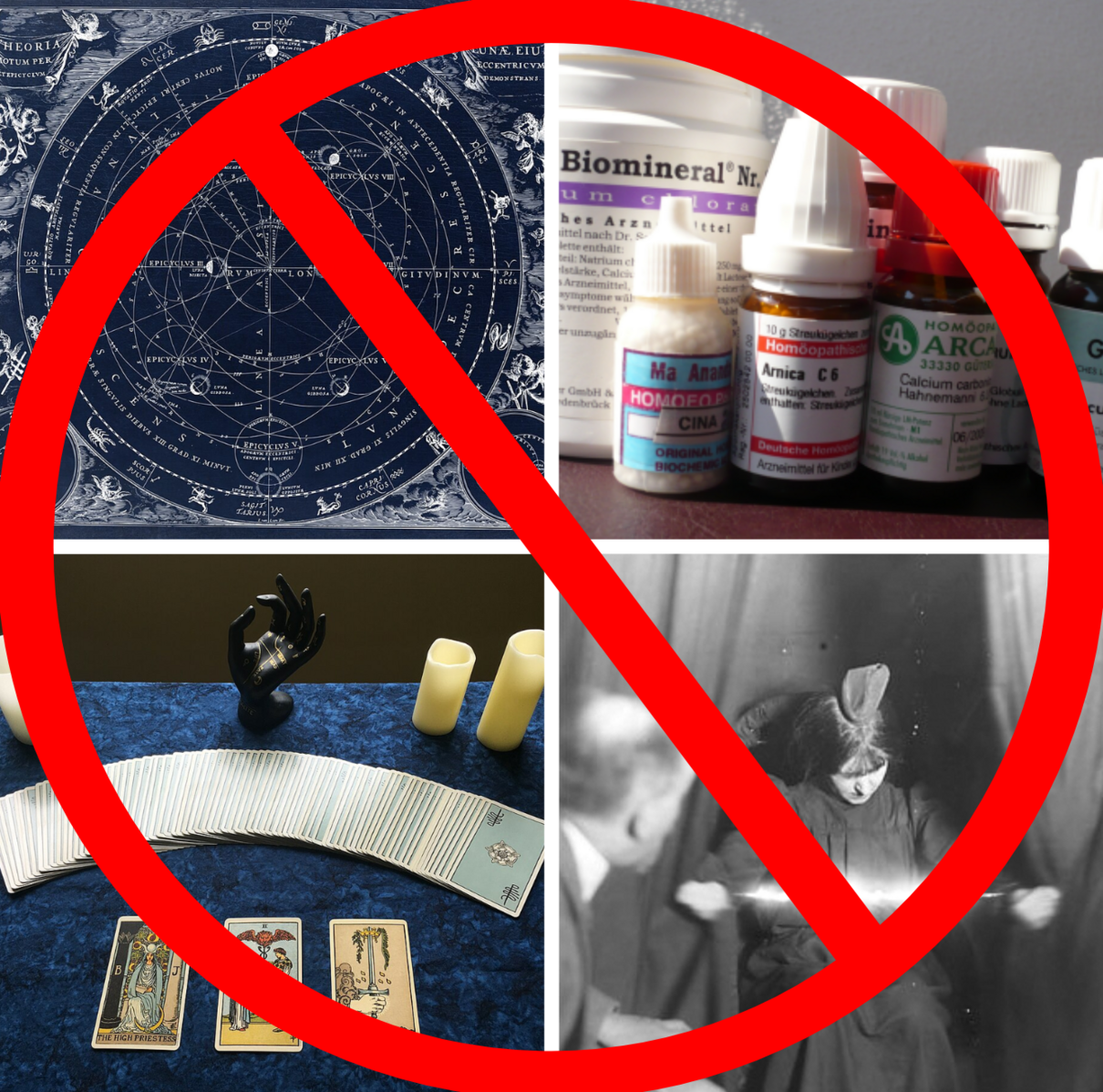
What Karl Popper argued in a 1953 seminar (from which most of his quoted words in this essay are taken) influenced various “radical” philosophers of science (such as Thomas Kuhn and Paul Feyerabend). For example, Popper wrote that “science must begin with myths”. However, he immediately qualified that statement by saying “and with the criticism of myths”. In other words, Popper believed that science doesn’t begin with observations or experiments. Instead, it begins with conjectures or even stabs in the dark. Such things work as myths. However, those myths are then criticised or qualified. Indeed, they become scientific precisely because they’re criticised. Pseudo-scientific theories, on the other hand, aren’t criticised by their upholders. They’re merely added to, enlarged, and, perhaps, refined.
Popper on Pseudo-Science
One way of putting Popper’s position is to argue that it doesn’t matter if scientific theories (or the statements within them) are shown to be false or inaccurate because they remain scientific nonetheless. In other words, they aren’t rendered unscientific or (non-scientific) by being shown to be false. In a strong sense, then, their truth status is irrelevant. What matters is whether the theory is scientific or pseudo-scientific.
This raises the obvious question as to what makes a theory genuinely scientific. According to Popper, the traditional answer to this question is that it “appeals to observation and experiment”. Popper wasn’t happy with that answer. Why? It’s because this is a “method” that is also
“exemplified by astrology, with its stupendous mass of empirical evidence based on observation — on horoscopes and on biographies”.
To many sceptics, using the words “stupendous mass of empirical evidence based on observation” may seem odd when applied to astrology. Popper believed that it’s not odd at all. After all, the stars are observed by astrologists. (Therefore astrology is, in some sense, empirical.) Personal lives and the events within them (or biographies) are observed by astrologists. (Therefore astrology is empirical.) These two things provide the empirical and observational basis of astrology. Not only that: astrological theories (or predictions) are often (seemingly?) “verified”.
Yet, according to Popper, astrology is a pseudo-science. Now Popper had a lot to explain after arguing all that.
In very basic terms, astrology isn’t a science because its theories and predictions can’t be falsified. As is now commonly known, Popper placed a lot of stress on falsifiability.
Popper on Confirmation and Prediction
Retrospectively, one can see Popper’s point about it being easy for almost any theory to be “confirmed” in some way or another. At least (to use Popper’s own examples) astrologers, Freudians, Marxists, etc. often tell us that their theories have been confirmed. (In the case of Marx, you often read the phrase: “If anything, Marx’s theories are more relevant today than ever before.”) All this, obviously, raises the question as to what confirmation is, and how particular theories are confirmed. If we don’t have any answers to those questions, then it’s not a surprise that Popper claimed that
“[i]t is easy to obtain confirmations, or verifications, for nearly every theory — if we look for confirmations”.
Popper helps us here with that last clause — “if we look for confirmations”. Thus, if we only look for confirmations, then we aren’t looking for disconfirmations… or falsifications. On the surface, however, even if we look for conformations, then that doesn’t mean that the confirmations aren’t… well, confirmations. All this means that confirmations themselves are suspect from a Popperian perspective.
This leads to the fact that Popper himself had a very particular take on confirmations. He tied them to what he called “risky predictions”. This is odd. Or at least it’s a very physics-based notion of confirmation. In other words, why do confirmations need to be tied to predictions at all?
If my theory is that all swans are white, and I confirm that by taking a photo of a white swan, then where is the prediction here? Of course, it might have been the case that I predicted that all future swans will be white. But confirmation still doesn’t seem to be necessarily linked to prediction. Then again, how else could my theory that all swans are white be cashed out? Surely it can only be cashed out on the unspoken assumption that all future swans will be white.
Popper himself talked in terms of an “event” being “incompatible with the theory”. Is observing a black swan an event? Well, the singular observation of a black swan can be interpreted as being an event. After all, it involves some kind of sequence of causally-related occurrences. That said, Popper probably had experimental tests in mind. In other words, an experimental test is an event. Thus, the mere observation of a black swan isn’t an experimental test. Therefore, it’s not part of science at all.
Falsifiability Isn’t Enough
Popper stated that
“*the criterion of the scientific status of a theory is its falsifiability, or refutability, or testability*”.
It may seem odd that the scientific status of a theory can be established by a single criterion, even if that criterion is important. Surely this was Popper attempting to be original and conclusive by offering something that would sometimes gain the status of a philosophical soundbite. Indeed, isn’t it ridiculous to imagine that the status of a theory can be summed up in such a way? This isn’t even a question of the likelihood of many counter-examples being discovered.
So, as it stands, falsifiability seems too categorical and simplistic.
Even a critic of astrology may believe that (mere) falsifiability can’t be that important when it comes to questioning astrology. Yes, if a prediction is falsified, then that’s a good (or a bad) thing. But there must be more to it than that.
This brings up another problem with Popper’s stress on falsifiability: he attempted to make it the be all and end all of not only (genuine) science, but of his entire philosophy of science. Thus, because of this absolute centrality of falsifiability, counter-examples to Popper’s idea were easy to find… if not always straight away.
Coming at the falsification principle from another angle.
The philosopher John Cottingham (expressing Popper’s position) said that
“[t]here is no standard procedure, no set of logical rules, for arriving at theories”.
There may be no such things for arriving at theories. However, Popper believed that falsifiability alone established the scientific status of a theory once it had been arrived at. Thus, Popper acknowledged the complexity of arriving at scientific theories. However, he didn’t do the same thing when it came to establishing a theory’s scientific status. Does this mean, then, that “trial and error” doesn’t apply to Popper’s own principle of falsification? (Is claiming that it has a “meta” status a good enough response?)
Tying into falsification, it’s hard to accept that all — or even most — scientists are always “trying [their] best to show that [their theories] are erroneous”. Yet perhaps that doesn’t matter (i.e., in the long run) because science as a whole is always moving forward. Alternatively, it doesn’t matter because other scientists will eventually show the scientific community that the original theories are erroneous.

No comments:
Post a Comment