


Postmodernist philosophers rejected Marxism — even those who were once Marxists. In fact, many deemed Marxism to be yet another metanarrative. [See ‘Marxism as a Metanarrative’.] Yet when you read postmodernist philosophers (such as Ernesto Laclau and Chantal Mouffe), you can find all sorts of challenges to capitalism, as well as ways in which capitalism may be challenged. Indeed, it’s hard to come across a single postmodernist philosopher who waxes lyrically about capitalism. [See note 1.] Consequently, it can be argued that many postmodernist philosophers were still inspired by the spirit of Marxism, if not by the letter.
[See my ‘Was Fredric Jameson a Marxist Snob Who Fought the Postmodern Culture Industry?’ and ‘Jean Baudrillard’s Postmodernist Take on Marxism’.]
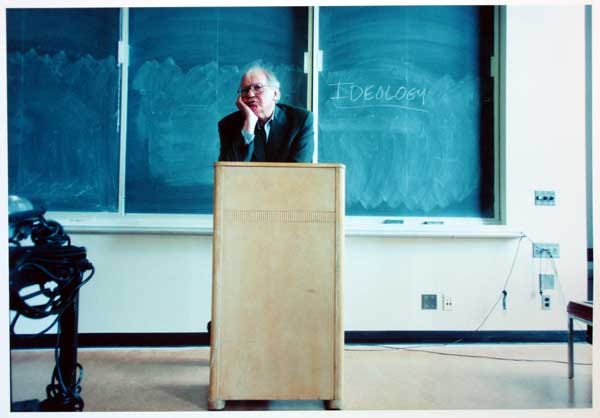
Fredric Ruff Jameson (1934–2024) was an American literary critic and Marxist theorist. His best-known books include Postmodernism, or, The Cultural Logic of Late Capitalism (1991) and The Political Unconscious (1981).
In 2024, Robert T. Tally reviewed the work of Jameson for the socialist magazine Jacobin. He wrote:
“[F]or over five decades, Fredric Jameson has been the leading Marxist literary and cultural critic in the United States, if not the world.”
Postmodernists aren’t Marxists
Despite radical postmodernism, and its embrace of many alternatives to the status quo, it was still not Marxist. Thus, according to Marxists, all the political fluff of postmodernism still wasn’t getting to the heart of the problem. And that problem was capitalism.
This basically meant that there was nothing postmodernist philosophers could do to please Marxists (such as Frederic Jameson) other than adopt Marxist theories and Marxist plans of action. The gist (again) is that if Marxist theories and Marxist plans of action aren’t embraced, then capitalism will remain. And capitalism is the main problem.
Jameson himself stated his political problem with postmodernism very clearly when he told his readers that
“postmodernism replicates or reproduces — reinforces — the logic of consumer capitalism”.
It does seem like an extreme position to say that the entirety of postmodernism simply replicates or reproduces — reinforces — the logic of consumer capitalism. (Readers will get their heads around Jameson’s use of the word “logic” later.)
Simply put, because Jameson was a Marxist, to him it must have been the case that capitalism gave rise to postmodernism. That’s because this is how Jameson’s Marxist materialism works. That is, the modes of production (or the “base”) give rise to just about everything else (i.e., the superstructure), including ideology, religion (e.g., Islam, Christianity, Judaism, etc.), art, and, in this case, postmodernism.
Yet Jameson wasn’t a Marxist philistine or fundamentalist because he did actually analyse the works of postmodernist and poststructuralist philosophers. However, it can be argued that Jameson tackled these postmodernist ideas and theories not because he wanted to broaden the nature of Marxism, but simply because he believed that Marxists should be aware of all the new rivals who exist in late-capitalist societies. Thus, postmodernist philosophers were now basically on the same plain as conservatives, reactionaries, Republicans, etc. (Okay, perhaps not exactly the same plain as these people.)
Jameson did raise the possibility that postmodernist philosophers may indeed “resist” capitalism when he wrote the following:
“We have seen that there is a way in which postmodernism replicates or reproduces — reinforces — the logic of consumer capitalism; the more significant question is whether there is also a way in which it resists that logic.”
It has already been argued that postmodernist philosophers did resist that logic, and many examples of this can be given. That said, if Jameson had accepted that postmodernist philosophers were “truly radical” (or even “truly revolutionary”), then there wouldn’t be much of a role for Jameson’s own Marxism. If anything, postmodernist philosophy was a direct threat to Marxism.
What is Late Capitalism?
Frederic Jameson told his readers that
“at some point following World War II a new kind of society began to emerge (variously described as postindustrial society, multinational capitalism, consumer society, media society and so forth).”
A new kind of society began to emerge after World War I too. New societies have emerged throughout history. That doesn’t mean that what Jameson argued is false or worthless. It does show that it’s nothing (too) spectacular.
In Jameson’s view, postindustrial society, multinational capitalism, consumer society and media society seem to be expressions of the same thing (if viewed from different angles).
Even from a non-Marxist perspective it can be argued that we do exist within a “postindustrial society”.
As for “multinational capitalism”: well, to some extent, that dates back (as Jameson himself stated) long before the rise of postmodernism itself. But, sure, it might well have reached higher levels by the 1980s.
Finally, “consumer society”: Marxists and other “radicals” began to discuss this in the early 1960s, if not before.
After his reference to “media society”, Jameson immediately explained himself when he referred to
“[n]ew types of consumption; planned obsolescence; an ever more more rapid rhythm of fashion and styling changes; the penetration of advertising, television and the media generally to a hitherto unparalleled degree throughout society”.
There were new types of consumption, as there were in the 1950s, 1920s, 1880s, 1820s, 1710s, etc.
Readers may also wonder why (to play the devil’s advocate) anyone would have a deep problem with all this. After all, take the inverse of all Jameson’s examples: an ever less rapid rhythm of fashion and styling changes, fewer types of consumption, etc.
Postmodernism Everywhere
When Jameson stated that
“postmodernism is the cultural expression of our own current period of late capitalism”
surely that was an assumption that postmodernism was literally everywhere. That is, postmodernism somehow expressed and captured everything (minus the works and actions of Marxists and selected minority groups) that was culturally expressed in the period of what Jameson called “late capitalism”.
In detail. Jameson believed that postmodernity did merge all discourse into a neat-and-tidy whole. That was because “corporate capitalism” now made a better job of the “colonization of the cultural sphere”.
More forcefully, Jameson believed that postmodernism was a form of mass culture. That mass culture is the product of capitalism. And, because it is mass, it can be found in literally every part of our daily lives.
Yet, here we are in 2025, and many aspects of postmodernism already seem old-fashioned or irrelevant. Thus, was Jameson (at least in the period 1994 to 1997) totalising postmodernism and its impact on literally all cultural expression?
Jameson also stated that
“postmodernism is closely related to the emergence of this new moment of late, consumer or multinational capitalism”.
Closely related?
Jameson might have been correct to say that postmodernism arose during this period. However, he was saying more than that. He was also arguing that “late, consumer or multinational capitalism” (as the substructure) is somehow responsible for (or the cause of) postmodernism.
For now, let’s just accept that there is such a thing as late consumer capitalism or multinational capitalism. Did it give rise to postmodernism? How, exactly, did it do so? Or did the two things simply occur at (roughly) the same time?
Interestingly, Jameson himself said that postmodernism and late capitalism weren’t co-occurrent :
“[T]he society the media or the spectacle, or multinational capitalism [ ] can be dated from the postwar boom in the United States in the late 1940s and early ’50s or, in France, from the establishment of the Fifth Republic in 1958.”
Postmodernism is generally dated back to the late 1960s. (It can be dated back to the 1950s too.) In terms of philosophy at least, it didn’t really get going until the 1970s. And it didn’t gain its “hegemony” until the 1980s. So it can be said that it took philosophers and theorists a long time to catch up with the changes to capitalism which Jameson himself highlighted.
So, again, this is more than a simple co-occurrence. Jameson believed that postmodernism’s “formal features in many ways express the deeper logic of that particular social system”. This is an odd use of the word “logic”, or at least it’s a loose use of that word. Jameson actually meant the material basis (or reality) of capitalism gave rise to postmodernism. In other words, the (Marxist) substructure of late capitalism gave rise to a superstructure which included postmodernism.
Superstructure and the Frankfurt School
Jameson extensively studied the Frankfurt School. What united them was the belief that “cultural criticism” is an important part of Marxism. So much so that, in 1969, Jameson himself co-founded the Marxist Literary Group at the University of California. (Arguably, this was before the rise of postmodernism.)
Why did a Marxist like Jameson concern himself with epiphenomena like postmodernism and postmodernist philosophy? After all, previously Marxists believed that the superstructure was utterly determined by the economic base. However, the people called “Western Marxists” did analyse culture too.
Yet Marxists can analyse culture and still believe that the substructure completely determines the superstructure…
It’s just that it helps the Marxist project to analyse culture — even if it is epiphenomenal. More relevantly, Jameson himself believed that the substructure completely determined the superstructure which — at least at that time — included postmodernism. Indeed, he spent a lot of time saying precisely that.
To complicate matters. Jameson did believe in an artistic mode of production, which, on the surface at least, appears to put artistic work on the same level as other modes of production. Yet here too artistic production was still seen (by Jameson) as being a product of the modes of production of the capitalist system.
Note:
(1) It can be argued that Jean Baudrillard came close to doing so. However, Baudrillard — and many of his fans -denied that. In simple terms, Baudrillard saw himself as being yet another “radical”.
(**) To follow: ‘Frederic Jameson as Cultural Snob’.

No comments:
Post a Comment