


I was always fascinated by the metaphysical debates about lumps of clay constituting statues, inpieces and outpieces, and so on. More correctly, I was fascinated by the fact that some philosophers clearly find these subjects fascinating. It’s not that they aren’t “relevant to everyday life” (I don’t know what that means): it’s that I couldn’t see what they were about at all. Very rarely are the metaphysical implications of these debates spelled out. That’s if they have any implications at all…
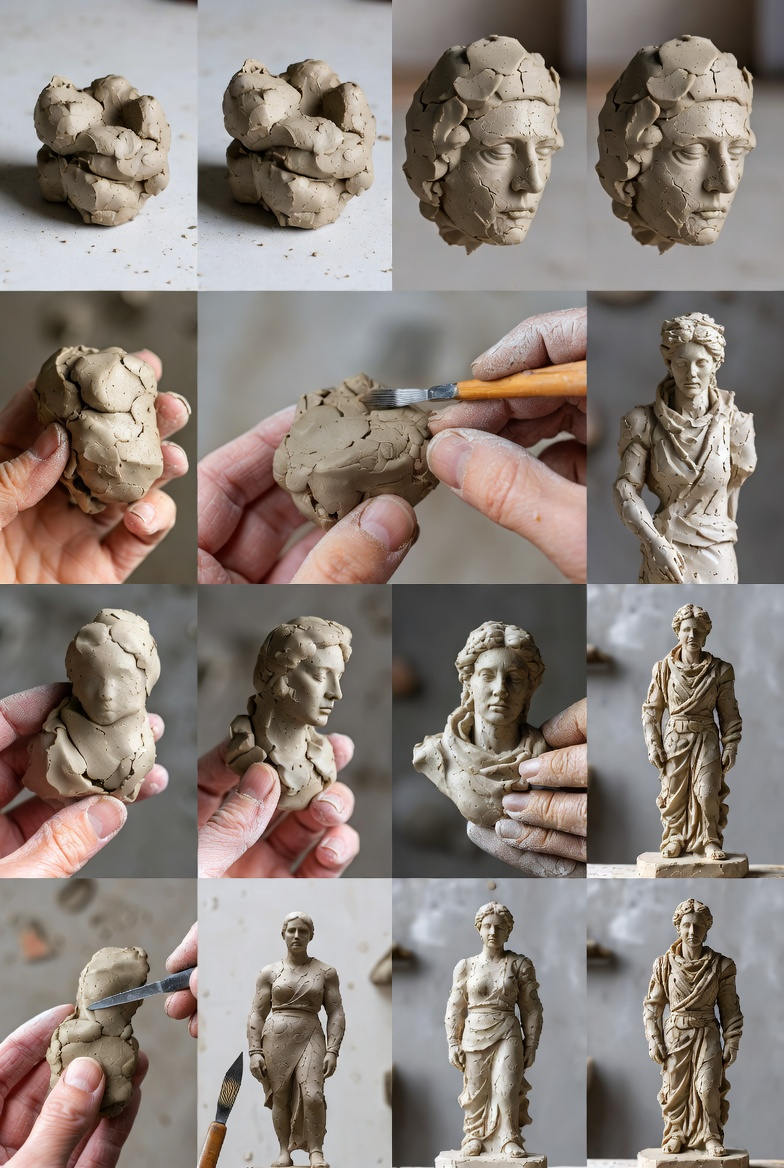
The Australian philosopher David Chalmers’ wrote a paper called ‘Verbal Disputes’. The following passage is part of the introduction to that paper:
“Is there a distinction between questions of fact and questions of language? Many philosophers have said no. [ ] Intuitively, a dispute between two parties is verbal when the two parties agree on the relevant facts about a domain of concern, and just disagree about the language used to describe that domain.”
Personally, I don’t entirely agree with this neat division between questions of fact and questions of language. But this isn’t the place to go into that. (See my ‘Merely Verbal Ado About Nothing: David Chalmers, Facts, Consciousness’.) More relevantly, the American philosopher Theodore Sider (to be featured in this essay) does agree with David Chalmers, at least to some degree.
According to the philosopher David Manley, the notion of merely verbal dispute is
“[m]otivated in part by intuitions of shallowness, they argue that the dispute is merely verbal, or that the disputants are not making truth-evaluable claims at all”.
Some readers will see that this passage assumes a clear position on what is and what isn’t truth-evaluable. Sider, for one, may not accept this position.
The American philosopher Craig Callender spots a specific problem with the metaphysical issues to be discussed in this essay. He writes:
“The reason is that it’s hard to imagine what feature of reality determines whether a fist is a new object or not. How would the world be different if hands arranged fist-like didn’t constitute new objects?”
The begged answer to that leading question is: No difference whatsoever.
Now we’ll rewrite that passage to make it relevant to what will follow:
The reason is that it’s hard to imagine what feature of reality determines whether a statue is a new object or not. How would the world be different if particles arranged statue-wise didn’t constitute a new object?
The Classification of x
The following essay is at least partially about different ways to classify — or even see/observe — the same thing. Sider writes:
“Imagine a takeover theorist from Mars. Instead of sorts like statue and piece of clay, beloved of Earthly takeover theorists, Martian takeover theorists speak of sorts like:
“outpiece: piece of clay located outdoors, no matter how shaped
“inpiece: piece of clay located indoors, no matter how shaped”
Sider implicitly stresses the earlier words, “the same thing”. So of course a Martian could classify any given x as an “outpiece” or an “inpiece”. People on Earth classify x as a “piece of clay” or a “statue”. Sider would argue that they’re all still classifying x — i.e., the same thing. In his own words:
“Of course, whether the clay is indoors or outdoors is irrelevant to what objects exist.”
Regardless of conceptual plurality, the object still exists… It always remains an object.
What has just been quoted includes examples which have been popular in analytic metaphysics in recent years. Is a piece of clay the same thing as the statue it constitutes? After all, the piece of clay and the (clay) statue take up the same spatial dimensions and share all their properties (unless one is a 4-dimensionalist). The takeover theorist believes that the piece of clay becomes a statue. Others argue that there are two objects in the same space at the same time. The Martian, on the other hand, sees both the piece of clay and the statue (or the clay that’s been made into a statue) as an outpiece or an inpiece, depending on whether it’s indoors or outdoors…
But none of these positions are argued for or against in this essay.
Sider himself take a metaphysically-realist position, but not on statues, pieces of clay, outpieces and inpieces.
Manley on Metaphysical Realism
David Manley captures Sider’s position (though he isn’t referring to Sider) when he writes the following:
“[M]ost contemporary metaphysicians think of themselves as concerned, not primarily with the representations of language and thoughts, but with the reality that is represented.”
In this case, then, contemporary metaphysicians are concerned with the value of the variable x.
As a metaphysical realist, then, perhaps Sider would argue that the true metaphysician is only concerned with x, not with whether the sortals “statue”, “piece of clay”, “inpiece” and “outpiece” are correctly applied to x. Yet how can Sider say anything at all about x without the use of sortals or concepts? What would he say about it?
In any case, Sider claims that “the realist picture requires the ‘ready-made-world’”, and that “there must be a structure that is mandatory for inquirers to discover”. So what have statues, inpieces, outpieces and even lumps of clay to with the this ready-made world? Moreover, in ‘Ontological Realism’, Sider writes:
“The point of metaphysics is to discern the fundamental structure of the world.”
Again, what have statues, etc. got to do with the fundamental structure of the world? Sider believes that there are “predicates that carve nature at the joints, by virtue of referring to genuine ‘natural’ properties”. He continues:
“The world has a distinguished structure, a privileged description
. [ ] There is an objectively correct way to ‘write the book of the world’.”
Sider believes that there is an objectively correct way to write the book of the world’. This means that it’s possible that a metaphysical book may well offer us the truth about the world. Yet this goes against so much which has been written against metaphysics in the 20th and 21st centuries.
More importantly, then, Sider argues that
“[e]veryone agrees that this realist picture prohibits truth from being generally mind-dependent”.
Statues are certainly mind-dependent. Inpieces and outpieces are dependent on the minds of Martians. A lump of clay is a little bit more problematic. However, a lump of clay certainly isn’t a part of either physics or metaphysics.
What is x?
We can now ask: What is this x before its classed as a “outpiece”, “piece of clay”, “statue”, etc? Perhaps Sider may admit that he couldn’t really say anything about x without relying on some “labels”. Alternatively, we can that say x is whatever is within a given set of spatial dimensions.
In a sense, it’s obvious that a Martian wouldn’t class x as either a “statue” or “piece of clay” if it has never come across statues or pieces of clay.
Sider explains the Martian position when he says that “[t]his inpiece exists so long as the clay is indoors”, and “[w]hen an outpiece is brought indoors, they say, the sort ‘inpiece’ takes over, the outpiece goes out of existence, and a new inpiece comes into existence”. This is an odd use of the word “exists”. It is existence via classification. An x exists in all cases, whether it’s a statue, piece of clay, inpiece or outpiece. Thus, x only exists qua outpiece if it’s outdoors. Similarly, x only exists qua statue if it’s shaped into a statue. x exists throughout these changes…
But what is x?
Does this fuss and bother have any metaphysical import? Is it all merely verbal? Sider writes:
“The Earthling and the Martian agree that she holds a single object in her hand, but they disagree over what its sort is.”
Okay. Is it all about sortals? Here we have an agreement — the Earthling and the Martian are both talking about “a single object in her hand”. Perhaps Sider would stress the fact that they’re both talking about the same object or x. But where does that get us? What is this x or object? More importantly, can anything else be said about it without sortals, concepts, etc?
Sortal Pluralism
Sider adds to his argument by stating the following:
“They cannot both be right, since the same object cannot both continue and cease to exist.”
There isn’t much of a complication here. The same object exists. It doesn’t cease to exist. However, x under the sortal “outpiece” does cease to exist, qua outpiece, when brought indoors. Or, rather, the sortal “outpiece” ceases to be applicable when the object is brought indoors. So, loosely, the sortal “outpiece” ceases to applicable, even if x remains.
It follows from all this that if
then the Earthling is wrong about the Martian being wrong. Not because the Earthling has a mistaken ontology, but because there is no right or wrong in this case. It isn’t wrong of the Martian to classify x as an outpiece or inpiece. It isn’t wrong of the Earthling to classify x as a “statue” or “piece of clay”. Yet perhaps if the Martian and Earthling went beyond mere naming, then either or both could be right or wrong. After all, if x is outside and a statue, then it’s still outside. The Martian isn’t required to class x as a “statue”, and the Earthling isn’t required to class x as an “outpiece”.
Metaphysical Realism?
Sider acknowledges the following:
“The Earthly takeover theorist’s choice of sorts suspiciously mirrors the words we here on Earth happen to have coined. We could have invented different words; we could have gone the way of the Martians and introduced words for inpieces and outpieces rather than statues and pieces of clay.”
Some readers may say that it’s not only about sortals of classification. All sorts of identity conditions are attached to the use of a specific sortal. But even here neither the Martian nor the Earthling are in the wrong. After all, can’t x be both an outpiece and a statue? x can be an outpiece and a statue if it is indoors. And x can’t be both an inpiece and a statue if it is outside.
So how can the Earthling say that “the true objects are pieces of clay and statues, not inpieces and outpieces” if the piece of clay and statue are outside?
Sider’s conclusion is correct:
Why is this case problematic? Is it problematic? The solution seems obvious. x can be both a statue and an inpiece. Or x can be both a piece of clay and an outpiece. In fact, many sortals can be applied to x. It’s certainly not contradictory to label the same x as both an “outpiece” and a “piece of clay”. When we come across a contradiction, it is only then that we’d to do some deeper analysis? That hasn’t occurred yet. But readers can suppose that it could do.
All along, it can be argued that Sider believes that a metaphysician must deal with deeper issues than these mere disagreements about classification.
Ontological Nihilism
Sider gets the conceptual plurality position across when he says that
This point is raised in relation to the position of nihilism in ontology.
Thus, yet again, we have the same x, which different beings (including Martians) classify in different ways. On the surface, and even under the surface, it seems like a simple verbal dispute to argue that there are only particles arranged statue-wise or that there is a statue. Of course, this subject has been debated to death in analytic philosophy, and I can admit that I don’t know all the arguments in favour of nihilism, or all the arguments against nihilism. Yet perhaps that doesn’t matter if the position adopted in this essay is correct. How can anything conclusively establish that x is a case of particles arranged statue-wise or that x is an actual statue? As Sider has already said, sensory experience alone can’t decide this issue. Nor can physics.
Sider on Universals
To Sider, it isn’t sortals or concepts that matter when it comes to x or to anything else — it’s universals. Sider provides his own example:
“[T]hese universals are related to one another in such a way that any instances of the first two [methane and oxygen] react to produce instances of the second two [carbon dioxide and water]. In short: the universals methane and oxygen necessitate the universals carbon dioxide and water.”
This isn’t only about universals: it’s also about universals necessitating other universals.
Now take the universal electron. What do all electrons share in virtue of which they are electrons? According to Sider:
“Physics tells us that all electrons have exactly the same charge. So according to physics the electrons have this property in common.”
There is more to it than that. It’s because “all electrons have exactly the same charge” that physicists conclude that they “plays a basic role in extremely well confirmed physical explanations of much of what happens in the world”. So is it the case that Sider has been talking about the properties accepted by physics all along? If that’s the case, then it may seem to some readers that if these metaphysicians do tie their metaphysics to physics, then surely that’s a good thing. At least they can now rein themselves in.
The x which has often been referred to in this essay may involve Sider talking about, not electrons as such, but the universal electron. In fact, he comes clean about this connection to physics when he states the following:
“David Armstrong, a leading contemporary proponent of the sparse universals idea, holds that only properties used in scientific explanations are genuine universals.”
Thus, statue, inpiece, outpiece and even lump of clay can’t be genuine universals.

No comments:
Post a Comment