Friday, 25 August 2023

Philosopher Julian Baggini on Derrida and the Anglo-Saxon Academy

This is my second essay on Julian Baggini’s Prospect article, ‘Think Jacques Derrida was a charlatan? Look again’. Baggini’s piece is an extremely positive appraisal of Derrida, taken via the route of Peter Salmon’s biography, An Event, Perhaps: A Biography of Jacques Derrida. The following concentrates on Baggini’s criticisms of what he calls “the Anglo-Saxon academy”, and how its approach to language, meaning and truth is diametrically opposed to Derrida’s own. (This theme was partially discussed in my previous essay, ‘Julian Baggini on the Anti-Derrida ‘Cambridge Affair’ of 1992’.)

Jacques Derrida (top) and Julian Baggini.

(i) Introduction
(ii) Julian Baggini Against the Anglo-Saxon Academy
(iii) Unfixed Meanings and Derrida’s Writing Style
(iv) Hugh Mellor and Marxists on Derrida’s Unfixed Meanings
(v) Derrida on Ordinary Language
(vi) All Analytic Philosophers are Realists!

“Derrida was both admiring and mocking when he described analytic philosophers’ ‘imperturbable ingenuity,’ but their absolute confidence in the rightness of their approach was anathema to him.”

— Julian Baggini [See source here.]

[Derrida] was in this respect more truly a philosopher than those [analytic philosophers] who question everything except the peculiarities of their own methods of questioning.”

— — Julian Baggini [See source here.]

Firstly, readers should note that this is an essay on Julian Baggini’s Derrida, as well as being on Baggini’s own take on Peter Salmon’s Derrida. In other words, it’s not on Derrida’s writings as I’ve personally encountered them.

So, as with all the Derrida Industry, we don’t know if (or when) we’re getting Derrida straight, rather than, instead, getting Baggini’s Derrida… or Salmon’s Derrida.

Of course, Salmon, Baggini and many other fans of Derrida will question the very idea of getting a philosopher right.

Indeed, never getting a philosopher right flows from Derrida’s very own philosophy.

[Ironically, Derrida himself reacted angrily to what he called “misreadings” of his own work. Take the passage (in response to John Searle) in note 1 from Limited Inc (1988) in which Derrida was explicit as could be.]

So where does that leave us?

Well, it leaves us with Baggini’s Derrida.

Or, perhaps, it leaves us with Baggini’s Derrida via the route of Peter Salmon’s Derrida.

Sure, all this (to use Baggini’s words) “radical questioning” of the Radical Questioner (i.e., Derrida) may simply show Baggini, Salmon and other fans of Derrida that I’m an anally-retentive analytic philosopher, as well as a (to parody Derrida) semantic fascist. [See note 2.]

Incidentally, if Baggini believes that Derrida was a “true philosopher”, then why has he never written on him before? If readers check Baggini’s personal website (see here), then they’ll find only a single reference to Derrida — and that’s to the Prospect article discussed here! (Place the word ‘Derrida’ in the search option of Baggini’s blog. This is what I found.) It’s probably the case that Baggini has indeed mentioned Derrida here and there over the last couple of decades. However, even on Google’s search engine, there’s nothing to discover. (See here and note 3.).

Thus, perhaps a single book — i.e., Peter Salmon’s biography of Derrida — truly has converted Baggini to the greatness of Derrida.

Julian Baggini Against the Anglo-Saxon Academy

Julian Baggini’s own case against what he calls “the Anglo-Saxon academy” (see note 4) finds a useful proxy in Jacques Derrida.

According to Baggini, Derrida was “more truly a philosopher” than most — even all? — analytic philosophers.

Baggini also informs us that

“Derrida was both admiring and mocking when he described analytic philosophers’ ‘imperturbable ingenuity,’ but their absolute confidence in the rightness of their approach was anathema to him”.

This is odd. That’s because Derrida’s phrase “imperturbable ingenuity” is precisely the kind of phrase that’s often been used about Derrida himself!

What’s more, it’s easy to argue that Derrida actually did have “absolute confidence in the rightness of [his] approach”, and no amount of playing with the sign or obscurity could hide that.

[Note again Derrida’s absolute disgust at some of the “misreadings” of his own work. See my ‘Derrida & Others on What Deconstruction Isn’t (or W̶h̶a̶t̶ D̶e̶c̶o̶n̶s̶t̶r̶u̶c̶t̶i̶o̶n̶ I̶s̶n̶’t̶)’, as well as note 1 again.]

In any case, Baggini continued by saying that because of Derrida’s (supposed) lack of “absolute confidence” in his own “approach”,

[h]e was in this respect more truly a philosopher than those who question everything except the peculiarities of their own methods of questioning”.

So some readers may find it hard to understand how this level of tribalism from Baggini (i.e., the implicit belief that most/all analytic philosophers aren’t true philosophers) is a fitting response to the supposed tribalism displayed during “the Cambridge Affair”, which Baggini opens up with in his own article.

Baggini adds:

“The complication of analytic philosophy arises from the attempt to be as precise as possible, whereas the complication for Derrida is the result of meticulously trying to avoid being more precise than is possible.”

Isn’t there a conflation here between analytic philosophers simply attempting to be as precise as they can be (or believing that precision in expression should at least be aimed at), and arguing that they actually believe that they have the world, things, or whatever precisely right? In other words, analytic philosophers don’t usually believe that they have the (as it were) absolute truth simply because they do attempt to be “as precise as possible”.

Most analytic philosophers believe that being as precise as possible is simply a means to get closer to the truth, and also the best way to communicate effectively with others.

Arcane and obscure philosophical prose, on the other hand, is often used as a means to disregard truth entirely, and let political, poetical and/or moral feelings rule the roost.

Unfixed Meanings and Derrida’s Writing Style

Readers and commentators can keep on asking self-referential questions about Derrida’s (or Baggini’s) various positions and ideas.

Yet perhaps Baggini is on safe ground here because Derrida himself once wrote: “To risk meaning nothing is to start to play.”

So does that (categorical) statement from Derrida mean nothing?

Or is it an act of play?

Sure, it could be both.

It could be an act of play, which also means something.

What about Baggini’s own words and positions?

Take Baggini’s view that many (most? all?) analytic philosophers believe that language can be precise. He writes:

“If you take as a premise ‘meaning cannot be fixed’ then in your writing you will take pains to avoid any suggestion of false precision.”

Is the meaning of Baggini’s own statement (i.e., “meaning cannot be fixed”) itself fixed in any way?

If its meaning isn’t fixed, then what’s the point of it? Where do we go from here?

However, if Baggini’s own meaning is fixed, then why is it an honourable exception to all other statements and utterances?

Similarly, is there a “suggestion of false precision” in Baggini’s own statement about false precision?

If there isn’t any false precision in Baggini’s own statement about false precision, then what’s the point of it? Where do we go from here?

On the other hand, if Baggini’s statement about false precision is itself truly precise, then why is it an honourable exception to all other statements and utterances?

Perhaps Baggini’s continuation of his passage about “fixed meanings”, “false precision”, etc. provides an answer to that question. It goes like this:

“You can see why Derrida’s writing could never have been clear and plain.”

Baggini’s argument here is that Derrida’s meanings were never themselves fixed precisely because his actual writing style displayed their unfixed nature.

Yet who’s to say that this is an accurate (truthful?) explanation of Derrida’s writing style?

There are many other ways to explain Derrida’s prose, including some offered by Derrida (or Baggini) himself.

For example, Baggini quotes Derrida saying — of himself - that he was “an incorrigible hyperbolite” who “always exaggerated”. In addition, what of “the play of the sign” (with an emphasis on the word “play”)?

[Loyal fans of Derrida will note that my account of the play of the sign is critical, negative and offered by someone outside Derrida’s academic tribe. Thus, to them, it simply must be a misreading.]

What’s more, Baggini himself puts what he takes to be Derrida’s positions in simple prose.

So why couldn’t Derrida have done the same?

More specifically, why couldn’t Derrida have said (if only once) the following (to borrow from Baggini’s own words)? -

You can see why my writing could never be clear and plain.

Similarly, why didn’t Derrida ever write something like this? -

If you accept my premise that meaning cannot be fixed, then in my own writing I’ll take pains to avoid any suggestion of false precision.

Derrida possibly did write such things, but in a writing style which itself avoided any suggestion of false precision!

Perhaps Derrida also told us that his writing could never have been clear and plain, but he did so in a writing style which was itself unclear and obscure.

Here’s another passage from Baggini that can be (as it were) deconstructed self-referentially:

“Philosophers’ attempts to pin down words are as futile as nailing jelly to a wall”.

So what about Derrida’s own attempt to pin down philosophers’ “attempts to pin down words”?

Was that also “futile”?

If it was futile, then what was the point of his attempt? Where do we go from here?

However, if Derrida’s attempt wasn’t futile, then what was it?

Indeed, what does the phrase “pin down words” mean?

Even if that phrase is taken poetically, have all analytic philosophers really attempted to do such a thing? (One can suppose that at least some philosophers have done so.)

So is all this Derrida simply playing games?

Baggini rounded all this off by saying that

“Derrida’s difficult style, far from being an affectation, is an inevitable requirement of his philosophy”.

Yet Baggini himself still wrote about the lack of “fixed meanings” in a way which is clear, and which many readers will believe has a fixed meaning. Similarly, Baggini rationalises Derrida’s unclarity and obscurity in a writing style which is clear and not obscure.

Does this mean that Baggini’s clear writing style itself still doesn’t have a fixed meaning or display false precision?

Consequently, is the end result of all this that Derrida’s obscure and poetic writing style doesn’t have a fixed meaning or display false precision, and Baggini’s clear and unpoetic renditions of Derrida’s writing style don’t have any fixed meanings or display false precision either?

So what’s the point of this game?

Where does all this take us?

Hugh Mellor and Various Marxists on Derrida’s Unfixed Meanings

Hugh Mellor (D.H. Mellor)

The philosopher Hugh Mellor (featured in my essay ‘Julian Baggini (Philosopher & Journalist) on the Anti-Derrida ‘Cambridge Affair’ of 1992’) had one answer to those two questions. He said:

[Derrida’s position on meaning] is obviously false, and has the most absurd implications. In the law, for instance, it implies that because a statute has no intrinsic meaning it could be reinterpreted so as to sanction, or to forbid, any course of action whatsoever. That is nonsense, but if people really believed it, it would sanction all sorts of arbitrary and authoritarian practices by the state. So it is either just nonsense, if it’s not believed; or it’s very dangerous, if it is believed.”

Sure, Hugh Mellor was part of Baggini’s “Anglo-Saxon academy” (i.e., he was an Anglo-Saxon analytic philosopher). However, Mellor’s position is very similar to various Marxist critiques of Derrida’s philosophical positions (see here) — particularly, his positions on language, meaning and truth. (See my Marxists on the Linguistic Idealism of Poststructuralism and Postmodernism’.) Indeed, Mellor’s reference to Derrida’s ideas about meaning, language and truth “sanction[ing] all sorts of arbitrary and authoritarian practices by the state” is strongly in tune with various Marxist critiques of Derrida.
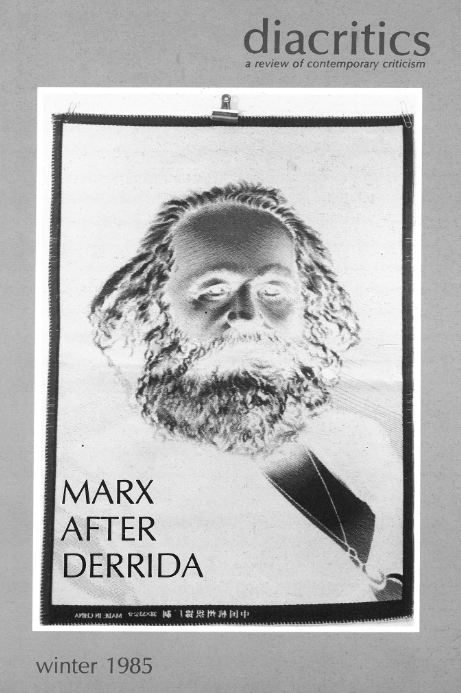
In simple terms, rather than Derrida’s philosophy being a means to “emancipation” (that’s Professor Simon Critchley’s word), Mellor and various Marxists have argued that it actually allows oppressors (of all types) to get away with all sorts of terrible things — such as denying data, facts, argument and reality. After all, if meanings aren’t fixed, and there can be no precision, then doesn’t that allow oppressors (as well as academics with a political goal and a mission to advance their own careers) the ability to literally play with words and meanings, as well as claim that their own — and other people’s — claims, theories, and political ideas don’t have any fixed meanings or any precision?

Indeed, it can be argued that Derrida himself realised all this when he went through his “political turn” late in life and started backtracking on some of his own ideas. (It can be presumed that many loyal fans of Derrida will deny this.) Ironically, this was partly — or even largely — a result of Derrida’s anger at some of the misreadings of his own work! (See note 1 again.)

It seems, then, that Derrida wanted to have his cake and to eat it too.

Baggini carries on his theme of analytic philosophers falsely believing that being as precise as possible is a good thing when he discusses Derrida’s position on what he called “ordinary language”.

Derrida on Ordinary Language

Baggini writes:

“Yet Derrida also sagely said ‘ordinary language is probably right,’ because ordinary language never pretends to have the precision or purity of philosophical speech.”

Surely ordinary language neither pretends to be precise nor to be imprecise. So is this Baggini pitting certain analytical philosophies of language (or philosophical analyses of language) against ordinary language?

What’s more, there have been analytical philosophers of language who certainly did not attempt to make ordinary language more precise than it is, or to “tidy it up”. Analytic Wittgensteinians and J.L. Austin are just two examples of this.

Indeed, you may recall this passage from Baggini used earlier on:

“Philosophers’ attempts to pin down words are as futile as nailing jelly to a wall.”

Now the following is an account of - and also a quote from - J.L. Austin:

The Meaning of a Word is a polemic against doing philosophy by attempting to pin down the meaning of the words used, arguing that ‘there is no simple and handy appendage of a word called ‘the meaning of the word (x)’’. Austin warns us to take care when removing words from their ordinary usage, giving numerous examples of how this can lead to error.”

In any case, many particular laypersons using ordinary language at particular times actually do believe that their use of ordinary language is precise. (That’s the case even if they don’t use the precise word “precise” about their statements and utterances.)

In other cases, other laypersons may not. It depends.

If laypersons were questioned, then it can be presumed that many wouldn’t say that their own uses of language are imprecise. They may admit that their (if put in their own words) arguments aren’t up to scratch or that they have limited data. However, they wouldn’t make Baggini’s (or Derrida’s) (sceptical) philosophical point about the nature of the language they use.

Again, readers can assume that Baggini’s (or Derrida’s) position is about certain philosophies of language (not everyday language or laypersons' views on their own usages) when we see the words

[p]hilosophy’s attempted resolutions of aporias are attempts to tidy up language”

and

“Derrida, in contrast, wants to remind us that language is even less precise, even more equivocal than common sense presumes”.

To repeat. Isn’t it the case that ordinary language (if we forget Baggini’s personification) neither pretends to be precise nor to be imprecise?

All Analytic Philosophers Realists!


One of the most outrageous passages about “the Anglo-Saxon academy” (i.e., analytic philosophers) that Baggini makes is the following:

“In much classical and contemporary analytic philosophy there is an assumption, more or less explicit, that there is a way that things are and that the task of language is to map it, to ‘carve nature at the joints’ as Plato put it.”

This is a generalisation, and perhaps a stereotype too — despite Baggini’s word “much”.

In simple terms, Baggini paints “much classical and contemporary analytic philosophy” as being philosophically realist. In other words, he deems the majority (?) of analytic philosophers to be realists. (See note 5.)

Yet there have been legions of anti-realists among analytic philosophers — dating back to the 1920s or before. These people were analytic philosophers who didn’t exactly question the idea “that there is a way that things are”. Instead, they questioned whether or not we can know the way things are… as they are.

It can be argued that the “analytic” positions of logical positivism, semantic anti-realism and scientific instrumentalism — arguably — all took a non-realist (if not always anti-realist) positions. In terms of names, we have the anti-realists (or non-realists) Michael Dummett, Hartry Field, Simon Blackburn, Bas van Fraassen, Robert Brandom, John McDowell, Michael Williams, etc.

So it’s also worth reading Lee Braver’s ‘Antirealism and the analytic-continental split’, in which he cites Wittgenstein, Quine, Davidson, Putnam, (Nelson) Goodman as being anti-realists. In addition, we have the Stanford Encyclopedia of Philosophy’s entry ‘Challenges to Metaphysical Realism’, which concentrates exclusively on various analytic philosophers who’re also anti-realists. Indeed, the philosopher Thomas Nagel castigated Ludwig Wittgenstein, Wilfred Sellars, Hilary Putnam, W.V.O. Quine, etc. for being anti-realists… or worse (see here)!

More particularly, various analytic philosophers have questioned the very idea of “carving nature at the joints”. Indeed, they’ve even used those very words and put them in scare quotes!

All that said, the literature on anti-realism and realism is huge and complex. Thus, admittedly, it’s not always clear (to me at least) which analytic philosopher is, or is not, an anti-realist. Added to that is the problem that a philosopher can be an anti-realist in one area of dispute, but not in another.

To jump to a very different attack by Baggini on analytic philosophers.

Baggini writes:

“Despite the way the Anglo-Saxon academy often bundles him in with them, Derrida was never one of the postmodernists.”

The problem here is that many fans of Derrida also “bundle[] him in with” the postmodernists. (The literary critic Catherine Belsey is a good example of this. See my Poststructuralism and Deconstruction as Forms of (Linguistic) Idealism’.)

Baggini himself tells us why this bundling goes on when he continued with these words:

[Derrida] did, however, share the movement’s distrust of grand narratives that provide single, and often simple, explanations that erase the complexities of the real world.”

Perhaps the Anglo-Saxon academy (whatever that is) picked up on “the movement’s distrust of grand narratives”, and that was at least partly why it too bundled Derrida in with the postmodernists.

Judging by this video (mentioned earlier, and in which Baggini is at pains to distinguish Derrida from postmodern philosophers — although that’s all he says), what Baggini states in in his article on Derrida, as well as on what other fans of Derrida who’ve written on this postmodern philosophers/Derrida distinction, the simple idea is that much postmodern philosophy is false, extreme and very silly, whereas Derrida’s philosophy is deep, profound and serious…

However, from an outside viewpoint looking in, this is very hard to see. Indeed, Derrida (when he can be understood) often seems to utter more falsehoods, be more extreme, and state sillier things than at least some postmodern philosophers I can think of.


Notes

(1) We have titles such as: ‘Limited Think: How Not to Read Derrida’, ‘Misreading Generalised Writing’, ‘Creative misreading and bricolage writing’, ‘In Praise of ‘In Praise of Overreading’’, etc.

But what of Derrida himself?

The following passage (from is Limited Inc) is Derrida responding to John Searle:

[H]ow can [Searle] discuss, and discuss the reading of what he writes? The answer is simple, this definition of the deconstructionist is false (that’s right: false, not true) and feeble: it supposes a bad (that’s right: bad, not good) and feeble reading of numerous texts, first of all mind, which therefore must be read or re-read.”

(2) The words “anally-retentive” and “semantic fascist” are used — at least partly — because Derrida himself once gave a psychoanalytic account of a well-known critic of his — the (analytic) philosopher John Searle. According to the “poet, writer and critic” Omar Sabbagh:

“Derrida attributed some of Searle’s arguments to a psychoanalytical mourning and/or killing of the father — JL Austin in Searle’s particular case!”

See an account of the Derrida-Searle debate here.

(3) I did find this video in which Baggini defends what he calls “objectivity” (if with various small qualifications). He also says that Derrida “wasn’t a postmodernist”. That’s about it — from Baggini — on Derrida in this video.

(4) The phrase “the Anglo-Saxon academy” isn’t original to Baggini. See this Google search here, in which this phrase is used in an almost exclusively negative way.

(5) Julian Baggini doesn’t mention either carrying out a survey or consulting one. I consulted ‘The 2020 PhilPapers Survey’ by the philosophers David Chalmers and David Bourget.

In terms of ontological realism (which is the relevant kind of realism when it comes to phrases such as “carve nature at the joints”), the survey tells us that 38% of those analytic philosophers surveyed deemed themselves to be “realists”, 28% deemed themselves to be “anti-realists”, and 11% deemed themselves to be “deflationary realists”. That last designation is fairly new, and, to many in the field, it’s simply a qualified kind of anti-realism.

The strong metaphysical realist Ted Sider (in his paper ‘Ontological Realism’) certainly sees ontological deflationism as a kind of anti-realism. He wrote:

“These critics — ‘ontological deflationists’, I’ll call them — have said instead something more like what the positivists said about nearly all of philosophy: that there is something wrong with ontological questions themselves. Other than questions of conceptual analysis, there are no sensible questions of (philosophical) ontology. Certainly there are no questions that are fit to debate in the manner of the ontologists.”

So, if deflationary realism is a kind of anti-realism, then that would mean that, of those surveyed, 39% deemed themselves to be “anti-realists”. That’s 1% more than those who deemed themselves be “realists”. Of course, this all depends on whether or not deflationary realism actually is a kind of anti-realism. And that difficulty is perhaps partly shown by the fact that many respondents didn’t (or couldn’t) designate themselves either way. That is, 39% + 38% = 77%, which leaves 23% who replied with the words “don’t know”.

Sometimes I reply “don’t know” on aspects of the well-worn subject of realism vs anti-realism!

(*) My final essay on Julian Baggini’s Derrida will follow shortly.

My flickr account and Twitter account.


Wednesday, 23 August 2023

Julian Baggini (Philosopher & Journalist) on the Anti-Derrida “Cambridge Affair” of 1992

In 2020, Julian Baggini wrote a piece on Jacques Derrida for the magazine Prospect. It’s called ‘Think Jacques Derrida was a charlatan? Look again’. He starts off with a retrospective account of what came to be called “the Cambridge Affair”. In Baggini’s own words: “In May 1992, academics at the University of Cambridge reacted with outrage to a proposed honorary degree from their venerable institution to Jacques Derrida.” Baggini then spends some time on that affair, and has strong words to say against members of what he calls “the Anglo-Saxon academy”. This is my own response to Baggini’s words.

Julian Baggini and Jacques Derrida.
“A certain sort of analytic philosopher who dismisses as meaningless what does not instantly make sense to his shallow pate. [] I coined a name for people like him: ‘philosophistine.’ A philistine out of his depth among real philosophers.”

Bill Vallicella [See source of quote here.]

Julian Baggini is a British philosopher, writer and journalist. His Prospect article on Jacques Derrida (‘Think Jacques Derrida was a charlatan? Look again’) is relentlessly positive — even deferential. Indeed, even when various criticisms of Derrida are broached, they’re summarily dismissed.

Baggini offers his readers two (if implicit) alternatives:

(1) If readers have made “a serious attempt to read” Derrida, then they’ll realise that he was a (to use Baggini's words) "true philosopher". 
(2) If readers believe that Derrida wasn’t a true philosopher (or, worse, if they believe that he was a “charlatan”), then they simply can’t have made
a serious attempt to read him.

So, in the light of Baggini’s unceasing positivity toward Derrida, this essay is critical of both Derrida and Baggini himself.

Yet had Baggini expressed at least some qualms about Derrida and his work (he does tackle other people’s qualms), then my own essay will have included at least some positive remarks about the dead French philosopher.

An Event at Cambridge University in 1992

It can be supposed that Julian Baggini simply couldn’t resist mentioning an infamous event which occurred in 1992. He wrote:

“In May 1992, academics at the University of Cambridge reacted with outrage to a proposed honorary degree from their venerable institution to Jacques Derrida. A letter to the Times from 14 international philosophers followed, protesting that ‘M Derrida’s work does not meet accepted standards of clarity and rigour’.”

Here’s another account (as found in the journal Sophia) from Jeffrey Sims at the University of Toronto:

“Conscientious objection from Professor Barry Smith and 18 others ensured a period of debate in the English press pertaining to issues of academic freedom, and academic responsibility. [] Smith’s letter to The Times is congruent with the efforts of four senior dons who announced a ‘non placet’ vote when the proposed degree was originally announced in March, 1992. The declarations came from David Hugh Mellor [who’ll be discussed later], Ian Jack, Raymond Ian Page, and Henry H. Erskine-Hill.”

Baggini himself continues by telling us that

[t]o them Derrida was a peddler of ‘tricks and gimmicks,’ a cheap entertainer whose stock in trade was ‘elaborate jokes and puns.’”

Baggini doesn’t seem to have much time for analytic philosophers or what he calls “the Anglo-Saxon academy”. (As opposed to Derrida’s Latin Academy? Or, say, the Teutonic Academy of Martin Heidegger and Paul de Man?) Alternatively and less strongly, is it that Baggini simply doesn’t have much time for those who’re critical of Derrida?

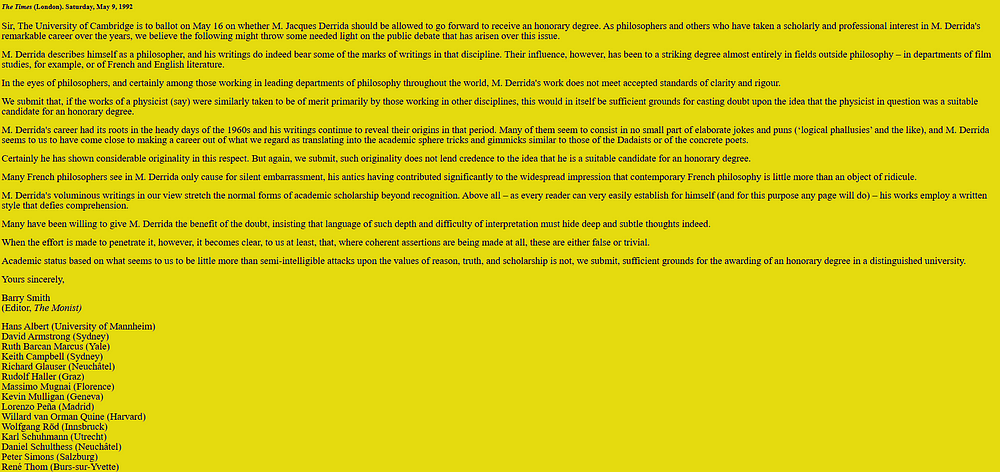
The letter to The Times.

Despite the innuendos, the letter to The Times certainly wasn’t signed by some kind of cabal of snobby and elitist English (or perhaps British) philosophers. (Derrida himself has attracted many elitist and privileged academics.) So Baggini also needs to bear in mind the signatories of the letter against Derrida included Germans, Italians, Spaniards, Austrians, Poles, Dutch, Swiss, etc…

Sure, perhaps they were all “analytic philosophers”, regardless of their nationalities. (I don’t know.)

In any case, that list included the following names:

Hans Albert (University of Mannheim)
Richard Glauser (Neuchâtel)
Rudolf Haller (Graz)
Massimo Mugnai (Florence)
Lorenzo Peña (Madrid)
Wolfgang Röd (Innsbruck)
Karl Schuhmann (Utrecht)
Daniel Schulthess (Neuchâtel)
René Thom (Burs-sur-Yvette)
Jan Wolenski (Cracow)

Added to international nature of these signatories (admittedly, Baggini does use the words “international philosophers” himself) are these words from the letter to The Times:

“Many French philosophers see in M. Derrida only cause for silent embarrassment, his antics having contributed significantly to the widespread impression that contemporary French philosophy is little more than an object of ridicule.”

Indeed, even a fan of Derrida (a Professor E.S. Schliesser) had the following to say about the signatories:

“They are an eclectic mix of anglo-phone analytical philosophers, anglo-phone ‘analytical’ historians of 19th and 20th century philosophy, European and anglophone Husserlians, European ‘Austrian’ philosophers, European analytical philosophers, and a few whom I wouldn’t know how to characterize.”

Have Derrida’s Critics Read Derrida?

More relevantly, Baggini informs us that

“Salmon concludes that ‘none of them had taken the time to read any of Derrida’s work’”.

Baggini himself claims that

[i]t would have been understandable if some had tried but quickly given up”.

Indeed, almost all the defenders of Derrida have simply assumed that none of the signatories had read Derrida.

For example, there’s a podcast called ‘Judging Philosophers You Haven’t Read’ on the “Cambridge Affair”. Then there’s Terry Eagleton’s article for the Guardian newspaper (called ‘Don’t deride Derrida’), in which he wrote the following:

“English philistinism continues to flourish [] Either they hadn’t read him, or they believed his work was to do with words not meaning what you think they do [].”

[See note.]

The American philosopher John D. Caputo didn’t claim that the signatories hadn’t read Derrida at all. Instead, according to Jeffrey Sims, he was

“ready to celebrate the idea that many of those found on Smith’s list of signatories may not have even read Derrida adequately”.

“Adequately”? What does that mean?

Should they have read Derrida to such an extent that they became positive about the French philosopher?

So how long does that take?

Now take these words from the podcast ‘Judging Philosophers You Haven’t Read’ mentioned earlier:

“How many of his books had they read? [] I’ve read about a dozen of them [] I seriously doubt that most of the signatories to the letter had read more than a smattering of Derrida’s work. Most of them would have likely read one or two of his books (more likely skimmed it), failed to understand what they were reading [] lost patience and probably their temper, and quickly stopped reading.”

In any case, Sims says that it “might be [] reasonable” to ask such questions about the signatories. However,

“it may be difficult for Caputo to know just how much of Derrida these philosophers have actually read”.

Yet the claim that the signatories of the letter (perhaps all of Derrida’s critics) haven’t read Derrida is simply false…

That’s right — false!

Sims continued:

“Clearly, as Barry Smith points out, some have read more of Derrida (J. Claude Evans, John Searle, and Kevin Mulligan) while others admit to having read less.”

Again, how much time should these philosophers have spent on Derrida?

As much time as Julian Baggini?

As much time as a biographer of Derrida, such as Peter Salmon himself?

As for the main signatory of the letter, Professor Barry Smith, he said:

“Certainly some of the many criticisms of Derrida’s work are not based on a scholarly understanding of the relevant literature to which Derrida is reacting. But I have endeavoured to be a serious critic of Derrida. I have taken the trouble to read his work [].”

And, in response to the question “What exactly were you reading [when Smith was in his 20s and 30s] in terms of French thought?”, Barry Smith replied:

“Sartre, Merleau-Ponty, Foucault, Camus []. But I rapidly became more and more interested in Central and Eastern European philosophy, and more specifically in Austrian philosophy. Over the years I became friendly with quite a number of philosophers in Eastern Europe. I collaborated with a number of people in Hungary, Poland, the Czech Republic (as it is now called), and I travelled a lot there, as well as in Austria and Germany.”

Now take Eric Schliesser’s words again:

“It is sometimes noted that it is extremely unlikely that most of the signers had read much more of Derrida than I had by the time I left graduate school. What is not noted is that it is extremely unlikely that these signers had read much of each other.”

As for the other critics of Derrida who signed the letter to The Times: had they read Derrida?

Isn’t it obviously the case that those philosophers who’ve sniffed what they believe to be a lot of (to use Hugh Mellor’s word) “bullshit” in Derrida’s work, won’t have wanted to spend too much time on him?

So how much time did Derrida spend on, say, the Anglo-Saxon W.V.O. Quine?

And how much time has Peter Salmon spent on, say, Bas van Fraassen, Jaakko Hintikka, or Hugh Mellor?

I suppose the argument here would be that Derrida didn’t write a letter to The Times stating his (negative) views about another philosopher.

And neither has Peter Salmon.

That’s true… Well, Derrida and Salmon didn’t do so to The Times anyway.

However, I’ve come across a hell of a lot of poststructuralists, postmodern philosophers, “theorists”, etc. who’re fiercely critical of analytic philosophy, yet who’ve hardly read a word of it.

So it works both ways.

Baggini himself provides no evidence that the signatories hadn’t read Derrida. Indeed, all this (as least as far as Baggini’s article is concerned) seems to be a conclusion based on a reference to the term “logical phallusies”, which these supposedly ignorant analytic philosophers claimed Derrida used in a letter.

In the book which Baggini was reviewing in his Prospect article (An Event, Perhaps: A Biography of Jacques Derrida), Peter Salmon says that Derrida never used such a term.

So what about the actual use of that term “logical phallusies” itself?

This is the passage from the original letter to The Times:

“Derrida’s career had its roots in the heady days of the 1960s and his writings continue to reveal their origins in that period. Many of them seem to consist in no small part of elaborate jokes and puns (‘logical phallusies’ and the like) [].”

Is this all that Salmon (as well as Baggini) have to go on?

This reference to “logical phallusies” was hardly the sole basis of the philosophers’ case against Derrida. It was something said in passing — and in parenthesis! — in a single letter. However, because Peter Salmon is a biographer of Derrida and a loyal fan, he picked up on this.

Baggini himself also says that

[t]he irony is that the protests showed a shocking lack of rigour themselves”.

Sure, perhaps a lack of research when it came to a single term.

However, is this single misattribution really that relevant in this overall debate about Derrida?

Perhaps all Peter Salmon is showing us is that he’s a scholar of Derrida, whereas most of Derrida’s critics… aren’t scholars of Derrida. Thus, like all experts, Salmon probably found it very easy to spot mistakes (or a single mistake in a single letter) when it came to the minutiae of Derrida’s biographical detail.

Hugh Mellor on Jacques Derrida

Hugh Mellor (D.H. Mellor)

Now take the case of one philosopher associated with this (as it were) campaign against Derrida — Hugh Mellor (D.H. Mellor).

As already quoted, Mellor was one of the

four senior dons who announced a ‘non placet’ vote when the proposed degree was originally announced in March, 1992”.

Mellor stated that Derrida

“is a mediocre, unoriginal philosopher — he is not even interestingly bad”.

What’s more, Mellor added that it had been “a bad year for bullshit in Cambridge”.

More relevantly, Mellor had read Derrida!

Take the following words from Mellor:

“Some of Derrida’s early work was interesting and serious. But this isn’t the work he has become famous for, and which led to him being put forward for an honorary degree. That is much later work which seems to me wilfully obscure.”

Of course, Mellor might have got Derrida wrong or simply been uncharitable.

Alternatively, he might simply not have been able to understand him correctly. (Perhaps he should have got Derrida via people like Julian Baggini or Peter Salmon.)

Mellor then gave his reasons for his “‘non placet’ vote”:

“If you spell out these later doctrines plainly, it becomes clear that most of them, if not false, are just trivial.”

Indeed, that sentiment can be found in the original letter (not written by Hugh Mellor) to The Times:

“When the effort is made to penetrate it, however, it becomes clear, to us at least, that, where coherent assertions are being made at all, these are either false or trivial.”

Mellor himself then cited an example:

“Take the fact that the writing down of a signature must have been present at whatever time in the past it was done. Now you can make this truism sound mysterious, as Derrida does. But there’s nothing mysterious about it: it’s just trivially true that if an action leaves a trace, then the trace will always be of something in the past that was once present.”

Now readers can be very sure that Peter Salmon will fault all this. However, it at least shows that Mellor had (tried to?) read Derrida.

In any case, Mellor concluded in the following way:

“So one objection is that Derrida goes in for mystery-mongering about trivial truisms. But he also mixes these truisms up with silly falsehoods, which, if believed and acted on, would cripple intellectual activities of all kinds.”

All the above may well be wrong. (Derrida’s ideas will be discussed in the next essay.)

It may be naïve.

It may itself be (to use Mellor’s own word again) “bullshit”.

What’s more, some of the things Mellor says on this subject I disagree with.

However, Mellor had read Derrida.

Conclusion

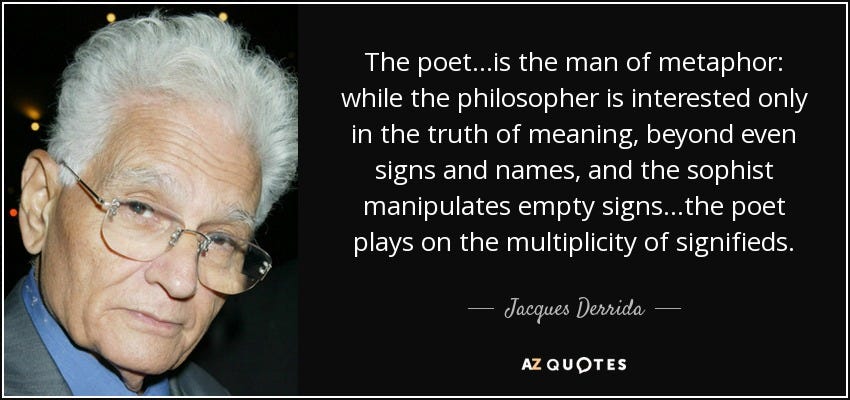
Quote from Derrida’s Margins of Philosophy.

On a personal note, I’ve been attempting to understand Derrida since the late 1990s. So perhaps that partially explains one major problem here.

Oddly enough, Julian Baggini acknowledges this when he admits that Derrida was a (well) show-off. Or, at the very least, Baggini quotes Derrida saying (of himself) that he was an “an incorrigible hyperbolite,” and that he would “always exaggerate”. Yet, of course, Baggini immediately (as it were) takes that back when he says that “[y]ou can see why Derrida’s writing could never have been clear and plain”. What’s more:

“Hence Derrida’s difficult style, far from being an affectation, is an inevitable requirement of his philosophy.”

All that said, my own lack of understanding can be explained in three — and probably more - ways:

(1) I’m (philosophically) dumb, I have a “shallow pate”, and/or I’m one of Terry Eagleton's “philistines”. 
(2) I’m biased and prejudiced against Derrida. 
(3) Derrida designed his prose (or his actual philosophy) to be only partially understand. What’s more, there isn’t that much to understand anyway, and what can be understood is often (to use Hugh Mellor’s word again) “trivial”.

As for the philosophers who signed the letter to The Times.

Perhaps some (even all) of them were merely being tribal in their criticisms of Derrida.

However, they don’t seem to have been nearly so tribal as Julian Baggini, Peter Salmon, Terry Eagleton, etc. have been in their responses to the now infamous “Cambridge Affair”. After all, words such as “English philistinism continues to flourish”, “Anglo-Saxon academy”, “it would have been understandable if some had tried [to read Derrida]”, “a shocking lack of rigour”, “none of them had taken the time to read any of Derrida’s work”, “remarkably sloppy”, “[John Searle] was snide and condescending”, etc. are hardly conducive to fostering dialogue and debate.

As stated earlier, it works both ways.


Note

(1) Terry Eagleton’s words about Derrida’s critics believing that “his work was to do with words not meaning what you think they do” are truly a (to use his own term about Derrida’s critics) “bone-headed” response to the philosophers who signed the letter to The Times. I doubt that a single philosopher has come even close to holding that position on Derrida’s work.

(*) See my ‘Philosopher Julian Baggini on Derrida and the Anglo-Saxon Academy’.

My flickr account and Twitter account.



Wednesday, 16 August 2023

‘A new study says [x]’: A Vacuous and Overused Headline?

The headline ‘A new study says [x]’ can often be found in newspapers and the media generally. Why do journalists use it? And what is the general status of such studies? These questions relate to our attitudes to science itself, as well as to our attitudes to particular studies, published at particular times on particular subjects. One study has shown that the “academic system incentivises journals and researchers to publish exciting findings”. An important consequence of this is that many studies end up being just plain “wrong”.

(i) Introduction
(ii) A New Study Says [x]
(iii) A Scientific Study About Scientific Studies
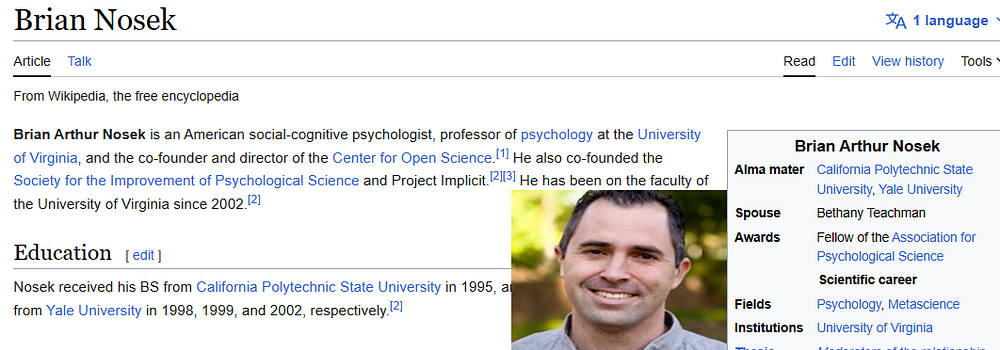
(iv) Professor Brian Nosek on Scientific Studies
(v) Other Media Clichés About Scientific Studies
(vi) Conclusion

Scientists and academics are human beings.

Scientists and academics have strongly-held values and strongly-held political beliefs.

Scientists and academics have strong emotions and feelings.

Scientists and academics have good careers and are usually tenured.

Scientists and academics need to pay their mortgages, bills, the school fees of their children, go on holidays, buy new homes, cars, computers, clothes, etc.

Most scientists and academics are funded by various and many bodies and institutions. They also work for — or actually within — governments, political parties, university departments (some with strong political and/or scientific biases), corporations, global institutions (such as the Intergovernmental Panel on Climate Change), thinks tanks (or policy institutes) and activist/pressure groups (such as The Heartland Institute and the Union of Concerned Scientists), the European Union, pharmaceutical/oil/etc. companies…

So it’s worth bearing all that in mind in the context of the following little story.

At the end of July I was reading a copy of the free newspaper Metro. In it, there were three short news items side by side. Two included the headline ‘A new study says [x]’, and the other one used the words “research shows” in the subtext.

These phrases are used all the time in national newspapers, on websites, and on social media. In fact, when it comes to national newspapers, it can safely be assumed that each publication will include at least one item every day which has the headline ‘A new study says [x]’.

There are also some odd examples of news items which have the headline ‘A new study says [x]’. Take these examples (which were easy to find):

‘Groundbreaking new study says time spent playing video games can be good for your well being’, ‘ChatGPT’s Performance Is Slipping, New Study Says’, ‘Some Extra Heft May Be Helpful, New Study Says’, ‘Climate change is leading to more home runs, says new study’, ‘People aged under 40 should not drink alcohol and consumption guidelines should be changed, study says’, ‘Bradford beats London for business startups, says new study’, ‘A new study says only working out on the weekend is just fine (and here’s how to do it)’, ‘Tip or no tip? Over 65% of U.S. have negative view on tipping, new study’, ‘Can You Be Overweight & Healthy? A New Study Says It’s Possible’, ‘A new study says it’s okay to eat red meat. An immediate uproar follows’, ‘New Jersey is one of the best places to live and work in the US, new study says’, ‘Turn off that camera during virtual meetings, environmental study says’, ‘Is Coffee Good For You? A New Study Says It Is’, ‘Children Who Are Exposed to Awe-Inspiring Art Are More Likely to Become Generous, Empathic Adults, a New Study Says’, ‘Is sitting always bad for older adults? A new study says maybe not’…

Ironically enough, we also have the following titles:

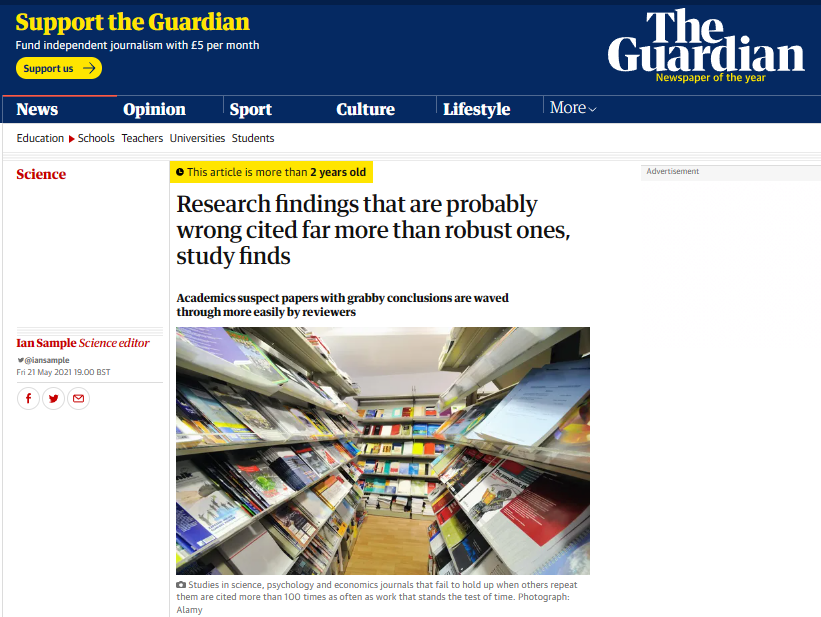
‘Most scientific papers are probably wrong’, ‘Study: half of the studies you read about in the news are wrong’, ‘Why Most Published Research Findings Are False’, ‘This is why you shouldn’t believe that exciting new medical study’, ‘New Study Says There Are Too Many New Studies, New Study Finds’, ‘Over half of psychology studies fail reproducibility test’, ‘Research findings that are probably wrong cited far more than robust ones, study finds’, ‘Is Most Published Research Really False?’
‘A new study of a new study which says that most new studies are wrong is wrong’

That last one is a joke!

Yet we do have this study: ‘Ioannidis (2005) was wrong: Most published research findings are not false’.

So now readers can wait for a study called, ‘The study which claimed that ‘Ioannidis was wrong to claim that most studies are wrong’ was itself wrong’. (Incidentally, Professor John Ioannidis’s research findings will be discussed later.)

In any case, every day there will be dozens — perhaps hundreds — of studies published. There’s also vast amounts of research being carried out all the time by numerous scientists, academics and graduates. Hundreds of studies and papers are published every month…

And all that largely explains why newspaper editors and journalists find it so easy to write news items with the headline ‘A new study says [x]’.

So I suggest that readers put the words ‘A new study says…’ into the Google search engine. (One set of results can be seen here.)

I personally found 50 ‘A new study says [x]’ headlines, and then I gave up counting. There are 20 Google pages of links with the headline ‘A new study says [x]’. And then, for some reason, the Google search just comes to an end. (Readers can presume that it could have gone on for a lot longer.)

So what are we meant to make of the news headline ‘A new study says [x]’?

A New Study Says [x]

This essay is going to stick to the words ‘A new study says [x]’, rather than going into the details of particular studies, or the details of the news items about particular studies. That said, there’ll be a small amount of commentary on the studies themselves.

That aforementioned distinction between scientific studies and new items about those studies is relevant here because journalists may simply get things wrong.

A news item on a scientific study may also be extremely biased.

What’s more, the news item (or journalist) may ignore various important parts of the study, and play up various unimportant parts.

All this is very easy to do, either wilfully or through basic ignorance.

On another theme.

What a new study says may be false.

Some parts of what a study says may be true, and other parts may be false.

What a study says may also be irrelevant, trivial, plagiaristic, biased, a waste of time, etc.

What’s more, what a new study says is often contradicted at a later point. Indeed, sometimes new studies are strongly contradicted within weeks (or less), but usually the contradictions come much later.

In addition, the headline ‘A new study says [x]’ is often meant to give legitimacy to whatever the news item is about. Basically, sometimes it’s the journalist himself who’s using the headline ‘A study says [x]’ to give credence to what he believes anyway. Editors may also publish stories about studies (or research) simply to fill space. Who knows, they may sometimes do so to enlighten their readers.

A Scientific Study About Scientific Studies

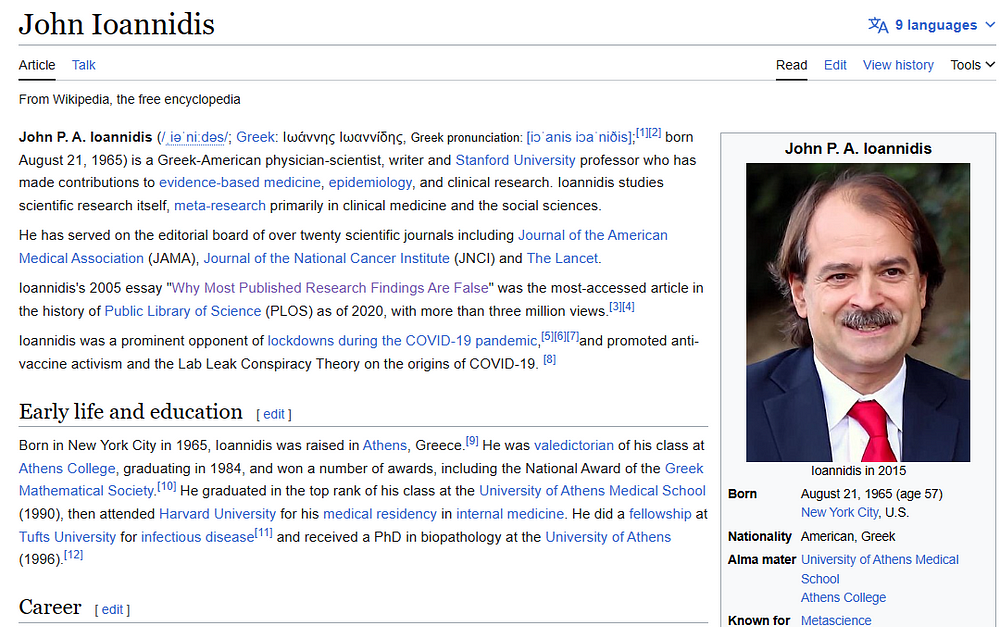
There’s a study called ‘Why Most Published Research Findings Are False’, which was written in 2005 by Professor John Ioannidis of the Stanford School of Medicine.

[When I Googled the words ‘A new study says…’, as mentioned earlier, I couldn’t find this particular new study. It was discovered via other means.]

Some readers may spot that there’s a self-referential problem here. The Guardian newspaper, for example, picks up on the self-reference when it says that this study “is itself not exempt from the need for scrutiny”.

In any case, one passage in ‘Why Most Published Research Findings Are False’ says something which many laypersons have known for decades. Professor Ioannidis wrote:

“There is increasing concern that in modern research, false findings may be the majority or even the vast majority of published research claims.”

What’s more:

“Published research findings are sometimes refuted by subsequent evidence, with ensuing confusion and disappointment.”

All this has been especially true about dietary matters or issues relating to food and health.

There’s also “controversy” over and above what is “refuted” in these studies. As Ioannidis put it:

“Refutation and controversy is seen across the range of research designs, from clinical trials and traditional epidemiological studies to the most modern molecular research.”

Is it really the case that, as Dr Marta Serra-Garci (who studies behavioural and experimental economics at the University of California) puts it, some studies “conclude that something is true or not based on one study and one replication”?

Readers may also wonder why certain (scare-quoted) “scientific” disciplines are more prone to bullshit than others.

Professor Brian Nosek on Scientific Studies

Professor Brian Nosek (at the University of Virginia) tells us that “[w]e presume that science is self-correcting”. Indeed, many scientists do say that science is self-correcting. (Perhaps Nosek meant fellow scientists — not people as a whole — by his word “we”.)

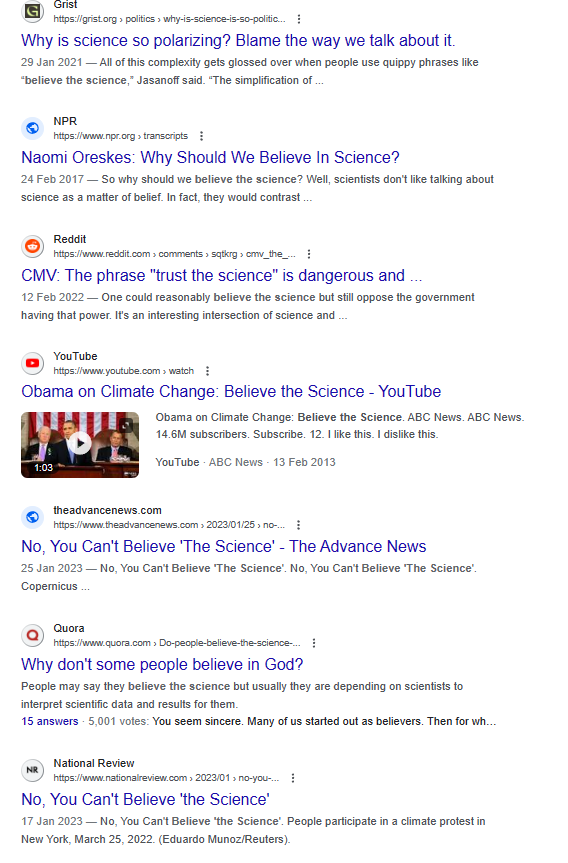
For a start, it’s not really the case that most laypersons presume that science is self-correcting. Most laypersons may well (as it were) believe in science (whatever that means). However, that probably isn’t because they also believe that science is self-correcting

Actually, it depends.

It depends on how much a particular (to put it crudely) pro-science layperson thinks about the nature of science.

Put it this way.

Many of those people who see themselves as being pro-science think less about the actual (philosophical and otherwise) nature of science (or read less science books and papers) than many of those who’re critical of science. Anecdotally, this is something I’ve come across many times — especially in political contexts. Particularly, claiming to be “pro-science” is often simply a way of also saying that one’s political opponent is anti-science.

To get back to Professor Nosek’s words:

[E]rrors will happen regularly, but science roots out and removes those errors in the ongoing dialogue among scientists conducting, reporting, and citing each others research.”

This is a simple point about the communal nature of (all? most? much?) science.

In basic terms.

On the large-scale and over (relatively) long periods, science often is self-correcting. However, particular scientists, particular groups of scientists, particular scientific journals, particular scientific departments, etc. are often not self-correcting. Or, at very least, they aren’t self-correcting to a satisfactory degree. (It would be hard to even imagine any scientist, scientific group or scientific institution never indulging in self-correction.)

In detail.

Even most scientists accept the problem of political and other kinds of bias in scientific work. So in this particular case, biased scientists don’t (to use Professor Nosek’s words) “root out and remove errors” when those errors work in support of their political — and otherwise — biases. Or, as it’s often been put, the errors will be retained if they work toward the conclusion (or thesis) that these scientists wanted to arrive at from the very beginning.

More relevantly, when a particular news headline tells us that ‘A new study says [x]’, then this may be a study by a group of scientists who weren’t sufficiently self-correcting. Indeed, in isolated cases, some scientists aren’t self-correctors at all.

All this ties in with Nosek’s words that

“dialogue among scientists conducting, reporting, and citing each others research”.

But what if many (even all) the other scientists engaged in a particular “dialogue” are also biased in the same way or ways?

What if they adhere to the same theories, worldviews, etc?

Thus, how will dialogue work (or help) in this case?

If anything, “citing each others research” would only compound (or solidify) the bias and/or lack of self-correction.

Professor Nosek himself admits that scientists aren’t always self-correcting. He says:

“If more replicable findings are less likely to be cited, it could suggest that science isn’t just failing to self-correct; it might be going in the wrong direction.”

Nosek also picks up on a point that undergraduate philosophy students - and almost everyone else with a logical mind — does (or should) spot. He tells us that it’s often the case that when it comes to the conclusions of particular studies, the “evidence is not sufficient to draw such a conclusion”. (Nosek believes this is true of many studies.)

The problem here, Nosek argues, is about the “social systems of science” which don’t “foster self-correction”.

Interestingly and relevantly, many scientists have been critical of what the philosophers Thomas Kuhn and Paul Feyerabend (along with many others) have said about the (to use Nosek’s words) social systems of science. However, we must add here that actual scientists have said similar things too. The thing is, many scientists will admit to various shortcomings when it comes to scientific practice, but virulently deny such things when it comes to science itself.

[To take just one example of a scientist who’s aware of scientific bias and the sociology of science, see theoretical physicist Lee Smolin’s ‘How Do You Fight Sociology?’ chapter in his book The Trouble With Physics. This specifically deals with the decades-old social systems of string theory.]

So now take this very Kuhnian passage from the aforementioned Guardian article:

“The academic system incentivises journals and researchers to publish exciting findings, and citations are taken into account for promotion and tenure. But history suggests that the more dramatic the results, the more likely they are to be wrong.”

So do we really have science on the one hand, and the social systems of science on the other hand?

Some “radical” philosophers of science (such as the ones just mentioned), as well as historians of science, have strongly questioned this bifurcation or binary opposition.

More relevantly, when we read the phrase ‘A new study says [x]’, we should be aware — at least to some degree — of the (to use Professor Nosek’s words again) social systems of science in which that study was embedded.

Other Media Clichés About Scientific Studies

The headline ‘A new study says [x]’ can even be taken to be a journalistic cliché. So now let’s looks at some other examples.

Take this headline: ‘A new study says that [x] might lead to [y]’.

A lot of other headlines (or actual studies) say that ‘[x] might be [y]’, ‘[x] could be [y]’ or ‘[x] could occur if [y]’.

The (very) important word here is might.

To be extreme for a moment. x might lead to all sorts of things. The probability of x leading to y may also be fantastically small. What’s more, the fact that it’s a fantastically small probability may not even be mentioned in the news item (or even the study) itself.

Indeed, there could be a flying teapot floating around the Sun (see ‘Russell’s teapot’). The Royal Family may be controlled by alien reptiles (see here). The world could come to an end on August the 20th, 2023. There could be philosophical zombies. Etc.

So saying that something could happen (or that something could be the case), may not be much of claim. Of course, the news item (or actual study) will still have the veneer of being important — even very important.

So all this has to be placed within the context of the infinite number of things which could be the case. What’s more, if ‘A new study says [x] is going to happen’, then another study (perhaps published the day after) may say that[x] is unlikely to happen’.

In other news headlines about studies (as well as the studies themselves) we also have the common, “[x] has been associated with [y]”. Again, and at an extreme, anything can be associated with anything else. [See note.]

Yet many journalists and editors don’t care about all this.

Indeed, even if journalists don’t sympathise with the explicit or implicit politics of the study (i.e., if they don’t want to “weaponize” it), or even care about the science of the study, then they may still write a titillating and saleable news item with the headline ‘A new study says [x]’. After all, most editors love this kind of stuff.

Conclusion

It must now be said that criticising particular scientists and particular studies is sometimes — indeed often — deemed to be what’s called “anti-science”. Yet seeing all such criticisms as being anti-science is itself very… anti-science. Or, at the very least, it’s very unscientific. In other words, this conflation of science itself with particular scientists and particular studies saying particular things at particular times is very unscientific.

More relevantly, this conflation of science itself with whatever a new study says is scientifically naïve.

However, it can be acknowledged that taking such a view of science may lead some people to arbitrarily pick and choose which scientists or scientific studies to believe. Yet that’s also certainly the case with many of those people who conflate particular scientists, particular scientific institutions or particular studies with (what’s now come to be called) “the science”.

Finally, all the above isn’t to argue that all studies are false, biased or a waste of time…

However, there are many good reasons (some just discussed) to believe that many studies are.

Of course, it would need to be explained why certain studies are false, biased or a waste of time, and others aren’t. And that explanation may itself display biases or simply show personal interests or concerns. It can also be suspected that most people do deem various (even many) studies to be false, wrong, biased or simply a waste of time. Of course, these conclusions too will probably involve at least some bias or personal interest.

Yet these controversial — often fierce — debates about what studies say are a very good thing… for science.


Note

(1) The guilt by association trick is used a hell of a lot in politics and on social media. For example, Person A is — as the phrase has it — “linked to” (nefarious) Group Y or Person Z in order to discredit that person. Yet that link may well be very weak or completely irrelevant. Still, the journalist’s (or activist’s) purpose is to plant that link into the minds of his viewers or readers.