Wednesday, 3 December 2025

When X’s Grok 3 Explains Posts


I was a bit of a latecomer to Grok as I only started using it a couple of weeks ago. [June 2nd, 2025.] And I must admit that I was very impressed with it. That said, I’m talking specifically about Grok on X, how it comments on philosophical subjects, and summarises my own essays. I used that latter option to add it to the X posts which are linked to my essays. Hopefully, this provides readers with another way of approaching the subjects I tackle.
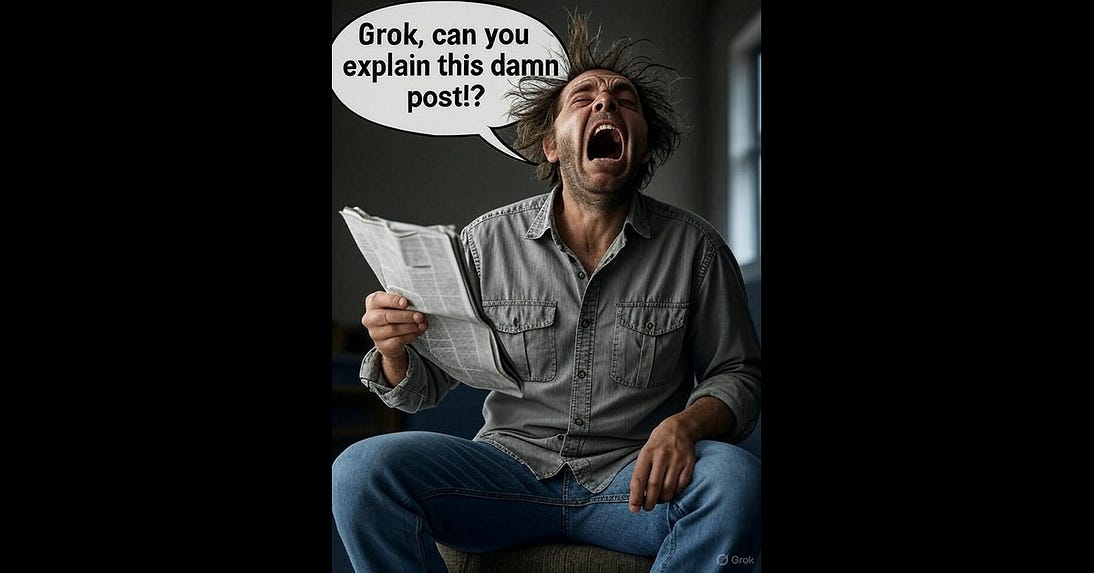
Image created by Grok, according to my specifications.

In the following, I’ll be relying on a few Medium “stories” to get my points across.

Often, Grok puts things better than I do. Indeed, I’m perplexed about how good its grammar or sentence structure is. (The technical AI reasons for this won’t be discussed in this essay… because I can’t do so.) Indeed, I believe that Grok’s prose style is superior to that of many academics.

So Grok does have a prose style. That is, all of Grok’s explanations seem to be written in the same style. It can be categorised as being midway between academic writing and a more informal (or “conversational”) style. They’re certainly easy to read, unlike much purely academic work.

Of course, sometimes Grok does get things wrong. For example, its following words are drastically wrong:

“The post questions the essence of analytic philosophy, highlighting its focus on logical analysis and universal truths.”

It’s wrong in two ways: (1) That was not what I argued. (2) And most analytic philosophers have certainly not focused on “universal truths”. However, this didn’t shock or disturb me.

So take a look at this title to a Medium article on Grok: ‘I Asked Grok (AI) A Question And The Answer Was So Wrong!’

So what!

All human beings get questions wrong too. They even get questions “so wrong”! This raises the interesting question as to why this writer expects Grok to be superior to human beings when it comes to answering questions.

Anyway, this was Roland Millward’s question:

“I asked Grok for the history of Warminster Town Football Club.”

Grok provided a lot of details in its response. I know that because Millward quoted the full response. Relevantly, the answer included something that he deemed to be “nonsense” and a “massive error”. So what was that massive error? This: “The club has not won or played in any proper round of the FA Cup.”

Clearly, at this stage of the game, Millward is asking for too much from Grok. Perhaps he’s expecting omniscience.

In terms of my own criticisms. Often Grok’s “explain this post” have content that isn’t closely linked to what’s actually being explained. However, that’s not such a bad thing as Grok often fills in the details which I, or any other writer, might well have left out.

Similarly, sometimes (though rarely) Grok’s “Explain this post” doesn’t even mention anything in the post. It does mention various names and subjects from within the post. However, it doesn’t mention the particular ideas or comments.

Grok can be very repetitive. Or at least it is when explaining my photos and minimal posts. That said, there are only limited things to say about my abstract or experimental photos. Or perhaps it’s because Grok simply can’t make anything of them.

Grok fails to recognise irony or humour.

In one write up on Grok (possibly by Grok itself!), it mentions its “sense of humour”. This isn’t something I’ve noted myself. Apparently you’ve got to prompt Grok to answer with humour. Here’s an example:

“I asked Grok,

psst grok, why is elon the way he is (answer in a joke)

to which Grok replied,

‘Why did Elon Musk become a tech mogul? Because he couldn’t become a rocket surgeon!’”

The word “conversational” (as used to describe Grok) does seem apt, at least up to a point. That said, sometimes Grok’s prose is closer to an academic prose than it is to a conversational one.

As for Grok’s “rebellious streak”, I’ve never noted that either. And I simply don’t know what “spicy questions” are.

Grok even tries to read my mind, or at least it spots what it takes to be my motivations. Take this example:

“The timing of the post, early on a Monday morning (04:53 UTC), aligns with Murphy’s pattern of frequent early-hour sharing, possibly targeting a global audience across time zones, a strategy common among content creators to maximize visibility (Social Media Studies, 2024).”

In actual fact, I have odd sleeping patterns, and often do much of my work in the early hours. That said, Grok does use the word “possibly” in the quote above.

Grok’s Politics?

So what about the politics of Grok?

This is Jim the AI Whisperer on that subject:

“Along with DeepSeek, Grok is one AI that I view with suspicion. There is a spectrum of how safe and aligned models are, with Claude the clear winner and ChatGPT as perhaps the standard. Grok and DeepSeek have ideological vested interests, and are the most politicized AI (thanks Elon Musk, and the Communist Party of China, respectively).”

He doesn’t say why ChatGPT and Claude don’t also have “ideological vested interests”. Perhaps he simply agrees with the ideological interests of the alternatives to Grok. After all, I’ve been told that some models are (according to the BBC) “woke”. Therefore, is Jim the AI Whisperer woke?

As a counterblast, the following is I, Napoleon B’s account:

“I find it not only disturbing but also lazy when instead of creating a better user experience Google and Open AI decided to censor or avoid answering anything that could potentially become controversial.

“Topics such as politics make these chatbots shut down.”

Indeed, Napoleon went so far as to state the following:

“Google’s Gemini will never answer anything related to politics, the same goes for ChatGPT and ClaudeAI.”

This is also true of Grok, if to a lesser degree. I ordered Grok to create various images of Hitler, but it refused to do so. Or at least it refused to do so when my specifications were of a comic nature.

Note:

When it comes to the bit-of-fun “draw me” option, I hate to say it, but sometimes Grok images made me look younger and better-looking than I actually am. So I’m going to assume here that this is a deliberate ploy on Grok’s part.

Another interesting thing is that as part of my vanity project, I downloaded the same photo, but got very different results. These images were more far-removed from me than previously. One made me look like an alien with an enormous forehead. Was this an example of Grok’s sense of humour?

Grok’s take on me.
Press enter or click to view image in full size
Beethoven, according to Grok.
Press enter or click to view image in full size
Grok working under my instructions.
  • ) To follow: ‘The Philosophy of Grok’.

Monday, 17 November 2025

Truth is Power: Foucault’s Battle to Create a New Regime of Truth


The following essay is based on a 1972 interview with Michel Foucault, which was published under the name ‘Truth and Power’. In this interview, Foucault argued that truth is literally power… Or, at the very least, he argued that truth is always fused with (or allied to) power. And power often comes along with politics and what Foucault called “violence”. However, Foucault was never against power or violence. (He supported the new theocratic regime in Iran in 1979.) His aim was to substitute the hegemony of the current “regime of truth” and power with a new regime of truth and power, one which was closer to his own truths and values.

Michel Foucault in 1974. Brazilian National Archives, Public domain, via Wikimedia Commons. (Source here.)
“The nature of these rules allows violence to be inflicted on violence and the resurgence of new rules that are sufficiently strong to dominate those in power. [ ] The successes of history belong to those who are capable of seizing these rules, to replace those who had used them, to disguise themselves so as to pervert them, invert their meaning, and redirect them against those who had initially imposed them.”

Michel Foucault, from ‘Nietzsche, Genealogy, History’ (1977).


Michel Foucault as Political Activist

If truth equals power (or at least if truth is necessarily fused with power), then it must also be fused with violence, as well as with (to use Foucault’s words) “the battle for ‘the truth’”. Thus, if “capitalists”, the clergy, the legal system, etc. have fused truth and power, and also truth with violence, then it’s up to Foucauldians (as with Marxists) to win that battle for the truth. That is, to establish an hegemony in all institutions.

If there’s truth fused with (or allied to) power, then there’s power fused with politics. Thus, Michel Foucault’s role as a philosopher was explicitly political. This is something he didn’t hide, or even contemplate hiding. After all, if all truth is fused with power, and power is fused with politics, then of course every philosopher must be political. Indeed, he must be political in specific ways. And Foucault clearly showed his readers in which political direction he was leaning.

Foucault wanted to “constitute a new politics of truth”. He wanted to create a “new ensemble of rules” (more of which later) which itself constituted his new politics of truth. That ensemble of rules was no more abstract than truths are abstract. Instead, what we have is a “political, economic, institutional regime of the production of truth”. It is is this (supposedly) singular regime that creates the rules, and therefore what is taken to be true.

The New Politics of Truth

Power, truth and hegemony have already been mentioned, so here’s an explicit passage in which Foucault was upfront about what his political goal was. It goes as follows:

“It’s not a matter of emancipating truth from every system of power (which would be a chimera, for truth is already power) but of detaching the power of truth from the forms of hegemony, social, economic and cultural, within which it operates at the present time.”

Now let’s simply requote that with a couple of small changes:

It’s not a matter of emancipating truth from every system of power (which would be a chimera, for truth is already power), but of detaching it only from certain systems of power. It’s a question of detaching the power of truth from certain forms of hegemony, and substituting it with other forms of hegemony. Forms of hegemony which square with my own politics and my own philosophies.

This is what Antonio Gramsci suggested some 45 years before Foucault’s spoken words above.

Gramsci wasn’t against what he called “hegemony” either: he was only against certain kinds of hegemony. Indeed, he wanted his followers to establish their own hegemony over the “institutions”. And, in many cases, they did. Foucault was almost at one with Gramsci on this, as is made clear in his actual words. After all, if (to repeat) “emancipating truth from every system of power [is a] chimera, for truth is already power”, then Gramscians and Foucauldians are in a battle for power. Whether that be in scientific philosophical, artistic or legal institutions, or in more-obviously political ones.

All this is an explicit call to establish a political hegemony. And, arguably, truth may well be the victim. However, that wouldn’t have concerned Foucault himself because truth is either identical to power, or it’s always fused with power. This ultimately means that there’s no genuine debate to be had between Foucauldians and non-Foucauldians… only a (to use Foucault’s own word) “battle”.

Truth = Power?

Many people know about the truth = power pseudo-equation which Foucault offered the world. And it’s in the ‘Truth and Power’ interview that Foucault best expressed his position on this.

The word “equation” has been used because from the way that Foucault often wrote about this matter, he really did see it as a literal identity. However, this isn’t to say that he often made the simple locution “truth is power”, and he certainly never wrote “truth = power”. Instead, he wrote such things as the following:

“The important thing here, I believe, is that truth isn’t outside power, or lacking in power [ ].”

Foucault then (for want of a better word) denigrated truth.

Firstly, he told the interviewers that much of what has been believed about truth is a “myth”. He continued:

[T]ruth isn’t the reward of free spirits, the child of protracted solitude, nor the privilege of those who have succeeded in liberating themselves.”

Even though some of the things Foucault says about truth (as will be shown) may be acceptable to certain readers, this kind of language is still rhetorical and shocking. Why? Well, take these simple questions: Is it true that racism is a bad thing? Is it true that Stalin put millions of people in the Gulag? Isn’t it true that the Earth isn’t flat?

Of course, Foucault might well have finessed his position had these questions ever been put to him. Yet he didn’t do so in the interview tackled here. Instead, he entirely bypassed such questions.

Foucault continued:

“Truth is a thing of this world: it is produced only by virtue of multiple forms of constraint. And it induces regular effects of power.”

Yet it’s here that we see that truth and power can’t literally be identical. (This would mean the following: If truth is power, then power is truth.) That’s because Foucault himself said that truth “induces regular effects of power”. That means that there is a thing (truth?), and then there are the regular effects of power induced by that thing. So truth is used, and it effects things. Thus, truth exists before its effects and uses.

Again, truth can’t be identical to power if Foucault states that “systems of power produce and sustain it”. After all, what is it that’s being produced and sustained? Power, it seems, comes on the scene only after truth is already there. Except, perhaps, that if something is produced, then it may also be created or even invented. Nonetheless, it is still sustained after it is produced.

In addition, Foucault tied truth to power when he said that truth is

“produced and transmitted under the control, dominant if not exclusive, of a few great political and economic apparatuses (university, army, writing, media)”.

Where did Foucault expect truth to be produced and transmitted when he included almost everything under the sun (e.g., universities, writing, the media, the family, the Church, etc.) under its rubric? Perhaps this question simply backs up his position. That is, truths must be produced and transmitted by people and institutions, and those people and institutions are allied to power.

Sure, if one defines the word “power” so broadly (Foucault did define “power” so broadly), then all these examples instantiate power in some form.

Foucault’s own work has been produced and transmitted in many university departments, the legal system, and in many instances of “writing”, since the 1970s onward. There have even been university courses classed as “Foucault Studies”, and many academics who’ve been Foucauldians. So did academic Foucauldians have power too? Well, on Foucault’s own definition, they most certainly did.

What Truth Isn’t

Foucault basically stated that truth isn’t an abstract object. He makes that point when he says that “[t]ruth is a thing of this world”. So, no matter what position people have on truth, we can’t avoid it. Or, at the very least, we can’t avoid using the word “truth” (i.e., even when that word isn’t put in scare quotes). This is largely a matter of grammar and a lack of alternatives. It’s also very convenient to use the word “truth”, and even to believe in truth.

So, according to Foucault, the thing called “truth” isn’t an abstraction, a matter of correspondence, etc: it’s “of this world”. It’s something that impacts of human beings, societies and life itself. To Foucault, however, all that meant that truth is power too.

Rules, Not Truth

Despite the pseudo-equation “truth = power”, Foucault did attempt to make at least one important distinction here. So although Foucault himself had been talking of truth in the abstract, he then told his interviewers that it’s not really truth-in-the-abstract which concerns him. (It’s not about “‘the ensemble of truths which are discovered and accepted”.) Instead, it’s all about

“the ensemble of rules according to which the true and the false are separated and specific effects of power attached to the true”.

Yet this isn’t really a difference which makes a (political) difference. Foucault simply moved from truth (or truth-in-the-abstract) to the “ensemble of rules” which produced them, and which are then allied to (or fused with) power. Thus, the ensemble of rules becomes the locus of power (if indirectly), not truths themselves. But, again, that’s a difference which doesn’t make a difference. Thus, from an analysis which focuses on power, the power starts with the rules, and then that power is passed on to the truths we accept. In other words, if you can seize control of the rules (as Foucault advised in the opening quote), then you have the power.

These rules are vital when it comes to establishing “the status of truth and the economic and political role it plays”. That is, the rules establish what is taken to be true in the domains of politics and economics. So if Foucauldians can seize (or create) the rules, then they can establish an hegemony of power within politics and economics.

Regimes of Truth

Foucault then juxtaposes his own brand of relativism with his fixation on power. He told his interviewers that “[e]ach society has its regime of truth, its ‘general politics’ of truth”. He went on to explain that in the following way:

[T]he mechanisms and instances which enable one to distinguish true and false statements, the means by which each is sanctioned; the techniques and procedures accorded value in the acquisition of truth: the status of those who are charged with saying what counts as true.”

The point that should now be made is that we (or a society) may well have “mechanisms and instances which enable one to distinguish true and false statements”, and there still be such a thing as truth. Indeed, there may be such mechanisms and instances in one society (or practice), and its statements and theories may be taken as being true in other societies (or practices). In the same manner, statements and theories may well be sanctioned and still be true. Again, they may be sanctioned in one domain, and then accepted in other domains.

Similarly, the techniques and procedures accorded value in the acquisition of truth may simply be means to establish truth. And they too may be accepted by other societies and their regimes.

After all, truth can’t simply exist in the ether. According to Foucault himself, truth isn’t an abstract object which exists eternally. Truth must be established. Thus, truth can’t help but belong to a “discourse” or to a “regime”. It can’t help but be the end result of “mechanisms” which establish what is, and what isn’t, true. There is no escaping any of this…

Of course, all this may be precisely Foucault’s point.

Those Who Control Truth

The last point (i.e., in this context) which Foucault made is perhaps the most important. He informed his interviewers about “the status of those who are charged with saying what counts as true”. The thing here is that this will resonate with just about everyone. Think about Covid and the endless controversies it brought about. In this case, one of the important subjects was (to use Foucault’s words) “the status of those who are charged with saying what counts as true”.

Now consider Fact Checkers, and all the chatter about “disinformation” and “misinformation”. What is the status of these Fact Checkers? How is it that they — at least to some extent — control the truth?

Yet even in these two cases there can’t be an automatic assumption that (at least some of) the statements and theories about Covid weren’t true. And some of what Fact Checkers say is true may well be true. Despite that, Fact Checkers, etc. still have a status within society, and therefore, according to Foucault, they must also have power. So, in these cases, truths are fused with power. Sure, falsehoods are also fused with power. That’s simply the way it goes.

Covid and Fact Checking are controversial subjects, so perhaps it would have been better to focus on some less titillating examples. What about the truths offered by physicists, priests, philosophers, binmen, etc? Are they fused with power too? And, even if they are fused with power, does that make their statements and theories suspect or even false?

Intellectuals

In the next section, Foucault tackled “intellectuals” (such as himself?). He stated that intellectuals are “not the ‘bearer of universal values’”. Instead, they “occupy[] a specific position” — a specific position linked to “the general functioning of an apparatus of truth”. Here Foucault fuses truth with the individuals who produce and transmit truth. Thus, perhaps these “‘intellectuals’ don’t bear universal values”, they simply transmit them. Indeed, perhaps they transmit them even if they do occupy a specific position. This isn’t to say that all their transmitted statements are true, or that all their values are “universal” or right. It simply means that truth and value may have a status which is independent of the specific positions inhabited by intellectuals.

Of course, Foucault would have denied this. Again, he’d have denied it because he fused truth and power. That is, if someone produced and transmitted a (supposed) truth in position X, then that position would pollute or contaminate that truth — by Foucault’s own definition! (Unless the intellectuals/academics were transmitting the theories and ideas of Foucault himself?)

Foucault became a little bit more concrete about these intellectuals and their specific positions. Firstly, he was concerned with their “class position (whether as petty-bourgeois in the service of capitalism or ‘organic’ intellectual of the proletariat)”. Foucault was concerned with the intellectual’s “conditions of life and work” too.

This is all almost traditional or standard Marxism. Thus, as with Marxists, one can ask if Foucault would have exempted himself and Foucauldians from his class analyses. Alternatively, as again with Marxists, were Foucault and Foucauldians “‘organic’ intellectuals of the proletariat”? (One would have to read a lot of Marxist literature to find out what an organic intellectual is.)

Scientific Truth

Physicists were mentioned earlier, along with the question as to whether their own statements and theories are also fused with power. Foucault believed that they are. Indeed, scientific truths were his first concrete example. He said:

“In societies like ours, the ‘political economy’ of truth is [ ] centred on the form of scientific discourse and the institutions which produce it.”

It’s certainly the case that science requires “institutions”. Thus, in one sense at least, truths are produced by such institutions. That said, there’s no reason why amateur scientists can’t discover — or even produce — truths. Indeed, they have done so.

A person can discover (or formulate) a truth in complete isolation. Foucault might have argued that such a “truth” (i.e., in inverted commas) fulfils no function as a truth in such a counterfactual scenario. It can only be a truth when it is taken to be a truth. It’s only institutions which can establish if such statements and theories are true. And institutions are vehicles of power.

Conclusion: Modest Foucault?

There’s a surprising passage in ‘Truth and Power’ in which Foucault stated that “[a]ll this must seem very confused and uncertain”. Why is that? It’s because, as Foucault suggested, all this should “be taken as a hypothesis [ ] in order for it to be a little less confused”. Foucault even claimed that his “propositions [are] not firm assertions but simply suggestions to be further tested and evaluated”. This may be taken as Foucault displaying a bit of humility or modesty. (One would rarely — if ever — come across a similar passage in the work of a whole host of other philosophers.) That said, Foucault went straight ahead and attempted to clear up that uncertainty to make his hypothesis superior to an… hypothesis.

Some readers may take it to be somewhat contradictory that Foucault used words such as “propositions”, “tested” and even “evaluated”. After all, are these propositions tested and evaluated in terms of an ensemble of Foucault’s own rules, and which are themselves fused with Foucauldian power? Of course, it’s quite possible that Foucault might have said “yes” to such a question had it ever been put to him. If he had said “yes”, then all the people who disagreed with him could have done is battle him for what Foucault called “the true”.