Saturday, 20 December 2025

Wittgenstein's Solipsism: "I am my world."


Ludwig Wittgenstein has been taken as being a solipsist. He’s been taken as not being a solipsist. And he’s been taken as simply hinting at solipsism too. (It’s primarily Wittgenstein’s prose style that’s responsible for the many and various interpretations of his every word.) In any case, Wittgenstein (in proposition 5.63 of the Tractatus) wrote: “I am my world.” Surely you couldn’t find a more solipsistic statement than that…

Image: Wiki Commons, Source here.

Interpreting Wittgenstein

One general position on Ludwig Wittgenstein is captured by a note offered by the American philosopher David Keyt about a specific remark from the Austrian philosopher. Keyt wrote:

“The most conservative conclusion that one can draw is that the parenthetical remark is genuinely ambiguous, in which case the proper translation could be settled only by a word from the master himself.”

Earlier in the same note, David Keyt involved himself in some difficult — and boring — mental gymnastics in his attempt to get Wittgenstein right. This involved arguing that both Elizabeth Anscombe and Erik Stenius got Wittgenstein wrong. [See my ‘The Wittgenstein Interpretation Industry’.] Keyt also needed to analyse Wittgenstein’s “original German”, carry out a technical analysis of Wittgenstein’s “objects”, and distinguish idealism from solipsism. All these problems of interpretation are largely caused by Wittgenstein’s gnomic prose.

Yet, in the end, Keyt himself stated that “the proper translation could be settled only by a word from the master himself”.

This isn’t only about a problem with any specific remark, but with much of Wittgenstein’s work. Of course, it can be argued that the remark Keyt referred to is problematic simply because there isn’t enough context to provide a satisfactory or conclusive interpretation of it. So this may not apply to other parts of Wittgenstein’s work… Yet it does apply to much of his work.

What Is Solipsism?

The Finnish philosopher Jaakko Hintikka (writing only 7 years after Wittgenstein’s death in 1951) put it in the following way:

“What is usually taken to be the claim of solipsism is the *impossibility* of getting ‘beyond the boundaries of myself’.”

Not getting beyond the boundary of the self (or subject) doesn’t necessarily mean that there’s nothing beyond it. For example, inside a secure prison, an imprisoned person cannot get beyond it, yet he still knows that there is a beyond. Of course, the comparison isn’t precise because this question can now be asked: What if this person had been in prison his entire life? (As in Plato’s allegory of the cave.) Indeed, even this possibility isn’t strong enough for what solipsists have had in mind.

In Wittgenstein’s case, his solipsism (if it is solipsism) is “not about the empirical subject but the ‘metaphysical’ subject discussed in philosophy”. What is the difference? According to Hintikka again, Wittgenstein is

“interested only in what can be said to be mine *necessarily*; for otherwise he would only be doing empirical psychology”.

This isn’t about particular subjects: it’s about the metaphysical subject. And even though it’s a metaphysical account, it still gives a vital role to language. Indeed, Wittgenstein believed that there is no subject without language.

One other reason why the subject is metaphysical is that, according to Wittgenstein, it’s an “extensionless point”. An extensionless point can hardly be the subject of empirical psychology. That said, the term has been used in psychology. For example, a person’s sense of self has been said to shrink to an “extensionless point” under certain extreme conditions (such as after taking an hallucinogenic drug).

These acknowledgements hardly tell us what an extensionless point is. In mathematics and geometry, of course, such a notion has been well discussed. What about metaphysics and the nature of the subject? How does the-subject-as-extensionless-point connect to a world of extension (i.e., of length, breadth, width and matter)?

Surely, this reality or possibility is even less likely when the subject is seen to be an extensionless point.

All this points to an obvious conclusion, which Wittgenstein himself stated: “The I is not an object.”

Hintikka: Wittgenstein Wasn’t a Solipsist

Wittgenstein has often been deemed to be a mystic of some kind. Yet one way of interpreting his work is to say that he argued that we can never get “beyond” language. Wittgenstein himself wrote:

“What we cannot think, that we cannot think; we cannot even say what we cannot think.”

Of course, this can be taken as stating the view that there actually is something beyond language. Yet, by definition, nothing can be said about it. To spoon-feed:

(1) What can we say about what we cannot think? (If we can’t think it, then we can’t say it.)

(2) What can we say about the possibility that we cannot think?

Having stated these positions (or interpretations), I’m still not sure that understand Wittgenstein here. (The clause “that we cannot think” is especially problematic.)

If we move on to Hintikka’s position again.

Hintikka captured what he took to be the prime mistake of other interpreters of Wittgenstein (echoing David Keyt earlier) by stating the following:

“How little Wittgenstein’s identification of one’s self with the logical limits of one’s language (which are nothing but the limitations of language in general) has to do with solipsism.”

This raises the question as to how traditional accounts of solipsism differed from Wittgenstein’s own position. One obvious point is that Wittgenstein’s position stressed the importance of language. Moreover, it stressed the logical limits of language (i.e., as such limits apply to the subject).

In any case, Hintikka was unhappy with the view that Wittgenstein was a solipsist. Indeed, he argued that

“5.62 was the only passage of the Tractatus which could have forced one to conclude that Wittgenstein held something like solipsism in the usual sense of the word”.

He continued:

“This is the basis of Wittgenstein’s ‘solipsism’. Having identified the metaphysical subject with the totality of one’s language and the limits of language with the limits of the world, he could say that the limits of the (metaphysical) subject are the limits of the world.”

Here it isn’t being argued that there’s only one subject. It isn’t even being argued that there’s only one subject — according to each subject. Instead, in Wittgenstein’s Tractatus, the subject is identified “with the totality of one’s language”. (This has a very post-structuralist and postmodern ring to it in that the subject is identified with — rather than created by — the language the subject uses.)

From that identification, it’s an easy step to also arguing that the limits of language are “the limits of the world”. Perhaps, more correctly, it should be said that the limits of the subject’s language are the limits of the subject’s world.

So this isn’t really about the world: it’s about the subject’s world…

What is beyond the subject’s world?

After all, no subject can transcend his/her language, and therefore his/her world. This effectively means that this position really is about the limits of the world.

Hintikka himself certainly accepted this much of Wittgenstein’s position:

“The only boundaries I cannot possibly transcend are those of my language. Whatever we think can be expressed in language; there is no way of getting ‘beyond’ language.”

Wittgenstein often talked about “boundaries” in different respects. In this precise respect, language constrains and limits what we can think because we cannot think beyond language. Indeed, thought and language are (almost?) fused together in Wittgenstein’s scheme. (This had a profound effect on analytic philosophy. It’s a position that can be dated back to Gottlob Frege [see here].)

Finally, there may be something we can experience or feel beyond language, but that “can only be shown, not said”.

… But Wittgenstein Was a Solipsist!

Wittgenstein did state an extreme — or perhaps simply pure — solipsism in the following passage:

“[T]he limits of my world and of the world are one and the same; therefore the world is my world.”

This is surely an explicit statement of solipsism in that Wittgenstein claimed that there’s nothing else but his world. In other words, there’s nothing beyond the limits of my world.

Now we can move from the words “my world to Wittgenstein’s “I am my world. (The microcosm.)”. Is there a difference between the world is my world and I am my world? Yes, the first locution is about possession, whereas the second states an identity.

Wittgenstein became more psychological when — in his Notebooks (1914–1916) — he said:

“What has history to do with me? Mine is the first and only world!”

That statement verges on some kind of egotistic solipsism in the sense that solipsism needn’t always be egotistic.

In the passage above, Wittgenstein dismissed history because history wasn’t (literally) him. Yet it can also be interpreted as meaning that history can only be interpreted through the individual subject (in this case, Wittgenstein). Indeed, that’s even the case if the subject reads other subjects’ interpretations of history. In this case, the subject simply interprets the historical interpretations of other subjects.

Thus, there’s no history that’s independent of the subject. So, to paraphrase, the following can now be stated: My interpretation and knowledge of history is the first and only history.

Wittgenstein went on to say something very similar about what we see. In the Blue Book, Wittgenstein wrote: “Only what I see (or: see now) is really seen.”

Conclusion

The Israeli philosopher Eddy Zemach clarified what he took to be Wittgenstein’s solipsism by saying that “the I as a metaphysical subject is the entire world”. Thus, there’s nothing more real to the “thinking subject” than the thinking subject. The subject is more real than the world because the world only exists because the subject experiences it as being real. The reality of the world, then, is dependent on the reality of the subject.

Unlike traditional solipsists, Wittgenstein himself added the original idea that the logical limits of the subject’s language are also the logical limits of the world. Thus, from all of Wittgenstein’s Tractarian positions, it’s easy to conclude that the world has no reality without the subject.

I Use Medium's AI Voices For YouTube Videos, and Some Critics Hate That


A while ago, I decided to transfer my Medium essays to YouTube. I used AI voices to narrate them. I did this for various reasons. However, on YouTube, almost all the comments have been negative, and nearly all focused exclusively on my use of AI voices.

Not a single critic so far has commented on the quality of the AI voices I use. Instead, they have a problem with the use of AI itself. Indeed, even if the voices were perfect, I suspect that they’d still have a problem.

I’ve also asked my critics if they like audio books, which, of course, aren’t AI voices. I don’t think they have a problem with the quality of the AI voices I choose, but with the very fact that I’m using AI voices. So the audiobooks are narrated by people who didn’t write the books. That doesn’t matter, as long as they ain’t AI.

What’s more, no critic has ever got around to asking me why I use AI voices. For all they know, I might have throat cancer, or a strong stutter, etc. As it is, I use AI because I have a very strong regional (i.e., northern English) accent, and I doubt that many viewers would understand me very well, certainly not if they’re American. I’m also not very confident vocally.

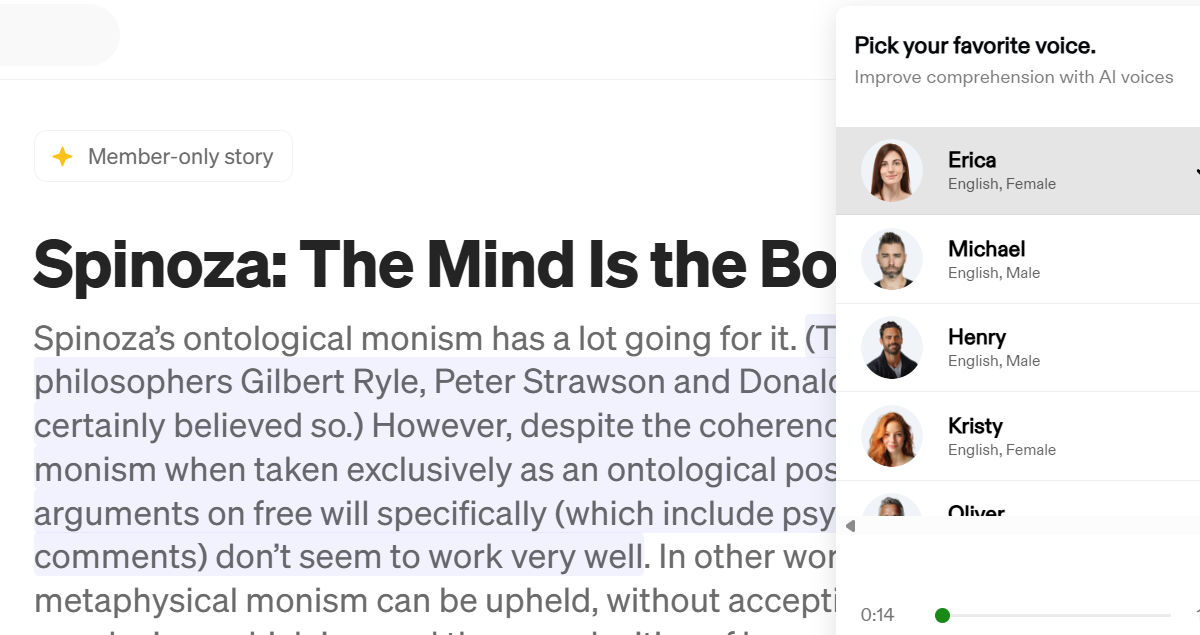
I personally believe that the voices on Medium are very good. (Some are better than others.) As far as I know, there are only five voices to choose from. Medium uses Speechify for its voices.

So I didn’t see it as being a big crime against human persons to use AI voices.

Sympathy With My Critics

I can guess at some of the reasons as to why my critics take such an strong stance against my use of AI voices. More broadly, this probably reflects a problem with AI “taking over”. After all, surely using an AI voice is much worse than an AI machine making the boxes or dildos which were previously made by human persons.

Some of my critics may believe that it’s inauthentic or even misleading to use AI voices. This is especially the case if they believe that my content is AI-generated too. This is odd. The critics seem to be implicitly admitting that they can’t tell the difference between AI-generated content and human-created content.

Personally, I believe that I can often spot AI-generated content, especially when it comes to news and politics channels on YouTube. The prose style is over-the-top and embarrassingly titillating. That said, this isn’t something I can prove.

In more detail. AI-content on YouTube (e.g., using ChatGPT) is often generic and repetitive. Apparently, this is called “AI slop”. So my viewers may simply assume that my content is AI-generated too.

The problem is even worse.

Take what is now called “AI Misinformation”. This, again, may excuse at least some of my critics. In addition, on Reddit there’ve been debates about YouTube’s “enshitification”. However, without being grand, I doubt that most of my critics actually spent much time on my videos. To put it bluntly, they probably clicked the video, heard the AI voice, and that was that!

Of course, I could be lying, and my content is, in fact, AI-generated!

Philosophy

My Medium essays are on philosophy. Therefore my YouTube videos are on philosophy too.

Philosophy is about ideas, arguments, concepts, data, etc. So surely using an AI voice should matter less when it comes to philosophy. It can be seen that using AI voices may not work when it comes to counselling videos (which will require empathy) or even politics. Perhaps if I were an existentialist, or a political philosopher, or a “philosopher of life”, then what I’ve said about counselling and political videos would also apply here too. As it is, in my essays “lived experience” or the “first person” plays a minimal role. Indeed, the closer I can get to Spock or Grok the better. Of course, this could be massive self-deceit on my part… But that’s not the issue here.


(*) This is one of my essays on YouTube.

Spinoza: The Mind Is the Body


Spinoza’s ontological monism has a lot going for it. (The 20th-century philosophers Gilbert Ryle, Peter Strawson and Donald Davidson certainly believed so.) However, despite the coherence of Spinoza’s monism when taken exclusively as an ontological position, some of his arguments on free will specifically (which include psychological comments) don’t seem to work very well. In other words, Spinoza’s metaphysical monism can be upheld, without accepting those conclusions which ignored the complexities of human psychology.

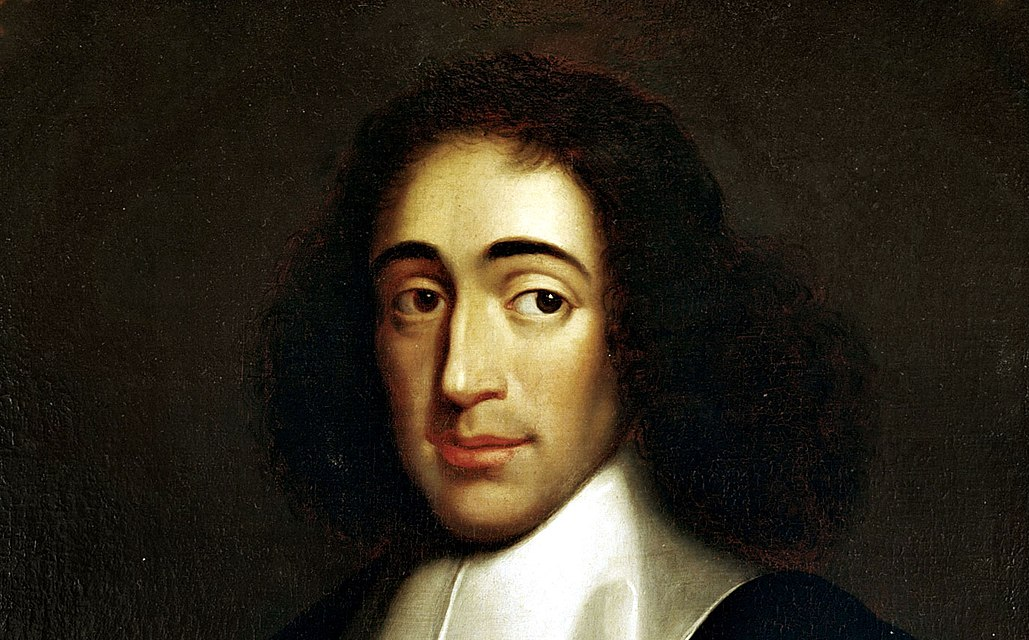
Image from Wiki Commons. Source can be found here.

Ontological Monism: Conceptual Pluralism

Baruch Spinoza expressed his overall monist position in the following way:

“Mind and body are one and the same thing, which is conceived now under the attribute of thought, now under that of extension.”

This is an expression of ontological monism in that the mind and body are deemed to be one and the same thing. (Spinoza implicitly used the is of identity” here, rather than the is of predication”.)

Spinoza’s term “attribute” may need explaining.

Rather than the duality of mind and body, here we have the duality of thought and extension. According to Spinoza, the mind’s essential attribute is thought. (Clearly, Spinoza was reacting to Descartes here.) The body’s essential attribute is extension. Of course, thought and extension seem to be very different things. Yet Spinoza believed that this is only how we conceive of one and the same thing. Thus, if we conceive of x under the attribute of thought, we deem x to be the mind. However, if we conceive of (the same) x under the attribute of extension, we deem x to be the body.

This raises the question: So what is the value of the variable x?

The “nature” of x can be “conceived under the former or latter attribute”. In more concrete terms, Spinoza went on to say that

“consequently the order of the actions and passions of our body is the same as the order of the actions and passions of the mind”.

Again, the mind and body are one and the same thing. To Spinoza, this also meant that the actions and passions of our body are one and the same thing as the actions and passions of the mind. In both cases, we’re conceiving the same x in two different ways.

One other way in which Spinoza got his point across was by arguing that

“a decision of the mind on the one hand, and an appetite and determination of the body on the other, are by nature simultaneous”.

Note that this isn’t about correlations (as with Nicolas Malebranche): it’s about simultaneity. In other words, decisions of the mind aren’t correlated with appetites and determinations of the body: “they are one and the same thing”. In 20th-century-speak, mental states/events aren’t correlated with brain states/events, they are all one and the same thing… if under two modes of presentation. As already stated, Spinoza’s phrase for this is “under the attribute of”. Thus, under the attribute of thought we use the word “decision”. And under the attribute of extension x is deemed to be a “determination [which can be] deduced from the laws of motion and rest”.

Just a moment ago, I stated that “in 20th-century-speak, mental states/events aren’t correlated with brain states/events, they are all one and the same thing”. In the work consulted here (i.e., Ethics), however, Spinoza never mentions the brain. Yet he hinted at it in various places.

For example, in terms of “what the body is capable of doing”, Spinoza went on to say that

“[f]or no one has yet achieved such an accurate knowledge of the structure of the body as to be able to explain all its functions”.

Spinoza even provided an example when he referred to “the things sleepwalkers do which they would not dare to perform while awake”.

Why did Spinoza bring all this up? It was primarily to explain why “the mind moves the body”, and how it does so.

The Phenomenology of Free Will

Spinoza focused on our (not his own words) phenomenological experience of — what we take to be — our own free will. He argued that this can’t be decisive. He wrote:

“[E]xperience, no less clearly than reason, amply shows that the only reason people believe themselves free is that they are conscious of their actions.”

Yet the same people are “unaware of the causes that determine them”.

Not only is Spinoza’s argument against free will radical, so are his explanations as to why he took his position. In terms of the causes that people are unaware of, they’re “nothing but its appetites [which themselves] vary depending on the various states of the body”. In other words, people can’t will their appetites, and neither can they will the changes in the their bodies.

So was Spinoza assuming a necessary relation between a given appetite and a given action? Does the same appetite always cause the same action in the same person over time? What about a similar appetite when it comes to another person? Would that result in the same action?…

Hah!

None of this may matter because all these other scenarios can be explained deterministically too.

If a specific appetite brings about a specific action at one time, but another action at another time, then it is still an appetite that has a deterministic effect on both actions. Indeed, even if the appetite changes over time, then it’s still the changed appetite which will have a deterministic effect on the following action.

Decisions and Appetites

Spinoza used the word “decision” rather than the broader term “action”. But whichever word he used, he concluded that “[t]he decisions of the mind are nothing but its appetites”. This is stronger than my earlier line of reasoning because I used the words “has a deterministic affect on”. Spinoza, on the other hand, again implicitly used the is of identity when he argued that the decisions of the mind are its appetites. Thus, the decisions of the mind aren’t expressions of appetites: they are appetites.

This could be seen as being a proto-behaviourist account of the appetites in that they must aways be tied to human actions or decisions. In Rylian (as in Gilbert Ryle) or Wittgensteinian terms, perhaps an unexpressed or un-acted upon appetite is not an appetite at all.

This still seems odd.

An appetite is usually regarded as a “natural desire to satisfy a bodily need, especially for food”, whereas a decision is deemed to be a mental action or volition. Spinoza, on the other hand, fuses appetite and decision together.

There’s a further problem here.

Spinoza immediately jumps from talking about “appetites” to talking about “emotions”. Indeed, he almost says the same thing about emotions as he had just said about appetites. Spinoza argued that “[o]ur own emotions are the basis for all the decisions we take”. The words “almost says the same thing” were used because in the case of emotions, Spinoza argued that they are “the basis” for all our decisions. When it came to appetites, on the other hand, Spinoza argued that the “decisions of the mind are nothing but its appetites”. So appetites, unlike emotions, aren’t the basis for all our decisions: they are our decisions.

Example 1: Spinoza on the Drunkard

Spinoza put the case against free will by citing the case of a drunkard. He wrote:

“[T]he drunkard may believe it is by a free decision of the mind that he says the things that later, once he has sobered up, he wishes he had not said.”

The argument here is that the drunkard didn’t will what he said when drunk. However, he did will what he said when sober. Yet perhaps he did indeed will what he said when drunk.

The difference here being that in one emotional and psychological state the drunkard said p, and in another emotional and psychological state he said not-p. Indeed, even though/if alcohol interfered with the drunkard’s brain, he might still have willed to say p. The fact that he later rejected saying p doesn’t seem that relevant to the notion of free will.

For example, someone can easily say that the drunkard “let his guard down” when drunk, yet his guard was up when sober. Indeed, perhaps he was more free when drunk, not less so. (This could be because his moral sense or psychology wasn’t determining his actions/words.)

The other option here is that either the drunkard had free will in both cases, or he didn’t have free will in both cases. Being drunk or sober doesn’t seem to be decisive in this debate.

Spinoza broadened out his argument by saying that “we do many things we are afterwards sorry for”. This means that we don’t even need to be drunk to do many things we’re sorry for afterwards.

When one thing was done at one time, the person doing it was in a particular emotional and psychological state. And when he regretted doing that thing at a later time, he was in a different emotional and psychological state. In both cases, he either had free will or he didn’t have free will.

In fact Spinoza is right when he said that “we are agitated by conflicting passions”… But what has that to do with free will? After all, both the state of mind this person was in when the regretted act was done, and the regret which occurred later, might have both been at least partially determined by his passions.

Underneath all this another argument against free will is hidden. Spinoza argued that “those of us who are afflicted by contrary emotions do not know what we want”. Yet, as before, contrary emotions don’t seem to advance the case either for or against free will.

Again, a specific emotion may cause a specific action, and its (if there is such a thing) opposite may cause a different action. Yet perhaps in both cases, perhaps we did know what we wanted, if only for a short time. So the existence of free will applies to both cases. Unless, that is, an emotion and its opposite occur at literally one and the same time. It’s hard to make sense of that. So, instead, say that contrary emotions rapidly fluctuate. In that case, then, it’s still hard to say that this works either for or against free will.

Example 2: Spinoza on Wagging Tongues

One other example is given by Spinoza. This doesn’t seem to work either. However, that may be because it’s (at least partially) an attempt at a joke. This is Spinoza’s take:

“[H]uman affairs would certainly be in a far happier state if people had as much ability to keep silent as they have to speak out.”

This showed Spinoza that “experience provides more than ample evidence that the tongue is the organ people have least control over”. This has a similar shape to Spinoza’s other arguments against free will. Having no control over the tongue presumably means that people sometimes say things they later regret, or that they say things they didn’t really(?) mean. Like the example of drunkard, this may simply mean that a person was in one state of mind at one point, and in another state of mind at another point. Indeed, perhaps at a yet later time that same person may come to regret his previous regret!

As before, none of this seems to work either for or against free will. It simply displays the complex psychology and emotions of most human persons.


Note on Donald Davidson’s Anomalous Monism

The philosopher Donald Davidson’s anomalous monism is anomalous because it states that “thought and purpose [are] free[] from law”. Spinoza, on the other hand, didn’t believe that thought, purpose, etc. are free from natural law. Even though Spinoza believed that the mind can be seen “under the attribute of thought”, he still didn’t believe it was free from natural law. That’s because mind and body are “one and the same thing”. Then again, Davidson also believed that mental events are the same as physical events, but… Yes, this is too complicated to tackle in detail here. Davidson’s position is complicated in itself, but tying it to Spinoza is even more complicated.

Anyway, the guaranteeing of free will can be said to be one of Davidson’s primary aims in his paper ‘Mental Events’. Yet despite the fact that earlier on in that paper Davidson had referred to “the efficacy of thought and purpose in the material world, and their freedom from law”, he was only explicit on this subject at the very end of his paper. This is what Davidson wrote:

“The anomalism of the mental is thus a necessary condition for viewing action as autonomous.”

To put that another way:

The mind’s freedom from physical causation is necessary in order to secure us freedom (that is, secure us free will).

Immanuel Kant undertook a similar enterprise.

In the last paragraph, Davidson paid homage to Kant by quoting — in full — a passage from Kant’s Fundamental Principles of the Metaphysics of Morals. This is the passage which Davidson quoted:

“[W]e think of man in a different sense and relation when we call him free, and when we regard him as subject to the laws of nature. [ ] It must therefore show that not only can both of these very well coexist, but that both must be thought as necessarily united in the same.”

In ‘Spinoza’s Causal Theory of the Affects’ (in the book Essays on Actions and Events), Davidson mentions Spinoza’s views on the mind and body. Davidson also references Spinoza in Subjective, Intersubjective, Objective (2001). There are other examples too…