Tuesday, 8 March 2022

David Chalmers’ 2020 Survey of Analytic Philosophers’ Views: History, Sociology… and Fashion

 A sociological survey of the fashions of analytic philosophers?

The following is a commentary on something called ‘The 2020 PhilPapers Survey’. It was edited by the philosophers David Chalmers and David Bourget.

This is the editors’ own summary of the survey:

“This site summarizes the results of the 2020 PhilPapers Survey, which surveyed the philosophical views of 1785 English-speaking philosophers from around the world on 100 philosophical questions.

“The 2020 PhilPapers Survey was a follow-up to the 2009 PhilPapers Survey. The 2020 survey increased the number of the questions from 30 to 100 and expanded the target population. It also collected longitudinal information on how philosophers’ views have changed since 2009.”

Why the Survey?

A survey of philosophers’ “views” may not seem too strange. Yet it may well seem strange (at least to some philosophers and others) that two philosophers themselves (i.e., David Bourget and David Chalmers) carried out this survey. That said, considering that nowadays some (or even many) analytic philosophers do pay attention to what the sciences (not only cognitive science and physics) have to say on various matters, then perhaps this (to use the jargon) “empirical survey” is just such a thing. Of course, although (for want of a better word) surveying itself isn’t an actual science; surveys can still be conducted scientifically.

This still leaves us with the question: Why was this survey carried out?

Well, the surveyors themselves answer that question.

In their commentary, David Chalmers and David Bourget state that such surveys can be “today’s sociology [and] tomorrow’s history” — or at least they can be (or can become) like sociology and history.

So why are philosophers indulging in a case of sociology which may become tomorrow’s history?

Chalmers and Bourget state that they carried out their survey because it “may be of some use to future historians of philosophy”. In more detail, Chalmers and Bourget write:

[T]he history of philosophy is often directly concerned with sociological matters, and data about today’s sociology may well be relevant to tomorrow’s history. [] The survey concerns philosophy, but it is not philosophy. If anything, it is an exercise in the sociology of philosophy. Sociology should not be confused with philosophy [].”

They continue:

“And certainly, survey votes are likely to be a poor guide to philosophical truth. Still, beliefs about the sociology of philosophy are often given a role in the practice of philosophy, in various ways.”

The main point here isn’t that this survey fails as philosophy — or even that it fails in any respectIt asks what purpose the head counting achieves — even when happily acknowledging that this survey isn’t supposed to be philosophy in the first place. (It can be doubted that anyone at all actually believes that this was Chalmers and Bourget’s attempt at — as it were — sociological philosophy.)

As for “the sociology of philosophy [being] given a role in the practice of philosophy” —this has very rarely been the case in virtually all analytic philosophy. Indeed many non-analytic philosophers have been keen to stress this fact — and have done so many times — about analytic philosophy and its traditions. (Admittedly, such philosophers usually mention analytic philosophers’ ignorance of the history of philosophy, rather than of the sociology of philosophy.)

So perhaps Chalmers and Bourget believe that the sociology of philosophy should be given a role in the practice of philosophy. That is, Chalmers and Bourget are taking a normative, not a descriptive, position on what analytic philosophers should do.

In that case, one may wonder why historians or sociologists of philosophy didn’t carry out this survey, rather than someone like David Chalmers. That is, Chalmers is most certainly not an historian or sociologist of philosophy. (He has has done a little metaphilosophy — see here.) And it’s also the case that the other editor, David Bourget, isn’t either. (It can be assumed — from the data — that Chalmers and Bourget are professional friends with strong academic connections in Australia and elsewhere.) All that said, it would of course be very unlikely that a sociologist could — or would — carry out such a survey when it includes highly-specific questions and details about technical issues and debates in analytic philosophy.

To sum this section up. Chalmers and Bourget mention sociology and history — yet only in relation to the purpose and nature of surveys such as their own…

But what about sociology and history when it comes to what philosophers actually believe?

Philosophical Fluctuations and Philosophical Fashions

Now the odd thing is that even though the central theme of this essay is one of philosophical fashion — that subject doesn’t seem to be the kind of sociology of philosophy which Chalmers and Bourget have in mind. Indeed their survey is an attempt to do something purely descriptive (despite the answers-to-critical-questions commentary referenced a moment ago) in that Chalmers and Bourget simply note such things as percentages and basic answer to questions. In other words, no sociological conclusions are made by Chalmers and Bourget.

One single example of the fluctuations (or changes in philosophical fashion) is cited in the survey itself.

In 2009, for example, there was a — swing to? - the position that there’s no such thing as free will. In 2020, on the other hand, there was a (to use Justin Weinberg’s words) “swing” away from “no free will”. That is, only 11 years later after 2009, there was a swing in the opposite direction.

But that’s just one example .

To use Justin Weinberg’s summary again (as found in his Daily Nous), there were also swings in the following directions too:

“towards not switching in trolley problem (bystander)

towards non-classical logic

towards non-cognitivism in moral judgment

away from invariantism regarding knowledge claims

towards Platonism about abstract objects”

So what do these swings tell us?

Is it largely a question of philosophical fashion?

Surely it can’t be about any new data.

So was it all about new and/or better arguments?

But that can’t be the case either.

That’s partly because it’s very possible that the pendulum will swing (back?) again by, say, 2030. (Unless, by 2030, there’ll be even better arguments which will help philosophers swing yet again.)

If it isn’t a swing in actual better or new arguments, then perhaps it’s simply a question of what subjects are concentrated upon by analytic philosophers. That is, these previous swings mightn’t have occurred because of new or stronger arguments, but simply because of what subjects were concentrated upon during the period 2009 to 2020 . (It’s also a question of the proportions of philosophers who were doing the concentrating.)

After all, Chalmers and Bourget didn’t select which analytic philosophers were asked which particular questions. That is, all the philosophers in the survey answered the same “100 philosophical questions”. Thus some of those philosophers questioned would have known a fair bit about, say, invariantism or Platonism — and others would have known next to nothing about these subjects. And, in that ten-year period, the proportion of those analytic philosophers who knew a lot about, say, non-classical logic (or who didn’t know a lot about it) would have changed from 2009 to 2020 too…

Thus philosophical fashion raises its head again.

So this isn’t only about swings (i.e., based on arguments) from one position to another: it’s also about various subjects becoming popular and then ceasing to be popular. That popularity (or lack thereof) of certain philosophical subjects will at least partly determine the nature of the aforementioned swings. Indeed, if one takes note of the history of analytic philosophy in the 20th century, then some philosophical fashions were very short-lived indeed!

Take reference — which was a relatively long-lived philosophical fashion.

There must have been hundreds — probably thousands — of papers and articles written on that subject between, roughly, the 1970s and the 1990s. Now it’s hardly covered at all. (This isn’t to say that no analytic philosopher touches this subject anymore.) And possible worlds were also all the rage for roughly the same period. And what about those sense-data which became the primary focus of large chunks of analytic philosophy in the first half of the 20th century? So I was surprised to see any reference at all to “sense-datum theory” in the survey. (That said, this position is only endorsed by 4.99% of analytic philosophers.)

More Percentages

In any case, here are some more percentages selected by Justin Weinberg from the survey:

“81.7% think abortion is sometimes permissible

75.1% think capital punishment is impermissible

The most popular view of consciousness is functionalism with 33% of respondents supporting it

51.3% accept some version of the extended mind thesis

50.9% endorse revising gender categories

40.4% endorse eliminating race categories

64.2% think human genetic engineering is sometimes permissible

44.9% would choose immortality, 41.3% would not, while 13.6 selected “other” as a response

Naturalist realism edged out non-naturalist realism and constructivism as the most popular metaethics

Almost 30% support capitalism, but 53% support socialism, while close to 20% choose “other”

56% think there is “a lot” of philosophical knowledge and 32.5% think there is “a little,” while paradox did not stop 3.6% from saying there is “none”

Respondents were about evenly divided on whether time travel is metaphysically possible

Only 2% thought particles could be conscious”

In terms of panpsychism, 2% seems very low. Yet I suspect that in 2009 it would have been even lower — perhaps 1% or even less! (I couldn’t find any reference to “panpsychism” in the 2009 survey.) That means that the number of analytic philosophers who believe that “particles could be conscious” might have doubled in ten years — even though it is now only 2%!

So fashion may be an issue even when it comes to panpsychism's seemingly low mark.

Similarly with functionalism.

According to the survey, 33% of analytic philosophers support this position in the philosophy of mind. This percentage figure may seem fairly high. Yet in functionalism’s heyday (say, the 1970s to the 1980s), I suspect that the percentage would have been a lot higher than 33%.

So how important are sociology and history when it comes to these percentages?

More relevantly and concretely, how important is living and working within a university environment when it comes to what view a professional (academic) philosopher has on, say, (to use phrases from the survey) “gender categories”, “capitalism and socialism”, “race categories”, etc? Is it really all about the (as its often put) “strength of philosophical arguments” that, for example, “53% [of analytic philosophers] support socialism”, 44% favour egalitarianism and only 13% favour libertarianism (i.e., not of the kind held in “free will” debate)? Alternatively, are these positions or views just as much to do with the sociology of universities than they have to do with arguments or data?

Of course academic analytic philosophers will have advanced arguments for these views. Yet their arguments are still (as it were) embedded within — and perhaps largely spring from — particular university (i.e., sociological) environments.

Philosophy By Consensus or By Fashion?

One other claim which Chalmers and Bourget make is odd too. They write:

[P]hilosophers often appeal to sociological claims about the distributions of views among philosophers, for example in justifying which views should be taken seriously, and it makes sense for these claims to be well-grounded.”

Personally, I’ve very rarely come across philosophers “appeal[ing] to sociological claims about the distributions of views among philosophers”. (Actually, I don’t believe that I’ve ever done so.) Prima facie, appeal to sociological claims in an odd thing for a philosopher to do — even if such a thing does occasionally occur. After all, adverting (or even deferring) to science ( à la naturalists such as Quine) is one thing — but appealing to sociological claims and caring about the distributions of views among philosophers are very different things.

So do these distributions of views among philosophers impact on what philosophers actually believe? Wouldn’t that be an example of (as it were) body-count philosophy?

In addition, these distributions of views among philosophers apparently (according to Chalmers and Bourget) “justify which views should be taken seriously”. Surely that can’t — or simply shouldn’t — be the case. This seems to be a commitment to philosophical-truth-by-consensus. Indeed it may even be a commitment to philosophical-truth-by-fashion. (Remember that Chalmers and Bourget answered these points earlier in this piece— scroll back up.) And even though various degrees of consensus — as is the case with most of the sciences — are indeed important in philosophy (i.e., in terms of debate, shared languages, techniques, etc.), what should be “taken seriously” (or not) surely can’t be a matter of large distributions of particular views and the focus on particular subjects.

Chalmers and Bourget also tell us that these large distributions of views among analytic philosophers — at least partly? — contribute to certain philosophical positions and subjects being “well-grounded” (i.e., “it makes sense for these claims to be well-grounded”). Yet, as the survey itself shows, professional (or academic) philosophical opinions often change from decade to decade (sometimes from year to year) and the subjects concentrated upon do so too. Thus if such philosophical views are indeed well-grounded, then why the obvious and frequent fluctuations in both philosophical views and in the philosophical subjects studied?

So does that mean that philosophical fashion — at least to some degree — determines these large distributions of (the same) views and therefore also their supposed well-groundedness?

A Peircian Convergence on the Truth?

Chalmers and Bouget also believe that

“if philosophy has any tendency to converge to the truth, then philosophers’ views might provide some guidance about the truth of philosophical views”.

Here again this survey itself stresses (if implicitly) philosophical —quite possibly random — fluctuations. So it’s odd that Chalmers and Bourget should use the words “if philosophy has any tendency to converge to the truth”. Those words are odd because philosophical history will show that this has rarely — if ever — occurred. To put that another way: if philosophy does ever converge on the truth, then it (at least in some areas) would have already done so — many times!

So in which cases has this philosophical convergence on the truth actually occurred?

Of course Chalmers and Bourget themselves recognise these questions and points when they continue with the following words:

“It is not clear whether philosophy tends to converge to the truth [].”

It can now be said that there are certain sections of philosophy which achieve a degree of consensus (or that there are large “distributions”) on a given subject and on (as it’s often put) “what constitutes a problem”. Yet even these examples of consensus don’t usually last for very long. And that’s to forget the many other philosophers who were never part of such (fashionable?) consensuses.

*******************************

Notes:

(1)

That’s an interesting list of which Philosophical Big Names the surveyed analytic philosophers identify with.

A philosopher who’s been dead for over two thousand years (i.e., Aristotle) is at the top of the list. Karl Marx comes above Socrates, Hobbes, Descartes, Spinoza, Davidson, Putnam. Leibniz, Locke, Popper, and many others. And poor old Michael Dummett is right down at the bottom of the list — side by side with Gilles Deleuze!

(2) I’ve always found it odd that sociologists have rarely — if ever — conducted studies on universities and how they help — at least partly — determine what people (including academic philosophers) politically and philosophically believe. (That’s even though some stuff has been written about this subject by non-academics — i.e., by journalists, writers and commentators.)

I mention this because many sociologists are very keen to tell us why particular classes, social groups and/or individuals believe what it is they believe. And such sociologists also stress how particular environments impact on the political, philosophical and/or religious beliefs of various social groups and individuals. So why isn’t all this also the case when it comes to those students and professional academics who’ve been deeply embedded in universities for a few years — or even for decades?

In addition, I personally have come across zero sociological studies of… sociologists. That said, I suspect that some such studies do exist… somewhere.

[I can be found on Twitter here.]


Friday, 4 March 2022

The God’s-Eye View of the World: Putnam and Heil vs. Metaphysical Realism

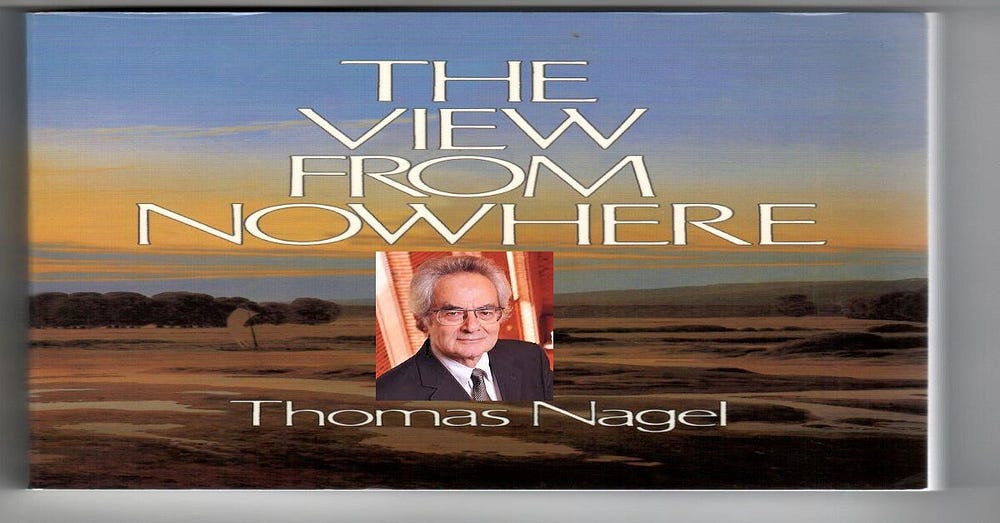
What is “the world itself”, “the view from nowhere” or the world as seen sub specie aeternitatis?

[A]ll levels would collapse into one, and thinking about the system would be just one way of working in the system. But it is not that easy. Even if a system can ‘think about itself’, it still is not outside itself.”

Douglas Hofstadter (as found in his Gödel, Escher, Bach: an Eternal Golden Braid).

******************************

The American philosopher John Heil (1943 — ) states the following words in his paper Are We Brains in a Vat? Top Philosopher Says ‘No’’:

[A]n externalist might wish to distinguish points of view on the world from the world itself.”

So what is “the world itself”?

Please tell me something about it. Describe it.

It can be suggested here that if you do so, then you’ll immediately be describing something that is, in fact, the world from a point of view — your very own…

But if that last statement isn’t actually correct, then what exactly is being argued by metaphysical realists here?

How can anything be known about “the world itself”? How can anything even be said about the world itself? Indeed what does that phrase “the world itself” even mean?

John Heil

To use Heil’s words again:

“Even a ‘God’s eye point of view,’ however, is a point of view.”

So what does a “God’s eye point of view” amount to? What on earth is it? Again, describe it to me.

(It can be accepted that a belief in a/the God’s eye point of view needn’t be theistic or religious in nature.)

Is a/the God’s eye point of view every conceivable point of view at one and the same time?…

What does that mean? And what would that view be… like?

So let’s tackle this from a slightly different angle. Firstly:

What is it for the world to be (to use Heil’s words) “a certain way”?

Secondly:

What is it for the the world to be a certain way “independent of any particular point of view”?

Oddly enough, “the world could [indeed] be a certain way independent of any particular point of view” — yet that still wouldn’t be of any help to us. That’s because we could never find out about the world as it is independent of any particular point of view. Indeed we couldn’t even utter a single word about the world as it is independent of any particular point of view.

So all that such metaphysical realists and mystics have, then, is the ability to use the words “the world could be a certain way independent of any particular point of view”. And, after stating that, there isn’t much more they can say. There isn’t much further they can go. Thus such philosophers and mystics have simply stressed and advanced a possibility about which nothing much — or even nothing at all — can be said.

The Ideal: Climbing Out of Our Own Minds

Of course we can happily understand the philosophical ideal of getting to (?) know the world as it is in itself. This ideal may even engender a degree of human humility in that it underplays merely human points of view and stresses the world itself. Yet often those who do stress the world itself (such as Thomas Nagel — see later) actually display the opposite of humility. That is, they proudly tell us — or sometimes merely hint — that they alone have come close to (or that they’ve even reached) a point of view that is the world’s own. And this, in turn, will include a set of statements which purport to show us the nature of the world itself.

Yet, like mystics or religious leaders throughout history and still today, talk of the world itself may simply be (in this case at least) a philosopher’s way of telling us that he is closer to ̶v̶i̶e̶w̶i̶n̶g̶ the world itself than all those other people who merely rely on all-too-human points of view.

So perhaps these (to use Nagel’s word) “transcendent” philosophers and mystics haven’t actually obtained a ̶v̶i̶e̶w̶ of the world itself at all! Perhaps they’ve simply fooled themselves — and fooled others — into believing that they have. Indeed they may only achieve this goal through the sheer emotional force of their poetic, literary and rhetorical prose.

A Brain in a Vat

John Heil then considers something much more specific when he tackles Hilary Putnam’s well-known take on the brain-in-a-vat thought experiment. Heil writes:

“Indeed this is precisely what externalists — and realists — seem to have in mind in insisting that it might be the case that one is a brain in a vat, even though, were this so, one could not entertain the thought that it is so.”

Here Putnam (1926–2016) was highlighting the strong possibility that what we take the world to be may not square with how the world actually is… Yes — this possibility has featured in philosophy for around three thousand years.

Indeed the brain-in-a-vat scenario is — at least partly — a 20th-century version of Plato’s Allegory of the Cave, the Hindu Maya illusion, Zhuangzi’s “Zhuangzi dreamed he was a butterfly” and the evil demon of René Descartes… And, here in the 21st century, we now have Professor Donald Hoffman’s recent rendition of this old charmer — with his personal addition of such non-philosophical phrases as “mathematical models” and his talk of “icons” (see ‘Reality Does Not Exist’).

But let’s get back to Hilary Putnam.

The brain-in-a-vat thought experiment was one way of graphically highlighting the possibility that a brain in a vat would have no (direct) link to “reality” — or to the physical world outside itself and its simulations. And one main point of this thought experiment is that there’s (possibly) no difference between a brain-in-a-vat’s “view” of the world and our own view of the world.

Of course Putnam went on to stress the possibility that a brain in a vat could never know that it’s a brain in a vat. Yet the broader issue here is that that we could never know that we have the world right or even that we have access to the world at all. (Note: It’s sometimes hard to decipher if Professor Donald Hoffman, mentioned a moment ago, is making the point that we don’t have direct access to the world or that there’s no — physical- world in the first place.)

Spinoza’s Sub Specie Aeternitatis

Of course it was the Dutch 17th-century philosopher Baruch Spinoza (1632–1677) who famously discussed — and argued for — viewing the world sub specie aeternitatis.

When translated from the Latin, sub specie aeternitatis means “under the aspect of eternity”. (Or as a character in a Philip K. Dick novel put it: “SSA stands for sub specie aeternitatis; that is, something seen outside of time.”) That translation (i.e., “under the aspect of eternity”) doesn’t seem to be too closely tied to the metaphysically-realist position discussed above. However, another translation, “from the perspective of the eternal”, does seem to be more closely connected. In any case, both translations hint at what’s often been called “the objective point of view”.

Now take the American philosopher Thomas Nagel (1937 — ) again (who was mentioned above).

Nagel’s following words offer us a contemporary (or perhaps not so contemporary) version on Spinoza’s original position. In his essay ‘The Absurd, Nagel wrote:

“Yet humans have the special capacity to step back and survey themselves, and the lives to which they are committed [] they can view it sub specie aeternitatis [].”

But it was Spinoza himself who offered us the best explanation of his own Latin phrase.

“It is of the nature of Reason to regard things as necessary and not as contingent. And Reason perceives this necessity of things truly, i.e., as it is in itself. But this necessity of things is the very necessity of God’s eternal nature. Therefore, it is of the nature of Reason to regard things under this species of eternity.”

And as put in basic terms, this God’s-eye view (or View from Nowhere), according to Spinoza, involves “[t]he third kind of knowledge, intuition”. And intuition “takes what is known by Reason and grasps it in a single act of the mind”.

To repeat: What exactly is Nagel’s View from Nowhere, the world “under the aspect of eternity” or the world from no point of view?

Describe one or all of these points of view to me.

It can strongly be suspected that this can’t be done.

So what do these grandstanding points of view (i.e., on transcending all points of view) offer us?

Nothing much.

Perhaps nothing at all.


[I can be found on Twitter here.]


Thursday, 3 March 2022

D.M. Armstrong on What Philosophers Should Do

 Armstrong argued that philosophers should “give an account of the general nature of things and of man”… and also “analyse concepts”.

David Malet Armstrong (1926–2014) was an Australian philosopher who studied philosophy at the Universities of Sydney and Oxford. He did much work in metaphysics and the philosophy of mind.

Like his fellow Australian, J.J.C. Smart (1920–2012), Armstrong influenced an entire generation of Australian philosophers. The Australian philosopher Keith Campbell, for example, said that Armstrong’s contributions to philosophy “helped to shape philosophy’s agenda and terms of debate”.

Armstrong’s philosophy is taken to be naturalistic. His overall position (i.e., naturalistic metaphysics) accepted (as stated in his Sketch for a Systematic Metaphysics) “the assumption that all that exists is the space time world, the physical world as we say”. In addition, Armstrong believed that philosophers should make sure that their theories and ideas square with — or, at the very least, take on board — what the sciences tell them about the world.

Armstrong was influenced by David Lewis (an American philosopher who had strong ties to Australia), J. J. C. Smart (a fellow Australian), Ullin Place, Herbert Feigl, Gilbert Ryle and G. E. Moore.

In terms of prose style. Armstrong's writings are clear and direct — in the “Australian style”.

On Philosophy Itself

In his paper, ‘The Causal Theory of Mind’ (1968), D.M. Armstrong argued that

“philosophers in the ‘analytic tradition’ swung back from Wittgensteinian and even Rylian pessimism to a more traditional conception of the proper role and tasks of philosophy”.

And Armstrong believed that the “proper role and task of philosophy” was

“to give an account [] of the general nature of things and of man”.

All this was largely Armstrong’s reaction to the stress on what was called conceptual analysis (or, more broadly, philosophical analysis) found in analytic philosophy at the time (Armstrong wrote these words in 1968.). That said, Armstrong still saw conceptual analysis as being important in philosophy.

Following on from all that, while many (analytic) philosophers accept that such things as conceptual analysis, explanation, definition, etc. (see later) are fruitful tools of philosophy, they still don’t believe that these things are all that there is to philosophy.

So what did Armstrong have to say on what philosophers should do?

…. But firstly note the word “should” here.

This isn’t a claim that all philosophers actually do all the things which Armstrong will mention. Thus it can be assumed here that Armstrong simply believed that they should do these things. In other words, Armstrong was being both metaphilosophical and normative in his statements.

What Philosophers Should Do

I’ll quote an entire passage from D.M. Armstrong in which he states both his (aforementioned) metaphilosophical and normative position on philosophy.

Armstrong wrote the following words:

“The philosopher has certain special skills. These include the stating and assessing of the worth of arguments, including the bringing to light and making explicit suppressed premises of arguments, the detection of ambiguities and inconsistencies, and, perhaps especially, the analysis of concepts.”

What won’t be discussed in the following are the following questions:

(1) Do philosophers actually have “special skills”? 
(2) How would a layperson know that any given philosopher had
special skills
(3) Which philosophers (or kinds of philosopher) was Armstrong actually referring to?

So let’s break down Armstrong’s own words.

On Philosophical Argument

Firstly, Armstrong begins in the following way:

“The philosopher has certain special skills. These include the stating and assessing of the worth of arguments [].”

It can easily be argued that argumentation is vital in philosophy. Indeed if a philosopher — or a layperson — doesn’t offer an argument for his position or viewpoint, then why on earth should anyone else accept it in the first place?

Of course there are indeed various — perhaps even many — reasons as to why people may accept a position or viewpoint without it being argumentatively advanced or defended.

These include the following:

(1) The reader or listener already agrees with much — or even all — of what’s being stated (i.e., not argued) by the speaker or writer. 
(2) The listener or reader finds the writer’s or speaker’s prose style (say, its rhetoric and poetry) emotionally appealing. (That said, it would probably only be emotionally appealing if, at least in part, the listener/reader already agreed with much — or even all — of what’s being stated.) 
(3) The reader or listener doesn’t really understand what’s being said; but he or she takes the speaker or writer to be some kind of expert or authority on the given subject. 
(4) The reader or listener feels emotionally, socially or politically obliged to agree with what’s stated by the speaker or writer. 
(5) The reader or listener simply doesn’t know of any arguments against — or even alternatives to — what’s being stated by the speaker or writer.

Suppressed Premises

More particularly, Armstrong believed that one of the “special skills” of philosophers “include[s] the stating and assessing of the worth of arguments”.

The obvious question to ask here is exactly how other people’s arguments are stated and assessed by philosophers with special skills.

Armstrong immediately goes on to answer that question when he says that the worth of arguments is stated and assessed (at least partly) by

“the bringing to light and making explicit [the] suppressed premises of arguments”.

The (possible) suppressing of premises (either deliberately or unknowingly) is of vital importance in nearly all debates or discussions — especially political ones. (See hidden/suppressed premises.)

To put this at its most basic.

In an argument, the suppressed premise (or suppressed premises) is simply assumed to be true from the very beginning. Indeed the argument wouldn’t even work at all if the suppressed premise wasn’t assumed (to be true) from the start. In other words, the entire position (or argument) depends on the reader or listener — as well as the speaker or writer himself — accepting the suppressed premise (either knowingly or unwittingly) as being true — or at least as simply existing (i.e., as being an assumed “fact”).

That said, often suppressed premises aren’t (strictly speaking) part of an argument at all. That is, such premises may simply be part of a stream of poetic or rhetorical statements expressed by, say, an activist, politician, scientist or even a philosopher.

The Detection of Ambiguities and Inconsistencies

Armstrong then mentions “the detection of ambiguities and inconsistencies”.

One would like to believe that literally everyone would have a problem with arguments (or simply positions) which contain “ambiguities and inconsistencies”. That said, the notion of ambiguity seems to be more… well, ambiguous than the notion of inconsistency. That said, not all inconsistencies are easy to spot either.

Thus, in a certain sense, an argument may be strong, valid and/or sound and still be expressed in an ambiguous manner. Or, less strongly, such an argument may simply contain ambiguous phrases or ambiguous individual words. In that case, then, the entire argument won’t necessarily fail simply because some phrases or words within it are ambiguous — or simply taken to be ambiguous.

All that doesn’t seem to also apply as clearly to an argument containing inconsistencies. That said, such inconsistencies may be a result of certain ambiguities and certain ambiguities may be the result of certain inconsistencies. This means that the notions of ambiguity and inconsistency need a lot of work in themselves.

The Analysis of Concepts: the Analysis of Things

D.M. Armstrong finishes off his account of the special skills of philosophers by mentioning what he called “the analysis of concepts”.

Despite the analysis of concepts being a worthwhile philosophical skill, Armstrong did offer some words of warning.

For example, Armstrong argued that

[Gilbert] Ryle was wrong in taking the analysis of concepts to be the end of philosophy”.

Armstrong himself, on the other hand, believed that

“the analysis of concepts is a means by which the philosopher makes his contribution to great general questions, not about concepts, but about things”.

Oddly enough, Armstrong’s position seems to have been replicated by the British philosopher Colin McGinn (1950-) — at least according to Barry Dainton and Howard Robinson. The latter two philosophers write:

“Colin McGinn has recently defended the view that philosophy is (and should be) a matter of conceptual analysis — although McGinn does not think this is incompatible with analysis-revealing truths pertaining to reality itself.”

Yet Timothy Williamson (1955-), on the other hand (again, according to Dainton and Robinson),

“argues that it is a mistake to think that philosophy is (or should be) a matter of linguistic or conceptual analysis: it is an investigation into reality itself”.

So it’s not that conceptual analysis (sometimes simply called philosophical analysis), specifically, ever completely went away — as the position of Colin McGinn shows. That said and as Armstrong put it, conceptual analysis did come under severe criticism during and after the demise of “linguistic philosophy”.

So at that historical point there was much talk of “pedantry”, “irrelevance” and a “petty focus on minutia” (i.e., at the expense of focussing on meaty, deep and heavy stuff). Sure, not all these criticisms were only aimed at conceptual analysis — yet even this fundamental and basic part of analytic philosophy was deemed suspect by some (or even many) philosophers and laypersons at one point in philosophical history — and still is today. (This is especially the case when it comes to some of those academics who specialise in scare-quoted “continental philosophy”; as well as a number of scare-quoted “continental philosophers” themselves.)

In any case, let’s take it as true that Gilbert Ryle (1900–1976) did believe that (as Armstrong put it)

“the analysis of concepts [is] the end of philosophy”.

Yet, if Ryle did believe such a thing, then that position hardly makes sense — at least at a prima facie level. After all, surely concepts, words or terms aren’t about (or they don’t refer to) other concepts, words or terms. How could Ryle have believed that? (Unless, that is, Ryle was some kind of “linguistic idealist”.)

So Armstrong clearly rejected the (as it were) “binary opposition” between the analysis of concepts and the analysis of things. Yet surely we can only get to Armstrong’s things (as it were) through our concepts. Of course that still doesn’t mean that the analysis of concepts is “the end of philosophy”.

The situation is that when we discus things, events, facts, theories, conditions, values, positions… or anything, we obviously use words, terms and/or concepts to do so. So it seems that it’s almost inevitable that philosophers should scrutinise the words, terms and concepts we use in such discussions and debates.

It can also be argued that much — perhaps very much — will flow from philosophers’ and laypersons’ own personal definitions (even if tacit or very vague) of the words (or terms) they use. In other words, it’s not as if there are determinate and fixed definitions of most of the words (or terms) used by philosophers and laypeople when discussing contentious issues and problems.

Of course a person may well claim that he defines a word in a particular way simply because he believes that his very own personal definition unequivocally follows from what the given x he’s defining actually is.

To repeat. Is all this about words (or technical terms) and how we define them?

No, not at all.

As D/M. Armstrong argued above: it’s also about things. So if definitions, conceptual analyses, etc. are very important, then once someone defines his word or term (say, “consciousness”, “existence”, “free will”, “fact”, “prove”, etc.), then we can move on from there. And that’s the case even if we’re using these words to talk about Armstrong’s things.


[I can be found on Twitter here.]


Monday, 28 February 2022

Historical Pragmatism: Logic as Inquiry and Logic for Use

On the American and British pragmatists’ reaction against formal and mathematical logic in the late 19th and early 20th centuries.

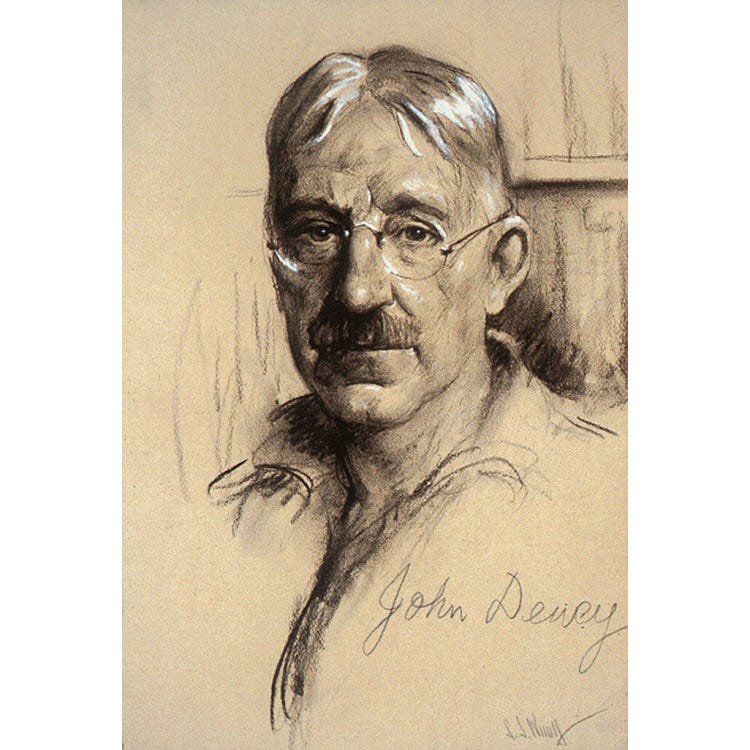
Left: John Dewey. Right: F.C.S. Schiller

The German-British philosopher F.C.S. Schiller (1864–1937) argued that logic is — or at least should be — a “theory of inquiry”. (This position is captured in Schiller’s book, Logic for Use.) In America and, to a lesser degree, in the United Kingdom, such a view was in the air from roughly the 1870s to the 1920s… and onward (see here). Indeed the American philosopher and pragmatist John Dewey (there’s more on Dewey in the final section) wrote a book called Logic — The Theory of Inquiry. (Dewey was influenced by Schiller; just as Schiller was, in turn, influenced by C.S. Peirce.)

So if logic is a theory of inquiry, then that means that it will be — primarily — an inquiry into human thought processes rather than into the formal relations which exist between logical symbols and statements. In addition, one prime pursuit of this kind of logic was to understand how people actually “fall into error”. Its concern, therefore, wasn’t such things as system-based validity, entailment, consistency, etc. And that was because — so these pragmatists believed — these things don’t depend on (as it were) empirical or observational truth — even if they do depend on soundness.

Schiller also argued that science simply isn’t as logical as many people assume. (Ironically, there was much that went under the description the logic of science written after Schiller died.) Moreover, logical techniques and logical methodologies, in Schiller’s eyes, aren’t fool-proof. Schiller also argued (perhaps obviously) that logic alone can’t solve all the problems that bedevil scientific experiment and research.

More specifically, Schiller argued that scientists simply can’t know (as the phrase has it) a priori about all the possible (what Schiller called) “unforeseen objections” (i.e., to their theories or experiments) which may appear on the scene in the future. In other words, there’s simply no way that these future possibilities can be known (or preempted) beforehand. And it’s not only these possible objections which are unforeseen; but also new physical conditions or experimental findings.

So scientists can’t logically (or fully) predict any future changes to science.

Now consider, for example, the impossibility of scientists predicting quantum phenomena in, say, the 18th century. And think also of all the other “revolutions” in 20th century science which could never have been predicted or preempted.

In terms of logic itself.

Consider the rise of many-valued logic. Consider the attacks — or at least questionings or revisions — of the Law of Excluded Middle. (The American philosopher W.V.O. Quine became a pragmatist about the Law of Excluded Middle — or at least its applicability - in response to the findings of quantum mechanics and the results of various scientific experiments — see here.)

Hardly any of these radical scientific and logical changes could have been prophesised in the (as mentioned) 18th century or even in the first half of the 19th century.

A traditional empiricist might also have argued that many of these scientific (if not logical) revolutions couldn’t have been predicted if such predictions, by their very nature, were simply — or at least partly — dependent on past and present experiences or observations. And because such things weren’t observed in the 18th century, then it follows that they couldn’t have been predicted either. This means that no matter how strong or speculative the prediction actually is, it should — or would — still at least partly depend on empirical data or observations. And if such things weren’t available to point in the direction of, say, quantum phenomena again, then such phenomena couldn’t even have been speculated about.

Of course it might have been the case that certain speculators’ predicted such scientific revolutions by (as it were) accident. Indeed in the philosophy of science much is made of scientists, philosophers and even lunatics getting things right — yet for the wrong reasons. So, in broad terms, some people have made wild leaps in the dark and still got things right. However, even if such speculators got things right, then few — if any — scientists (of their day) would have taken much — or any — notice of them. That primarily because such speculative theories (or ideas) would have been completely divested of any observational or experimental foundation or content.

Of course even the scientists who were strict sceptics would never have demanded complete and unequivocal justifications of the speculators’ predictions or hypotheses. Indeed scientists have always realised that speculations are vital in science. That said, such scientists would at least have expected the aforementioned speculations (or theories) to have had at least (as it were) one foot on the ground. In other words, such speculations should never entirely belong to another world.

A Little More on John Dewey

In John Dewey’s eyes, logic should be largely derived from the methods and practices which are used in science and by everyday people — even those people who aren’t experts. And because science is always on the move, then Dewey also believed (as expressed in his Essays on Experimental Logic) that logicians shouldn’t see logical principles as

“eternal truths which have been laid down once and for all as supplying a pattern of reasoning to which all inquiry must conform”.

More generally, Dewey expressed his naturalist position on logic (or at least on “thinking”) in this way:

[T]hinking, or knowledge-getting, is far from being the armchair thing it is often supposed to be. The reason it is not an armchair thing is that it is not an event going on exclusively within the cortex or the cortex and vocal organs. It involves the explorations by which relevant data are procured and the physical analyses by which they are refined and made precise.”

So Dewey believed (like C.S. Peirce before him) that logic should be fallibilist in nature — just like science. Indeed his fellow American philosopher W.V.O. Quine (as already mentioned) was even a fallibilist when it came to both mathematics and logic.

Dewey also (if indirectly) argued that the arrow should point from the world to logic; as well as from science to logic. In that sense, then, logic seemed to take a back seat when it came to science.

Moreover, because science’s relation to the world is both more (as it were) direct than logic’s and philosophy’s, then the latter two (to use Quine’s words) “should defer to science”. Alternatively and to use a term used in the 20th century, logic and philosophy should be naturalised so that they don’t systematically conflict with science and its findings.

So Dewey clearly took a pragmatist line on logic.

Dewey noted the many successes (however defined) of science and everyday life. He therefore believed that whichever logical rules or principles scientists and everyday people use when they scored their particular successes, that logicians should also adopt them. In any case, scientists themselves have always taken on board new logical methods in their pursuits. And Dewey believed that logicians should do so too.

[I can be found on Twitter here.]