Monday, 11 April 2022

Quantum Weirdness, Gödelian Truth, Define Your Terms, Etc.

Selected (mainly critical) responses to my essays on Medium - and my replies to them. (1)

Quantum Weirdness


Mirco Milletarì Ph.D.’s response:

“Your main point is that quantum particles are neither particles or waves, but a ‘bit of both’, that is indeed the standard point of view.”

My reply:

“It isn’t really my own point of view — I’m not a physicist. I was putting (as you put it) ‘the standard view’. After all, (as it were) fusing two modes of classical description (i.e., waves and particles) won’t really be any better that using a single mode of classical description (i.e., a wave or a particle).”

Mirco Milletari continued:

“A quantum object is really neither of them (this is what I was taught in QM 01) but some of their properties can be described within one of the two frameworks. The quantum object is something else, it is not weird as much as a wave is not weird for not behaving like a particle.”

My reply:

“I believe that’s largely we’re I’m coming from. To be finicky, even the word ‘object’ is problematic because classical objects are seen to be what philosophers call individuals (which has nothing to do with how that word is used in everyday life, politics, sociology, psychology, etc.). You can conceive of a classical individual/object existing in many different environments and still being that self-same object. Yet you can’t really do the same when it comes to most quantum xs. In other words, quantum xs are parts of systems, fields and/or states and have no real identity separate from them. That said, some philosophers and theorists argue the same about classical objects/individuals too!”

More Quantum Weirdness


Frank Front’s response:

“But Micro, quantum effects are very weird from a lay reference frame life experience based intuition…. those who understand the why and to some extent the how — in this case those with some pretty deep exposure to quantum physics theory. And that is not most people. So for most people, yeah this stuff is weird. Very weird.”

My reply:

“I can see your point. However, it’s often physicists themselves — and, of course, popular science writers — who stress the ‘weirdness’ of quantum mechanics, not laypersons. (I suspect that many of them do so to entice laypersons in to physics because they’re so desperate to create an interest in the subject.) So some of those who understand the theory also thought that things are weird — Richard Feynman is a good example. Yet since Feynman completely dismissed any philosophical — or any — account of the quantum formalism, then he had no right to say that. Feynman strongly believed in the “shut up and calculate” mantra. So why did he also say that QM is ‘weird’? The calculations and mathematical formalisms aren’t at all weird. Only the (rival and/or conflicting) interpretations are weird. And Feynman largely rejected such things.”

*************************************

Roger Penrose on Gödelian Truth


Chuan Hiang Teng’s response:

“This is profound. I would add that in order to ‘see’ mathematical truth, one must have the ability ‘invent’, reconfigure, reason from the material to an abstract state with a superstate posited in the mind. If we train our minds to think objectively and with agility and flexibility being able to combine different knowledge and theories, our neurons in the physical sense will follow suit in its reconfiguration accordingly. The spiritual self must drive the physical self. In this sense, computers will never have this ability sense I cannot envisage how human beings can create consciousness. It is far more superior.”

My reply:

“The problem is that, as far as I can see, Roger Penrose is mainly — or even exclusively — talking about Gödel sentences (or truths) here. And the problem is that not many people can ‘see’ them — not even some mathematicians. In addition, some reject Gödelian ‘truth’ entirely. (The word ‘truth’ isn’t apt when it comes to mathematical systems.) What’s more, if seeing Gödelian truth is fundamental for mathematical truth and indeed consciousness itself, then where does that leave 99.9% of the population? Unless Penrose simply means that human subjects merely have the potential to see Gödelian truths.”

******************************

Does the Brain “Produce” Consciousness?


Lawrence Bloom’s response:

“The brain produces consciousness and thoughts like the urinary system produces urine.”

My reply:

“That’s also the philosopher John Searle’s position. As you can see in the essay, Daniel Dennett ridicules it. One can observe someone’s urinary system and someone’s urine. Yet you can’t observe someone else’s consciousness or the relation between the the brain and consciousness. You can also observe a person’s behaviour — both bodily and vocal. And some philosophers take that to be — at least partly — constitutive of consciousness. But many other philosophers don’t.

“The urinary system is well understood, both from an evolutionary and a physiological perspective. That can’t really be said about consciousness… Or can it? Also, surely you can’t have a urinary system without urine. Though many philosophers have argued that you can have a brain without consciousness… or at least without consciousness as it’s understood by those who defend qualia, etc… As it is, I sorta see myself as a physicalist. That said, I have serious problems with your position.”

More on the Brain Producing Consciousness

Johnny wrote:

“We could go so far as to say that, ‘all facts are physical processes,’ rather than ‘all facts are causally dependent upon physical processes’…”

My reply:

“I don’t accept that. Then again, the word ‘fact’ is interpreted in many ways. Many definitions amount to mere stipulations. (Perhaps all are!) Some see facts as ‘ways of dividing up the world’. Or as ‘the content of true statements’… Or as… I’ve never seen all — or any — facts as actually being physical processes. Some facts are about — or refer to — physical process. But facts surely can’t be physical processes themselves. I can hardly make sense of that.”

Johnny’s response:

“If we understand ‘awareness’ to be awareness of physical change…”

My reply:

“I’m not sure that awareness needs to be of ‘physical change’. Though that may be useful for a philosophical project. Can’t someone be ‘aware’ of an abstract mathematical equation and its solution? Can’t someone be aware of a blank white wall on which nothing happens? Etc."

Johnny’s response:

“and if we understand that ‘process’ need not be defined in terms of ‘this causing that’ but rather as ‘this has become that,’ then we could say that ‘to be aware’ is to be aware of the continual ‘becoming’ of our physical world.”

My reply:

“Yes; but can’t ‘this has become that’ mean that this causes that? That is, if x becomes y, then that can be because x causes y. Then again, can x become something it isn’t? I suppose so. Thus, in that case, if x becomes y, then x ceases to exist when y comes on the scene. But that wouldn’t work in the brain-to-consciousness case because the brain states and events necessary for consciousness don’t cease to exist when we become conscious of something. So, in this case, it can’t be a case of brain states (or brain events) becoming something else. This can work in other cases. A lava becomes a butterfly. Yet, arguably, there is still a temporal and causal (which you reject) identity over time. Again, that doesn’t work for the brain’s relation to consciousness.

“Your replies are interesting; though I don’t think I agree with them.”

*****************************

Define Your Terms


Alex Shkotin’s response:

“Any definition is an element of a theory (theoretical knowledge). Taken alone it’s useless. What is a theory? What kind of theories do we have? What is a system of definitions of this or that theory? Axioms are a kind of definition. And the main question: theory of what?”

My reply:

“I’m not expecting anything deep, heavy or technical when I ask for a definition in a debate or discussion. I just want to know what someone means by the terms he or she is using. If I don’t know what a person means (or can’t even guess what it means(, then the exchange becomes literally pointless — at least to me.

“Also, you can’t overplay the ‘theory’ behind all the terms people use. If you did, then I wouldn’t understand your response either. I’d need to know the theory behind the terms you’ve used and the theory behind your entire response. As it is, I know what you’re saying. So, in this case at least, the background theory isn’t required.”

***********************

Michael Williams Doesn’t Reject Truth and Knowledge


Paul Fiery’s response:

“My plain point is this: When Michael Williams makes a statement such as ‘There are no such things as knowledge and truth,’ that’s it. This is the end of the line. His further utterances can be disregarded, for he has declared them empty.”

My reply:

“That’s why you should read the articles you respond to. Firstly, Michael Williams doesn’t say exactly that. I do. If you note the title (‘Michael Williams: There are No Such Things as Knowledge and Truth’), the words after his name aren’t in quotation marks. If they were his precise words, then I’d have put them in quotes. Not only that, the article begins this way:

‘Despite the provocative title of this piece, the British philosopher Michael Williams (1947-) does accept that “[w]e can have an account of the use and utility of [the word] ‘know’ without supposing that there is such a thing as human knowledge’”.

“And, moments later, there are the following words:

“Williams (again) happily concedes that ‘[a] deflationary account of ‘know’ may show how the word is embedded in a teachable and useful linguistic practice’.’

“So you should have taken on board two aspects of the title itself. 1) The words aren’t in quotation marks. 2) There are No Such Things as Knowledge and Truth. The article is explicit and repetitive on that subject — Michael Williams has a problem with seeing knowledge and truth as things. That is, as entities which are also natural kinds or even platonic universals. This seems to show that you either didn’t read the article or you simply didn’t understand it.

“Do you really believe that Michael Williams — or anyone else knowledgeable about philosophy — wouldn’t be aware of your possible self-referential trap? It isn’t, however, a self-referential trap because Williams believes that we can use and accept the word ‘know’ and even teach it. In other words, we can defend our claims without also believing that knowledge and truth are fixed and determinate things — abstract or otherwise. But, sure, perhaps Williams qualifications and take on ‘practices’, ‘use’, etc. doesn’t work. But at least take on board what his actual position is...

“So, all in all, it seems that you only responded to the title alone and that explains why you haven’t mentioned any detail from the actual essay. (This time you even misread the title precisely because you didn’t read the essay itself.) This time you kind of admit that because of the title, you didn’t read the article — not even out of curiosity. But this may be what you do with all other articles too — respond to titles and perhaps a few other words glanced at during speed-reading….. The rest of your response is about other subjects too. You even say I should have something to say on ‘nonsense’ — which I have! But this essay isn’t about nonsense or what is taught in universities. Ironically, these subjects were vaguely touched upon in my last essay!”

[I can be found on Twitter here.]


Saturday, 9 April 2022

C.S. Peirce on Abduction: The Logic of Scientific Hypotheses

The logician, mathematician and philosopher C.S. Peirce on abductions as “explanatory hypotheses”.

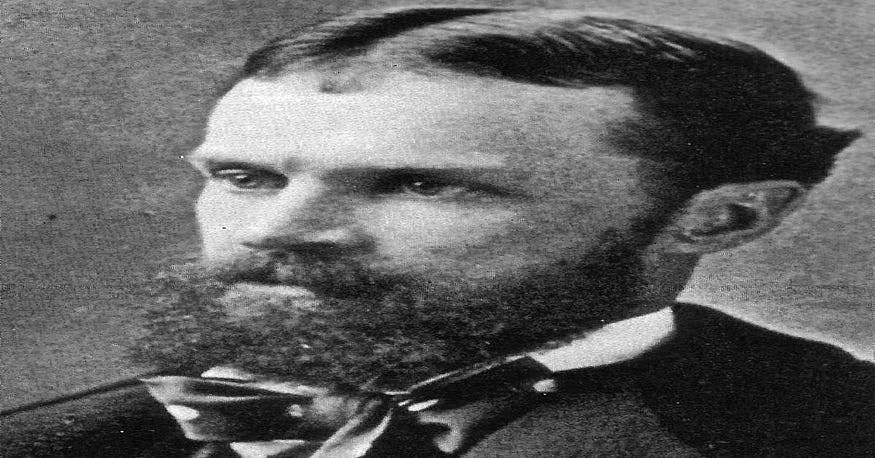
C.S. Peirce

One problem with various philosophers of science is that it’s not always clear if they’re being normative (see here) or descriptive in their accounts of science and scientific practice. Indeed it may be the case that some philosophers of science haven’t even made such a distinction in their own minds. (It can be said that if such philosophers were being entirely descriptive, then they wouldn’t actually be doing philosophy at all.) In addition, some philosophers tend to simplify what actually happens in science (or what scientists actually do). And, because of that, many scientists — and even some fellow philosophers - get somewhat annoyed with these philosophical accounts precisely because of such simplifications and their somewhat disguised normative nature.

To put all that in very simple terms.

Scientists (i.e., the ones who’ve bothered to consult any philosophers of science) have detected some philosophers turning certain patterns of reasoning into rigid and neat logical structures which have been deemed (by such philosophers) to capture the essence(!) of science and scientific practice.

So take this single example from a book by John Losee. In that book Losee tackles the philosophy of science of John Stuart MillHere is Losee discussing the 19th-century English philosopher:

[J.S.] Mill stressed the importance of these methods [i.e., Mill’s own methods] in the discovery of scientific laws. Indeed, in the course of a debate with [William] Whewell, Mill went so far as to claim that every causal law known to science had been discovered ‘by processes reducible to one or other of those [i.e., his own] methods’[].”

All these (possible) flaws may also be detected in C.S. Peirce’s own account of science — as stated in the following. Of course the problem here may be that just as some philosophers of science simplify both science and scientific practice, so this essay may be simplifying C.S. Peirce’s own account of science and scientific practice. Indeed Peirce himself wasn’t even sure that one logical form alone (i.e., his own) could account for all the possible examples of abduction (see here). In addition, it’s not strictly the case that Peirce only had science in mind when he formulated his general principles of abduction.

All that said, this essay is only a short introduction to Peirce’s position on scientific abduction.

But, firstly, here are a few biographical details.

Charles Sanders Peirce (1839 — 1914) was an American philosopher, mathematician, logician and scientist. He’s often referred to as being “the father of pragmatism”.

Peirce was educated as a chemist and actually employed as a scientist for thirty years. Interestingly, in the 1880s Peirce realised that logical operations could be carried out by electrical switching circuits (see also logic gate). This idea was later used as a basis for digital computers. And, more relevantly to this essay, Peirce was the first to define the concept of abductive reasoning.

Finally, the philosopher Paul Weiss once wrote (if way back in 1934) that Peirce was

“the most original and versatile of American philosophers and America’s greatest logician”.

C.S. Peirce on Deduction, Induction and Abduction

The following words are C.S. Peirce’s own distinctions between abduction, induction and deduction:

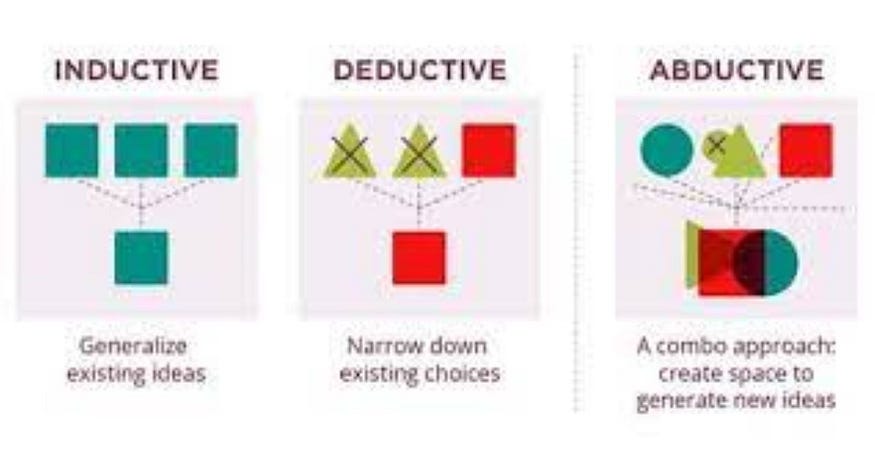
“Deduction proves that something must be; Induction shows that something actually is operative; Abduction merely suggests that something may be.”

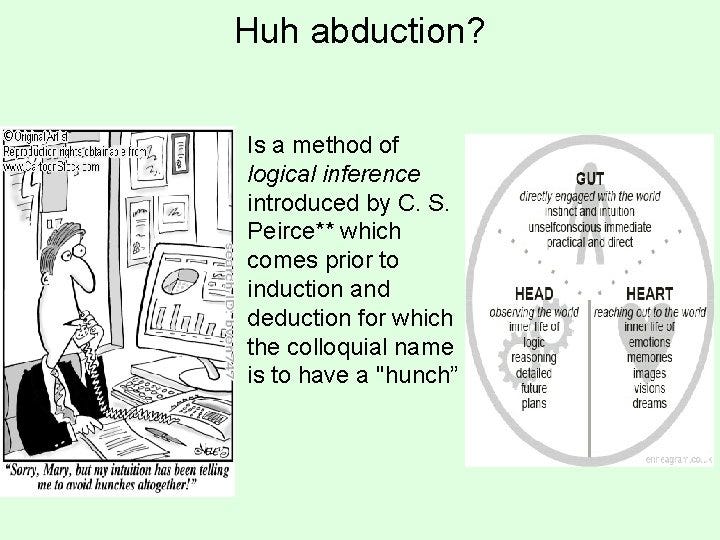
In order to make some immediate sense of abduction, it’s helpful to note that Peirce also called a particular case of abduction a “presumption”, “retroduction” or “hypothesis”. Indeed abduction can even be characterised as (plain) guessing.

Moreover, because abductive hypotheses were deemed (by Peirce) to come first in scientific reasoning, then it may follow that they are the most important type of inference out of the aforementioned three.

Yet abduction isn’t a historical curiosity.

For example, in the 1990s there was renewed interest in the logic of abduction when it came to researchers in artificial intelligencecomputer science and even in the law (i.e. when it came to the analysis of evidence). Indeed, more specifically, diagnostic expert systems often employ abduction (see here).

In any case, in the simple — and somewhat vague — terms of Peirce’s words above, deduction moves from something that’s already taken as given or even as being true. And if that something is given or taken to be true, then what follows from it (if correctly derived) must also be true.

Abduction, on the other hand, isn’t a case of moving from what is given or taken to be true. Instead, it’s a suggestion as to what may be true (or to be the case). That is, a (to use Peirce’s own words) “surprising fact” is observed, and then the abductive hypothesis (or inference) “merely suggests” that certain things may explain that surprising fact.

The Logical Form of Abduction

In 1903, Peirce offered this formalisation of abductive inference:

“The surprising fact, C, is observed;

But if A were true, C would be a matter of course, Hence, there is reason to suspect that A is true.”

So the hypothesis above attempts to explain — or account for — a fact. Someone employing induction, on the other hand, will want to test hypothesis A (i.e., in Peirce’s own example) in order to see if it is true or accurate.

(One may wonder how the word “fact” is being used by Peirce if what’s being described is supposed to be both “surprising” and new.)

It needs to be said here that in the accounts of induction which follow, it isn’t always the case that induction is simply a case of testing hypotheses. (This seems to be Peirce’s own slant on induction.) Instead, induction (or inductive inference) moves from given observations (or phenomena) to generalisations (or conclusions) about them.

Now take another often-quoted formalisation of the distinctions between deduction, induction and abduction (based on Peirce’s own example):

Deduction:

Rule: All the beans from this bag are white.
Case: These beans are beans from this bag.
Result: Therefore these beans are white.

Induction:

Case: These beans are [randomly selected] from this bag.
Result: These beans are white.
Rule: Therefore all the beans from this bag are white.

Abduction:

Rule: All the beans from this bag are white.
Result: These beans [oddly] are white.
Case: These beans are from this bag.

To quickly sum up the formalisations above.

The deduction begins with a statement of a truth or a fact. (“All the beans from this bag are white.”) The induction simply notes a phenomenon. (“These beans are [randomly selected] from this bag.”) And the abduction (which has the same wording as the deduction) is not a statement of a truth or a fact (despite the wording): it’s a hypothesis. (“All the beans from this bag are white.”)

(The abduction is stating that it may be the case that all the beans from the bag are white. The deduction states that all the beans from the bag are white.)

The deduction then notes what is taken to be another fact. (“These beans are beans from this bag.”) The induction — again — simply notes a given phenomenon. (“These beans are white.”) And the abduction also notes a given phenomenon. (“These beans are [oddly] white.”)

Finally, the deduction notes that because the beans are from the bag, then they must be white. (“Therefore these beans are white.”) The induction concludes that all the beans from the bag are white — even though it’s possible that not all of them are! (“Therefore all the beans from this bag are white.”) And the abduction concludes that the white beans (in front of the observer) may be from the bag because the original hypothesis (or premise) of that same abduction had it that “All the beans from this bag are white”.

In broader terms than all the above, deductive inference begins with an axiom or premise (or from a small set of axioms or premises). And inductive inference begins with a singular instance of a given observed phenomenon (or from a statement about it) and moves on to further instances of that same phenomenon. Abductive inference, on the other hand, is more like a wise (i.e., rather than unwise) shot in the dark motivated by a (to use Peirce’s words again) surprising fact.

So when we come across a surprising fact, we often need to explain it. In other words: Why is it surprising or curious? We then come up with an explanation of the surprising or curious phenomenon. Yet that explanation must also serve a purpose. That purpose is to make the curious or surprising phenomenon (or event) less curious or surprising. The explanation must — at least partly — explain the phenomenon's (or observation’s) former curious or surprising nature. Thus, by explaining or understanding the phenomenon (or observation), we take away its anomalous character.

At least that’s my everyday (or colloquial) rendition of C.S. Peirce’s position on abduction.

Moreover, this explanation of the phenomenon (or observation), according to Peirce, would therefore be an “explanatory hypothesis”. This means that such a hypothesis isn’t deductively or inductively inferred from anything . In other words, it isn’t a logical conclusion, entailment or implication. It’s an explanation of a given phenomenon or observation. In addition, the abductive explanation (or hypothesis) isn’t itself factual: it’s simply a means of making sense of something.

Another important point about Peirce’s abductive hypotheses is that they come before any tests, calculations, experiments, etc. Indeed these latter things are (or may be) carried out in order to determine the truth (or accuracy) of the abductive hypothesis in question. So it’s not the case, as many people think, that the hypothesis is formulated after the tests, calculations and experiments. (The abductive hypothesis isn’t inferred or deduced from such things.) Instead, the abductive hypothesis may give people a strong motivation to carry out tests, calculations and experiments.

All this may well also mean that such abductive hypotheses are essentially creative acts or even (if only in a loose sense) acts of intuition.

For example, if I came across a remote village that’s been levelled to the ground, I may immediately formulate the hypothesis that there’s been a very-large bomb dropped on the village. However, I wouldn’t formulate that hypothesis because of — or after — carrying out radiation tests, calculating the strength of the (possible) bomb or collecting data on the nature of the destruction (i.e., to help me infer that there’s been an attack). No; the hypothesis is spontaneous. However, even if the hypothesis isn’t strictly speaking spontaneous, then it still won’t rely on prior tests and experiments (or the things that I can infer from such things).

This means that the whole point of the abductive hypothesis about the levelled village is to get the ball rolling. In other words, the hypothesis doesn’t come after the ball has (as it were) stopped rolling.

What also matters with this explanatory hypothesis is what it says may happen if certain experiments, tests, etc. are carried out. And if those things do in fact occur, then the hypothesis will be taken to be true, correct or accurate (if only for a given or short amount of time).

So firstly we begin with abduction. However, after the act of abduction, it may indeed be the case that scientist will then employ induction and deduction.

Conclusion


To recap:

1) Firstly, there is the abductive hypothesis.

2) Then that abductive hypothesis will (or should) be followed by tests, experiments, calculations, further observation's, etc. (all of which will attempt to legitimise — or perhaps falsify — the abductive hypothesis).

3) Finally, the results or conclusions of all this will (or should) be put together to become the subject of further inductive and deductive inferences.

Yet, despite all the above, many laypeople tend believe that science is nearly all about induction — as, arguably, J.S. Mill (as mentioned above) did. In actual fact, however, scientists utilise induction, deduction and abduction (amongst many other non-logical things).

As stated, the abduction (or explanatory hypothesis) may be used as a basis — and guide — for further inductive and deductive inferences. This — again — can be summed up in the following way:

(1) Firstly, the abductive hypothesis states this or that (or it explains this or that).

(2) Secondly, the scientist investigates various examples (or instances) of the phenomenon which were explained by the prior abductive hypothesis.

(3) Finally, the scientist sees whether or not it’s the case that the explanatory hypothesis holds true for any further instances of the phenomenon under scrutiny.

Yet, from a purely inductive point of view, the abductive hypothesis is unsatisfactory because it should explain more than a single phenomenon. That is, it should also explain other phenomena of the same type. What’s more, different instances of the same type should be put together (or made uniform) through various inductive and deductive processes. Finally, after all this is carried out, the scientific result (or results) may be formalised via various deductive (logical) systems which also now have empirical content.

More technically, the inductive and deductive conclusions (i.e., the results of the former abductive hypothesis) may themselves become axioms (or premises) in otherwise deductive logical systems (with empirical content). Specifically, if an inductively-derived conclusion is the case (or accurate), then what will deductively follow from it (i.e., by simply analysing the conclusion-come-premise itself)? In other words, what can we deduce from the inductively-derived conclusion (itself a product of the original abductive hypothesis) simply by exploring its (as it were) logical grammar?

To sum up.

C.S. Peirce believed that abductive hypotheses had often been the original sources of what later became bona fide scientific theories.

[I can be found on Twitter here.]