


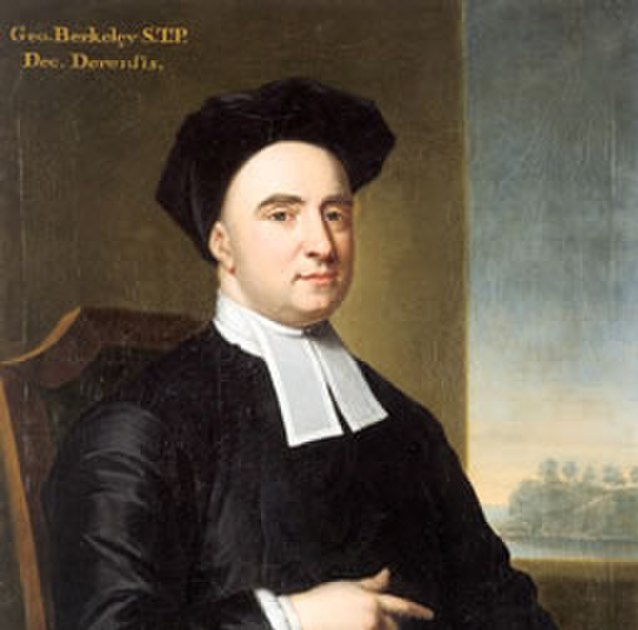
Anglo-Irish philosopher George Berkeley indulged in what later came to be called the philosophy of physics. [See note 1.] Berkeley was influenced by Isaac Newton’s physics. He was also influenced by Newton’s opinions on physics. This is hardly a surprise. The work concentrated upon in this essay (De Motu) was written in 1721. Newton died in 1727. Berkeley and Newton had a serious problem with what they both called “occult qualities”. They wanted to banish them from physics.
Berkeley as a Linguistic Philosopher?
Berkeley can’t really be classed as a linguistic philosopher. Nonetheless, he did focus on what he called “linguistic usage” and “terms”. However, unlike the linguistic philosophers of the 1940s to the 1960s, Berkeley’s account of the vices of linguistic usage was just a means to an end. That end being the separation of physics from metaphysics.
If we returned to linguistic usage.
As Voltaire supposedly put it, “If you want to converse with me, first define your terms.” [See note 2.] The following is Berkeley’s own take on this subject:
“In the pursuit of truth we must beware of being misled by terms which we do not rightly understand.”
Even when philosophers and laypeople believe that they do understand the terms they use, they may still be misled by them. So say that a philosopher coins the term “corbottoid”, and defines it strictly as “The spiritual and metaphysical entymerial influence of Jesus H. Corbett on all knowing subjects”. This philosopher understands that word, and even provides a definition of it. However, isn’t he misled by it too? At least he is in the simple sense that it’s a bullshit term.
Berkeley himself went further. He argued that although philosophers believe that they understand the terms they use, many of them don’t actually do so.
Berkeley, almost like a 20th century postmodernist philosopher, focussed on discourse… Well, he didn’t actually use the word “discourse”. However, he did warn us about “all prejudice”, whether “rooted in linguistic usage or in philosophical authority”. He advised us, instead, to “fix our gaze on the very nature of things”. That is Berkeley expressing his empiricism. [See note 3.]
Berkeley then tied his empiricism directly to linguistic usage when he wrote that “no one’s authority ought to rank so high as to set a value on his words and terms unless they are based on clear and certain fact”. This too is an attack on metaphysics, or at least an attack on the metaphysics of what Berkeley later called “the Schoolmen”.
Let’s make all this more concrete.
What terms did Berkeley have in mind at this time?
Berkeley on Metaphysical Terms in Physics
Berkeley cited the following examples: solicitation of gravity, urge, dead forces, force, etc. According to him, following the positions of Isaac Newton, all these are “occult” terms or “occult qualities”.
So what about Newton?
Newton believed that “theories” were acceptable, but that “hypotheses” were (largely) unacceptable. (Newton used these terms in his own 17th-century way.) His term “theory” was used for that which can be “deduced from” what is observed and/or experimentally produced (or noted). Thus, inductive evidence can lead to a theory about such evidence. Thus, Newton didn’t like his own theories being classed as hypotheses.
As already seen, Berkeley used the word “occult”. So too did Newton.
For example, Newton once claim that hypotheses were about what he called “occult qualities”.
What are occult properties?
They’re properties which can’t be observed or “measured”.
Let’s add to this by going forward in time to David Hume.
In terms of examples, Hume had a problem with such “hypothetical entities’” as substance, vacuum, necessary connection and the self. (All this can be found in Hume’s book An Enquiry Concerning Human Understanding.) Newton himself had a problem with such things as the aether and corpuscles.
If we return to Berkeley.
Firstly, Berkeley tackled only two of the terms mentioned above: solicitation and effort. Again, like Newton before him, Berkeley acknowledged that there may well be a pragmatic use for such terms. However, “they must be taken in a metaphorical sense”. Having just said that, he did add that “a philosopher should abstain from metaphor”.
Clearly, this is too strict a position. It can be argued, instead, that philosophers should abstain from those metaphors which they don’t take to be metaphors. If they don’t take them to be metaphors, then there doesn’t seem to be a big problem. (Berkeley might have disagreed with this position too.)
In any case, Berkeley’s problem with these terms was that they “belong properly to animate beings alone”.
The Distinction Between Physics and Metaphysics
Berkeley wasn’t arguing that metaphysics is bullshit. He was arguing something far more simple: keep metaphysics out of physics. So, unlike the later logical positivists, Berkeley believed that there is indeed a role for metaphysics. What he wanted was for physics and metaphysics to put their houses in order. Or at least to know their “bounds”. Let Berkeley speak for himself here:
“Allot to each science [he classed metaphysics as a science] its own province; assign its bounds; accurately distinguish the principles and objects belonging to each. Thus it will be possible to treat them with greater ease and clarity.”
This passage sounds like a missive against interdisciplinary research. (Such a term or discipline didn’t exist back then.) Perhaps it is. That said, it was written in 1721.
Again, Berkeley didn’t deny the relevance of metaphysics. He simply argued that it doesn’t “belong to mechanics or experiment”. Berkeley stated the following:
“In first philosophy or metaphysics we are concerned with incorporeal things, with causes, truth and the existence of things.”
In this case, it was “metaphysical principles” such as “real efficient causes” which don’t belong to physics. However, they can still “serve to define the limits of physics, and in that way to remove imported difficulties and problems”. (Certain contemporary physicists wouldn’t be very happy with Berkeley’s idea that metaphysics defines the limits of physics.)
Berkeley emphasised pragmatics (or “utility”) again when he discussed geometry:
“[G]eometers for the sake of their art make use of many devices which they themselves cannot describe nor find in the nature of things.”
Berkeley went even further in the following passage:
“[M]athematical entities have no stable essence in the nature of things; and they depend on the notion of the definer. Whence the same thing can be explained in different ways.”
Berkeley was arguing that abstract mathematics is fine and dandy. However, once it’s applied to the nature of things, then the situation becomes problematic. (Empiricists still need to confront the nature of mathematics even when it isn’t applied to the nature of things.) So physicists and philosophers must “distinguish mathematical hypotheses from the nature of things [and also] beware of abstractions”.
All that must have been easier to accept than Berkeley’s words about physics. He continued:
“[T]he mechanician makes use of certain abstract and general terms, imagining in bodies force, action, attraction, solicitation, etc., which are of first utility for theories and formulations, as also for computations about motion.”
All this is similar to the theoretical physicist Lee Smolin’s position as expressed in the following:
“[Scientists] showed us how to display the records of these motions in simple diagrams whose axes represent the position and times in a way that is frozen and hence amenable to being studied at our leisure.”
In a related manner, one can add to this, as Nancy Cartwright did, that there is no such thing as a frictionless plane when it comes to rolling a ball down such a thing. (As in the well known experiment connected to Galileo.) In addition, at least at first, there was no empirical reason to believe that quarks existed.
If we return to Berkeley.
He was raising the interesting philosophical problem of the precise relation between the abstract (i.e., mathematics) and the concrete (i.e., physics).
Of course, all physicists recognise the importance of abstract mathematics. However, Berkeley really had his eyes on the notions of force, action, attraction, etc. Yet here again he took a pragmatic position and simply argued that such things “must be considered to be of a kind with other hypotheses and mathematical abstractions”. If physicists and philosophers don’t view such things as hypotheses, then they’re
“in danger of sliding back into the obscure subtlety of the Schoolmen, which for so many ages like some dread plague, has corrupted philosophy”.
Conclusion
So, in some cases at least, could it have been that (in both physics and philosophy) the things which had pragmatic (or instrumental) value were reified into metaphysical entities, conditions, properties and principles?
Notes:
(1) It may seem like an odd thing to say, but Berkeley’s philosophy of physics actually contains a lot of physics. This is unlike many 20th century examples of the philosophy of science which didn’t contain that much science.
(2) If taken literally as defining all one’s terms, then no philosophical work would ever get off the ground. (See my ‘Define Your Terms and Explain Your Concepts’.)
(3) From a retrospective perspective, it does seem a little naïve. As if fixing our gaze on things alone will tell us the nature of such things. Yet this is still a superior approach to wild metaphysical speculation.

No comments:
Post a Comment