Friday, 19 December 2025

Marxist Frederic Jameson on Counterrevolutionary Postmodernism


Postmodernist philosophers rejected Marxism — even those who were once Marxists. In fact, many deemed Marxism to be yet another metanarrative. [See ‘Marxism as a Metanarrative’.] Yet when you read postmodernist philosophers (such as Ernesto Laclau and Chantal Mouffe), you can find all sorts of challenges to capitalism, as well as ways in which capitalism may be challenged. Indeed, it’s hard to come across a single postmodernist philosopher who waxes lyrically about capitalism. [See note 1.] Consequently, it can be argued that many postmodernist philosophers were still inspired by the spirit of Marxism, if not by the letter.
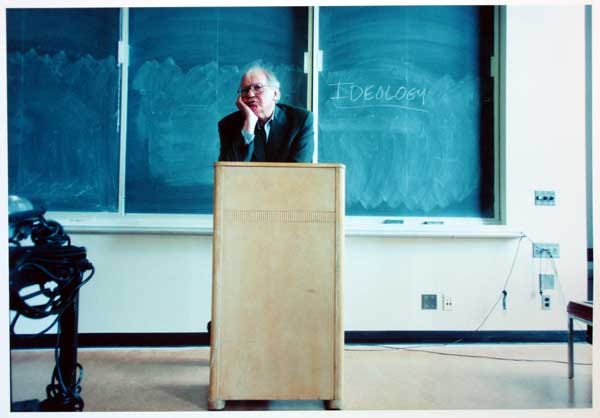


Fredric Ruff Jameson (1934–2024) was an American literary critic and Marxist theorist. His best-known books include Postmodernism, or, The Cultural Logic of Late Capitalism (1991) and The Political Unconscious (1981).

In 2024, Robert T. Tally reviewed the work of Jameson for the socialist magazine Jacobin. He wrote:

“[F]or over five decades, Fredric Jameson has been the leading Marxist literary and cultural critic in the United States, if not the world.”

Postmodernists aren’t Marxists

Despite radical postmodernism, and its embrace of many alternatives to the status quo, it was still not Marxist. Thus, according to Marxists, all the political fluff of postmodernism still wasn’t getting to the heart of the problem. And that problem was capitalism.

This basically meant that there was nothing postmodernist philosophers could do to please Marxists (such as Frederic Jameson) other than adopt Marxist theories and Marxist plans of action. The gist (again) is that if Marxist theories and Marxist plans of action aren’t embraced, then capitalism will remain. And capitalism is the main problem.

Jameson himself stated his political problem with postmodernism very clearly when he told his readers that

“postmodernism replicates or reproduces — reinforces — the logic of consumer capitalism”.

It does seem like an extreme position to say that the entirety of postmodernism simply replicates or reproduces — reinforces — the logic of consumer capitalism. (Readers will get their heads around Jameson’s use of the word “logic” later.)

Simply put, because Jameson was a Marxist, to him it must have been the case that capitalism gave rise to postmodernism. That’s because this is how Jameson’s Marxist materialism works. That is, the modes of production (or the “base”) give rise to just about everything else (i.e., the superstructure), including ideology, religion (e.g., Islam, Christianity, Judaism, etc.), art, and, in this case, postmodernism.

Yet Jameson wasn’t a Marxist philistine or fundamentalist because he did actually analyse the works of postmodernist and poststructuralist philosophers. However, it can be argued that Jameson tackled these postmodernist ideas and theories not because he wanted to broaden the nature of Marxism, but simply because he believed that Marxists should be aware of all the new rivals who exist in late-capitalist societies. Thus, postmodernist philosophers were now basically on the same plain as conservatives, reactionaries, Republicans, etc. (Okay, perhaps not exactly the same plain as these people.)

Jameson did raise the possibility that postmodernist philosophers may indeed “resist” capitalism when he wrote the following:

“We have seen that there is a way in which postmodernism replicates or reproduces — reinforces — the logic of consumer capitalism; the more significant question is whether there is also a way in which it resists that logic.”

It has already been argued that postmodernist philosophers did resist that logic, and many examples of this can be given. That said, if Jameson had accepted that postmodernist philosophers were “truly radical” (or even “truly revolutionary”), then there wouldn’t be much of a role for Jameson’s own Marxism. If anything, postmodernist philosophy was a direct threat to Marxism.

What is Late Capitalism?

Frederic Jameson told his readers that

“at some point following World War II a new kind of society began to emerge (variously described as postindustrial society, multinational capitalism, consumer society, media society and so forth).”

A new kind of society began to emerge after World War I too. New societies have emerged throughout history. That doesn’t mean that what Jameson argued is false or worthless. It does show that it’s nothing (too) spectacular.

In Jameson’s view, postindustrial society, multinational capitalism, consumer society and media society seem to be expressions of the same thing (if viewed from different angles).

Even from a non-Marxist perspective it can be argued that we do exist within a “postindustrial society”.

As for “multinational capitalism”: well, to some extent, that dates back (as Jameson himself stated) long before the rise of postmodernism itself. But, sure, it might well have reached higher levels by the 1980s.

Finally, “consumer society”: Marxists and other “radicals” began to discuss this in the early 1960s, if not before.

After his reference to “media society”, Jameson immediately explained himself when he referred to

“[n]ew types of consumption; planned obsolescence; an ever more more rapid rhythm of fashion and styling changes; the penetration of advertising, television and the media generally to a hitherto unparalleled degree throughout society”.

There were new types of consumption, as there were in the 1950s, 1920s, 1880s, 1820s, 1710s, etc.

Readers may also wonder why (to play the devil’s advocate) anyone would have a deep problem with all this. After all, take the inverse of all Jameson’s examples: an ever less rapid rhythm of fashion and styling changes, fewer types of consumption, etc.

Postmodernism Everywhere

When Jameson stated that

“postmodernism is the cultural expression of our own current period of late capitalism”

surely that was an assumption that postmodernism was literally everywhere. That is, postmodernism somehow expressed and captured everything (minus the works and actions of Marxists and selected minority groups) that was culturally expressed in the period of what Jameson called “late capitalism”.

In detail. Jameson believed that postmodernity did merge all discourse into a neat-and-tidy whole. That was because “corporate capitalism” now made a better job of the “colonization of the cultural sphere”.

More forcefully, Jameson believed that postmodernism was a form of mass culture. That mass culture is the product of capitalism. And, because it is mass, it can be found in literally every part of our daily lives.

Yet, here we are in 2025, and many aspects of postmodernism already seem old-fashioned or irrelevant. Thus, was Jameson (at least in the period 1994 to 1997) totalising postmodernism and its impact on literally all cultural expression?

Jameson also stated that

“postmodernism is closely related to the emergence of this new moment of late, consumer or multinational capitalism”.

Closely related?

Jameson might have been correct to say that postmodernism arose during this period. However, he was saying more than that. He was also arguing that “late, consumer or multinational capitalism” (as the substructure) is somehow responsible for (or the cause of) postmodernism.

For now, let’s just accept that there is such a thing as late consumer capitalism or multinational capitalism. Did it give rise to postmodernism? How, exactly, did it do so? Or did the two things simply occur at (roughly) the same time?

Interestingly, Jameson himself said that postmodernism and late capitalism weren’t co-occurrent :

“[T]he society the media or the spectacle, or multinational capitalism [ ] can be dated from the postwar boom in the United States in the late 1940s and early ’50s or, in France, from the establishment of the Fifth Republic in 1958.”

Postmodernism is generally dated back to the late 1960s. (It can be dated back to the 1950s too.) In terms of philosophy at least, it didn’t really get going until the 1970s. And it didn’t gain its “hegemony” until the 1980s. So it can be said that it took philosophers and theorists a long time to catch up with the changes to capitalism which Jameson himself highlighted.

So, again, this is more than a simple co-occurrence. Jameson believed that postmodernism’s “formal features in many ways express the deeper logic of that particular social system”. This is an odd use of the word “logic”, or at least it’s a loose use of that word. Jameson actually meant the material basis (or reality) of capitalism gave rise to postmodernism. In other words, the (Marxist) substructure of late capitalism gave rise to a superstructure which included postmodernism.

Superstructure and the Frankfurt School

Jameson extensively studied the Frankfurt School. What united them was the belief that “cultural criticism” is an important part of Marxism. So much so that, in 1969, Jameson himself co-founded the Marxist Literary Group at the University of California. (Arguably, this was before the rise of postmodernism.)

Why did a Marxist like Jameson concern himself with epiphenomena like postmodernism and postmodernist philosophy? After all, previously Marxists believed that the superstructure was utterly determined by the economic base. However, the people called “Western Marxists” did analyse culture too.

Yet Marxists can analyse culture and still believe that the substructure completely determines the superstructure…

It’s just that it helps the Marxist project to analyse culture — even if it is epiphenomenal. More relevantly, Jameson himself believed that the substructure completely determined the superstructure which — at least at that time — included postmodernism. Indeed, he spent a lot of time saying precisely that.

To complicate matters. Jameson did believe in an artistic mode of production, which, on the surface at least, appears to put artistic work on the same level as other modes of production. Yet here too artistic production was still seen (by Jameson) as being a product of the modes of production of the capitalist system.


Note:

(1) It can be argued that Jean Baudrillard came close to doing so. However, Baudrillard — and many of his fans -denied that. In simple terms, Baudrillard saw himself as being yet another “radical”.

(**) To follow: ‘Frederic Jameson as Cultural Snob’.


Sunday, 7 December 2025

Deleuze and Guattari as Rousseauian Romantics


Wiki Commons. Source here.

“[Man in the state of nature] [ ] his faculties are so exercised and developed, his ideas so extended, his feelings so ennobled, and his whole soul so uplifted.”

— Jean-Jacque Rousseau, The Social Contract

“Men in a state of nature [ ] His soul, which nothing disturbs, is wholly wrapped up in the feeling of its present existence, without any idea of the future.”

— Rousseau, Discourse on the Origin and Basis of Inequality Among Men

Note: The single name Deleuze, instead of Deleuze and Guattari, will be used in this essay in order to save space and time. See my ‘According to Deleuze and Guattari, Capitalism Causes Schizophrenia’.

Deleuze and Guattari as Rousseauian Romantics

The argument in this essay is that Gilles Deleuze and Felix Guattari consistently romanticised schizophrenics and the condition of schizophrenia. Indeed, this romantic element of the anti-psychiatry movement (which predated Deleuze’s and Guattari's writings) had a large impact of psychiatrists, the arts, politics, and even on writers like Ken Kesey and his novel One Flew Over the Cuckoo’s Nest. (Although it can be said that Ken Kesey influenced this movement, rather than the other way around.)

Deleuze himself was tapping into a (mainly French) tradition that went back to Jean-Jacques Rousseau.

Now consider this poetic passage from Deleuze:

“[C]ontact with the profound life of all forms or all types of beings, who is responsible for even the stars and animal life, and who ceaselessly plugs an organ-machine into an energy-machine, a tree into his body, a breast into his mouth, the sun into his asshole.”

Great poetry!

Is it more than that?

Should it be more than poetry?

Did many (or any) psychiatrists, schizophrenics, concerned citizens, etc. plumb the depths of Deleuze’s words looking for strategic and hands-on advice when it came to schizophrenia and schizophrenics? Indeed, did political activists translate his ideas into concrete political strategies and goals?

Now for another passage from Deleuze:

“As for the schizo, continually wandering about, migrating here, there, and everywhere as best he can, he plunges further and further into the realm of deterritorialization.”

Deleuze then wondered whether “these peregrinations are the schizo’s own particular way of discovering the earth”.

To Deleuze, deterritorialization is a good thing, no matter what form it takes.

The schizophrenic captures (or even knows) what Deleuze called “the Real”.

What is the real?

This:

“‘[T]he demoniacal element in nature or within the heart of the earth [alongside] the historical process of social production.”

It’s worth noting here that Deleuze was influenced by Spinoza’s monism. However, I doubt that the latter had much to say about the “demoniacal”. Yet, in a strong sense, people like Marquis de Sade, Nietzsche and Foucault did. Indeed, to all these writers, violence and the love of power and violence were taken to be part of nature’s demoniacal (though that word wasn’t used) side. (This is something that Foucault expressly stated in his words on “revolutionary violence” — though this is disputed - and his penchant for sadomasochism.)

Thus, much of this debate was dressed in terms of “power” having an impact on mental health. And, of course, capitalism incorporates power. The “ bosses” have power, and those who support them have power too. Of course, it’s all dependent on what’s meant by “power”, and how that explains the link between capitalism and mental health (or schizophrenia).

There comes a point at which power is interpreted so broadly that there’s power literally everywhere. That means there are “power relations” between leftwing professors and their students, the leaders of revolutionary groups/parties and their “members”, and even between “radical journals” and those people who read them. In fact, Michel Foucault — for one — did believe that power is everywhere, and he particularly noted it in the French Communist Party (PCF).

Here’s another passage from Deleuze:

“A schizophrenic out for a walk is a better model than a neurotic lying on the analyst’s couch. A breath of fresh air, a relationship with the outside world.”

Of course, on the superficial surface, that romantic vision seems fair enough. But it’s simplistic in that in suggests (or even states) that all schizophrenics like walks in the fresh air, and that they all become neurotics when on the analyst’s couch or when institutionalised.

In any case, Deleuze meant a model of a “desiring-machine”.

What did he mean by the word “machine”?

Deleuze believed that “[e]verything is a machine”. Indeed, “the breast is a machine that produces milk, and the mouth a machine coupled to it”. He also talks of the “eating-machine” and “anal machine”

Basically, a desiring-machine is a machine which desires. And desires should never be repressed. [Readers should refer back to the words on de Sade, Nietzsche and Foucault.) Relevantly, a schizophrenic is repressed when “found in mental institutions” in which he or she is “a limp rag forced into autistic behaviour”.

Deleuze also quoted Karl Jaspers (in a note) talking about “madness in our time”. Jaspers wrote that madness is

“‘a state of total sincerity, in areas where in less chaotic times one would have been capable of honest experience and expression without it”.

So here we have the madman capturing the Real, or at least being totally sincere.

Earlier in another note, Deleuze had also quoted Henry Miller’s Tropic of Cancer in which one character states that his “guts spilled out in a grand schizophrenic rush, an evacuation that leaves me face to face with the Absolute”.

The Ego and the I

The following is Deleuze on the “schizo”:

“There are those who will maintain that the schizo is incapable of uttering the word *I*, and that we must restore his ability to pronounce this hallowed word. All of which the schizo sum up saying: they’re fucking me over again. ‘I won’t say *I* any more, I’ll never utter the word again; it’s just too damn stupid. Every time I hear it, I’ll use the third person instead, if I happen to remember to. If it amuses them. And it won’t make one bit of difference.’”

This seems to be tapping into the New Age, “spiritual”, etc. view about “erasing the ego”, I or whatnot, which was popular in the 1960s and after.

According to Deleuze, it’s not that the “schizo” can’t use the word “I”, or that he doesn’t understand its function. Instead, he simply believes it’s a stupid word, and it doesn’t serve a purpose for him… However, in the Samuel Beckett passage quoted by Deleuze, it serves at least one function. (It’s no wonder that Deleuze concentrates on a character in a novel by Beckett because he rarely mentions real patients and their real experiences.) The schizo says, “I won’t say I any more, I’ll never utter the word again [ ].” That’s right, the schizo uses the word “I” and “I’ll” in a first person way, and “I” as a reference to the pronoun.

Of course, all this largely depends how we cash out this word “I”. It can be cashed out in Hume’s deflationary and technical sense, etc., or it can be seen as a substitute for what Deleuze calls “the ego”.

Freud had a lot to say about “the ego” and what Deleuze called “daddy-mommy”. According to Deleuze, “the schizo has long since ceased to believe in it”. Instead, “[h]e is somewhere else, beyond or behind or below these problems, rather than immersed in them”.

Freud the Capitalist

Felix Guattari’s criticisms of Sigmund Freud can be seen as an infight between psychiatrists at a particular period in history, and in a particular set of places (i.e., mainly universities in France).

To put it simply, Deleuze and Guattari took Freud to be a (not his own words) “defender of capitalism”. The problem here is that according to many Marxists, if someone isn’t an explicit critic (or “enemy”) of capitalism, then that person (either implicitly or explicitly) must be a defender of capitalism. Indeed, if someone isn’t a Marxist, then he/she (whether implicitly or explicitly) must be a defender of capitalism.

[Many of the criticisms of Freud also boil down to the Marxist idea that capitalism “invented” the “nuclear family”. Think here of Black Lives Matter in its early days, and its criticism of the nuclear family.]

In simple terms, Deleuze liked schizophrenics. Freud, on the other hand, “doesn’t like schizophrenics”. Indeed, he tended “to treat them more or less as animals”. Deleuze went on to say more about Freud’s take on schizophrenics:

“They mistake words for things [ ] They are apathetic, narcissistic, cut off from reality [ ].”

In terms of being “cut off from reality”, Deleuze believed that schizophrenics were more in tune with reality or the Real.

As for mistaking words for things, this could be a way of characterising (if slightly rhetorically) the philosophical mindset of many postmodernist and poststructuralist philosophers.

Deleuze also showed his Marxist credentials by using the word “idealism” for Freud’s psychoanalysis. Indeed, the term “idealism” [see here], along with “positivism” [see here], have often been used by Marxists and left-leaning philosophers about all sorts of (non-idealist and non-positivist) positions.

In slightly more concrete terms. Deleuze believed that capitalism enforced “fixed identities” rather than “multiplicity”. Yet postmodernists (largely after Anti-Oedipus) and even Marxists have highlighted the fact that capitalism can tolerate multiplicity, as long as that multiplicity doesn’t threaten Das System. (Slavoj Žižek talks of “hybrid entities” living comfortably within capitalist states or societies.) Indeed, Capitalism (with a platonic ‘C’) even takes risks with identities which do threaten Das System.

As it is, readers can happily agree with some — or even many — of Deleuze’s criticisms of Freud’s positions, and still not embrace Deleuze’s own vision.

Materialist Psychiatry

In my last essay (According to Deleuze and Guattari, Capitalism Causes Schizophrenia’) I stated how Deleuze shoehorned Marx’s terms and theories into his own work. Now take a look at the following two “equations”:

Nature = Industry, Nature = History

What did Deleuze mean by all that?

Of course, anything can be likened to anything. So nature can indeed be likened to industry, as well as to history.

But what point did it serve?

In 1972, and in the years before, there would have been a lot of pressure on left-leaning intellectuals and academics to incorporate Marxist ideas and terms into their work. Thus, Deleuze talked about his “materialist psychiatry”.

Deleuze stated that his “materialist psychiatry [introduces] desire into the mechanism, and [ ] production into desire”. So here we have the materialist (as well as reductionist?) word “mechanism”, and the Marxist word “production” in a passage about psychiatry.

Deleuze even tied Marx to his own interest in “desire”. He told his readers that “[a]s Marx notes, what exists in fact is not lack, but passion, as a ‘natural and sensuous object’”. (Marx used the word “passion” not “desire”, but one can see what’s going on here.)

To an outsider, it may seem odd to claim that a kind of psychiatry can be “materialist”. However, it was a specific kind of materialism Deleuze had in mind: Marxist (or historical) materialism.