

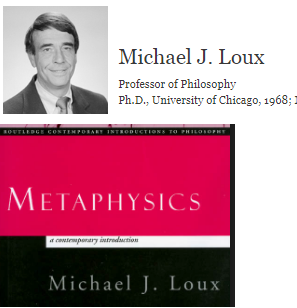
The American philosopher Michael J. Loux seems to be a master of playing games with modal terms — at least within this particular 2002 discussion of bare objects (i.e., within ontology).
Now it’s often been said that modal terms form a “closed circle” in that the definition of one term must include reference to all, some or at least one other modal terms (i.e., they’re necessarily interdefinable). And since I’m going to be sceptical about the use of modal terms (if only within the context of what Michael Loux has to say), here’s the English philosopher Bob Hale on the sceptic’s position on necessity and how it must bring in (at least part of) the aforesaid closed circle of modal terms or properties:
“It is difficult to see how his scepticism about necessity could be so much as expressed without employing the notion of possibility. And once a notion of possibility has been granted houseroom, the intelligibility of a correlative notion of necessity can hardly be denied.”
More particularly, Loux (as it were) fuses different modal terms (or properties) in that he believes that the acceptance (or use) of one must bring on board at least one other modal term (or property).
Just to cite another example of this modal (as it were) fusion, take Loux’s fellow American philosopher Alvin Plantinga. He also goes in for using modal terms together when he tells us that “some properties” are “necessarily essential to all objects”. (He offers us the examples of the properties self-identity and existence.) Plantinga also makes the statement that “a necessary proposition is just a proposition that has truth essentially”.
In the specific case Michael Loux tackles here, the terms “essentially”, “necessarily” and “contingently” are played around with. And these terms are played around with in the specific context of the ontology of bare objects (or bare particulars).
The words “essentially” has just been mentioned. It’s worth saying here that there is some dispute as to whether the word “essence” (or “essentially”) is a modal term and what its precise status is. (For example, E.J. Lowe argues that “rather than attempt to explain essence in term of necessity, we need to explain necessity in terms of essence”.) Some modal theorists claim that “essence” (or “essentially”) isn’t actually a modal term and therefore that it isn’t a modal property. However, Michael Loux himself strongly connects essential properties to the other modal properties. Yet, in terms of the passage above, one may have no problems with what Bob Hale says about necessity and possibility and still have problems with Loux’s shoehorning of essential properties into these modal domains.
Loux is committed to essential properties. And he — at least partly — arrives at this commitment via necessity. For example, Loux writes:
“[N]ecessarily everything has some properties essentially.”
Loux believes that this metaphysical fact (if we can use the word “fact” in this ontological context) is a way of “refuting” what he calls “anti-essentialism”. Here again Loux displays his closed circle of his modal terms. That is, according to Loux it is a necessary metaphysical fact that all things have at least “some” essential properties. (We also have some kind of non-Quinian modal universal existential quantification in the quote above. See here.)
What are Properties?
Michael Loux assumes (at least within the passages quoted) the existence of essential properties. And, from that assumption, almost everything else in his general argument follows.
For a start, if there are essential properties, then there must also be contingent properties. After all, the postulation of essential properties literally makes no sense without also postulating contingent properties. So, to paraphrase a well-known statement (usually about an entirely different subject), take the following:
If all properties were essential (or contingent), then no properties would be essential (or contingent).
(It must be said here that in the Leibnizean position on objects and their essences it is argued — at least by some — that all an object’s properties must be taken as being essential to it. See here.)
And in which way do such properties “belong” to objects? Do they “inhere” in objects? How, exactly, do these specific properties belong or inhere in objects? Within this context, what do those words actually mean?
Trivial Properties?
Michael Loux argues that “everything” has essential properties. (This isn’t the Leibnizean position that all an object’s properties are essential to it.) So which kind of properties must everything have? Loux firstly cites “trivially essential properties”. They’re
“properties like being self identical, being red or not red, being coloured if green and being either identical with or distinct from the shape of triangularity”.
Now I don’t mind saying here that I have a very strong aversion to these ostensible properties. Or, more correctly, I have a very strong aversion to them being used in philosophical arguments. Having said that, I don’t want to be a philosophical philistine about them. So perhaps there are profound logical and philosophical consequences to be had from accepting these properties. Then again, Loux may simply accept them because he believes that they are real (or that they have being)— full stop.
So what if the property having no properties (cited by Loux later) is not actually a property at all? Similarly, what if properties like being self-identical or being red or not red (two more examples from Loux) are not properties at all? This must depend on what properties are actually taken to be. In this sense, then, they’re surely abstract if they’re anything. That is, one can’t observe, touch, kick, smell, experiment upon, etc. the property being self-identical or being red or not red.
As stated, all this may entirely depend on what a property actually is. Or, more accurately, all this may entirely depend on what properties are taken to be in these very specific modal and ontological contexts.
From a cursory point of view, it can quickly be seen that trivial properties (of the kind that Loux accepts) must be infinite in number. After all, if there is the property being red or not red, then there must also be the property being blue or not blue. Similarly, if there is the property being either identical with or distinct from the shape of triangularity (an example from Loux himself), then there must also be the property being either identical with or distinct from the shape of a banana. Finally, if there’s a property being colored if green, then there must also be the property being an animal if a human being… and so on ad infinitum.
And then we also have weirder properties such as not being self-identical. And what about the conjunctive property being self-identical and being an apple?
Impure Properties
The American philosopher Albert Casullo refers to what he calls “impure” properties. These are similar — though not identical — to Loux’s trivial properties. He cites “being identical with individual A” as an example.
Now the property being identical with individual A (as well as other impure properties) is different to the trivial properties which Loux argues all objects must have; as well as being different to the properties that just some objects must have (such as being coloured if green). That’s the case because only one object can “have” the property being identical with individual A (at least according to the identity of indiscernibles thesis). Thus the property being the number 4 also fits into this category. Indeed Casullo states that “such properties are obviously unshareable”. Of course a property being unshareable doesn’t automatically make that property suspect. However, it may be suspect anyway.
Casullo himself uses the words “[i]mpure properties, if such there be”. That at the least hints at a degree of scepticism on Casullo’s part.
In any case, Casullo seems to countenance impure properties because he uses them as a means to another philosophical end. (In his case, it’s to show that “individuals [] are ontologically derivative from properties” — see note at the end of this piece.) So perhaps Loux himself is countenancing his own trivial properties for other philosophical ends too. In other words, fake, silly, trivial or impure properties are smuggled into these arguments in order to advance various philosophical arguments which are independent of these supposed properties. Clearly, Loux uses these properties to reject bare objects and to advance his own essentialism. (In Casullo’s case, he uses his impure properties to advance an argument against the bundle theory.)
To give one more example.
I mentioned Alvin Plantinga earlier and he too offers his own seemingly genuine property: existence. This subject has been well-debated in philosophy and Plantinga is fully aware of that fact. So he tells us that “[s]ome philosophers have argued that existence is not a property”. However, Plantinga himself believes that “every object has existence in each world in which it exists”. Here again I’ll only mention Plantinga’s philosophical position on the property existence in passing because it seems similar to Loux’s own positions.
Examples
Example 1
The following is a perfect example of Michael Loux seemingly fusing properties which are contingent with properties which are essential. He writes:
“[T]here is another property they [bare objects] have essentially — the property of having merely contingently the property of having no properties essentially.”
Apart from that passage being hard to understand and it being very strange (at least intuitively), here the terms (or properties) “contingently” and “essentially” are intimately linked to one another.
Loux is arguing here that a contingent property is “essential” to (in this case) a bare object. That is, the contingent property having no properties essentially is essential to the bare object which has that property. What’s more, that essential property is the very property having no properties essentially. Thus a property which is — at least initially — deemed to be contingent is shown to be an essential property. In other words, when an ontologist commits himself to an object which is bare, he’s also committing himself to an object which has no properties. However, Loux argues that this commitment to an object with no properties is an implicit and necessary commitment to that bareness itself being an essential property. It is essential because it’s deemed necessary (if implicitly) that a bare object be bare. And if a bare object is deemed to have no properties necessarily, then it must also have at least one property essentially: the property having no properties essentially.
Of course this may simply be Loux showing us that this position (on bare objects) leads to absurdity (or to a contradiction). That’s unless he’s actually arguing that a bare object has a property that is both contingent and essential. (His other conclusion is that there is no such thing as a genuinely bare object — and that’s precisely because it must have at least one property.)
As hinted at earlier, what if the believer in such a bare object doesn’t see having no properties as being a property at all? What’s more, if he doesn’t believe having no properties is a property, then (by definition) he won’t accept the modal having no properties essentially is a property either.
To go into more detail. Why does Loux stick the word “essentially” on the end of “having no properties”? If the ostensible property having no properties can — at least initially — be seen as being suspect, then the property having no properties essentially is surely an even more suspect property. Yet, of course, Loux is attempting to show us that the commitment to the idea that a bare object must have no properties is also to be commitment to accepting that such a bare object must have no properties essentially.
Thus, is the property having no properties essentially what Loux calls a “trivial essential property”?
Example 2
Michael Loux also asks this question:
“Does a thing with no essence have the property of being essenceless essentially?”
Here again it’s assumed that being essenceless is a property. And because Loux sees it as being a property, then it follows (as least in Loux’s own scheme) that the property being essenceless must be a property of some particular kind. That is, it must either be an essential or a contingent property.
Loux’s first question generates his next statement:
“If not, then apparently it [a bare object] could have had an essence [].”
Loux is arguing that if a bare object having no essential properties is a contingent metaphysical fact, then it’s also possible that this very same bare object could possibly have had an essential property. Thus it’s not necessary that this bare object is without essential properties. Indeed, as we’ve already seen, according to Loux’s scheme this bare object must have at least one property. Indeed that one property turns out to be an essential property!
Loux’s argument (at least here) is specifically about bare objects. However, it still shows us Loux’s fusion of modal terms; as well as his assumption that essential properties are real (or have being). Thus, from seemingly showing that bare objects must have at least one property, Loux then concludes that that at least one property could be an essential property. Taken together, then, Loux offers an argument against the bareness of bare objects; as well as an argument which supports (some kind of) essentialism.
Loux then goes one step further in his fusion of modal terms by bringing in necessity and possibility. He writes:
“[B]ut, then, on any plausible understanding of the notions of necessity and possibility, there is another property that is essential to [this bare object]— that of being possibly essenceless.”
Loux believes that he’s just established that this bare object could possibly have an essential property. Now he simply makes the obvious conclusion that this same bare object could possibly be essenceless. Here we have another property — being possibly essenceless. But what kind of property is that? It seems to be (to use Loux’s own word) trivial.
So Loux is attempting to show that it’s impossible for an object (even an ostensibly bare object) to be essenceless. Yet here he’s discussing the property being possibly essenceless. And of course the property being possibly essenceless can itself be seen as being an essential property!
As earlier, I would question the reality of the property being essenceless. What’s more, being possibly essenceless seems to be an even more suspect property.
Example 3
Michael Loux concludes by saying that
“[n]ecessarily every object has every one of these properties essentially”.
In this particular example of the vicious circle of modal terms we have Loux tying necessity to essence
Loux also tells us that that
“it is a necessary truth that every object has many such properties essentially”.
In other words, Loux has chosen properties that every object must “have”. Specifically, Loux says that every object must be self-identical, red or not red, etc. However, that doesn’t apply to his other example of “being coloured if green”. (Obviously, that property only applies to objects which are green.)
Having said that, Loux does provide us with essential properties which don’t belong to “every object”. He gives the examples of the properties being distinct from the number nine and being non-human. Clearly, the number nine isn’t distinct from the number nine. And humans can’t have the property being non-human.
Finally, Loux arguments are all designed to lead to the following conclusion:
“So it is impossible that there be any entities with no properties essentially.”
Loux’s position that bare objects must have at least one property arises because each bare object must have the property not having any properties. More relevantly, Loux is specifically advancing the position that the property having no properties is an essential property. That is, being committed to an object having no properties is, by default, also a commitment to it having at least one property: having no properties. This leads to contradiction and/or absurdity. Thus Loux concludes that bare objects — and all objects — must have at least one property. Not only that: all objects must have at least one essential property.
To sum up. Loux argues against the position that bare objects have no properties as a means to advance his essentialist position on all objects. That is, Loux believes that all objects must have at least one essential property. Thus Loux is advancing ontological essentialism.
Note:
Casullo’s argument is that the property being identical with individual A incorporates a reference to an individual — individual A. Thus individuals — not properties — seem to be primary.


