

Opening Note
As will be seen throughout this essay, the word “nothing” has, at time, been capitalised in a Heideggerian (or Platonic) manner.
Why?
The statement
It’s the case that really nothing is important.
when expressed as, say, psychological and personal advice, is different to the statement
It’s the case that nothing is important.
when expressed as a statement about ontology.
Basically, I borrowed this capitalisation from John D. Barrow. (He, presumably, capitalised the word “nothing” for roughly the same reason.)
Nothing?
What is it?
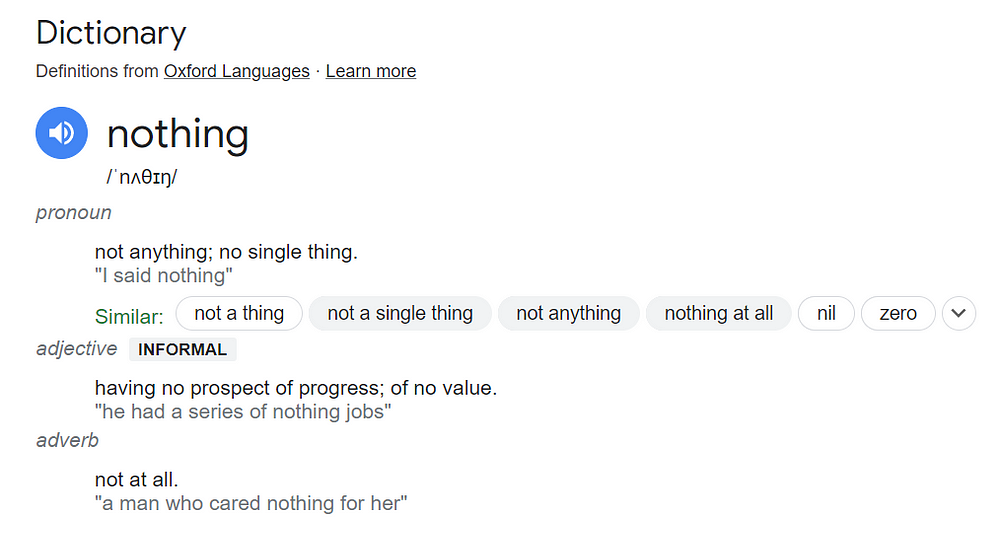
If we deal with the English word “nothing”, then, etymologically, it begins life simply as “no thing”. It’s also been defined as “the complete absence of anything”.
Of course, even these basic beginnings are problematic.
The following four questions can now be asked:
(1) “No thing” in which place?
(2) No thing at which time?
(3) The “complete absence of anything” everywhere? Or just somewhere?
Finally,
(4) The complete absence of everything at all times? Or just at certain times?
In any case, why has Nothing been so important in philosophy and religion?
The English cosmologist, theoretical physicist and mathematician John D. Barrow (mentioned a moment ago) summed things up with the following passage:
“So much for these snippets of nothing. They show us nothing more than there is a considerable depth and breath to the contemplation of Nothing.”
We’ll see that the “considerable depth and breadth” on the subject of Nothing may well be largely down to the grammar of the word “nothing”.
To put that another way.
Perhaps there is considerable depth and breadth to Nothing because the word “nothing” is used in so many different ways by so many different people. This effectively means that Nothing can’t really be something specific even when believed to be considerably deep and wide.
John Barrow also tells us that
“Eastern philosophies provided habits of thought in which the idea of Nothing-as-something was simple to grasp and not only negative in its ramifications”.
This claim almost entirely depends on what Eastern philosophers took Nothing to be. After all, it turns out that they meant something very different by the word “nothing” to what many Western philosophers meant — and still mean. Indeed, “nothing” is such a problematic word (at least when tackled philosophically) that different Eastern philosophers themselves will have meant different things by the word “nothing” (i.e., when this word is suitably translated into the relevant languages).
In any case, what’s just been said about the word “nothing” is also true of the words “consciousness”, “freedom”, “truth”, “justice”, “existence”, etc. Indeed, it’s likely that “nothing” is even more problematic than these well-known cases.
The Grammar of the Word “Nothing”
John Barrow waxes even more lyrically about Nothing in the following passage:
“At first, such questions about the meaning of Nothing seemed hard, then they appeared unanswerable, and then they appeared meaningless: questions about Nothing weren’t questions about anything.”
Perhaps much of this “paradoxical” and heavy stuff is largely down to grammar.
Yes! This view is very old-fashioned.
[Most other philosophical positions are also old-fashioned.]
It’s old-fashioned because it dates back (in various ways) to Wittgenstein, the logical positivists, “ordinary-language” philosophers, etc. Of course, all these Dead Philosophers made their points about grammar, language and philosophy in very different ways. Indeed, I make my own points in my own way.
[For example, I have a problem with the logical positivists’ term “meaningless”. See later section.]
On the other hand, Nothing may well be meaty and profound for the simple reason that it has featured so strongly in philosophy, theology and even in physical cosmology.
Yet, despite that acknowledgment, perhaps the old questions about Nothing were (to use Barrow’s word again) “hard” primarily because of the grammar of the word “nothing”. Indeed, as Wittgenstein put it (in his Philosophical Investigations) about many other words pained over by philosophers for hundreds of years, when it comes to the word “nothing” (in this case), the following can be stated:
“A whole cloud of philosophy [is] condensed into a drop of grammar.”
All that said, sentences with the word “nothing” in it, and questions about Nothing, can’t be “meaningless” for the simple reason that they may not be questions about Nothing itself. Instead, they may largely be about the word “nothing”, as well as about how people use that word.
The History of Nothing

According to traditional Christianity, God created the world out of Nothing. Interestingly, John the Scot (or Johannes Scotus Eriugena — c. 815–877) argued that the word “nothing” (in this context at least) is synonymous with “God”. [Thus, God created the world out of God?]
Eriugena’s position displays the (as it were) semantic reality of this overall issue.
So what about other philosophers?
Philosophers have denied that Nothing “exists”, and also stated that it does exist. Other philosophers have seen the entire issue of Nothing as a non-problem — or even as a “pseudo-problem”.
On another tangent. This philosophical and religious (as it were) interest in Nothing has been at least partly down to the horror vacui. (Put in plain English, the idea that “nature abhors a vacuum”.) An early version of this was displayed by Leucippus (early 5th century BC). To Leucippus, “the void” is the opposite of Being. In other words, the void is not-Being.
It should also be quickly noted here that, historically, many scientists believed that (empty) space is not “nothing”. Instead, they deemed it to be some kind of receptacle in which “material objects can be placed”.
Relatedly, scientists have also been much obsessed by the vacuum (or by vacuums-in-the-plural).
Yet a vacuum (like the void) was always something very different from Nothing…
Or was it?
It depends…
It depends on what the words “nothing” and “vacuum” are taken to mean in different contexts. It also depends on how these words are actually used.
This problem is captured in the following passage about a related issue:
“This is somewhat reminiscent of early philosophical plenum ideas, and means that vacuum and nothing are certainly not synonyms.”
The word “vacuum” isn’t an acceptable synonym of the word “nothing” simply because there’s no fixed (or universal) definition of that latter word in the first place. And now we must also go all ontological and say that the nature of Nothing has been disputed for over two thousand years.
Parmenides on Nothing
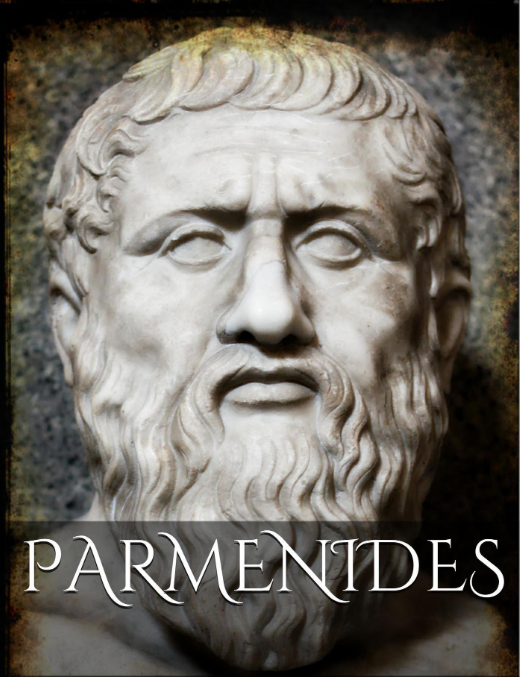
It’s best to start with the following philosophical position:
In order to refer to something, then that something must exist in some way.
The Greek philosopher Parmenides (5th century BC) based his philosophy of Nothingness primarily on such a basic position.
Parmenides argued that there can be no such thing as nothing for the simple reason that to name it means that it must exist. And Nothing (unlike a stone or a person), he believed, can’t exist.
John Barrow picked up on this when he wrote the following words:
“[Parmenides] maintained that you can only speak about what is: what is not cannot be thought of, and what cannot be thought of cannot be.”
Light-heartedly, and to rely on Barrow again, if Parmenides was right, then what about the following limerick by William Hughes Mearns? -
“As I was going up the stair,
I met man who wasn’t there.
He wasn’t there again today,
I wish, I wish he’d stay away.”
Less light-heartedly, what about this statement? —
Superman is sexy!
Or this one? —
God does not exist.
It seems obvious that we can refer to things which no longer exist. Indeed, we can even refer to things which never existed.
Sure, perhaps we can’t refer in any ordinary way… That’s if there is an ordinary way of referring.
So perhaps existence must be replaced by some kind of (capitalised) Being.
[The distinction between being and existence has been rejected by many philosophers. See ‘Being and Existence’.]
That said, in the cases of “Superman is sexy!” and other statements, neither existence nor Being are claimed in any direct way.
So what about the word “nothing”?…
Or what about Nothing itself?
According to this logic (or perhaps not), if we speak of “nothing”, then surely nothing must be… something. After all, we’ve named Nothing. Therefore it must exist (or have Being) as a… something.
Alternatively put, I’ve used the word “nothing”. Therefore Nothing (not the word “nothing”) must exist (or have Being).
Let’s now go into more detail on Parmenides and his arguments.
Parmenides’s Argument
Parmenides’ own positions are more convincing than they may at first seem.
In his scheme, not only is Nothing rejected, so too is the existence of historical facts or history itself.
The possibility of change is similarly rejected.
The following are three of his basic positions (i.e., it’s not an argument as such) on Nothing:
1) Nothing doesn’t exist.
2) To speak of a thing, is to speak of a thing which exists.
3) When one speaks of Nothing, one speaks of it as if it is something which exists.
Yet surely, in statements (1) to (3), Nothing has been spoken of (it has been named). Therefore, by Parmenides’s own light, surely either Nothing must exist, or he had no right to speak of it.
What about the events in the past or the past itself?
Parmenides’s position is very similar:
i) If we can’t speak of (or name) Nothing,
ii) then we can’t speak of (or name) the things or events of the past either.
iii) That’s because such events (or things) don’t exist.
iv) Therefore, when we refer to them, we’re referring to Nothing.
Here again there are references to Nothing, which Parmenides warned us against.
What about change, which Parmenides similarly rejected?
His rejection of change is strongly connected to his rejection of the past. The argument is as follows:
ia) If the past doesn’t exist,
ib) then only the present exists.
iia) Yet if only the present exists,
iib) then there can be no change from past to present, or from present to future.
iii) Therefore, there can be no change at all.
I’m not entirely sure if I’ve done justice to Parmenides in the formulations above. Alternatively, perhaps there’s a problem with the arguments themselves.
[It’s hard to find Parmenides’s actual words, rather than writers and historians telling their readers what Parmenides believed.]
Firstly, i) (“The past doesn’t exist”) is taken to true with proof, argument, evidence, etc. That said, most arguments must — and do — begin with unargued-for premises. Perhaps this is an example of that.
And there’s also the problem with the word “exist”. It’s never defined. Its meaning is simply assumed.
In any case, it seems that Parmenides’ position was resurrected — if in a modified and grammatical (or linguistic) form — in the 20th century by Bertrand Russell.
Russell and Quine on Nothing
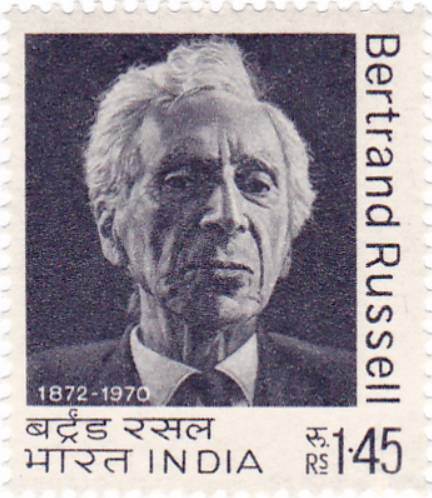
In his 1918 paper ‘Existence and Description’, Bertrand Russell argued that in order for names to be names, then they must name — or refer to — things which exist.
So now take this passage:
“The fact that you can discuss the proposition ‘God exists’ is a proof that ‘God’, as used in that proposition, is a description not a name. If ‘God’ were a name, no question as to existence could arise.”
That passage delivers a position that’s fairly similar to Parmenides’s own position. Russell’s argument, however, is different in that it’s based on language and semantics.
In detail. Russell, at the time, was reacting to the (as Quine once put it) “ontological slums” of the Austrian philosopher Alexius Meinong in which different objects and things were brought into being willy-nilly. (For example, the golden mountain and even the round square.) However, Russell’s semantic philosophy simply seems stipulative (or a normative) in nature. That is, it’s strategically designed to quickly solve various ancient and modern philosophical problems. [Personally, I don’t have much time for Russell’s position of 1918.]
This is where W.V.O. Quine enters the philosophical fray.
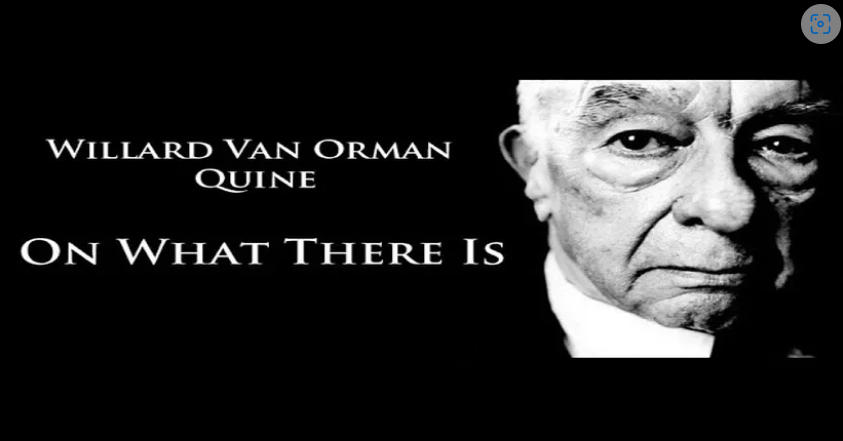
Quine had no problem at all with the naming of non-beings or non-existents. (Non-being and non-existence aren’t the same thing.)
In his ‘On What There Is’ of 1948 (some 30 years after Russell’s paper), Quine rejected Russell’s position. However, he put Russell’s position in the mouth of a certain McX, and uses the word ‘Pegasus’ rather than the word ‘God’.
Quine wrote:
“He confused the alleged named object Pegasus with the meaning of the word ‘Pegasus’, therefore concluding that Pegasus must be in order that the word have meaning.”
Put simply. A name can have a “meaning” without it referring to something which exists, or even to something which never existed. Thus, Quine unties meaning from reference, whereas Russell primarily thought in terms of reference. (At the least, Russell tied a name’s meaning to its reference.)
Parmenides, as we’ve seen, made a similar mistake.
He didn’t think that a name could have a meaning without the thing being named also existing (or Being). However, we can speak of something that doesn’t exist because the naming of such an x doesn’t entail or imply its existence. However, and in homage to Meinong (as well as, perhaps, to the philosopher David Lewis), Russell might then have asked us what kind of Being the named object (or thing) has.
Technically, Russell’s theory is an attempt to solve this problem by arguing that if a named x doesn’t exist (or have Being), then that name must be a “disguised description” or denoting phrase. (In the case of the name “Pegasus”, the description would be “the fictional horse which has such and such characteristics”.)
The Logical Positivists on “Meaningless” Statements
In any case, the old logical-positivist way of classifying such sentences (e.g., “God does not exist”) as “meaningless” was way over the top. It was nothing less than Diktat Philosophy. That’s not because there actually is something Deep and Profound about what we call “nothing”, or because God does or does not exist. It’s because the logical positivist’s term “meaningless” is simply the end product of certain philosophical stipulations, rather than end result of arguments alone.
Quine, for one, realised this when he happily accepted that sentences such as “God does not exist” and “The unicorn is angry” are certainly not meaningless — even if God and unicorns don’t exist!
Relatedly, the more obviously extreme “Pink ideas glide in and out of the vacuum” may be a silly sentence, but it’s not meaningless. Thus, the statement “Nothing is the most important subject” (or even Heidegger’s “The nothing nots”) isn’t necessarily meaningless. It may be silly or pretentious, but not meaningless.
Thus, we needn’t class “questions about nothing” as “meaningless” simply because Nothing doesn’t exist… as a thing…
That’s if Nothing doesn’t exist as a thing!
Now we can defend Parmenides’s position, as well as Russell’s, by attacking Heidegger’s.
Martin Heidegger on Nothing
Speaking (perhaps) ironically, can mere words bring things into existence?
What about the words “round square” or “the timplebums” bringing a round square or the timplebums into existence… or into Being?
Indeed, what about Chomsky’s well-known statement “Colorless green ideas sleep furiously”?
In any case, Martin Heidegger was perplexed by the fact that we can refer to Nothing.
Was Nothing brought into existence (or into Being) by virtue of people using the word “nothing”?
Heidegger asked, “What about this nothing?”
He also asked:
“The nothing — what else can it be for science but an outrage and a phantasm?”
Heidegger contended that “[s]cience wants to know nothing of the nothing”.
[Note the definite article in the two words “the nothing”. No wonder John D. Barrow capitalised this word.]
According to Heidegger (who was critical of science for many other reasons too), science’s main sin is that it “tries to express its proper essence it calls upon the nothing for help”. That is, science refers to (the) Nothing, yet it “rejects” Nothing.
[One wonders why Heidegger singled out science in this respect. After all, all of us use the word “nothing” and refer to nothing.]
Of course, Heidegger himself doesn’t use the words “refer” and “reference” — as analytic philosophers do. In other words, these terms weren’t found in his technical bag. However, surely when Heidegger asked “What about this nothing?”, he meant… what?
Well, we can refer to anything — even to nothing. That’s unless the word “refer” is taken in some kind of strict philosophical sense, as Bertrand Russell did earlier.
In any case, was Heidegger actually referring to the vacuum?
The Nothing has hardly featured at all in most physics, and not even in speculative physics. However, as we saw at the beginning of this essay, the vacuum has been. Yet the vacuum is actually worlds away from Nothing.
More grammatically:
1) Do we “posit [nothing’s] being” when we use the word “nothing”?
2) Do we simply use the word “nothing” because it is useful in certain — indeed, in many — contexts?
What did Heidegger think? This:
“With regard to the nothing, question and answer alike are absurd.”
Again, it must be assumed that Heidegger meant “vacuum”.
Now for Graham Priest.
Priest’s position seems similar to Heidegger’s. This is hardly surprising since Priest is a fan of Heidegger, and he refers to him a fair few times in his papers, articles and books.
Graham Priest on Nothing

The Australian philosopher of logic Graham Priest (like Martin Heidegger) appears to believe (if only when viewed critically) that words creates objects…
Of course, he doesn’t actually make that claim.
So in Priest’s own words:
“An object is anything you can refer to with a noun phrase, think about, quantify over.”
As with Heidegger earlier, the problem here is that the readers of this essay can make up new “noun phrase[s]” on the spot.
So what about these examples (which start with a noun phrase)? — “The Something does”, “The bastules blinge”.
Thus, this is a liberal (or pluralist) position on objects in that Priest concludes that
“so there are many objects, like Marcus, like Bond, like the City University of New York, like the Sun and so on all these things you can think about you can refer to”.
… As well as objects like Something and bastules.
Indeed, this is a positively Meinongian conclusion. (Apart from the fact that Alexius Meinong never stressed — and possibly even ignored — language.) However, as Bertrand Russell, Ludwig Wittgenstein, Rudolf Carnap and many others put it (if in their various ways), Priest and Heidegger might well have been “misled by language”.
It must be added here that apart from language, Priest also emphasises quantification. However, this amounts to a very similar thing — quantification too brings objects into existence.
As the American philosopher Hilary Putnam once put it: this is a case of the miraculous “backward E” (i.e., the existential quantifier ∃) doing its thing.
Quantifying Nothing
Graham Priest refers to quantifying over both everything and Nothing. However, he has a position on quantification that appears to be at odds with the common one.
Usually, it’s thought that all acts of quantification have a specific domain in mind. Priest, on the other hand, believes that “it’s okay to use a quantifier with the widest possible scope”. In other words, it’s fine to quantify over literally everything. (This is like a quantificational version of Russell’s universal set.)
Priest offers us a variation on the Parmenidean theme (discussed earlier) by arguing for the following:
i) If we “quantify over” any given x,
ii) then that x must be an “object” of some kind.
According to Priest, we also refer to (or quantify over) everything — so that too must be an object.
Yes, Priest says that “everything is an object” — just like Nothing.
It’s then that Priest gets all dialethic by saying that Nothing is “not an object” too.
This means that Priest applies the same logic to Everything as he does to Nothing. The following words will make that clear:
“Everything is the mereological sum of every object [] If everything is the fusion of the sum of all objects, [then] what is nothingness? Nothingness is the sum of everything that isn’t an object because everything is an object. [Nothingness is] the sum of no things. What you get when you fuse together no things is exactly nothingness.”
In Priest ‘s logic, philosophers too have referred to Nothing. So Nothing must be what he calls an object.
Priest himself refers to Ludwig Wittgenstein (who said — remember — that a “whole cloud of philosophy [can be] condensed into a drop of grammar”) and Nagarjuna on this issue. He says that these two thinkers
“tell [] you that something is ineffable; and then [they] explain why it’s ineffable — thereby talking about”.
That is certainly the case with the Tractatus, in which Wittgenstein discussed the “form of the world”. We also had Kant’s many references to noumena. (That’s even though Kant believed that nothing could be known about noumena.) Then again, all this is also true of the words “round square” or “the brick with a sense of humour” — which I’ve just referred to!
To repeat. Priest goes all linguistic or grammatical when he says that “‘nothing’, can also be a noun phrase”. Basically, that’s because we can and do talk about it.
More specifically, Hegel and Heidegger talked a lot about Nothing. As Priest puts it, “[w]e may say that Hegel and Heidegger both wrote about nothing”.
Moreover, “nothing” is “not [always] a quantifier phrase”. In other words, this story isn’t all about counting or quantifying. It’s also about a thing — or an object.
One other way in which we can talk about Nothing is to note that “[w]e can say that [Hegel and Heidegger] said different things about it”. In addition, Christianity talks about Nothing in that (so Priest tells us) “the Abrahamic God is supposed to have created the world” out of Nothing.
So we can see that Priest is fully committed to Plato’s Beard in that (rhetorically or not) human sayings and writings bring objects into existence.
Note
(1) Some of the quoted words and passages from Graham Priest are taken from the ‘Everything and Nothing’ seminar — a Robert Curtius Lecture of Excellence at Bonn University — which Priest gave in 2017. I relied on both the transcript and the video itself. However, I’ve edited a lot of what Priest says in that seminar to make it more comprehensible. For example, I removed many of the uses of the word “so”, added full stops, commas and suchlike. Hopefully, the philosophical content is kept intact. None of this applicable to the words and passages I quote which come from Priest’s papers and books.