“The article you are about to read is written entirely by GPT-3, OpenAI’s powerful new language generator.”
My reply:
“Yes — it may have been ‘written by AI’ (or by a programme) — yet that may not amount to much. Perhaps all the words in this programme came from human (i.e., non-AI) sources. The AI programme might have simply played about with the words a little. I don’t know. This is equivalent of a AI ‘composer programme’ which often has phrases or tunes in its programme and then it simply juxtaposes that data according to strictly-programmed rules. (To put it very crudely.)
“In fact evidence will need to be provided that this AI programme didn’t simply (as it were) copy and paste someone else’s work (or somehow fuse the work of different writers). Then again, much of what’s just been said can also be said of human beings too!”
[This isn’t an argument against AI. It’s simply a sceptical take on this particular case.]
“So, yea, in the end I don’t think Derrida matters. That’s all. I feel we are wasting our time right now.
“Why are you interested in all this? Did you already share?”
My reply:
“Don’t you mean that Derrida doesn’t matter to you? He clearly matters to a lot of people — at least within academia. [That is] his views have had a large impact on such things as American university departments [as well as] what’s taught in them, lawyers, etc. In addition, his views are ‘simplified’ (despite Professor Christina Howells not wanting them simplified by the wrong people) and have filtered down to activists ‘on the street’ (something you appear to deny). Now that’s despite what both of us have said about his obscure prose. And that’s a situation that needs explanation.
“Also, you yourself must be ‘interested in all this’ because you’ve replied twice and you read the original article. [So the words ‘Why are you interested in this?’ are rhetorical.]
“There are many reasons why I’m interested in this — some of which I’ve just given. It began, however, when I was force-fed Derrida’s and similar theorists’ views as a mature student at university. The situation was so bad that I ended up demanding that my degree be externally marked because of the clear bias and even antipathy of the professors toward me. (I was at an ‘arts college’ of a larger university — Leeds University. Thus the college sent my degree work to the main university — and those there, I presume, didn’t really know the professors who taught me.) It turned out well because I ended up getting a 1st Class Degree.”
“What, exactly, is a ‘left-brained argument’? You don’t mention a single argument, quote a single passage or even mention a single syllable of a 14-minute essay. It’s almost as if you simply read the title [i.e., ‘Murray Gell-Mann on Scientific Reductionism’]and wrote a vague and highly-generalised emotional response to it. Did the single word ‘reductionism’ [i.e., in the title] get you going?”
MD Cobbald wrote:
“The perpetual physical reductionism of of science is one thing, but what of the abhorrent metaphysical reductionism inherent in post Newtonian scientific philosophy?”
My reply:
“What of it? Is your rhetoric enough? Is supplying argumentation, data, evidence, reasoning, etc. also ‘reductionist’ and therefore ‘abhorrent’ too?”
MD Cobbald wrote:
“Phenomena are observed through the narrow perception of the human machine in an attempt to describe principals broader than the perception of the human machine.”
My reply:
“What does all that mean? Is it poetry? You yourself clearly seem to be attempting to observe things beyond the human machine that is yourself. Yet because your own rhetoric is anti-reductionist and embarrassingly vague, that must be okay to you.”
“What about ‘true’ statements which can’t be proven? If there is no prove for a true statement, it is not merely ‘correct’ in the sense of ‘mathematical grammar’. Nevertheless, Gödel has shown such unprovable true statements exist in mathematics.”
My reply:
“That wouldn’t in itself work against Wittgenstein’s position — at least as it’s presented in the essay above. In this essay, the debate about the relation between truth and proof isn’t brought up. That said, this truth-without-proof would still depend on systems, grammar and correctness. That is, it’s the grammar and correctness of the statements within a system which, according to Gödel, produce such truths which can’t be proven [i.e., within the system/s]. An unprovable truth would still be a product of grammar, correctness and a system. There could be no platonic mathematical truth which is free-standing.
“Now, as far as truth-without-proof is concerned:this has been much disputed too. (The main contention is to ask how mathematicians know that they’ve intuited the truth of a statement without any process of proof or demonstration.) But since it’s not the theme of the essay above, I won’t comment on it — save to say that here again it only applies to truths both within and produced by mathematical systems. It’s for this reason that this Gödelian result is hard to apply across the board — even though it often has been!”
“Sigh. That’s ok. I’ll just say one thing — ‘fermions’ ‘bosons’ and the rest are abstractions created by physicists. They don’t directly provide evidence of anything real. But that’s philosophy, not science. I’ll leave it at that.”
My reply:
“Why are fermions and bosons ‘abstractions’? The mathematics used in the theories of physics may be abstract, but surely fermions and bosons aren’t themselves abstract. They are indirectly observed in experiments, manipulated, fired, produced, modeled, etc. You wouldn’t be writing these words if it weren’t for fermions and bosons — if not fermions, then for somethingphysical.
“If physics doesn’t show ‘anything real’ — then what does? And what do you mean by the word ‘real’? You seem to implying that philosophy or… something else can show us what is real. Is that correct?
“You used the word ‘sigh’. Are you sighing at someone putting a different view to your own?”
Bernardo Kastrup’s Manichean war against “materialists”.
[This is the last — and shortest — of my series of essays on Bernardo Kastrup.]
I haven’t read every single word that Bernardo Kastrup has ever written. So it must be noted here that when philosophers and scientists criticise Kastrup’s Cosmic Idealism, he often says that they “don’t understand” it. Thus Kastrup basically conflates criticising his Cosmic Idealism with not understanding it. This is a very popular technique which is also used by religious and political fundamentalists.
Of course it can be conceded that Kastrup obviously knows more about his own Cosmic Idealism — and probably other idealisms — than most (or even all) of his critics; just as a religious or political fundamentalist will often know more about his chosen ideology or religion than most of his critics.
This situation is made even worse because Kastrup has a penchant for offering psychological, psychanalytic and Jungian depth psychological hitjobs on all his critics…
And, yes, this is precisely — at least in part — what I’m doing to him in this and in other essays.
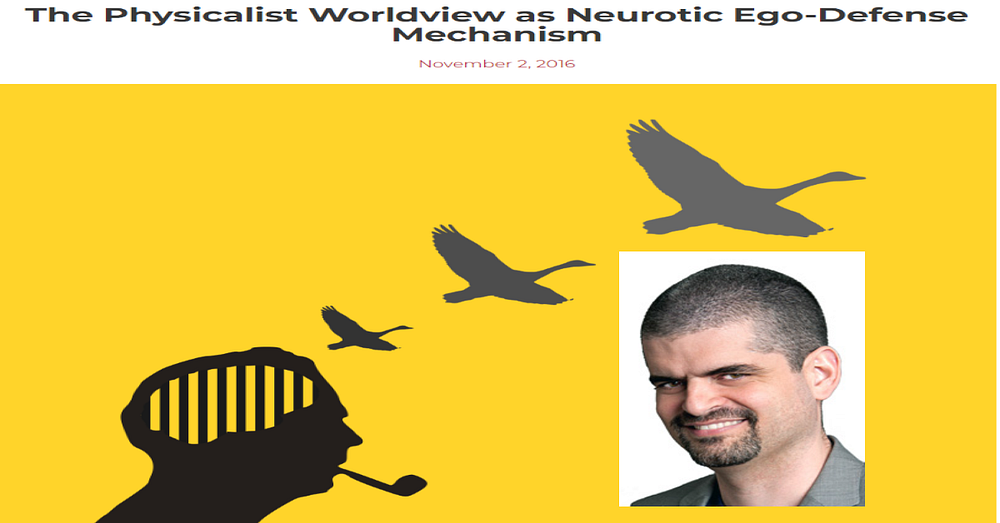
In any case, Kastrup often looks for the psychological motivations which, for example, supposedly drive people’s “physicalism” or “materialism”. Moreover, Kastrup does exactly the same thing when it comes to those people who criticise his own Cosmic Idealism. Indeed there’s an entire paper by Kastrup in this vain: it’s called ‘The Physicalist Worldview as Neurotic Ego-Defense Mechanism’.
So perhaps Kastrup himself should be the victim of such psychological analyses. Indeed perhaps it is Kastrup who displays “neurotic ego-defence mechanisms” when people express what he takes to be “materialist” positions. In less pretentious terms, it’s certainly the case that Kastrup oftenattacks other people — and not only his critics. (Kastrup deems nearly all his critics — as well as people with differing views, such as journalists — to be materialists or physicalists.) And he’s also very defensive about his own philosophical and spiritual positions.
Take Kastrup’sstrong words on just about every person and position he doesn’t fully endorse. For example, his highly personalised and smug criticisms of Philip Goff (see here and here), Sabine Hossenfelder (see here and here), Sam Harris (see here and here), Massimo Pigliucci (see here and here), all “materialists” (see here and here), “our culture” (see here and here), etc. etc. etc.
To change tack a little.
Kastrup may not claim to know that his Cosmic Idealism is true, right or correct. Perhaps he simply classes it as a theory. If that’s the case, then he rarely — if ever — states that. And if Cosmic Idealism is just a philosophical theory, then it’s just a theory among many others. Yet, here again, you don’t get the impression from Kastrup that Cosmic Idealism is simply one philosophical theory among many others. To him, it is clearly the Supreme Philosophical Theory. That is, there is very little modesty in Kastrup’s words about his own theories and ideas. And neither does Kastrup tolerate — or show decency toward — those philosophers and scientists who criticise them.
This is Kastrup being embarrassingly jealous and vindictive. Is this an example of Kastrup’s “ego-dissolution”?
So, for someone who knows about psychanalysis and psychotherapy (see here, here, and here), Kastrup seems to lack self-awareness. Particularly, he is the most egotistical and rude cotemporary philosopher I’ve come across.
Finally and paradoxically (or just perversely), perhaps Kastrup’s self-proclaimed attempts to escape (partly/largely through psychedelic substances — see here) from what he himself calls the “egoic loop” have actually helped create his huge ego.
**********************
Kastrup appears to be an admin of his own Facebook “fan club” — see image directly above. (See his fan club @ Facebook here.)
Note: See ‘The Science of Spiritual Narcissism’, at Scientific American. See also a psychologist on “spiritual narcissism” here. Finally, this piece is on the direct link between being supposedly “egoless” and having a huge… well, ego — something that the writer admits to and thinks is a good thing.
Selected (mainly critical) responses to my essays on Medium — and my replies to them. (3)
[Editorial square brackets have been added to make things clearer.]
Intelligence and Consciousness
I wrote:
“I mentioned the fact in the essay that people define ‘intelligence’ and ‘consciousness’ in many different ways. And you’re using the word ‘intelligence’ in a very particular way. I would say that you’re using the word in a way that’s at odds with how it’s used in everyday language or by most people. But that doesn’t really matter at all. I presume that you’re using the word as some scientists or theorists use it.”
“[] for that to be the case, a basic algorithmic intelligence must be present, such as, ‘sense light, move toward (or away from) it’.”
My reply:
“These examples are simply programmed or genetic responses to the environment, And, in terms of any given species, every individual in that species will ‘move away’, etc. from the light in more or less the same way. And that alone means that the word ‘intelligence’ is being used in a way in which most people don’t use it.
“But why must something as rudimentary as that be accompanied by consciousness? I say that because earlier you wrote that this movement must be ‘accompanied by some sort of minimal subjective experience’. Not really. This level of response isn’t that different to a thermometer responding to changes in temperature or even a (security) light sensor in a garden responding to movement.”
Cristóbal de Losada wrote:
“[Consciousness] was selected for because it proved advantageous in Darwinian-fitness terms. And for that to be the case, a basic algorithmic intelligence must be present, such as, ‘sense light, move toward (or away from) it’.”
My reply:
“[] there’s no obvious reason why (as you put it) Darwinian ‘fitness’ requires consciousness. Indeed many philosophers and scientists have argued that it doesn’t. (Hence all the arguments about consciousness — or at least qualia — being ‘epiphenomenal’.) Thus, on this reading, consciousness is a superfluous cream on the cake. Other people, on the other hand, have argued that consciousness is ‘advantageous’ from an evolutionary perspective — but certainly not for the rudimentary examples you’ve cited.”
Cristóbal de Losada wrote:
“There can be sporadic spontaneous appearances of consciousness in basic organisms here and there (after all, that must be how the whole thing started), but if they confer no evolutionary advantage, they will not spread.”
My reply:
“Not really. Not if consciousness is largely the result of crossing a threshold of complexity (though not complexity alone) and a high level of relevant ‘causal powers’. Perhaps consciousness only kicks in at certain levels — not at all levels. Thus your position resembles that of panpsychists in that they argue that it makes sense to argue that consciousness was there all along — or that even things as basic as particles or single-celled organisms must have a rudimentary level of consciousness. They say this otherwise the ‘sudden appearance of consciousness’ in higher animals and human beings would be a ‘mystery’. Also, there’ll never be any evidence that what you call ‘basic organisms’ had instantiated consciousness in the past or even that they do so today.”
Cristóbal de Losada wrote:
“Those cases could be examples of consciousness without intelligence, or at least of consciousness decoupled from any intelligence that the organisms involved might have.”
My reply:
“But didn’t you argue (above) that when basic organisms react to light (by moving toward or away from it) that this is an example of intelligence? This is what some plant scientists who are panpsychists also argue.”
Cristóbal de Losada wrote:
“Thus I think it’s possible, in principle, to have conscious experiences without anything we’d typically call intelligence associated with it.
“As to whether some sort of human-like consciousness can spontaneously arise from the sheer complexity and sophistication of some software programs (as some suggest), I think that’s absurd. Since high-level consciousness doesn’t just arise in animals (it has to be selected for by natural selection in a gradual, iterative, and ‘deliberate’ way and for very specific purposes), there’s no reason to think it would in AI.”
My reply:
“I don’t think even AI theorists would ever say that it would simply be a result of ‘complexity’. It would be, to them, a result of the right algorithms, etc. After all, ants are physiologically and structurally very complex — but we needn’t posit that they are conscious in a ‘human-like’ way or in any way at all. Complexity alone isn’t the whole story.
“Although many would argue that consciousness has resulted from ‘natural selection’ — it doesn’t at all follow that itmust be. For example, up until the 1940s, every calculating machine was a human brain (if we rule out things like the abacus, etc.). And then along came computers.”
“On the topic of inference fields the new data is mainly from fMRI studies. I cover these in my book on lying (in terms of giving references to the evidence). There is a link to that book and the basic Cartesian arguments here.”
My reply:
“The problem here is that your have your own expertise [neuroscience or the brain] and I have mine [logic a an abstract discipline and logic as used by human persons]. And the two only vaguely interlock. Indeed this lack of a shared language often occurs when people from different disciplines interact — despite the sometimes superficial ‘inter-disciplinary’ cross-border communications.
“Thus your fine detail isn’t really about the philosophy of logic (which is the subject of the main essay I posted [and which you responded to]) — but about your own knowledge of neuroscience, Sejnowski, etc. So I had a problem tying all your detail to my precise points. []
“Just a taster. Your and other people’s use of the word ‘inference’ when it comes to what occurs at the neuronal level — which I mentioned in my first reply to you. I know that some neuroscientists, etc. use this word in this context — but it’s still odd to me. I suppose it’s similar to how some physicists use the word ‘information’ [or ‘observation’]in contexts that have nothing to do with semantics, human knowledge, observations or even minds. Perhaps my position is ‘linguistically conservative’ [or conceptually conservative]— except that I’m not against new uses of old words. I just believe that it should all be made clear — especially to those on the outside! Scientists and experts shouldn’t assume that everyone knows that they’re using old words in very-new ways.”
Robert Thibadeau wrote:
“[] our neural network systems today achieve quite powerful inferences which are fundamentally inductive. They achieve this by being radically overdetermined. Instead of making an identification with sparse inductive evidence, they can draw evidence for a discrimination or classification from many more sources than classical, efficient, statistics would ever computationally allow.”
My Reply:
“I presume that you’re talking about non-conscious ‘inferences’. As you’ll know, this is a long way from Descartes and any formal logic [mentioned by Robert and in the essay]. Though it can be argued that such neuronal processes [physically underpin and] replicate the inferences of formal logic — or vice versa!”
Robert Thibadeau wrote:
“Both deductive and inductive systems are termed inference for a reason. Both, today, can be completely certain. Both have weak presuppositions overcome by strong process yielding surprising conclusions.”
My reply:
“What do you mean by saying that ‘inductive inferences’ can be ‘completely certain’? Do you mean that those who use them become psychologically certain that their inferences are correct/true or that such inferences [themselves] are completely certain — full stop? Also, I’m not sure what the words ‘both have weak presuppositions overcome by strong process yielding surprising conclusions’ mean.”
“Could it be that an individual photon does not experience time like other particles because it is fundamental and does not degrade or separate into other particles?”
My reply:
“That may be the case — but putting it in that bare form doesn’t explain why that’s the case. That is, a photon’s fundamental nature doesn’t automatically explain its timelessness. And this would also mean that electrons and quarks are timeless because they aren’t made up of other particles either. That said, there’s also the Leibnizian argument that if an object doesn’t change, then it can’t take part in time. However, even though photons don’t ‘degrade’ and are fundamental, they’re still involved with interactions, etc. — and [perhaps] therefore they ‘take part’ in change/s.”
Ken Swisz wrote:
“The fact that it takes time for it to travel is not so much the property of the photon but rather is our observation of it.”
My reply:
“Good point. [] That said, what is a photon when taken in complete separation from all observations, measurements, etc? How is the photon’s timelessness cashed out in other ways?”
Ken Swisz wrote:
“A photon is the same regardless of where it’s going or where it’s from — it just vibrates depending on how it was created and goes on its way until something absorbs its energy.”
My reply:
“Yes — a photon [is said — by some — to have] an ‘intrinsic nature’ in that it has specific properties regardless of its interactions, etc. Yet doesn’t it ‘go’ in time? Doesn’t it ‘vibrate’ in time? Doesn’t it existin time even before it’s absorbed or emitted?
“Anyway, thanks for your good questions and points. Many responses to my essays are written by people who never mention a single argument, idea or even syllable of the essay they’re supposed to be responding to.”
There are indeed fundamental properties and/or entities in physicswhich are said to “vibrate” and “ripple” (see here and here). However, are Bernardo Kastrup’s own words “vibrations” and “ripples” purely metaphors which can’t really be unpacked because they contain very little (if any) scientific (or even philosophical) content? And even if the words “ripples” and “vibrations” aren’t metaphors, could Kastrup go into any detail about them — as physicists most certainly do when discussing their own ripples or vibrations?
In any case, this means that Kastrup’s version of consciousness (or Cosmic Consciousness) isn’t so fundamental that it can’t vibrate and ripple. Yet usually the things which vibrate and ripple are in some way physical in nature…
Yet, as ever, Kastrup can dodge that particular bullet. And he often does so by simply stating that the physical things which vibrate and ripple are instantiations of consciousness too!
The Brain as a Filter?
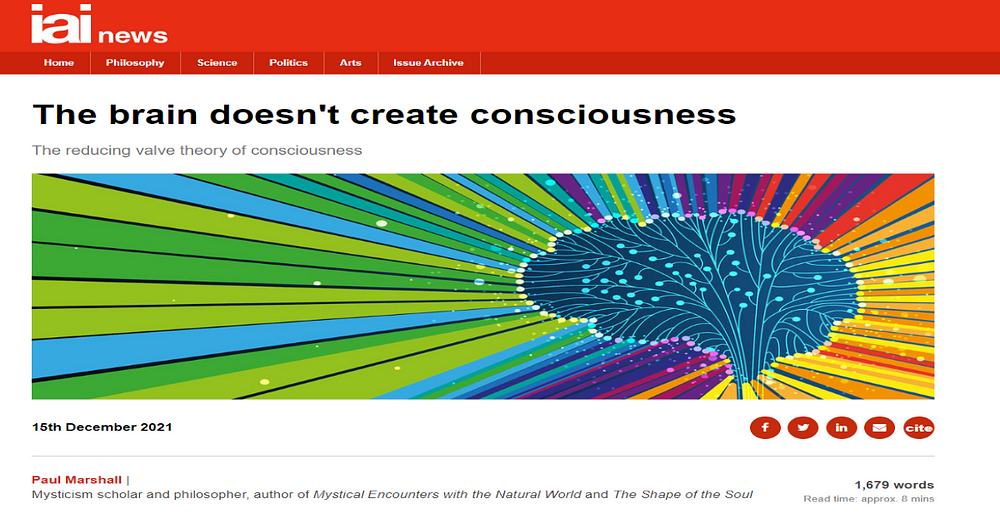
Many (or even all) Cosmic Idealists argue that the human brain is a (to use Kastrup’s own word) “filter” (see here). That is, they argue that the brain is something that consciousness (or Cosmic Consciousness) — which they take to already exists — is filtered through. Thus the biological brain neither produces consciousness nor does consciousness have any necessary link to it. (Except for the extremely strong link that every human case of consciousness — that is, tens of billions of human cases throughout history — has been tied to the biological and physical brain.)…
But we must slow down here!
Accordingto Kastrup himself, “the brain is [also] an image of consciousness”. Thus Kastrup’s warns usabout the “filter theory” of consciousness (i.e., despite using the term himself and thinking it a decent “metaphor”). That is, if “all is consciousness”, then how can the brain — which, by definition, must also be consciousness — be seen as a filter of consciousness?
“The idea that the brain does not generate consciousness, but instead limits and filters it down, seems to require dualism and contradict idealism. After all, if all reality exists in consciousness, how can the brain — which is a part of reality — filter down that which gives it its very existence? A water filter is not made of water; a coffee filter is not made of coffee; how can a consciousness filter be made of consciousness? It sounds like a self-referential contradiction.”
[Kastrup also makes his position clear in this YouTube video response to Dr Steve Taylor, who is a “panspiritist”. It begins at 35 minutes and 24 seconds.]
Kastrup’s own Cosmic Idealism, then, is more (as it were) totalthan some other takes on this ism.
Here is a similar problem; as included in a passage from Gerald R. Baron (see here):
“In these versions consciousness is a universal substrate underlying all reality including the physical world. Some hold that what appears to us as solid matteris actually an illusion and only experience is real (idealism) [].”
Yes; if everything is consciousness, then how can consciousness also be a “substrate”? That is, if consciousness is a substrate, then what is it a substrate of? Is consciousness a substrate for something that isn’t itself consciousness? (That’s problematic for Kastrup’s Cosmic Idealism.) So is consciousness a substrate for… well, consciousness? (Does that even make sense?)
Indeed Kastrup himself uses the word “substrate” here:
“[T]he substrate of mind cannot be measured, detected, or analyzed like some kind of stuff, because it is that which measures, detects, and analyzes in the first place.”
[This passage will be tackled in the next section.]
In any case, various Cosmic Idealists continue to reason as follows.
When death arrives, then there is another filter which is Cosmic Consciousness. This is something which human persons can (as it were) use or tap into. More accurately (i.e., in the theology of Cosmic Idealism), the consciousnesses of human persons “return to Cosmic Consciousness”. So, in that literal (or strict) sense, Cosmic Consciousness can’t be seen as a filter if everything is consciousness. (Again, this is similar to Kastrup’s problem with the brain being seen as a filter.)
Here is another writer adding some details to this brain-as-filter position. Manu Herrán states the following:
“A possible explanation here is that our minds are like radio receivers, capable to connect to some emitting ‘station’.”
The passage above has it that it’s not even that our brains are “like radio receivers” — our “minds” are. Yet some Cosmic Idealists argue that an individually embodied brain (in a particular set of physical environments) is like a temporary — physical? — “conduit” into which Cosmic Consciousness (as it were) seepsfor a very short duration of time — that is, for a specific person’s lifetime.
“The mind, as the radio-receiver, does not generate something new (experiences), but connects to them. [] We can call this the opposite of ‘emergentism’, that is, ‘immersionism’.”
According to the passage above, your experience of, say, a dog having a shit (or a poppy waving in a breezy summer field)is actually your mind connecting to that very same experience as it exists outside of the your brain and the spatiotemporal slice that is the dog having a shit (or a poppy waving in a breezy field). That is, your mind (as “radio-receiver”) is delivered the experiential input (from Cosmic Consciousness) of a dog having a shit (or a poppy waving in a breezy field). So the experience of a dog shitting (or a poppy waving) is what happens when we “immerse” with Cosmic Consciousness”.
We also have Gerald R. Baron (again) on thesame theme here (though he’s not necessarily endorsing these positions):
“The filter model []describes the role of the brain as a filter or reducing valve that serves to limit and select experiences or thoughts from the source or sources and the perhaps infinity of options available to it. In this case, the brain does not produce the thought as much as receive it, process it and act on it.”
Here again, the brain “select[s]” the “experience[]” of a dog having a shit (or of a poppy waving in a breezy summer meadow) “from the source or sources and the perhaps infinity of options available to it”. Thus the “brain does not produce” the experience of a dog having a shit (or poppy waving) “as much as receive[s] it, process[es] it and act[s] on it”. Of course, on an everyday or non-idealist picture, the brain alone isn’t seen to be solely responsible for the experience of a dog shitting (or of a poppy waving). Something has to occur outside the mind to bring about these experiences. Still, the experience is indeed in the mind — and this acknowledgement provides grist to the idealist’smill. On the other hand and on this Cosmic Idealist picture, there’s literally nothing outside the individual mind. Alternatively, there’s literally nothing outside Cosmic Consciousness — “the source” of the experience of a dog shitting (or of a poppy waving).
But what the hell does all that mean?
Do any Cosmic Idealists actually go into any detail on all this or is the experience of a dog having a shit (or of a poppy waving) “fundamental”?
So why quote the word “fundamental” here?
Is Consciousness Fundamental?
The following passage is Bernardo Kastrup discussing what he calls the “substrate of mind”. He writes:
“[T]he substrate of mind cannot be measured, detected, or analyzed like some kind of stuff, because it is that which measures, detects, and analyzes in the first place.”
In another place, his position is expressed in much simpler terms:
“The medium of mind itself cannot be known directly, for it is the knower.”
And here’s another similar passage from Kastrup:
“Mind is an irreducible aspect of nature which itself cannot be explained in terms of anything else.”
Basically, then, Kastrup is arguing that because consciousness is (so) fundamental, then it can’t be “measured, detected, or analyzed”. That’s because if consciousness could be measured, detected and analyzed, then it wouldn’t actually be fundamental at all!
Yet all this is very easy and somewhat cheap.
That’s primarily because almost anything can be deemed to be fundamental — viastipulation. Thus many people may deem an angelto be fundamental. (“So don’t ask me any questions about what it is!”) The experiences of the “afterlife” can be deemed to be fundamental too.
So it can be supposed that if consciousness is truly fundamental , then Kastrup doesn’t need to explain such categorical statements as the following:
“Inanimate objects are simply ‘vibrations’ or ‘ripples’ of consciousness and, ultimately, nothing but consciousness itself [].”
[Philosophers such asDavid Chalmers and Philip Goff also believe that consciousness is fundamental; though in very different ways to Kastrup — see hereand here.]
Kastrup doesn’t need to explain the passage above because that which is fundamental (as already stated) can’t be further explained. Alternatively, consciousness can’t be (in Kastrup’s own words) “measured, detected, or analyzed” either.
Yet if some x were believed to be truly fundamental, then could it also be said to (getting back to an earlier theme) vibrate and ripple?
Kastrup may well admit that these words are simply metaphors. Thus, again, hehas his cake and eats it too. On the other hand, mere soulless mortals like me — who’ve been corrupted by “materialist” false consciousness — may not get the deep, complex and profound messages which Kastrup is humbly offering the world (if in the guise of poetic and emotionally-appealing metaphors).
Still, the basic argument must be (again, under the metaphors and technical terms from science and philosophy) that because consciousness is fundamental, then nothing can be said about it.
All this means that Kastrup can make the following statement without fear of embarrassment:
“Idealism proposes that all reality is in mind and, as such, one can say metaphorically that everything is ‘made of’ the substrate of mind.”
So what is the non-metaphorical explanation of all this?
As stated: there isn’t one!
Again, that’s because mind (or consciousness) is fundamental.
Thus all we really have left are Kastrup’s metaphors (all suitably fused with copious technical terms from science, philosophy and Carl Jung).
Indeed Kastrup even rationalises his (over)use of metaphors in the following way (as already quoted at the top):
“Metaphors are powerful tools to paint subtle, complex and nuanced mental landscapes that are difficult or even impossible to communicate literally.”
How does Kastrup know anything at all (or, if not know, then how can he say anything at all) about this these “subtle, complex and nuanced mental landscapes” if they’re also “difficult or even impossible to communicate literally”? (Not that we can be sure what Kastrup means by the words “mental landscapes”.) How does Kastrup even know that these mental landscapes are subtle, complex and nuanced at the very same time as claiming that they’re difficult or even impossible to communicate literally?
So what are these mental landscapes which can’t be communicated literally?
Are they simply intuited? Are they only (as it were) known through thesoul or through individual consciousness? (To Kastrup, the individual soul may well be the same as individual consciousness — at least that “egoless” aspect of the mind which is shared with Cosmic Consciousness.)
Admittedly, Kastrup is talking about “mental landscapes” here. Then again, in Kastrup’s Cosmic Idealism the entire Cosmos is mental. Thus the entire Cosmos — and perhaps even the actual position of Cosmic Idealism itself— must also be difficult or even impossible to communicate literally. Hence Kastrup’s many metaphors.
So how neat, tidy and convenient is all that?
And perhaps these speculations are entirely a figment of Kastrup’s ego.
Conclusion
Does all the above mean that Bernardo Kastrup and his fellow Cosmic Idealists can take refuge in such metaphors at the very same time as finding them very emotionally and psychologically appealing?
Finally, just when one thought that the word “consciousness” was already too vague or protean to help within any genuine debate between people with rival views (a view which dates back to thelate-19th century and now is often deemed to be a “positivist” position), then along comes Bernardo Kastrup and other Cosmic Idealists to make the situation even worse than it already was.