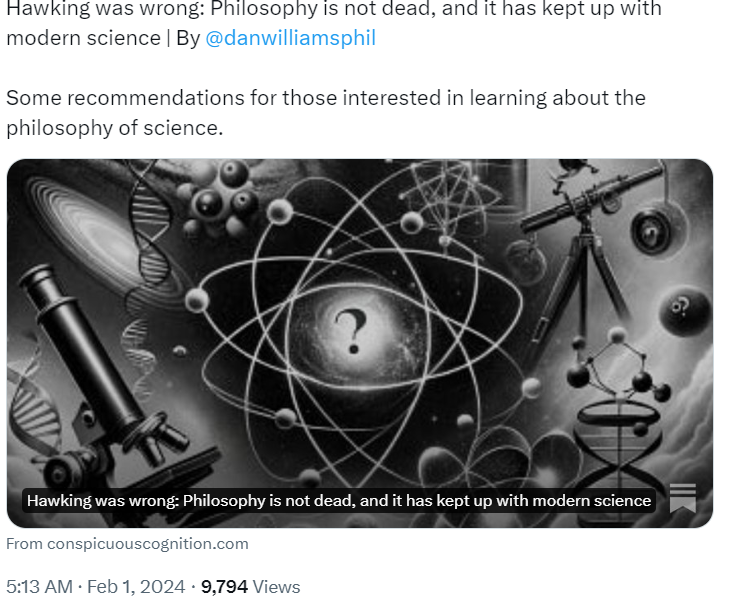
(i) Philosophy is not dead. It has kept up with science.
(ii) Sexy Popular Science
(iii) It’s Been Peer-Reviewed! Wow!
(iv) What Happened to Philosophy? (Philosophy Now)
This is the second of a series of my philosophy posts (or tweets) on X, as now published here on Medium.
The tweets were relatively long anyway, as I have a X Premium subscription which allows people to publish long posts. Indeed, I went for the subscription option precisely because I was unhappy with X’s word limit (as well as other limitations)…
What can you say in (up to) 280 characters? Not that I ever intended to do the opposite: post article-long posts on X.
Thus, I intended to strike a happy medium between posting full essays, and posting short (usually unhelpful) tweets on X.
In terms of my reposts on Medium, I’ll often need to stop myself from over-extending the original X posts, which will kinda defeat the object of reposting “shorts”. However, as stated, some X posts will be tweaked and extended if required.
Finally, I also add links to the original tweets, which can’t be done on X itself.
Philosophy is not dead. It has kept up with science.
Sure, some philosophers haven’t kept up with science. However, many have.
Or, I should say, many analytic philosophers have.
Some philosophers outside that tradition, on the other hand, don’t have much respect for science. Indeed, they’re positively anti-science. So perhaps Stephen Hawking had them in mind… Probably not.
This also depends on what the words “kept up with” mean. What is deemed to be up to date anyway? Full knowledge of the papers which have been published in the last, say, three months in respected science journals?
It’s also true that some philosophers (such as metaphysical realists) believe that philosophy actually trumps science in that if there’s a clash between the two, then science itself must accommodate philosophical theories.
It also depends on how much knowledge of science critical scientists expect from philosophers. As much knowledge — and as many skills — as scientists themselves have? However, if that were ever the case, then wouldn’t such philosophers actually be scientists?
So is that the problem that some scientists have with all philosophers — that they aren’t actually scientists?
Is it really that simple?
Sexy Popular Science
Perhaps “pop culture” often gets these things wrong because of what physicists themselves write and say. More precisely, because of what physicists write in their “popular science” books.
This has got a lot to do with physicists (not pop culture) attempting to make their topics (more?) sexy.
There are two main reasons why such physicists tart up science:
(1) In order to get more people interested in science.
(2) To help sell more of their own books.
It’s Been Peer-Reviewed! Wow!
In response to the claim above, are we meant to stand back and shout the following? —
Peer-reviewed! Wow! I’ll order half a dozen.
I’m not actually against peer-review. (It would be an odd thing to be against.) And there is a strong need for it. However, there are also problems.
For example, what if all the reviewers of a paper (or within a specific journal) believe similar things, have been educated in similar ways, uphold the same political or scientific views, etc?
What if there are only two reviewers for a particular submitted paper?
What if all (or perhaps just some) of the reviewers are biased, corrupt, dumb, or simple careerists?
So it’s odd how strong and systematic the links are between the philosophers who criticise “professional philosophy”, and, well, professional philosophy, as well as their links to university departments of philosophy, and to their various colleagues who’re professional philosophers. Indeed, Simon Critchley is a professional academic philosopher and critic of “professional philosophy”, and has been so for almost his entire adult life.
Alexander Jeuk (who classes himself as a “Marxist philosopher”) says that “modern philosophy suffers from overspecialization”. (My very strong bet is that he actually means analytic philosophy.) Would he also say that about any other discipline — such as physics, chemistry and economics? And what about Critical Race Theory, Subaltern Studies, Women’s Studies, etc?
Perhaps the (romantic) argument is that philosophy isn’t (or shouldn’t be) like these (former) disciplines. It should be “for the people”.
I’m also curious about Alexander Jeuk’s reference to “simplistic argument structures”. On the face of it, isn’t “overspecialised” philosophy (again, he means analytic philosophy) the prime culprit when it comes to too-complex “argument structures”?… So perhaps these (seemingly?) complex structures are actually simplistic structures, at least according to Alexander Jeuk.
Now I’m very curious.
Shorter
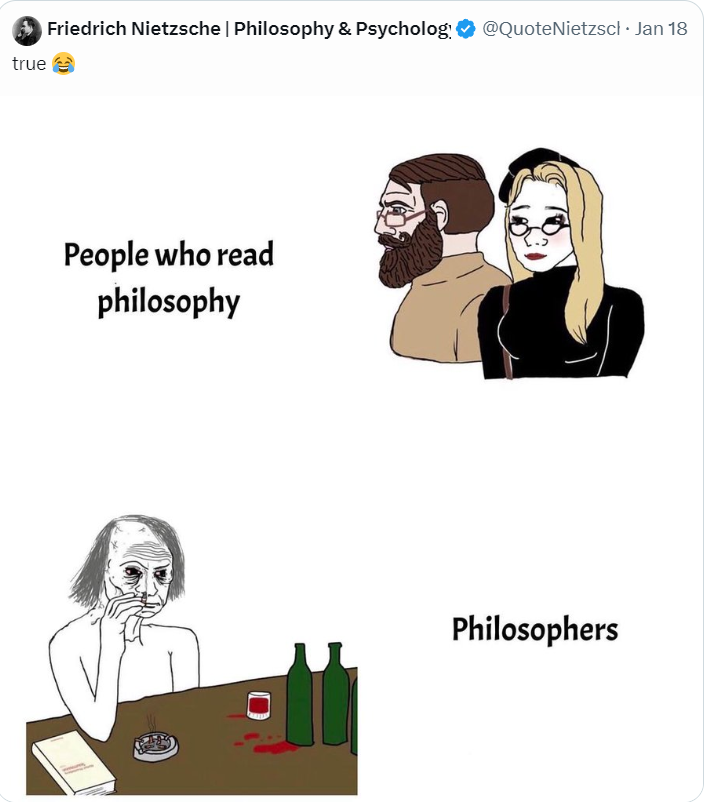
Did Nietzsche prove that?
Shorter
This is wank.
As if there are any important philosophers who haven’t “read philosophy”.
Of course, the meme above is poetic and rhetorical. However, if taken literally, then it’s wank.
Nietzsche himself read lots of philosophy. And Nietzschean philosophy is largely a response to prior philosophy.
So am I missing the point here anyway?
Is this simply about hipster memes-for-teens on Twitter/X?
(i) Albert Einstein, Just War Theory, and Pacifism
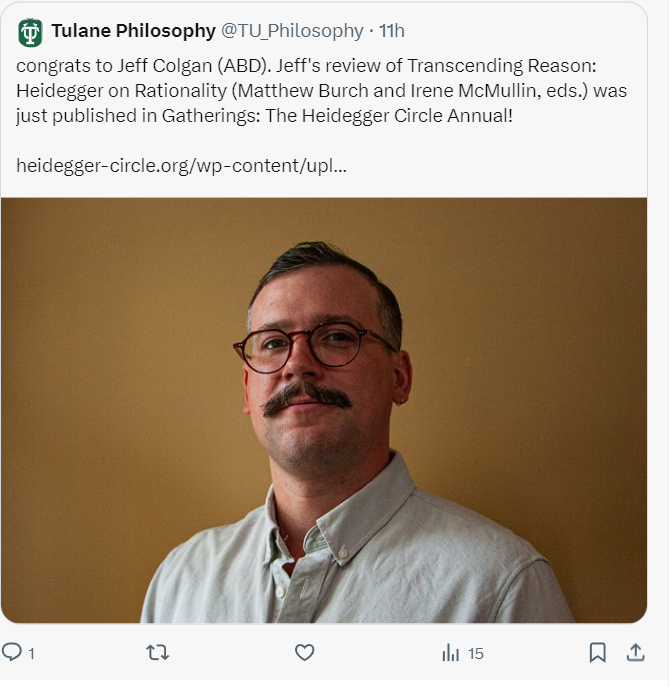
(ii) Transcending Reason
(iii) Why Study Philosophy?
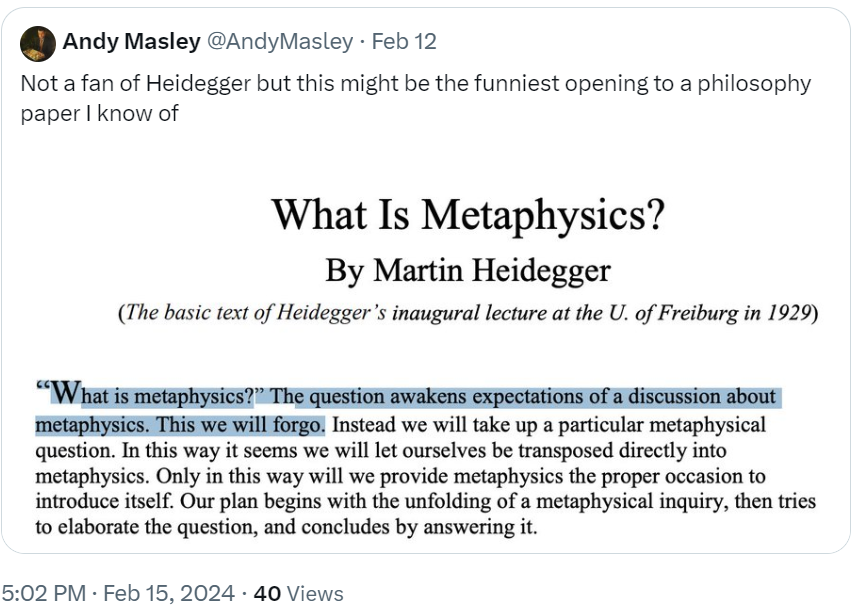
(iv) The Nothing Nots
(v) Theoretical Physics Isn’t Philosophy?
(vi) Is Time Travel Possible?
(vii) Do Academic Philosophers Contribute to “Public Discourse”?
This is the first of a series of my philosophy posts (or tweets) on X, as now published on Medium.
The tweets were relatively long anyway, as I have a X Premium subscription which allows people to publish longish posts. Indeed, I went for the subscription option precisely because I was unhappy with X’s word limit (as well as other limitations)…
After all, what can you say in up to 280 characters? Not that I ever intended to do the opposite: post article-long posts on X.
Thus, I intended to strike a happy medium between posting full articles (or essays), and posting short (therefore usually unhelpful) tweets on X.
In terms of my reposts on Medium, I’ll often need to stop myself from over-extending the original X posts, which will kinda defeat the object of reposting “shorts”. However, as stated, some X posts will be tweaked and extended if required.
Finally, I also add links to the original tweets, which can’t be done on X itself.
Albert Einstein, Just War Theory, and Pacifism
Albert Einstein believed in a “just war”. He must have done. He believed that the war against Nazi Germany (in 1939) was just. Yet he was also a self-described “pacifist”.
So was this like the following?-
“I’m a pacifist, BUT…”
[“I’m not a racist, but…” Or: “I’m not a Marxist, but…” Etc.]
So perhaps most people are pacifists-but. Or perhaps most pacifists are pacifists-but.
I’m not sure if there’s a strong contradiction here, and perhaps Einstein stopped being a pacifist at some point. However, didn’t he become a pacifist again after the Second World War? (I don’t know much biographical detail about Einstein.)
Can pacifists pick and choose as Einstein seemingly did? More relevantly to the tweet above, do some pacifists believe that some wars are just?…
Well, if they do, then surely they’re not pacifists…
Transcending Reason
There are two problems with (supposedly) “transcending reason”:
(1) Historically, reason has often been required (or “used”) to transcend reason. (2) Those who genuinely transcend reason will also need to compete with others who genuinely transcend reason.
Irrationalists (or those who “transcend reason”) usually compete with rival irrationalists by using violence, abuse, emotional language, poetic and categorical proclamations, etc. That’s what I meant in (2) above.
Most Heideggerians, of course, deny all this, or say that it’s irrelevant to his philosophy.
Really?
Not if Nazi and other other kinds of irrationalism are embedded in Heidegger’s actual philosophy! Indeed, isn’t that one implicit claim of some of those who speak of “transcending reason”?
Why Study Philosophy?
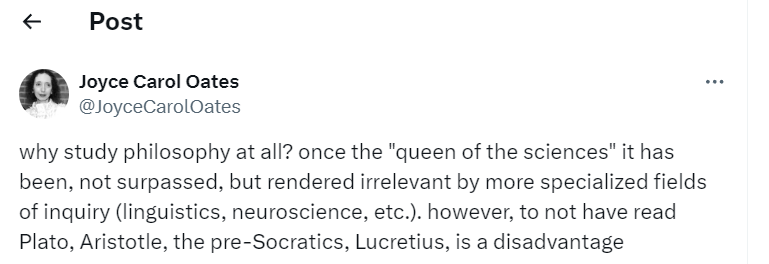
Joyce Carol Oates could do with studying more philosophy herself.
She doesn’t even bother telling her readers why philosophy has been “rendered irrelevant by more specialized fields of inquiry (linguistics, neuroscience, etc.)”. In fact, at face value, it’s hard to know what that even means. It’s almost like saying that tennis has been rendered irrelevant by dogging.
In her favour, it’s only a tweet, not a paper or article.
The thing is, many tweeters can’t go much further than slogan-full posts. What’s more, most philosophers haven’t read Lucretius. So that philosopher is an oddly personal choice.
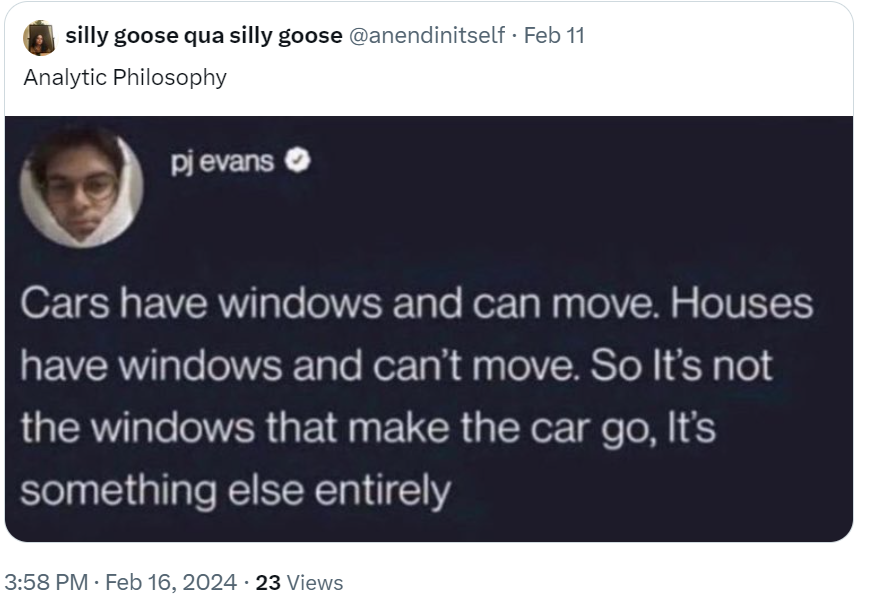
“Cars transcend the multi-variational multiply of epic Being-qua-Being. Houses are fascistic in intent and design. Thereforeto4, it’s not that cars aren’t fascistic too, it’s that Godel’s theorem says that houses are more fascistic…”
Theoretical Physics Isn’t Philosophy?
Theoretical physics may not actually be philosophy. However, surely it’s often philosophical. Indeed, much of it is speculative…
And a good thing too… up to a point.
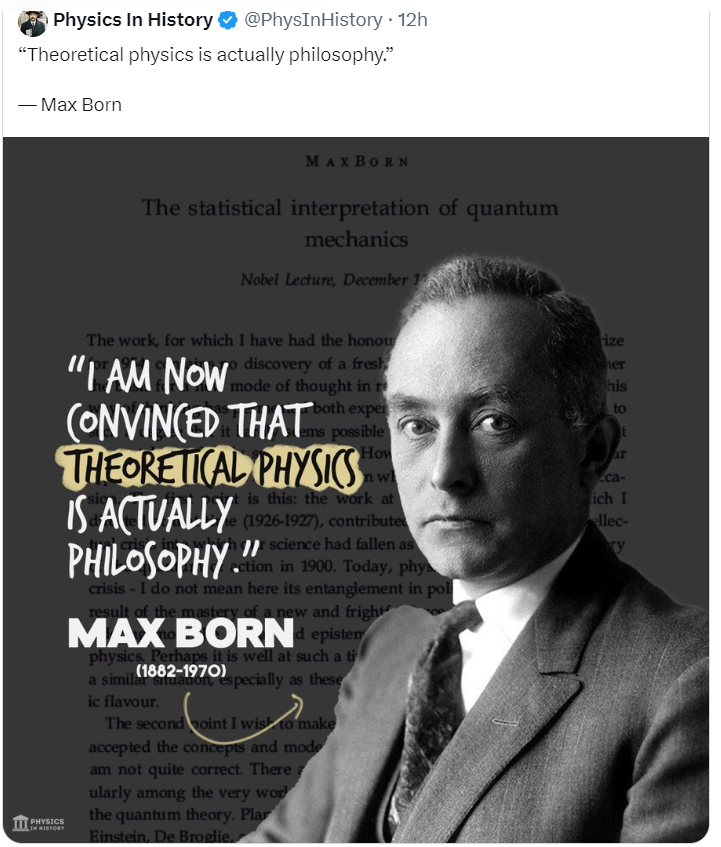
Do other physicists, unlike Max Born, believe that theoretical physics isn’t philosophy simply because the subject matter is, well, physics? Does the maths contained in it automatically stop it from being philosophy?
I’m not arguing that theoretical physics is philosophy (as in “the ‘is’ of identity”).
Is time travel possible?
Some philosophers and scientists have argued that time travel is logically impossible. Thus, it seems that their position has little to do with technological limits, physical laws, spacetime, etc.
In any case, what some philosophers and scientists deem to be logically impossible, may not actually be logically impossible.
Do Academic Philosophers Contribute to “Public Discourse”?
I’m not in favour of any cuts to philosophy departments. However, I still need to know what the words “an excellent Philosophy Dept, whose faculty members have contributed so much to public discourse” mean.
To pin that down a little.
What do the words “contributed so much to public discourse” mean?
I suppose that because universities are “public” bodies, and the work of academics is public, then, by definition, academic philosophers must have “contributed so much to public discourse”… But I’m not sure.
Academics really must be more philosophical about why they deem their own careers to be so important, and also about the role they believe they play in society at large. I suspect that Michela Massimi is only tweeting to other academics. However, how does she believe her words will sound to all those outside the Academy?
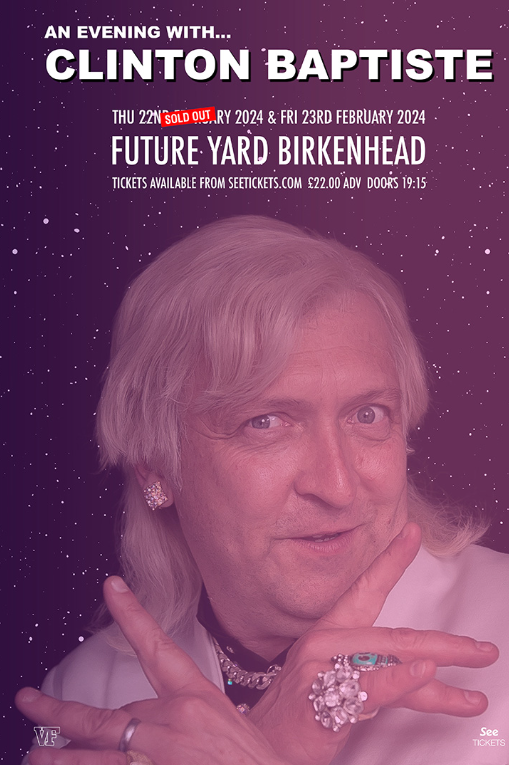
The thing about Clinton Baptiste is that he actually looks deeply spiritual. His blonde locks display that deep spirito di punto inside all of us. Indeed, when in close proximity to the great man, you can smell his spirit.
Materialists, scientists and naysayers will say what they say about him, but they can’t ignore his uncanny spiritual abilities.
For example, when psyching for an audience of 500 peoples, Baptiste passed a message to a Pascal Del Monte from the Other Side: “Someone called Dave says you’re a twat.”
So who, but a soulless materialist, could doubt Clinton’s incredible psychic gifts when he also said to an audience, “I’m getting the name… John. Is there a John in the audience?”
And guess what.
There was a John in the audience!
Now that is true spiritual greatness!
Yes, Baptiste’s psychic skills are quite remarkable, despite what the materialists and sceptics sneeringly say in their Medium stories.
Some people have even suggested that the police should use Baptiste’s services. Take the time when he did some heavy-duty psyching:
“I’m getting the word… ‘nonce’.”
Yes! Baptiste had correctly identified a nonce in the audience.
And the proof that he was Right came when the nonce punched him in the face.
Here’s another example.
Baptiste has psyched Michael Jackson, Kurt Cobain (who died), Neil Armstrong, and Jesus H. Christ. (“He’s got a beard and the long robes and everything”).
Yet, oddly enough, Baptiste himself needs a spiritual guide in order to take him to a yet-higher spiritual realm. His guide is Taruak the Eskimo. (Later rechristened as Taruak the Inuit when Baptiste became well aware of cultural sensitivities and stuff.)
Clinton is very much hands on too.
Basically, all the spiritual stuff isn’t just based on theory: it’s also grounded in practice, reality and experience. Indeed, Clinton has personally experienced 23 Near Death Experiences in the last 7 years (as recalled here).
Scientists and Materialism are Evil
Take the case of astrology, and what all those closed-minded scientists say about it.
192 scientists were once asked about astrology. (19 of them were Nobel Prize winners.) In broad terms, they all claimed that astrology has no scientific support, logical explanation, and is a bunch of bull*shit.
Clearly, these scientists — all of them — are total fuck*ers.
Yes, they’re soooooooo cocooned in their petty world of fact, argument and data that they can’t see the Truth.
If only they felt the Truth.
I blame materialism myself.
Materialism is, well, evil.
It’s responsible for literally — and I mean that literally — all the ills of the Western world.
In the Spiritual East, and to some extent in our own spiritual past, there were no wars, no persecutions, no narrowmindednesses, no tribalism, no hate. There was simply a holistic spiritual reality in which all the parts of the Universal 1 were interconnected to each in some crazy quantum-entangled kinda way.
Indeed, in the Spiritual East, even farmers and bricklayers stared at the stars for at least half-an-hour each day, contemplated-Being-for-a-while, and then blended into Mother Nature’s welcoming womb.
But in the West, all that ended in 1637 - with the satanic birth of materialism!
Yes, when Desmond “the Des” Carts released his first album — Discourse on der Method.
Materialism?
Well, where do I start?
Materialism embodies an entire omni-omni-bus-pass-of-a-mindset and a worldview.
From dawn till dusk (or both), materialism controls every aspect of our lives — from our love of war and our hate of love, to how we make love to beatifical ladies.
What’s more, metaphysical materialism and everyday materialism — consumerism! — are actually one and the same thing. And that’s because the latter grew on the dung heap of the former.
Hence, the rampant egoism in the West.
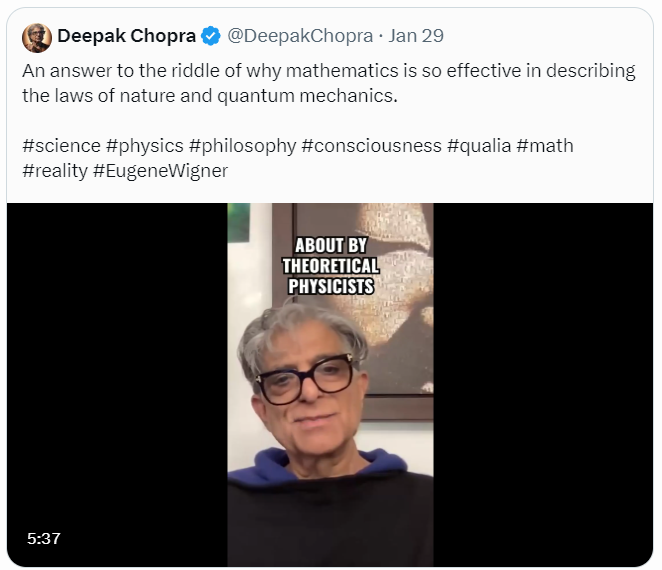
Deepak Chopra. Clinton Baptiste is a good spiritual friend of Chopra. They grew up together in Bolton’s “spiritual quarter”. They share the same accountant.
Unlike millionaire gurus and quantum businessmen, most Westerners (especially the scientists) are ruled by their possessions, self-image, titles, and a sense of their own superiority…
And it is that hellhole that spiritual conduits like Clinton Baptiste are rebelling against.
Yes, spiritual-but-not-religious people are showing us the way to a selfless, possessionless, and egoless world.
Baptiste himself displayed his selflessness and ego death when during Peak Covid he manged to carry out bargain-priced seances and readings over Zoom.
So please checkout Clinton Baptiste’s live acts, as well as his podcast — the Paranormal Podcast. Tickets are only 50 quid for the acts, and each podcast is downloadable for free at only £9.99.
This essay is mainly about Eugene Wigner’s position on the wave function and its relation to what he called “sensations” and “impressions”. It also connects all of that to idealism, and the role of consciousness in quantum mechanics.
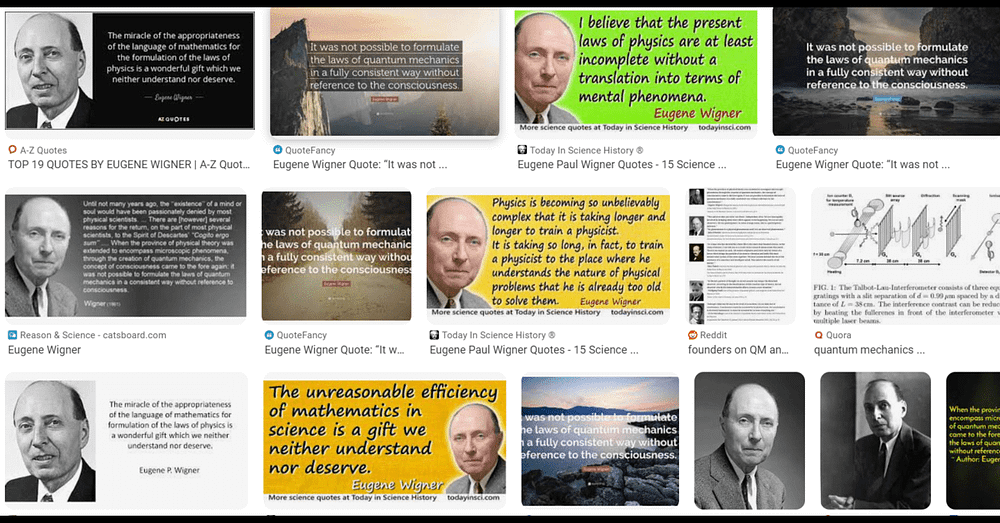
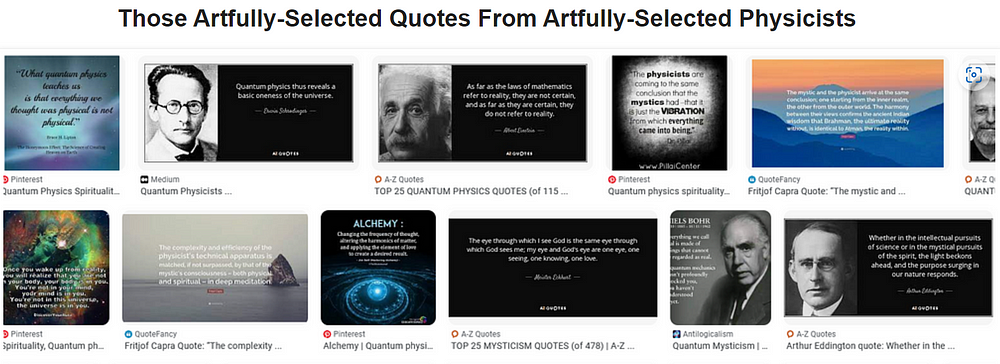
New Agers, spiritual commentators, and some idealists have created multiple images (or memes) with the words of a small number of famous physicists embedded within them. The passages quoted are nearly always the same ones. Indeed, they’ve been used countless times. These passages are often little more than a single sentence. And, as ever, they’re taken completely out of any context. All this quoting of famous physicists is usually (or even always) done for one reason, and for one reason only: to advance various spiritual and religious beliefs (often about “cosmic consciousness”) which have virtually nothing to do with physics qua physics.
(i) Introduction
(ii) Was Eugene Wigner a Positivist?
(iii) Eugene Wigner on “Impressions” and “Sensations”
(iv) Wigner on Sensations and the Wave Function
Writers must be careful when discussing Eugene Wigner’s philosophical views.
For a start, no one could deny that his paper ‘Remarks on the Mind-Body Question’ (whichI’ll be concentrating upon) has inspired at least some New Agers, idealists and spiritual commentators. (At least those who feel the need to mention scientists to back up what they already believe.)
Actually, it’s lines and passages from that paper that New Agers and spiritual commentors quote…. Or, even more accurately, the often-used quotes from that paper are what such people quote. In other words, they quote the quotes, rather than the paper itself. (As can be seen in the main image for this essay, requotes often appear in the form of social-media memes.)
Despite all that, ‘Remarks on the Mind-Body Question’ itself is far from being New Age, mystical, spiritual, or idealist.
So it’s now also worth noting here that Wigner actually began to play down the role of consciousness in quantum mechanics. Specifically, he came to believe that the idea that “consciousness causes the collapse of the wave function”leads to solipsism. In his own words, Wigner argued that “[s]olipsism may be logically consistent with present quantum mechanics”.
That said, even a full commitment to consciousness collapsing the wave function isn’t necessarily tied to idealism. Of course, it has been tied to idealism. Yet it still doesn’t need to be an idealist position. In fact, there are ways of reading wave-function collapse which actually work against idealism, and which some theorists have picked up on.
What’s more, Wigner also came to emphasise that what’s true at the quantum scale, isn’t also true of “classical” or macroscopic objects and events. Thus, Wigner’s (later?) positions don’t help idealism (or a consciousness-first position) at all. After all, in idealism, literally every object and event (including trees, human beings, acts of sexual intercourse, etc.) is the product of consciousness. Alternatively put, everything is a manifestation (or instantiation) of “universal consciousness”.
In any case, it’s much less the case that Wigner was an idealist, and more the case that some people stress that he believed that quantum mechanics “spell[ed] the end for materialism”. Indeed, Wigner did write the following words:
“The principle argument against materialism [] that it is incompatible with quantum theory. The principle argument is that thought processes and consciousness are the primary concepts, that our knowledge of the external world is the content of our consciousness.”
At the beginning of ‘Remarks on the Mind-Body Question’, Wigner also told his readers that
“most physicists in the then-recent past had been thoroughgoing materialists who would insist that ‘mind’ or ‘soul’ are illusory, and that nature is fundamentally deterministic”.
[See note 1 for a quick take on these two “anti-materialist” passages from Wigner.]
All the above said, Wigner himself (at least in one place) did use the word “idealist” about what he called “the concept of the real”. In his own words:
“The concept of the real to be arrived at shows considerable similarity to that of the idealist. As the title indicates, it is formulated as a dualism.”
This isn’t much help to idealists or consciousness-first philosophers either.
For a start, the position Wigner advanced in that paper (‘Two Kinds of Reality’) only shows “considerable similarity to that of the idealist”. Thus, even the strong adjective “considerable” still shows that Wigner didn’t deem his “concept of the real” to be actual idealism. (Of course, it might have been idealist without Wigner himself having fully realised that.) What’s more, Wigner then immediately says that his concept of the real is actually “formulated as a dualism”.
Was Eugene Wigner a Positivist?
It’s fairly hard to decide if Eugene Wigner was an old-style empiricist, a positivist, a phenomenalist, or simply a physicist who endorsed the Copenhagen interpretation of quantum mechanics.
One main reason for this is that Wigner wasn’t a philosopher. This means that he didn’t really write enough to go on. That said, Wigner did write more philosophical stuff that most physicists.
In any case, it doesn’t really matter which precise ism Wigner falls under because all the philosophical (as it were) schools mentioned above are basically part of the empiricist tradition. Thus, all the differences between theseschoolsdon’t really matter that much within the specific and limited context of this essay.
This issue is complicated even more when it comes to Wigner’s philosophy of mathematics, as perfectly expressed in his well-known article ‘The Unreasonable Effectiveness of Mathematics in the Natural Sciences’. It would be difficult to place that work within the domain of either empiricism or positivism. Indeed, it’s been classed as an expression of mathematical realism by many, and even as Pythagoreanism by other commentators…
Such is the anomalous nature of mathematics. And that’s something that positivists, empiricists, and materialists have freely acknowledged.
To return to the central theme.
Wigner did often use the terms “impressions” and “sensations” in his paper ‘Remarks on the Mind-Body Question’. Thus, this usage alone squares fairly well with the following definition of empiricism:
“In philosophy, empiricism is an epistemological view which holds that true knowledge or justification comes only or primarily from sensory experience.”
However, perhaps the term “phenomenalism” best suits Wigner’s position.
“Phenomenalism is the view that physical objects, properties, events (whatever is physical) are reducible to mental objects, properties, events.”
Now, in Wigner’s case, it can be said that “sensory experience” and “mental objects, properties, events” are what we have to go on in the case of wave functions and scientific experiments. In fact, Wigner will be quoted explicitly stating this later…
Okay, then. Perhaps “positivism” is a better term for Wigner’s positions.
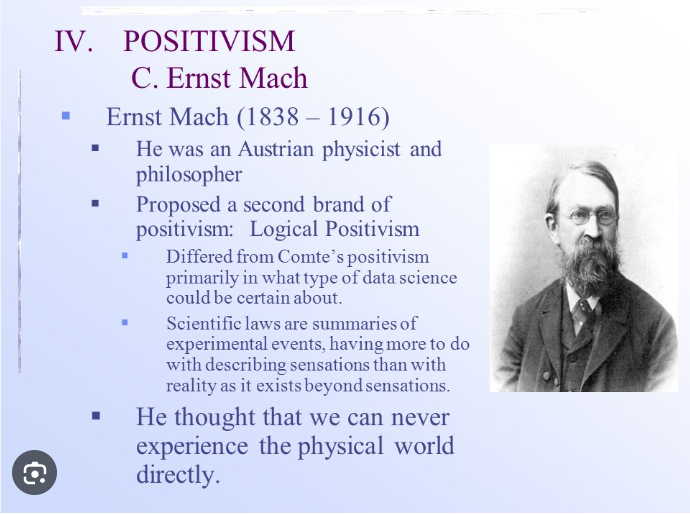
After all, a few decades before Wigner’s paper, various logical positivists strayed into the territory of physics and argued that all scientific (or “synthetic”) statements must be reducible to “perceptions” and “direct observations”.
[Of course, it now need hardly be said that all the various isms just discussed had their own problems.]
Finally, it’s now also worth stating that none of the above directly argues (or even implies) that Wigner was at one with 18th-century British empiricists, the logical positivists, etc. Indeed, the following passage alone highlights one fundamental difference:
“It is at this point that the consciousness enters the theory unavoidably and unalterably. If one speaks in terms of the wave function, its changes are coupled with the entering of impressions into our consciousness. If one formulates the laws of quantum mechanics in terms of probabilities of impressions, these are ipso facto the primary concepts with which one deals.”
Why this passage isn’t purely empiricist — or even positivist — will hopefully become clear in what follows.
Wigner on “Impressions” and “Sensations”
As already stated, there’s little in Eugene Wigner’s words which can be directly (or strongly) tied to either idealism or to mysticism.
That said, what about Wigner’s many uses of the words “sensations” and “impressions” in his ‘Remarks On the Mind-Body Question’?
Whereas New Agers, idealists and spiritual commentators nearly always talk about consciousness in very vague terms, Wigner himself mainly refers to “impressions” and “sensations”.
Relevantly, the word “consciousness” (in this context at least) has grown to have an idealist or even mystical ring to it, whereas Wigner’s “impressions” and “sensations” just seems like an old-style empiricist way of putting things.
Yet Wigner himself did refer to “consciousness” a few times in that paper!
In fact he did so in the same passages in which he referred to “impressions” and “sensations”.
“I believe that the present laws of physics are at least incomplete without a translation into terms of mental phenomena.”
Of course, Wigner’s sensations and impressions occur within consciousness — where else could they occur? [See note 2 on this spatial metaphor.] So, in that rudimentary sense, 18th century empiricists might just as easily and justifiably used the word “consciousness” about their own empiricism — had that word been as fashionable way back then as it is today.[John Locke did use the word “consciousness” in the 1690s, but not really in the way that many do so today.]
In any case, Wigner stating that we “rely on sensations” isn’t a commitment to idealism. It’s broadly an empiricist position,and such a position datesback (in various forms) to the 18th century. (Arguably, it dates much further back than that— see here.)Such a position was also adopted — if in a “logical” form — by the logical positivists… We’ve had phenomenalism too!
“All that quantum mechanics purports to provide are probability connections between subsequent impressions (also called ‘apperceptions’) of the consciousness, and even though the dividing line between the observer, whose consciousness is being affected, and the observed physical object can be shifted towards the one or the other to a considerable degree, it cannot be eliminated.”
As far as that passage is concerned, it can be argued that Wigner believed that he was taking the Copenhagenist line to its (as it were) logical conclusion. After all, Niels Bohr, Werner Heisenberg, Max Born etc. also stressed (or at least used) the words “impressions” and “sensations”. [See here.]Rudolph Carnap and other logical positivists, on the other hand, used terms such as “cross-sections of experience”. Indeed (as already stated), the emphasis on “sense impressions” goes back to the British empiricists of the 18th century.
Yet none of the examples cited — certainly not Carnap and the logical positivists — could be deemed to be idealists or people with idealist or “mystical” inclinations…
That’s unless empiricism (if of a 20th-century kind) is actually taken to be a kind of idealism. [There has been some debate about this when it came to Bishop Berkley. See note 3.]
All that said, it’s now important to tie Wigner’s words about impressions and sensations to thewave function. After all, the wave function was central to quantum mechanics after 1926,and Wigner himself had much to say about it.
Wigner on Impressions and the Wave Function
Eugene Wigner himself described the wave function in the following way:
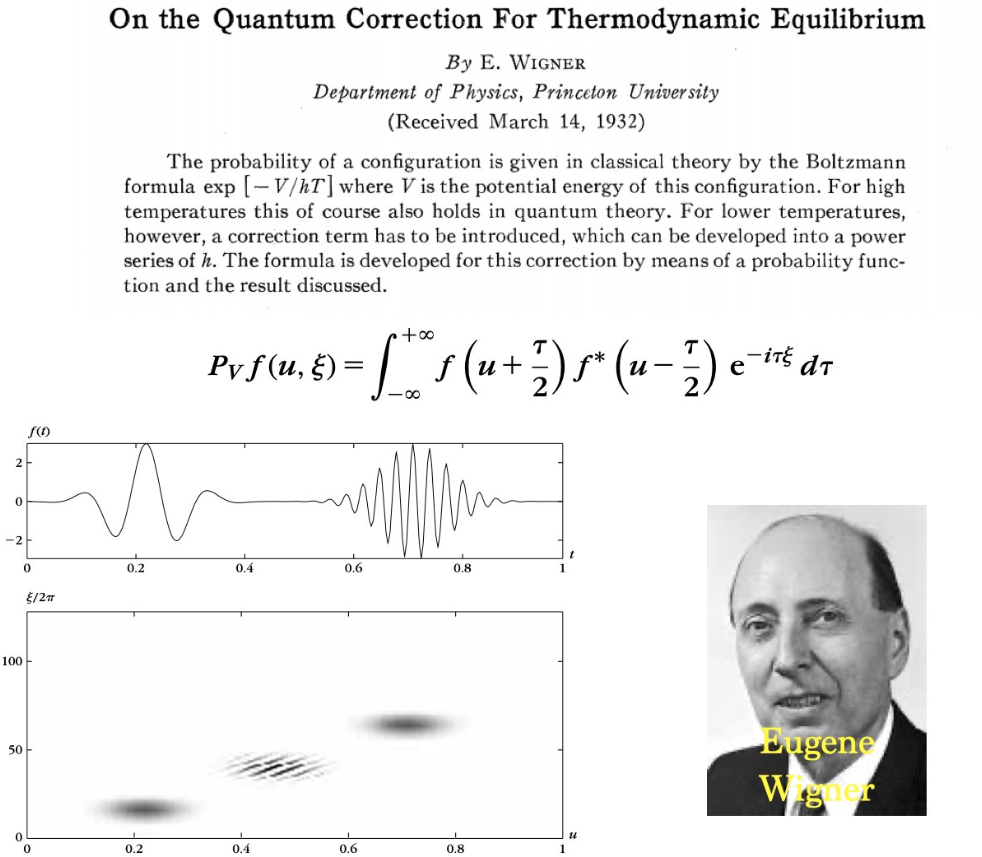
“This is a mathematical concept [] it is composed of a (countable) infinity of numbers. If one knows these numbers, one can foresee the behavior of the object as far as it can be foreseen. More precisely, the wave function permits one to foretell with what probabilities the object will make one or another impression on us if we let it interact with us either directly, or indirectly.”
“Given any object, all the possible knowledge concerning that object can be given as its wave function. [] [T]he wave function is only a suitable language for describing the body of knowledge — gained by observations — which is relevant for predicting the future behaviour of the system.”
And elsewhere:
“[K]nowledge of the wave function does not permit one always to foresee with certainty the sensations one may receive by interacting with a system.”
Wigner again stressed “impressions” (or “sensations”) when he wrote the following words:
“The information given by the wave function is communicable. If someone else somehow determines the wave function of a system, he can tell me about it and, according to the theory, the probabilities for the possible different impressions (or ‘sensations’) will be equally large, no matter whether he or I interact with the system in a given fashion.”
Wigner’s words above are really at one with the Copenhagen interpretation of quantum mechanics. As already stated, Niels Bohr, Werner Heisenberg, etc.often stressed “sensations” and “impressions” too. However, Bohr himself, for example, didn’t often use the word “consciousness” in these specific respects. That said, Wigner quotes Bohr using precisely that word — but not about the wave function or even about quantum mechanics! (Wigner: “In the words of Niels Bohr, ‘The word consciousness, applied to ourselves as well as to others, is indispensable when dealing with the human situation’.”
More relevantly, it can be supposed (at least at first) that Wigner goes beyond plain-old positivism (or even Copenhagenism) when headded these words:
“[E]ven though the dividing line between the observer, whose consciousness is being affected, and the observed physical object can be shifted towards the one or the other to a considerable degree, it cannot be eliminated.”
Now that is truly something that you’d expect a 20th century quantum physicist to write.
Notes:
(1) There are problems with Eugene Wigner’s account of materialism: (1) Materialism isn’t necessarily incompatible with quantum theory. However, quantum theory certainly was at odds with 19th-century materialism in the 1920s. (2) Empiricists dating back to the 18th century wouldn’t have had any problems with stating that “sense impressions” (if not “thought processes and consciousness”) are “primary”, and that we gain access to the “external world” through our sense impressions (if not through “the content of our consciousness”). Indeed, that last point captured the very essence of empiricism!
Of course, idealists historically picked up on the fact that empiricists claimed to gain access to the external world via their sense impressions, and then they logically and philosophically questioned that position. Basically, idealists argued that empiricism led to (subjective) idealism. (It certainly did so with Bishop Berkeley.)
As for the second passage. It’s worth remembering that Wigner wrote the following words in 1961:
“[M]ost physicists in the then-recent past had been thoroughgoing materialists who would insist that ‘mind’ or ‘soul’ are illusory, and that nature is fundamentally deterministic.”
In 1961, “most physicists” didn’t “insist” upon such things. Apart from the fact that most physicists didn’t have much to say about the mind or soul (at least not qua physicists), they certainly — as a whole — weren’t against all mentions of the “mind”. On the other hand, perhaps many physicists would have had a problem with the soul. Better, with the word “soul”. That’s unless the word “soul” was simply deemed to be a synonym of the word “mind” in those days.
So perhaps Wigner really meant philosophical physicists or simply philosophers.
Well, even many materialist philosophers didn’t have a serious problem with discussing the mind before 1961. They might sometimes have had a radical take on the mind. (Such as with Gilbert Ryle’s book The Concept of Mindfrom 1949.) However, they wouldn’t have said that the “mind is illusory”. And that was for the simple reason that it had been given materialist, behavioural, functionalist, etc. explanations before Wigner wrote his words in 1961…
Now what about consciousness?
Well, that’s another matter…
(2) Of course, the nature — and even existence — of consciousness itself is also contested.
For example, I used the words “sensations and impressions occur within consciousness” in the essay above. Note the two words “in consciousness”. Surely that’s a spatial metaphor. In other words, why can’t sensations, impressions and other mental things actually constitute consciousness, rather than be in it?
(3) Some writers have argued that Bishop Berkeley’s empiricism morphed into what they called subjective idealism. Other writers have argued thatit was such a thing from the very beginning.
Berkely’s philosophy also ties in with 21st century idealism in that God fulfils much the same role as “universal consciousness” (or “cosmic consciousness”) does. That’s in the sense that whatever is not directly perceived by a single subject (or even by a collective of subjects), is perceived by God himself (“God in that gap”) in Berkeley’s philosophy. In the case of “cosmicidealism”, on the other hand, all objects and events are, not perceived by “monotheistic God”: they’re actually instantiations of Universal Consciousness. (To the idealist Bernardo Kastrup, the brain, trees, acts of sexual intercourse, etc. are “images” or “representations” of consciousness.)