Monday, 24 January 2022

Thomas Nagel on “Darwinian Imperialism”, Naturalism and Mind (Part Two)

 Thomas Nagel fights “Darwinist imperialism” and Naturalism

Thomas Nagel being burned at the stake by satanic “Darwinian” and “materialist” analytic philosophers in red robes.
“The total world-view of modern man [has] let itself be determined by the positive sciences [which has resulted in] an indifferent turning-away from the questions which are decisive for a genuine humanity.”

Edmund Husserl (see source here)

Skip the following square-bracketed introduction if you’ve already read my ‘Thomas Nagel as Philosopher-Priest and New Mysterian (Part One)’.

[This essay was written quite some time ago. The style is somewhat rhetorical, literary and (as it were) psychologistic. That said, I still agree with much of its philosophical content. However, if I were to write it today, the style would be a little different. Indeed most analytic philosophers would probably regard this essay as one long ad hominem against the American philosopher Thomas Nagel (1937-). Sure; there is an element of the ad hominem in the following. Yet hopefully it will be shown that there’s more to the essay than that.

In fact I chose to write in a rhetorical style partly in response to the clear and prevalent rhetoric and “psychologising” I found in Thomas Nagel’s own book, The Last Word.

In addition, the prefix “new” in “new mysterian” is a little dated (i.e., new mysterianism is no longer new) because the term was first coined in 1991 by the American philosopher Owen Flanagan (1949-). (See Flanagan’s The Science of the Mind.) What also needs to be said is that I’m using Flanagan’s word “mysterian” more widely and more literally than he does. That is, in Nagel’s case I’m stressing Nagel’s mysterianism and mysticism across the board. Flanagan, on the other hand, only (really?) had mysterian positions on consciousness in mind. That said, the term “new mysterianism” has also been applied to the wider position that there’s far more than one “hard problem” (i.e., the “hard problem of consciousness”). It also includes the belief that science is intrinsically and fundamentally limited in many respects. This is a self-conscious kind of anti-scientism.]

********************************

Thomas Nagel’s General Anti-Naturalism

In the following I shall discuss Thomas Nagel’s desire to keep the human person (or “man”) securely away from any attempts to naturalise him or her.

This desire, of course, has a long tradition dating back to the ancient Greeks. A whole host of characteristics of the human subject have been put forward as truly distinguishing us from not only all the other animals; but also from the rest of the universe.

Originally, man was “the only rational animal” (laughter was also offered up by Aristotle). Then we had, in no particular order, the mind, the soul, the love of God, language, free will, “complex social structures”, music and so on. More recently, the distinguishing features of man which have been cited (at least by philosophers) have been meaning and intentionality. These characteristics are meant to distinguish man from everything else in the universe. The problem with that enterprise is that although there may well be features of human persons (or “mankind”) which distinguish them from everything else in the universe, every other thing in the universe probably has distinctive features that differentiates itself from human persons — and indeed from other non-humans too. (For example, having a hundred legs, being able to survive a mile under water, being able to live in freezing temperatures, having intrinsic spin, travelling at the speed of light, being able to penetrate solid walls… ad infinitum.)

There’s another manoeuvre which is of more recent origin. This is the stressing of aspects of man that can’t be naturalistically reduced to straightforwardly physical features. Here we have intentionality again, semantics, the “the intrinsic nature of the first-person perspective” and qualia.

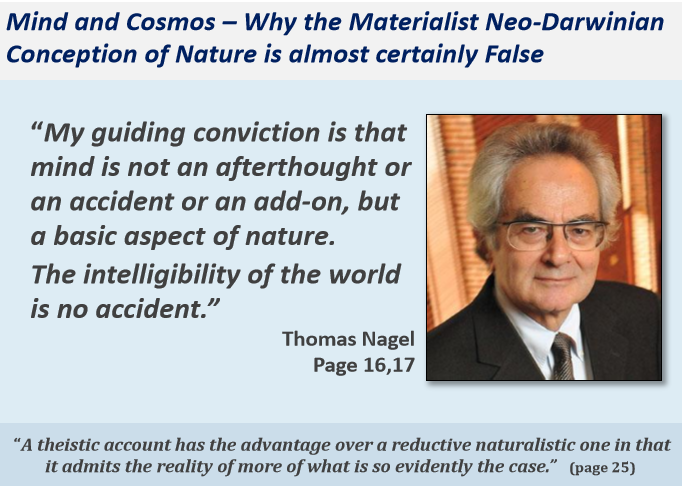
The main threat against Nagelian mysticism or mysterianism is posed by what Nagel calls “Darwinist imperialism” (see here and here). What Darwinism does, according to Nagel, is

“eliminate purpose, meaning, and design as fundamental features of the world”.

My immediate reaction to that is that the vast majority of Darwinians probably don’t have anything at all to say about “meaning”. So perhaps Nagel is actually talking here about (as it were) Darwinist philosophers like Daniel Dennett.

So does “naturalistically reducing” automatically mean elimination?

The old religious account of “purpose” may well be eliminated; though what of meaning? (There are very few “naturalist” semantic eliminativists.)

As for “design”: it depends on what Nagel means. And, in any case, even many Christians have finessed their views on the world’s design by taking into account Darwinism. That said, perhaps I’m misinterpreting Nagel’s reference to the world’s “design”. After all, he does frequently stress (e.g., in almost every interview) that he’s an atheist.

More broadly, what the Darwinian picture offers us is a denial of Nagel’s assertion that “mind is an irreducible and nonaccidental part [of the] cosmic order”. I suspect that few Darwinists (certainly not all physicalists) believe that the mind is in fact (fully?) reducible (see non-reductive physicalism). However, all most certainly do believe that mind is an “accidental” result of biological evolution and all the cosmic physical processes that preceded it. This means that Nagel’s fusing of the irreducible and the nonaccidental is suspect and somewhat arbitrary.

Again, bearing in mind that Nagel claims to be an atheist, what can he mean by saying that the mind is a “nonaccidental part [of the] cosmic order”? And it also depends on what he means by “reduction” or the mind being “reducible”. Perhaps the mind can’t be reduced in the way a table can’t be reduced (i.e., to atoms and molecules) without losing its essential (as it were) tablehood. (This simply means that physicists wouldn’t be the ones who explain to us that tables are for eating or for playing tennis on.)

Nagel offers us another criticism of the Darwinian story of mind. He lets Mark Johnston articulate it in the following way:

“‘Why is the natural order such as to make the appearance of rational beings likely?’”

According to Nagel, the only acceptable answer to the above question must be a “teleological” one. And I can’t help thinking that whenever teleological explanations are brought to bear on the appearance of mind (or Soul), then that telos is invariably God. (Keep in mind. Nagel’s earlier reference to “design”.) Nagel will certainly believe that any mention of “design”, “teleology”, the “nonaccidental appearance of mind” and its “irreducibility” within a theistic/ Christian framework would make many other analytic philosophers take him less seriously. That said, the analytic philosophers Richard Swinburne, Alvin Plantinga, Antony Flew, William Alston, Linda Zagzebski, Paul Moser, etc., on the other hand, are explicit about their “Christian theism” and other religious or Deistic positions. (Take Richard Swinburne’s position on personal identity: it’s an explicit commitment — if not a simple reworking - of the Christian position on the soul. And Alvin Plantinga slips God into many of his papers.)

Again, it is in Nagel’s attitude to reason that the philosopher’s quasi-mysticism or mysterianism can be seen.

Reason, Mind and Intentionality

So why does Nagel feel the need to say that the “basic methods of reasoning we employ are not merely human? What could that possibly mean other than being a religious or mystical statement? To put it starkly: Nagel must surely believe that reason and mind are not “human” — or at least they have no relation to the biological and historical. He must believe, them, that reason is a faculty of a non-corporeal soul.

Another mantra of Nagel’s is that human subjects are not objects. This position is clearly seen in certain debates in the philosophy of mind. More precisely, Nagel vehemently rejects all attempts to what may be called scientise the mind. This can be seen in the on-running third/first person debate. Nagel believes that there is something about the first-person perspective that could never — even in principle! - be caught by the third-person language of science. Nagel also famously believes that no scientist could ever tell us “what it is like to be a bat”; or, indeed, what it is like to be Thomas Nagel.

Most of Nagel’s anti-naturalistic fire has been aimed at those who have attempted to naturalise (or reduce or eliminate) intentionality and qualia. He wrote:

“Intentionality cannot be naturalistically analysed…nor can it be given naturalistically sufficient conditions. It is not to be captured by either physical or phenomenological description.”

Nagel’s argument also seems to be that whatever we say about the evolutionary heritage of intentionality (i.e., if we accept such a thing), or the physics and neurobiology which underpins it, we could never indulge in (as it were) a priori reasoning to satisfactorily arrive at the effect (i.e., intentionality and qualia) exclusively from the causes (i.e., natural conditions). And even if we work backwards with purely a posteriori reasoning from the phenomena of intentionality and qualia, natural conditions may be necessary; though they would never be sufficient for a satisfactory explanation of intentionality. In fact with intentionality, it’s believed that human subjects have something that the rest of the universe simply doesn’t have. Intentionality sticks out like a sore thumb both in nature and in the minds of non-naturalist and mysterian philosophers. Indeed Nagel believes, as Brentano believed over 100 years ago, that “aboutness” is irreducible.

So Nagel argues that he can place intentionality firmly outside the causal nexus. He claims that

“it is possible to accept a worldview that does not explain everything in terms of quantum field theory without necessarily believing in God”.

Nagel continues:

[I]t seems hardly credible that its [the mind’s] appearance should be a natural accident, like the fact that there are mammals.”

So if the mind’s (or soul’s) appearance isn’t a “natural accident”, then is it a supernatural what?

*******************************

See my: ‘Thomas Nagel as Philosopher-Priest and New Mysterian (Part One)’.

To follow: ‘Thomas Nagel on Good and Bad Philosophy (Part Three)

Thomas Nagel as New Mysterian and Philosopher-Priest (Part One)


Thomas Nagel on Transcendence and Ineffability

“There are, indeed, things that cannot be put into words. They make themselves manifest. They are what is mystical.”

- Ludwig Wittgenstein (from his Tractatus Logico-Philosophicus)

[This essay was written quite some time ago. The style is somewhat rhetorical, literary and (as it were) psychologistic. That said, I still agree with much of its philosophical content. However, if I were to write it today, the style would be a little different. Indeed most analytic philosophers would probably regard this essay as one long ad hominem against the American philosopher Thomas Nagel (1937-). Sure; there is an element of the ad hominem in the following. Yet hopefully it will be shown that there’s more to the essay than that.

(In fact I chose to write in a rhetorical style partly in response to the clear and prevalent rhetoric and “psychologising” I found in Thomas Nagel’s own book, The Last Word.]

In addition, the prefix “new” in “new mysterian” is a little dated (i.e., new mysterianism is no longer new) because the term was first coined in 1991 by the American philosopher Owen Flanagan (1949-). (See Flanagan’s The Science of the Mind.) What also needs to be said is that I’m using Flanagan’s word “mysterian” more widely and more literally than he does. That is, in Nagel’s case I’m stressing Nagel’s mysterianism and mysticism across the board. Flanagan, on the other hand, only (really?) had mysterian positions on consciousness in mind. That said, the term “new mysterianism” has also been applied to the wider position that there’s far more than one “hard problem” (i.e., the “hard problem of consciousness”). It also includes the belief that science is intrinsically and fundamentally limited in many respects. This is a self-conscious kind of anti-scientism.]

(i) Introduction
(ii) Nagel’s Metaphilosophy and His Moral Hopes
(iii) Nagel on Transcendence and Ineffability
(iv) Is Nagel’s Position Mystical?
(v) Is Nagel an Atheist?

Introduction

“There are desires and sentiments prior to reason that it is not appropriate for reason to evaluate.”

-Thomas Nagel, The Last Word (1997)

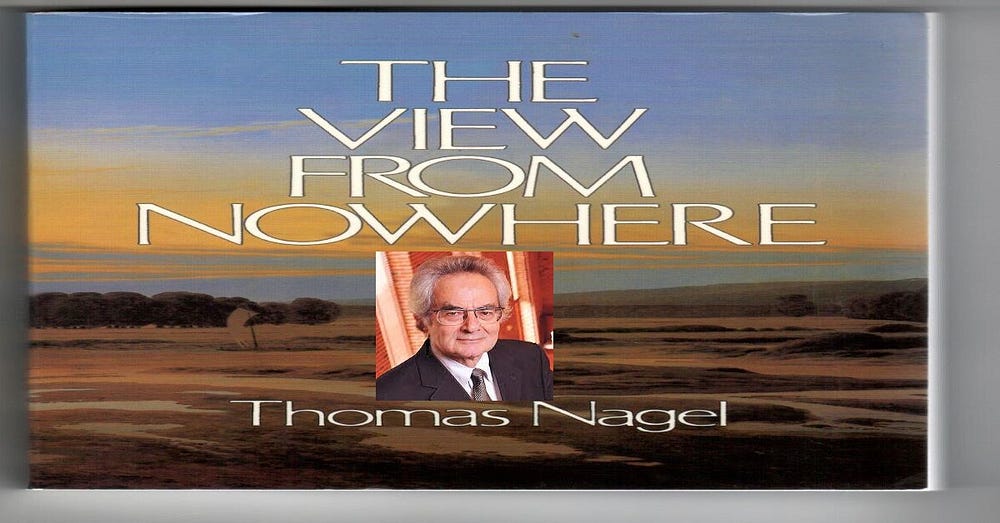
My reason for taking the following approach to Thomas Nagel’s philosophical positions comes from certain comments he made in his books The View from Nowhere (1988) and The Last Word. In those books he states that his philosophy is driven by his moral feelings. Now some people may say that there’s nothing strange with that in the field of ethics itself. However, what if Nagel’s “desires and sentiments” are responsible for his metaphysical and epistemological positions too?

Take Nagel’s (following) pronouncements and compare them with Michael Ayers comments on John Locke. In that book Ayers writes that it’s “absurd” to think of

“a particular moral, political or religious orientation’s motivating a theory of knowledge or being”.

So this essay isn’t really an analysis of Nagel’s positions within metaphysics and epistemology. It’s an examination of why Nagel may hold such positions in the first place. It’s not to the point, therefore, to say that I don’t offer any good critical analyses of Nagel’s positions on necessity, objectivity or “pre-linguistic concepts”. Such analyses are not the purpose of this essay. Instead, I want to explain why Nagel holds such positions; not whether his positions have any argumentative power.

This means the work is also somewhat speculative and psychological. And that’s primarily the case because — to state the obvious — I haven’t actually got access to Nagel’s (non-verbalised) mind.

Nagel’s Metaphilosophy and His Moral Hopes

In Nagel’s case there seems to be a kind of pragmatism in the air. In fact precisely the same kind of pragmatism that Nagel argues against when displayed by philosophers like Richard Rorty (see Nagel on Rorty here) and Hilary Putnam (1926- 2016) (see Putnam on Nagel here). What is meant by this is that one could take Nagel’s opening quote to be an acknowledgment that one’s metaphysics and epistemology should simply be the handmaidens of one’s metaphilosophical and moral hopes.

Indeed this was what Kant more or less argued (in his Critique of Pure Reason) about “moral philosophy” and its relation to metaphysics and epistemology. It’s also what Aquinas argued (in his Summa Theologica) about logic’s and philosophy’s relation to theology.

In the case of Nagel, if certain metaphilosophical and moral “desires and sentiments” are “prior to reason” and should therefore not be “evaluated”, then they should also be defended all the way down the line of philosophical speculation and analysis. And, as is clear, Nagel’s comments on logic, mathematics and various givens may simply the groundwork for his positions on metaphilosophy and morality which he deems to be much more important. This may mean that the metaphysical and epistemological positions advanced in (for example) The Last Word are simply the substructure which Nagel feels is needed to support his larger metaphilosophical and moral edifice.

As already hinted at, there’s nothing new here.

For example, Kant the transcendental idealist professor ended up believing exactly the same things about God, immortality, freedom and morality as Kant the North German Pietist who preceded him. Indeed it can easily be argued that Kant’s whole philosophical enterprise was an attempt to “limit reason in order to make room for faith”. Bishop Berkeley’s philosophical system was also an attempt to limit the pretensions of the advancing materialist and deterministic Newtonian science. And Descartes was at his most dishonest when he smuggled in God to tighten up his system and guard Christianity from 17th century sceptics.

So Nagel (via his anti-naturalism or mysterianism) is attempting to limit philosophical naturalism (which, in his view, includes pragmatism, positivism and the late Wittgenstein) in order to make room for (amongst other things) the ineffable, the necessary and for non-linguistic “thought”.

Nagel on Transcendence and Ineffability

It will become clear that Nagel is [or was] offering some kind of mystical or quasi-religious line on philosophy. Take Nagel’s own words on this in his book The Last Word:

“Rationalism has always had a more religious flavour than empiricism.”

So it’s clear (to me at least) that Nagel is precisely the kind of rationalist he refers to above.

So let’s cite some examples.

Nagel wants to downgrade the analysis of language (or at least language use). The analysis of language is, after all, an empirical enquiry. Nagel, instead, emphasises the point that his own own “concepts” predate experience in a manner which roughly compares with Kant’s a priori “concepts” or Frege’s notion of what he called Thoughts.

Nagel is a rationalist in the Cartesian sense too.

To such rationalists, the human subject can unhook himself from the rest of the empirical world (including his own body) and then philosophise in order to gain truth. Indeed not even the empirical data needed for such cogitations are of much importance when compared to the (to use Nagel’s words) “order of reasons” which we must “submit to” rather than “create”.

Thus Nagel is searching for the necessary, the absolute and those aspects of the human mind which we all share. Such a search is essentially Kantian in spirit, if not in actual content.

Yet what is it, precisely, that’s mystical or quasi-religious about all the above?

Is Nagel’s Position Mystical?

As just stated, Nagel downgrades experience, language and contingency. He’s essentially stressing those facets of reason and mind which human beings come into the world with. That is, those things which are built into us as human subjects in a manner which Kant would recognise. (Note that Nagel attacks Kant’s “idealism”.) And if these things were there before language and all other interactions with society, then they’re closer to God than they are to the world of departmental seminars, raging hormones, book deals, voting and tax forms. (A world in which Nagel, presumably, lives and breathes.) By tapping into these givens (or simply by using or understanding them through realist analytic philosophy), we’re also acknowledging God’s — rather than society’s — gifts to us.

Yet even if Nagel is not — rather immodestly — placing himself and selected other philosophers closer to God, he is in effect celebrating the things which God has placed within us. This effectively means that by distancing himself from (as Nagel puts it) “time and chance”, Nagel becomes closer and closer to the Eternal and the Necessary — which are God’s works. Contingency, on the other hand, is the Devil’s work.

This is also the Platonist strain in Nagel.

Yet there are some things about Nagel’s philosophical positions which are clearly more mystical than outrightly religious.

Take his frequently reiterated position on the “view from Nowhere”.

Firstly, when it comes to Nagel’s view of the world and its relation to scientific claims, things don’t appear particularly mystical. However, when Nagel says that he wants to “get outside” of himself in order to “reach a descriptive standpoint from which the first person has vanished”, he does indeed sound mystical.

Of course it needs to be asked if readers are meant to take Nagel literally or metaphorically when he utters these phrases. Yet it seems that there are good reasons to take him literally. In any case, how would a metaphorical reading of his words be cashed out? Perhaps not even Nagel could tell us.

So if we take Nagel literally, shades of (amongst others) Plotinus can be seen. However, whereas Plotinus wanted to achieve harmony with what he called “the One”, Nagel would like to achieve harmony with the perspective-free external world — the world we discover when we cleanse ourselves of what Nagel’s calls the “first person”.

The world (as it’s often put) as it is in itself is like God — or is God — to Nagel. (This may show the influence of Spinoza.) Similarly, whereas Plotinus rages against “plurality”, Nagel’s devil is contingency. (Wasn’t “plurality” a consequence of contingency for Plotinus?)

To finish off on this line of reasoning, here’s a poetic (i.e., for Kant) passage from the Critique of Pure Reason (1781/1787):

[] Plato, abandoning the world of sense because of the narrow limits it sets to the understanding, venture[s] upon the wings of ideas beyond it, into the void space of pure intellect.”

It need hardly be said that Nagel is similarly advocating “abandoning the world” of empirical (or experiential) reality and language because he deems such things to be inadequate to the task of providing us with necessity, certainty, objectivity and other such holies. So perhaps Nagel too ends up in the “void space of pure intellect”.

Now there’s large problem for my position as advanced in all the above: Nagel has often called himself an “atheist” (see here)!

Is Nagel an Atheist?

Even if Nagel’s honesty can’t be doubted (as Nagel himself doubts the honesty of Alasdair MacIntyre and what he calls the “ritualist relativists and subjectivists”), his atheism isn’t really a big problem to the central thesis. That’s because the religious impulse (or instinct) can survive quite easily without the God of monotheistic religions. Indeed all sorts of psychologists and sociologists have written thousands of words on this very phenomenon. These people have shown us (if we needed to be shown) how hard it is to throw off the baggage placed upon us by our history, society and our parents.

Thus Nagel has finessed mystical/religious positions and made them seem more modern and sophisticated. That is, he’s expressed mystical/religious positions in the language game of late 20th century analytic philosophy. Thus it’s mainly a case of old wine in new bottles.

The early Wittgenstein (i.e., unlike the late Wittgenstein) also provides Nagel with ammunition to fight for the ineffability and transcendence cause. Nagel sums up Tractarian Wittgenstein as claiming that

“what couldn’t [] be said was much more important than what could be”.

For Wittgenstein at this point, these (as it were) ineffables were (among other things) “logical objects”, logical relations and the relations between empirical propositions and the possibilities they represented. However, to Wittgenstein these things were simply (at least on my reading) the logical entities which grounded much more important ineffables — such as the human subject. This subject is outside the world and also the foundation of moral and aesthetic value judgements — judgements which the subject simply intuits or feels (i.e., subjects not unlike Kant’s noumenal self).

Again like the early — and late — Wittgenstein, Nagel doesn’t like too much talk. Too much talk ruins or destroys what it is that’s talked about. So let’s try not to talk about, say, neurons and synapses when we talk about the self or mind. Let the self or mind, unlike every other thing in this gigantic universe, spring free of all causal mechanisms. Nagel believes that we intuitively know this to be true. And talk could undo that truth. Indeed only positivists and “scientistic philosophers” want to talk about everything. Such people, Nagel seems to believe, don’t recognise the soul (or the soul’s calling) quite simply because they don’t recognise that they have souls.

This interest in the ineffable often goes alongside a belief in philosophical depth.

Nagel believes that that real (or important) philosophical problems are intrinsically deep. He even tells us that an old teacher of his (i.e., J.L. Austin) distrusted depth; though “depth was what I thirsted for”. This seems to mean that it was depth in itself (or depth for itself) that interested Nagel at that time — and still does; not the fact that depth is often simply an accidental byproduct of certain (i.e., not all) philosophical problems.

So what is “philosophical depth”?

Those words can’t be a synonym for “philosophical complexity”. Is it more, well, spatial than that? Is it the Reality under the Appearances? The Noumenal Self under the empirical self? The Logical Form under the grammatical form? The Essence under the accidents? The Truth under the (to use Nagel’s word) “simulacra”?

Depth is something priests like to give us. It’s something they believe to be beyond trivialities and superficialities. And when we reach the depths such priests have hinted at, then we will find “the meaning of life” and “what it’s all about”. In the case of Nagel, we also find essence, necessity and objective truth: all seen from the non-perspectival and incredible View From Nowhere.

The early Wittgenstein (again) similarly “thirsted for depth”. That said, he came to believe that philosophers had (in a sense) been mislead by this spatial metaphor (amongst other things). Or, as the American philosopher Terence Parsons once put it (if about a slightly different subject):

[As] half the rest of the [analytic] philosophical world have been telling us, you can’t trust the ‘surface’.”

*****************************************************************

See my: ‘Thomas Nagel on Darwinian Imperialism, Naturalism and Mind (Part Two)’.

[I can be found on Twitter here.]