Saturday, 26 December 2020

Raymond L. Wilder's Anthropology of Mathematics: Platonism and Applied Mathematics


Raymond Louis Wilder was born 1896 and died in 1982. He was an American mathematician who specialised in algebraic topology and the theory of manifolds. Wilder was professor at the University of Texas, Ohio State University and at the University of Michigan. He was also vice president of the American Mathematical Society and its president from 1955 to 1956. (He was the Society’s Josiah Willard Gibbs Lecturer in 1969.) From 1965 to 1966, Wilder was the president of the Mathematical Association of America. (This association awarded him its Distinguished Service Medal in 1973.) Wilder was elected to the American National Academy of Sciences in 1963.

Evolution of Mathematical Concepts

Raymond L. Wilder called for mathematics to be analysed by the social sciences. He therefore predated elements of George Lakoff and Rafael E. Núñez’s book Where Mathematics Comes From; which was published only twenty years ago (in 2000). Wilder himself suggested that we should

“study mathematics as a human artefact, as a natural phenomenon subject to empirical observation and scientific analysis, and, in particular, as a cultural phenomenon understandable in anthropological terms”.

More relevantly to this piece, Wilder wrote the following words:

“The major difference between mathematics and the other sciences, natural and social, is that whereas the latter are directly restricted in their purview by environmental phenomena of a physical or social nature, mathematics is subject only indirectly to such limitations.”

In terms of the word “Platonism” in the title above, Wilder went on to say that

“Plato conceived of an ideal universe in which resided perfect models [however] the only reality mathematical concepts have is as cultural elements or artefacts”.

Finally, the following is primarily a commentary on Wilder’s well-known book Evolution of Mathematical Concepts: An Elementary Study; which was written in 1968. It tackles only specific ideas in that book.

Platonic Mathematics vs. Applied Mathematics

R.L. Wilder informed his readers that both “the Platonic” and practical approaches to mathematics could be found at one and the same time in ancient Greece. He wrote:

“[M]athematics was considered to be an attempt to describe the forms, quantitative and geometric, that one finds in the environment.”

On the other hand, mathematics was also seen as a

“description of an ideal world of concepts existing over and above the so-called real world”.

These two approaches weren’t always in conflict — even if for Plato himself they were indeed in conflict.

So it’s possible that there wouldn’t have been a pure — or Platonic — mathematics if it weren’t for prior mathematics “describing the forms — quantitative and geometric, that one finds in the environment”. On the other hand, it might have been the other way around. That is, there might not have been a practical mathematics without a prior Platonic — or Pythagorean — mathematics which described “an ideal world of concepts existing over and above the so-called real world”. More likely, however, perhaps both pursuits always existed in tandem — even if particular mathematicians or philosophers chose one approach or the other.

If we bring all that up to date.

Theoretical research (as in physics) in mathematics has often led to practical advances and applications in both science and technology. Wilder cites various examples of this in the following:

“The cases of Faraday and his researches in electricity and magnetism (making possible the electric motor) and of Clerk Maxwell and his equations (revealing the existence of radio waves) are classical instances. There are matched by the history of mathematical logic — the utmost in abstraction, one might say — and its ultimate importance in the computing industry (von Neumann, was originally a worker in the foundations of mathematics…).”

We can even see that pure mathematics has an effect on the hallowed “real world” we hear so much about. As Wilder put it:

“[I]t appears that no matter how abstract and seemingly removed from physical reality mathematics may become, it works — it can be applied either directly or indirectly to ‘real’ situations — as witness radio, air travel, and the like, none of which would have been possible without mathematics.”

One may initially wonder why Wilder singled out radio and air travel particularly. He probably did so because mathematics is the (as it were) distillation (or, to use an ugly word, abstractification) of radio and air travel in that it captures what is truly important and fundamental (from a scientific and technological point of view) in these concrete cases.

We can also see the close relation (or, indeed, unity) of physics and mathematics in the history of classical mechanics. Wilder wrote:

“When the basic postulates of classical mechanics were established by Galileo and Newton [] classical mechanics was []regarded as a branch of applied mathematics.”

Wilder then stated that “as a result of the theory of relativity, we know that the classical postulates do not correspond to physical reality”. Wilder made this conclusion because this (as it were) qualification of classical mechanics made it the case that it could no longer be seen as a branch of applied mathematics. He believed that it must be seen, instead, “as an abstract doctrine pertaining to pure mathematics”.

All this simply means that applied mathematics must be, well, applicable to “physical reality”; whereas pure mathematics needn’t be. Nonetheless, classical mechanics — as a branch of pure mathematics — has survived. Yet classical mechanics can also be said to have survived as a purely physical theory — despite being added to (not “overthrown”!) by the theory of relativity. The English mathematical physicist and mathematician Roger Penrose, for example, argues that classical mechanics retains its status in physics — though only “as a limit”. He wrote:

“Current physics ideas will survive as limiting behavior, in the same sense that Newtonian mechanics survives relativity. Relativity modifies Newtonian mechanics, but it doesn’t really supplant it. Newtonian mechanics is still there as a limit. In the same sense, quantum theory, as we now use it, and classical physics, which includes Einstein’s general theory, are limits of some theory we don’t yet have.”

On Wilder’s reading (as stated), on the other hand, classical mechanics — qua pure mathematics — now has an independence from application and indeed from the nature of the physical world.

Despite all the above, we shouldn’t get too fixated on the prefixes “applied” and “pure”; at least not when we take into account the history of mathematics. Wilder himself wrote:

“[W]hat is considered ‘applied’ mathematics today may… become ‘pure’ mathematics tomorrow. And, at any given moment in time, there is no clear distinction between what is ‘pure’ and what is ‘applied’. Even the ‘purest’ of mathematics may suddenly find ‘application’.”

Wilder then cited some further examples in the following:

“A problem of great importance to an electrical industry, which had failed of solution by its own engineers, has been solved by using methods of set-theoretic topology. Topics in matrix theory, topology, and set theory have been applied to production and distribution problems; abstract concepts of modern algebra find application in electronics; and mathematical logic is applied to the theory of automata and computing machines.”

To state the obvious. It can be seen from the above that mathematics — in its many forms — has had many technological applications. Nonetheless, these applications were often not apparent to either the mathematicians themselves or to anyone else at the time the various mathematical areas were created. (A layperson may now wonder how set theory crosses over “to production and distribution problems” or how modern algebra crosses over into electronics.)

Let me add an extra philosophical point here.

Mathematics can’t contradict the world. It can only confirm its basic (as it were) form. (Just as Wittgenstein’s logic — in his Tractatus — attempted to capture “the form of the world”.) More accurately, mathematics can’t contradict the world; though elements of mathematics may not have any role when it comes to describing the world — at least not at present! To cite Roger Penrose again, he gives various actual examples of this:

“Cantor’s theory of the infinite is one noteworthy example [] extraordinary little of it seems to have relevance to the workings of the physical world as we know it. [See the discussion of singularities at the very end of this piece.] The same issue arises in relation to [] Gödel’s famous incompleteness theorem. Also, there are the wide-ranging and deep ideas of category theory that have yet seen rather little connection with physics.”

Mathematics & Truth

What is the role of truth in mathematics?

What do mathematicians take truth to be?

Wilder himself informed us that

“most mathematicians of prominence concur in the doctrine that modern algebraic and geometric theories are true only in the sense that they are logical consequences of the axioms that form their bases”.

Did Wilder mean that these mathematical theories aren’t — strictly speaking — true? Or did he mean that the theorems (or propositions) found within modern algebra and geometry aren’t — strictly speaking — true? In other words, perhaps mathematical theories aren’t true in the same way in which individual theorems (or propositions) are true. Alternatively, perhaps neither mathematical theories nor individual theorems can be taken to be true.

According to Wilder, what make things true in mathematics is that they’re the “logical consequences of the axioms that form their bases”. Clearly other philosophical notions of truth (such as the correspondence theory) aren’t applicable to things which are true simply because they’re the logical consequences of particular axioms. (This is partly why the — late — Wittgenstein preferred the word “correct” rather than the word “true” — see here.) In any case, Wilder definitely denied the honorific true to Euclidean and non-Euclidean geometries. He wrote:

“No mathematicians who is familiar with the modern situation in mathematics will argue for the ‘truth’ of either Euclidean or non-Euclidean geometry, for example.”

However, Wilder did make an exception to this when he continued with these words:

“But in the case of those parts of mathematics that depend on the natural number system and its extensions, as well as on logical derivation therefrom — and this ultimately includes a good part of mathematics — there are those who argue for the absolute character of their conclusions.”

As stated, Wilder didn’t use the word “true” (or “truth”) in this context. He talked, instead, of the

“absolute character of [the] conclusions of the natural number system and its extensions”.

One must now ask what the vital difference is between Euclidean, non-Euclidean geometry, algebra and geometry and what Wilder calls “the natural number system and its extensions”. It seems (though Wilder didn’t say this explicitly) that truth is relevant for the natural number system and its extensions.

Mathematics & Reality

R.L. Wilder also discussed mathematical constructivism within these contexts. This movement is very relevant when it comes to discussing the relation between mathematics and the world.

The ironic thing about mathematical constructivism is that it doesn’t (or didn’t) believe that mathematics must abide by the (as it were) dictates of reality. Instead, it sees mathematics as being free to journey wherever it likes. According to Wilder, this is because mathematics is a human construction and each mathematical concept is itself an individual mental construction.

Wilder saw the rise of this new mathematical freedom in the context of developments which came to fruition in the 19th century. He wrote:

“Following the 19th century developments, the mathematical world came to feel that it was no longer restrained by the world of reality, but that it could create mathematical concepts without the restrictions that might be imposed by either the world of experience or an ideal world to whose nature one was committed to limited discoveries.”

Wilder then put the pure mathematician’s position when he continued with these words:

“One is reminded of the mathematician who, disgusted by the uses to which a backward and laggard world was putting scientific concepts, explained, ‘Thank God that there is no danger of my work ever being put to practical use!’ He was giving expression to that kind of ‘freedom’ that the mathematical world came to feel during the past century.”

This freedom from “the world of experience” (or from physical reality) may make one think in terms of a Platonic conception of mathematics. That said, if one is a Platonist, then one must be equally committed to Plato’s ideal world. Yet this is also a world and it too must inevitably “limit [one’s] discoveries”. So it’s no wonder that that the Platonic conception of mathematics is implicitly — or even explicitly — committed to a correspondence theory of truth for both numbers and equations. That is, mathematicians must be both committed to — and make their numbers and equations correspond to — the abstract mathematical entities in Plato’s ideal world. And surely this is just as much of a limitation as making one’s mathematics abide by the dictates of physical reality (or the dictates of experience).

It was no surprise, then, that some mathematicians (or at least some metamathematicians or philosophers of mathematics) rejected the infinite. They did so because they emphasised the point that there are no actual infinities in the physical world (or in the world of experience). Indeed, in the 20th century, it was seen that the laws of physics “break down” when it came to the ostensible infinities found at black holes and other singularities. (This occurs when mass is believed to have an infinite density or when spacetime has an infinite curvature.) More clearly, the ostensible infinities of physical singularities are the mathematical result of problematic and incomplete physical theories.


Monday, 21 December 2020

The Logical Positivists’ Use of the Word “Meaningless”: A Retrospective


I always had a problem with the term “meaningless” as it was used by the logical positivists in the 1920s, 1930s, and 1940s. My problem existed even though I sympathised with (some of) the spirit of logical positivism. (I still do.) It seemed to me that classing statements as “meaningless” is problematic and somewhat pompous. And even when I came to realise that the word “meaningless” had a highly-technical meaning, I still found it suspect.

Still, once the details are out of the way, it can be seen that the use of word “meaningless” is not as problematic as it initially sounds.

Rudolf Carnap’s Position


In his 1932 paper ‘The Elimination of Metaphysics Through Logical Analysis of Language’, Rudolf Carnap wrote the following:

“The metaphysician tells us that empirical truth-conditions [for metaphysical terms such as ‘the absolute’] cannot be specified; if he asserts that nonetheless he ‘means’ something, we show that this is merely an allusion to associated words and feelings, which however, do not bestow a meaning.”

It’s certainly the case that there’s something stipulationary about the passage above.

For a start, there are clearly no “truth-conditions” for countless acceptable statements in the English language (as well as in all languages). That said, the logical positivists only had certain statements in mind. That is, they weren’t referring to exclamations like “Shut that door!” or even value judgments like “Mozart’s 40th Symphony is a great piece of music”. They were referring to what some philosophers call assertoric statements — i.e., those statements which are (seemingly) capable of being either true or false. Thus the positivists argued that such suspect statements assert nothing. That is, they can be neither true nor false. Yet such statements still gave the (as it were) impression of being acceptable statements.

Carnap himself stressed the importance of what he called “empirical truth-conditions”. Such things alone can’t supply the meaning of any statement or sentence. For a start, individual words don’t have truth-conditions. And, arguably, if some of the individual words which make up a statement don’t have truth-conditions (or, more correctly, referents or extensions), then the entire sentence can’t have a truth-condition either.

In any case, Carnap was saying that if a sentence doesn’t have an empirical truth-condition (or an empirical truth-condition that “cannot be specified”), then it can’t have a meaning. Thus empirical truth-conditions were tied to meaning.

It’s also worth noting here that, at one point in his career, Ludwig Wittgenstein expressed virtually the same position as Carnap when he wrote the following words in 1929 (i.e., some three years before Carnap expressed his own position):

“The other conception, the one I want to hold, says, ‘No, if I can never verify the sense of a proposition completely, then I cannot have mean anything by the proposition either. Then the proposition signifies nothing whatsoever. In order to determine the sense of a proposition, I should have to know a very specific procedure for when to count the proposition as verified.”

This is odd really when taken within the context of the hard work the Wittgenstein Interpretation Industry has carried out earnestly attempting to distance Wittgenstein (or at least the Wittgenstein of this particular period) from the logical positivists. Such people are also very keen to stress that the logical positivists didn’t (truly) understand Wittgenstein’s work. However, if we take Wittgenstein’s words above alone (or as they stand), then they almost perfectly square with Carnap’s position.

If we return to Carnap himself.

Carnap also mentioned “associated words and feelings” in the passage above.

Does it follow that because there are associated words and feelings (as it were) attached to a statement, that it can’t also have empirical truth-conditions? That may be the case if the given statement has only associated words and feelings attached to it. But why can’t those associated words indirectly (as it were) supply the empirical truth-conditions?

For example, the statement “God is good” may not have any empirical truth-conditions. However, the words — and arguments — associated with it may well do so. The problem then would be that the statement isn’t taken as it is. That is, we’d need to decipher which other words — and arguments — are associated with it. Having said that, isn’t that also the case with virtually all other statements in a natural langue? In other words, are any statements genuinely freestanding?

And why can’t “feelings” also “bestow a meaning” on a statement?

What I mean by that is this.

What if those feelings are given a linguistic (or verbal) expression? In other words, feelings alone can’t have meanings. However, the sentences which express those feelings may have meanings. Indeed feelings are — at least partly — empirical (i.e., behaviour and physical) phenomena even if they’re not truth-conditions in themselves. This means that if someone says “God is good”, then the feelings associated with that statement can be expressed in words and those words may have meanings. In addition, words can be used to explain why these feelings gave rise to the expression “God is good”. And those words, in turn, may have meanings. Again, the problem here is that we’re moving further and further away from the bare statement “God is good” — even though it’s the empirical truth-conditions of that statement which we’re supposed to be considering (i.e., not the truth-conditions of “associated” words or statements).

Grammar

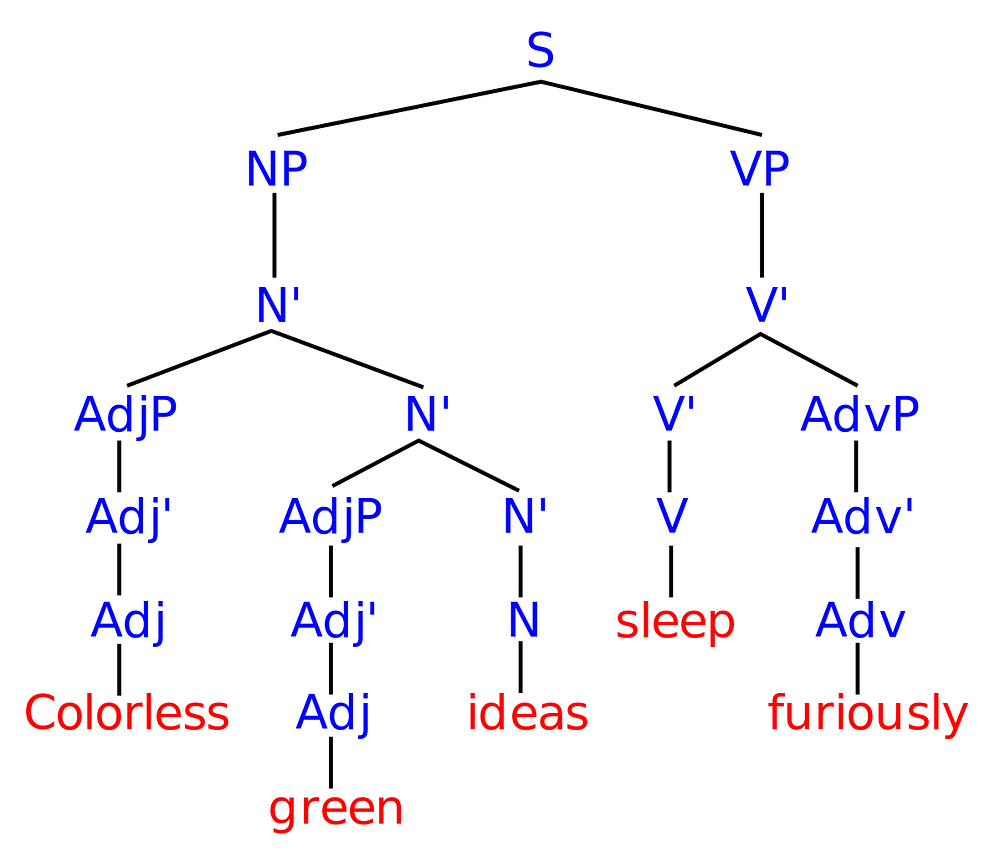
Noam Chomsky’s well-known grammatical sentence, “Colorless green ideas sleep furiously.”

To state what may be obvious: the logical positivists didn’t mean ungrammatical by “meaningless”. Indeed the supposedly meaningless statements they had in mind were perfectly grammatical. Moreover, the perfectly-acceptable grammatical form of these statements was what made them problematic in the first place (at least in part). In addition, it was usually only philosophical (or “metaphysical”) statements which the logical positivists had their eyes on.

So if someone writes (or says) “Cat colours when they are at it bad”, then that’s clearly meaningless. However, the statement “God is perfectly good” is grammatically acceptable. And that (again) is precisely why the logical positivists had a serious problem with it. This means that they believed that many people were (to use Wittgenstein’s words) “misled by the grammar” of such statements.

That said, problems with this logical-positivist position were quickly spotted.

For example, in 1953 the Polish logician Czesław Lejewski wrote the following words about the word “meaningless”:

“One may disagree as to the truth-value of the proposition ‘Pegasus exists’ but one would have to have attained an exceptionally high degree of sophistication to content that the expression was meaningless.”

Lejewski then went on to give an example of this:

“Quine does not think that empty noun-expressions are meaningless just because they do not designate anything. He allows for the use of such words as ‘Pegasus’, ‘Cerberus’, ‘centaur’, etc…”

As can be seen, the words above are actually about W.V.O. Quine’s philosophical position on the the status of “empty noun-expressions” (or non-referring proper names). That said, they’re still perfectly apt for this discussion. Quine himself, however, was never a logical positivist — not even when young. Yet he was indeed influenced by logical positivism and he even attended sessions of the Vienna Circle (see here).

In this specific example, Lejewski (at the very least) disentangled truth from meaning (i.e., without also denying that they’re strongly related to each other).

Put at its most basic: it may seem that the logical positivists — and many others — simply meant false when they used the word “meaningless”. So because they deemed the sentence (say) “God is omnipotent” to be false, then they also deemed it to be meaningless. That is, that statement is meaningless because it is false. But that’s an obvious conflation. In other words, it is false to claim that a false statement must also be meaningless. Indeed even the sentence “The Hobbit is six-miles tall” isn’t meaningless.

It’s not just that the logical positivists — and others — deemed a given statement p to be meaningless because it is false. They also deemed p to be meaningless because their philosophical (or semantic) position — alone — rendered it meaningless. This meant that the statement “God is omnipotent” (or “Pegasus exists”) was only meaningless to someone who’d already adopted a philosophical (or semantic) position that displays (to use Lejewski’s words) “an exceptionally high degree of sophistication”. To put that simply: if a person had no idea whatsoever about the exceptionally-sophisticated philosophical (or semantic) position of the logical positivists, then there was no reason on earth why he should have believed that the statement “Pegasus exists” (or “God exists”) is meaningless. False…perhaps. Meaningless… absolutely not!

In specific reference to Quine’s case (as commented on by Czesław Lejewski).

Empty noun-expressions within a statement don’t render that statement meaningless. They may render it false. However, even that claim is problematic when it comes to statements about fictional characters and situations. As Lejewski himself hints, it’s possible that even statements about fictional characters and situations may be deemed true if they correctly abide by the pre-existing fiction about those characters and situations. (This is another issue entirely!) The relevant point here is that statements about Pegasus (or God) aren’t automatically meaningless simply because there’s never been such a thing as Pegasus (or God) outside of mythology (or religion).

Let’s go back further than the logical positivists of the 1930s. I’ll do so because it can be seen that some of their views (at least in a variant form) had a history dating back to 1918 and probably before that.

Take Bertrand Russell’s position on names.

Russell — in his 1918 paper ‘Existence and Description’ — believed that in order for names to be (genuine) names, then they must name — or refer to — things which exist. Thus Russell’s theory was an attempt to solve that problem by arguing that if a named x doesn’t exist (or have being), then that name of that given x must be a “disguised description”. (In the case of the name “Pegasus”, the description could be “the fictional horse which has such and such characteristics”.)

Now take this remarkable passage from the aforementioned paper:

“The fact that you can discuss the proposition ‘God exists’ is a proof that ‘God’, as used in that proposition, is a description not a name. If ‘God’ were a name, no question as to existence could arise.”

Personally, I don’t have much time for Russell’s argument above. It seems to have the character of a philosophical stipulation — as with the logical positivists’ use of the word “meaningless”! It’s primary purpose is logical and philosophical. At the time Russell was reacting to the “ontological slums” (as Quine later put it) of the Austrian philosopher Alexius Meinong (1853–1920). However, this semantic philosophy (as stated) simply seems like a stipulation (or a normative position) designed to solve various perennial philosophical problems.

As for Quine, he had no problem at all with the naming of non-beings or non-existents (though non-being and non-existence aren’t the same thing). In his 1948 paper, ‘On What There Is’, he dismissed Bertrand Russell’s position. Quine, however, put Russell’s words in the mouth of McX and used the name “Pegasus” rather than the name “God”. Quine wrote:

“He confused the alleged named object Pegasus with the meaning of the word ‘Pegasus’, therefore concluding that Pegasus must be in order that the word have meaning.”

So to sum up: a name — like a statement — can have a “meaning” (or, more accurately, “sense”) without it referring to something which exists (or even something which has being). Quine thus untied meaning from reference; whereas Russell only thought in terms of reference (or, at the least, he tied meaning to reference).

Yes… Logical Positivism’s Self-Referential Self-Destruction

By “empirical truth-conditions” the logical positivists (or at least Carnap) meant that which we experience — or can experience — with our senses.

The problem here is the often-commented-upon one of logical positivism’s self-referential self-destruction (which is a mouthful). The American philosopher Peter van Inwagen, for example, puts the point perfectly. Firstly he expresses the logical positivists’ general position:

“The meaning of a statement consists entirely in the predictions it makes about possible experience.”

And then van Inwagen gleefully notes its self-referential flaws:

“Does this statement make any predictions about possible experiences? Could some observation show that this statement is true?… It would seem not… And, therefore, if the statement is true it is meaningless; or, what is the same thing, if it is meaningful, it is false.”

The problem with van Inwagen’s analysis is that although many logical positivists might have accepted the statement “The meaning of a statement consists entirely in the predictions it makes about possible experience”, what van Inwagen says about this statement may still not be the case. Logical positivist might have taken the statement — indeed some did! — as a second-order (or a meta) statement. Either that or as a principle (normative or otherwise). In other words,

“The meaning of a statement consists entirely in the predictions it makes about possible experience”

is a statement about a statement, not a metaphysical statement. That is, it’s not a statement about the nature of the world: it’s a statement about a statement about the world. Another way of putting that is to say that it’s an epistemological take on a statement about the world.

The failure to make this kind of distinction is summed up by the science journalist John Horgan when he recalled an interview with Karl Popper. Firstly Horgan quotes Popper. He writes:

“[]‘The first thing you do in a philosophy seminar when somebody proposes an idea is to say it doesn’t satisfy its own criteria. It is one of the most idiotic criticisms one can image!’[].”

Then Horgan adds his own take:

“Falsification itself is ‘decidedly unempirical’; it belongs not to science but to philosophy, or ‘metascience’, and it does not apply to all science. Popper was admitting… that his critics were right: falsification is a mere guideline, a rule of thumb, sometimes helpful and sometimes not.”

Having said all that, we can now return to Carnap’s own words and apply what’s just been said to them.

Specifically, what sensory experiences (as it were) belong to the following statement?-

What the metaphysician states is merely an allusion to associated words and feelings, which, however, do not bestow a meaning.

Did the logical positivists experience (with their senses) a metaphysician alluding to “associated words and feelings” when he stated something? The logical positivists might well have experienced the metaphysician’s words if he had verbally expressed— or written — the fact that his own words were associated with various other words and feelings. However, what if the metaphysician didn’t do so? If the metaphysician didn’t do so, then the logical positivists weren’t relying exclusively on their own sensory experiences (or on empirical truth-conditions) to state what they stated. In fact they might not really have had any (empirical) idea that the metaphysician was doing any of the things they were (as it were) accusing him of.

In addition, did the logical positivists experience the “bestow[ing] of meaning” on statements? Does the act (if that’s what it is) of bestowing meaning itself have empirical truth-conditions? Indeed even if the logical positivists were correct when they stated that meaning is tied to empirical truth-conditions, is that tie itself empirical? Did the logical positivists experience that tie with their senses? More pedantically, does the word “meaning” have a referent or an extension?

We can also accept the Frege’s context principle is which a word only has a (semantic) place within a sentence. But even then we can still ask what legitimacy the word “meaning” has from an logical positivist point of view.

To change tack.

Is a word, concept or statement automatically “pseudo” if it “asserts nothing”? This might of course be a circular argument. That is, if a word, concept or statement didn’t abide by the rules of logical positivism, then, by definition, logical positivists will have deemed it to be a pseudo word, concept or statement. But no one was ever required to accept the rules of logical positivism. And even if they were required to do so, wasn’t the word “pseudo” — like “meaningless” — still a little rhetorical?


Saturday, 12 December 2020

Rumsfeld’s Logic of Known Knowns, Known Unknowns and Unknown Unknowns


On February the 12th, 2002, the then Secretary of Defense of the United States, Donald Rumsfeld, stated the following words (as captured in a YouTube video here):

“[A]s we know, there are known knowns; there are things we know we know. We also know there are known unknowns; that is to say we know there are some things we do not know. But there are also unknown unknowns — the ones we don’t know we don’t know.”
At first I wasn’t going to tackle this passage because some people may believe that I have some political sympathy for Donald Rumsfeld and what he said. However, since this passage was spoken some 18 years ago, and was spoken by someone who no longer has a prominent position in politics, I can’t see why that should be the case. Besides which, I shan't refer to the political context of Rumsfeld’s words at all (although I will offer a little background). Indeed I shall take his words as a short piece of logic and epistemology.
So it may seem odd — or perverse — too see these words as Rumsfeld’s attempt at logic and epistemology!… Actually, I don’t see it that way — at least not entirely.
In terms of at least a little context. Rumsfeld’s words were a response to a question about the lack of evidence linking Saddam Hussein’s regime in Iraq to the supply of “weapons of mass destruction” to various terrorist groups.
The passage above is almost always taken to be gobbledegook and/or political dissimulation. They were even awarded the Foot in Mouth Award. (Read the BBC on this here.) Indeed I’ve vague recollections of interpreting his words as political dissimulation and prevarication the first time I heard them.
Rumsfeld himself said that “the logic” of his words might have seemed “obscure” and “enigmatic”. Rumsfeld also mentioned Socrates:
“Some with an interest in philosophy have made note of a line attributed to Socrates: ‘I neither know nor think that I know.’ This has been interpreted to mean that the beginning of wisdom is the realization of how little one truly knows.”
Interestingly enough, even the Slovenian philosopher Slavoj Žižek couldn’t resist making exclusively political sense of Rumsfeld’s words. I mean that in the sense that Žižek didn’t really say anything about the purely logical force of the passage. (See Žižek’s article — from 2004 — here.) Of course there was no reason to take Rumsfeld’s words as being purely — and innocently — logical! That’s obviously the case. Then again, Žižek himself did — kinda — recognise the logic of Rumsfeld’s statements. That said, Žižek simply connected Rumsfeld’s logic to political deceit and hypocrisy. More specifically, Žižek happily accepted that there were “unknown unknowns” when it came to Saddam Hussein’s regime. However, although Žižek accepted Rumsfeld’s unknown unknowns, he also stressed the known knowns. (Žižek had the torture at Abu Ghraib in mind here.)
Having put Žižek’s negative response, there were also positive responses from some people. And, by that, I don’t mean positive responses which were purely motivated by politics. (They were political too.) For example, Mark Steyn called Rumsfeld’s words “a brilliant distillation of quite a complex matter”. In addition, Australian economist John Quiggin stated that “[a]lthough the language may be tortured, the basic point is both valid and important”..
I would simply say that the logic and epistemology underlying Rumsfeld’s words couldn’t help but be “tortured” — as my own commentary will show!
In any case, Rumsfeld’s words weren’t entirely original anyway. For example, the phrases “known unknowns” and “unknown unknowns” had already been used in strategic planning and project management. It can also be seen that they date back to 1997 (see here). (The phrase “known unknowns” has been used to refer to “risks you are aware of, such as cancelled flights”.) Rumsfeld himself wrote:
“I first heard a variant of the phrase ‘known unknowns’ in a discussion with former NASA administrator William R. Graham, when we served together on the Ballistic Missile Threat Commission in the late 1990s.”
Indeed my bet is that these phrases can probably be found many times before the 1990s. And, as I’ll attempt to show, they’ve also been featured many times in logic and philosophy — even if not in the precise way in which Rumsfeld expressed them!
But what of Rumsfeld’s peculiar way of expressing them?
The main reason that Rumsfeld’s words were seen as gobbledegook (rather than as pure political dissimulation) was the repeated use of the word “know” and its derivatives. That is, we have such phrases as “know knowns”, “know we know”, “known unknowns” and “unknown unknowns”. However, this is very similar to such well-known phrases as “love to love”, “the death of death”, “the end of the end”, “truer than true”, “bigger than big”, “life in life”, etc.
Again, at first glance, Rumsfeld’s words seem to either be gobbledegook or political dissimulation — or both! Yet they also make logical sense. This means that his words may be logical and an expression of (context-based) political dissimulation at one and the same time! Added to that is the fact that Rumsfeld’s words are… well, somewhat poetic. Indeed they’re almost like a Zen koan.
*******************************
So let’s simplify Donald Rumsfeld’s words:
As we know, 1) There are known knowns. There are things we know we know. 2) We also know there are some things we do not know. 3) But there are also unknown unknowns - The ones we don’t know we don’t know.
And all the above can be pared down further in this way:
(1) known knowns (2) known unknowns (3) unknown unknowns
Now let’s take one statement at a time:

(1) Known Knowns


Rumsfeld said that “[k]nown knowns are facts, rules, and laws that we know with certainty”. For example, “[w]e know [that] gravity is what makes an object fall to the ground”.

(1) is actually fairly problematic. It immediately hints at a possible infinite regress which has be found many times in various parts of philosophy.

Let me explain.

If we know p, and also know that we know p, then do we also need to know that we know that we know p? (This is very Rumsfeldian in tone.) And so on. What’s more, if we can stop at knowing that we know p (i.e., we don’t need to concern ourselves with knowing that we know that we know p), then perhaps we can also cut this regress short by simply settling for knowing p. Again, why do we also need to know that we know p?

At a more basic level, we can provisionally accept that there are “known knowns”. Generally, people accept that we know that we know that, say, the sun is the center of the solar system. But, again, what does knowing that we know p add to simply knowing p? What is it, exactly, to know that we know any given p?

In addition, if there can be “known knowns”, then what sense can we make of subject S not knowing that he knows p? That is, can S know p without also knowing that he knows p? If S can know p without also knowing that he knows p, then the opening clause “knowing that” (in “knowing that I know p”) may be redundant. In other words, why not stick with “S knows p”?

This is somewhat like an epistemic version of the redundancy theory of truth.

Take this compound sentence:

The sentence “Snow is white” is true.

Some philosophers have argued that the clause “is true” is “redundant”. (It may still have pragmatic force.) Similarly, in the sentence

“I know that I know that snow is white.”

the clause “I know that” may also be redundant. (Perhaps that too only has pragmatic force.)


Something similar to this epistemic regress is found in logic.

Take Lewis Carrol’s premises paradox.

In this paradox the sceptic demands a justification of the premises which lead to a specific conclusion (i.e., in a logical argument). More tellingly, the sceptic also requires a justification of the inferential links between the premises themselves, not just a justification of the premises.

Yet if such justifications were given of the premises, then these justifications would also need justifications too. Indeed this would also apply to the justifications of the links between the premises and between all the premises and the conclusion. And then those justifications would themselves require their own higher-order justifications.

The solution to this (as with simply accepting the statement “S knows that p”) is simply to argue that the way the premises lead to a conclusion simply doesn’t need a justification. All justifications are contained within the terms and statements used in the argument; as well as in the “logical rules” implicitly used. In other words, the logical argument must stand on its own if we’re to avoid an infinite regress.


(2) Known Unknowns


Rumsfeld stated that “[k]nown unknowns are gaps in our knowledge, but they are gaps that we know exist”. He continued:

“If we ask the right questions we can potentially fill this gap in our knowledge, eventually making it a known known.”

This makes sense at the same time as being problematic.

For example, we know that there are aspects of distant galaxies that we don’t know anything about. More mundanely, we know that we don’t know how many grains of sand there are on Earth. (Surely there must be an exact number.) We also know that we don’t know how many times King Henry VIII farted in his entire lifetime. (He must have farted a given number of times in his lifetime.)

However, there’s something odd about knowing that we don’t know any given x. In order to know that we don’t know about any given x, we must at least know something about that x in order to so much as mention it. We don’t know, then, the exact number of grains of sands on the Earth (or how many times King Henry VIII farted in his lifetime); but we do know that there must be a specific number.

This means that talking about “unknowns” is fine. However, also talking about “known unknowns” is problematic.

On a different tack.

The British philosopher Colin McGinn strongly claims that we will never know certain “deep truths” about consciousness (see here). But how does he know that? How does McGinn know that we will never know these deep truth about consciousness? Surely, in order to know that we don’t know anything about any given x, then that implies that we must at least know something about that given x. Of course it’s true that knowing something about x isn’t the same as knowing everything about x. However, we still know something about x. And if we know something about x, then how can we rule out our knowing everything — or at least much more — about x? So, in McGinn’s case, there are indeed (to go back to Rumsfeld’s words) “some things we do not know” about consciousness. However, can we also conclude that we will never know the deep truths about consciousness?


(3) Unknown Unknowns


Rumsfeld says that the “category of unknown unknowns is the most difficult to grasp”. Moreover, “[t]hey are gaps in our knowledge, but gaps that we don’t know exist”. He continued:

“There are many things of which we are completely unaware — in fact, there are things of which we are so unaware, we don’t even know we are unaware of them.”

Surely it’s a little problematic to say that there is a “gap[] in our knowledge” if, ostensibly, we don’t know anything about that gap or even anything about the subject of that gap. Technically, a human subject can neither know nor not know something about that which he doesn’t know about. More prosaically, a subject can’t have a position on some subject he’s never even heard of. Perhaps such an epistemic situation can’t even be described as being a lack of knowledge in that there are infinite things which any given subject will not — and cannot — know about. So, again, this is hardly an epistemological deficit.

(3) above is also Rumsfeld’s cute distinction between our not knowing about (to use my earlier examples) the supposed deep truths of consciousness, how many grains of sand there are on Earth, and how many times King Henry VIII farted in his lifetime, and our not knowing about things we don’t even know we don’t know about. (Here again things are getting very Rumsfeldian.) In Rumsfeld’s own words, these are “things of which we are so unaware, we don’t even know we are unaware of them”.

In these cases of unknown unknowns, it’s simply impossible to give any examples. No examples can be given of things we know we don’t know about. That’s because if any examples were given, then that would betray the fact that we — at the least — know something about the things we don’t know everything about. However, in Rumsfeld’s case, we’re supposed to be talking about “unknown unknowns”. That is, things “we don’t know we don’t know”.

So can’t we ask how we know that there are some things “we do not know”? To know that there are unknowns in any given area (or even unknown generally) hints at the fact that we are at the least (metaphorically) on the periphery of those unknowns. In other words, what are these unknown things we’re referring to?

So is this situation a little like Plato’s beard?

In the Plato’s beard analogy (as expressed by W.V.O Quine), the argument (at its most basic) is that the very mention of some x which is supposed not to exist confers some kind of “being” on it. Thus Pegasus, nothing and even the round square must have some kind of being. Why? Because we refer to these… things.

So if we use Plato’s beard and reapply it (if in a loose way) to this logical and epistemological case, then the very mention of unknown unknowns hints that we at least know that these things are unknown — therefore we know at least one thing about them. (Socrates knew at least one thing — that he “knew nothing”.)

To sum up.

It’s not that we need to know the things we don’t know because then we’d know them. However, do we know that (to get back to Rumsfeld’s words) “there are some things we do not know”? It is very likely that we don’t know many things. However, do we also know that we don’t know many things? How could we know that? To repeat: it’s highly probable that we don’t know many things. However, can we also know that we don’t know many things?