Philosophers such as Philip Goff believe that physicists leave something important out when they define and explain mass.
“I’ll never forget the end of one of those lectures, in which the professor said, ‘We evaluate electricity not by knowing what it is, but by scrutinizing what it does.’ This was a great statement. It really expresses the whole philosophy of modern physics, not only for electricity but also for all phenomena that aren’t directly tangible.”
— Stan Gibilisco (source here).
The philosophers who stress the idea that physics doesn’t tell us anything about what they call intrinsic properties often cite the case of mass.
Such philosophers argue that mass is defined, explained, and measured exclusively in terms of objects (with mass) and how they’re affected by forces, other objects, acceleration, etc.
Yet physicists do believe that mass is an intrinsic property of objects.
(Definition: “An intrinsic property is a property that an object has of itself.” And from the same definition: “Mass is an intrinsic property of any physical object.”)

The following is the English philosopher Philip Goff (who’ll be featured later) writing about mass:
“What is mass? We know what mass is when we know what it does. What is spacetime curvature? We understand what spacetime curvature is only when we know what it does, which involves understanding how it affects objects with mass. But we understand this only when we know what mass is. And so we find ourselves in a classic Catch 22.”
The argument is that in most — or even all — accounts of mass (i.e., in physics) we aren’t told what mass actually is.
Now take this definition from a physicist:
“Mass is both a property of a physical body and a measure of its resistance to acceleration (rate of change of velocity with respect to time) when a net force is applied. An object’s mass also determines the strength of its gravitational attraction to other bodies.”
And here’s an even simpler definition:
“The term mass, as used by physicists, refers to a quantity of matter in terms of its ability to resist motion when acted on by a force.”
In the above, we’re told about the mass of a body and its “resistance to acceleration” (prima facie, an extrinsic property). Yet we’re also told that “mass is [] a property of a physical body”.
So does that property of mass actually equal the resistance to acceleration? (The equality sign = states that mass is literally equal — or identical — to the resistance to acceleration.) Alternatively, is there a property of mass, and only then does that property — in this instance at least — resist acceleration?
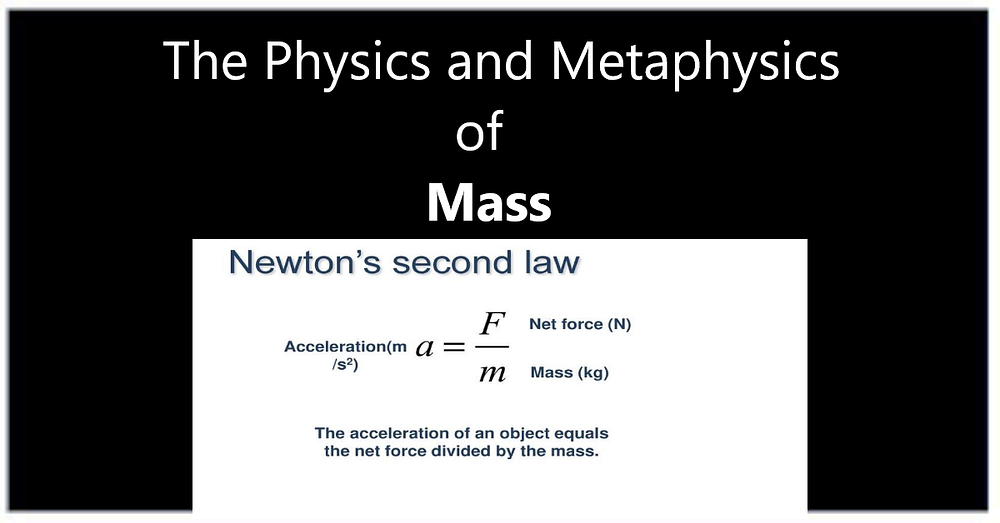
All this is expressed in one form of Newton’s Second Law, in which the value to be found is that of acceleration (i.e., not force or mass):
a = F/m
Translation:
acceleration a (in meters per second) = force of magnitude F (in newtons) divided by mass m (in kilograms)
In that sense, then, mass is like the everyday notion of weight (to which mass can be connected, but isn’t identical to) in that weight isn’t a thing — it’s what things (as it were) have. And things have mass too.
To repeat: in various definitions in physics we’re told that mass is a “property of a physical body”. So this means that we aren’t only being told what mass does. It’s being said that mass (as it were) belongs to physical bodies: it’s a property of physical bodies.
Now take Philip Goff again.
Goff has been selected here because he believes that mass isn’t an intrinsic property. Yet he too happily states that mass is a
“measure of its resistance to acceleration (rate of change of velocity with respect to time) when a net force is applied”.
And, elsewhere, Goff goes on to tell us that
“mass also determines the strength of its gravitational attraction to other bodies”.
Thus, in simple terms, mass is defined in terms of force, acceleration and “other bodies”. And force is surely separate from an object’s mass. So too, more obviously, are other bodies. And acceleration is what happens to bodies with mass.
So, according to Goff’s philosophical story, mass isn’t an intrinsic property at all.
Perhaps, then, mass is purely a measurement of matter and also a case of objects and their relations to other bodies and to forces.
In that case, here’s a physicist being explicit about the relation between mass and measurement:
“Mass is a measurement of an object’s tendency to resist changing its state of motion, known as inertia [].”
Yet here’s another physicist who says that mass is indeed an intrinsic property:
“Mass is an intrinsic property of matter and is measured in kilograms.”
Of course, a particular mass could be both a measurement and an intrinsic property… Or could it?
In any case, much of this issue is almost entirely dependent on precisely what an intrinsic property is taken to be in the first place!
Mass and Quantities of Matter
It will be noted that in many of the definitions of mass the words “quantity of matter” can be found. (For example: “Mass refers to a quality of matter in terms of its ability to resist motion when acted on by a force.”) So although mass is defined, explained, and/or measured in terms of outside forces — what is acted upon is actually matter. That is, matter has mass. And matter — in very simple terms — is made up of fermions. So, it can now be said, even though forces, other objects, and acceleration can’t be intrinsic to an object’s mass, it’s still the case that the object is made up of matter (fermions) and therefore it has mass.
Indeed the mass of a given object O also has magnitude — basically, size and extent.
All this works both ways.
That is, just as the mass of an object can be (or is) defined, explained, and measured (at least partly) in terms of force; so the force can be defined, explained, and measured by the effect it has on objects with mass.
Thus we now have another formulation of Newton’s Second Law, in which the value to be found is that of force (i.e., not mass or acceleration):
F = ma
Translation:
force of magnitude F (in newtons) = mass m times its acceleration a
This is all very (as philosophers put it) relational. That said, there’s still an object made up of matter (i.e., fermions).
Now take a more concrete example of all this.
When you’re travelling in a car and then you accelerate, your body is pressed backwards into the seat. Indeed your body is also pressed downward toward the Earth.
That description of your car journey seems to be largely — or even entirely — about force. And force is something extrinsic to the object — in this case, you driving a car.
Thus being pressed backwards and downward is down to a force — i.e., gravity. Yet it’s still an object with mass — you! — that’s being pushed, shoved, and pulled. This means that it’s not all about forces, other objects, acceleration, etc. Indeed the force, in this instance at least, is itself caused in part by your mass and in part by gravity and acceleration.
This means that it’s not as if the philosophers’ intrinsic properties are being factored out of this equation of a human being driving a car. And this is also true of an individual particle.
Of course, the object with mass — you or a particle — can itself be defined and/or measured entirely in terms of relations, forces, other objects, etc!…
But can this game go on indefinitely?
Take the following very simplified breakdown of the aforementioned body with mass — a human body:
(1) The human body is made up of body parts and organs
(2) Body parts and organs are made up of cells.
(3) Cell are made up of molecules.
(4) Molecules are made up of atoms.
(5) Atoms are (as it were) “made up of” fermions.
(6) Fermions include protons, neutrons and electrons. And protons and neutrons are made up of quarks.
(7) Quarks and electrons are not believed to be made up of anything.
That long list above can be simplified even more as follows:
(1) All matter is made up of fermions.
(2) Fermions are made up of quarks; except in the case of electrons.
Perhaps quarks and electrons (or matter itself) aren’t fundamental either!
So if quarks and electrons aren’t fundamental, then what is?
The American theoretical physicist Lee Smolin (1955 — ) gives an answer which is expressed in clear terms:
“If fields are not made from matter, perhaps fields are the fundamental stuff. Matter must then be made from fields.”
Smolin also sees “the geometry of space as another field”. Not only that: we also have a symmetry here in that “the geometry of space is almost the same as the gravitational field”. Finally, if we take a look at the whole picture, then Smolin finishes off by saying that “[w]e have a bunch of fields all interacting with one another, all dynamical, all influencing one another”.
Note Smolin’s words “interacting” and “all influencing one another”.
The problem (if it is a problem!) here is that this may be just more physics in that it may simply evade the (philosophical) issue of intrinsic properties. In addition, everything philosophers (such as Goff) have said about mass (or objects with mass) can now be said about fields. That is, they too are doings, effects, interactions, etc. which can be relationally described.
Indeed even the quantum (i.e., the minimum amount of any physical entity or physical property) is defined relationally or in terms of doings and interactions.
Philip Goff was mentioned a few moments ago. So now let’s tackle his philosophical position on mass in some detail.
Part Two: Philip Goff on Mass

Philip Goff claims that we don’t know what mass (along with spacetime, gravity, etc.) is. Indeed Goff’s overall position is one which I can only presume many laypersons will find bizarre — or, perhaps, simply puzzling.
Goff’s central position is that the properties of physics are described in terms of both what they do and in terms of their relations — not in terms of what they actually are.
But, as we’ve seen, is that true?
Goff’s argument is that surely something (or some things) must be responsible for the doings. In other words, you don’t usually have a verb without an object.
To take just one relevant example.
If mass curves spacetime, then what is it that curves spacetime? Alternatively, if spacetime (to use John Wheeler’s words) “tells objects how to move”, then what is it that’s telling objects (with mass) how to move?…..
Relationalism and Causal Structuralism
Isn’t it the case that even if mass can be defined (or characterised) and measured in terms that don’t include what it does, then that characterisation would still include things outside of mass itself?
Indeed it’s hard to even imagine how this could be any other way.
In other words, how can the (to use Goff’s words) “nature of a given thing” ever be “understood in isolation from all other things”? Or, perhaps less strongly, how can the nature of a given thing ever be understood without bringing on board at least some other things? (Even if not Goff’s “everything else”.)
What would such an (as it were) atomic understanding (or account) of mass — or anything else — even look like? What’s more, this question makes even more sense if we think of classical examples such as cups, trees… and people — how could we give an account of a cup, tree, or a person in isolation from all other things?
More relevantly, it’s difficult to even comprehend giving an account of mass in isolation from all other things.
So perhaps Goff could — perhaps he does — embrace some kind of (philosophical) relationalism. Moreover, he could do so without also feeling the need to posit intrinsic properties — let alone consciousness as the ultimate intrinsic property.
More specifically, Goff takes up a position against what he calls causal structuralism…
More accurately, Goff doesn’t exactly reject causal structuralism. It’s more a case that he believes that it leaves something out — just as he believes that physics itself leaves something out!
The following is Goff’s own take (partly quoted earlier) on the causal structuralist position on mass:
“What is mass? For a causal structuralist, we know what mass is when we know what it does, i.e., when we know the way in which it curves spacetime. But to really understand what this really amounts to, as opposed to merely being able to make accurate predictions, we need to know what spacetime curvature is. What is spacetime curvature? For a causal structuralist, we understand what spacetime curvature is only when we know what it does, which involves understanding how it affects objects with mass. But we understand this only when we know what mass is. We find ourselves in a classic catch-22: we can understand the nature of mass only when we know what spacetime curvature is, but we can understand the nature of spacetime curvature only when we know what mass is.”
To state the (almost) obvious.
If we’re (only) doing physics, then — almost by definition — any account of mass is going to bring in spacetime (among other things from the lexicon of physics); and any account of spacetime is going to bring in mass…
So it’s hard to know what other option a physicist would (or could) have.
But Goff is not alone — at least not when it comes to his position on mass.
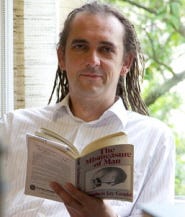
Take Goff’s fellow English philosopher James Ladyman.
Ladyman basically agrees with Goff on how physics defines, explains, and measures mass. The big difference is that Goff believes that an intrinsic nature (in his case, consciousness) underpins mass and everything else in physics — yet Ladyman doesn’t believe that!
On Ladyman’s picture, subatomic particles and their mass are almost entirely defined in terms of their “relational” properties: such as their interactions with fields, forces, or with other particles. (See my ‘Carlo Rovelli’s Relational Quantum Mechanics’.) So the mass of a particle can’t be defined as an intrinsic property because it’s determined by its place within a quantum system (or systems). More technically, a particle’s mass is determined by its relation to fields, forces, and to other particles.
The following is James Ladyman himself on this subject. He writes:
“[A] particle that never interacts with anything else could [never] have any value whatever for its mass.”
Nonetheless,
“since real particles will always interact with something or other [we can] ignore this”.
It can also be said that mass is “defined operationally” in that “the ratio of the masses of two particles is a constant of proportionality”.
Interestingly enough, Ladyman takes a particle’s lack of a non-relational essence to have the consequence that it can’t be what philosophers call an individual. (In broad terms, an individual is any given x which is deemed to be — to a large degree at least — self-sufficient, determinate, and circumscribed.)
If we return to Goff.
Goff is of course asking philosophical questions. And that must mean that the physicist — again, almost by definition — won’t be able to answer his philosophical questions (at least not qua physicist).
Think about this.
Goff is demanding an account of mass that doesn’t mention spacetime, gravity, other objects, or any other property specified by physics. Similarly, Goff is demanding an account of spacetime that doesn’t mention mass, gravity, or any other property specified by physics.
In other words, Goff is demanding that physics stop being physics…
Now to be fair to Goff (or to backtrack a little): he may not be expecting physics to stop being physics. Instead, he may simply be making the point that physics alone can’t (as it were) join the dots. That is, physics is good at what it does. However, it doesn’t provide us with a complete picture of what reality is. Philosophy, then, must do that job.
(One would hope that Goff also believes that philosophy must do that job — at least partly — on the solid grounding that physics has already provided.)
Goff himself says as much in a few places.
For example, straight after the just-quoted words above, Goff writes:
“I agree that mass can be uniquely identified — as it were, homed in on — in terms of its place in the abstract pattern of causal relationships realized by the entire network of physical properties.”
In other words, Goff fully accepts that mass is “uniquely identified” in terms of an “abstract pattern of causal relationships realized by the entire network of physical properties”. Yet all that alone doesn’t provide us with a complete picture of reality.
And elsewhere Goff (alluding to a well-known passage from the physicist Stephen Hawking) writes:
“The equations of physics allow us to predict the behaviour of matter with great precision. But is is the intrinsic nature of matter that breathes fire into those equations. And on this topic physics has nothing to say.”
Again, Goff believes that physics is great… though only within (its own) limits. (It can be said that some physicists have happily accepted such limits.) In this case, physics is great for “predict[ing] the behaviour of matter” and it does so “with great precision”. The problem is — or so Goff believes — that it leaves out what he calls intrinsic nature — and it’s intrinsic nature which “breathes fire into the equations”!
But we should slow down here!
All along Goff is simply assuming (though, admittedly, he has provided arguments for his assumption) that there is such a… thing… as intrinsic nature.
Now it’s worth stating here that the term “intrinsic nature” is almost exclusively an invention of philosophers.
Part Three: What is Intrinsic Nature?
Very few physicists will use the term “intrinsic property” or “intrinsic nature” (at least as it’s used by Goff). Of course, that fact alone isn’t a good reason to dismiss either the usage of the term “intrinsic nature” or even the existence(?) of intrinsic properties. And that’s primarily because Goff and various other philosophers have provided arguments as to why there must be intrinsic properties and therefore intrinsic nature.
So it may well be the case that physics doesn’t provide a complete picture of reality or Nature.
Yet it doesn’t help here that we’re talking about what are called “properties”. That’s because it’s not clear how that word is meant to be read or interpreted.
In other words, all this will depend on what intrinsic properties are supposed to be. And it may be the case that whatever such philosophers take these properties to be, they can never be described by physics. Indeed that may be (rhetorically put) the whole point of such properties.
More importantly, Goff himself doesn’t simply stress the fact that physics only concerns itself with doings and relations. He also tells us what’s missing from this picture: intrinsic nature. Indeed Goff goes one step beyond that by telling us exactly what intrinsic nature is! He does so in the following passage:
“What then is the intrinsic nature of matter? Panpsychism offers an answer: consciousness. Physics describes matter ‘from the outside’, that is to say, physics gives us rich information about the behaviour brought about by mass, spin, charge, etc. But there must be more to what something is than what it does; and according to panpsychism, mass, spin, charge, etc, are, in their intrinsic nature, forms of consciousness.”
As it is, panpsychism isn’t going to be discussed in this piece. That’s primarily because there are different properties that are taken to be intrinsic by other philosophers. It’s also because panpsychism is far too outré for this discussion. Or, more clearly, the claim that “mass, spin, charge, etc, are, in their intrinsic nature, forms of consciousness” is too outré for this piece. (I have tackled panpsychism elsewhere. See, for example, my essay ‘Philip Goff’s Panpsychism vs. Sam Coleman’s Russellian Monism?’.)

It may be the case that Goff’s position on intrinsic nature is inspired by the work of the American philosopher David Lewis (1941–2001).
Firstly, let’s take Lewis’s own definition of intrinsic properties:
“A thing has its intrinsic properties in virtue of the way that thing itself, and nothing else, is.”
Lewis’s wording above is almost identical to some of the passages from Goff which have been quoted earlier and which can be found elsewhere.
So could there ever be such a state as “the way that a thing itself is” regardless of everything else? That is, regardless of a thing’s relations to other properties/objects/events/etc., its place in time and space… and so on?
Lewis’s position can be taken to its most extreme (or perhaps ridiculous) in the following statement:
Object (or thing) O would still have intrinsic property P if after the entire world around it disappeared, O would still have P.
Perhaps there’s a midway position in which it can be argued that there are indeed intrinsic properties; though they still have vital (or even essential) relations to extrinsic properties. That is, extrinsic proprieties may determine — to some extent at least — intrinsic properties. That said, it may be countered that because objects are such-and-such-a-way, then they can only be affected (or determined) in particular ways precisely because they have the intrinsic properties which they do have. That may mean that there may be some kind of mutual relation between intrinsic and extrinsic properties.
Yet there still may be no “way” an object is regardless of its relations to other things — or to extrinsic properties.
To be clear on one distinction.
Some metaphysicians highlight the difference which can be made between the following:
(1) Properties which objects have independently of any external factors acting upon them (i.e., intrinsic properties).
(2) Properties which are deemed to be the way they are regardless of what’s external to them (i.e., essential properties).
If the distinctions above are applied to Goff’s own example, then the intrinsic nature of mass would be what it is independently of any external factors acting upon it. Similarly, an object (or its intrinsic property) will be what it is regardless of what’s external to it.
Yet don’t all these arcane distinctions and subtleties (in the ontology) seem crazy when applied to the fundamental properties of physics?
In any case, whatever philosophers take intrinsic properties to be, those properties will be beyond physics — as already stated. So, again, one could almost (rhetorically) say that they are designed to be beyond physics. In other words, Goff’s intrinsic properties are designed to be (quite literally) metaphysical.