
Wednesday, 27 December 2023

Consciousness & Qualia: Who Cares About “How They Seem To Us”?


(i) Introduction
(ii) Against Phenomenology?
(iii) Owen Flanagan on Phenomenology
(iv) Daniel Dennett’s Heterophenomenology
(v) Dennett on Qualia (Via Flanagan)
(vi) Flanagan on Dennett’s Position
(vii) Conclusion: Physicalism, Anti-Physicalism or Something Else?

The English philosopher Philip Goff has used the words “consciousness is a datum in its own right” a few times in his writings and interviews. Other philosophers have expressed exactly the same idea (if in different words).

The Latin word datum can be translated as “(thing) given” and “to give”. Thus, a datum has been deemed to be something that is (as it were) theory-free (i.e., something that’s given before it’s theorised about). Of course, this isn’t to say that all (or even most) scientists and philosophers take the word “datum” in that limited and etymologically-strict way. That said, some scientists and philosophers certainly have taken this word to mean that-which-is-given.

Is this the case with Philip Goff?

Now how does Goff’s own datum that is consciousness stand within the context of all the books and papers which he and others have read on the subject of consciousness? What’s more, can any distinction at all be made between such a datum and all the things each philosopher and layperson has read about it?

In other words, if readers have read lots of (or just some) books on consciousness (or, alternatively, come across the word “qualia” many times), then surely that will impact on how they describe and/or theorise about any ostensibly (to use Goff’s words again) “private seemings” they may have.

Now take specifically those who stress how things seem to them.

Don’t they (or a least some of them) additionally take these seemings to be the basis for what they also take to be qualia? Relevantly, most of these people would deem it ridiculous to say that technical terms, definitions, theories, books on consciousness, etc. have anything to do with qualia or how things seem to them

However, these things most certainly do have a lot to do with the matter of consciousness — and even a lot to do with subjects’ phenomenological descriptions of their subjective states and qualia.

So it’s not really private seemings which are the problem: it’s what people say about them. More relevantly, it’s how people philosophise and theorise about them. Indeed, it’s also about how reading books about consciousness (or coming across the word “qualia” all the time) may influence what they say about consciousness.

More strongly, perhaps when a layperson first uses the word “qualia”, then that’s precisely the moment he/she stops being a layperson. (Of course, such a person doesn’t also need to be an expert, or to have read lots of academic papers on qualia.) Indeed, the philosopher Patricia Churchland once said that the word “‘qualia’ is a term of art, which was introduced by philosophers”.

So it’s relevant to bring up the historical phenomenologists here.

According to the German philosopher Rüdiger Safranski, the “great ambition” of Edmund Husserl and “his followers” was to

“disregard anything that had until then been thought or said about consciousness or the world [while] on the lookout for a new way of letting the things [they investigated] approach them, without covering them up with what they already knew”.

As already argued, most laypersons don’t believe they’re covering anything up when they discuss their subjective states — or at least when they discuss their qualia. (They believe that qualia are theory-free.) Husserlian phenomenologists, on the other hand, realised that consciousness came with baggage, and that was precisely why they wanted to get beyond that baggage.

So an important (or at least relevant) question here is the following:

Could we see our own subjective states, or even our own qualia, in any other way?

The Canadian philosopher Paul Churchland (to take just one example) believes that we could.

Churchland goes into detail in the following passage:

“Given a deep and practiced familiarity with the developing idioms of cognitive neurobiology, we might learn to discriminate by introspection the coding vectors in our internal axonal pathways, the activation patterns across salient neural populations, and myriad other things besides.”

Of course, at present it would be virtually impossible (even in the case of all neuroscientists working collectively together) to describe our (to use Churchland’s own words) “first-person” thoughts, feelings and beliefs in terms of “coding vectors in our internal axonal pathways”, “activation patters across salient neural populations”, etc. Indeed, it may be hard to even imagine such a state of affairs at present.

However, Churchland wasn’t talking about the case as it is today. He explicitly stated that

“it is entirely possible for a person or culture to learn and use some other framework in that role”.

Clearly, this is a statement about the future. In other words, this isn’t about an elite group of neuroscientists imposing a new language on the populace today — or even slowly over the years.

On the other hand, if the “language” of folk psychology has been with us since human language itself began (or perhaps even before), then perhaps Churchland’s wishes for the future may be a little utopian. (Or, depending on one’s views, dystopian.) After all, there’s surely a difference between people or cultures picking up new words or terms (which happens all the time), and people picking up a new language to talk about their subjective states. However, surely critics can’t argue that this is something that won’t — or can’t — happen in the future.

Incidentally, Churchland isn’t an eliminativist about qualia. [See his ‘Knowing Qualia : A Reply to Jackson’.] Although Churchland wants to eliminate (which isn’t a very helpful word) propositional attitudes (see here), he doesn’t actually want to eliminate qualia. Instead (as already stated), Churchland simply wants to re-envision what qualia (as well as other mental states) are, and how we should theorise (or philosophise) about them.

Against Phenomenology?
The position advanced in this essay is at least partially in agreement with one that the American philosopher Owen Flanagan advanced in the following passage:

“One might nonetheless think [i.e., after reading the arguments in favour of phenomenology] that phenomenology does more harm than good when it comes to developing a proper theory of consciousness, since it fosters certain illusions about the nature of consciousness.”

Indeed, Flanagan also told us that

[s]ome philosophers think that phenomenology is fundamentally irrelevant”.

Flanagan then told us why that’s the case:

“Firstly, there is no necessary connection between how things seem and how they are. Second, we are often mistaken in our self-reporting, including in our reporting about how things seem.”

It’s a fact that things seem a certain way (in terms of mental states) to certain human subjects at certain times — or even to all subjects at all times!

Not many philosophers or scientists would deny that.

However, isn’t there often a conflation (or confusion) here between seeming and what actually is the case? (Sure, this is an epistemological minefield, which has been frequently discussed.)

For a start, even a hardcore phenomenologist (or “qualiaphile”) can’t treat all subjective accounts as gospel because such accounts often contradict each other. However, things still seem a certain way even if those seemings are given contradictory descriptions or accounts. In other words, in all these cases, there was still a way that things seemed.

But who’s denying that?

What’s more, what work does this acknowledgement of seemings do for the science and ontology of consciousness?

Again, there is indeed a “how things seem”. However, how should we theorise/philosophise about how things seem? How should we scientifically scrutinise such seemings? Clearly, we can’t believe that if things seem a particular way, then they must be that particular way.

This is a lesson many students of philosophy learned in their first philosophy class.

It detail.

To subject S, the cricket bat in the water seems to be bent. Yet that doesn’t mean that the cricket bat is bent — it’s refracted. Similarly, subject S hallucinating a red goblin is “private to the person” who has that hallucination. However, we wouldn’t conclude that the red goblin actually exists.

Yet aren’t many people doing something similar to that when it comes to their own seemings? Or does all this mean that we can’t make mistakes about private conscious (or mental) states? Yes we can. Indeed, there’s a large literature on this very subject which tells us that we often do. [See here.]

So why should the case be in different when it comes to phenomenology or the reports of our own subjective states?

It is because they’re “purely internal”?

Does that really make a difference?

Well, there may well be a difference between looking at a stick in the water and reporting on one’s own mental state. However, do many people assume that no mistakes can be made about the latter, but they can be made about the former?

Isn’t this an implicit adoption of the idea of Cartesian infallibility about subjects’ mental states?

To return to the opening theme:

How do Philip Goff’s words “consciousness is a datum in its own right” fit into all this?

In other words, how does the datum of consciousness fit into the phenomenological descriptions (or simply the “verbal reports”) of such a thing?

Take the arguments of Owen Flanagan again.

Owen Flanagan on Phenomenology
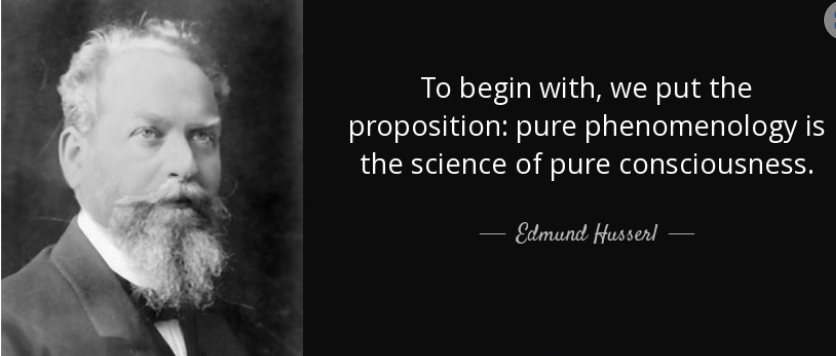
Strictly speaking, Owen Flanagan’s use of the word “phenomenology” doesn’t square too well with many other accounts of phenomenology (i.e., as mainly found in — to generalise - continental philosophy).

Flanagan’s usage, instead, is more in tune with the etymology of the word, as in this account:

“The term phenomenology derives from the Greek φαινόμενον, phainómenon (‘that which appears’) and λόγος, lógos (‘study’).”

The relevant words in the above are “that which appears”. Indeed, the phenomenologist Edmund Husserl once used the (Cartesian) words “given in direct ‘self-evidence’” when he referred to what he was doing

Flanagan’s usage, on the other hand, doesn’t strictly abide by the following definition:

“Phenomenology is the philosophical study of objectivity and reality (more generally) as subjectively lived and experienced.”

In simple terms. Flanagan’s use of the word “phenomenology” seems to factor out (or simply ignore) “objectivity and reality”. More correctly, Flanagan believes that the qualiaphiles and anti-physicalists he’s arguing against do so.

So although Flanagan (as it were) accepts phenomenology, he’s also a naturalist whose writings are full of scientific detail and case studies. This means that he’s certainly not a phenomenologist in the following sense either:

“Phenomenology proceeds systematically, but it does not attempt to study consciousness from the perspective of clinical psychology or neurology. Instead, it seeks to determine the essential properties and structures of experience.”

As already stated, Flanagan’s position is at odds with what many other philosophers (though not all) have taken phenomenology to be. That said, it’s not being said here that Flannagan actually claims to be a phenomenologist (at least not in any strict sense). Instead, his position is that phenomenology is something that naturalists (such as himself) should accept, take note of, and tackle.

In basic terms, Flanagan believes that phenomenology (to ironically rewrite Goff’s opening slogan) is a datum in its own right.

In any case, Flanagan actually bounces off both Daniel Dennett and Dennett’s opponents, as will now be shown.

Daniel Dennett’s Heterophenomenology
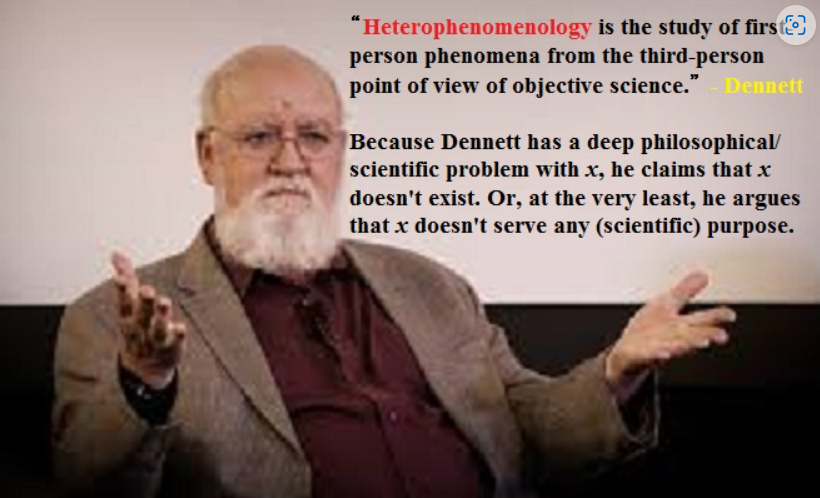
The American philosopher Daniel Dennett has created his own neologism: “heterophenomenology”. Heterophenomenology is the

“study of first-person phenomena from the third-person point of view of objective science”.

Since phenomenology was originally seen as a (to use Dennett’s own words) “catalogue of phenomena”, then there’s no necessary reason why it should only be a study of subjects’ accounts of their own first-person mental states.

Dennett goes into more detail when he adds that heterophenomenology

“exploits our capacity to perform and interpret speech acts, yielding a catalogue of what the subject believes to be true about his or her conscious experience”.

Again, this isn’t a “catalogue” of conscious experiences, pains, mental states, qualia, etc. (as it were) in themselves. It’s a catalogue of the “speech acts”, etc. about these things. In other words, physiological responses, physical behaviour, “verbal reports”, etc. are the (as it were) meat of heterophenomenology — not consciousness, experiences or mental phenomena in themselves

Of course, Dennett would argue that there can’t even be anything in itself in these cases.

Since phenomenology was originally seen to be the study of phenomena (again, according to Dennett) “before there is a good theory of them”, then how does this work in the case of third-person (scientific) accounts of first-person mental phenomena? After all, Husserl and other phenomenologists saw their own phenomenology as being “presuppositionless” and “non-theoretical”. Not only that: (for Husserl at least) it was an attempt to provide a basis (or grounding) for science. [Husserl’s purpose was substantially Cartesian in nature. See here.]

Now can it also be said that Dennett’s own brand of phenomenology (if that’s what it actually is) is presuppositionless, non-theoretical, and a basis for (i.e., rather than a part of) science?

Of course it can’t!

So, yes, it’s indeed the case that studying any kind of phenomena can be deemed to be phenomenology. (This is true by definition.) However, studying mental phenomena as a project in science (i.e., with its own presuppositions and theories which will be applied to such phenomena) surely can’t be classed as phenomenology — at least not in the way that historical phenomenologists saw things.

Dennett on Qualia (Via Flanagan)
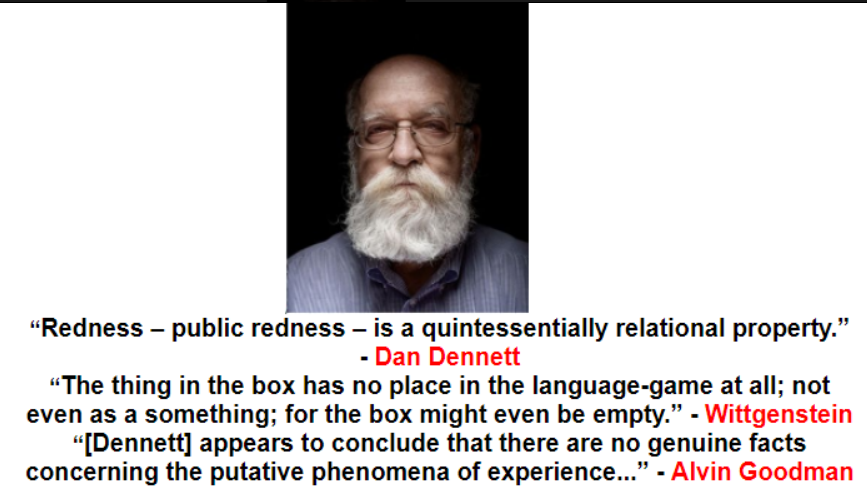
Even Daniel Dennett himself accepts that qualia are “real”… at least according to Owen Flanagan. In detail, Flanagan wrote the following:

“Qualia are for real. Dennett himself says what they are before he starts quining. Sanely, he writes, ‘‘Qualia’ is an unfamiliar terms for something that could not be more familiar to each of us: the ways thing seem to us’ [].”

Okay — there are ways things seem to us.

But where do we go from there?

Dennett may well (initially) accept qualia. However, he certainly doesn’t accept what he takes to the main philosophical account of them to be. [See here.] In other words, such qualia (at least in Dennett’s view) are mere “quicksilver” (i.e., “things” with very little scientific or even philosophical point).

In detail. Flanagan (again) puts Dennett’s position on qualia in the following way:

“To think this, Dennett must think that the identification of qualia with the ‘way things seem to us’ must be interpreted as meaning that a quale is a state such that, necessarily, being in it seems a certain way and, necessarily, there is nothing else to it.”

On this account of Dennett (if in crude terms), if quale x (or set of qualia y) “seems a certain way”, then it seems a certain way

There is nothing else to it.

So perhaps Dennett’s account of qualia (if via Flanagan) is made of straw.

That said, if Dennett’s account weren’t broadly accurate, then qualia wouldn’t do all the work their supposed to do for anti-physicalists and many others. In other words, such people actually require Dennett’s account of qualia to be accepted. That’s because without it their own case against physicalism, etc. simply won’t work. [Note: some physicalists accept the existence of qualia.]

So it’s not just the case that Dennett wants to portray qualia in this (seemingly?) extreme way: it seems that qualia enthusiasts do so too. That’s because (again) if qualia aren’t taken to be as Dennett believes they’re taken to be (i.e., by qualiaphiles), then what would be the (philosophical) point of them?

More broadly, much qualia-talk is (as it were) designed to end up with Flanagan’s final statement — “there is nothing else to it”. That nothing else to it is used to guarantee qualia complete freedom and autonomy from any (complete?) physical account or description of them.

As it is, Flanagan is unhappy with Dennett’s account.

Flanagan on Dennett’s Position

Flanagan wrote:

[] I claim that the concept simply doesn’t need to be understood that way. The alternative interpretation is that a quale is a state such that being in it seems a certain way. This interpretation is better because it allows us the concept of the way things seem without making seemings atomic, intrinsic, exhaustive, ineffable, and so on.”

This is a hard passage to grasp. (I needed to read it more than once.)

On first reading, Flanagan seemed to be simply repeating Dennett’s own account of qualia — if with slightly different wording.

Thus, in one passage Flanagan says that Dennett identifies qualia “with the ‘way things seem to us’”. On Flanagan’s own account, on the other hand, “a quale is a state such that being in it seems a certain way”.

So is there a substantive difference between the way x seems to us, and quale x is a state such that being in it seems a certain way? (Other than Flanagan’s use of the words “a quale is a state”.)

That question just asked, I believe that Flanagan’s point is the following.

For both qualiaphiles and for Dennett, quale x seeming a certain way is (literally) the end of the story. To Flanagan, on the other hand, being in state x, and quale x seeming a certain way to us, isn’t the end of the story.

On this reading, then, we have an explanation as to why Flanagan concluded with the following words:

“This interpretation is better because it allows us the concept of the way things seem without making seemings atomic, intrinsic, exhaustive, ineffable, and so on.”

Thus, Flanagan’s interpretation is better (to Flanagan at least) because even though there are indeed (as it were) brute seemings — that’s not the end of the story…

However, surely it isn’t (or wasn’t) the end of the story for Dennett either.

So perhaps Flanagan’s point is that we can accept that there is a way things seem, yet not also take these seemings to be (Flanagan quotes Dennett’s terms) “atomic, intrinsic, exhaustive, ineffable, and so on”.

Flanagan’s conclusion (if I have it right) can be summed up in this way:

(i) Because Dennett believes that qualia must be construed as being “atomic”, “intrinsic”, “exhaustive” and “ineffable”,
(ii) then, to qualiaphiles, that must be the end of the story.

This means that Dennett is taking the qualiaphiles and anti-physicalists at their word.

Flanagan, on the other hand, isn’t taken them at their word.

Instead, Flanagan’s “alternative interpretation” is that “a quale is a state such that being in it seems a certain way”. (I still don’t really understand this phrasing.) Thus, that isn’t the end of the the story for Flanagan. Indeed, Flanagan supplies lots of very persuasive and interesting philosophical and scientific detail as to why seemings aren’t — or even can’t be — the end of the story.

All the above ties up directly to the broad philosophical position of physicalism and its relation to consciousness (i.e., not just on whether one takes a physicalist or anti-physicalist take on qualia).

Conclusion: Physicalism, Anti-Physicalism or Something Else?
Perhaps the seemingly(?) non-physical nature of mental seemings is largely — or even entirely — down to people’s subjective (or first-person) takes on them. In other words, to the (as it were) owners, qualia and/or seemings do indeed seem to be non-physical. Yet do things seeming-to-be-non-physical mean that they are non-physical?

In other words, perhaps there’s a fundamental reason as to why the owner (or haver) of seeming S takes it to be non-physical.

This means that because (to quote Peter Carruthers) “[c]onscious states are private to the person who has them”, then the notion of the non-physicality of seemings will be private to the person who has them too. Yet how can we draw out the actual non-physicality of seemings from such personal “reports” on them?

Indeed, perhaps that seeming-to-be-non-physical-to-subjects is largely a product of personal psychology, learning, books, culture, history, and sociology.

More broadly, what relevance or status do personal (or private) accounts of mental seemings have on the actual metaphysical and scientific status of such things?


Saturday, 23 December 2023

Gerald R. Baron’s Religious “Crusade” Against Materialism

The Medium writer Gerald R. Baron is on a (to use his own word) “crusade” against what he describes as “physicalism” (i.e., philosophical materialism). From Baron’s own words, it’s very clear that his religious views are a prime motive behind his anti-materialism. Yet when critics mention the prior religious beliefs and motivations of such religious (or “spiritual”) anti-materialists, Baron doesn’t deem that to be a good thing. Indeed, he suggests that critics should stick to the arguments.

“My crusade then, if there is one, is to expose the false teaching that physicalism represents [].”

— Gerald R. Baron [See source here.]


(i) Introduction
(ii) Gerald Baron’s Religious and Political Views
(iii) Gerald Baron on Being Called a “Science-Denier”
(iv) Are Baron’s Scientific Big Names Really Physicalists?

Gerald R. Baron has said that critical commentators shouldn’t talk about the motivations and prior religious convictions of those who criticise materialism (or physicalism), as well as the religious motivations of those people who go against what he deems to be “mainstream science”. In Baron’s own words:

“Murphy is critical of Goff’s views on panpsychism, and more recently, cosmopsychism. Again, he doesn’t argue against these ideas directly, but attributes them to his prior political and religious ideas or commitments.”

Later, Baron adds:

“What I miss in this process is the substantive analysis of the ideas.”

Those two statements are outrageously and obviously false.

Now Baron may not like what I’ve written on these subjects, but does he also need to make claims which are obviously false? Is this kind of thing allowed in his “crusade”?

Sure, I can give Baron the benefit of the doubt here and say that in the single essay which he tackled, I may not “argue against these ideas directly”. But I have done so, in great detail, elsewhere. (Baron has stated that he’s read at least some of my other stuff.) More particularly, I’ve done so in many essays that never mention “prior political and religious ideas or commitments” — not a single time. [See note 1 for a list of such essays.]

What’s more, I did actually argue against the ideas directly even in the essays Baron focused upon. [See note 2.]

The same is true when when I’ve written on Paul Davies, and even when I’ve written on Bernardo Kastrup. Yet it’s hard not to bring up religion, etc. when discussing Davies’s and Kastrup’s ideas because they often do so themselves.

All that said, I don’t deny for one moment that I have indeed mentioned the motivations and prior religious views of Bernardo Kastrup and Philip Goff. So I do both: I tackle their technical arguments, and then I place that within the (what I deem to be) important context of their prior religious and political views.

If that’s still a problem, then I need to know why.

Indeed, chronologically, I came to discuss these writers’ prior political and religious views precisely because I noted the (obvious) weaknesses of their arguments (or lack thereof). More relevantly, the weaknesses of their arguments are best explained (to me at least) by their religious and political views and motivations. [See note 3.] In other words, it can be strongly and easily argued that the philosophical arguments such writers put forward are purely and simply designed to advance their prior religious and political positions.

All this can be brought right up to date.

Baron has just published an article called ‘Decoding David Bohm’s Metaphysics’. (David Bohn is a favourite with New-Agers and “spiritual” people. See Graham Pemberton’s ‘Quantum Physics and Spirituality — part 7, David Bohm’ and here.) When you read this “first in a short series of posts”, you can clearly see exactly where it’s all heading — to religious/spiritual and (to use Baron’s own word) “transcendent” conclusions. Thus, David Bohm’s quoted words are simply a vehicle for these conclusions. Bohn’s physics isn’t t embraced (as it were) in itself. It’s embraced simply as a means to an end. Hence, Baron quotes Bohn extensively, but he never adds much (or even any!) critical — or otherwise — commentary.

So religion and politics wag the dog.

Of course, all this is up for debate.

However, if a writer did only one of these things (e.g., concentrate entirely on the motivations and prior religious views of Kastrup, Goff, Baron, Davies, etc.), then that may well be a problem. However, I’ve never personally done such a thing — not even in the essays in which I do, admittedly, mention such people’s motivations and prior religious views.

So was the following really the case?

It was Baron himself who focussed on my mentions of “motivations” and “prior religious views”, and he simply ignored all my arguments (i.e., those arguments which didn’t mention such things). Indeed, from what I’ve read, Baron never tackles the technical arguments of flesh-and-blood physicalists or materialists, or even paraphrases what they’ve written. [See note 4.]

To slightly change tack.

It’s odd that Baron doesn’t like critics bringing up his own and other people’s motivations and prior religious views — and that’s because Baron does so himself.

For example, in an interview with a self-described “humanist, a seeker and [] globalist” called Anders Bolling, Baron was very open and honest about all his religious and political motivations.

In detail.

All the following information (i.e., the bits of autobiography, the talk of motivations, etc.) come from an interview on YouTube called ‘Gerald Baron: To unite science and faith’. In that interview (or at least in the written introduction), Baron tells us that he’s a Christian. He also says that his Christian faith “validates much of what the Bible tells us”. Indeed, Baron believes that “[o]ne such example is the studies at the University of Virginia that show compelling evidence of reincarnation”.

Baron also almost perfectly expresses the position of Intelligent Design in the following passage:

“There is evolution, but it is not random. The digital code in our DNA is remarkably complex and carries meaning. In science we know of no process of creating meaningful code other than through an intelligent mind.”

Baron then ties neo-Darwinism to, yes, physicalism. [See Baron here.]

So perhaps critics can mention religious, etc. motivations because anti-materialists like Baron, Bernardo Kastrup, etc. do so themselves — frequently.

Finally, if it’s a bad thing to mention such motivations in a critical manner, then shouldn’t it be a bad thing to mention them (as Baron and Bolling did in their interview) in a positive manner too?

Gerald Baron’s Religious and Political Views

Gerald Baron’s case against physicalism is hardly motivated by metaphysical and logical argumentation. Indeed, Baron hardly ever (perhaps never) quotes physicalists (certainly not contemporary philosophers) arguing (in detail) for physicalism. (To be clear. I’ve never read Baron doing so in all the stuff I’ve read. It is of course possible that he’s done so elsewhere.)

Thus, this is Baron himself on the subject of physicalism:

“The above argument may suggest my primary concern is how that belief system [physicalism] determines our values, priorities and actions. But that is not my primary reason.”

He then continues by more or less saying that this is indeed his “primary reason”:

“If physicalism is true, then the destructive results of living without any possible meaning or purpose and choosing our own versions of right and wrong without accountability should and will play out as the laws of nature demand.”

In the following passage, Baron then sets out what can only be described as his political agenda:

[P]hysicalism is not true, of that I am fully convinced. Yet, because that is the belief system that is widely promoted by scientists, philosophers, scientists speaking as philosophers, educators and journalists, choices made individually and corporate in our culture are based on false premises. If the physicalist belief system is harmful to individual people and societies as I believe it is, the harm is multiplied by the false basis.”

Baron then gets even more prophetic in the following:

"Major paradigm shifts will be represented in some significant changes in worldview. The foundation of science is crumbling, and most scientists understand that.”

Just like Kastrup, Baron also uses terms from psychological literature, as in the following:

“My crusade then, if there is one, is to expose the false teaching that physicalism represents and in doing so help resolve the dissonance. Resolving this may well mean not a return to traditional Christian beliefs, but perhaps something related but new, a syncretistic and more universal spirituality that is thoroughly transcendent. Perhaps Richard Rohr’s The Universal Christ points the way to the future of belief.

So Baron is indeed on a crusade against physicalism which, it can be argued, has very little to do with metaphysics, logic and/or argumentation. Instead, Baron’s (to use his own words again) “primary reason” for his crusade in that he believes that physicalism corrupts “our culture” as a whole.

Gerald Baron on Being Called a “Science-Denier”

New versions of the idea of “false consciousness” occur all the time.

Gerald Baron blames “the media” for what he takes to be the embrace of physicalism.

He believes that the media “stands for Fear, Uncertainty, Doubt and Outrage”. More relevantly, Baron believes that the media is to blame for people not upholding his own (i.e., non-physicalist and religious) views. (This is much like the position which many political activists take toward the media when they too come across people with very different views to their own.)

Baron has written two books about the media: Now is Too Late: Survival in an Era of Instant News and Black Hats White Hats: Why Activists Almost Always Win and How to Defeat Them.

Thus, if you don’t like an individual’s or some group’s views, then blame the media. (Or “media brainwashing”, as teens often put it.)

Or if someone holds a view you find distasteful, then blame the media.

Of course, all the above are variations on the false consciousness theme.

In any case, politics isn’t going to be discussed here. However, Baron does tie the (Platonic) Media to, yes, “our culture’s embrace of physicalism”. [See also Kastrup’s Materialism as a political weapon’.]

More specifically, Baron writes:

[W]hat is most important to me is the fact we are continually told that if you do not accept the belief system of physicalism, [then] you are a science-denier.”

That passage is bizarre because I can honestly say that I’ve never once come across anyone stating that “if you do not accept the belief system of physicalism, [then] you are a science-denier”.

Never once.

Of course, Baron may believe that those precise words needn’t be used, just variations thereon.

So which actual words does Baron believe have been used, and has he ever quoted them?

Whichever way this supposed categorical statement about physicalism and science-denial is expressed, can Baron cite any examples of scientists (or others) mentioning physicalism in this way, and then saying that if you don’t accept it, then you simply must be a “science-denier”?…

Unless this is physicalism by default.

In other words, if a scientist doesn’t accept religious, paranormal, spiritual, etc. explanations of any given x, then he simply must be a physicalist.

So now take an admittedly extreme example.

If a scientist or layperson doesn’t accept astrology (or the existence of ley lines), then does this also mean that he simply must also be committed to physicalism?

Alternatively, say that someone — anyone — doesn’t accept Baron’s championship (see here) of Carl Jung’s “objective reality” (i.e., the unconscious), is such a person automatically a physicalist?

Does all this mean that the word “physicalist” (or “materialist”) is simply a stand-in for the following position? —

All those people who don’t accept my own religious and non-physicalist views.
Bernardo Kastrup — spiritual idealist and Baron’s fellow crusader against materialism and “mainstream science”.

Bernardo Kastrup, for one, seems to go in for this kind of thing.

Kastrup regards almost everyone under the sun outside his own idealist “school” (from Guardian journalists, biologists, physicists, to people he gets into arguments with on YouTube) as “materialists”.

Thus, we end up with the following Manichean war: (supposed) materialists vs Kastrupian idealists and Jungians, Christian dual-aspect monists, etc.

Are Baron’s Scientific Big Names Really Physicalists?

Gerald Baron’s main point is that “the mainstream position of science today is physicalism”.

Is it?

Baron targets various scientific (as it were) big names. In his own words:

“Leading scientists such as the late Stephen Hawking, Brian Greene, Neil deGrasse Tyson, Sean Carroll, Brian Cox, Richard Dawkins and a great many others are assuming the mantle of philosophy and from that esteemed podium are the prophets, priests and evangelists of the quasi-religion of physicalism. Our education system tolerates no alternative view other than physicalism and the exclusive claims of evolution despite widespread and increasing scientific discomfort with the claims. [] Our science journalists and major media channels rarely allow any exposure to data, reports, discoveries or discussion that question the tenets of physicalist belief. If they do, ardent defenders of physicalism rally to call for the dismissal of the offending editors.”

That passage is very similar to the following one from Kastrup:

“But science-as-you-know-it implicitly adopts the materialist ontology. Perhaps not all scientists do this; perhaps even only a minority does. But this minority is vocal and influential. They clearly control where the research funding goes, for projects that do not assume the materialist metaphysics collectively get much less funding than projects that do. [] Moreover, this vocal minority also controls how science-as-you-know-it is presented in the media, in school curricula, and to the culture at large. Just think of people like Lawrence Krauss, Richard Dawkins, Neil deGrasse Tyson, Stephen Hawking, and others such specialized prodigies of rhetoric and intellectual puzzles, who cavalierly ignore rigorous logic, epistemology, and ontology.”

So Kastrup mentions Lawrence Krauss, Richard Dawkins, Neil deGrasse Tyson, Stephen Hawking. And, guess what, Baron also mentions Stephen Hawking, Neil deGrasse Tyson, and Richard Dawkins. Indeed, not only are the names the same, so are the general positions.

The scientists Kastrup and Baron mention are very different to each other. So readers can suppose they’re all connected together (i.e., by Kastrup and Baron) because of their supposed commitment to physicalism (or materialism). Yet this is a philosophical position which they rarely (if ever) actually discuss.

So Baron and Kastrup may believe that these scientific big names must have caught physicalism via some kind of “virus of the mind”.

In any case, Baron refers almost exclusively to the writers of popular-science books and those scientists in the public eye. Perhaps Baron has a good reason to do this because he believes that these scientific big names are corrupting what he calls “our culture”.

Again, I can only say that most — even all — the famous scientists Baron targets never even refer to “physicalism”. They certainly never class themselves as “physicalists”…

After all, these people are scientists.

“Physicalism” is a term of art, mainly used in analytic philosophy.

In detail.

The term “physicalism” dates back to the 1930s, and was first used by two logical positivists: Otto Neurath and Rudolf Carnap. [See here.] However, this term didn’t have a widespread use until the 1960s — or even later. Interesting enough, the long Wikipedia entry on ‘Physicalism’ only mentions “physics” (i.e., not “physicalism”) twice, and doesn’t refer to a single scientist. The same is broadly true of the Stanford Encyclopedia of Philosophy’s own entry on ‘Physicalism’. (The bibliography doesn’t include a single work by a scientist.)

As for scientists. I’ve read most of the the scientists that Baron mentions, and I don’t recall a single time they’ve used the term “physicalism”, let alone discussed it in any (philosophical) detail. Sure, I’m willing to be corrected on this. Perhaps some of these big names have indeed used the term “physicalism”. However, even if they have, then it must have been extremely rarely.

In addition, it can be guessed that some of the popular scientists Baron targets would argue — if only when pressed - that they have no need to use the term “physicalism”, or to commit themselves to this philosophical doctrine. Instead, their views on science generally, as well as on particular scientific theories, are simply a product of tests, experiments, observations, theorising, mathematics, logical reasoning, etc., not the product of an arcane and academic doctrine which is mainly found in analytic philosophy.

This may be “philosophically naive” when it comes to scientists ignoring philosophy. However, it’s not being argued here that scientists deny all philosophical elements to their scientific theories and positions. No, this is specifically about their supposed commitment to physicalism.

So as hinted at earlier, the best Baron can do is opt for Kastrup’s position of physicalism-as-false-consciousness (or physicalism-by-osmosis).

In other words, scientists — and just about everyone else who isn’t “spiritual”, religious, an idealist, etc. — must catch physicalism in the air without ever using that term, and certainly without thinking deeply (or philosophically) about it.

Again, physicalism is a technical philosophical position which actually requires much (philosophical) thought. And I’d suggest that most scientists — and other offenders — don’t give physicalism that much thought…

Indeed, perhaps that acknowledgement can be made to actually work in favour of Baron’s own position!

In other words, the (false) idea that scientists “blindly accept materialism” actually works in Baron’s favour. (Even though most scientists don’t blindly accept materialism, and for all the reasons just given… and more.)

Yet Baron did say that “the mainstream position of science today is physicalism”, and I’m saying that most scientists don’t philosophise about physicalism.

So can Baron and Kastrup have it both ways?

The best that can be argued is that physicalism (Kastrup both implies and states this in his writings) is caught in the air, or it influences scientists through osmosis (i.e., in today’s “materialist culture”)…

Yet Baron and Kastrup can’t argue that scientists are “committed to physicalism”, and, at the very same time, also admit that scientists don’t think (or philosophise) about physicalism.

Consequently, imbibing physicalism unconsciously, and being intellectually committed to physicalism, are two very different things.


Notes:

(1) The following are examples of essays I’ve written on Philip Goff which never mention his religious and political views: ‘Intrinsic Nature: Philosopher Philip Goff on What Physics Leaves Out’, ‘Against Philip Goff’s (Panpsychist) Phenomenal Bonding’, ‘Philip Goff’s Panpsychism vs. Sam Coleman’s Russellian Monism?’, ‘Panpsychist Philip Goff’s Combination Problem: Little Conscious Subjects and Emergence’, ‘John Horgan and Philip Goff on Panpsychism & Geocentrism’, ‘Philip Goff on the Brute Identity Theory: Flogging a Dead Horse?’, ‘Philip Goff’s Panpsychist Conceivability-to-Possibility Argument’, etc.

(2) Where are the references to prior religious beliefs and motivations in the following passage?

[N]ow take Carl Jung’s idea (as expressed by Gerald R. Baron) that ‘the unconscious is in the realm of objective reality while the conscious [mind] is not — it is subjective’. (It’s worth noting here that Pauli offered criticisms of Jung’s work, particularly of the notion of synchronicity.)
“In the light of Jung’s reference to ‘objective reality’, it can be said that Pauli rejected the opposition between *objective reality* itself (or ‘ultimate reality’), and what we can can know about reality (as did Niels Bohr). In other words, knowing ‘how Nature is’ amounts to no more than a metaphysician’s dream. All we actually have is ‘what we can say about Nature’. And, at the quantum-mechanical level at least, what we can say is what we can say with the mathematics — in conjunction with experiments, tests, observations, etc. Consequently, just about everything else is interpretational, analogical and/or imagistic in nature. Indeed, the analogical, imagistic and interpretational stuff can — and often does — mislead us. It also causes endless insoluble controversies.”

Needless to say, Baron didn’t respond to this passage, or any passages like it. Instead, he focussed (almost) entirely on my mentions of people’s prior religious beliefs and motivations.

Baron also (indirectly) refers to an essay I wrote on Philip Goff, in which the following passage can be found:

“When Goff first discussed panpsychism in his early papers (they date back to 2006), there was very little (if any) science to be found within them. There certainly wasn’t much — or even anything — about physical cosmology and scientific cosmology. This was the case up until around 2017, when Goff started to refer to ‘cosmopsychism’. Sure, Goff had previously referred to atoms, electrons, etc. in his early papers. However, he did so simply to argue that such things might (or do?) instantiate experience or consciousness.
“Then Goff moved on to include spacetime itself within his panpsychism. (Goff wrote: ‘Spacetime on its own is a simple and ubiquitous experience[].’) And now, in 2023, Goff states that the ‘quantum vacuum’ may be conscious.”

Again, there’s not much about religion or motivations here either.

(3) Some of the positions and arguments in Philip Goff’s book Galileo’s Error are strikingly poor. However, this is only the case when Goff broadens out his discussion to refer to such things as the politics of trees. (See my ‘Professor Philip Goff’s (Panpsychist) Philosophy of Trees’.)

(4) Even in an article called ‘Panpsychism trapped by physicalism’, all Baron does is quote the critics of physicalism.

Baron’s argument is that Galen Strawson, who is a panpsychist, is also a physicalist. (Strawson does class himself as a “real physicalist”.) Yet Strawson actually argues against physicalism in the video ‘Galen Strawson: Panpsychism vs. Physicalism?’. However, because Strawson doesn’t also embrace religion, Jung, synchronicity, etc., then his critical words about physicalists simply aren’t enough for Baron. Instead, Baron believes that Strawson should also be thoroughly committed to what he calls “the transcendent”.

As ever, Baron doesn’t quote or even paraphrase any of Strawson’s actual arguments. (He repeatedly quotes the often-used “mystical” and/or “spiritual” passages from Arthur Eddington, David Bohm, Erwin Schrödinger, etc.) However, he does quote Strawson saying the following:

[Galen Strawson] states at the outset his firm commitment to physicalism. He even admits that this is a personal preference, something he ‘wants’.”

Isn’t this Baron talking about people’s motivations and prior beliefs?