Tuesday, 29 August 2023

Julian Baggini’s Banal, Unoriginal and Dogmatic Derrida

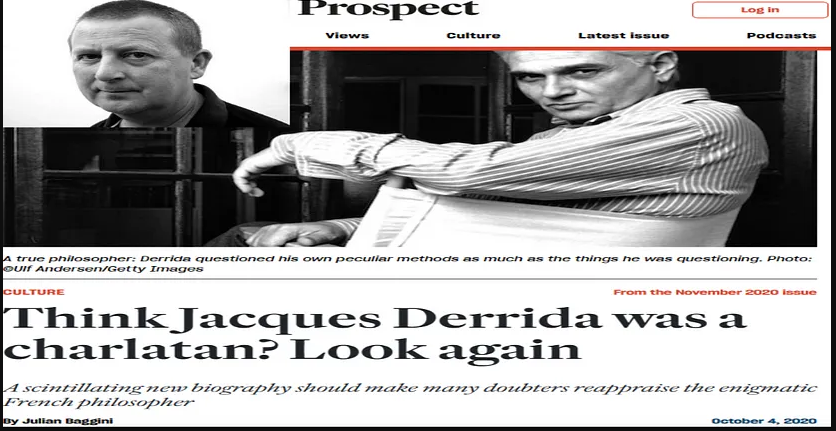
This is my final essay on Julian Baggini’s Prospect article ‘Think Jacques Derrida was a charlatan? Look again’. (It’s a follow up to my ‘Julian Baggini on the Anti-Derrida ‘Cambridge Affair’ of 1992’ and ‘Philosopher Julian Baggini on Derrida and the Anglo-Saxon Academy’.) The following focuses on various banal, unoriginal and dogmatic claims by — and ideas from - Derrida, at least as they’re offered up by Julian Baggini.
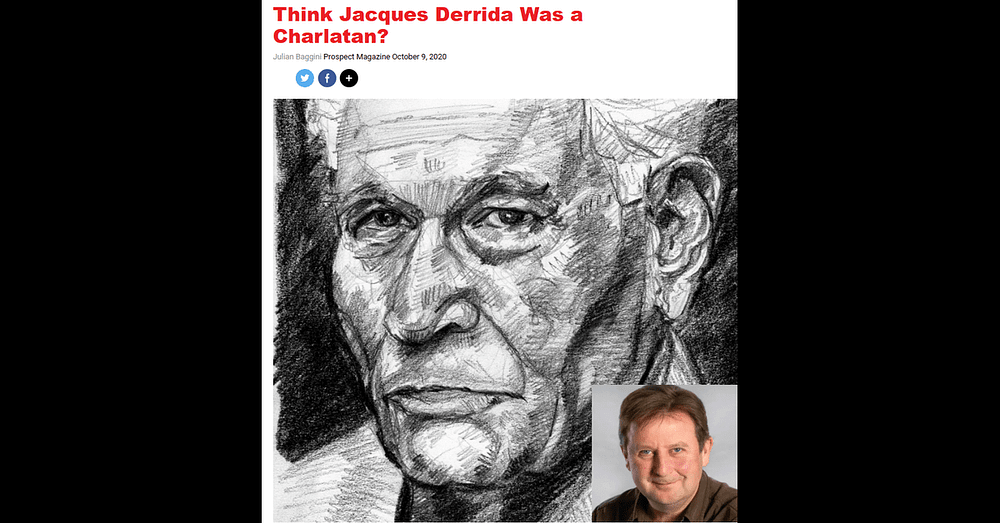
Jacques Derrida and Julian Baggini.
“British-trained philosophers like myself don’t know much about Derrida, though that doesn’t stop some of them dismissing him. I don’t dismiss him, but nor do I know enough to be able to sum him up.”

— Julian Baggini. [The source of that passage can be found here. See note at the end of this essay.]

(i) Introduction
(ii) Julian Baggini’s Original Derrida
(iii) Derrida’s (or Baggini’s) Dogmatic Claims
(iv) Derrida’s (or Baggini’s) Banal Claims
(v) Conclusion

To offer up a forced binary opposition: Julian Baggini is on the side of those who believe that Jacques Derrida was a (to use his own words) “true philosopher”. The other side of that opposition believes that he was a “charlatan”. (See Baggini’s own forced binary opposition of Stalinism-vs-Catholicism later.)

The Derrida-was-a-true-philosopher position dates back to the late 1960s… and even before that.

Baggini writes:

“One of Derrida’s examiners at his prestigious high school, the Lycée Louis-le-Grand, wrote of his work: ‘The answers are brilliant in the very same way that they are obscure.’”

Perhaps this examiner was simply bowled over — or even hoodwinked — by Derrida’s writing style and its inherent (poetic or literary) obscurantism. Of course, that writing style is one of the (main) reasons why so many people still admire Derrida.

So how did this examiner know that Derrida’s answers were “brilliant” at the very same time as acknowledging that they were “obscure”? They were clearly not obscure enough for this examiner not to recognise that they were also brilliant.

Thus, perhaps Derrida’s answers either weren’t obscure at all, or they couldn’t actually have been known to be brilliant — precisely because they were obscure.

The same line argument can be aimed at Michel Foucault.

According to Baggini, Foucault said that Derrida’s work was “either an F or an A+”.

Nice line! But what does it mean?

Am I being a “pedant” here?

Am I merely “logic chopping”?

In other words, am I failing to simply immerse myself in the poetic and quasi-religious experience of reading Derrida?

On the other hand, if Derrida was truly a “joker” (as so many have claimed), then all this is made a little clearer.

Was Derrida a joker?

It’s hard to tell. Take the following words from Professor Eric Schliesser:

“Now one need not be friend of Žižek (who makes Derrida seem highminded), to recognize that one, thereby, is in no position to recognize that sometimes — maybe all the time in our fallen world in which our hands are sullied with innocent blood everywhere — the stance of the jokester is the only morally responsible stance.”

So was Derrida a joker, and that was a good thing?

Was he a joker, and that was bad thing?

Or was Derrida simply not a joker at all?

Julian Baggini’s Original Derrida

Some of the ideas which Julian Baggini claims (or sometimes merely hints) are original to Jacques Derrida… aren’t original to Derrida.

Indeed, the very opening subtext of Baggini’s article is a good example of this. It goes like this:

“A true philosopher: Derrida questioned his own peculiar methods as much as the things he was questioning.”

We also have this:

“Derrida’s project is diametrically opposed to that of most philosophers.”

Baggini adds that “Derrida’s whole project was one of radical doubt”.

Is Baggini (or Peter Salmon) really claiming that all this radical questioning wasn’t the case with many of the philosophers who came before Derrida?

Alternatively, is Baggini referring exclusively to those philosophers who belong to what he calls “the Anglo-Saxon academy”?

Now Baggini does seem to claim (or sometimes simply imply) that this radical questioning is peculiar to Derrida…

Actually, he seems to have it both ways.

Baggini emphasises Derrida’s profound originality (“Derrida’s project is diametrically opposed to that of most philosophers”), at the same time as stressing that he was part of a tradition:

“For all his 20th-century jargon, Derrida at heart belongs to a long line of sceptics that traces back to Pyrrho in Ancient Greece.”

Of course, it can be provisionally accepted that profound originality and being part of a tradition can exist together.

So perhaps it depends.

A tradition of “radical doubt” (even of one’s “own peculiar methods”) can most obviously be found in René Descartes’s work, and later in David Hume’s. It can also be found further back in history (as Baggini himself acknowledges) with various Greek philosophers.

Even Baggini’s stress on aporia isn’t original to Derrida.

Take this description:

“In philosophy, an aporia is a philosophical puzzle or a seemingly irresoluble impasse in an inquiry, often arising as a result of equally plausible yet inconsistent premises (i.e. a paradox).”

To take only a single example, that passage is an almost perfect account of Kant’s antinomies.

In addition, most general accounts of aporia mention its use in Greek philosophy. Worse for Baggini, it’s even called an “instrument of investigation in analytic philosophy”!

However, it’s the following additional definition of aporia that Baggini (as well as Salmon) link specifically to Derrida:

“It can also denote the state of being perplexed, or at a loss, at such a puzzle or impasse.”

Except that many of the critics of Derrida won’t see any states of being perplexed in his work. Quite the opposite in fact (as will be shown in a few moments).

What about Derrida’s position on truth — is that original?

Baggini writes the following:

“He was not a nihilist who denied truth, but a sceptic who thought ‘we cannot know whether there is truth or not.’”

Yet doesn’t that leave us in roughly — even exactly — the same position as a nihilist, or, indeed, a relativist? In other words, what practical or philosophical difference is there between denying truth outright and claiming that “we cannot know whether there is truth or not”?

More to the point, what do the words “we cannot know whether there is truth or not” mean?

Is it a poeticism?

Is Derrida’s non-nihilist position on truth something so deep and profound that it’s beyond explanation (or justification), and even without a (what Baggini calls) “fixed meaning”?

Derrida’s (or Baggini’s) Dogmatic Claims

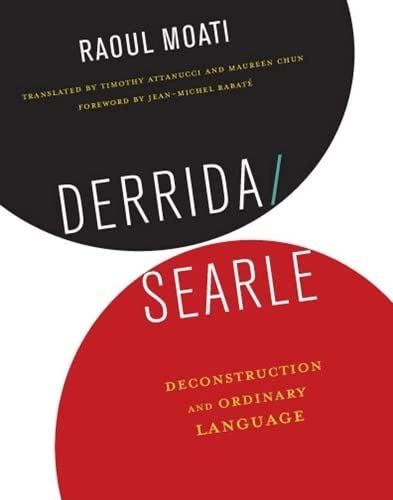
In the “Searle-Derrida affair”, Derrida expressed lots of categorical claims, used the word “truth” about his own positions, and displayed written and verbal anger at John Searle and his other critics.

Derrida (if only via Baggini) makes a lot of categorical — even dogmatic — claims.

For example, we have this categorical statement:

“Deconstruction is not destruction, as he was at pains to point out.”

Who says that deconstruction is not destruction?

Well, obviously, Baggini does, and Derrida did too.

Many others argue that deconstruction is (a mode of) destruction, and such people have done so in great detail.

What’s more, Martin Heidegger’s own term Destruktion was literally based on the word “destruction”. Take these words:

“Heidegger employs a number of words for ‘destruction’ — including Destruktion, Zerstörung, and ‘dismantling,’ ‘unbuilding,’ or ‘deconstruction’ (Abbau).”

More relevantly, Derrida borrowed this term from Heidegger himself.

Many sympathetic commentators on both Heidegger and Derrida see both Destruktion and deconstruction as being (philosophical) means of… destruction. (See the many links here.)

Now, of course, no one is claiming that (Derrida’s) deconstruction and (Heidegger’s) Destruktion are identical. Still, even if critical commentators are ignorant of Heidegger’s coinage, they still have a multitude of reasons for believing that deconstruction is a philosophical mode of destruction.

What’s more, even if Baggini provides arguments, then there’s still no reason why other people should accept his categorical (or dogmatic) claim that deconstruction is not destruction.

Another example of a dogmatic — or at least categorical — claim can be found when Baggini says (speaking of Derrida’s position) that

[p]hilosophers’ attempts to pin down words are as futile as nailing jelly to a wall”.

Here’s another example:

[W]hen talking of promising as a speech act, Searle wrote: ‘I am ignoring marginal, fringe, and partially defective promises.’ For Derrida this was inexcusable.”

Note the very-strong word “inexcusable”.

Here’s another categorical claim:

“By only focusing on abstracted, tidied-up, ideal forms of speech acts, Searle was ignoring how they actually work.”

Baggini is writing about the complexity of speech acts as they occur in the (as it were) real world. Thus, it’s a position against idealisation and rigidity. Yet Derrida was still telling us — in strong words — how speech acts “actually work”…

Yes, that’s right: Derrida told us how speech acts actually work.

So Derrida must have believed he knew how speech acts work. He must have also believed that he knew that John Searle didn’t know how they work. Yet Baggini also writes that

“Derrida thought it was another example of philosophy choosing a false precision over more truthful messiness”.

Is there false precision in Derrida’s statements about Searle’s (supposed) “false precision”? (Note that Baggini uses the term “truthful” about Derrida’s — as opposed to Searle’s — position.)

Baggini also writes:

“‘Crucial to [Derrida’s] thinking,’ says Salmon, was an opposition to the ‘violence of any gesture that pretends (assumes, supposes, presupposes) to know.’”

Did Derrida know that we can’t know any given x… or know anything at all?

Alternatively, did Derrida simply pretend, assume or suppose that he knew that we couldn’t know?

To move on. Some of Derrida’s ideas aren’t only unoriginal, they’re also banal.

Derrida’s (or Baggini’s) Banal Claims
The charge of banality raises the question (again) as to Baggini’s assumption (actually, he states it too) that most (many? all?) critics of Derrida haven’t actually read him. (This assumption was featured in my Julian Baggini on the Anti-Derrida ‘Cambridge Affair’ of 1992’). Yet some critics have understood Derrida well enough to realise that it’s often the case that banality lurks underneath the arcane prose. Indeed, some of Derrida’s critics have cited many actual examples of this.

For a new example of banality, Baggini informs us that Derrida attempted

“to show that the way we think of things is not the only way they can be thought”.

We also have this:

[A]s Derrida incessantly argued, all categorisations are to some degree arbitrary.”

The important and relevant word (from a philosophical point of view at least) is the last one — “arbitrary”.

The word “arbitrary” is strong.

Or at the least that word is often used rhetorically. Relevantly, it can be argued that it’s used rhetorically in the passage from Baggini above.

So here’s one definition of the word “arbitrariness”:

“Arbitrariness is the quality of being ‘determined by chance, whim, or impulse, and not by necessity, reason, or principle’. It is also used to refer to a choice made without any specific criterion or restraint.”

Derrida and postmodern philosophers have claimed (or often simply assumed) that something is arbitrary if it isn’t necessary. What’s more, poststructuralists and postmodern philosophers have really played on this assumption, and it’s even central to their various philosophies. (Think of the omnipresent phrase “the social construction of [x]” in this context.)

In detail. Because nature, culture, our mind/brain or whatever doesn’t force us to categorise x in the way (or ways) that we do actually categorise it, or “name” any given x with the name we do actually give it, then (the Derridean position is) it must be the case that any categorisation at all must be purely arbitrary.

Yet that’s not the case.

True, our choice of names or words are contingent, and, in a sense, of little importance to the philosopher. (Locke made this point way back in the 17th century. See here.) In other words, we needn’t have called trees “trees” or mountains “mountains”. So, sure, that’s just an English word, and the French word for a tree is just a French word too. However, this is to conflate not only linking the words we choose with contingency, and thus with arbitrariness, but literally all categorisations too.

Here’s another banality from Derrida (or from Baggini):

“For Derrida, it is not that nature has no joints, or that the world can simply be carved however we please. Rather, there is always more than one way to carve.”

Okay.

Asking questions about nature’s joints isn’t banal. However, Baggini must at least acknowledge that these types of question have been asked by numerous analytic philosophers in the 20th century — both before and after Derrida. Indeed, such philosophers have even used the phrase “carve nature at its joints”, and questioned the assumption — and even the possibility — that we can do so.

Baggini continued:

[E]very slice divorces us from possible alternative ways of seeing and understanding. Naming is thus, says Salmon, a ‘founding act of violence [] before there is a road taken and a road not taken.’”

Now this ethical addition to a metaphysical thesis may well be original to Derrida. (The metaphysical thesis itself has been held by many analytic philosophers.) Or perhaps not. Derrida actually had very similar view to Emmanuel Levinas on this matter (see here).

Now take this banality:

“As a graduate student Derrida felt he faced a choice between just two available options: the ‘Catholics’ or the ‘Stalinists’. He rejected that dichotomy and this fed into his later attacks on binary oppositions as being philosophically fallacious.”

Sure, Baggini doesn’t actually quote Derrida here. Indeed, it may well be the case that Derrida himself didn’t actually use the term “binary opposition” in relation to this particular biographical choice of his.

In any case, having a problem with being forced to choose between only two options (or even seeing things in terms of only two options) is a commonplace situation noted by many adult human beings. What’s more, it’s commonplace to state that “there are more than two options” in many particular cases.

Sure, there may well be some genuine binary oppositions.

However, is Stalinism-or-Catholicism really such a thing?

Instead, was this just an option faced by a particular French philosopher (i.e., Derrida) at a particular time in history? In other words, why dignify this event in Derrida’s life with the pompous (technical) term “binary opposition”?

Conclusion

Julian Baggini finishes off his article on Derrida by saying that those with open minds

“will surely have their minds changed by Salmon’s scintillating account of his life and thought”.

That’s possible.

However, why on earth would (or could) a single book on Derrida make such a big difference? It may do so to those who’re new to Derrida. However, could it really be the case that those who previously believed that Derrida was a “charlatan” would suddenly stop believing that after reading Peter Salmon’s book?

Is that all it takes?

To put that another way.

Surely the understanding of Derrida isn’t dependent on a single biography written by Peter Salmon. Personally, I’ve never really understood Derrida. That’s the case even though I’ve been attempting to do so since the late 1990s.

So perhaps my true understanding was all dependent on reading Salmon’s biography of Derrida (published in 2020).

This single book may be my own — and many readers — gateway into Derrida.


Note

(*) To be fair to Julian Baggini, this passage was written in 2004. Perhaps things have changed since then. Indeed, perhaps Peter Salmon’s biography changes everything when it comes to “British-trained philosophers” — as well as others — getting Derrida.

My flickr account and Twitter account.


Friday, 25 August 2023

Philosopher Julian Baggini on Derrida and the Anglo-Saxon Academy

This is my second essay on Julian Baggini’s Prospect article, ‘Think Jacques Derrida was a charlatan? Look again’. Baggini’s piece is an extremely positive appraisal of Derrida, taken via the route of Peter Salmon’s biography, An Event, Perhaps: A Biography of Jacques Derrida. The following concentrates on Baggini’s criticisms of what he calls “the Anglo-Saxon academy”, and how its approach to language, meaning and truth is diametrically opposed to Derrida’s own. (This theme was partially discussed in my previous essay, ‘Julian Baggini on the Anti-Derrida ‘Cambridge Affair’ of 1992’.)

Jacques Derrida (top) and Julian Baggini.

(i) Introduction
(ii) Julian Baggini Against the Anglo-Saxon Academy
(iii) Unfixed Meanings and Derrida’s Writing Style
(iv) Hugh Mellor and Marxists on Derrida’s Unfixed Meanings
(v) Derrida on Ordinary Language
(vi) All Analytic Philosophers are Realists!

“Derrida was both admiring and mocking when he described analytic philosophers’ ‘imperturbable ingenuity,’ but their absolute confidence in the rightness of their approach was anathema to him.”

— Julian Baggini [See source here.]

[Derrida] was in this respect more truly a philosopher than those [analytic philosophers] who question everything except the peculiarities of their own methods of questioning.”

— — Julian Baggini [See source here.]

Firstly, readers should note that this is an essay on Julian Baggini’s Derrida, as well as being on Baggini’s own take on Peter Salmon’s Derrida. In other words, it’s not on Derrida’s writings as I’ve personally encountered them.

So, as with all the Derrida Industry, we don’t know if (or when) we’re getting Derrida straight, rather than, instead, getting Baggini’s Derrida… or Salmon’s Derrida.

Of course, Salmon, Baggini and many other fans of Derrida will question the very idea of getting a philosopher right.

Indeed, never getting a philosopher right flows from Derrida’s very own philosophy.

[Ironically, Derrida himself reacted angrily to what he called “misreadings” of his own work. Take the passage (in response to John Searle) in note 1 from Limited Inc (1988) in which Derrida was explicit as could be.]

So where does that leave us?

Well, it leaves us with Baggini’s Derrida.

Or, perhaps, it leaves us with Baggini’s Derrida via the route of Peter Salmon’s Derrida.

Sure, all this (to use Baggini’s words) “radical questioning” of the Radical Questioner (i.e., Derrida) may simply show Baggini, Salmon and other fans of Derrida that I’m an anally-retentive analytic philosopher, as well as a (to parody Derrida) semantic fascist. [See note 2.]

Incidentally, if Baggini believes that Derrida was a “true philosopher”, then why has he never written on him before? If readers check Baggini’s personal website (see here), then they’ll find only a single reference to Derrida — and that’s to the Prospect article discussed here! (Place the word ‘Derrida’ in the search option of Baggini’s blog. This is what I found.) It’s probably the case that Baggini has indeed mentioned Derrida here and there over the last couple of decades. However, even on Google’s search engine, there’s nothing to discover. (See here and note 3.).

Thus, perhaps a single book — i.e., Peter Salmon’s biography of Derrida — truly has converted Baggini to the greatness of Derrida.

Julian Baggini Against the Anglo-Saxon Academy

Julian Baggini’s own case against what he calls “the Anglo-Saxon academy” (see note 4) finds a useful proxy in Jacques Derrida.

According to Baggini, Derrida was “more truly a philosopher” than most — even all? — analytic philosophers.

Baggini also informs us that

“Derrida was both admiring and mocking when he described analytic philosophers’ ‘imperturbable ingenuity,’ but their absolute confidence in the rightness of their approach was anathema to him”.

This is odd. That’s because Derrida’s phrase “imperturbable ingenuity” is precisely the kind of phrase that’s often been used about Derrida himself!

What’s more, it’s easy to argue that Derrida actually did have “absolute confidence in the rightness of [his] approach”, and no amount of playing with the sign or obscurity could hide that.

[Note again Derrida’s absolute disgust at some of the “misreadings” of his own work. See my ‘Derrida & Others on What Deconstruction Isn’t (or W̶h̶a̶t̶ D̶e̶c̶o̶n̶s̶t̶r̶u̶c̶t̶i̶o̶n̶ I̶s̶n̶’t̶)’, as well as note 1 again.]

In any case, Baggini continued by saying that because of Derrida’s (supposed) lack of “absolute confidence” in his own “approach”,

[h]e was in this respect more truly a philosopher than those who question everything except the peculiarities of their own methods of questioning”.

So some readers may find it hard to understand how this level of tribalism from Baggini (i.e., the implicit belief that most/all analytic philosophers aren’t true philosophers) is a fitting response to the supposed tribalism displayed during “the Cambridge Affair”, which Baggini opens up with in his own article.

Baggini adds:

“The complication of analytic philosophy arises from the attempt to be as precise as possible, whereas the complication for Derrida is the result of meticulously trying to avoid being more precise than is possible.”

Isn’t there a conflation here between analytic philosophers simply attempting to be as precise as they can be (or believing that precision in expression should at least be aimed at), and arguing that they actually believe that they have the world, things, or whatever precisely right? In other words, analytic philosophers don’t usually believe that they have the (as it were) absolute truth simply because they do attempt to be “as precise as possible”.

Most analytic philosophers believe that being as precise as possible is simply a means to get closer to the truth, and also the best way to communicate effectively with others.

Arcane and obscure philosophical prose, on the other hand, is often used as a means to disregard truth entirely, and let political, poetical and/or moral feelings rule the roost.

Unfixed Meanings and Derrida’s Writing Style

Readers and commentators can keep on asking self-referential questions about Derrida’s (or Baggini’s) various positions and ideas.

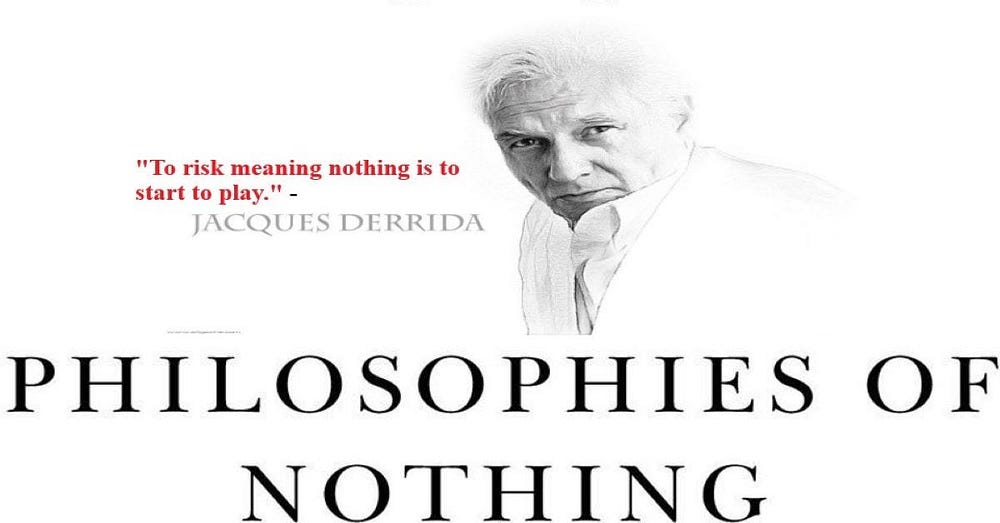
Yet perhaps Baggini is on safe ground here because Derrida himself once wrote: “To risk meaning nothing is to start to play.”

So does that (categorical) statement from Derrida mean nothing?

Or is it an act of play?

Sure, it could be both.

It could be an act of play, which also means something.

What about Baggini’s own words and positions?

Take Baggini’s view that many (most? all?) analytic philosophers believe that language can be precise. He writes:

“If you take as a premise ‘meaning cannot be fixed’ then in your writing you will take pains to avoid any suggestion of false precision.”

Is the meaning of Baggini’s own statement (i.e., “meaning cannot be fixed”) itself fixed in any way?

If its meaning isn’t fixed, then what’s the point of it? Where do we go from here?

However, if Baggini’s own meaning is fixed, then why is it an honourable exception to all other statements and utterances?

Similarly, is there a “suggestion of false precision” in Baggini’s own statement about false precision?

If there isn’t any false precision in Baggini’s own statement about false precision, then what’s the point of it? Where do we go from here?

On the other hand, if Baggini’s statement about false precision is itself truly precise, then why is it an honourable exception to all other statements and utterances?

Perhaps Baggini’s continuation of his passage about “fixed meanings”, “false precision”, etc. provides an answer to that question. It goes like this:

“You can see why Derrida’s writing could never have been clear and plain.”

Baggini’s argument here is that Derrida’s meanings were never themselves fixed precisely because his actual writing style displayed their unfixed nature.

Yet who’s to say that this is an accurate (truthful?) explanation of Derrida’s writing style?

There are many other ways to explain Derrida’s prose, including some offered by Derrida (or Baggini) himself.

For example, Baggini quotes Derrida saying — of himself - that he was “an incorrigible hyperbolite” who “always exaggerated”. In addition, what of “the play of the sign” (with an emphasis on the word “play”)?

[Loyal fans of Derrida will note that my account of the play of the sign is critical, negative and offered by someone outside Derrida’s academic tribe. Thus, to them, it simply must be a misreading.]

What’s more, Baggini himself puts what he takes to be Derrida’s positions in simple prose.

So why couldn’t Derrida have done the same?

More specifically, why couldn’t Derrida have said (if only once) the following (to borrow from Baggini’s own words)? -

You can see why my writing could never be clear and plain.

Similarly, why didn’t Derrida ever write something like this? -

If you accept my premise that meaning cannot be fixed, then in my own writing I’ll take pains to avoid any suggestion of false precision.

Derrida possibly did write such things, but in a writing style which itself avoided any suggestion of false precision!

Perhaps Derrida also told us that his writing could never have been clear and plain, but he did so in a writing style which was itself unclear and obscure.

Here’s another passage from Baggini that can be (as it were) deconstructed self-referentially:

“Philosophers’ attempts to pin down words are as futile as nailing jelly to a wall”.

So what about Derrida’s own attempt to pin down philosophers’ “attempts to pin down words”?

Was that also “futile”?

If it was futile, then what was the point of his attempt? Where do we go from here?

However, if Derrida’s attempt wasn’t futile, then what was it?

Indeed, what does the phrase “pin down words” mean?

Even if that phrase is taken poetically, have all analytic philosophers really attempted to do such a thing? (One can suppose that at least some philosophers have done so.)

So is all this Derrida simply playing games?

Baggini rounded all this off by saying that

“Derrida’s difficult style, far from being an affectation, is an inevitable requirement of his philosophy”.

Yet Baggini himself still wrote about the lack of “fixed meanings” in a way which is clear, and which many readers will believe has a fixed meaning. Similarly, Baggini rationalises Derrida’s unclarity and obscurity in a writing style which is clear and not obscure.

Does this mean that Baggini’s clear writing style itself still doesn’t have a fixed meaning or display false precision?

Consequently, is the end result of all this that Derrida’s obscure and poetic writing style doesn’t have a fixed meaning or display false precision, and Baggini’s clear and unpoetic renditions of Derrida’s writing style don’t have any fixed meanings or display false precision either?

So what’s the point of this game?

Where does all this take us?

Hugh Mellor and Various Marxists on Derrida’s Unfixed Meanings

Hugh Mellor (D.H. Mellor)

The philosopher Hugh Mellor (featured in my essay ‘Julian Baggini (Philosopher & Journalist) on the Anti-Derrida ‘Cambridge Affair’ of 1992’) had one answer to those two questions. He said:

[Derrida’s position on meaning] is obviously false, and has the most absurd implications. In the law, for instance, it implies that because a statute has no intrinsic meaning it could be reinterpreted so as to sanction, or to forbid, any course of action whatsoever. That is nonsense, but if people really believed it, it would sanction all sorts of arbitrary and authoritarian practices by the state. So it is either just nonsense, if it’s not believed; or it’s very dangerous, if it is believed.”

Sure, Hugh Mellor was part of Baggini’s “Anglo-Saxon academy” (i.e., he was an Anglo-Saxon analytic philosopher). However, Mellor’s position is very similar to various Marxist critiques of Derrida’s philosophical positions (see here) — particularly, his positions on language, meaning and truth. (See my Marxists on the Linguistic Idealism of Poststructuralism and Postmodernism’.) Indeed, Mellor’s reference to Derrida’s ideas about meaning, language and truth “sanction[ing] all sorts of arbitrary and authoritarian practices by the state” is strongly in tune with various Marxist critiques of Derrida.

In simple terms, rather than Derrida’s philosophy being a means to “emancipation” (that’s Professor Simon Critchley’s word), Mellor and various Marxists have argued that it actually allows oppressors (of all types) to get away with all sorts of terrible things — such as denying data, facts, argument and reality. After all, if meanings aren’t fixed, and there can be no precision, then doesn’t that allow oppressors (as well as academics with a political goal and a mission to advance their own careers) the ability to literally play with words and meanings, as well as claim that their own — and other people’s — claims, theories, and political ideas don’t have any fixed meanings or any precision?

Indeed, it can be argued that Derrida himself realised all this when he went through his “political turn” late in life and started backtracking on some of his own ideas. (It can be presumed that many loyal fans of Derrida will deny this.) Ironically, this was partly — or even largely — a result of Derrida’s anger at some of the misreadings of his own work! (See note 1 again.)

It seems, then, that Derrida wanted to have his cake and to eat it too.

Baggini carries on his theme of analytic philosophers falsely believing that being as precise as possible is a good thing when he discusses Derrida’s position on what he called “ordinary language”.

Derrida on Ordinary Language

Baggini writes:

“Yet Derrida also sagely said ‘ordinary language is probably right,’ because ordinary language never pretends to have the precision or purity of philosophical speech.”

Surely ordinary language neither pretends to be precise nor to be imprecise. So is this Baggini pitting certain analytical philosophies of language (or philosophical analyses of language) against ordinary language?

What’s more, there have been analytical philosophers of language who certainly did not attempt to make ordinary language more precise than it is, or to “tidy it up”. Analytic Wittgensteinians and J.L. Austin are just two examples of this.

Indeed, you may recall this passage from Baggini used earlier on:

“Philosophers’ attempts to pin down words are as futile as nailing jelly to a wall.”

Now the following is an account of - and also a quote from - J.L. Austin:

The Meaning of a Word is a polemic against doing philosophy by attempting to pin down the meaning of the words used, arguing that ‘there is no simple and handy appendage of a word called ‘the meaning of the word (x)’’. Austin warns us to take care when removing words from their ordinary usage, giving numerous examples of how this can lead to error.”

In any case, many particular laypersons using ordinary language at particular times actually do believe that their use of ordinary language is precise. (That’s the case even if they don’t use the precise word “precise” about their statements and utterances.)

In other cases, other laypersons may not. It depends.

If laypersons were questioned, then it can be presumed that many wouldn’t say that their own uses of language are imprecise. They may admit that their (if put in their own words) arguments aren’t up to scratch or that they have limited data. However, they wouldn’t make Baggini’s (or Derrida’s) (sceptical) philosophical point about the nature of the language they use.

Again, readers can assume that Baggini’s (or Derrida’s) position is about certain philosophies of language (not everyday language or laypersons' views on their own usages) when we see the words

[p]hilosophy’s attempted resolutions of aporias are attempts to tidy up language”

and

“Derrida, in contrast, wants to remind us that language is even less precise, even more equivocal than common sense presumes”.

To repeat. Isn’t it the case that ordinary language (if we forget Baggini’s personification) neither pretends to be precise nor to be imprecise?

All Analytic Philosophers Realists!


One of the most outrageous passages about “the Anglo-Saxon academy” (i.e., analytic philosophers) that Baggini makes is the following:

“In much classical and contemporary analytic philosophy there is an assumption, more or less explicit, that there is a way that things are and that the task of language is to map it, to ‘carve nature at the joints’ as Plato put it.”

This is a generalisation, and perhaps a stereotype too — despite Baggini’s word “much”.

In simple terms, Baggini paints “much classical and contemporary analytic philosophy” as being philosophically realist. In other words, he deems the majority (?) of analytic philosophers to be realists. (See note 5.)

Yet there have been legions of anti-realists among analytic philosophers — dating back to the 1920s or before. These people were analytic philosophers who didn’t exactly question the idea “that there is a way that things are”. Instead, they questioned whether or not we can know the way things are… as they are.

It can be argued that the “analytic” positions of logical positivism, semantic anti-realism and scientific instrumentalism — arguably — all took a non-realist (if not always anti-realist) positions. In terms of names, we have the anti-realists (or non-realists) Michael Dummett, Hartry Field, Simon Blackburn, Bas van Fraassen, Robert Brandom, John McDowell, Michael Williams, etc.

So it’s also worth reading Lee Braver’s ‘Antirealism and the analytic-continental split’, in which he cites Wittgenstein, Quine, Davidson, Putnam, (Nelson) Goodman as being anti-realists. In addition, we have the Stanford Encyclopedia of Philosophy’s entry ‘Challenges to Metaphysical Realism’, which concentrates exclusively on various analytic philosophers who’re also anti-realists. Indeed, the philosopher Thomas Nagel castigated Ludwig Wittgenstein, Wilfred Sellars, Hilary Putnam, W.V.O. Quine, etc. for being anti-realists… or worse (see here)!

More particularly, various analytic philosophers have questioned the very idea of “carving nature at the joints”. Indeed, they’ve even used those very words and put them in scare quotes!

All that said, the literature on anti-realism and realism is huge and complex. Thus, admittedly, it’s not always clear (to me at least) which analytic philosopher is, or is not, an anti-realist. Added to that is the problem that a philosopher can be an anti-realist in one area of dispute, but not in another.

To jump to a very different attack by Baggini on analytic philosophers.

Baggini writes:

“Despite the way the Anglo-Saxon academy often bundles him in with them, Derrida was never one of the postmodernists.”

The problem here is that many fans of Derrida also “bundle[] him in with” the postmodernists. (The literary critic Catherine Belsey is a good example of this. See my Poststructuralism and Deconstruction as Forms of (Linguistic) Idealism’.)

Baggini himself tells us why this bundling goes on when he continued with these words:

[Derrida] did, however, share the movement’s distrust of grand narratives that provide single, and often simple, explanations that erase the complexities of the real world.”

Perhaps the Anglo-Saxon academy (whatever that is) picked up on “the movement’s distrust of grand narratives”, and that was at least partly why it too bundled Derrida in with the postmodernists.

Judging by this video (mentioned earlier, and in which Baggini is at pains to distinguish Derrida from postmodern philosophers — although that’s all he says), what Baggini states in in his article on Derrida, as well as on what other fans of Derrida who’ve written on this postmodern philosophers/Derrida distinction, the simple idea is that much postmodern philosophy is false, extreme and very silly, whereas Derrida’s philosophy is deep, profound and serious…

However, from an outside viewpoint looking in, this is very hard to see. Indeed, Derrida (when he can be understood) often seems to utter more falsehoods, be more extreme, and state sillier things than at least some postmodern philosophers I can think of.


Notes

(1) We have titles such as: ‘Limited Think: How Not to Read Derrida’, ‘Misreading Generalised Writing’, ‘Creative misreading and bricolage writing’, ‘In Praise of ‘In Praise of Overreading’’, etc.

But what of Derrida himself?

The following passage (from is Limited Inc) is Derrida responding to John Searle:

[H]ow can [Searle] discuss, and discuss the reading of what he writes? The answer is simple, this definition of the deconstructionist is false (that’s right: false, not true) and feeble: it supposes a bad (that’s right: bad, not good) and feeble reading of numerous texts, first of all mind, which therefore must be read or re-read.”

(2) The words “anally-retentive” and “semantic fascist” are used — at least partly — because Derrida himself once gave a psychoanalytic account of a well-known critic of his — the (analytic) philosopher John Searle. According to the “poet, writer and critic” Omar Sabbagh:

“Derrida attributed some of Searle’s arguments to a psychoanalytical mourning and/or killing of the father — JL Austin in Searle’s particular case!”

See an account of the Derrida-Searle debate here.

(3) I did find this video in which Baggini defends what he calls “objectivity” (if with various small qualifications). He also says that Derrida “wasn’t a postmodernist”. That’s about it — from Baggini — on Derrida in this video.

(4) The phrase “the Anglo-Saxon academy” isn’t original to Baggini. See this Google search here, in which this phrase is used in an almost exclusively negative way.

(5) Julian Baggini doesn’t mention either carrying out a survey or consulting one. I consulted ‘The 2020 PhilPapers Survey’ by the philosophers David Chalmers and David Bourget.

In terms of ontological realism (which is the relevant kind of realism when it comes to phrases such as “carve nature at the joints”), the survey tells us that 38% of those analytic philosophers surveyed deemed themselves to be “realists”, 28% deemed themselves to be “anti-realists”, and 11% deemed themselves to be “deflationary realists”. That last designation is fairly new, and, to many in the field, it’s simply a qualified kind of anti-realism.

The strong metaphysical realist Ted Sider (in his paper ‘Ontological Realism’) certainly sees ontological deflationism as a kind of anti-realism. He wrote:

“These critics — ‘ontological deflationists’, I’ll call them — have said instead something more like what the positivists said about nearly all of philosophy: that there is something wrong with ontological questions themselves. Other than questions of conceptual analysis, there are no sensible questions of (philosophical) ontology. Certainly there are no questions that are fit to debate in the manner of the ontologists.”

So, if deflationary realism is a kind of anti-realism, then that would mean that, of those surveyed, 39% deemed themselves to be “anti-realists”. That’s 1% more than those who deemed themselves be “realists”. Of course, this all depends on whether or not deflationary realism actually is a kind of anti-realism. And that difficulty is perhaps partly shown by the fact that many respondents didn’t (or couldn’t) designate themselves either way. That is, 39% + 38% = 77%, which leaves 23% who replied with the words “don’t know”.

Sometimes I reply “don’t know” on aspects of the well-worn subject of realism vs anti-realism!

(*) My final essay on Julian Baggini’s Derrida will follow shortly.

My flickr account and Twitter account.