Friday, 31 July 2015

Patricia Churchland vs. the Functionalists


Patricia Churchland has a problem with the fact that many functionalists have “ignored neuroscience”. Indeed they've also “rejected reductionism” (1986). However, I suspect that this is much less true today than it was when Churchland wrote those words in 1986.

Not only do many functionalists ignore neuroscience, they also take some pride in doing so. Or, as Churchland surmises, functionalists may think that

the less known about the actual pumps and pulleys of the embodiment of mental life, the better, for the less there is to clutter up one's functionally oriented research” (1986).

I would say that the primary reason for this functionalist ignorance of all things neuroscientific is that functionalists believe that “computational (functional) psychology” can only then be seen as an “autonomous science”. They may believe that if neuroscience had the last word on these matters (or if it were all a question of reduction in the end), then such functionalists wouldn't really have any territory they could call their own.

Of course one can be this kind of functionalist and still be a physicalist. Though can functionalists also be reductionists? Yes, in principle; though primarily because of the multiple realizability argument (which is tackled later), that would rarely be the case. In principle, a functionalist could also know lots of neuroscience and still not find his mind “cluttered up” (as Churchland puts it). Indeed he may know loads of neuroscience and argue that all the cognitive sciences should still be seen as autonomous.

According to Churchland, Zenon Pylyshyn puts the case for this neat division of labour thus:

i) “... cognitive scientists will figure out the functional/cognitive...”

ii) “... neuroscientists can untangle the underlying physical devices that instantiate the cognitive 'program'...” (1986)

At first glance it simply seems to be counter-productive to argue that these two departments should never interact (or clutter each other up). It depends, though, on whether that separation is complete or not. And Churchland herself says that it's “doubtful” that “anyone really holds that extreme version of the research ideology” (1986). Nonetheless, Churchland does go on to say that “certainly milder versions [of this approach] have won considerable sympathy”. And she too says that the “autonomy of psychology is the rationale” behind that.

Reductionism

Just as Churchland thinks that it's a bad idea for functionalists or psychologists to ignore neuroscience, so she also thinks it's an equally bad idea for neuroscientists (or eliminative materialists) to ignore functionalism or psychology. She writes:

Neuroscientists would be silly to make a point of ignoring psychological data... just as psychologists would be silly to make a point of ignoring all neurobiological data.” (1994)

Indeed if pressed (or looking from the outside looking in) it would seem almost impossible for either neuroscientists to ignore psychology or for psychologists to ignore neuroscience. Though, when one looks at the history, one quickly sees that this was indeed the case. Perhaps the most obvious example was the “black box” position adopted by behaviourists from the 1920s to the 1960s. (This was the position in which the mind-brain was simply seen as a receptacle for stimulations or the locus of various inputs and outputs.)

Churchland continues by mollifying psychologists about that scareword - “reductionism”. She tells psychologists or functionalists not to worry. She says that by “reductionist research strategy” she

does not mean that there is something disreputable, unscientific or otherwise unsavoury about high-level descriptions or capacities per se.” (1994)

Churchland says something that may even surprise some philosophers. She argues that reductionism can exist side-by-side with what she calls “high-level descriptions or capacities”.

In any case, reduction is vitally important in many sciences and it comes up with many important results. Nonetheless, it doesn't follow from this that all forms of reductionism have no room for “higher-level descriptions”. Indeed E.O. Wilson put a similar point (though about another area) when he wrote the following:

Major science always deals with reduction and resynthesis of complex systems, across two or three levels of complexity at a step. For example, from quantum physics to the principles of atomic physics, thence reagent chemistry, macromolecular chemistry, molecular biology, and so on – comprising, in general, complexity and reduction, and reduction to resynthesis of complexity, in repeated sweeps.”

Churchland herself says that

research techniques reveal structural organisation at many strata: the biochemical level; then the level of the membrane, the single cell, and the circuit; and perhaps yet other levels, such as brain subsystems, brain systems, brain maps, and the whole central nervous system” (1989).

Nonetheless, E.O. Wilson is of course well aware that the “very word 'reductionism'” has a “sterile and invasive ring, like a scalpel or catheter”. He goes on to say that the

[c]ritics of science sometimes portray reductionism as an obsessional disorder, declining towards a terminal stage one writer recently dubbed 'reductive megalomania'” (1998).

Multiple Realisability

The main argument against reduction in the philosophy of mind is the multiple realisability argument, as first advanced by Hilary Putnam in 1967 in his 'The Nature of Mental States'.

Churchland tackles this subject and makes a distinction between type-type and token-token reductions. The gist of the argument is that just as various types of mental function or state can be multiply realised, so can various types in physics. Basically, that doesn't make the reduction either problematic or unscientific.

Take the scientific type temperature. Churchland writes:

Notice that what was reduced [in thermodynamics] was not temperature tout court, but temperature of gas. The temperature of a gas is mean kinetic energy of the constituent molecules, but the temperature of a solid is something else again...” (1986)

Thus reduction in this and in other cases is domain-specific. Or as Churchland puts it:

The initial reduction in thermodynamics was relative to a certain domain of phenomena, to wit, gases...”

However, this domain-specificity, according to Churchland, still means that “it was a bona fide reduction for all that”. As a result, did it make thermodynamics a special science (as psychology, economics, etc. are seen as special sciences)? Not according to Churchland. She says that that thermodynamics isn't “independent and separate from physics”.

Does that means that the special sciences aren't “independent and separate from physics” either? Surely it does.

In fact Churchland deals with the case of psychological functionalism and multiple realisability herself. She says that

if human brains and electronic brains both enjoy a certain type of cognitive organisation, we may get two distinct domain-relative reductions” (1986).

Churchland concludes by saying that the “domain-relative” reductions just discussed aren't thereby “phony reductions or reductions manqué”. And it “certainly does not mean that psychology can justify [its] methodological isolation from neuroscience” (1986).

However, just to backtrack a little, it isn't correct to say that Churchland's examples are token-token reductions because, for example, the temperature of a gas (as opposed to that of a solid or of plasma) is still dealing in types. It's just a lower-level type of a higher-level type. That is, we have the lower-level type [the temperature of a gas] and the higher-level type [temperature]. Indeed there will even be sub-types within the type [temperatures of gases] which would include different kinds of gases (though they too would still be type-reductions, not token-reductions).

All this can clearly be distinguished from, say, the attempt to reduce a single person's mental state (qua token) to its physiological and physical reduction-base. Then again, mental types are also problematic, as we will now see.

Some philosophers (i.e., not psychologists or cognitive scientists) do say that such reductions are unscientific – at least the reductions of mental types or functions. This may all depend on whether mental functions can be distinguished form the category of mental states. That is, reductions of mental functions may be less problematic than reductions of mental states. After all, mental functions can be seen as abstracta; whereas that's not the case with all – or any - mental states.

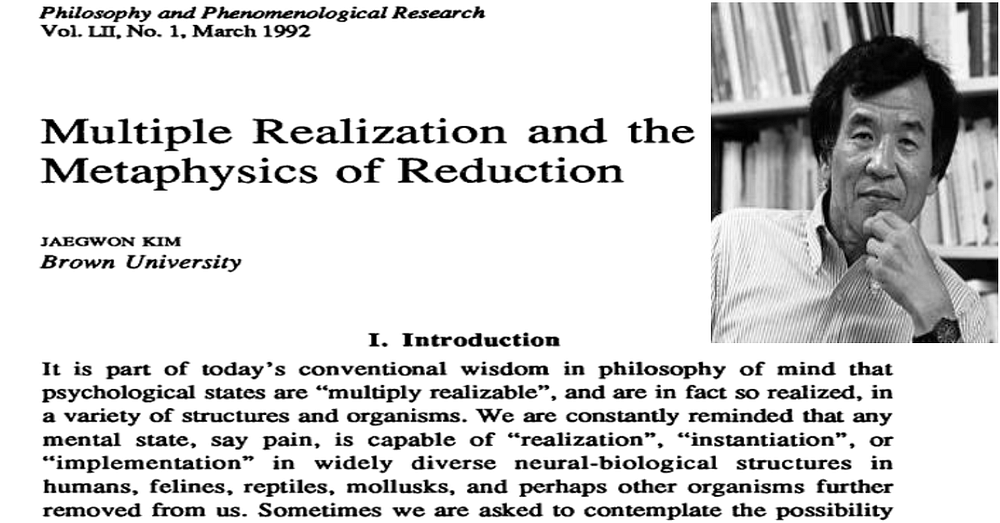
Take, for example, Jaegwon Kim's solution to all this: it seems to be old-style reductionism. Or at least he puts the reductionist position when he says that the “reductionist identifies pain with neural state N”. The question is whether or not pain can be seen functionally. And even if it isn't seen that way, is it still problematic from a scientific point of view?

Kim does argue that pain as a "scientific kind... must go” and that elimination or reduction is the answer. That's primarily because - in Kim's case at least - of the problems associated with what's just been discussed: the multiple realisability of mental kinds in many and various physical substrates.

This is what Kim himself writes on this subject:

.... the frank acknowledgement that MR [multiple realisability] leads to the conclusion that pain as a property or kind must go. Local reduction after all is reduction, and to be reduced is to be eliminated as an independent entity.” (1992)

Kim accepts that pain and mental states/qualities exist: it's just that he doesn't deem them to be scientific kinds or properties.

Functionalist Dualism: Biology & Brains Matter

It's ironic that many of the functionalists and cognitive scientists who accuse all and sundry of being “dualists” should themselves be categorised in this way.

For example, many call John Searle a dualist. Searle, in return, says that those who stress function and ignore biology are effectively creating a non-material Cartesian reality populated with functions or computations (i.e., rather than with “ideas” or “thoughts”). Patricia Churchland, on the other hand, doesn't use the word “dualist”, though she does say the following:

Many philosophers who are materialists to the extent that they doubt the existence of soul-stuff nonetheless believe that psychology ought to be essentially autonomous from neuroscience, and that neuroscience will not contribute significantly to our understanding of perception, language use, thinking, problem solving, and (more generally) cognition.” (1989)

Put that way, it seems like an extreme position. Basically, how could materialists (when it comes to the mind) possibly ignore the brain? It's one thing to say that “psychology is distinct from neuroscience”: it's another thing to say that psychology is “autonomous from neuroscience” and that “neuroscience will not contribute significantly to our understanding” of cognition and whatnot. Sure, the division of labour idea is a good idea. Though to see the “autonomous” in “autonomous science” as being about complete and total independence is surely a bad idea. In fact it's almost like a physicist stressing the independence of physics from mathematics.

Churchland thinks that biology matters. In this, she has the support of many others.

For example, the Nobel laureate Gerald Edelman says that the mind

can only be understood from a biological standpoint, not through physics or computer science or other approaches that ignore the structure of the brain” (1996).

In addition, you perhaps wouldn't ordinarily see Patricia Churchland and John Searle as being bedfellows; though they are on this issue. So it's worth quoting a long passage from Searle which neatly sums up some of the problems with non-biological theories of mind. Searle writes:

I believe we are now at a point where we can address this problem as a biological problem [of consciousness] like any other. For decades research has been impeded by two mistaken views: first, that consciousness is just a special sort of computer program, a special software in the hardware of the brain; and second that consciousness was just a matter of information processing. The right sort of information processing -- or on some views any sort of information processing --- would be sufficient to guarantee consciousness..... it is important to remind ourselves how profoundly anti-biological these views are. On these views brains do not really matter. We just happen to be implemented in brains, but any hardware that could carry the program or process the information would do just as well. I believe, on the contrary, that understanding the nature of consciousness crucially requires understanding how brain processes cause and realize consciousness.. ” (1999)

In a sense, then, if one says that biology matters, one is also saying that functions aren't everything (though not that functions are nothing). Indeed Churchland takes this position to its logical conclusion when she more or less argues that in order to build an artificial brain one would not only need to replicate its functions, but also everything (physical) about it.

Here again she has the backup of Searle. He writes:

Perhaps when we understand how brains do that, we can build conscious artefacts using some nonbiological materials that duplicate, and not merely simulate, the causal powers that brains have. But first we need to understand how brains do it.”

Of course we can say that we can have an artificial mind without having an artificial brain. Though isn't it precisely this position which many dispute (perhaps Churchland does too)?

In any case, to use Churchland's own words on this subject, she says that

it may be that if we had a complete cognitive neurobiology we would find that to build a computer with the same capacities as the human brain, we had to use as structural elements things that behaved very like neurons” (1986).

Churchland continues by saying that

the artificial units would have to have both action potentials and graded potentials, and a full repertoire of synaptic modifiability, dendritic growth, and so forth”.

It gets even less promising for functionalism when Churchland says that

for all we know now, to mimic nervous plasticity efficiently, we might have to mimic very closely even certain subcellular structures”.

Put that way, Churchland makes it sound as if an artificial mind (if not artificial intelligence) is still a pipe-dream.

Readers may also have noted that Churchland was only talking about the biology of neurons, not the biology of the brain as a whole. However, wouldn't the replication of the brain (as a whole) make this whole artificial-mind endeavour even more complex and difficult?

In any case, Churchland sums up this immense problem by saying that

we simply do not know at what level of organisation one can assume that the physical implementation can vary but the capacities will remain the same”.

That's an argument which says that it's wrong to accept the implementation-function “binary opposition” (to use a phrase from Derrida) in the first place. Though that's not to say - and Churchland doesn't say - that it's wrong to concentrate on functions or cognition generally. It's just wrong to completely ignore the “physical implementation”. Or, as Churchland says at the beginning of one paper, it's wrong to “ignore neuroscience” and focus entirely on function.

Churchland puts the icing on the cake herself by stressing function. Or, more correctly, she stresses the functional levels which are often ignored by functionalists.

Take the cell or neurone. Churchland writes that

even at the level of cellular research, one can view the cell as being the functional unit with a certain input-output profile, as having a specifiable dynamics, and as having a structural implementation in certain proteins and other subcellular structures” (1986).

Basically, what's being said here is that in many ways what happens at the macro level of the mind-brain (in terms of inputs and outputs) also has an analogue at the cellular level. In other words, functionalists are concentrating on the higher levels at the expense of the lower levels.

Another way of putting this is to say what Churchland herself says: that neuroscientists aren't ignoring functions at all. They are, instead, tackling biological functions, rather than abstract cognitive functions.

References

- 'Reductionism and Antireductionism in Functionalist Theories of Mind' (1986), in The Philosophy of Mind: Classical Problems/Contemporary Issues (1992/1997), edited by Brian Beakley and Peter Ludlow.
- 'Neural Representation and Neural Computation' (1989)
Edelman, Gerald, quoted in John Horgan's The End Of Science (1996)
Kim, Jaegwon, 'Multiple realization and the metaphysics of reduction' (1992)
- 'Mental Causation' (chapter 6) in his Philosophy of Mind (1996)
Searle, John, 'Consciousness' (1999)
Wilson, E.O., quoted in What Philosophers Think (2003), edited by Julian Baggini and Jeremy Stangroom.
- Consilience: The Unity of Knowledge (1998)

Monday, 27 July 2015

Paul Smolensky: Is Perception or Logical Inference Primary?


What is at the heart of intelligence and cognition?

According to Paul Smolensky, there are two main alternatives or rivals: perception and logical inference.

One can immediately ask if there can be such a simple categorisation, explanation and/or description of something as broad as intelligence or cognition. Of course at a prima facie (empiricist) level one can say that perception doesn’t seem to be cognitive at all. Perception may be a basis for cognition; though is it actually cognition itself?

Logical inference, on the other hand, is clearly cognitive in nature. Yet here again (at least on an empiricist conception) we use logical inferences when responding to our perceptions. Of course perception itself can also be seen as being (or it actually is) cognitively enriched.

Perception

Paul Smolensky (a Professor of Cognitive Science at the Johns Hopkins University and a Partner Researcher at Microsoft Research) deems perception to be “subsymbolic”. Thus if it’s subsymbolic, mustn’t it also be sub-logical or even sub-cognitive? That, of course, raises this question:

Why assume that all cognition (or at least all intelligence) must somehow be symbolic in nature?

That said, x’s being sub-symbolic isn’t the same as it being non-symbolic… Or perhaps it is.

In any case, that which is deemed (by Smolensky) to be subsymbolic is still about the “categorisation of other perceptual processes”. So here is can be seen that perception isn’t viewed as being (as it were) basic or fundamental. It isn’t been said here (as stated earlier) that perception is — in and of itself — a question of logical inferences or cognition. What we have, instead, is the “categorisation [of] perceptual processes”. That means that on this picture there’s categorisation which seems to be above about beyond the perceptions themselves.

Perception and Evolution

There are various things which work to the advantage of seeing things primarily in terms of perception rather than in terms of logical inference.

One way is that logical inference (or, more widely, reasoning) must have come after the “categorisation of perceptual processes” in our evolutionary history. Or as Smolensky puts it:

“An evolutionary argument says that the hard side of the cognitive paradox evolved later, on top of the soft side.”

That must mean that there were cognitive processes which predated the higher processes of logical inference (or reasoning) and indeed of language-use. Surely that must have been the case. Homo sapiens (or the species which grew into homo sapiens) surely couldn’t have been logical reasoners from the very beginning. Again, homo sapiens (or their forbears) couldn’t have started off as language-users or logical reasoners. Indeed all the evidence says that this wasn’t — and indeed couldn’t — have been the case.

Basically, both language and logical inference must have been built upon such things as the (to use Smolensky’s words) categorisation of perceptual processes (as well as upon much else). Thus language use and logical inference — obviously — didn’t occur ex nihilo.

Connectionism, Connectoplasm and Symbols

If this evolutionary account is correct, then it no surprise that

“it is much easier to see how the kind of soft systems that connectionist models represent could be implemented in the nervous system”.

After all, isn’t it the case that our nervous system today is basically as it was before we acquired languages and the skills of logical reasoning? So even though cognition and mentality have changed, our biological hardware hasn’t. Thus if our biological hardware predates symbolic processing, then perhaps our current models should do so too. Symbolisation and computation may be parts of cognition; though the biological nervous system which subserves all this was designed (in the evolutionary sense!) for other things.

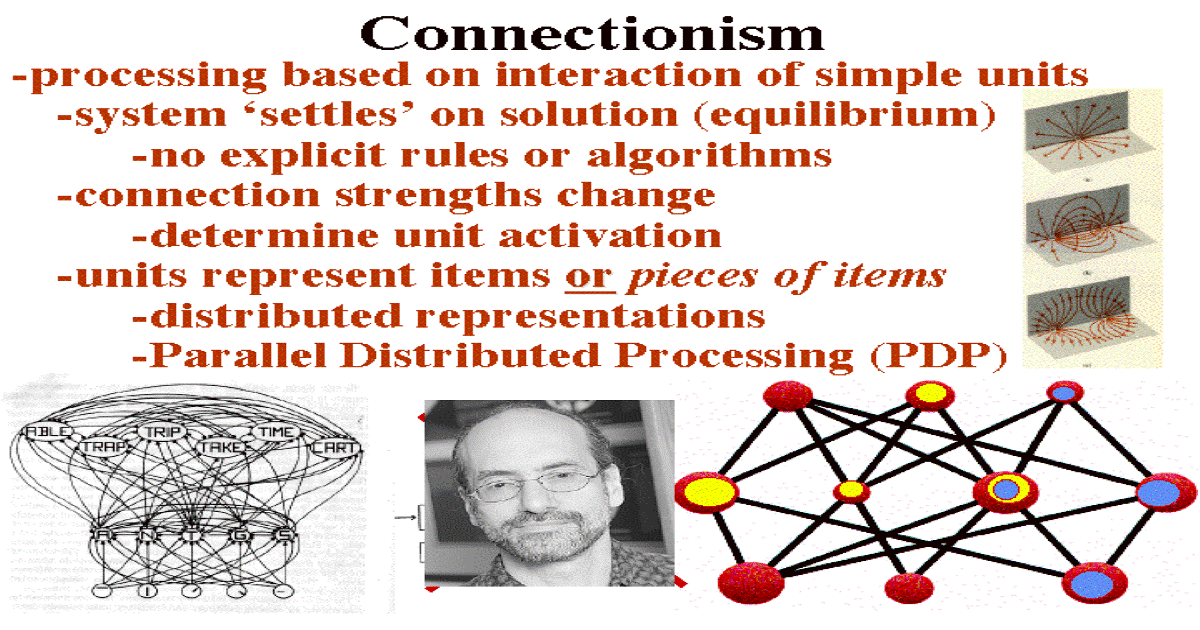
Some people believe that connectionists reject mental symbols and everything that goes with them. And, by virtue of that, they also believe that connectionists reject computation — at least as the primary basis of cognition.

In Smolensky’s case, that isn’t entirely true.

Indeed Smolensky talks about “building symbols” out of “connectoplasm”. In his view, symbols arising from connectoplasm is a better idea than symbols arising from… well, he doesn’t really say: from the Language of Thought or something similarly symbol-based? (Symbols don’t arise from the Language of Thought — they constitute it.)

In any event, Smolensky writes:

“With any luck we will even have an explanation how the brain builds symbolic computation. But even if we do not get that directly, it will be the first theory of how to get symbols out of anything that remotely resembles the brain.”

It’s clear here that Smolensky believes that he’s creating a theory (or model) that’s biologically feasible; unlike many of the alternatives. Of course it will need to be said exactly how and why it’s biologically feasible.

As it is, we can firstly cite J.L. McClelland’s account of this issue here:

“One reason for the appeal of PDP [parallel distributed processing] models is their obvious ‘physiological’ flavor: They seem so much more closely tied to the physiology of the brain than are other kinds of informational-processing models. The brain consists of a large number of highly interconnected elements which apparently send very simply excitatory and inhibitory messages to each other and update their excitations on the basis of these simple messages. The properties of the units in many of the PDP models we will be exploring were inspired by basic properties of the neural hardware.”

We also need to know (in Smolensky’s words) “how the brain builds symbolic computation”. In fact we also need to know exactly what Smolensky means by the words “the brain builds symbolic computation”.

The point to stress here is that Smolensky does believe that the brain builds symbols. So, at the very least, symbols are part of Smolensky’s connectionism.

Despite all that, elsewhere in the same paper Smolensky does indeed play down the importance of symbols. Basically, Smolensky wants “formal accounts [of] continuous mathematics” (see here) rather than the “discrete mathematics [of much] traditional symbolic formalism”. In more detail, Smolensky writes:

“[M]y characterisation of the goal of connectionist modelling is to develop formal models of cognitive processes that are based on the mathematics of dynamical systems continuously evolving in time: complex systems of numerical variables governed by differential equations.”

There’s no mention above of symbols or even of quasi-symbols. In fact this account sounds — strange as it may seem - both mechanical and biological in nature. So why shouldn’t the biological also be seen as mechanical and dynamical? And if we’re talking of the mechanical and the dynamical, then it stands to reason that “numerical variables” and “differential equations” — rather than symbols — will be primary. Indeed it seems that in even simpler terms, all this is more a case of the measurement of dynamical systems rather than the symbols themselves (i.e., within a symbol-system — e.g., the mind/brain).

It may appear to the case that causation is also of prime importance in Smolensky’s scheme. That is, we have the numerical measurements of the interplay between the environment (in terms of input) and a dynamical system which results in certain internal states and then certain kinds of output.

Main Reference:

Smolensky, Paul, ‘The Constituent Structure of Connectionist Mental States: A Reply to Fodor and Pylyshyn’ (1988)

[I can be found on Twitter here.]

Jaegwon Kim's Case Against a Science of Pain

On epiphenomenalism? The Korean-American philosopher argued that pain isn’t a “scientific kind”. He didn’t also argue that people don’t feel pain.

Symbols:

N = a particular neural state
P = a particular pain
W = a particular wince

Causal Overdetermination?

The philosopher Jaegwon Kim (1934–2019) argued that a particular neural state (symbolised N) is what he called the “supervenience base” of my toothache.

I winced (W) because of my toothache (P).

What caused that wince?

Surely it must have been the pain that caused me to wince. Jaegwon Kim, on the other hand, believed that it’s a particular neural state that caused me to wince. More radically, as Kim himself put it, N is “causally sufficient for wincing”.

So was there a difference between the neural state N and the experience of the toothache?

If N and P are two different (as it were) things, then both N and P (the pain) might have caused me to wince. However, according to Kim, this would be a case of something being “causally overdetermined”.

Yet why does it automatically follow that if two things cause a third thing, that this third thing is causally overdetermined? That is, doesn’t it sometimes take two or more things to cause a third thing? In fact, can’t there can be very many causal conditions which are required to bring about a particular effect?

A simple answer to the passage above is this:

If x is causally necessary and sufficient to bring about y, then x is all that’s required to bring about y.

Of course overdetermination has been widely discussed in philosophy. (For example, in the ontology of objects and in the philosophy of science.) However, Kim doesn’t got into detail on this. The following is probably the reason why.

If P and N are one and the same thing, then to say that both P and N (as separate phenomena) cause W is a case of overdetermination because… well, they’re the same thing. However, that’s not actually causal overdetermination: it’s thinking that one thing is two things. Thus, in actual fact, there’s no genuine overdetermination at all here.

In any case, there’s an alternative to this possible overdetermination which involves a three-way journey from N to the wincing.

We can have a chain from N to P… and then to W. Yet Kim says that N and P are perfectly simultaneous. There’s no causal journey from N to P because they occur at one and the same time…

… But do they?

It’s indeed the case that human cognition can’t register the time-lapse between N and P; though that doesn’t mean that there is no time-lapse. The interval may be milliseconds or less. And even if only a millisecond, that would still have constituted a temporal and “causal gap” between N and P.

Kim completely rejects this causal gap. Indeed he doesn’t even discuss the possibility that it may exist. Instead, he argues that P “supervenes on” (or is “realised by”) a neural state: it’s “not caused by” N.

Thus, in Kim’s eyes, supervenience isn’t a relation of causation.

When argued argued that P supervenes on N, then that didn’t also mean that N causes P. It simply meant that P supervenes on N

But what exactly does that mean?

Can such supervenience occur without causation? But if it does, then how and why is that the case? And if this applies to the relation between N and P, then does it also apply to all mental states and their supervenience-bases?

For example, say I formed a mental image of Johnny Depp. That means that I can’t say that neural or (brain state) N caused my mental image of Depp. All I can say is that the mental image supervenes on a particular neural state…

Though, again, what exactly does that mean?

So what plays the main “causal role” when it comes to my wincing? Is it N or P?

What is the Causal Role of Pain?

If N doesn’t cause P (i.e., if P supervenes on N), then perhaps that question doesn’t make sense. Perhaps both N and P caused W. However, Kim has just argued that this is a case of overdetermination. And, if that’s the case, then wouldn’t that mean that Kim wanted to (somehow) get rid of pain (or get rid of this specific P, e.g., my toothache)?

Kim couldn’t get rid of N because there’d be no pain without a neural state. So could he get rid of the pain itself? Surely not. Would I have winced without a (mental) pain? Of course not… surely.

Kim, at a prima facie level, didn’t seem to want to get rid of P. Or at least he wrote that “if we trace the causal chain backward from the wincing, we are likely to reach N first, not the pain”. Indeed he continued by arguing that it’s

“incoherent to think that the pain somehow directly, without an intervening chain of physiological processes, acted on certain muscles, causing them to contract; that would be telekinesis, a strange form of action at a distance!”.

This seems to be a denial that something that’s purely mental can act on the physical. Or, at the least, it’s a argument that the mental can only act on the physical if the mental is itself physical. (Or, in this case, if the mental supervenes on the physical.) So Kim rejected what can be seen as the Cartesian or dualist position. Indeed Kim argued that something purely mental acting on the physical (in this case, on muscles) would be like “telekinesis” or “action at a distance”. The only way out of that would be to see the mental and physical as one — otherwise we would indeed have telekinesis or action at a distance.

Again, it must now be said that Kim didn’t reject either pain or the mental generally. Instead, he argued that

“if the pain is to have a causal role, it must somehow ride piggyback on the causal chain from N to the wincing”.

[We’d need to discover what exactly the words “pain riding piggyback on N” actually mean.]

As stated, Kim firmly rejected what he called the overdetermination that is “two independent causal paths”. That would be a path from N to the wincing and another path from P to the wincing”. The simple way out is to see N and P as one.

But how can a neural state and pain be as one?

This was the position adopted by the old-style identity theorists (or “type physicalists”) of the 1950s and 1960s. The main difference with Kim, it seems, is the introduction of the notion of supervenience. However, is the notion of supervenience satisfactory and/or acceptable?

In any case, one obvious conclusion to all this is to argue that P is epiphenomenal. And that’s what Kim did argue.

Is Pain Epiphenomenal?

Is there a difference between the following? -

(1) P supervenes on N.
(2) P is epiphenomenal.

In other words, if P is truly epiphenomenal, then it is (to use Kim’s words) “wrong to think of pain as a causal effect of N”? In fact earlier in the paper, Kim himself cited an analogical case. He referred to the shadows of a moving car. He wrote:

“The shadows are caused by the moving car but have no effect on the car’s motion. Nor are the shadows at different instants causally connected [].”

And then Kim compared the car’s shadows with someone’s toothache. He continued:

“Similarly, you may think that the pain in your tooth has caused your desire to take aspirin, but that, according to epiphenomenalism, would be a mistake: Your toothache and your desire for aspirin are both caused by brain events, which themselves may be causally connected, but the two mental events are not related as cause to effect any more than two successive car shadows.”

So if all that’s the case, then what purpose does the pain actually serve? After all, according to Kim, it’s

[b]eing real and having causal powers go hand in hand; to deprive the mental of causal potency is in effect to deprive it of its reality”.

[The problems with the view above is that it would make numbers, past events, propositions, etc. unreal too.]

Indeed without the pain working as a genuine cause, aren’t we talking here about a simple mechanical cause and effect without the interaction of any kind of mentality? If the actual tooth… ache, in this instance, has no causal role, then what role does it play?

Reductionism or Eliminativism?

Jaegwon Kim’s solution to all this seems to be reductionism. Or at least he puts the reductionist position when he says that the “reductionist identifies pain with neural state N”.

In another paper, Kim did argue that pain as a “scientific kind [] must go” and that reduction is the answer.

Pain — at least as a scientific kind — must go primarily because (in Kim’s case at least) of the problems associated with the multiple realizability of mental kinds in many and various physical substrates. This is what Kim himself wrote on that subject:

[T]he frank acknowledgement that MR [multiple realizability] leads to the conclusion that pain as a property or kind must go. Local reduction after all is reduction, and to be reduced is to be eliminated as an independent entity.”

As already stated, it’s clear that Kim accepted that pain and mental states (or qualities) exist: it’s just that he didn’t also deem them to be scientific kinds or properties.

However, when putting his case, Kim identified P with N — but with the addition of supervenience. (Unless, of course, such a reduction can exist side-by-side with supervenience.)

In any case, Kim happily finished off by arguing that

“reductionism has been rejected by the majority of philosophers of mind for what they take to be compelling reasons”.

References

Kim, Jaegwon, ‘Multiple realization and the metaphysics of reduction’ (1992)


[I can be found on Twitter here.]


Friday, 24 July 2015

Kantian Experience in Contemporary Jargon


There are philosophers who claim that there's such a thing as “non-conceptual experience”. Christopher Peacocke, for example, says that there are experiences “with non-conceptual contents” (1992). That is, concepts don't wholly or partly determine all mental contents.

Perhaps Kant was correct about experience. He argued that we apply certain “a priori concepts” or “categories” automatically: i.e., non-cognitively. It can be added here that we may also apply non-Kantian contingent concepts in such a way. It may follow from this that there's no such thing as non-conceptual experience.

One may consequently ask what a baby experiences or sees. The Kantian “manifold”? Not according to Kant himself. The reason being that the baby’s “cognitive faculties” (in contemporary terms), or its “transcendental a priori structures” (in Kantian terms), are already determining the baby's experience of the world according to necessary concepts or categories.

The Kantian scheme is broadly correct; although we shouldn’t adhere too zealously to the letter.

Take this un-Kantian way of putting things.

The innate neurophysiological structures determine the mental concepts and the mental concepts (applied non-cognitively) determine both perceptual experience and linguistic categories (such as subject/object/substance, cause and effect, temporal sequence, spatial ordering etc.).

What if we aren’t a Kantian in the above sense?

Take the following as a piece of a priori theorising about the experiences of a baby.

Babies must have non-linguistic concepts and categories. That of an object and event for a start (this is still a Kantian position).

Take the mothers of babies.

Of course babies don’t at first use the word “mama”, for example; though they may well have a concept of the object they will later call “mama”. That is, mama is individuated, differentiated and perhaps identified (somehow) as the object that will be called “mama” in the future. Babies may even have non-linguistic conceptual criteria of identity for mama. Indeed they must have conceptual criteria of identity in order to individuate mama from, say, the chair on which she sits. They don’t, after all, smile at the chair.

So babies must have the concept [mamma] before they can use the name “mama” otherwise they couldn’t use “mama” to refer to mama. The word 'mama' itself doesn’t individuate mama. The word 'mama' refers as much to the concept [mama] as it does to the object mama. Without all this, there would be an object to the baby; though it wouldn’t be mama.

It may, of course, be difficult to accept non-linguistic conceptual criteria of identity. Can we make sense of non-linguistic concepts and criteria of identity (therefore, non-linguistic individuation)? Of course we can. Take the case of my parents’ dog.

This dog, Joe, knows who I am. It doesn’t have a language. How does it recognise me? By individuating me from other persons and objects by applying conceptual criteria of identity to the object humans call “Paul Murphy”. The possible conceptual criteria of identity Joe applies to Paul Murphy may be [a particular smell], [particular clothes], [facial features] and [a particular voice].

Joe, the dog, has also individuated and applied criteria of identity to events.

For example, (my) picking up the dog chain must be a specific individuated event for the dog. This event “means”, to Joe, that it will be going for a walk (itself an individuated event). Possible conceptual criteria of identity for the dog chain event for Joe could be [the noise of the dog chain], [my picking it up] and [my going into the hallway].

This is a quasi-Kantian position on experience. Kant himself, in his Prolegomena To Any Future Metaphysics, wrote:

“…concepts…under which every perception must be first of all subsumed and then by their means changed into experience.”

And elsewhere:

“…perception can never work as experience without the law that, wherever an event is observed, it is always referred to some antecedent…”

Kant’s passages are, of course, referring to a priori necessary concepts of experience (e.g. [cause-effect], [substance] [object], etc.), which are automatically or non-cognitively applied to sensations. But the passages could equally apply to a posteriori contingent concepts; which are also sometimes non-cognitively “applied” - though often cognitively applied too.

For example, I cognitively apply the new concept [lad] to a young man of a certain kind; though I don’t always cognitively apply the concept [crash] to a crash. Although the concept [crash] is a posteriori and contingent, a crash is an [event], which is a Kantian concept, and therefore a priori and necessary.

Jennifer Church writes:

To those of us with Kantian sympathies…it seems that a state…cannot count as an ‘experience’…unless it is a certain way for, or to as a subject.” (1995)

This isn’t just a pedantic conceptual point that the word 'experience' means what Kant says it means. It's to say that there's no such thing as nonconceptual… whatever you want to call it.

One can take a quasi-Kantian position on experience without using Kant’s own terms or indeed philosophical terms at all. For example Michael Tye writes:

“…[in] very early vision…categorisations are automatic [non-cognitive]. They do not demand that the creature have beliefs or thoughts…” (Tye, 1990)

However, Tye goes on to say, about animals, that

some…further categorizations…do so without the essential involvement of concepts (understood as involving a public language or thought…”

Surely Kantian a priori concepts wouldn’t need a “public language”; and neither would the kind of animal concepts acknowledged later.

Perhaps Tye precludes such “categorisations” as conceptual because they are “automatic”: i.e., non-cognitive and therefore a priori. Though there's no antecedent reason why concepts shouldn’t be automatic and non-cognitive. Indeed we even apply contingent non-Kantian concepts non-cognitively, such as the concept [crash], which is based on the Kantian concept [event]. In any case, an animal is still seeing an object as a particular object or an event as a particular event. And this is where Tye does indeed use a near-Kantian term – “categorization”. Through the Kantian categories, minds/persons individuate objects and events.

A person could have experienced a murder and not experienced it as a murder. This doesn’t mean that no concepts were applied to that event or experience. He certainly experienced it as something. A dog that experienced the murder wouldn't have experienced it as a murder. It would, however, have applied concepts to it. It would have experienced it as an individuated and therefore a determinate event. (It may have been frightened by it.)

The upshot is that (Kantian) experience needn't be propositional or linguistic; though it must be conceptual.

                                 ********************************************************

Note: the above was written in 2005/6. Hilary Putnam, for example, radically contradicts the position I adopted at that time. For example, in Putnam's paper 'What Is Innate and Why: Comments on the Debate' (1980), he writes:

... to have a concept is to have mastered a bit of theory, that is, to have acquired the characteristic uses of such expressions as... and some key beliefs, expressed by sentences involving such expressions, or equivalent symbolism.”

However, later he writes:

I don't claim that all concepts are abilities to use symbolism; an animal that expects the water to reach the same height when it is poured from a pot back into the glass might be said to have a minimal concept of conservation, but I claim that anything like the full concept of conservation involves the ability to use symbolism with the the complexity of language in certain ways.”

References

Church, Jennifer, 'Fallacies or Analyses?' (1995)
Kant, Immanuel, A Prolegomena to Any Future Metaphysics (1783/2004)
Peacocke, Christopher, A Study of Concepts (1992)
Tye, Michael, 'A Representational Theory of Pains and Their Phenomenal Character' (1990)