Saturday, 26 September 2015

Ladyman & Ross's Philosophy of Physics: Ontology (5)


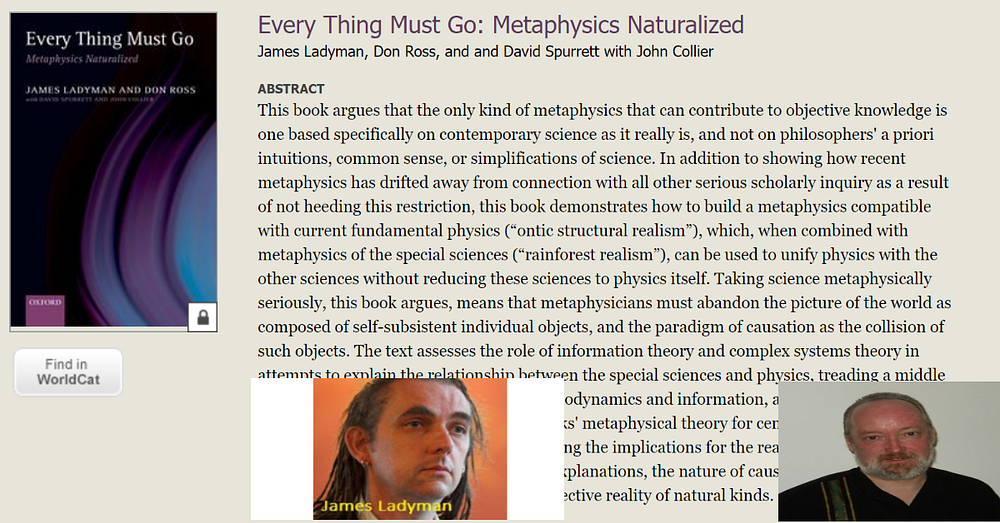
These pieces are primarily commentaries on the 'Ontic Structural Realism and the Philosophy of Physics' chapter of James Ladyman and Don Ross's book Every Thing Must Go. There are also a handful of references to – and quotes from – other parts of that book.

                                *****************************************************
  
Ladyman and Ross (L & R) offer a list of four statements which they believe summarise the position of “standard metaphysics”.

Take (i).

    (i) “There are individuals in spacetime whose existence is independent of each other. Facts about the identity and diversity of these individuals are determined independently of their relations to each other.”

The problem is how to take the word “independent” in the above. One can accept individuals and also believe they that they aren't independent of other individuals. That is, the existence of individuated objects and their lack of independence aren't mutually exclusive. What's more, one can accept the “identity and diversity of these individuals” and also deny that such “individuals are determined independently of their relations to each other”. In other words, I don't see why a commitment to individuals necessarily means that one also accepts their complete independence from all other individuals (or from events, processes, conditions, states, etc.).

In addition, it's simply false that metaphysicians have accepted all that's claimed in (i). Randomly, take the various monists in history and philosophers like Bradley and A.N. Whitehead. They certainly didn't believe that individuals are “independent of each other”.

What about L & R's second statement? They say that “standard metaphysicians assume” the following:

    (ii) “Each has some properties that are intrinsic to it.”

Here again what was said about claim (i) partly goes for claim (ii) as well. Throughout the history of Western metaphysics there have been metaphysicians who would now be classed as anti-essentialists. Indeed we could go back to Heraclitus to find anti-essentialists (or at least to find proto anti-essentialists).In addition, we had the medieval nominalists. Come the 20th century, there have been many anti-essentialist metaphysicians and philosophers.

What do essentialists believe? That an individual “has some properties that are intrinsic to it”. In addition, some of the ontologists who've (broadly speaking) accepted the bundle theory of individuals could also be classed as anti-essentialists. (In that they would have denied the statement that each individual must have at least some intrinsic properties.)

Discernibility and Individuality

One method for distinguishing two objects is basically Quine's reworking of Leibniz. Quine called it “absolute discernibility”. L & R express his position this way:

Quine called two objects... absolutely discernible if there exists a formula in one variable which is true of one object and not the other.”

This is a reworking of Leibniz (with the addition of references to “formulas”) thus:

(x) (y) (F) (x = y ⊃. F (x) ≡ F (y).)

One way a and b can be deemed to be “absolutely discernible” is if they “occupy different positions in space and time”.

Now for “relatively discernible”.

According to L & R,

[m]oments in time are relatively discernible since any two always satisfy the ‘earlier than’ relation in one order only”.

This clearly makes a moment in time relational in nature. Or at least its relatively discernible nature is accounted for by its relational nature (i.e., ‘earlier than’, 'later than', etc.).

What's just been said about time is similar to what's also said about space (as well as the “mathematical objects” which measure it). L & R write:

An example of mathematical objects which are not absolutely discernible but are relatively discernible include the points of a one-dimensional space with an ordering relation...”

More precisely,

... for any such pair of points x and y, if they are not the same point then either x > y or x < y but not both.”

Here there's a fusion of points in space with moments in time. Thus x and y are absolutely discernible because x is before (or “earlier than”) y or x is after (or “later than”) than y. In other words, x can't be both earlier than and later than y (as well as vice versa) at one and the same time.

Now let's take L & R's definitions of discernibility and individuality. They write:

The former epistemic notion concerns what enables us to tell that one thing is different from another. The latter metaphysical notion concerns whatever it is in virtue of that two things are different from one another, adding the restriction that one thing is identical with itself and not with anything else.”

At first glance these definitions come across as two different ways of saying the same thing. Clearly the second definition (“whatever it is in virtue of that two things are different from one another”) is ontological in character and the former (“what enables us to tell that one thing is different from another”) is, as L & R say, epistemic. However, don't the two definitions fuse? That is, in order to know “whatever it is in virtue of that two things are different from one another” (an ontological fact) one would need to employ the epistemic tools which “enable us to tell that one thing is different from another”. Thus the ontological question merges with the epistemological question (or vice versa).

Black's Spheres, Substantivalism & Relationalism

We can say that because of the spatial differences between Max Black's two spheres (in his well-known thought experiment), sphere a and sphere b would only be classed as “weakly discernible” on L & R's picture.

L & R make Max Black's example more concrete (as well as scientific) by talking about fermions instead of spheres (which are a mile apart). According to L & R:

Clearly, fermions in entangled states like the singlet state violate both absolute and relative discernibility...”

Fermions “in entangled states like the singlet state” aren't absolutely discernible because there are neither spatial nor temporal means to disentangle each fermion from other fermions. (Hence the technical term “entanglement”.) However, Max Black's two spheres are also spatially indiscernible in that they're in constant movement around a figure of eight. Thus sphere a would be continuously occupying a spacial point which had only just been occupied by sphere b – as well as vice versa. (The only way out of this would be to either literally or imaginatively freeze the movements of both spheres – though surely that's unacceptable.)

One problem which can be raised about objects (as well as about L & R's position on objects) can be expressed by stating two positions:

i) Objects have their intrinsic natures independently of the rest of the world.

ii) Objects can exist independently of the rest of the world.

This problem specifically arises in the context of “points of spacetime” rather than objects. (Although it may be said that they amount to the same thing.) In this case, L & R use the word “exist” (as in ii) above). This is also a product of two different positions: substantivalism and relationalism. Thus:

i) According to substantivalism the “points of the spacetime manifold exist independently of the material contents of the universe”.

    ii) According to relationalism “spatio-temporal facts are about the relations between various elements of the material contents of spacetime”.

The idea that “points of the spacetime manifold exist independently of the material contents of the universe” sounds a little like David Lewis's take (1982) on intrinsic properties. Lewis wrote:

A thing has its intrinsic properties in virtue of the way that thing itself, and nothing else, is.”

Lewis's position (if not the substantivalist position) can be taken to its most extreme in the following statement:

Object a would still have intrinsic property P if, after the world around it disappeared, a would still have P.

In L & R's rendition of substantivalism, it's said that an object or point in spacetime could “exist” regardless of everything else. Could there ever be “the way that a thing itself is” regardless of everything else? That is, can object a be the way that it is regardless of its relations to other properties/objects/events, its place in time and space and so on?

References

Ladyman, James, Ross, Don. (2007) Every Thing Must Go: Metaphysics Naturalised.
Lewis, David. (1982) 'Extrinsic Properties'.
Quine, W. V. O. (1976) 'Grades of Discriminability'.


Ladyman and Ross's Philosophy of Physics: Particles (4)

James Ladyman and Don Ross argue that particles can’t be individuated without reference to external and relational factors. (All particles are parts of package deals.) So, to them, this means that particles simply aren’t “things” at all.

This essay is a commentary on the ‘Ontic Structural Realism and the Philosophy of Physics’ chapter of James Ladyman and Don Ross’s book Every Thing Must Go: Metaphysics Naturalised. (There are also a handful of references to — and quotes from — other parts of that book.)

The rather pompous term “ontic structural realism” basically refers to a realism about structures, not a realism about what the authors call “things” (i.e., things such as particles… or anything else other than structures).

*********************************

The philosophers James Ladyman and Don Ross’s philosophy of physics is primarily motivated by the findings and theories of quantum mechanics. Elements of their position can be traced back to — among others — the German philosopher Ernst Cassirer (who died in 1945).

Ladyman and Ross have much to say about Cassirer. For example, they wrote the following:

“OSR [ontic structural realism] agrees with Cassirer that the field is nothing but structure. We can’t describe its nature without recourse to the mathematical structure of field theory.”

Some readers may wonder what the words “nothing but structure” actually mean.

The usual assumption is that there can only be a structure if there are things (of some kind) that make up (or are part of) that structure. That said, this may be one of those everyday “intuitions” which the authors warn us against. Hopefully, Ladyman and Ross’s position on the nature of structure will become clear in the following. In addition, the phrase “[w]e can’t describe [a field’s] nature without recourse to the mathematical structure” is fairly commonplace — at least within physics — and has been since the late 19th century.

What Ladyman and Ross say about Ernst Cassirer’s position on objects (or “things”) is almost exactly the same as their own position on objects. Indeed it was also quantum mechanics which provided Cassirer himself with the motivation to reject (what Ladyman and Ross call) “individual objects”. Ladyman and Ross write:

“Ernst Cassirer rejected the Aristotelian idea of individual substances on the basis of physics, and argued that the metaphysical view of the ‘material point’ as an individual object cannot be sustained in the context of field theory. He offers a structuralist conception of the field.”

It may seem odd that, at least within the context of 20th-century physics, an “Aristotelian idea” is being discussed at all. Not only that: we also have the technical philosophical term individual substance too. That said, these are the words of two philosophers of physics, not the words of two physicists.

One can firstly ask whether or not a commitment to the existence of objects (or things) is also automatically a commitment to “individual substances”; as well as to intrinsic (or essential) properties. After all, the bundle theory (among other theories) rejects the notion of substance; though not that of an individual.

We can also ask whether or not these positions are equally applicable to objects in the “classical” (or macro) world. Let’s put it this way. Cassirer’s, Ladyman’s and Ross’s positions are far more acceptable when applied the the quantum world than when applied to the classical world. More precisely, all this is far easier to swallow in the (to use Ladyman and Ross’s words) “context of field theory” than it is in relation to human persons, cups or trees.

Essential and Intrinsic Properties?

It does seem strange (if only intuitively strange) that all “quantum elementary particles of a given type” are deemed to “have the same mass, size, and shape (if any), charge, and so on”. As it is, mass, size and charge are (essentially) seen as intrinsic properties. In fact it’s hard to imagine elementary particles having other (i.e., inessential) properties. After all, we’re not talking about classical objects here. So one can also easily imagine a natural kind having essential properties; though, when it comes to a particular member of that kind, having contingent properties too.

Can we also imagine an elementary particle having contingent properties?

If such particles don’t have such contingent properties (due to the nature of the micro-world), then it may literally be the case that the set {mass, size, charge} is all there is to them. Thus essentialism of some kind may be an easier option to uphold for particles than it is for classical objects such as lions or even a given sample of water.

That said, Ladyman and Ross do cite examples of what can be taken as a particle’s accidental properties. They cite “velocity or position at a particular time”. Indeed, in commonsense terms, it can be doubted that anyone would take the position or velocity of a particle at a particular time as being anything other than an “accidental” property. (Could it be that physicists could take a particular velocity — or at least mean velocity — of a type of particle to be essential to it?)

From what’s just be said, it’s therefore no surprise that different particles of the same type can be seen as what Ladyman and Ross call “indistinguishable”. However, particles may still have properties which aren’t intrinsic. That is, they may have properties which are relational or extrinsic.

Ladyman and Ross cite “spatio-temporal or other state-dependent properties” as examples.

In terms of spatio-temporal properties.

Does that mean that particles are even more likelier candidates for being four-dimensional objects than classical objects (see ‘Four-dimensionalism’)?

As for state-dependent properties .

That must mean that the nature of a particle must necessarily depend on the parallel (or corresponding) nature of the “state” (or system) to which it belongs.

Individuals?

Ladyman and Ross give a very concrete example of the physics which underlies the problematic nature of seeing elementary particles as single entities.

Firstly, they put the position of classical physics:

[C]lassical physics assumed a principle of impenetrability, according to which no two particles could occupy the same spatio-temporal location. Hence, classical particles were thought to be distinguishable in virtue of each one having a trajectory in spacetime distinct from every other one.”

Clearly, in quantum mechanics, many — or all — the assumptions in the classical picture above are rejected. (At the least, on some interpretations of quantum mechanics all these assumptions are rejected.)

Firstly, the “principle of impenetrability” is either questioned or rejected.

On the classical picture, if particles are impenetrable, then that means that “no two particles could occupy the same spatio-temporal location”. On the other hand, if particles are penetrable (or if the notion of penetrability does make sense), then one can conclude that two particles “could occupy the same spatio-temporal location”.

Thus one can immediately ask the following question:

If two particles occupy the same spatiotemporal location, then is it correct to talk about two particles in the first place?

In consequence, the second part of the classical picture is either rejected or questioned. That second part (which follows from the first) is that

“classical particles were thought to be distinguishable in virtue of each one having a trajectory in spacetime distinct from every other one”.

Clearly, if the penetrability argument is true and two particles may occupy the same location, then each particle can’t be seen to have its own trajectory in spacetime. In other words, it will share that trajectory with other particles.

This has the result that the Leibnizian picture breaks down in the case of quantum mechanics. Or as Ladyman and Ross put it:

“Thus for everyday objects and for classical particles, the principle of the Identity of Indiscernibles is true [].”

It can now be shown that the notion of a field plays an important part in Ladyman and Ross’s philosophy.

Particles as Package Deals

The central argument is that fields and particles are intimately connected. Indeed they’re so strongly connected that a distinction between the two hardly seems warranted.

Firstly, there’s the problem of distinguishing a particle from the state it (as it were) belongs to. Thus, in an example given by Ladyman and Ross, we can interpret a given field/particle situation in two ways:

1) A two-particle state.
2) A single state in which two “two particles [are] interchanged”.

Since it’s difficult to decipher whether it’s a two-particle state or a single state in which two particles are interchanged, Ladyman and Ross adopt the “alternative metaphysical picture” which “abandons the idea that quantum particles are individuals”. Thus all we have are states. This means that the “positing individuals plus states that are forever inaccessible to them” is deemed (by Ladyman and Ross) to be “ontologically profligate”.

Ladyman and Ross back up the idea that states are more important than individuals (what’s more, that there are no individuals) by referring to David Bohm’s theory. In that theory we have the following:

“The dynamics of the theory are such that the properties, like mass, charge, and so on, normally associated with particles are in fact inherent in the quantum field and not in the particles.”

All this means that mass, charge, etc. are properties of states, not of individual particles. However, doesn’t this position (or reality) have the consequence that a field takes over the role of an individual (or of a collection of individuals) in any metaphysics of the quantum world? Indeed doesn’t that also mean that everything that was said about particles can now be said about fields?

On Bohm’s picture ( if not Ladyman and Ross’s), “[i] t seems that the particles only have position”. Yes; surely it must be a particle (not a field) which has a position. Indeed particles also have trajectories which account for their different positions at different times.

To Bohm, “trajectories are enough to individuate particles”. It’s prima facie strange how trajectories can individuate. Unless that means that each type of particle has a specific type of trajectory. Thus the type of trajectory will tell us which type of particle is involved in that trajectory.

Ladyman and Ross spot a problem with Bohm’s position. That problem is summed up in this way:

If all we have is trajectory (as with structure), then why not dispense with particles (as individuals at least) altogether?

This is how Ladyman and Ross explain their stance on Bohm’s theory:

“We may be happy that trajectories are enough to individuate particles in Bohm theory, but what will distinguish an ‘empty’ trajectory from an ‘occupied’ one?”

Here again Ladyman and Ross are basically saying that if all we’ve got are trajectories (which is part of the structure?), then let’s stick with trajectories and eliminate particles (as individuals) altogether.

Ladyman and Ross go into more detail on this by arguing that

[s]ince none of the physical properties ascribed to the particle will actually inhere in points of the trajectory, giving content to the claim that there is actually a ‘particle’ there would seem to require some notion of the raw stuff of the particle; in other words haecceities seem to be needed for the individuality of particles of Bohm theory too”.

Of course most physicists would have no time for a term like “haecceities”, but if Ladyman and Ross’s physics is correct, then what they say makes sense. Positing particles seems to run free of Occam’s razor. In other words, Bohm was (to mix two metaphors) filling the universe’s already-existing ontological slums with yet more superfluous entities .

One way of interpreting this position is by citing two different positions. Thus:

1) The positing of particles as individuals which exist in and of themselves.
2) The positing of particles as part of package deals which include fields, states, trajectories, etc.

Then there’s Ladyman and Ross’s position.

3) If there are never particles in splendid isolation (apart from fields, etc.), then why see particles as individuals in the first place?

Ladyman and Ross are a little more precise as to why they endorse 3) above. They make the metaphysical point that “haecceities seem to be needed for the individuality of particles of Bohm’s theory too” (see ‘Haecceity’). In other words, in order for particles to exist as individuals (as well as to be taken as existing as individuals), such particles will require what Ladyman and Ross call “individual essences” in order to be individuated. However, if the nature of a particle necessarily involves fields, states, other particles, trajectories, etc., then it’s very hard (or impossible) to make sense of the idea that it could have an individual essence.

To sum up. A specific particle is always part of a package deal. Indeed all particles simply can’t be individuated without reference to external, extrinsic or relational factors. Thus particles simply aren’t individuals (or things) at all.