Monday, 27 July 2015

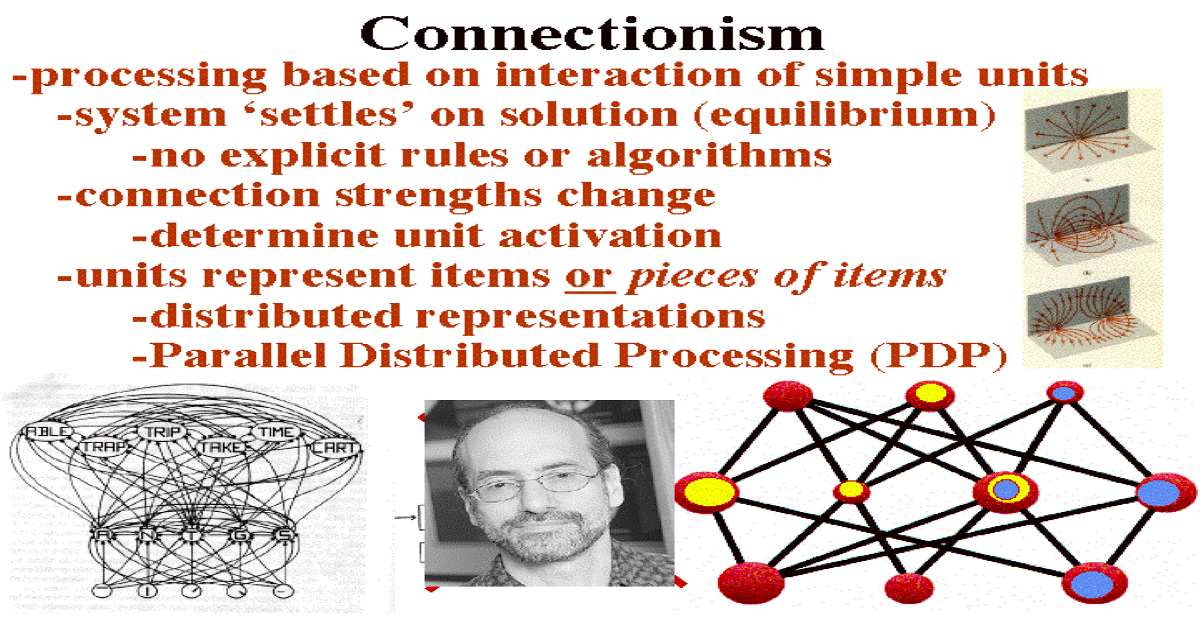
Paul Smolensky: Is Perception or Logical Inference Primary?


What is at the heart of intelligence and cognition?

According to Paul Smolensky, there are two main alternatives or rivals: perception and logical inference.

One can immediately ask if there can be such a simple categorisation, explanation and/or description of something as broad as intelligence or cognition. Of course at a prima facie (empiricist) level one can say that perception doesn’t seem to be cognitive at all. Perception may be a basis for cognition; though is it actually cognition itself?

Logical inference, on the other hand, is clearly cognitive in nature. Yet here again (at least on an empiricist conception) we use logical inferences when responding to our perceptions. Of course perception itself can also be seen as being (or it actually is) cognitively enriched.

Perception

Paul Smolensky (a Professor of Cognitive Science at the Johns Hopkins University and a Partner Researcher at Microsoft Research) deems perception to be “subsymbolic”. Thus if it’s subsymbolic, mustn’t it also be sub-logical or even sub-cognitive? That, of course, raises this question:

Why assume that all cognition (or at least all intelligence) must somehow be symbolic in nature?

That said, x’s being sub-symbolic isn’t the same as it being non-symbolic… Or perhaps it is.

In any case, that which is deemed (by Smolensky) to be subsymbolic is still about the “categorisation of other perceptual processes”. So here is can be seen that perception isn’t viewed as being (as it were) basic or fundamental. It isn’t been said here (as stated earlier) that perception is — in and of itself — a question of logical inferences or cognition. What we have, instead, is the “categorisation [of] perceptual processes”. That means that on this picture there’s categorisation which seems to be above about beyond the perceptions themselves.

Perception and Evolution

There are various things which work to the advantage of seeing things primarily in terms of perception rather than in terms of logical inference.

One way is that logical inference (or, more widely, reasoning) must have come after the “categorisation of perceptual processes” in our evolutionary history. Or as Smolensky puts it:

“An evolutionary argument says that the hard side of the cognitive paradox evolved later, on top of the soft side.”

That must mean that there were cognitive processes which predated the higher processes of logical inference (or reasoning) and indeed of language-use. Surely that must have been the case. Homo sapiens (or the species which grew into homo sapiens) surely couldn’t have been logical reasoners from the very beginning. Again, homo sapiens (or their forbears) couldn’t have started off as language-users or logical reasoners. Indeed all the evidence says that this wasn’t — and indeed couldn’t — have been the case.

Basically, both language and logical inference must have been built upon such things as the (to use Smolensky’s words) categorisation of perceptual processes (as well as upon much else). Thus language use and logical inference — obviously — didn’t occur ex nihilo.

Connectionism, Connectoplasm and Symbols

If this evolutionary account is correct, then it no surprise that

“it is much easier to see how the kind of soft systems that connectionist models represent could be implemented in the nervous system”.

After all, isn’t it the case that our nervous system today is basically as it was before we acquired languages and the skills of logical reasoning? So even though cognition and mentality have changed, our biological hardware hasn’t. Thus if our biological hardware predates symbolic processing, then perhaps our current models should do so too. Symbolisation and computation may be parts of cognition; though the biological nervous system which subserves all this was designed (in the evolutionary sense!) for other things.

Some people believe that connectionists reject mental symbols and everything that goes with them. And, by virtue of that, they also believe that connectionists reject computation — at least as the primary basis of cognition.

In Smolensky’s case, that isn’t entirely true.

Indeed Smolensky talks about “building symbols” out of “connectoplasm”. In his view, symbols arising from connectoplasm is a better idea than symbols arising from… well, he doesn’t really say: from the Language of Thought or something similarly symbol-based? (Symbols don’t arise from the Language of Thought — they constitute it.)

In any event, Smolensky writes:

“With any luck we will even have an explanation how the brain builds symbolic computation. But even if we do not get that directly, it will be the first theory of how to get symbols out of anything that remotely resembles the brain.”

It’s clear here that Smolensky believes that he’s creating a theory (or model) that’s biologically feasible; unlike many of the alternatives. Of course it will need to be said exactly how and why it’s biologically feasible.

As it is, we can firstly cite J.L. McClelland’s account of this issue here:

“One reason for the appeal of PDP [parallel distributed processing] models is their obvious ‘physiological’ flavor: They seem so much more closely tied to the physiology of the brain than are other kinds of informational-processing models. The brain consists of a large number of highly interconnected elements which apparently send very simply excitatory and inhibitory messages to each other and update their excitations on the basis of these simple messages. The properties of the units in many of the PDP models we will be exploring were inspired by basic properties of the neural hardware.”

We also need to know (in Smolensky’s words) “how the brain builds symbolic computation”. In fact we also need to know exactly what Smolensky means by the words “the brain builds symbolic computation”.

The point to stress here is that Smolensky does believe that the brain builds symbols. So, at the very least, symbols are part of Smolensky’s connectionism.

Despite all that, elsewhere in the same paper Smolensky does indeed play down the importance of symbols. Basically, Smolensky wants “formal accounts [of] continuous mathematics” (see here) rather than the “discrete mathematics [of much] traditional symbolic formalism”. In more detail, Smolensky writes:

“[M]y characterisation of the goal of connectionist modelling is to develop formal models of cognitive processes that are based on the mathematics of dynamical systems continuously evolving in time: complex systems of numerical variables governed by differential equations.”

There’s no mention above of symbols or even of quasi-symbols. In fact this account sounds — strange as it may seem - both mechanical and biological in nature. So why shouldn’t the biological also be seen as mechanical and dynamical? And if we’re talking of the mechanical and the dynamical, then it stands to reason that “numerical variables” and “differential equations” — rather than symbols — will be primary. Indeed it seems that in even simpler terms, all this is more a case of the measurement of dynamical systems rather than the symbols themselves (i.e., within a symbol-system — e.g., the mind/brain).

It may appear to the case that causation is also of prime importance in Smolensky’s scheme. That is, we have the numerical measurements of the interplay between the environment (in terms of input) and a dynamical system which results in certain internal states and then certain kinds of output.

Main Reference:

Smolensky, Paul, ‘The Constituent Structure of Connectionist Mental States: A Reply to Fodor and Pylyshyn’ (1988)

[I can be found on Twitter here.]

Jaegwon Kim's Case Against a Science of Pain

On epiphenomenalism? The Korean-American philosopher argued that pain isn’t a “scientific kind”. He didn’t also argue that people don’t feel pain.

Symbols:

N = a particular neural state
P = a particular pain
W = a particular wince

Causal Overdetermination?

The philosopher Jaegwon Kim (1934–2019) argued that a particular neural state (symbolised N) is what he called the “supervenience base” of my toothache.

I winced (W) because of my toothache (P).

What caused that wince?

Surely it must have been the pain that caused me to wince. Jaegwon Kim, on the other hand, believed that it’s a particular neural state that caused me to wince. More radically, as Kim himself put it, N is “causally sufficient for wincing”.

So was there a difference between the neural state N and the experience of the toothache?

If N and P are two different (as it were) things, then both N and P (the pain) might have caused me to wince. However, according to Kim, this would be a case of something being “causally overdetermined”.

Yet why does it automatically follow that if two things cause a third thing, that this third thing is causally overdetermined? That is, doesn’t it sometimes take two or more things to cause a third thing? In fact, can’t there can be very many causal conditions which are required to bring about a particular effect?

A simple answer to the passage above is this:

If x is causally necessary and sufficient to bring about y, then x is all that’s required to bring about y.

Of course overdetermination has been widely discussed in philosophy. (For example, in the ontology of objects and in the philosophy of science.) However, Kim doesn’t got into detail on this. The following is probably the reason why.

If P and N are one and the same thing, then to say that both P and N (as separate phenomena) cause W is a case of overdetermination because… well, they’re the same thing. However, that’s not actually causal overdetermination: it’s thinking that one thing is two things. Thus, in actual fact, there’s no genuine overdetermination at all here.

In any case, there’s an alternative to this possible overdetermination which involves a three-way journey from N to the wincing.

We can have a chain from N to P… and then to W. Yet Kim says that N and P are perfectly simultaneous. There’s no causal journey from N to P because they occur at one and the same time…

… But do they?

It’s indeed the case that human cognition can’t register the time-lapse between N and P; though that doesn’t mean that there is no time-lapse. The interval may be milliseconds or less. And even if only a millisecond, that would still have constituted a temporal and “causal gap” between N and P.

Kim completely rejects this causal gap. Indeed he doesn’t even discuss the possibility that it may exist. Instead, he argues that P “supervenes on” (or is “realised by”) a neural state: it’s “not caused by” N.

Thus, in Kim’s eyes, supervenience isn’t a relation of causation.

When argued argued that P supervenes on N, then that didn’t also mean that N causes P. It simply meant that P supervenes on N

But what exactly does that mean?

Can such supervenience occur without causation? But if it does, then how and why is that the case? And if this applies to the relation between N and P, then does it also apply to all mental states and their supervenience-bases?

For example, say I formed a mental image of Johnny Depp. That means that I can’t say that neural or (brain state) N caused my mental image of Depp. All I can say is that the mental image supervenes on a particular neural state…

Though, again, what exactly does that mean?

So what plays the main “causal role” when it comes to my wincing? Is it N or P?

What is the Causal Role of Pain?

If N doesn’t cause P (i.e., if P supervenes on N), then perhaps that question doesn’t make sense. Perhaps both N and P caused W. However, Kim has just argued that this is a case of overdetermination. And, if that’s the case, then wouldn’t that mean that Kim wanted to (somehow) get rid of pain (or get rid of this specific P, e.g., my toothache)?

Kim couldn’t get rid of N because there’d be no pain without a neural state. So could he get rid of the pain itself? Surely not. Would I have winced without a (mental) pain? Of course not… surely.

Kim, at a prima facie level, didn’t seem to want to get rid of P. Or at least he wrote that “if we trace the causal chain backward from the wincing, we are likely to reach N first, not the pain”. Indeed he continued by arguing that it’s

“incoherent to think that the pain somehow directly, without an intervening chain of physiological processes, acted on certain muscles, causing them to contract; that would be telekinesis, a strange form of action at a distance!”.

This seems to be a denial that something that’s purely mental can act on the physical. Or, at the least, it’s a argument that the mental can only act on the physical if the mental is itself physical. (Or, in this case, if the mental supervenes on the physical.) So Kim rejected what can be seen as the Cartesian or dualist position. Indeed Kim argued that something purely mental acting on the physical (in this case, on muscles) would be like “telekinesis” or “action at a distance”. The only way out of that would be to see the mental and physical as one — otherwise we would indeed have telekinesis or action at a distance.

Again, it must now be said that Kim didn’t reject either pain or the mental generally. Instead, he argued that

“if the pain is to have a causal role, it must somehow ride piggyback on the causal chain from N to the wincing”.

[We’d need to discover what exactly the words “pain riding piggyback on N” actually mean.]

As stated, Kim firmly rejected what he called the overdetermination that is “two independent causal paths”. That would be a path from N to the wincing and another path from P to the wincing”. The simple way out is to see N and P as one.

But how can a neural state and pain be as one?

This was the position adopted by the old-style identity theorists (or “type physicalists”) of the 1950s and 1960s. The main difference with Kim, it seems, is the introduction of the notion of supervenience. However, is the notion of supervenience satisfactory and/or acceptable?

In any case, one obvious conclusion to all this is to argue that P is epiphenomenal. And that’s what Kim did argue.

Is Pain Epiphenomenal?

Is there a difference between the following? -

(1) P supervenes on N.
(2) P is epiphenomenal.

In other words, if P is truly epiphenomenal, then it is (to use Kim’s words) “wrong to think of pain as a causal effect of N”? In fact earlier in the paper, Kim himself cited an analogical case. He referred to the shadows of a moving car. He wrote:

“The shadows are caused by the moving car but have no effect on the car’s motion. Nor are the shadows at different instants causally connected [].”

And then Kim compared the car’s shadows with someone’s toothache. He continued:

“Similarly, you may think that the pain in your tooth has caused your desire to take aspirin, but that, according to epiphenomenalism, would be a mistake: Your toothache and your desire for aspirin are both caused by brain events, which themselves may be causally connected, but the two mental events are not related as cause to effect any more than two successive car shadows.”

So if all that’s the case, then what purpose does the pain actually serve? After all, according to Kim, it’s

[b]eing real and having causal powers go hand in hand; to deprive the mental of causal potency is in effect to deprive it of its reality”.

[The problems with the view above is that it would make numbers, past events, propositions, etc. unreal too.]

Indeed without the pain working as a genuine cause, aren’t we talking here about a simple mechanical cause and effect without the interaction of any kind of mentality? If the actual tooth… ache, in this instance, has no causal role, then what role does it play?

Reductionism or Eliminativism?

Jaegwon Kim’s solution to all this seems to be reductionism. Or at least he puts the reductionist position when he says that the “reductionist identifies pain with neural state N”.

In another paper, Kim did argue that pain as a “scientific kind [] must go” and that reduction is the answer.

Pain — at least as a scientific kind — must go primarily because (in Kim’s case at least) of the problems associated with the multiple realizability of mental kinds in many and various physical substrates. This is what Kim himself wrote on that subject:

[T]he frank acknowledgement that MR [multiple realizability] leads to the conclusion that pain as a property or kind must go. Local reduction after all is reduction, and to be reduced is to be eliminated as an independent entity.”

As already stated, it’s clear that Kim accepted that pain and mental states (or qualities) exist: it’s just that he didn’t also deem them to be scientific kinds or properties.

However, when putting his case, Kim identified P with N — but with the addition of supervenience. (Unless, of course, such a reduction can exist side-by-side with supervenience.)

In any case, Kim happily finished off by arguing that

“reductionism has been rejected by the majority of philosophers of mind for what they take to be compelling reasons”.

References

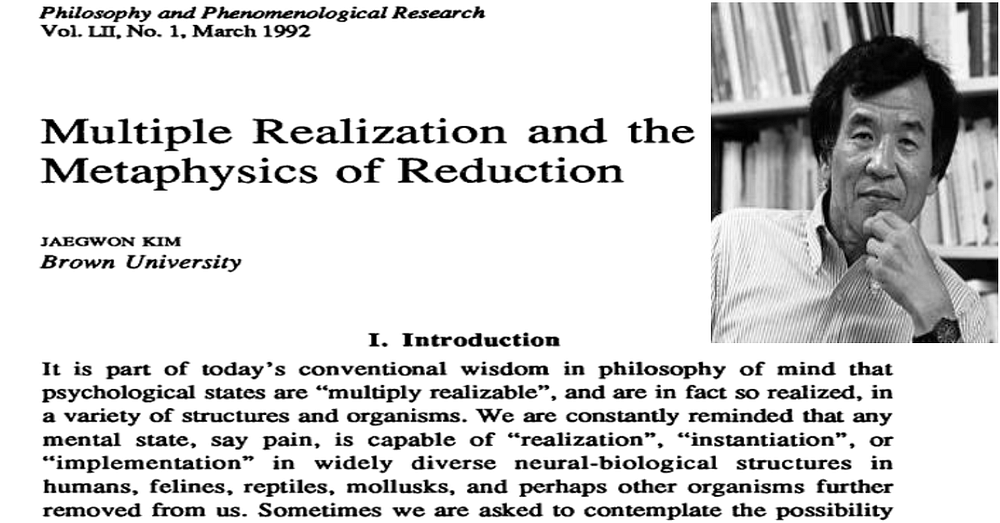
Kim, Jaegwon, ‘Multiple realization and the metaphysics of reduction’ (1992)


[I can be found on Twitter here.]