


This essay is on Sheldrake’s The Science Delusion. It exposes the faulty logic, lack of evidence, and philosophical errors in his tests.
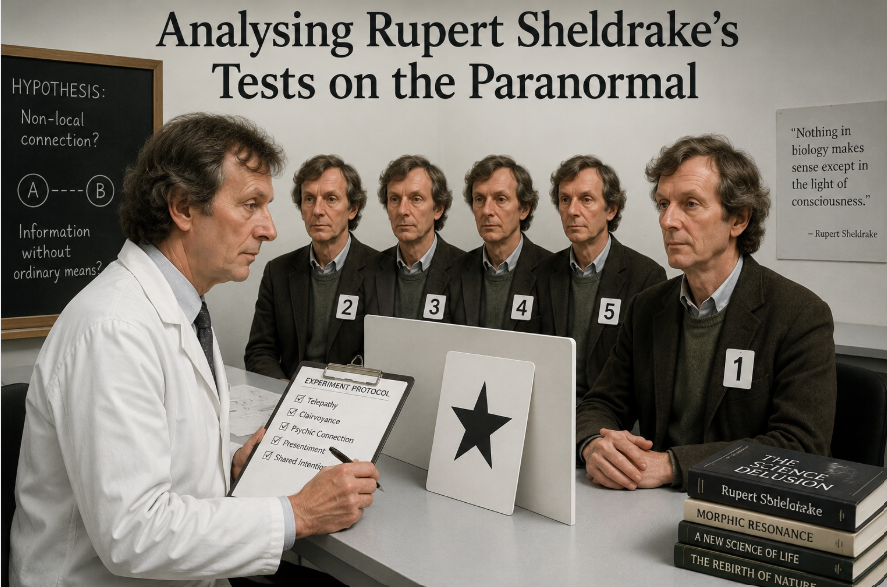
In his book The Science Delusion, the biologist and paranormal researcher Rupert Sheldrake cites many tests — some of which are his own — of telepaths and paranormal phenomena. I noted the lack of evidence for many of his claims about these tests, as well as faulty logic and philosophical mistakes. Sheldrake and his defenders will (or may) argue that the hard detail and data can be found elsewhere in various papers and surveys. However, many believers and sympathisers (who read this book) won’t go elsewhere. So I read The Science Delusion as a book that should stand on its own, just as non-sceptics will have done so.
Sheldrake on Mainstream Science
Rupert Sheldrake frequently argues that “mainstream science” ignores his own work, as well as paranormal phenomena generally. Yet he himself cites examples which show that this isn’t true. For example, the University of Virginia, Goldsmiths (University of London), Lund University (Sweden), the University of Edinburgh, etc. all tackle paranormal phenomena. For Sheldrake, the problem here is that these are all specialist parts of the aforementioned universities, not parts of existing science departments. That isn’t enough for him.
Sheldrake isn’t happy that there are parapsychology laboratories or research units at some universities … and then there are scientific laboratories. In other words, he argues that parapsychology has been pushed aside and into a niche. It’s clear that Sheldrake wants parapsychology to be mainstream, and that’s why he’s very critical of what he calls “mainstream science”. For Sheldrake, it’s not enough that there have been trials and tests in “fringe” parapsychology laboratories. There should be trials and tests in scientific laboratories.
Sheldrake is demanding a lot!
Sheldrake on Card-Guessing
Sheldrake tells us that “[m]any card-guessing trials were carried out at the famous parapsychology laboratory at Duke University, North Carolina” (now called the Rhine Research Center). Sheldrake writes:
“By chance subjects would have been right 20 per cent of the time. In hundreds of thousands of trials, the average hit rate was 21 percent, only slightly above the chance level, but highly significant statistically because of the large number of trials.”
A difference of 1 percent may not seem much. As it is, 1% may well be “significant”. Does this 1 percent difference become significant statistically because of “the large number of trials”? Surely given a larger the number of trials, one would expect a larger percentage difference if this parapsychological phenomenon were real. Moreover, Sheldrake treats the 20% mathematical probability as a baseline for human behavior. The 20% refers only to numbers and cards in the abstract, not to human persons guessing the next card.
If telepaths can guess which cards will come next, then why can’t they guess them every time, and in many different contexts?
After saying that a 1% difference is significant, Sheldrake goes on to say why the difference wasn’t actually wider:
“Unfortunately, the experimenters’ desire to follow rigorous scientific procedures led them to adopt procedures far removed from the way telepathy occurs in real life. These repetitive, boring laboratory tests between strangers using abstract stimuli were about as unnatural as it was possible to be.”
Sheldrake often makes the point that the procedures used in the tests of the paranormal are more rigorous than in (much?/all?) mainstream science. He appears to be saying that here too.
It’s not clear why telepathic skills can’t be displayed in unreal life. Sheldrake may have reasons for saying this. However, saying that the tests were “repetitive”, “boring”, etc. doesn’t seem adequate.
Sheldrake concludes that
“[i]n the 1960s, a new generation of researchers tried to find ways of doing research that were closer to the conditions under which telepathy occurs spontaneously, particularly in dreams”.
Here’s the important point to extract from all this. Sheldrake argues that these tests (under supposedly “controlled conditions”) aren’t like what “occurs in real life”. Does that mean that telepathy is at its strongest when no scientists or sceptics are around to witness them? Do only believers witness them?
Sheldrake on a Boxing Match and a Dead Rat
Sheldrake provides some more cases. For example,
“one subject dreamed about buying tickets for a boxing match while the sender was looking at a picture of a boxing match”.
Why couldn’t this be a coincidence? It’s not even as if the sender was looking at a picture of people buying tickets for a boxing match. He was looking at a picture of a boxing match, and the subject was dreaming about buying tickets for a boxing match. Sure, there is indeed a connection. But it could be a coincidence.
Sheldrake’s next example is even weaker. In this case,
“the subject dreamed of a dead rat in a cigar box, while the sender was looking at a picture of a dead gangster in a coffin”.
Sheldrake admits that the “connection was more symbolic”.
It’s not clear that this connection is actually symbolic. The dead rat in a cigar box needn’t have symbolised a dead gangster in a coffin, just as a dead gangster in a coffin needn’t symbolise a dead rat in a cigar box. It is indeed odd to dream of a dead rat in a cigar box. Yet many dreams are weird. Why didn’t the subject dream of a dead gangster in a coffin if such telepathy is a real thing?
Sheldrake concludes that “[i]n a total of 450 dream telepathy trials, the overall results were very significantly above the chance level”. Since Sheldrake himself brought up symbolism, then that changes much. Anything can symbolise anything. If a subject dreams about a sausage, and the sender is looking at a picture of a farm, then that dream can be taken to symbolise that farm because pigs exist on farms, and sausages are made out of pork. With symbolism, you have free rein. That means that one experimenter may see y as symbolising x, whereas another experimenter doesn’t.
Sheldrake presents another case that seems obviously flawed. As ever, he can claim that the details are supplied elsewhere. Most readers won’t go elsewhere. This is Sheldrake:
“[W]hen emotional images were *about* to appear, the increase in electrodermal activity began *before* the picture appeared on the screen, three or four seconds in advance.”
The flaw in this seems so obvious that I can’t help thinking I’m missing something. The increase of electrodermal activity might have been due to the expectation of seeing “emotional images”, even if it were possible that “calm pictures” might have been selected by the computer. After all, psychologists tell us that rehearsing an emotional, fearful, sad, etc. situation often brings about the exact same physical symptoms that would occur during an actual situation. (See here.)
Sheldrake on J.W. Dunne and Precognition
Now read the following sentence from Sheldrake:
“[J.W. Dunne] found he often dreamed about events that were about to happen, but usually forgot these dreams.”
What’s wrong with it?
If the British soldier, aeronautical engineer and philosopher J.W. Dunne “usually forgot these dreams”, then how did he know that they were dreams about events that were about to happen? It can be supposed that the word “usually” (as in “usually forgot these dreams”) may be doing some work here. Is it? If Dunne usually forgot these dreams, then that must mean that sometimes he didn’t forget them. However, Sheldrake uses the words “these dreams”. The dreams he forgot were supposedly about events that were about to happen.
Perhaps Dunne retrospectively worked out that his forgotten dreams were about events which were about to happen. This may make sense in the context of Sheldrake’s claim that
“[o]nly by keeping careful records of his dreams, writing them down as soon as he awoke, did the phenomenon become clear”.
Is this what happened?
When Dunne began to keep careful records of his dreams, did he then realise that his dreams were about events that were about to happen? Yet that only applies to the dreams which occurred after he started to keep records. What about the dreams which occurred before Dunne started to keep records? Did he still dream about events that were about to happen, but later forgot them?
Interestingly, Sheldrake doesn’t offer his readers evidence that Dunne’s dreams did accurately foretell events in the future. Instead, he tells them that Dunne “made an astonishing discovery” about his dreams.
Of course, this can be tied into déjà vu, and Sheldrake does the tying himself. Dunne “found that he sometimes had experiences that seemed familiar”. It may well be the case that Sheldrake supplies examples elsewhere. Readers can consult Dunne’s book An Experiment With Time to get details. Yet that doesn’t change the fact that the details aren’t actually in Sheldrake’s book. So that surely means he expected most of his readers to accept his words as they stand. Indeed, readers need to accept Dunne’s words, as well as Sheldrake’s words about Dunne’s words.
Sheldrake on Telephone Telepathy
Sheldrake tackles what he calls “telephone telepathy”. He continues:
“Hundreds of people told me that they had thought of someone for no apparent reason, and then that person rang in a way that seemed uncanny. Or they knew who was calling when the phone rang before they looked at a caller ID display or answered.”
Sheldrake says that “some people simply accepted that it was telepathic or intuitive”. He then cites some rather obvious arguments against this. What he concludes is the interesting bit. Sheldrake writes:
“I searched the scientific literature to find out if these standard arguments were supported by any data or observations. I could find no research whatever on the subject.”
What kind of data, observations or tests is Sheldrake talking about here? How would scientists test the cases in which people “thought of someone for no apparent reason, and then that person rang”? This seems almost impossible to test. It would require a scientist to know when a person randomly thought about someone, and then that someone ringing them. No matter how ingenious such a test is, I still can’t see how this could be done.
The other thing is that if this test were done by “sceptical” scientists, then they would only do so in response to Sheldrake’s claims. Perhaps that’s precisely Sheldrake’s point. No such test would ever be carried out by sceptics unless the paranormal claims were themselves being tested. There is indeed little chance that a scientist would test something as obscure as placing people in experimental situations in which they have a random thought about someone, and then that someone phones them.
Sheldrake above talked about the lack of “data or observations” from sceptics. His own data, on the other hand, was a “series of surveys in Europe and in North and South America”. This was the result:
“On average, 92 per cent of the respondents said they had thought of someone as the telephone rang, or just before, in a way that seemed telepathic.”
Now that is indeed data. However, it’s not an account of a scientific test or experiment. To be fair to Sheldrake, perhaps he would accept that and say that’s precisely why we need tests on this topic. And, yes, he did devise his own test. The problem is that his test was very artificial, as well as being divorced from the account he gave of hundreds of telepaths. In simple terms, Sheldrake’s test seems to have been designed to bring about only positive results. Here, Sheldrake will say that this often happens in science. The problem is, when it happens in science, Sheldrake criticises it.
Firstly, Sheldrake only tested subjects “who said they quite frequently knew who was calling before answering the phone”. It can be supposed that people who don’t think they are telepathic wouldn’t have been tested at the same time. Still, this is an odd test.
As stated, these tests were so artificial (as, I suppose, many scientific tests and experiments are) that it’s hard to know where to start. However, it’s worth focussing on one sentence from Sheldrake:
“None of the subjects was right every time, but they were right much more than they should have been if the chance coincidence theory were true.”
Is it now unfair to ask the following question? —
Why weren’t these subjects right every time?
If telepathic skills or abilities are real, then why weren’t the telepaths right every time? Sheldrake may cite test conditions which may have interfered with their telepathic skills. After all, when referring to another test, he claimed (as quoted earlier) that
“the experimenters’ desire to follow rigorous scientific procedures led them to adopt procedures far removed from the way telepathy occurs in real life”.
In the case of telephone telepathy, the test conditions and procedures could have interfered in a positive way too! In other words, if “rigorous scientific procedures” dampen down the effects of telepathy, then a lack of such things can do the opposite. Of course, in the telephone telepathy case, Sheldrake will claim that he did use rigorous scientific procedures. Did he? It certainly has the outward appearance of a scientific test. However, once you scrape the test’s surface, that’s not the case at all. It’s as if Sheldrake believes that by simply using the jargon and supposed procedures of scientific tests, his tests become scientific.
Sheldrake may believe he’s on safe ground here because he’ll probably say that all scientific tests and experiments are artificial in many ways. Artificial, yes, but also bogus?
Sheldrake on Sceptics
I wonder if Sheldrake would see me as being a “self-appointed vigilante”. He uses these words about the “members of skeptical organisations”. I’m not a member of a sceptical organisation, so Sheldrake may see me as a lightweight who can be safely ignored. The problem here is that Sheldrake takes issue with critics precisely because they’re members of sceptical organisations. This would mean that Sheldrake has set up a no-loose situation for himself.
What about these self-appointed vigilantes?
If they didn’t appoint themselves, then who would appoint them? And why, exactly, are they vigilantes? (Sheldrake does explain this.)
Again, I wonder if I fit into the artfully selected sceptics whom Sheldrake cites. It can be admitted, it wouldn’t look good for sceptics if readers were to rely exclusively on Sheldrake’s own words about them.
Take the case of the developmental biologist, author, and broadcaster Lewis Wolpert, whom Sheldrake mentions a few times in separate places. (Wolpert died in 2021.) He was well known (perhaps even among “materialists”) for being opinionated and sometimes rude. (Take Wolpert’s critical words on philosophy too.)
Sheldrake tells his readers that he had
“summarised evidence for telepathy from thousands of scientific trials and showed a video of recent experiments”.
How did Wolpert react to all this?
According to Sheldrake, he “star[ed] ahead, tap[ped] a pencil on the table, sighing as if bored”. Moreover, “[h]e did not turn around to see the evidence behind him”. Wolpert might well have been bored with the (supposed) evidence. However, he went along to a debate on this subject. So, if Sheldrake is telling the truth, Wolpert’s behaviour was embarrassing. What’s more, it seems like Sheldrake was telling the truth because this debate was covered by the journal Nature (‘Telepathy debate hits London’). In that article, it’s said that “[m]any in the audience variously accused Wolpert of ‘not knowing the evidence’ and being ‘unscientific’”. This may depend on people taking “the evidence” as genuine evidence. However, that still doesn’t excuse Wolpert’s tubthumping behaviour.
Sheldrake tackles the sceptics again. He writes:
“Sceptics often argue that such impressive collections of data are misleading, because researchers may publish only positive results, and leave negative studies unpublished in their files, the so-called ‘file-drawer effect’.”
Then comes the important line:
“This objection is plausible, but it applies to all branches of science, including physics, chemistry and biology, where most data go unpublished.”
Okay. Let’s say that the file-drawer effect does occur in physics, chemistry and biology too. That still means that it occurs in research on the paranormal. So how does the case of physicists, chemists and biologists hiding negative results help Sheldrake’s own case?

No comments:
Post a Comment