Sunday, 2 April 2023

Isaac Newton’s Religious Physics?

Paul Davies (the physicist and writer of popular science) informs his fellow scientists (as well as his readers) about Isaac Newton’s religious physics.
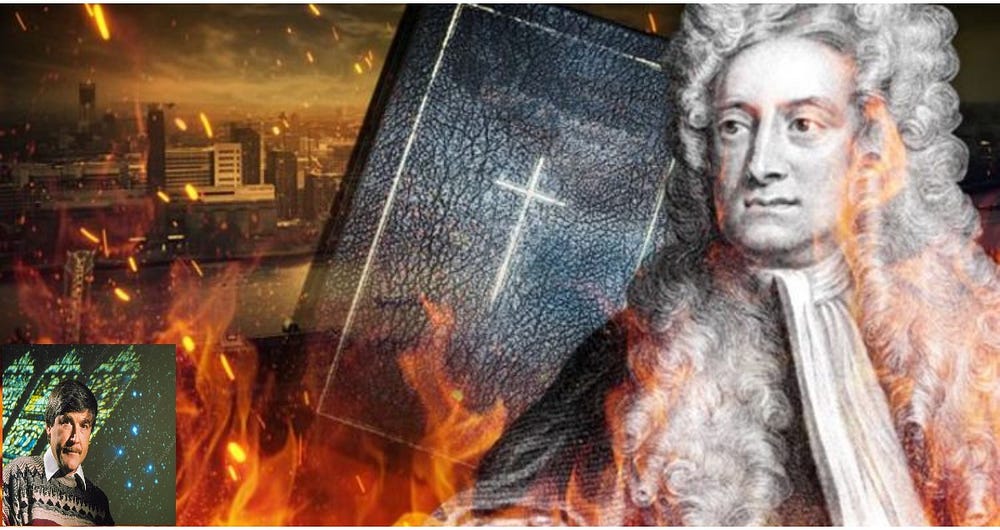
Paul Davies and Isaac Newton

The main problem with Paul Davies’s stress on Isaac Newton’s religious beliefs, and how they influenced (or even determined) his actual physics, is that he fails to distinguish the context of discovery from the context of justification. Thus, at its crudest, it wouldn’t make the slightest bit of difference to Newton’s theories, ideas or hypotheses (i.e., in physics) whether he was a serial killer, believed in pink goblins, was a Christian fundamentalist or stole all his ideas from Leibniz.

Broadly speaking, Paul Davies’s stress on Newton’s religious beliefs is something which had just previously occurred in the national media of many countries. This (as it were) new-found interest in Newton (at least when it came to the media) was largely down to the circulation of unpublished and previously unknown documents which had been written by the 17th-century English scientist (see here).

More particularly, many commentators were very excited by the fact that Newton prophesied that the world would end in 2060!

The story about Newton’s 2060 prophesy (alongside comments on his alchemy, his fixation with numbers, his many chronologies, his interpretations of the Bible, and his takes on the “philosopher’s stone” and “sacred geometry”) was featured on the front page of the UK’s Daily Telegraph, Canada’s National Post and other national newspapers. Added to that were the many internet and television features which followed, as well as a number of documentary films.

Of course, much has also been made of Newton’s (as it were) religious credentials. What’s more, spiritual-but-not-religious people and New-Agers have also made much of Newton’s alchemy, Biblical prophesies, chronologies, fixation with numbers, interpretations of the Bible, and his takes on the philosopher’s stone and sacred geometry. Indeed, their biographical and historical detail about Newton may be largely correct too.

So what can we draw from all that?

This new hullabaloo about Newton occurred in February and March 2003. That was around four years before Davies’s article ‘Taking Science on Faith’ for the New York Times (which is the main focus of this essay).

All that said, nothing in the words above is intended to imply that Paul Davies himself doesn’t have his own original and purely physics-based angle on Newton’s (as it were) religious physics. However, it can be safely assumed that many physicists and scientists both read and watched at least some of these titillating stories and programmes about Newton — despite what Davies believes about their complete ignorance of his biography and (well) religious motivations.

Isaac Newton’s Religious Physics?

The English physicist and science writer Paul Davies uses the case of Isaac Newton to get his central point across about the (to use his own word) “faith” scientists are supposed to have in the Universe’s “immutable laws”. He wrote:

“Christians envisage God as upholding the natural order from beyond the universe, while physicists think of their laws as inhabiting an abstract transcendent realm of perfect mathematical relationships.”

But what about Isaac Newton himself?

In basic terms, Davies ties Newton’s religious views to his physics. He told us that Newton

“first got the idea of absolute, universal, perfect, immutable laws from the Christian doctrine that God created the world and ordered it in a rational way”.

Davies then concluded by saying that

[t]his shared failing is no surprise, because the very notion of physical law is a theological one in the first place”.

Davies adds that this is a “fact that makes many scientists squirm”.

It must be said that Davies is certainly correct about Newton’s religious views. And he’s also correct about how Newton himself tied his religious views to his own physics.

Take just a single example. Newton once stated the following:

“When I wrote my treatise about our System I had an eye upon such Principles as might work with considering men for the belief of a Deity and nothing can rejoice me more than to find it useful for that purpose.”

Yet all that is part of the context of discovery — as we shall see later.

Davies then (as it were) had a go at scientists for failing to see that Newton’s (to put it crudely!) physics is religious.

Davies also told us that

[h]istorians of science are well aware that Newton and his contemporaries believed that in doing science they were uncovering the divine plan for the universe in the form of its underlying mathematical order”.

Indeed, historians of science will be aware of all that. Yet not many scientists would have a problem with any of this — despite what Davies says. Of course, some (or many) of them probably wouldn’t find it very interesting - at least not from a scientific perspective. However, Davies is arguing that they should find it interesting from a scientific perspective.

In any case, Davies concluded:

“I am depressed that reminding scientists of this well-known historical fact should elicit such a shock-horror response.”

It can be strongly doubted that there has been such a “shock-horror response” from most — or even any — scientists. This is especially the case if most scientists are well aware of the context of justification and context of discovery distinction (which will be tackled in a moment). Of course, scientists needn’t use these precise or specific technical terms from the philosophy of science.

Indeed, there’s one physicist who’s neither ignorant of, nor shocked by, Newton’s (as it were) religious context. Take the case of the theoretical physicist Lee Smolin.

This is what Smolin wrote in response to Davies’s essay ‘Taking Science on Faith’:

“As Davies says, the idea of immutable eternal laws arose in Newton’s time, when science and theology were much closer together.”

Smolin even (at least partially) agreed with Davies’s central thesis when he continued in this way:

“It does seem that getting rid of this idea is a necessary step for modern science to become fully free of the 17th century theological climate in which it was born.”

Relevantly, Smolin then diverges from Davies:

“However it is an exaggeration to say that until this is done science’s claims to be ‘free of faith are bogus.’ Most of science is healthy and most scientists rely on notions of laws that are restricted to certain domains where they are well tested.”

This passage includes Smolin’s realisation that Davies continuously conflates certain physicists with scientists as a whole. What’s more, Davies isn’t even right about all physicists, as Smolin’s own physics (or philosophy of physics) shows. And so too does the position of, to take only one example, Leonard Susskind and all those other physicists who’ve raised the possibility of “local bylaws” in the Universe. (Susskind once wrote: “If these things prove true, then some features of the laws of physics (maybe most) will be local environmental facts rather than written-in-stone laws — laws that could not be otherwise.”) There are also those physicists (a fair few of them) who’ve raised the possibility that the universal constants may not be… constant after all (see here).

Added to all that is the fact that Davies is clearly wrong about most biologists and virtually all other scientists (i.e., outside physicists) when it comes to their supposed faith in immutable laws.

[See my essay ‘Physicist Paul Davies’s Faith in His Idea That Science is “Founded on Faith”’ for more on this.]

In any case, the basic problem with Davies’s position on Newton’s religious physics is that he fails to distinguish the context of discovery from the context of justification.

The Context of Discovery and Justification

It can be supposed that in a short article (i.e., ‘Taking Science on Faith’) for the New York Times (in which most of Davies words in this essay can be found), Paul Davies simply didn’t have time to say much about the discovery-justification distinction. That said, he virtually ignores it elsewhere too.

Put at its simplest. This is a distinction which can be made between the creation (or formation) of a new scientific theory, idea or hypothesis, and the justification, defense, and/or verification (or testing) of it. Thus, at its crudest, it wouldn’t make the slightest bit of difference to Newton’s theories, ideas or hypotheses whether he was a serial killer, believed in pink goblins, was a Christian fundamentalist or stole all his ideas from Leibniz.

It’s also worth stating here that virtually every scientist in Europe was a Christian and monotheist when Newton was working and writing. Thus, it would have been very strange if their religious beliefs hadn’t impacted in some way — or even in many ways — on their work.

So, basically, the context of discovery is all the stuff (from Davies or whoever) about Newton’s religious beliefs and even what he got up to in his private life.

Now if we get back to the precise nature of the discovery-justification distinction.

The philosopher Karl Popper had influential things to say about this distinction. (The terms “context of discovery” and “context of justification” are often associated with Hans Reichenbach’s work.)

Take Popper’s position as it’s expressed in the following passage (from his The Logic of Scientific Discovery):

“The initial state, the act of conceiving or inventing a theory, seems to me neither to call for logical analysis not to be susceptible of it. The question how it happens that a new idea occurs to a man — whether it is a musical theme, a dramatic conflict, or a scientific theory — may be of great interest to empirical psychology; but it is irrelevant to the logical analysis of scientific knowledge. This latter is concerned not with questions of fact [ ] but only with questions of justification or validity [ ]. Its questions are of the following kind. Can a statement be justified? And if so, how? Is it testable? Is it logically dependent on certain other statements? Or does it perhaps contradict them? [ ] Accordingly I shall distinguish sharply between the process of conceiving a new idea, and the methods and results of examining it logically.”

There are both positive and negative aspects to Popper’s influential take on the discovery-justification distinction.

For a start, one certainly doesn’t need to take the view that the context of discovery isn’t a legitimate subject for the philosophy of science. (At one point in the 20th century, this was indeed the consensus position.) Moreover, that context of discovery isn’t even all about “intuition”, “eureka moments”, “creativity”, “cultural and religious influences” and the like either.

Thus, there are problems with this distinction - as there are with all similar distinctions.

So it’s true that the distinction may be too neat and tidy. (Note that this essay isn’t about the distinction.) In Newton’s case, it isn’t the whole story that he created a theory in a particular cultural, religious and biographical context, and only then (or after) did he scientifically, epistemically and logically assess it. In other words, even at the heights of Newton’s religious enthusiasm (say, when he triumphantly tied his religion to physics or vice versa) there would have been (purely) scientific and logical aspects to his (as its sometimes put) theory formation

The central point is simply that there is a context of discovery.

Of course, Paul Davies may respond to all this by arguing that he’s tying Newton’s religious beliefs to his theories in physics in very precise and even technical ways. Thus, perhaps it would be very hard to do the same thing with Newton (possibly) being a serial killer, (possibly) believing in pink goblins, or (possibly) stealing all his ideas from Leibniz.

That said, it’s worth saying is that an artful commentator (with a knowledge of physics, history, religion, and biography) could indeed link (or tie) Newton’s (possibly) being a serial killer, (possibly) believing in pink goblins, or (possibly) stealing all his ideas from Leibniz to Newton’s actual physics (even if not as convincingly as Davies). Indeed, I could imagine a Freudian psychoanalyst doing a very good job of this kind of thing. (He or she would have a field day with Newton.)

Finally, it can be said that lots of religious people are keen to get Newton (as it were) back on board (i.e., after he was “stolen” by atheists, materialists, Rationalists, or whatnot). Yet, if we adhere to the context of justification, then it simply doesn’t matter if Newton was a (proto)Enlightenment thinker (see here) and a hard-headed Rationalist (see here), or if he was a Christian literalist (see here), a magician (see here) or even a merchant of woo (see here).

Infinite Contexts of Discovery

Paul Davies and other commentators wouldn’t place too much stress on literally every aspect of any given context of discovery.

Thus, if Newton’s Christianity or monotheism is important to his physics, then was his antipathy toward Catholics (see here), his hatred of counterfeit money, etc. important too? Of course, Paul Davies directly ties Newton’s theological ideas to his actual physics - as already stated. So perhaps my examples are unfair. However, I’m sure that an artful historian, biographer or even scientist could tie something peculiar in Newton’s private and religious life to at least something in his physics (or vice versa) if he tried hard enough.

So let’s take another admittedly extreme example to get the point across.

Many — or even all — scientists were introduced to the various sciences by particular teachers at school. Does this mean that contemporary physicists should factor in these teachers, their characters, what they said and how they said it into their actual theories in physics?

More relevantly, if religious commentators are going to stress Newton’s religious beliefs and attitudes, then they’re going to need to do a hell of a lot of picking and choosing. That’s primarily because I doubt that all Newton’s religious beliefs and attitudes will fall neatly into place in any (contemporary) religious camp.

For example, Newton rejected the Trinity, which would not be of much use to Catholics and many other Christians. (See Newton on the Trinity here.) And should commenters stress the fact that Newton believed that the Papal Office was the realisation of the Biblical predictions of the Antichrist? (See Newton on the Antichrist here.)

Newton also denied that there is such a thing as an immortal soul (see here), which would be unpalatable to most monotheists. Newton even refused the sacrament of the Anglican church, which was offered just before his death (see here). And how do contemporary Christians feel about those Deists who’ve claimed Newton for themselves (see here)?

What’s more, Newton has also been claimed by rationalists against pantheists and (religious) enthusiasts. More particularly, Newton’s science was seen to be an antidote to mysticism, religious (as it were) emotionalism and superstition. So rather than Newton being some kind of (as he’s been called) “mystic” or “magician”, his physics and theories have actually been used to counteract such things.

So, as can be seen, almost everyone wants a piece of Isaac Newton!

And that’s precisely why the discovery/justification distinction is so important, relevant and, indeed, helpful.

******************

(*) See my essays ‘Physicist Paul Davies’s Deep — or Specious! — Questions About Life, the Universe and Everything’ and ‘Physicist Paul Davies’s Faith in His Idea That Science is “Founded on Faith”’.

My flickr account and Twitter account.


Tuesday, 28 March 2023

Stephen Jay Gould and E.O. Wilson on the Fact-Value and Science-Religion Distinctions

Stephen Jay Gould’s neat, tidy and sharp separation of values from facts, as well as religion from science, can itself be seen as an expression of his own political values. Rhetorically, Gould’s idea of what religion is seems to have been a product of his own imagination. And, in that imagination, religion completely abided by Gould’s own political sensitivities. Perhaps, then, it was only Gould’s view that religion should “keep[] itself away from science’s turf”, not that it has actually done so.

(i) Introduction
(ii) Fact and Value: Science and Religion
(iii) E.O. Wilson on Deriving an Ought From an Is
(iv) Where Do Values Come From?
(v) The Is-Ought Gap

In his book Rocks of Ages: Science and Religion in the Fullness of Life, the American palaeontologist, evolutionary biologist and historian of science Stephen Jay Gould (1941–2002) argued that science and religion are what he called “nets”. Science is a net which captures certain phenomena. And religion is a different net which captures very different phenomena.

Moreover, these nets have

“a legitimate magisterium, or domain of teaching authority, and the two domains do not overlap”.

It will be argued that Gould is telling us what should be, not what is. Rhetorically, then, Gould’s idea of what religion is seems to have been a product of his own imagination. And, in that imagination, religion completely abided by his own political and diplomatic sensitivities.

Fact and Value: Science and Religion

In the following passage, Stephen Jay Gould went into some detail about the fact-value distinction as it applies to science and religion:

“Science tries to document the factual character of the natural world, and to develop theories that coordinate and explain these facts. Religion, on the other hand, operates in the equally important, but utterly different, realm of human purposes, meanings, and values — subjects that the factual domain of science might illuminate, but can never resolve.”

It almost seems like a statement of the obvious to say that it is outright false to claim that religion restricts itself to “human purposes, meanings, and values”. Religion has also had tons to say (as well as do) about “the factual character of the natural world”. (Do I really need to give examples here?)

Gould’s claim that religion and science are “two magisteria [which] do not overlap” clearly ignores the fact that religion (or religions in the plural) has had very much to say on facts and physical reality. His claims also ignore (or simply play down) the fact that the many and various miracles of religion are supposed to have impacted on physical reality in very specific ways. In addition, prayers are also believed to have concrete effects on the physical world.

The British evolutionary biologist and author Richard Dawkins (see note at the end of this essay) expressed his more abstract position on Gould’s fact (science)-value (religion) distinction in the following:

[I]t is completely unrealistic to claim, as Gould and many others do, that religion keeps itself away from science’s turf, restricting itself to morals and values.”

Dawkins added:

“A universe with a supernatural presence would be a fundamentally and qualitatively different kind of universe from one without. The difference is, inescapably, a scientific difference. Religions make existence claims, and this means scientific claims.”

It is simply false to claim that religion has kept itself to itself, not only “unrealistic”.

So surely what Gould claimed is actually normative, rather than factual.

Perhaps, then, it was Gould’s view that religion should “keep[] itself away from science’s turf”, not that it actually has done so, and will continue to do so in the future. It certainly hasn’t done so in the past. And, clearly, that’s still the case today…

Indeed, isn’t all this obviously the case?

Gould also stated the following:

“‘Do we violate any moral codes when we use genetic technology to place a gene from one creature into the genome of another species?’ represent questions in the domain of values.”

This passage just seems so categorical and dichotomous. A student wouldn’t get away with writing it.

Perhaps Gould did get away with this philosophical ineptitude because his prose style is so literary, and therefore hard to pin down. (Many commentators have praised Gould’s writing style. See Analysis of Stephen Jay Gould’s Writing Style’.) Perhaps it’s also because Gould was so highly regarded as a scientist.

However, the statements above (from Gould) are not themselves scientific. His comments on the neat, tidy and sharp separation of facts from values (or vice versa), and science from religion, can themselves be seen as an expression of Gould’s political values.

Gould’s NOMA (“non-overlapping magisteria”) idea is also extremely artificial. Indeed, it’s a position driven by a desire for political diplomacy.

[Gould once wrote: “Religion is too important to too many people for any dismissal or denigration of the comfort still sought by many folks from theology.”]

In detail. Even if there is no role for scientific (or sociological, psychological, evolutionary, etc.) scrutiny and data on the nature of values, then why should we accept (or trust) anything any religion has to say on it? This isn’t to reject religion’s input out of hand. However, Gould either/or religion/science binary is so crude that it must surely have the consequence that science is automatically excluded from any input on the nature of values — as least values as expressed by religion (or by religions).

And what about philosophy and other forms of critical thinking which are neither scientific nor religious? After all, Gould’s NOMA idea is itself neither scientific nor religious — it’s primarily political.

Moreover, what if the sciences do have something to say on the values we’ve adopted about gene transferal (Gould’s own example) or about any other subject? And what about the evolutionary origins of our values and ethics?

Sure, scientists may well make incorrect claims on these issues. Yet scientists make correct claims too. However, Gould’s neat, tidy and political division leaves no role for any science when it comes to religious values.

[I suspect that Gould might have denied this last claim when expressed in that simple and categorical way. He might have argued — or implied — that there is a role for science when it comes to values… as long as that role doesn’t involve the strong criticism of religion.]

And what about the “moral codes” which Gould said that scientists and others “violate”? What if they are pernicious moral codes? What if they are historically contingent or tribal moral codes?

In these cases, then, the sciences can help with the moral codes themselves, not just with the “facts”.

So what can evolutionary theory and the sciences generally tell us about values and morals?

As British science writer and journalist Matt Ridley puts it (see here), morals involve human behavior, which is observable. And what is observable is open to scientific scrutiny.

Some religious people may now respond by arguing that many claims in evolutionary theory aren’t (always?) based on anything that’s literally (or obviously) observable. They will also stress the theoretical nature of many claims about evolution itself.

In addition, a distinction can be made, and will be made, between the human expressions of values and moral positions, and their abstract or religious (as it were) reality. That is, according to religious people (or monotheists), values and moral truths exist timelessly in the mind of God. And according to some philosophers (such as moral realists), values and moral truths exist timelessly in some abstract space (or domain), and even in the concrete world itself, without having any necessary connection to either God or religion.

To sum up. The core of Gould’s NOMA idea is a consequence of his somewhat naive belief in a chasm (or at least large gap) between fact and value.

Now E.O. Wilson provides an interesting counterpoint to Gould on the fact-value distinction, if not also on the science-religion distinction.

E.O. Wilson on Deriving an Ought From an Is

Some readers may agree with the following passage from Daniel Dennett:

“If ‘ought’ cannot be derived from ‘is,’ just what can ‘ought’ be derived from? Is ethics an entirely ‘autonomous’ field of inquiry? Does it float, untethered to facts from any other discipline or tradition? Do our moral intuitions arise from some inexplicable ethics module implanted in our brains (or our ‘hearts,’ to speak with tradition)?”

In tune with the Dennett passage above, one can say that if the ought (or values) can’t be derived from “facts” (or from the scientific is), then religious values (at least) must indeed be completely autonomous. Indeed, perhaps we can’t derive values from any other domain. (Except, perhaps, philosophy or personal whim.)

The passage from Dennett also squares fairly well with E.O. Wilson’s position.

Edward Osborne Wilson (1929–2021) was an American biologist and naturalist. Wilson has been called “the father of sociobiology”. (He has also been called “the father of biodiversity” for his environmental advocacy.)

E.O. Wilson attempted to provide a scientific account of what he called “ethics”, if not what Gould called “values”. In addition, Wilson seemed to believe that an ought can be derived from an is, which Gould clearly didn’t believe.

[Various philosophers have offered us very intricate examples and analyses of how an ought can be derived from an is — see here. However, none of them seem to bear much of a relation to Gould’s position on religion and values.]

If religion is truly an autonomous “magisterium”, then its values can’t be derived from scientific facts or, indeed, from what is (i.e., not anything outside the religious what is).

That said, whereas Gould’s NOMA (i.e., “non-overlapping magisteria”) fails because it is primarily political in nature, Wilson’s position fails because his overall position on the is-ought distinction is (I believe) philosophically flawed.

[Wilson, in turn, believed that philosophy is a waste of time primarily because he — like many physicists and other scientists — believed that all philosophers ignore all science. See here.]

More relevantly, E.O. Wilson took almost the exact opposite position to Gould.

Whereas Gould demanded that science must keep out of the magisterium of religion, and that religion must keep out of the magisterium of science, Wilson believed that values and ethics (if not religion itself) are the sole domain of science.

It’s not surprising, then, that someone who believed in (universal) scientific consilience should have believed that ethics (if not religion) is a suitable subject for scientific scrutiny. (Consilience:the principle that evidence from independent, unrelated sources can ‘converge’ on strong conclusions”.)

[It’s interesting, and not coincidental, that there were both scientific and political conflicts between Gould and Wilson. In fact, it can be argued — and many people have — that the scientific conflicts were largely political in nature, at least on Gould’s part. See here and here.]

Where Do Values Come From?

So how did E.O. Wilson explain science’s relatively new interest in ethics? Wilson argued:

“The objective meaning of ethical precepts comprises the mental processes that assemble them and the genetic and cultural histories by which they evolved. Those who think that an is/ought gap exists have not reasoned through the way the gap is filled by mental process and history.”

So what do the words “the objective meaning of ethical precepts” mean?… Actually, it’s fairly clear what Wilson was getting at. Still, it’s an odd use of the words “the objective meaning of”.

Clearly, Wilson was offering what he took to be a purely descriptive position on “ethical precepts”, not a normative one. Perhaps it follows from this (at least to some people) that it’s not ethics at all. Instead, it’s simply the scientific study of human ethics…

Wilson might well have dismissed that just-stated distinction.

In more detail, Wilson’s position can be seen as being purely scientific. That’s primarily because of statements such as the following:

[E]thical precepts comprises the mental processes that assemble them and the genetic and cultural histories by which they evolved.”

These passages are about what we (whoever “we” are) have taken ethical precepts to be — not what ethical precepts are or what they should be. In that sense, then, it can be argued that Wilson’s position isn’t ethics at all. It’s the scientific (i.e., biological, neuroscientific, psychological, sociological, historical, etc.) study of human ethics.

Again, Wilson might well have taken these distinctions to be entirely bogus.

Yet isn’t ethics about how we should live, not how we have lived and how we do live?

More concretely, if Wilson believed that ethics is the study of the “genetic and cultural histories by which [ethical precepts] evolved”, then perhaps we can’t do much (or even anything) about such causal aetiologies of our ethical standards and principles. That’s the case because such things have already happened.

So is this is simply a causal account of what we believe and do in the ethical sphere?

As already stated, perhaps the study of the “mental process that assemble [our ethical precepts]” isn’t itself in the domain of ethics.

The Is-Ought Gap

Is the is/ought gap (or is-ought problem) bridged simply by reasoning about this “mental process and history”?

And is all this still in the magisterium of the is and was, not in the magisterium of the ought?

In detail. Even if we can fill in the gap (as Wilson put it) between the original causes of our beliefs and principles and the beliefs and principles themselves which followed, then does that bridging alone take us into the normative (or from the is to the ought) ? By filling in the causal gaps between causes and their effects (ethical precepts in Wilson’s book), then perhaps we still don’t move from the is to the ought (or from the descriptive to the normative).

So it’s still unclear why Wilson believed that the is/ought gap has been (or can be) bridged or “filled’ in the way he outlined.

To repeat. How will acquiring knowledge of the causes of our ethical precepts tell us whether or not our precepts are the right or the wrong ones? The causal or scientific facts of genetics (or whatever scientific data we can find or use) may indeed help us understand why we hold our ethical precepts. However, surely such facts alone can’t tell us why we should still hold them.

The English philosopher, writer and journalist Julian Baggini (1968 — ) sees some of these problems too. He writes:

“The idea here seems to be that ethical precepts — for example, the incest taboo — have their roots in particular genetic and cultural histories. It is clear that understanding such histories will be a useful tool in making ethical judgements. What is less clear is that this is a way out of the is/ought problem.”

We will indeed learn much from the aetiology of the incest taboo. However, we won’t learn whether or not that taboo is right or wrong from studying its “roots in particular genetic and cultural histories”. This knowledge, of course, may (again) help us in other ways. It will tell us, for example, that the taboo wasn’t passed down from heaven or that it’s not a non-natural precept which we somehow “intuit”. What’s more, all that scientific knowledge may — or will — indeed have an effect on our “ethical judgements”. However, that knowledge will not, at least not on its own, determine the conclusions of our ethical judgements…

So what will?

Wilson seems to have argued that we can indeed derive what we ought to do from what is (or what was) the case. That is, if something is genetically and/or culturally inscribed, then it must be a correct ethical precept…

Yet that clearly doesn’t follow.

What’s more, Wilson himself probably wouldn’t have accepted that this was his position when expressed in that categorical and simple way.

Our natural instincts, for example, may be bad instincts. As Baggini (again) puts it when he argues that

“we will do well to struggle to behave in ways that might seem contrary to our natural instincts, as, for example, with respect to ethical precepts rooted in a mistrust of strangers or in aggression responses”.

Of course certain natural instincts may also be good instincts. So it all just depends…

*********************

(*) See my essay ‘Stephen Jay Gould on Science and Religion: The Politics of Non-Overlapping Magisteria’.

Notes:

(1) Many people have a (to use the Reverend Ian Paisley’s words about his attitude toward Catholics) “perfect hate” of Richard Dawkins. This is hardly surprising when one considers the fact that religion had a “hegemonic” political, moral and social position for millennia — as Stephen Jay Gould himself noted. And Dawkins strongly criticises that hegemonic entity which Gould says people feel strongly about. (Gould: “Religion is too important to too many people for any dismissal or denigration [].”) Thus, people feel strongly about Dawkins largely because he criticises the religion they feel strongly about.

(2) Stephen Jay Gould wrote:

[] I also know that souls represent a subject outside the magisterium of science. My world cannot prove or disprove such a notion, and the concept of souls cannot threaten or impact my domain. Moreover, while I cannot personally accept the Catholic view of souls, I surely honor the metaphorical value of such a concept both for grounding moral discussion and for expressing what we most value about human potentiality: our decency, care, and all the ethical and intellectual struggles that the evolution of consciousness imposed upon us.”

There’s a problem here. Religious people (Catholics in this case) do not see souls as having “metaphorical value”. They believe that souls are real or that they (well) exist. They also believe the the nature of souls is truthfully expressed in religious texts — and what is expressed in them bears no resemblance to what Gould says about them. In that sense, then, Gould’s view of souls can be deemed to be both insulting and condescending to religious people. Indeed, his view is also like “the God of the philosophers” in that it bears little resemblance to (as it were) the God of the people.

Of course, Gould might have replied to these accusations by saying that only to him are souls (as it were) metaphorical entities. In that case, then, when Gould discussed souls with religious people (if he ever did), then wouldn’t both parties have been talking about two different things or even talking passed each other?

My flickr account and Twitter account.

Friday, 24 March 2023

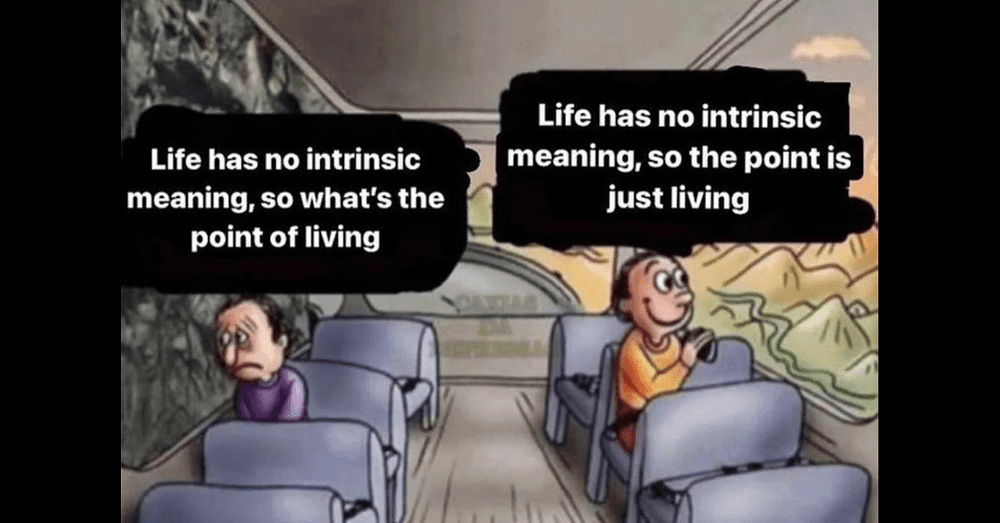
Life and the Universe are Neither Meaningless nor Meaningful

Many religious people look for the (singular) meaning of Lifethe Universe and everything. The existentialists, on the other hand, embraced the meaninglessness (or absurdity) of these very same things. Yet surely the latter position is just an inversion of a binary opposition. In Derrida’s terms, one half of this opposition is completely parasitical on the other half. Ironically, then, the existentialists embraced religious ways of thinking.

“I would warn you that I do not attribute to nature either beauty or deformity, order or confusion. Only in relation to our imagination can things be called beautiful or ugly, well-ordered or confused.” — Baruch Spinoza

Oddly enough, this essay was motivated by what the physicist and science writer Paul Davies wrote on the possible absurdity of the Universe. Thus, it wasn’t initially a reaction to what the existentialists or Albert Camus wrote on this subject.

Davies believes that if (what he calls) “the laws” of the Universe can’t be explained, then we must live in an “absurd” universe. I took issue with that position in my essay ‘Physicist Paul Davies’s Faith in His Idea That Science is “Founded on Faith”’.

In an op-ed article called ‘Taking Science on Faith’ (which was published by the New York Times), Davies argues that without an ultimate explanation of the laws of the Universe (or any answers to his deep questions), then nature is a fiendishly clever bit of trickery”. What’s more, we are faced with

“meaninglessness and absurdity somehow masquerading as ingenious order and rationality”.

So why use the word “absurdity” here? (Davies also used the words “reasonless absurdity”.)

As many readers will know, the word “absurdity” (or “absurd”) is used all the time in this debate about the nature of the Universe and our relation to it. However, it’s very easy to view it as being used in an almost entirely rhetorical or poetical way.

The Word “Absurd”

The word “absurd” is sometimes defined as “extremely silly” and/or “ridiculous”. And the word “absurdity” can be used as a simple synonym for “unreasonableness” or “reasonlessness”.

Yet the word “absurdity” isn’t always (or even usually) used as a simple synonym of “unreasonableness” or “reasonlessness”. More relevantly, these definitions don’t capture what, for example, the absurdists and existentialists had in mind.

Basically, the definitions above simply aren’t heavy (or deep) enough.

The following definitions, then, may take us closer to the Deepness.

On the whole, the existentialists saw “absurdity” as the Universe “having no rational or orderly relationship to human life” (see here).

As for the absurdist playwrights and novelists (see here and here) of the 1940s and 1950s: they took absurdity to be the “condition in which human beings exist in an irrational and meaningless universe”. What’s more, in that irrational universe, “human life has no ultimate meaning”.

Ironically, it can be argued that the absurdists and existentialists were simply embracing religious ways of thinking.

What’s meant by this is that many religious people look for the (singular) Meaning of Life… the Universe and everything. The absurdists and/or existentialists, on the other hand, embraced the meaninglessness (or absurdity) of Life, the Universe and everything. Yet surely this is just a binary opposition. In Jacques Derrida’s terms, one half of the binary (i.e., the position that Life, the Universe and everything is meaningless) is completely parasitical on the other half (i.e., the position that Life, the Universe and everything is meaningful).

Indeed, according to John Foley, the French author, dramatist and philosopher Albert Camus accepted Jean-Paul Sartre’s religion-inspired definition of “the Absurd” as being the following:

“That which is meaningless. Thus man’s existence is absurd because his contingency finds no external justification.”

So what is that “external justification” to which Sartre referred?

Surely it must be God and (His?) “absolute values”.

That must also mean that most existentialists accepted the religious view on what is and isn’t absurd. The difference being that they embraced it.

Thus, again, existentialism was parasitical on religion (or on Christianity) in it also accepted the choice that we must make between universal meaningfulness or universal meaninglessness. However, instead of embracing universal meaning as most religious people do, the existentialists embraced absurdity instead.

In a strong sense, then, religion was still calling the shots. And that’s not a surprise when you consider the fact that nearly all the absurdists and existentialists were brought up in strongly religious (i.e., Christian) environments. (See “Existentialist concerns are essentially religious concerns”.)

What is Absurd?

It’s certainly not the case that all people define (or take) the word “absurd” in the same way.

Take the American philosopher Thomas Nagel’s examples of the absurd in the following:

[S]omeone gives a complicated speech in support of a motion that has already been passed; a notorious criminal is made president of a major philanthropic foundation; you declare your love over the telephone to a recorded announcement; as you are being knighted, your pants fall down.”

[This passage can be found in Thomas Nagel’s paper ‘The Absurd’.]

Some people may well claim that the first example (i.e., “someone gives a complicated speech in support of a motion that has already been passed”) is indeed absurd. Yet many others won’t. (They will see it in various other ways.)

The second example (i.e., “a notorious criminal is made president of a major philanthropic foundation”) is surely more about something being morally and/or politically problematic, rather than absurd.

All that said, my interpretations of the word “absurd” (at least in these contexts) aren’t set in stone either. And that’s the problem here.

Nagel seems to disagree with this emphasis on contextuality.

Although Nagel takes a position against Camus and his stance on the absurd, he nonetheless sees absurdity (or the Absurd) as being a (as it were) real concrete thing.

Nagel even mentions the “philosophical sense of absurdity” (at least in relation to Camus), and explains it in this way:

[I]t must arise from the perception of something universal — some respect in which pretension and reality inevitably clash for us all.”

Whether or not Nagel accepts this account or simply states it, it’s still not clear that all other accounts (even if philosophical) of absurdity need square with what Nagel, Camus or any of the existentialists wrote on the subject.

Moreover, perhaps Nagel’s account of absurdity is beholden to (or even parasitical upon) Camus’s account; just as Camus’s own account was beholden to the religion (or Christianity) he rebelled against (see here). That said, Nagel did reject Camus’s general conclusions. However, Nagel still offered his readers a single account of something that he deemed to be real — absurdity.

The following is what absurdity is to Nagel. Nagel tells us that

[r]eflection on our minuteness and brevity appears to be intimately connected with the sense that life is meaningless; but it is not clear what the connection is”.

Nagel is both right and wrong on this. Many people may well reflect on the “minuteness and brevity” of their lives, yet they won’t also conclude that (Platonic) “life” is “meaningless”. Other people may well conclude that it is. So it depends on the individual.

Nagel is also right when he says that there’s no necessary (or immediate) connection between this minuteness and brevity of human life and meaninglessness. Again, the fact that “we are going to die” has no necessary connection to absurdity (or meaninglessness) either.

The Psychologies of Existentialists

Much of what has been written on the subject of absurdity is a case of writers, philosophers and religious people projecting onto Life, the Universe and everything (see ‘Psychological projection’). However, it isn’t the case that what people believe and feel passes over to Life, the Universe and everything.

So when it comes to the supposed absurdity and/or meaninglessness of Life, the Universe and everything, perhaps it’s all largely about individual human temperaments and psychologies. In other words, there are no (as it were) facts about any of this. (Unless we can refer to facts about — or the “verbal reports” of — the temperaments and psychologies of individuals and social groups.) Indeed, there aren’t even any across-the-board generalisations which can be made about what all (adult) human beings believe (or think) about Life, the Universe and everything.

So let’s heed some words of warning from Baruch Spinoza when he referred to the anthropocentric view of Life, the Universe and everything (or, at the least, the anthropocentric view of the Universe and everything). Thus:

“I would warn you that I do not attribute to nature either beauty or deformity, order or confusion. Only in relation to our imagination can things be called beautiful or ugly, well-ordered or confused.”

[I must come clean here and say that I’ve quoted this passage many times in my essays.]

Spinoza’s central philosophical point is that Nature can only (as it were) be. All the rest is simply (in contemporary parlance) human psychological projection.

So let’s rewrite Spinoza’s passage above to make it more relevant to the theme of this essay:

I would warn you that I do not attribute to Life, the Universe and everything either meaningfulness or meaninglessness. Only in relation to our imagination can things be called meaningful or meaningless.

Another way of looking at all this is to invert the usual way of looking at (existentialist) absurdity.

Life, the Universe and everything didn’t bring about the “depression, anxiety and despair” of the existentialists. These people might well have already been suffering from varying degrees of depression, despair and anxiety, and only then did they develop their views on absurdity and meaninglessness. In other words, the philosophical views of the existentialists were a least partly (or even largely) a result of their already-existing psychological (or brain/genetic) conditions. Or, at the very least, there was a subtle interplay between the psychological and physiological states (as well as their temperamental dispositions) of the existentialists, and their philosophical positions.

Conclusion

Perhaps the existentialists should have seen their own views as being absurd and/or meaningless. After all, if Life, the Universe and everything are absurd, then existentialist views about these things must also be absurd (or meaningless) too.

Who knows, perhaps some existentialists and absurdists acknowledged this.

So Life, the Universe and everything aren’t meaningless (or absurd). And they don’t instantiate meaning either.

What’s more, they don’t lack meaning for all individuals. They lack meaning for particular individuals at particular times. And, at least in the cases discussed in this essay, Life, the Universe and everything lacked meaning for French intellectuals in the 1940s and 1950s (see here).

Finally, perhaps absurdity should neither be embraced nor rejected. And that’s primarily because the word “absurdity” (at least as used by absurdists and existentialists) isn’t always useful or accurate in most philosophical and scientific contexts.

My flickr account and Twitter account.