“Observation
is crucial for physical-object talk, the authority of sacred texts
and holy persons for religious discourse, and the sincere
asseveration of the subject for reports of experience. It is a piece
of outrageous imperialism to suppose that any single requirement for
justification applies across the board.” - William
P. Alston,
in his ‘Yes,
Virginia, There is a Real World’
(1979)
i) Søren
Kierkegaard and William James
ii) Martin
Luther and Martin Buber
iii) John
Searle
This short piece is largely introductory in nature. It contains very little philosophical commentary or criticism.
“Christianity
is not…a theory…but a description of something that actually
takes place in human life.”
This
isn't surprising if one bears in mind the influence of SørenKierkegaardon
Wittgenstein. Of course it's been quite well documented that the
Danish philosopher had a strong influence on the Wittgenstein of the
Tractatus.
It's less well documented that there are elements of Kierkegaard’s
philosophy that may well have also influenced Wittgenstein’s later
work. In respect to languages
gamesonly,
Kierkegaard believed that people's religions were (in an obvious
sense) either in - or actually were – forms
of life.
These language games (or modes
of “being-in-the-world”
- Martin
Heidegger)
were seen by Kierkegaard as coherent and interrelated sets of beliefs
which are embodied in various practices. Kierkegaard’s chief
criterion for a legitimate language game (a term he never used) - which he believed
enabled each language game to identify other language games - is how
(or if) it determines “the
good life”.
Early
on in his career, Wittgenstein also readWilliam
James’s
popular book, Varieties
of Religious Experience.
He responded to this book by saying: “This book does me a lot of
good.” It could be said that William James was a kind of early
language-game theorist. Indeed James was also well known for his idea
of “the
will to believe”.
This doctrine - according to certain commentators at least - states
(to put it simply, though accurately) that if a religious belief
works
for you
(or works for a community as a whole), then why not adopt it? It
doesn’t matter if one’s beliefs are true (this, of course, begs the question) or whether or not they
correspond to anything outside the actual practice. What matters are
the pragmatic effects of religious belief. In fact, according to
James’s liberal pragmatism
(unlike, say, C.
S. Peirce’s),
a belief is actually made
true if
and when it works. (I strongly suspect that many experts on James
will see this as a simplification of James's position.) So it's easy
to conclude that James’s views on religious practice may well have
filtered down to the late Wittgenstein.
According
to Wittgenstein’s own position on language games, there's a
different “substratum”
which belongs to each discourse of “enquiring and asserting”
(1950).
If Wittgenstein believed that this is the case, then it naturally
follows that religion, mysticism and art can all equally supply this
substratum.
Wittgenstein still claimed, however, that within these different
“inherited backgrounds” it's still possible to “distinguish
between [the] true and [the] false”.
“Real
language…is the language of the terrestrial world.” (1924)
So
Wittgenstein’s defence of religious language games or forms of life
(which, in a sense, was already a part of his Tractarian vision - if
less concretely stated there) gave him a new way of defending the
“ineffable
truths”
and experiences of religion and religious persons. However, whereas
in the Tractatus
it was a question of religious truths and beliefs being beyond
science,
philosophy and all “factual
discourse”
(therefore inexpressible or “unsayable”),
in his later period Wittgenstein concentrated on the autonomous
nature of various religious practices and discourses. This meant that
within a religious language game, religious things can indeed be
expressed or said.
Martin
Luther and Martin Buber
We
can also see a quasi-Wittgensteinian attitude towards religious
discourse in the work of the Austrian
theologian Martin
Buber.
He, like late (though not early) Wittgenstein, believed that
revelation
and even religious knowledge itself is essentially a matter of
linguistic/verbal communications and intersubjective contact rather
than of (on the model of epistemology and science) a detached
observation of some kind of object or event (Buber,
1923).
It's
often hard to fathom whether or not religious (as well as other)
language games were seen by Wittgenstein to be somehow truly
autonomous or also dependent on things outside the game. That is, is
it all a question of conventions, rules, rule-following and nothing
else?
Perhaps
Wittgenstein's so-called “anthropocentric” position on religious
language games may be equally seen in the light of Martin
Luther’s
discovery (as it were) of “justification
by faith alone”.
John
Searle
Despite
that, it may well be helpful to have a taster of one of the realist(for
want of a better word)attacks
on Wittgenstein notion of a language game.
The
term “realist” is simply used here in the very basic sense of
arguing that there must be things outside
these langauge games which make the beliefs within them true.
John
Searle,
for example, believed that the majority of people within religious
language games won't - or even couldn’t - accept this nonrealist
attitude towards religious language games; though it might well have
been the case for Wittgenstein himself. Searle
writes:
“[W]hether
or not there is a God listening to their prayer isn’t itself part
of the language game. The reason people play the language game of
religion is because they think there is something outside the
language game that gives it a point.” (1987)
Of
course we can ask here (in a Searlian spirit) whether or not the very
concept of (realist) truth has any real purchase in some (or all) of
these disparate language games. That is, is it really the case that
each language game - including the language games of art and religion
- can formulate and then use its own concepts of truth? Or,
alternatively, is it actually the case that language games have the
same concepts of truth as those used outside each language game.
Searle’s
point, then, is that Wittgenstein’s liberalism (if that’s what it
was) towards religious language games may not, in actual fact, have
been very well appreciated by the actual participants in these
language games. That is, if they had come to know that Wittgenstein
believed that that such games are completely autonomous creations (or
constructions), then they might not have accepted that their own
particular religious practices are in fact Wittgensteinian language
games.
The
following is a commentary on a interview (see video above) of the
philosopher and logician Graham Priest conducted by Alex
Malpass
(who's a Research Fellow at the University of Bristol). The interview
tackles such things as the logical paradoxes (specifically Zeno's
arrow), quantum mechanics, Hegel and legal inconsistencies.
i) A
Legal Contradiction or Inconsistency?
ii) Zero's
Arrow, Other Paradoxes and Quantum Mechanics
iii) Priest's
Fusion of Epistemology, Philosophy of Science and Logical Pluralism
A
Legal Contradiction or Inconsistency?
It's
very hard to accept Graham
Priest's
example (at 55 minutes and 14 seconds) ofdialetheism-in-practice
(as it
were). He cites the the case of the Australian law on property owners
being given the vote and aborginess being denied the vote.
So
what happened when an aborigine gained property? He became an
aborigine who could also vote. Thus Priest sees this as a dialetheic
contradiction. Yes, it was certainly an inconsistency
in the law. But was it also a contradiction-in-the-world?
Priest
seems to dismiss this law-world distinction as just an example of
different ways of viewing what "the world" is. He says:
"That
really depends on what you mean by 'the world'.”
Priest
admits, however, that this legal example is a "midway" case
of dialetheism. But what does that mean?
Zeno's
Arrow, Other Paradoxes and Quantum Mechanics
At
59:57 Priest offers us a very cogent and clear explanation of the
"paradox
of motion"; using Zeno's
arrow
andHegel's
position as examples. (See Graham Priest on Hegel's position on
motionhere.)
The problem is that it's difficult to see how Priest ties all this to
his dialetheism and he doesn't really say (at least not in this
videoed interview). He simply explains
and describes
Zeno's arrow and leaves it (more or less) at that... That is, except
for this statement:
“To
be in motion is precisely to be in a contradictory state. It's to be
here and not here at the same time.”
Who
knows, perhaps Zeno's arrow is also a case of dialetheist
contradiction and therefore not actually about
the world.
It may, instead, be about how we think
about -
or even perceive
- the world. Here again we enter the world of epistemology – even
if applied to a case which has clear logical implications.
One thing that can be said about Priest's dialetheism is that it's dependent on paradoxes
That's ironic because Priest states that fellow dialetheists have
concentrated too much on what he calls“self-referential
paradoxes”
- paradoxes which are very unlike Zeno's arrow. It's hardly a surprise, then, that a logic which “embraces
contradictions”
should rely on paradoxes to back it up (as it were).
Priest
also relies (if to a lesser extent) on quantum mechanics to defend his
dialetheism. That is, he mentions quantum mechanics a lot in his
work. Yet, at the same time, Priest doesn't seem to believe that
quantum mechanics does much work for (his) dialetheism. (At least he
hints at that in the video above.) Though, again, why does Priest
keep on bringing up aspects of quantum mechanics if it's (more ore
less) beside the point when it comes to dialetheism?
If
we return to paradoxes.
One
can either take some kind of deflationary view of the paradoxes or
say that they don't do much - or any - work for dialetheism. One
thing is for sure, however, and this is that no one is going to solve
(if that's the right word) the paradoxes any time soon – least of
all a critic of dialetheism. So, again, it needs to be made clear
what exactly the relation is between the paradoxes Priest cites and
his own dialetheism.
Priest's
Fusion of Epistemology, Philosophy of Science and Logical Pluralism
All
Priest's examples of dialetheic contradictions are really about human
perceptions of - or attitudes towards - the world, not the world
itself. They also concern inconsistencies in scientific and legal theories
about the world. This makes dialetheism both a position in
epistemology and in the philosophy of science. If all that is the case,
then surely dialetheism isn't a "robust
ontology"which
happily embraces contradictions-in-the world after all.
Of
course Priest's next move may be to question this possibly bogus
distinction between the
world
and our
statements about - and knowledge of - the world.
Actually,
he does
question this distinction and he even uses the term “social
constructionism” .
This is a (kind of) anti-realist
(if not a social-constructionist) move. Still, most/all anti-realists don't
accept that there are "true
contradictions"
in the world!
Priest
also seems to endorse a position named “logical
pluralism”
in the video. This is almost parallel to Ludwig
Wittgenstein's
notion of
language games.
That is, Priest argues that different logics can be applied to
different domains or problems. And that must also mean that certainly
logics can be misapplied to certain domains or problems. (Though it
may also be the case that the same logic can be applied to different
domains without thereby creating any problems.) Priest himself says:
“You
need one kind of logic to reason about one kind of thing and a
different kind of logic to reason about something else.”
It
must now be said that Priest is critical of what may be called naïve
logical pluralism;
just as he's critical of too-easy uses of quantum mechanics to back
up (his) dialetheism. Nonetheless, Priest doesn't (completely)
dismiss logical pluralism or the relevance of quantum mechanics to
dialetheism. That is, he defends logical pluralism (in this video at
least) and also frequently cites quantum mechanics (in his papers,
books, seminars, etc.) to defend dialetheism.
So
does Priest have a dialetheic position on the relevance of logical
pluralism and quantum mechanics to dialetheism itself? That is:
Does
Graham Priest believe that logical pluralism and quantum mechanics
both are
and are
not
relevant to dialetheism?
In
a superficial sense, anyone can accept the position just stated. That
is:
Logical
pluralism and quantum mechanics are
relevant to dialetheism in some respects (or ways) and they are not
relevant to dialetheism in other respects (or ways).
But
that isn't dialetheism! The dialetheic position must surely be this:
Logical
pluralism and quantum mechanics are
and are
not
relevant to dialetheism in exactly the same respects (or ways).
So
to recap.
All
in all it can be said that Priest fuses positions in epistemology,
the philosophy of science and logical pluralism in order to back up (or defend) his dialetheism.
“No
one, it is true, will be able to boast that he knows that there is a
God…No, my conviction [that God exists] is not logical, but moral
certainty…it rests on subjective grounds.” - Immanuel
Kant,
Critique
of Pure Reason,
'Transcendental Method')
Ludwig
Wittgenstein believed that it's entirely counterproductive - and against the very
essence of religion (or Christianity) - to try to justify one’s
beliefs with philosophical arguments. We simply don’t get the gist
of Christianity (or religion generally) if we indulge in such a
pointless practice. Wittgenstein felt (as Martin Heidegger also did)
so strongly about this that he believed that Roman Catholicism had
placed too much weight on reason and argumentation when it comes to
religious belief. Wittgenstein himselfwrote:
“It
is a dogma of the Roman Catholic Church that the existence of God can
be proved by natural reason. Now this dogma would make it impossible
for me to be a Roman Catholic.” (1930)
This
was partly the reason why Martin
Heidegger
placed so much faith in Duns
Scotus
- rather than in Thomas
Aquinas.
The Scottish
philosopher and theologian, after all, deemphasised the importance
Aquinas and other philosopher theologians had put on reason in
theological and religious debates. He, instead, reiterated the prime
importance of unadulterated faith. (Something which existed, then,
well before the rise of Protestantism.)
In
addition, like Kant before him, Wittgenstein believed that we must
sweep away the grand pretensions of “reason” (a word that
Wittgenstein himself infrequently used) and make way for a faith and
a spirituality which were untouched by philosophy – and even by
theology.
This
Wittgensteinian position wasn't something that was always adhered to
by Heidegger.
Heidegger
had a more ambivalent attitude to the relation between
religion/spirituality and theology/philosophy. For example,
Wittgenstein - especially early Wittgenstein - believed that the two
domains were completely separate. Heidegger, on the other hand,
didn't believe this.... At least not until his “late
period” (i.e., “the
turn”)in
which Heidegger attempted to literally obliterate metaphysics and
even theology from his new - more mystical - brand of
philosophy/theology - or “ontotheology”
and “ontic-theology”.
Again,
like Kant before him, Wittgenstein was as against the rationalist
Christian who believed that he could prove the existence of God as he
was against the atheist who believed that religion had no evidence at
all on which to build belief.
Before
all that, Aquinas believed that a proof of God’s existence is
possible and had, in fact, already been achieved; whereas Heidegger’s
Duns Scotus believed that it was impossible. Or, at the least (like
Wittgenstein after him), Scotus believed the such a proof isn't
needed and is in fact even anti-Christian.
(Aquinas, however, also believed that proof isn't needed; though only
in the case of uneducated Christians.) It's not just that proof was
impossible for Wittgenstein: the idea
of proof itself was suspect and essentially beside the point when it
comes to religious beliefs and feelings.
So,
yet again, Wittgenstein cohered with Kant: proof and rational belief
aren't needed when it comes to religious belief and faith.
(Ironically enough, Kant - unlike Wittgenstein - provided dense
and detailed arguments
to back up this position.) Although Wittgenstein wasn't a Protestant
(unlike the PietistKant
before him – although the influence of Pietism
on Kant's philosophy has been disputed), he too thought that science
and philosophy (if not “reason”) needed to be swept away in order
to make room for faith. Of course it isn't been claimed here that
Wittgenstein himself would have ever put it in quite like that.
Nevertheless, Wittgenstein did think that the mimicking of scientific
and rationalist thought isn't the right way for a spiritual or
religious person to behave (as Kant also believed). On the other
hand, a Wittgensteinian (i.e., not Wittgenstein himself) may however
replying by arguing that the same kind of evidential criteria (i.e.,
scientific criteria) isn't needed for religious belief. However,
religions do have their own kinds of evidence. It can now be argued,
in response, that the very notion of evidence simpliciter
(in the context of religion and faith) was highly suspect for
Wittgenstein (in the sense that “faith
alone”
(sola
fide)
is the thing that we truly need).
One
can see these positions in Wittgenstein's works that either preceded
or were contemporaneous with the Tractatus.
Franz
Rosenzweig and Martin Buber
And
like Wittgenstein in his Tractatus,
Franz
Rosenzweig
(1886 – 1929) believed that the world, man and God are essentially
outside the ambit of reason (or outside empirical science and
philosophy, in Wittgenstein’s case). Rosenzweig, therefore, spoke
of the “meta-logical”,
the “meta-ethical”,
and the “meta-physical”.
That is, Rosenzweig believed that the essential dimensions of the
world, man and God are “hidden” and couldn't be discovered (or
conquered) by reason. And neither could they be victims of a
naturalistic
reduction
(or explanation) in terms of any other elements of the world (1921).
Despite that, Wittgenstein’s position on “the world” (though
not on man and God) differs in some ways from Rosenzweig’s. This
was because a positivistic, scientific and analytic environment
surrounded Wittgenstein from his early years. This therefore
influenced his views on the
world;
though not his views on man, and certainly not on God. Rosenzweig, on
the other hand, was a philosopher of religion who hadn't been
particularly tainted by these traditions on the outside of German
theology and philosophy of religion. He therefore applied his
philosophical theories not just to God and man, but also to the world
itself.
There
are other parallels which can be made between Wittgenstein and other
continental philosophers - indeed also with theologians and
philosophers of religion.
Like
Wittgenstein and Kant before him, Martin
Buber
(1878-1965) was suspicious of the “rationalist
theological tradition”.
He once claimed that he knew of no cogent proof of God’s existence.
Not only that: he said that if such a thing existed, he would have
rejected it. Buber wrote:
“I
have no metaphysics on which to establish my faith…My
philosophy…does not serve a series of revealed propositions…but
an experienced, a perceived attitude that it has been established to
make [it] communicable.” (1967)
The
passage above perfectly describes Wittgenstein's position; and, if to
a lesser extent, Heidegger's.
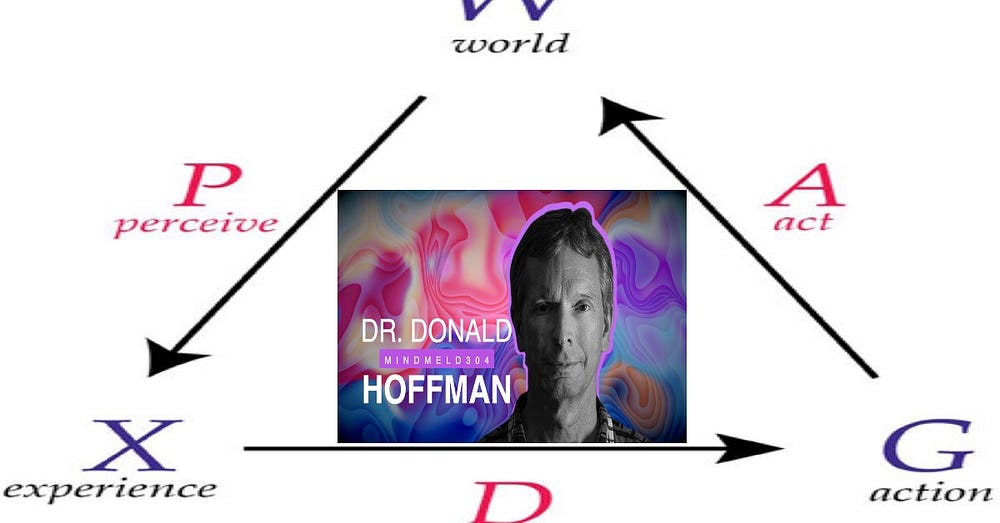
Donald Hoffman is attempting to “come up with a mathematically precise theory of consciousness and [] space, time, and matter”. That project involves an essential commitment to idealism. But how substantive is the maths in his project?
[The title above is an ironic take on Donald Hoffman’s ‘Reality is Eye Candy’, which was a presentation he gave in 2017 at a SAND conference.)
“Part of my background is in psychophysics. This is the science of studying conscious experiences and building mathematical models. Your conscious experiences are not random things. We do careful experiments and can write down mathematical equations that actually describe the conscious experiences you will have. They’re mathematical, so conscious experiences can be described by mathematics.”
As just stated, Hoffman often mentions “mathematical models”. However, he rarely says what he means by those two words. And he rarely offers us any examples of these models. (The ones I’ve found will be discussed later.)
There may be a good reason as to why Hoffman doesn’t give us any examples. For example, he says thatwe must
“admit that maybe consciousness can be described with mathematics”.
Hoffman doesn’t say that consciousness has been “described with mathematics”here: he uses the word “maybe” instead. Yet elsewhere Hoffman keeps on talking about his mathematical models of consciousness (as well as of experiences).
Models of “conscious experiences”?
What form do they take?
And what does it mean to claim that scientists like Hoffman
“can write down mathematical equations that actually describe the conscious experiences you will have”.
Does Hoffman may mean that there are mathematical models of the physical bases or correlations of what he calls “conscious experiences” or consciousness itself?(See ‘Neural correlates of consciousness’.) That is, is Hoffman simply taking about what goes on in third-person (physical) brains — along with observable physical and verbal behaviour — when such things are studied by scientists?
If so, then any commitment to correlations, brains and behaviourwould make Hoffman’s position very much like that of those neuroscientists, psychophysicists and other scientists who’re also physicalists…
That, at least in itself, isn’t a contradictory position on Hoffman’s part. It simply means that Hoffman’s position on what (in this case) brains and neurons actually are needs to be made explicit — at least to all those people who aren’t aware that he’s an out-and-out idealist.
But what about having mathematical models of conscious experiences themselves?
Of course many scientists of mind and consciousness reject this “binary opposition” in that they don’t even attempt to divorce consciousness and mind from the brain. And the primary reason why they don’t do so is that most of them are either explicitly or implicitly committed to physicalism. Indeed Hoffman himself is keen to stress the fact that most scientists (specifically when it comes to the brain, mind and conscious) are — if often tacit — physicalists (see here).
So, again, how does Hoffman fit into this debate?
The general point here, then, is that mathematical models exist in physics, biology, economics, etc. Yet can there also be mathematical models of experiences and conscious agents?
In terms of the latter, the answer is yes… in a sense. That is, only if the verbal and behavioural actions of “conscious agents”, along with what happens in their physical brains, are being modelled…
Yet all that isn’t only what Hoffman is attempting to do.
Conscious Realism
Donald Hoffman often uses the word “we” when he should really use the word “I”. Take this eulogy to his own conscious realism. Hoffman writes:
“Here there is good news. We have substantial progress on the mind-body problem under conscious realism, and there are real scientific theories.”
It can be conceded that Hoffman has a few postgraduate workers, and even a few fellow professors, working with him on his conscious realism. However, phrases such as “we have substantial progress on the mind-body problem” seem a bit too grand. However, it’s the passage which follows which is relevant to this essay. Hoffmancontinues:
“We now have mathematically precise theories about how one type of conscious agent, namely human observers, might construct the visual shapes, colors, textures, and motions of objects [].”
Now that’s fair enough.
It can easily be seen how scientists (cognitivescientists) can construct “mathematically precise theories” about how “human observers might construct the visual shapes, colors, textures, and motions of objects”. The thing is that Hoffman goes much further than this. He has done so by entering the domain of speculative philosophy. Not only that: the reference to constructing shapes, colours, and the motions of objects can all be placed under what’s often been called “third-person science”. That is, in such a science, the researchers will rely primarily on two things:
1) The “reports” of the subjects in scientific experiments. 2) The neuroscience, etc. of vision, etc.
Hoffman moves beyond all that. He claims to have constructed a “mathematically precise” theory (or “model”) of consciousness, experiences, cognitive agents, etc. too. In addition, Hoffman also uses such mathematical models to defend (or simply describe) his philosophical position of conscious realism. Now what we have here is a huge jump from the neuroscience/cognitive science (mentioned in the quote above) to Hoffman’s speculative philosophical position.
Why the Maths?
The question is simple. When Hoffman says that his theory
“gives mathematically precise theories about how certain conscious agents construct their physical worlds”
what does he mean?
More precisely, in what way are numbers and other mathematical tools used to explain how “conscious agents construct their physical worlds”?
This can easily be answered in one way.
Numbers or mathematics generally can be used to describe or explain just about anything.
For example, if I randomly throw a deck of cards on the floor, the positions of all the individual cards can be given a precise mathematical description…
But why bother?
The other question is about how exactly maths makes sense of what goes on in minds or consciousnesses. Here again maths can be used (perhaps arbitrarily or pointlessly) to do so. More to the point, what work is the maths doing in Hoffman’s philosophical position of conscious realism?
Hoffman himself compares what he’s doing to what Alan Turingdid. In Hoffman’s own words:
“[T]he tip from Turing is that Alan Turing decided to give a theory of what is computation and he came up with this really simple formalism. A little machine that has a finite set of states finite set of symbols some simple transition rules and it turned out he could prove that any computation could be done by this simple little device called the Turing machine and that was what launched the theory of computation computer science [].”
Consequently, Hoffman continues by asking us this question: “[C]an we do the same thing for consciousness?” That is:
“Can we come up with a simple formalism which will handle all aspects of consciousness?”
And, again, in the following we may have a category mistake when Hoffman asks this question:
“Can we come up with a mathematically precise theory of consciousness and, from that, boot up space, time, and matter?”
What’s more, Hoffman tells us that he “think[s] [that] a precise mathematical science of consciousness is possible”.
Models as Idealisations
No one will have a problem with the fact that mathematical models can — or always do — idealise what it is they’re modelling.
For example, this is the case with ideal gases, point particles, massless ropes, and lots of stuff in boxes (see Lee Smolin’s“physics in a box”). However, it’s often the case that these “idealisations” (or simplifications) go way too far.
So is this true of Hoffman’s models of consciousness, conscious agents and the rest?
Here it also needs to be stressed that real situations (or things) in the world are very complicated and thus models — especially Hoffman’s models — may be extremely approximate in nature. However, perhaps the problem is not even approximation when it comes to Hoffman’s supposed “modelling” of consciousness, experiences, “conscious agents”, etc.
Yet idealisations and simplifications are often very-good things.
For a start, a model must provide us with more than “empirical data”. Put simply, models serve a purpose that’s beyond any painstaking description of every aspect of what it that’s being modelled. And it’s precisely because models — all models (by definition) — go beyond that data that there can be the following problems:
1) Models can oversimplify. 2) Models can bear little relation to what it is they model. 3) The relations between a model and what it models can be very vague, weak and even purely metaphorical/analogical — and that can even be the case when the model utilises much mathematics.
All this means that each mathematical model also has to take into account the to and thro between accuracy and simplicity. These and other scientific criteria are always being played against each other. This also means that other factors must come in — such as the “predictive power” of the model. In addition, simplicity is supposed be cherished in the theories of physics and when it comes to mathematical modelling. Thus, if a model is complex, then it will more faithfully reflect the thing that is modelled. If it’s too complex, on the other hand, then it won’t serve the purpose of being a model very well. (The complex model may be hard to analyse and difficult to understand.)
Now how much of all the above also applies to Hoffman’s models and what he claims about them?
This means that Hoffman’s mathematical models (if they are mathematical models) need to account for the question as to whether or not they really do describe systems (or any given phenomena) accurately. In that sense, Hoffman’s models face the same problem which he stresses human “perceptions” face in his (part) evolutionary account of conscious realism.
**************************
Part Two
Examples of Hoffman’s Models
The following are a few examples of Hoffman’s “mathematical models” — or mathematical charts (i.e., they’re hardly even mathematical graphs).
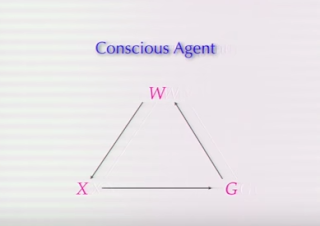
Firstly, we have this mathematical model of what Hoffman calls a “conscious agent”:
Hoffman uses the (supposedly) mathematical symbols of W, X and G in the above:
W = “a world” X = an “experience” G = a “conscious agent’s action”
Now once you have these symbols, you can play with them. In Hoffman’sown words:
“We can translate this into some mathematical symbols. We have a world W, experience X and action G.. and then we have a map [see next image], a Markovian kernel… and an integer counter [n] which is going to account for the number of perceptions you have[].”
And so on. And where you have mathematical symbols, you often also have maps, graphs, gridsand suchlike. Hoffman makes use of them too.
So what we have is a triadic set of relations between W, X and G.
Does it tell us anything? Is it gratuitous? And even if it’s not actually mathematical in nature, does it still help us in some way?
For one, as mentioned earlier, this model is certainly an idealisation (or a simplification): all we have represented is a world (W), an experience (X) and an action of a conscious agent (G).
So why only these three (as it were) variables?
Why a single experience and a single action? (Unless X is meant to be a symbol for experiences or experience in general.) And why are X and G seemingly taken in separation of the rest of W? What’s more, how would an externalistor anti-individualist take this almost Cartesian position on a world, an experience and an action? And what about the agent (G) and his/her/its embeddedness in the world (see ‘Embodied embedded cognition’)?
It’s of course the case that Hoffman’s conscious realism may provide all the answers to these questions
So to recap.
Hoffman’s graph above is seemingly scientific. We have the symbols W, X and G for a start. Not only that: the letters are connected in a geometric graph…
But so what?
How does this graphic and symbolic representation help matters? More importantly, what does it really say? And is this really a mathematical model?
And then Hoffman goes deeper — or at least his next graph is more complex than the first one.
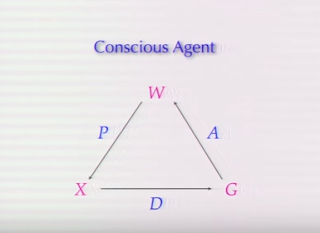
Now we have this:
Here we have extra “mathematical symbols” and thus more (supposedly) scientific rigour.
In addition to the symbols W, X and G, we now also have the symbols P, A and D. Thus:
A = “action map” P = “a Markovian kernel” D = “a perception map” or a “decision map” N = “an integer counter” which “counts the number of perception which you have”.
According to Hoffman, “a conscious agent is just[yes, just] a sextuple” — that is, “(X, G, P, D, A, N)”.
This means that the connecting line from W (a world) to X (an experience) is symbolised by P (Hoffman’s “markovian kernel” — see ‘Markov kernel’). And X’s connecting line to G is symbolised by D (a “perception map” or a “decision map”). That is, an agent carries out an “action” in a (or the) world.
Again, how does that model help?
And is the model accurate?
What sort of world (if a conscious agent’s world ) can be summed up by a “sextuple” (X, G, P, D, A, N) — even if we acknowledge the importance of idealisation or simplification?
Things get even deeper here:
Here we have a symbolic and graphic representation of “two conscious agents”, not one. In addition, we have N₁ and N₂ (both “integer counters”).
What does the image above really tell us?
If we didn’t get much meat out of the left-hand side of this image (as quoted above), then how can we get much more meat when we have both sides taken together?
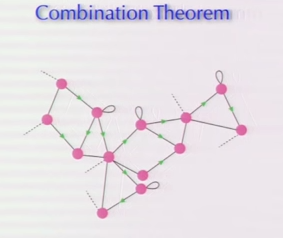
Finally, we have this:
In the above, “each dot is a conscious agent” and “each link is a connection between conscious agents where they are communicating with each other”.
Even Hoffman must admit that the placings of the agents (the pink dots) and the resultant shapes of these agential interrelations are completely arbitrary. (There are symbolisations of triadic interrelations and quadratic relations; which, in turn, are related to other geometric relations.) This, however, may not matter to the philosophical point that Hoffman is attempting to get across.
Three things are now worth mentioning here:
(1) Why the use of the mathematically-sounding title “combination theorem” (see mathematical combination)?
(2) Why is the above a theorem? (More mundanely, why use the word “theorem” at all?)
(3): What does Hoffman’s graph actually give us?
Conclusion
To offer a sceptical conclusion.
Perhaps all that Hoffman means by his frequent references to “using precise mathematics” (or, more often, to using “mathematical models”) is simply the use of what he calls “mathematical symbols”; which, in turn, are then placed in graphs(such as in those above).
Yet mathematical symbols can be used for anything and they can be used by anyone.
This raises the following question:
What does Hoffman mean by the words “mathematical symbol”?
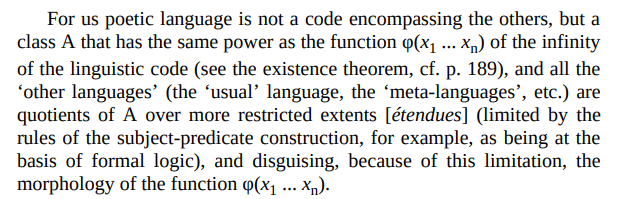
Is Hoffman really doing something that’s very different to what Julia Kristeva did in the following passage? -
And what about this “equation” from Jacques Lacan? -
It’s not being said that Hoffman’s models are entirely in the same ballpark as the other two outré examples. However, they’re still largely gratuitous. More importantly and finally, it can be argued that Hoffman’s mathematical symbols are used to simply (as it were) tart up his speculative philosophical positions...