Our brains are made of matter:neurons, biochemicals and other physical stuff. All these things are (as it were) “flesh and blood”. So, the British philosopher Colin McGinn (1950-) asks, how can “technicolour phenomenology arise from [this] soggy grey matter?”. In other words, why does the brain produce, cause or give rise to something so different from matter itself? What makes the brain so different to all the other human organs? More specifically, what is it, exactly, about billions of neurons that gives rise to consciousness or experience?
These questions were asked (if not in these precise ways) inColin McGinn’s well-known and important paper, ‘Can We Solve the Mind-Body Problem’. That paper was published in 1989 in the journal Mind.
Mind and Brain
Despite all the above, the main issue of McGinn’s paper is not one of how or why consciousness arises from the the brain. It raises the possibility that the link between the brain and the mind (or, more accurately, consciousness/experience) may be — permanently? — closed off to us.
McGinn calls this “cognitive closure”. And the “property” responsible for that cognitive closure he names P.
McGinn focuses on our (possible) cognitive limitations.
But firstly let’s take different species of animals. McGinn tells us that they are
Think here of bats and echolocation. Dogs too can hear sounds which we can’t even register and they have a far better sense of smell than human beings. So what’s true for other animal species will also be true for human beings.
Yet all these examples only display sensory — i.e., not cognitive — limitations and extensions.
So let’s get back to cognitive closure.
McGinn’s (or our) P is a real (or actual) property. It may even be concrete (e.g., part of the brain). Thus McGinn doesn’t believe that he’s (to use his own term) “irrealist” about P. That said, McGinn does cite the possibility that P is noumenal. As with Kant, noumena are permanently unknowable — by (Kantian) definition. (Kant also believed — living before Darwin - that the structures of the mind-brain would remain static for… well, the rest of time.)
It’s the very nature of the mind-brain link which renders P permanently closed off to us. Yet despite that possibility, P could still be — at least according to McGinn — part of a respectable naturalistic theory. Again, we shouldn’t be irrealist or mysterious about P. (Many philosophers do see Colin McGinn as a mysterian.) That said, one can’t help but see x as being mysterious if that x is also believed to be permanently closed off to us.
So does McGinn actually think in terms of permanent cognitive closure?
Hume, Locke and Kant
McGinn discusses another case of closure which occurred in the philosophy ofDavid Hume (1711–1776).
To Hume, our perceptual limitations determine our cognitive limitations. (Hume was a thoroughgoing empiricist.) More clearly, Hume believed that because our “ideas” are always copies of sensory “impressions”, then that also meant that our concept-forming system itself must always rely on— in whichever ways — those impressions. Thus nothing can transcend the information provided by impressions. (It can be asked here what was Hume’s philosophical position — as an empiricist — on such things as the existence of distant stars, the past, other minds, mathematics, etc.)
“comes from our own cognitive limitations, not from any objective eeriness in the world”.
Kant, on the other hand, believed that knowledge begins with impressions (or, more accurately, with “phenomena”). However, he also believed that impressions aren’t the sole source of our knowledge. That’s primarily because Kant postulated innate a priori concepts and categories which (as it were) get to work on phenomena.
Back to McGinn
Colin McGinn explicitly states his position with regards to P. To repeat: he claims to resolutely shuns what he calls “the supernatural”. P must be “natural”. (How does he know this?) He goes on to say that
“it must be in virtue of some natural property of the brain that organisms are conscious”.
McGinn then concludes:
“There just has to be some explanation for how brains subserves minds.”
Again, why must P be natural? Is this a case of McGinn having (as it were) faith in naturalism? Alternatively, is McGinn’s theory of P naturalist in the first place?
According to Alan Turing (writing in 1936/7), when it comes to human beings, a computation is the following:
A computation occurs when the human mind carries out a mental action according to a rule.
The words above (which aren’t Turing’s own — exact — words) don’t mean that people know that they’re following a rule. (Therefore people don’t know what that rule is.) Human grammar, after all, is also rule-governed; though not all children — and even many adults — can formulate the grammatical rules they employ. Nonetheless, almost everyone still follows these rules. (This is similar to both the philosopher’s notion of tacit knowledgeand Noam Chomsky’s theory of innate universal grammar.)
It was said that computability is the mind’s following a rule. Well, Turing believed that this is usually the case. So does that mean that there can be computability (or computations) without the following of rules?
More specifically, when machines (or computers) modify their own behaviour, is that an example of not following a rule?
It’s certainly the case that computers can do things which weren’t predicted by their programmers (or designers). So does that mean that such computers aren’t following any rules? After all, they could be following new rules which they have (as it were) created themselves. So not following the programmers’ rules doesn’t automatically mean that computers aren’t following any rules at all.
We can even say that such computers have genuinely learned (forget the semantics for now) something which wasn’t fed into them by their programmers (or designers). However, they may still be following rules. In fact the new rules may be the logical/mathematical consequences of the programmers’ old rules.
That said, how does all this stuff about rule-following computers directly connect with the brains and minds of human beings?
Alan Turing did think that the human brain is amachine… Or at least he thought that many — perhaps all — of the functions of the brain are that of a machine. Nonetheless, he also believed that the brain is so complex that it can give us the impression of not following a rule.
Now it seems clear that it’s the complexity of the brain that generates only an “appearance” of the brain not following a rule (see here). So that basically means that even though the brain appears not to be following a rule, it may still be doing so. It’s just that the brain is so complex that the investigator — or even the (as it were) owner of the brain — couldn’t know all the rules which the brain is following. Similarly, the complexity of the brain may also generate the belief that it is an “indeterministic machine”. Yet if the brain were truly indeterministic, one could also question its status as a “genuine machine”.(Douglas Hofstadter, for example, seems to have believed — at least at one point in his career — that if a “machine” does go beyond the rules, then, by definition, it can’t actually be a machine — see here.)
Following on from all this, does that mean that if the computer has learned something — or has created its own rules — that it’s displaying (or showing) what’s often called “genuine intelligence”? After all, the computer has gone beyond what the programmer programmed. It can be supposed that all this depends on the semantics of the word “intelligence” (as with the word “learned” earlier). If not following the rules of the programmer is a case of genuine intelligence, then the computer is displaying genuine intelligence. Nonetheless, is not following the rules of the programmer really genuine intelligence or is it something else? In that case, what exactly is it?
It depends on how the word is used and in which context it’s being used. In Alan Turing’s case, we (or mathematicians) use our intuition when seeing the truth of a formally unprovable Gödel sentence. That’s because Gödel sentences can’t be proved. Nonetheless, they’re true and they’re taken to be true.
How do we know they’re true without mathematical proof?
According Kurt Gödel himself, it’s through the use of human intuition (see here).
And if a Gödel sentence can’t be formally proved, then it can’t be shown to be true through “mechanical” methods. Again, it can’t be proved because proof is deemed to be a mechanical process (at least in this respect).
Another way of looking at intuition is with another of Turing’s ideas: the “oracle”.
In the case of a Gödel sentence, the mathematician (or the oracle) simply “has an idea” that the Gödel sentence is true. That is, he doesn’t use a mechanical method to establish its truth. He has an idea (or an intuition) that it is true. This hints at the brain (not the mind) working in ways which are way beyond conscious thought. That is, intuition is a result of the brain (not the mind) indulging in unconscious processes.
You may now ask how something can be established as true — especially in mathematics — without proof. You may also ask how truths can be established — especially in maths — only on the flimsy basis of a mathematician’s (or even of hundreds of mathematicians’) intuition or his simply “having an idea”.
Computer scientists — and the philosophers of mind who focus on computer/brain comparisons (or who even see the brain-mind as a literal computer) — will like Turing’s conclusion (of 1945/6) that algorithms are enough to account for all mental activity. Bearing in mind the previous comments about intuition, Turing believed that algorithms also encompassed non-mechanical intuition.
Just as intuition follows algorithms (therefore rules), Turing believed that what he called “initiative” didn’t require uncomputable steps either. In other words, both human and computer initiative is also a mechanical process. (That would make the idea of computer’s showing initiative less problematic for the simple reason that what it’s doing is still a computable — or mechanical - process.) However, as stated earlier when it was mentioned that computers may go beyond the rules (or programmes) created by the programmer, even if a computer departs from the computations which were programmed by the programmer, it would still be following a (new) rule, indulging in computations, or following mechanical processes.
Indeed — what else could a computer (or machine) be doing?
Another way of looking at a computer’s — or a Turing machine’s — ability to follow its own rules (or to show initiative) is for the programmer to engineer an element of randomness into the computer (or into the programme). That was what Turing did with hisManchester computer of 1948/50. That means that such randomness is deemed to (as it were) bring about intuition (or initiative). However, it would still be intuition (or initiative) that’s grounded in computation or in mechanical processes. The randomness, therefore, would simply be a result of the computer not abiding by the programmer’s rules (or programmes). It wouldn’t — or doesn’t — mean that the computer has gone beyond rules or computations.
The philosophers Bertrand Russell(1872–1970)and A.J. Ayer (1910–1989) once argued — along with many others — that no empirical statement could ever be certain. As a consequence of that position, Russell particularly targeted the use of the word “certain” in ordinary language.
“[I]t never has been and never will be right, for any person to say ‘I know for certain that p’, where p is a material-thing statement, is that he regards that form of speech as improper. He regards it as improper in just the same way that the sentence ‘I see something which is totally invisible,’ is improper… in the sense in which every self-contradictory expression is improper.”
Certainly at first glance it does not seem that the sentence
“I know for certain that I have two hands.”
is linguistically “improper” and/or indeed “self-contradictory”. The sentence
“I see something which is totally invisible.”
on the other hand, can be seen as linguistically improper and/or self-contradictory. That said, it’s not even clear that the word “improper” should be used about the above. After all, I understand it. Why not simply say, instead, that it’s false or that it does indeed say something which is self-contradictory. It’s just odd (or even pompous) to argue that it’s linguistically improper (or a “misuse” of language). Indeed even Noam Chomsky’s well-known sentence
“Colorless green ideas sleep furiously.”
can be deemed to be linguistically proper in that it’s grammatically correct. What’s more, perhaps Ludwig Wittgenstein (1889–1951) might have argued that there could be a language-game in which the sentence above is perfectly proper. Thus the same may go for “I see something which is totally invisible”. That sentence can still be said to be (simply) false and/or self-contradictory.
Again, the sentence
“I know for certain that I have two hands.”
is only improper if one knows about — and is committed to — the philosophical position which renders it improper and/or self-contradictory. Yet ordinary language isn’t really (or at least always) a philosophical language. So why should the utterer have prior knowledge of Bertrand Russell’s — or any other philosopher’s — philosophical position before he/she can say something about his/her hands? Indeed what if another philosopher says something different about that very same sentence? For that matter, what if a philosopher sees it as perfectly proper — as G.E. Moore himself did?
We can’t escape the fact that even if this sentence is improper and/or self-contradictory, then it is so only according to a prior philosophical theory which we may have no knowledge of. And even if we have knowledge of — or a commitment to — it, then we can still separate it from our ordinary-language locutions and commitments. Yet Bertrand Russell and A.J. Ayer suggested that we use the language of philosophers — and not ordinary language — when we’re tempted to say things like “I know for certain that I have two hands”. They argued (at least at one point in their careers) that only in logic and mathematics can statements be certain. (No empirical statement can ever be certain.) Thus one must conclude that anything we say about the two hands in front of us can never be certain.
G.E. Moore on Certainty
As a riposte to all that, Norman Malcolm quotes the English philosopher G.E. Moore (1873–1958)in this way:
“‘It is a proper way of speaking to say that we know for certain that there are several chairs in this room, and it would be an improper way of speaking to say that we only believe it, or that it is only highly probable!’”
“The philosopher” says that Moore’s way of speaking is “improper” and Moore (who was a philosopher) says that the philosopher’s way of speaking is improper. Moore’s way is improper, according to the philosopher, because we can never be certain about the empirical matter of there being two chairs in a room. The philosopher’s way is improper, according to Moore, because he’s using the word “certain” in its strictly logical sense — i.e., not how it’s used in ordinary language. Yet both the philosopher and Moore are talking about the correctness or otherwise of “linguistic statements”; not about the truth or falsehood of an empirical fact. According to Moore, “when we sat in a room seeing and touching chairs” it would simply be wrong (according to the dictates or ordinary language — if such things even exist) to say that
“we believed there were chairs but did not know it for certain, or that it was only highly probable that there were chairs”.
Quite simply, phrases like “highly probable” aren’t (often?) used in ordinary language. Or, if they are, then they aren’t used in contexts like this. Instead they’re used in sentences such as this:
"It is highly probable that the Loch Ness monster does not exist."
Not in sentences like this:
“It is highly probable that these chairs in front of me exist.”
So we can now say:
“I believe that the Loch Ness monster exists.”
However, we can’t say:
“I believe that these chairs in front of me exist.”
Similarly, many people would say that they aren’t certain that God exists; though they are certain that the two chairs in front of them exist. Another way to put this is as Moore did. He argued that if a child were to say (not that he would) “that it was ‘highly probable’ that there were chairs there”, then “we should smile, and correct his language”.
We can now ask, then, whether or not all these disagreements are really just about language, semantics or language use; rather than being about whether or not the chairs really do exist or whether we can be certain that they exist.
So doesn’t all that raise questions against Moore’s thesis?
What Norman Malcolm wrote next suggests that this isn’t just a question of language or semantics. It is, in fact, about what is expressed by “empirical statements”. Malcolm continued:
“Moore’s reply constitutes a refutation of the philosophical statements that we can never have certain knowledge of material-thing statements… and so shows us that Ayer is wrong when he says that ‘The notion of certainty does not apply to propositions of this kind.’…”
So Moore wasn’t just arguing that we’re allowed to use the word “certain” in “material-thing statements” (i.e., not just in logic and maths). He was arguing that we’re certain that what those statements claim is in fact the case. In this case, we’re certain that the chairs in front of us exist. After all, “material-thing statements” are about… well, material things. And Moore argued that we’re certain about the existence of (certain) material things such as chairs and our hands. Indeed what would be the point of being able to use the word “certain” if we weren’t (really) certain about material things? (Similarly with the word “know”.)
Having said that Moore’s position isn’t just a question of correct usage or semantics, Malcolm does then go on to make a distinction between the phrase
“I know for certain…”
as it’s used in — or about — a priori statements; and as it’s used in — or about — empirical statements. In each case, the word has a different (to use Malcolm’s word) “sense”. Malcolm wrote:
“The truth is, not that the phrase ‘I know for certain’ has no proper application to empirical statements, but that the sense which it has in its application to empirical statements is different from the sense which it has in its application to a priori statements.”
We’ll need to know what sense the word “certain” (or the phrase “I know for certain”) has when applied to an empirical statement. It clearly can’t have the sense that “the negative of it is self-contradictory”. That sense, then, must be that if we can see and touch our hands or the chairs in front of us, then we have the right to be certain that such things exist. The “negative” of such empirical statements will indeed not be self-contradictory. That’s because these statements aren’t supposed to be a priori or logical in nature — i.e., they don’t even open up the possibility of any contradictions or self-contradictions. However, couldn’t we say that it’s indeed self-contradictory to claim the following? -
“I can see and feel these chairs in front of me but I don’t know for certain that they exist.”
At least according to the dictates of ordinary language that sentence is contradictory. In this example, then, it wouldn’t (only) be a question of “correcting the language” of the person who uttered the above. In other words, if you can see, feel and kick the chair in front of you, then what more do you want or need? You can’t have logical or a priori certainty about this claim because it isn’t a logical or an a priori statement. So let us, Wittgenstein might have said, keep ourlanguage-games apart. And by keeping them apart, we can also stop all this silly fuss and bother about certainty or the correct use of the word “certainty”.
The (perhaps) counterintuitive and/or dismissive response to that statement is to ask this question: Is that really such a bad thing? Indeed do the implications of Lepore’s statement actually amount to much?
Ask yourself what it means — yes, means — when someone states the following:
You and I mean the same thing by the word “dog”.
Of course we can both say that we both mean dog by the word “dog”. However, that won’t get us very far. (This is somewhat like Alfred Tarski’sseeminglyvacuousT sentence. Namely: “The sentence ‘Snow is white’ is true if and only if snow is white.”)
Lepore’s claim (i.e., “you and I mean different things when we say ‘dog’”) wouldn't seem quite so outlandish if we were referring, instead, to a word like “democracy”. Thus:
You and I mean different things when we say “democracy”.
Most of us would happily accept the fact that what different people mean by the word “democracy” may be — or even will be — different (if only to varying degrees). So why couldn’t the same — or something similar — also be the case with the word “dog”?
Of course the word “democracy” is an abstract noun; whereas the word “dog” is aconcrete noun. But does that difference really make much of a difference? Sure, it’s easier to refer to — or pick out — a dog than it is to do the same with democracy. Yet that ease of referring to — or picking out — a dog with the word “dog” doesn’t necessarily mean that you and I mean the same thing — or exactly the same thing — when we use that word. Both you and I always — or nearly always — successfully pick out (or refer to) dogs with the word “dog”. Again, it doesn’t follow from this that we do so because we mean the same thing by the same word.
Does it matter, for example, that you think of — or simply mean — creatureswithwagging tails, and I think of — or mean — canine animals when we use the word “dog”? (Of course we may not even rely on any explicit — or conscious - definitions at all when we use the word “dog”.) Yet despite these (possible) differences, both you and I both still successfully refer to — or pick out — the same things when we use the word “dog”.
“If there is indeterminacy in our use of the term ‘rabbit,’ [or ‘dog’] it is an indeterminacy that is somehow rabbit-involving [or dog-involving]. While it may be indeterminate whether a given individual’s use of the term ‘rabbit’ [or ‘dog’] involves a reference to three-dimensional enduring substances, their temporal parts, their undetached spatial parts, their fusion, or some universal they instantiate, all the alternative reference assignments that are admissible here are tied together by being, in some rough sense, all rabbit-centered [or dog-centered].”
Alternatively, perhaps we don’t really mean anything when we use the word “dog”. Or perhaps it’s our causal and/or historical connections with dogs (i.e., rather than our internal meanings) which really matter. In addition, perhaps you (in homage to Quine again) pick out dog-parts, temporal dog-slices or doghood with the word “dog”; whereas I — being the sensible person that I am — pick out… dogs when I use the word “dog”.
Lepore goes on to say that
“this line of argument leads to such surprising claims as that natural languages are not, in general, inter-translatable”.
According to Lepore, Quinebelieved this. Yet Quine could speak fluent German — so how could he have believed this?… Of course I’m being slightly rhetorical here.
What Quine did believe is that the (in his own words) “facts of the matter” about, say, German meanings aren’t kept complete and intact in any translation. That’s because there are no facts of the matter when it comes to translation and therefore to meaning! (All of this is well captured in Quine’s paper ‘Ontological Relativity’.) That’s primarily because there can be no one-to-one correspondence between the language of translation and the objectlanguage — and that’s not only the case when it comes to “alien speakers”. Again, that’s primarily because there’s nothing determinate to translate — and therefore no determinate translation — in the first place. And this isn’t only because of the banal reason — among others — that there are certain German words which don’t (really) have an English translation (at least not a precise one). It’s because there are no abstract meanings, meanings as mental items or even meanings simpliciter — to correctly (or incorrectly) translate in the first place.
Quine himself argued that all we actually have (or need?) is “stimulus-synonymy” (as well as behavioural-response synonymy) when it comes to the translation of alien utterances. And that’s also the case — if to a lesser extent — when it comes to German speakers and even to our fellow English speakers! As for a circumscribed translation, even if all the physical and behavioural facts are available, various translations — perhaps indefinitely many — will always be possible. Thus it will be our choice of which “translation manual” to use — and that will largely determine the translation. Thus no single translation will capture the true meaning better than any other translation. Again, that’s because there’s no true meaning to capture. That said, perhaps some translations will be better or worse than others (say, for pragmatic or other reasons). We may — or will — also need to adopt the principle of charity when it comes to translating other speakers. Still, these qualifications (if that’s what they are) of the indeterminacy of meaning thesis may be hard to argue for.
The only way it would be possible to capture the true meaning of any utterance would be if there were true meanings to capture in the minds of the speakers of another language. Yet there are no such things — as Ludwig Wittgenstein and others have forcefully shown. (See the Private Language argument.) Indeed even if there are such private mental items, then how can we — as third parties — gain access to them? Thus the only way we can access them is when the translated person overtly expresses them. (Quine often used the words “overt behaviour”.) Consequently, if there’s no missing part when it comes to such behavioural expressions (in that they don’t really lose anything of the mental meanings), then perhaps such mental meanings can be entirely dropped from the picture. And that’s because such a (private) mental meaning (or item) will be a (to use two of Wittgenstein’s phrases) “wheel without a function” and a “beetle in a box”.
Lepore himselfgoes on to admitthat the people he calls “mitigated holists” needn’t be too concerned with meaning indeterminacy in that to them
“a notion of similarity of meaning (of mental content) somehow replaces the notion of semantic identity”.
Thus perhaps we simply don’t require any identity of meanings in order to understand other people when they use the same words we use. And we especially don’t require it when an alien speaker uses a word which we believe is his own word for, say, dogs. However, if we can’t have identity ofmeaning, it can now be asked why we can have similarity ofmeaning. Perhaps if meaning identity isn’t available (or possible), then neither is meaning similarity. A further question is:
What would count as similarity of meaning and how would that in itself solve the problem of the indeterminacy of meaning?
“… Philippe Sollers asserts… that our private lives ‘merit investigation’: ‘What do they like? What paintings do they have on their walls? What are their wives like? How are those beautiful abstract statements translated in their daily and sexual lives?’ Well! Let’s concede once and for all that we are arrogant, mediocre, sexually frustrated scientists, ignorant in philosophy and enslaved by a scientistic ideology (neoconservative or hard-line Marxist, take your pick).
“But please tell us what this implies concerning the validity or invalidity of our arguments.”
It’s likely that straight after reading some of my words in this piece that — at least some — readers will claim that I too have an (as the phrase has it) “ulterior motive” for arguing that Philip Goff and Immanuel Kant have (or had) ulterior motives for advancing their own philosophies.
So it’s now worth making a distinction.
A Distinction Between Known and Unknown Motives
Perhaps there are those ulterior motives which philosophers are well aware of; though which they then hide or deny. On the other hand, perhaps there are also those motives (which aren’t ulterior) which are uncovered by people external to the philosophers themselves (say, by psychologists, social/political theorists, historians, etc). Indeed it can be argued that if the “ulterior motives” aren’t acknowledged by the philosopher as his own motives, then they aren’t actually ulterior motives at all.
Yet perhaps all this depends on how complex we take the mind to be and whether or not it can work on different semi-independent levels. (It’s not necessary to believe in a Freudian unconscious — or any equivalent — here.) The point is that there’s a difference between a philosopher who quite consciously has a (to use the cliche) “hidden agenda” (whether political, religious, etc.); and a philosopher who’s simply not aware of his motivations, social positioning, professional status, his place within a historical context, etc. The latter may have no idea how these things can — to lesser or greater degrees — determine his philosophical views (or at least his choice of subjects).
So if we’re talking about truly subliminal motives, then it’s clearly not worth criticising the philosopher concerned because a philosopher can’t be culpable for something he doesn’t know about. (I suspect that this will be disputed in ethics.) Of course the philosopher’sputative “hidden” motives could be pointed out to him and his reactions to this will be interesting in itself. On the other hand, the philosopher who systematically hides his overall game planis a different case entirely.
So let’s now tackle what Philip Goff himself said about other philosophers “believing what they want to believe” (i.e., rather than him actually using the words “ulterior motives”).
Philip Goff
The contemporary English philosopher Philip Goffexpressed the following when interviewed for a YouTube video:
“When we’re doing science or doing philosophy, then we should certainly be thinking about not which view we’d like to be true; but which view is most likely to be true.”
In the context of everything else Goff had said in this interview, wasn’t this a hopeless ad hominem aimed at Goff’s own philosophical opponents?
More specifically, Goff claimed that materialists shouldn’t “believe what they want to believe”. But surely that claim is against the man and not against any specific argument. Clearly Goff believes that various (though not all?) physicalists, Darwinians and scientists would “like their views to be true” and for panpsychism to be false. However, I can just as easily turn this ad hom on its head and aim it at Goff himself. That is, Philip Goff may like — or want — panpsychism to be true. After all, panpsychism has been tied to almost three-thousand years of religious, spiritual and moral beliefs/views of various kinds — not least in the video itself.
Of course panpsychists and others may dispute my claim that Goff was aiming his ad-hom statements exclusively at the critics of panpsychism. In other words, they may argue that Goff was expressing a “general approach” to philosophy and science when he talked about people wanting P to be true or false. Yet, as already stated, in the context of what Goff says in this video — and elsewhere — about the detractors of panpsychism, I simply believe that this isn’t the case. That is, Goff believes that many philosophers and scientists are emotionally against panpsychism. And, in the context of the video above, I think it’s also clear that he’s only — or at least mainly — targeting panpsychism’s opponents.
It didn’t help either when Goff said that “materialism is dismal”. Surely that’s not a philosophical comment.
I suppose none of this matters if Goff’s arguments work. However, it was Goff himself who used ad homs against others — and he’s done so on more than one occasion.
So this is where we are now.
Goff claimed — if implicitly or obliquely — that those who’re against panpsychism don’t want it to be true. And then I aimed that way of “arguing” against Goff himself by saying that he wants panpsychism to be true. In turn, it can now be turned against my own position against Goff… Consequently, many philosophers — especially analytic philosophers — may well see all this as a hopeless game.
But not so quick!
One can confront the arguments and also do some — amateur — psychology and sociology. Indeed the sociology and psychology may help us understand the arguments. So pointing out these possible motivations for believing in panpsychism (which Goff himself happily acknowledges and even cites in the video and elsewhere) may not be philosophy; but it may still be relevant.
Now let’s take the case of Kant.
Immanuel Kant
We can’t be sure how honest Immanuel Kant was being about what can indeed be called his own (as it were) ulterior motives when he wrote the following words:
“[T]here can only be one ultimate end of all the operations of the mind. To this all other aims are subordinate, and nothing more than means for its attainment. This ultimate end is the destination of man…The superior position occupied by moral philosophy, above all other spheres.”
This seems to be a statement that “moral philosophy” should be — or is — First Philosophy. (Relevantly, the mid-20th-century French philosopher Emmanuel Levinas explicitly stated that Ethics is — or should be — First Philosophy — see here.) In other words, the quote above is a more or less honest acknowledgement by Kant of his own ulterior motives. (Of course Kant would never have used these precise words about himself.) That is, he stated that “all the operations of the mind” (including, it must be assumed, all Kant’s own philosophising in metaphysics, epistemology, etc. — i.e., everything outside his moral philosophy) were nothing more than
“means for [the] attainment [of the] ultimate end [of] moral philosophy”.
So, unlike the common conception of Kant as a systematic and objective “system builder”, it can be saidthat Kant wasn’t working from the bottom up (i.e., from foundations), but from the top down. That is, Kant’s “moral philosophy” wasn’t born of his general philosophy. Instead, Kant’s moral philosophy gave birth to — and determined — his overall philosophical system. So no matter how systematic, coherent and internally valid (or indeed true) Kant’s philosophical system (or at least the parts or propositions thereof) is, its (as it were) First Cause was Kant’s moral philosophy.
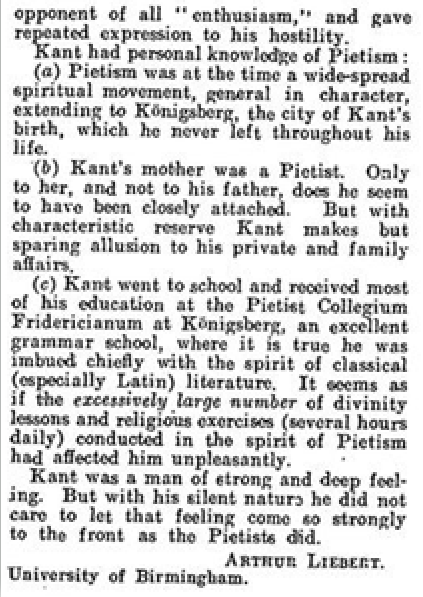
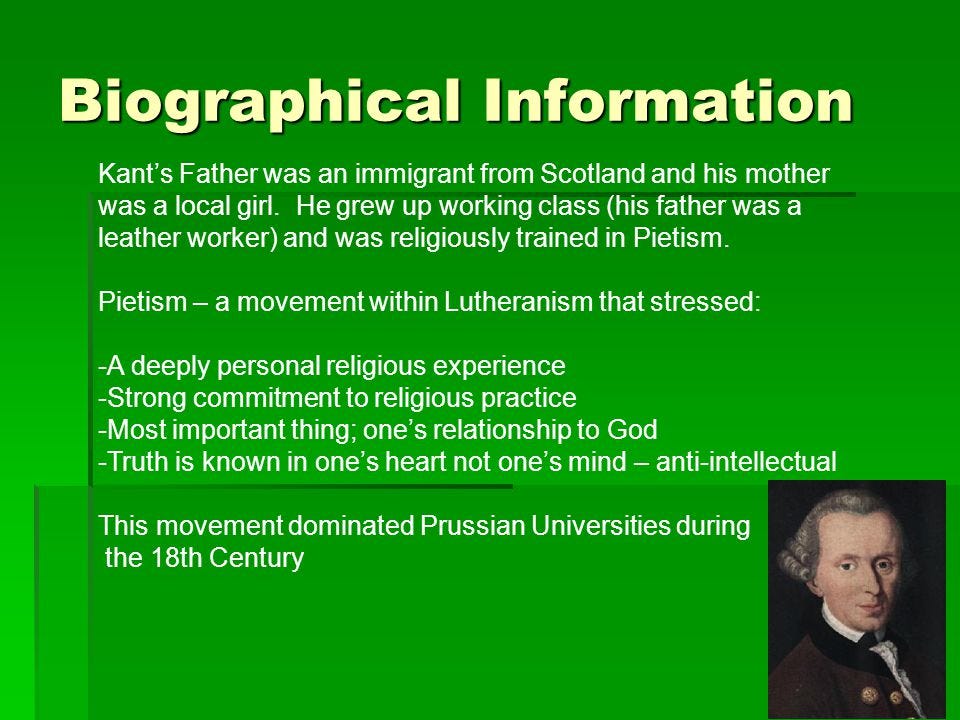
And who’s to say that Kant’s moral philosophy (which he also admitted — if obliquely — was determining his entire philosophical system) was not itself built up from — and determined by — its own First Cause? That is, just as Kant’s moral philosophy determined his entire philosophical system, so perhaps something completely outside philosophy determined his moral philosophy. And let’s not beat around the bush here. Perhaps it was Kant’s Pietist Protestantism(or Lutheranism)which determined his moral philosophy, which in turn determined his entire philosophical system.
There is more — strictly philosophical — evidence of Kant’s religious (or moral) a priori when it came to his destruction of the Ontological Argument for the existence of God.
In this precise technical case, Kant attempted to prove that the word “‘exist’ is not a predicate”. And by so doing he believed — and many others did too — that the support underneath the Ontological Argument had been taken away. And let’s not forget here that Kant and other philosophers believed that they had previously refuted all the other “proofs” of God’s existence too.
So what were Kant’s ulterior motives for refuting the Ontological Argument?
“No one, it is true, will be able to boast that he knows that there is a God…No, my conviction [that God exits] is not logical, but moral certainty… it rests on subjective grounds.”
And what did Protestants generally (or even always) believe when it came to their religious beliefs and the existence of God? They believed that it should rest on “faith, not reason”. Kant, therefore, “made room for faith” by destroying the (supposed) rational proofs of God’s existence. This too he — indirectly — admitted to in this segment:
“[T]he principles of reason…do not conduct us to any theological truths…we recognise [Reason’s] right to assert the existence of a perfect and absolutely necessary being, [but] this can be admitted only from favour, and cannot be regarded as the result of irresistible demonstration.”
Kant’s moral philosophy also squares very well with another important feature of Protestant Pietism: the emphasis on personal morality. And, as all Kantians and those knowledgeable about Kant will know,“the moral sense within us all” is essential to Kant’s ethics.
Conclusion: A Long Ad Hominem?
It can of course now be said that all the above is nothing more than an elaborate and long ad hominem. And, as already stated in the introduction, surely what matters is whether or not Kant’s system (or its propositions taken individually or collectively) is true.
For example, it may well be the case that some particular person has an ulterior motive for believing that 2+2=4. That doesn’t thereby stop 2+2 equalling 4. And even outside arithmetic this logic may still apply. For example, someone may believe x solely because he is inherently nasty or vicious. However, his statements about x may still be true.
So perhaps it would be wise to come down somewhere in the middle on this issue.
We shouldn’t believe that if a philosopher states P and that he’s also culpable in some way, then that (somehow!) makes P false — or at least probably false. And neither should we believe P is false — or even suspect — simply because it was articulated by a philosopher — or by anyone else — at a certain suspect point in history (or in a certain suspect environment) which somehow automatically invalidates P.
That said, neither should we completely ignore the aetiology of beliefs and ideas. And one reason it’s unwise to do so is that from the (as it were) context of discovery and belief (whether psychological, historical, political, etc.) we can gain a better understanding of the beliefs or ideas themselves — not only the contexts of such beliefs or ideas. The contexts, in this case, would only be a means to a (philosophical) end.
So by learning about Kant’s motives (if that’s what they truly were) we may actually gain an insight into his philosophical ideas themselves. More particularly, if we know that Kant was “making room for faith” in certain — or even all — areas of his philosophy, then that may also help us come to know what he was doing and why he was doing it.
Notes:
1) Kant wasn’t the only Pietist thinker of the Enlightenment era: there was also Friedrich Heinrich Jacobi (1743–1819). It just so happened that they took different approaches to the “excesses” of the Enlightenment. Jacobi emphasised the necessity of faith and irrational belief. Kant, on the other hand, knew that the Enlightenment mind would only accept Reason to set limits on Reason. And that was precisely what Kant attempted to do.
Kant’s pro-Enlightenment position was basically an ultra-Protestant stance against Church authority. To Kant, the Enlightenment was a reaction against a Catholic past in which there was an “inability to use one’s reason without the guidance of another”.
2) It’s interesting to see the way in which individual philosophers have set out to defeat scepticism. In other words, we may not be mistaken in being sceptical about their anti-scepticism. It can be argued that philosophers like Kant knew precisely where they wanted to go before they had even set off on their philosophical journeys. (This is often said about the studies written by academics too.) In other words, perhaps these philosophers weren’t only led by truth or sound arguments: perhaps they were also led by the desire to, say, squash scepticism.
Now Take these words:
“Kant regarded the failure to refute scepticism as a ‘scandal’ to philosophy, and offered his Critique of Pure Reason as a solution.”
Similarly, perhaps Descartes knew where he was going before he set off on his philosophical journey. More particularly, Descartes believed that God would keep His highplace in the universe after all his radical philosophising. And he also believed that all globally-sceptical views would be crushed by his “method of doubt”.