Monday, 19 July 2021

Donald Davidson’s Anomalous Monism: Mental Events


This essay is almost entirely devoted to a single influential philosophical paper: Donald Davidson’s ‘Mental Events’ (1970).

Donald Davidson (1917–2003) was an American philosopher whose work - from the 1960s onward — has been very influential in many areas of analytic philosophy. He has also had a smaller impact on various Continental philosophers.

This following essay basically expresses Davidson’s position of anomalous monism. This is a philosophical thesis about the mind–body relation. The theory has it that mental events are identical with physical events (hence the monism in anomalous monism). Yet it also argues that the mental is anomalous in that under the descriptions of mental events, relationships between them are not describable by strict physical laws. This means that Davidson proposed an identity theory of mind without the bridge laws that strongly tie mental events to physical (or brain) events (as in the type-identity theory).

Mental Events

Many people accept that the mind interacts with the brain. Or, more technically and to use Donald Davidson’s own words, “some mental events interact causally with physical events”. Davidson gives a very concrete example of this:

i) Mental Events: perceivings, notings, calculations, judgements, decisions, intentional actions, changes of belief.
ii) Physical Event: the sinking of the Bismarck.

The mental events in i) brought about physical event ii).

So if there are causal events between the mind and the body, then, Davidson argued, these causal events must instantiate the kind of physical laws found in every other part of the universe. To use Davidson’s words:

“[E]vents related as cause and effect fall under strict deterministic laws.”

Many people think that this is the case simply because it’s the case everywhere else in the universe.

The “third principle”, as Davidson calls it, is a position that’s not well-known outside the philosophy of mind. This is that

“there are no strict deterministic laws on the basis of which mental events can be predicted and explained”.

That basically means that we can never really know, for certain, what a mind (or a person with a mind) will do next. If we kick a ball, we know what will happen: it will move in a particular direction. Though put a mind (or a person) in any given situation, then we can’t forecast precisely how he or she will act. (Of course we won’t know the exact trajectory of a kicked ball either.) We can, however, offer probabilistic forecasts of that mind’s behaviour; though this would be a forecast determined by past behaviours and verbal expressions rather than by the “inner” nature of the mind or the workings of the brain.

And because Davidson believed in what he called “the anomalism of the mental” (i.e., that there aren’t strict deterministic laws with which we can forecast, predict or explain mental events), then the Identity Theorist has a problem because he believes that the mental and the physical are identical. That means that there must be such laws for mental events.

Let’s be clear what the Identity Theorist believed. He believed that, for example, a particular pain is identical to a particular brain state. They’re literally numerically identical.

Anomalous monism (the position advanced by Davidson), on the other hand, is still physicalist; despite the special position it gives to mental events. The anomalous monist believes that all events are physical. Yet the anomalous monist also believes that “mental phenomena [can’t] be given purely physical explanations”.

So why aren’t mental events subsumable under scientific laws?

How does the monist account for this anomaly?

Firstly, although the mental and the physical aren’t identical, there is a very close relation between the two. Mental phenomena depend — or supervene — upon physical phenomena. And the supervenience thesis is both strong and, according to some, thoroughly physicalist.

Let’s explain this close relation between mental events and physical events.

If two events are alike in all physical respects, then they’ll be alike in all mental respects — despite the fact that they’re not identical! To put the same position somewhat differently. Two objects can’t alter in some mental respect without also altering in some physical respect.

Now a little will be said on the monist’s position on reductionism (which is very important in the philosophy of mind), vis-à-vis the relation between mind and matter.

Reductionism

As Davidson put it:

“Dependence or supervenience of this kind does not entail reducibility through law or definition.”

Anomalous monism isn’t a reductive physicalist position. This means that the mind can’t be reduced to the brain without remainder. Thus supervenience doesn’t entail psychophysical laws.

Again, Davidson went into the reasons why we can’t use physical predicates to describe or explain mental events. So, despite his physicalism, he argued that no physical predicate has the “same extension as a mental predicate”. To sum up: Davidson essentially argued that the physical and the mental are ontologically identical (again, hence the monism); though descriptively (or conceptually) non-identical.

Yet, at a prima facie level at least, this seems to be a hard position to defend. That is, can we make sense of ontological monism alongside conceptual dualism?

To defend his position Davidson discussed the long tradition of naturalist attempts to define the mental (or supposedly non-physical) in terms of the physical. (For example, behaviourists tried to define or describe the mind — or the mental — in terms of observable physical behaviour.) Davidson also argued that naturalism in ethics failed; as well as in instrumentalism and operationalism in the sciences; in the causal theory of meaning in semantics; and, finally, in phenomenalism in epistemology. According to Davidson, all these attempts at “definitional reductionism [were] conspicuously inadequate”. So it can now be said that Davidson was a realist about the mind or the mental (as well as about ethical terms/concepts and even properties). And, finally, Davidson believed that meaning is something that is not reducible to the physical.

Davidson then became slightly more technical and went into more detail about the anomalism of the mental.

The Technical Argument

Davidson cited the case of a mental event (m) and a physical event (p).

If m causes p, then “under some description m and p must instantiate a strict law”. However, this law must be physical because there are only physical laws. Yet “if m falls under a physical law, [then] it [must have] a physical description”. That is to say: m must be a physical event. This in turn means that in order for m to be subsumed under laws, it must be described in the language of p.

Davidson then argued something which , prima facie, seems contradictory. He wrote:

“So every mental event that is causally related to a physical event is a physical event.”

This appears to be saying that the mental is physical. Alternatively, that the mental is both mental and physical (hence the conceptual dualism). Yet hasn’t Davidson been arguing against the mental’s subsumption under the physical (hence the “anomalism of the mental”)?

To recap: In Baruch Spinoza’s fashion (in his own substance monism), Davidson claims that we can look at the mental qua mental and also the mental qua physical. m-descriptions can’t be reduced down to p-descriptions. And, therefore, p-descriptions can’t be lifted up to m-descriptions. However, if Davidson was a monist, m and p are the same substance. Therefore m = p. That said, it has already been stated that Davidson didn’t accept the Identity Theory. So one can now ask:

Can one be an ontological monist of mind and not be an identity theorist?

Human Freedom

It can be argued that there’s an idée fix running throughout all of Davidson’s paper.

It boils down to one thing: the necessity (or simple possibility) of human freedom.

The explanation — or perhaps the guaranteeing of — free will can be said to be one of Davidson’s primary aims in his paper. Yet despite the fact that earlier on Davidson had talked about “the efficacy of thought and purpose in the material world, and their freedom from law”, it’s strange that he was only explicit on this matter at the very end of his paper.

This is what Davidson wrote:

“The anomalism of the mental is thus a necessary condition for viewing action as autonomous.”

To put that another way:

The mind’s freedom from physical causation is necessary in order to secure us freedom (that is, secure us free will).

But which came first for Davidson?

Did the arguments about the anomalism of the mental lead to Davidson’s views about human freedom? Or did his pre-existing views about human freedom lead him to his arguments about the anomalism of the mental? Most analytic philosophers will say that whether or not this chicken or egg came first doesn’t matter at all. They’ll argue that if Davidson’s arguments work, then that’s all that matters.

In any case, the argument that Davidson’s faith in human freedom pre-dated his philosophical defences of human freedom becomes a little stronger when we bear in mind his references to Immanuel Kant — who, of course, undertook a similar enterprise.

In the last paragraph, Davidson paid homage to Kant by quoting — in full - a passage from Kant’s Fundamental Principles of the Metaphysics of Morals. This is the passage from Kant which Davidson quotes:

“[W]e think of man in a different sense and relation when we call him free, and when we regard him as subject to the laws of nature… It must therefore show that not only can both of these very well coexist, but that both must be thought as necessarily united in the same subject.”

[I can be found on Twitter here.]

Thursday, 15 July 2021

One Challenge to Physicalism in the Philosophy of Mind


i) Introduction
ii) Jeffrey Poland’s Hierarchically-Structured System
iii) Abstract Objects, Properties and Relations
iv) Murray Gell-Mann’s Staircases Between the Sciences
v) Conclusion

Despite the title of this essay, the following piece offers a number of criticisms of that one challenge to physicalism (in the philosophy of mind). In other words, this essay doesn’t itself offer a challenge to physicalism. That said, it does understand and tackle that challenge. And there’s also various attempts to show why philosophers and laypeople may sympathise with it.

That challenge itself is the existence of non-physical or abstract (for want of a better word) phenomena within both physics and physicalist philosophy and how that fact relates to positions taken on the mind or consciousness.

Jeffrey Poland’s Hierarchically-Structured System

Put simply, there are non-physical objects, properties and relations which are quite acceptable to both contemporary physicists and to physicalist philosophers.

Take, as a single example, the following position.

Professor of Science and Technology (at Brown University) Jeffrey Poland puts his case in this way:

“It should be understood that the primacy of physics in ontological matters does not mean that everything is an element of a strictly physical ontology… [physicalism] allows for non-physical objects, properties, and relations… physicalism should not be equated with the identity theory in any of its forms… I prefer the idea of a hierarchically structured system of objects grounded in a physical basis by a relation of realization…”

All the above is quite acceptable on a physicalist picture of the world. That said, does any of the above help in the mind-body problem? Does it somehow justify attacks on physicalist positions on the mind or on consciousness?

In general, physicalists accept the existence of various concepts, properties, objects, etc. which are non-physical. Thus physicalism — generally perceived — can’t be seen as a position which denies the existence of such abstractions.

In addition, most physicists (i.e., rather than physicalists) believe that that certain phenomena supervene on the physical. (Admittedly, supervene — or supervenience — is a word from philosophy which physicists rarely use.) Moreover, because of this acceptance of supervenience, then few physicalists accept that all properties in the world are type identical to physical properties. (Consequently, this often brings about a commitment to what’s called multiple realizability.)

(Supervenience theorists argue that all social, biological and mental properties supervene on physical properties. This means that that two “worlds” can’t be physically identical yet differ in their social, biological or mental properties.)

Despite all the above, the following isn’t meant to be an essay on physicalism itself. However, it must be noted here that physicalism isn’t only a philosophical take on the nature of what is. It’s also often a philosophical position which commits itself to what science (mainly physics) tells us what is. This means that physicalism is strongly tied to naturalism — although they aren’t the same thing. Thus as the Australian philosopher Daniel Stoljar (1967-) puts it:

[A] property is physical if and only if it either is the sort of property that physical theory [i.e., physics] tells us about or else is a property which metaphysically (or logically) supervenes on the sort of property that physical theory tells us about.”

But now let’s tackle abstract (i.e., non-physical) objects, properties and relations.

Abstract Objects, Properties and Relations

The first thing which should be said is that the non-physical nature of abstract objects, properties and relations aren’t of the same logical order as the ostensibly non-physical nature of mind or consciousness. (That’s if the mind or consciousness is non-physical in the first place.) So surely we can’t say that mind or consciousness is abstract in nature. Of course many accept that the mind is non-spatial. Yet does even the acceptance of that position make mind equivalent to abstract objects like propositions, universals, relations, etc.? Indeed even W.V.O Quine (an arch-naturalist and physicalist) accepted the existence of numbers and mathematics generally. And if anything is an abstract object, then surely a number is! (Of course that too has been disputed.)

This means that Poland’s quote — if used by an anti-physicalist — would actually set up a disanalogy between the abstract objects, properties and relations accepted in physicalist philosophy (as well as in physics) and the ostensibly non-physical nature of mind or consciousness.

In any case, the passage above finishes off with a statement of Poland’s statement that he prefers the

“idea of a hierarchically structured system of objects grounded in a physical basis by a relation of realization”.

This too is acceptable to most philosophers of the physicalist kind. Perhaps, more importantly, it’s also acceptable to scientists because they see meteorology, biology, anthropology, palaeontology, geology, anatomy, etc. as “higher-level sciences” — or at least sciences which study higher-level phenomena.

Or as the philosopher John Heil (1943-) writes:

“If you threw out ‘higher-level’ mental states or properties solely on the grounds that they depend in a mysterious way on lower-level material phenomena, you would have to toss out all the special sciences as well.”

So how does all this concern the scientific and philosophical question of consciousness or mind?

It can be accepted that the sciences mentioned above do grow out of physics. (Of course the phrase “grow out of” is both vague and metaphorical.) Thus chemistry — more directly — grows out of physics. And biology grows out of chemistry (at least to a large extent).

The important point here, however, is that even though chemistry and biology grow out of physics, this isn’t to deny the complexity of this issue and the problems with advancing any naive and simplistic kind of reductionism.

Gell-Mann’s Staircases Between the Sciences

The American physicist and Nobel Prize winner Murray Gell-Mann (1929–2019) once stated the following:

“The laws of biology do depend on the laws of physics and chemistry, but they also depend on a vast amount of additional information about how those accidents turned out.”

Gell-Mann went into further detail:

“In very simple cases, an approximation to QED [quantum electrodynamics] is used to predict directly the results at the chemical level. In most cases, however, laws are developed at the upper level (chemistry) to explain and predict phenomena at that level, and attempts are then made to derive those laws, as much as possible, from the lower level (QED). Science is pursued at both levels and in addition efforts are made to construct staircases (or bridges) between them.”

Today the theoretical physicist Sean M. Carroll (1966-) often stresses the autonomy of science’s higher-level descriptions. (The philosopher Jerry Fodor also focused on what he called the “strong autonomy” of the “special sciences”.) Indeed Carroll advances the “autonomy” of what he calls “emergent theories”. (This is a vital part of his overall “poetic naturalism”.)

Sean Carroll writes:

“The emergent theory is autonomous… it works by itself, without reference to other theories.”

Yet Gell-Mann himself (unlike Carroll who uses the phrases “without reference to other theories”) then went on to tell us why reduction is — despite all the above — a thoroughly scientific method in the following passage:

“I know of no serious scientist who believes that there are special chemical forces that do not arise from underlying physical forces. Although some chemists might not like to put it this way, the upshot is that chemistry is in principle derivable from elementary particle physics.”

In fact Gell-Mann did appear to offer us a middle-way between (strong) reductionism and the complete autonomy of the individual (special) sciences. He believed that it’s all about what he called the “staircases” between the sciences. As Gell-Mann put it (in the specific case of the staircases between psychology and biology):

“Many people believe, as I do that when staircases are constructed between psychology and biology; the best strategy is to work from the top down as well as from the bottom up.”

Interestingly enough, a man who’s often been accused of “reductionism” — the American biologist and naturalist E.O Wilson (1929-) - expressed a similar view in the following:

“Major science always deals with reduction and resynthesis of complex systems, across two or three levels of complexity at a step. For example, from quantum physics to the principles of atomic physics, thence reagent chemistry, macromolecular chemistry, molecular biology, and so on — comprising, in general, complexity and reduction, and reduction to resynthesis of complexity, in repeated sweeps.”

So instead of Gell-Mann’s simplicity and complexity, in this case we have the “reduction” and “resynthesis” of complex systems in “repeated sweeps”.

In addition, the philosopher Patricia Churchland (who classes herself as a “reductionist”) also advances a position which is similar to Gell-Mann’s. In her case, she confronts the neuroscience-versus-psychology binary opposition. And, in so doing, she mollifies people about that scareword “reductionism” by saying that the

“reductionist research strategy does not mean that there is something disreputable, unscientific or otherwise unsavoury about high-level descriptions or capacities per se”.

The words above can be summed up in the following way:

i) Simply because a scientist (or philosopher) says that x can be reduced to y (though not necessarily without remainder),
ii) then that certainly doesn’t also mean that this scientist (or philosopher) also believes that x is (to use Churchland’s words) “disreputable, unscientific or otherwise unsavoury”.

Patricia Churchland then goes on to say something that may surprise some philosophers. She argues that reductionism can exist side-by-side with what she calls “high-level descriptions or capacities”. This too perfectly expresses Gell-Mann’s own position as advanced above.

So how does all the above translate into the case of mind or consciousness?

Gell-Mann himself wrote:

“Where work does proceed on both biology and psychology and on building staircases from both ends, the emphasis at the biological end is on the brain (as well as the rest of the nervous system, the endocrine system, etc), while at the psychological end the emphasis is on the mind — that is, the phenomenological manifestations of what the brain and related organs are doing. Each staircase is a brain-mind bridge.”

So let’s simply rewrite Gell-Mann’s earlier words in this way:

There are no special mental properties which do not arise from underlying physical properties (or facts). Although some philosophers and laypeople may not like to put it this way, the upshot is that the study of mind is in principle derivable from neuroscience and the relevant cognitive sciences; which are themselves dependent on (more fundamental) biology, chemistry and, ultimately, physics.

The problem here is that the reduction of biology to chemistry and of chemistry to physics are of a different logical order to the reduction of mind (or consciousness) to the physical… Or are they?

To rewrite Gell-Mann again:

In very simple cases, an approximation to biology, the brain, etc. is used to predict directly the results at the level of mind or consciousness.

Well, the passage above is the case… in a vaguely analogous sense. That is, from (for want of a better word) happenings in the brain, one can indeed predict what’s going on in the mind (or in consciousness) — at least to some degree of approximation. Of course this is what’s often accused of being “mere correlation”. And because it is seen as being mere correlation, then moving from happenings in the brain to happenings in the mind (or consciousness) isn’t the same as — or even equivalent to — reducing what goes on in the mind (or consciousness) to what goes on in the brain.

Yet the words above almost entirely depend on how we take the word “reduction”. What goes on the the mind can be reduced to what goes on in the brain — but not without remainder. That is, what happens in the mind can be reduced to what happens in the brain in the sense that we can work from the former to the later. That is, the former (mind/consciousness) is — at least partly — explained in terms of the latter (the brain or happenings in the brain). However, the former cannot be said to be identical to the latter . So identity itself is the problem — or at least “identity” is the important word here.

Conclusion

So does the mind or consciousness really grow out of the physical in the same — or even in a similar — way to all these acceptable scientific examples? Are these higher-level states and properties of the special sciences emergent states and properties in the same way in which the states and properties of the mind (or consciousness) are often seen as being emergent?

Most anti-physicalists will argue that this parallel is far from exact.

[I can be found on Twitter here.]


Sunday, 11 July 2021

Is There Thought Before Language?


“The original question, ‘Can machines think?’, I believe to be too meaningless to deserve discussion.” — Alan Turing

In (vague) accordance with the words of Alan Turing above, in this essay there will be no attempt to tackle the word “thought” (or “thinking”) or define (or explain) what, exactly, it means. That said, the semantics of the issues covered in the following will — inevitably — still be hovering in the background.

The Prehistory of Thought

Some philosophers have argued that something (whatever it was) relatively complex must have predated language use in humans otherwise language wouldn’t have arisen in the first place. In other words, language couldn’t have come from nowhere — ex nihilo. So it can be assume that at least some kinds of conscious activity or even thought must have predated language use. The question is: Which kinds of conscious activity or thought?

I suspect that some people would question the use of the word “thoughtprimarily for two reasons:

(1) Language (of various forms) is used in most examples of thought.
(2) Only a language-user would have risen to the level of thought in the first place.

Yet there are many acts of the mind (or mental events) which, arguably, don’t involve language — even in adult human beings. Mental imagery is just one example.

You can imagine a round blue shape, for example, being stuck on the surface of a black square. You can even imagine adding an extra nose to someone you know. Despite that, some philosophers may argue that such mental activity (even if non-linguistic) could only be carried out by language users. They may argue that language even “infects” such (supposedly) language-innocent examples as mental imagery. After all, without the mastery of language, you may not even have a concept of a square and of a round shape. (This will depend on how we take the word “concept”.) The same goes for adding a nose to a face. The mental imagery itself doesn’t include the use of language; though perhaps only a language-user could think about such mental images and juxtapose them in the ways he, she or it does.

In any case, it’s not clear if philosophers (at least not on their own) can answer questions as to what humans thought about (or how they thought) before they were language users. (Weren’t homo sapiens always language users in some very basic sense?)

The evolutionary fact (or simple possibility) that something must have predated language (i.e., earlier than, say, 100,000 years ago) was mentioned earlier. Yet we don’t need to go that far back. Philosophers have also argued that right here and right now - and before humans say anything or even think something to themselves — something must come before the articulation (even if a sub-vocalisation) of any natural-language expression or vocalisation...

Or must it?

Many (analytic) philosophers, for example, have talked about an abstract proposition coming before its expression in a natural language. That may be the case. However, that doesn’t impinge on what goes on in an individual’s mind and brain before he expresses himself in a natural language. Even if abstract propositions do exist, then there’s still a different question to be asked about what predates natural-language expressions in the mind-brains of human language users — i.e., regardless of a realm of abstract propositions (if such things “exist” — or have being — at all).

One answer to some of this is the “language of thought” (LOT) theory first advanced by Jerry Fodor. Others provide a more naturalistic (or neuroscientific) account of what happens before we say or think something in a natural language.

Take the position of Paul Churchland.

Paul Churchland and Jerry Fodor

Patricia and Paul Churchland

The Canadian philosopher Paul Churchland (1942-) argued that

“how to formulate, manipulate, and store a rich fabric of propositional attitudes is itself something that is learned” .

And elsewhere in the same paper he wrote:

“[L]anguage use is something that is learned, by a brain already capable of vigorous cognitive activity…language use appears as an extremely peripheral activity, as a species-specific mode of social interaction which is mastered thanks to the versatility and power of a more basic mode of activity. Why accept, then, a theory of activity that models its elements on the elements of human language?”

It can be assumed that the first quote above would be given an immediate reply by a follower of Jerry Fodor (1935–2017). He may argue that the formulation, manipulation and storage of “a rich fabric of propositional attitudes” can be accounted for by something linguistic or at least something language-like: i.e., the language of thought. Thus we don’t escape from language here. Indeed, with relevance to the issue of animals, Fodor says that the cognitive activity of animals could also be “linguaformal”.

Although Churchland may accept that the LOT could account for our learning (i.e., in the first place) how to formulate, manipulate, and store a rich fabric of propositional attitudes, his own position is that our learning to do so is actually based on purely non-linguistic phenomena in the brain. To Churchland, it’s mainly a question of the following:

“[A] set or configuration on complex states…figurative ‘solids’ within a four- or five-dimensional phase space. The laws of the theory govern the interaction [“formulation”?], motion, and transformation [“manipulation”?] of these ‘solid’ states within that space.”

The point of bringing in Churchland here is — and we needn’t accept his whole philosophical scheme — that if he supplies us with some possibilities (or actualities) of non-linguistic “cognitive activity”, then clearly this can be co-opted to show the same for non-linguistic thought.

Yet Fodor muddied the water (as already stated) by claiming that, say, animal cognitive activity may also be “linguaformal”. The problem here is that Fodor’s use of the word lingua (in what inferentially appears to be his acceptance of an animal Language of Thought) may be a use of a word that’s so vague that it doesn’t satisfy any of the usual criteria for being a language.

Churchland offers us more on all this.

Take his reference to non-linguistic “representations” in the following:

“Any competent golfer has a detailed representation (perhaps in his cerebellum…) of a gold swing. It is a motor representation…The same golfer will also have a discursive representation of a gold swing (perhaps in his language cortex…).”

And later:

“A creature competent to make reliable colour discriminations has there developed a representation of the range of familiar colours, a representation that appears to consist in a specific configuration of weighted synaptic connections…This recognition depends upon the creature possessing a prior representation…This distributed representation is not remotely propositional or discursive…It…makes possible…discrimination, recognition, imagination…”

In a strong sense, what’s been argued in the passages above makes much sense — at least from an evolutionary perspective. At the level of species there must have been a continuum (at least of a kind) between animal and human thought. And, on the scale of individual human beings, there must also be a continuum between what can be called proto-thought and purely linguistic thought or verbal expression. (That’s if any mental activity at all can ever be purely linguistic.)

So, finally, what about the classic case of thinking about mathematics?

Roger Penrose’s Position on Mathematics

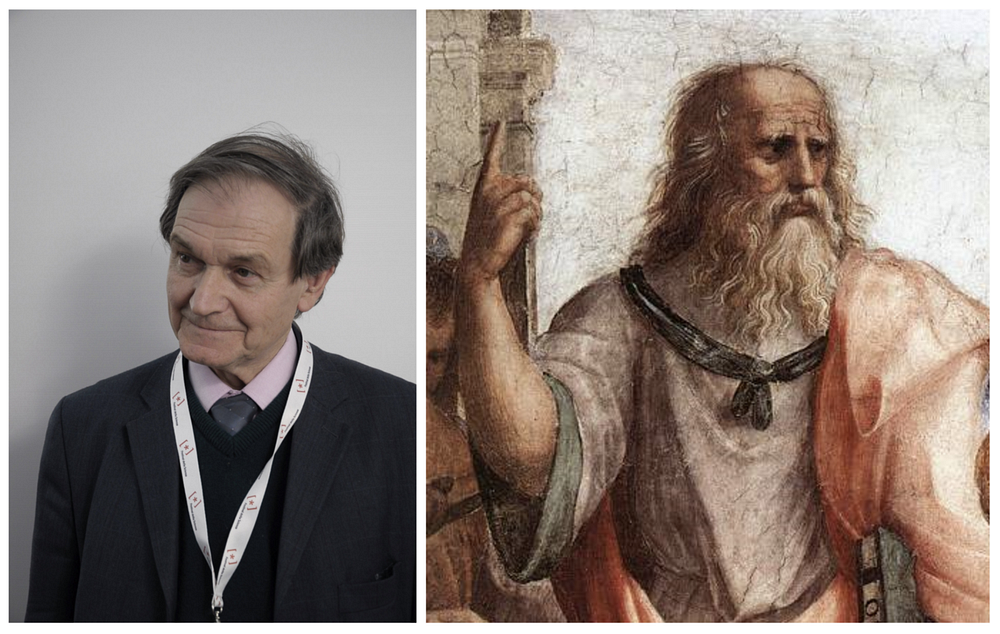
Roger Penrose and Plato

Do mathematical (for want of a better word) cognitions require words?

Would someone have ever reached any level of mathematical skill without being a user of language in the first place? Of course it must now be said that simply because language was (obviously) required to get a mathematician to where he/she is, that doesn’t also mean that language is used in all — or indeed any — of his/her mathematical (again, for want of a better word) reasonings.

More specifically, Roger Penrose (1931-) once stated the following words:

“[I] find words almost useless for mathematical thinking. Other kinds of thinking, perhaps such as philosophizing, seem to be much better suited to verbal expression. Perhaps this is why so many philosophers seem to be of the opinion that language is essential for intelligent or conscious thought!”

Like Plato before him, Penrose appears to glory in this escape from contingency. In this case, from the contingency of “words”. To be somewhat poetic/rhetorical again: both Plato and Penrose believe that the lack of precision when it comes to words (or all linguistic expressions) must be escaped from… Or at least that’s the case when it comes to mathematics.

Yet surely language is - (again) obviously - essential for Platonists too. That is, in order to become the Platonists that they are, language itself must have led their way when it comes to most — or even all — of their philosophical reasonings and then positions. Indeed (as just stated) that’s even the case when it comes to their mathematical cognitions.

So if we now take Penrose himself.

It can be argued that he would never have adopted and used these (supposedly) non-linguistic mathematical (as he puts it) “concepts” if they weren’t first described to him in “words”. And, as with the a priori in philosophy (or epistemology), we firstly need to learn what the a priori is in words — and also to learn the terms used in a priori statements — in order to have a priori “thoughts”. So this must mean that Penrose is talking about what happens after such words and linguistic concepts are acquired. And what happens after is (Penrose argues) something that’s completely non-verbal (or non-linguistic).

To sum up — what may be — Penrose’s position.

Of course one has to know — a posteriori — what the words and symbols in the equation, say, 2 + 2 = 4 mean. Yet after that, the non-linguistic status of this truth remains unchanged. Thus the Platonist will happily and obviously accept that we firstly need to learn the terms involved in mathematics and other areas of rationalist inquiry. However, once we’ve acquired such words and symbols, then we can (to quote Kant’s critical words on Plato’s position) “float free of the moorings” of language and rise into the Platonic realm.

[I can be found on Twitter here.]

Wednesday, 7 July 2021

Barry Stroud’s Critique of Naturalised Epistemology


It may be worth putting Barry Stroud’s (1935–2019) critique of naturalised epistemology in some kind of context. That’s partly because this is something that Stroud himself did when he tackled philosophical problems and issues.

So here are a couple of passages from his obituary — as published in Berkeley News (a publication of the University of California):

“While best known for his work in epistemology and philosophical skepticism… Stroud’s overarching legacy, his colleagues say, was his ability to see the big picture and get to the heart of philosophy…
“As a philosopher, Stroud came of age during a time when the prevailing Western attitude was that philosophical questions could be answered by the natural or social sciences, and he challenged those ideas...
“‘One might say that, while everyone else was philosophizing about consciousness, reality and knowledge, he was philosophizing about philosophizing itself,” [Kolodny] added.
“‘Barry single-handedly brought philosophical skepticism — which gives reasons to doubt whether we can know even the most ordinary things about the world around us — back to the center of philosophical discussion,’ Bridges said.”

**************************

In his ‘The Significance of Naturalised Epistemology’ (1981), the Canadian philosopher Barry Stroud offers a realist point against W.V.0. Quine’s naturalist position on epistemology. He makes the simple distinction between

1) Beliefs which are “constructions or projections from [sensory] stimulations” [Quine’s position].

and

2) Beliefs about the world.

Stroud’s question is: How do we get from 1) to 2)? Or:

How do we get from sensory stimulations — which are (it is assumed) caused by the world — to truths about the world or representations which are taken to be true of the world?

This is the ancient sceptical question. Indeed, at least since Descartes, this was once the central question of epistemology.

Another way of putting all this is in terms of what and how we know.

On Quine’s account, all we know about is are sensory stimulations and what we assert in response to them. This means that we don’t know anything about the world itself. (A locution which Quine would, no doubt, have rejected.) Or, as Stroud puts it, from this

“we would not in addition have independent access to the world they are about on the basis of which we could determine whether they are true”.

If what Stroud is saying is correct, then we can’t even say that sensory stimulations — and the causally resultant assertions — are “about the world” if they aren’t true of the world (or give us knowledge of the world) in the first place.

So are beliefs and assertions about our own and other people’s beliefs and assertions not directly (or even indirectly) about the world? These beliefs and assertions (or Quine’s “projections”)

“could not be seen as a source of independent information about the world against which their own truth or the truth of the earlier beliefs could be checked”.

This is as strong a statement of the possibility of scepticism in epistemology as you could hear from a sceptic himself. That is, we can compare beliefs against beliefs; though we can’t compare beliefs (or their contents) with the world (or its parts) itself. The American philosopher Donald Davidson (1917–2003) would even argue that we can’t compare beliefs, etc. with sensory stimulations because there are no belief-free sensory stimulations “which could count as evidence” in the first place.

All this can be (partly) boiled down — or is analogous — to Bishop Berkeley’s well-known statement that an “idea” can only be like another idea and not like what it’s an idea of in the world. Stroud, then, is referring to the traditional epistemological problem of “bridging the gap between sense data and bodies” (Quine, quoted in Stroud). However, whereas traditional epistemologists saw this as a problem, the logical positivists saw it is a “pseudo-problem”. Or, as Quine put it, this move between sense-data (or Quine’s “sensory stimulations”) and bodies is “‘real but wrongly viewed’” (Quine, quoted in Stroud).

In terms of this (logical) gap between “data and bodies”, Quine neither saw it as a pseudo-problem nor saw it, as Kant did, as the greatest failure of philosophy. Quine’s

“positive account does not try to show how we rule out the possibility that the world is completely different in general from the way our sensory impacts and our internal makeup lead us to think of it”.

If Quine did believe this, then we can argue that he might as well have believed that the problem of the external world (or even its existence) is a pseudo-problem if the sceptic or realist doesn’t “try to show how we rule out the possibility” that the world may be different to what we think it is. Perhaps, then, there’s a logical gap between data (or evidence) and the world. If there is, then why didn’t Quine think that such problems are pseudo-problems as the logical positivists did? Or as Stroud puts the logical positivist (or verificationist) position:

“The traditional epistemological question of the reality of the external world and our knowledge of it was for Carnap and Schlick and other verificationists a meaningless pseudo-question; no answer to it was empirically confirmable or disconfirmable.”

We can’t get between our evidence (or data) to get directly to — or at — the world in order to match the evidence (or data) with the world. Hence the logical gap. Yet physicists - or at least many of them - had always accepted that they must rely on evidence (or “phenomena” in the case of Kantian scientists like Einstein and Mach in the early 20th century). And because physics had the last (as well as first?) word on the world or nature, and if physicists happily accepted the importance of sense-data (or Carnap’s “cross-sections of experience”) when it came to world-talk, then the logical positivists did so too. Thus, as a consequence of this “deference” (Quine’s term) to physics, Stroud comments that

“[f]or Carnap we must distinguish a philosophical (pseudo) employment of a form of words from an ordinary or scientific employment of the same words”.

We mustn’t talk about the world or reality (its nature or existence) in the way the sceptics or epistemologists do. Instead we must speak as physicists (or even laypersons) speak. However, if we take the former option, then we’ll basically be talking rubbish.

In terms of Quine’s position again.

What’s the point of accepting the possibility that the “world [could be] completely different” if Quine didn’t offer us a way out of this problem? Again, if the gap is logical, then he must surely have seen the problem as a pseudo-problem. However, if all we have are “sensory impacts” and a largely given “internal makeup”, then we must surely see why Quine took the (pragmatic?) position which he did take.

Despite Donald Davidson’s criticisms of Quine’s emphasis (or very position) on sensory stimulations (hinted at earlier), Stroud argued that Quine’s position isn’t like that of the sense-data theorists (or British Empiricists/ phenomenalists). What Quine doesn’t do, even with his sensory stimulations, is try

“to isolate a domain of pure sensory data evidentially or epistemically prior to the knowledge of nature that is to be explained”.

So perhaps Quine’s position was midway between the “atomism” of sense-data theorists and Davidson’s holism. Thus:

(1) The sense-data theorists’ position: Sense-data are untouched by belief and theory.
(2) Davidson’s position: Beliefs are (clearly) touched by (other) beliefs and theory.

And , perhaps, the happy medium:

(3) Quine’s position: Sensory stimulations are touched by belief and theory but which nevertheless must ground (future) beliefs and theories.

Stroud’s perspective seems to depend on accepting a very controversial theory of metaphysically-realist truth. (Putnam once argued that, in terms of scientific truth, Quine was himself a metaphysical realist who, for example, accepted the principle of bivalence for the statements of physics— see here.)

Stroud puts this realist position by — once again — questioning Quine’s exclusive reliance on sensory stimulations and the resultant “projections” (or “posits”) we make “about the world” because of such sensory stimulations. He asked Quine this simple question:

“[How do the] subject’s ‘projections’ or ‘posits’ turn out to be correct, and not just a question about how he comes to make them [?]”

If the (to use Richard Rorty’s phrase) “world is well lost” (or if we don’t have direct access to the world), then how do we know which projections (or posits) are correct and which are incorrect without the (as it were) world telling us so? (Rorty and Davidson would say that the world can’t tell us anything — not even metaphorically or indirectly.) How does the Quinian decide which posits (or projections) are correct and which ones are incorrect? Are these decisions made exclusively on pragmatic or instrumentalist lines?

Of course Quinians can’t only be concerned with “how he comes to make” these projections (or posits) because some people come to make such projections about goblins or the influence of ley lines. So there’s more to the Quinian story than (mere) projections or posits. And, according to Stroud. that something extra is causality (or causation),

Stroud puts this rather simple causal approach to knowledge this way. He says that we

“would see that the world around [the investigator or epistemologist] is generally speaking exactly the way he says it is and that its being that way is partly responsible for his saying and believing what he does about it”.

This is certainly largely Davidson’s position and also the reason why he argued that “most of the beliefs in a coherent set of beliefs are true”. That is, we wouldn’t say (or believe) what we do about the world if the world wasn’t (as it were) responsible for what we say (or believe) about it. That relation (or connection) between belief and the world is largely accounted for in terms of causation. (According to Davidson, “causation does not come under a description” and it’s not in itself “explanatory”.) This causal (for want of a better word) position may seem simple and even a little naïve. Stroud writes that

“[m]any philosophers nowadays would hold that that is enough for knowledge: the subject believes that p, he is right, and it is no accident that he is right”.

So say that Jeff believes that P because the world is as he says it is. That is, the world causes him to believe (or say) that P in a causal-kinda-way. Indeed this almost has the appearance of being some kind of isomorphic relation between the world and what Jeff says (or believes) about it. It’s no surprise, then, that Stroud concludes by saying that the “adequacy of any such ‘causal’ account of knowledge is still questionable at best”.

And because of everything that’s just been said about Stroud’s account (i.e., that we essentially loose the world on Quine’s alternative), then we must also accept “that countless ‘theories’ could be ‘projected’ from the sensory impacts we receive”. Yet that’s no surprise at all because Quine himself admitted that. Indeed Quine was well known for stating the following: All theory is underdetermined by the sensory evidence. (All this is also part of the story of ontological relativity, the indeterminacy of meaning and the inscrutability of reference.) And that’s precisely why Quine also believed that we must employ “pragmatic” requirements and judgements when it comes to theory choice.

Stroud puts all the above less positively. He argued that because of this theory-pluralism (or theory-liberalism),

“if we do happen to accept one such ‘theory’ it could not be because of any objectively discoverable superiority it enjoys over it competitors”.

The theory we choose won’t be a truer account of the world. It won’t give us (so to speak) more of the world. It will only be pragmatically (or instrumentally) superior (to us) than the other theories. It won’t be truer or even more correct. It won’t have been chosen because something has been (as Stroud puts it) “objectively discovered” which places it in a superior position — i.e., in terms of truth rather than (mere) pragmatic utility (or whatever). That said, according to Stroud, Quine did accept an objective component to his alternative position. Yet that objective component is only the “meagre [sensory] data” which isn’t itself the world (as well as not really data or evidence on Davidson’s position). Even this pseudo-objective component doesn’t amount to much because (as already stated) this same objective data (or evidence) can be used to construct many competing, complementary or — sometimes - even contradictory theories.

Reference

Stroud, Barry, ‘The Significance of Naturalised Epistemology’ (1981)

[I can be found on Twitter here.]