Saturday, 21 August 2021

Define Your Terms and Explain Your Concepts


(Note: The quote in the image directly above is a paraphrase of Voltaire’s actual words. The full passage — which does, however, state the same idea in more detail — can be found in his Dictionnaire philosophique , from 1764.)

i) Introduction
ii) Conceptual Analysis?
iii) Debate?
iv) D.M. Armstrong on the Analysis of Concepts and the Analysis of Things
v) Problems With Definitions and Analysis

Philosophers can use the same words or (technical) terms in very different ways. What’s more, not all philosophers define or explain their terms. Nor do they explain how and why such words or terms almost entirely flow from their very particular philosophies. (This is especially true of academic philosophers who write only for those few fellow academics “in the know”.)

The situation is even worse when philosophical subjects are discussed and (technical) philosophical terms are used on social media or in other everyday contexts.

So here are a few examples of the kind of terms or words this essay has in mind. (The relevant words or terms are in bold. I’ll leave it to readers to decide if they were written by philosophers or by laypersons.) Here goes:

“What was the most relevant philosophy in the 20th century?”
“The statement ‘God exists’ (or ‘God doesn’t exist’) is meaningless.”
“His theory has been debunked.”
“Pegasus exists but is not actual.” 
“There are facts which can never be known.”
Consciousness is an energy which pervades the universe.”
“No one as proved that there is such a thing as evolution.”

Of course some of those terms or words have those have been defined; though still rarely. Others are virtually never defined — especially by most of the people who use them.

Conceptual Analysis?

It’s not that conceptual analysis (sometimes simply called philosophical analysis), specifically, ever completely went away. That said, as D.M. Armstrong hints later in this piece, it did come under severe criticism during and after the demise of “linguistic philosophy”. So at one point there was much talk of “pedantry”, “irrelevance” and a “petty focus on minutia” (at the expense of focussing on meaty, deep and heavy stuff). Sure, not all these criticisms were aimed specifically at conceptual analysis — yet even this fundamental and basic part of philosophy was deemed suspect by some (or even many)philosophers and laypersons at one point — and it still is today. (This is especially the case when it come to some of those academics who specialise in continental philosophy; as well as a number of continental philosophers themselves.)

D.M. Armstrong was mentioned a moment ago. In the late 1960s (when he wrote the following words) he argued that

“philosophers in the ‘analytic tradition’ swung back from Wittgensteinian and even Rylian pessimism to a more traditional conception of the proper role and tasks of philosophy”.

And the “proper role and task of philosophy” was

“to give an account… of the general nature of things and of man”.

It must now be said that the words “conceptual analysis” are used in an extremely broad way in the following piece. In other words, there are no references to specific movements or positions within philosophy — either past or present. Rather, this essay is mainly about what’s prosaically called defining your terms. Yet that must surely — at least in part — involve the analysis of concepts.

So, for example, the following has nothing to say about Quine’s rejection of the analytic–synthetic distinction. And neither does it argue that one can “give necessary and sufficient conditions for the application of the concept” one uses. (Demanding necessary and sufficient conditions for the concepts we use is both a — hidden - normative stance and it also seems to reify concepts.) In other words, with Wittgenstein it can be accepted that there are different ways in which the same words, terms or concepts can be used. Yet the acceptance of all this still allows for — and still demands — the definition of terms within any philosophical debate or context you like.

Following on from all that, while many (analytic) philosophers accept that conceptual analysis, explanation and definition are fruitful tools of philosophy, they still don’t believe that these things are all that there is to philosophy. (See later comments on — and quotes from — D.M. Armstrong.)

Debate?

In basic terms, if a philosopher or layperson doesn’t define his terms, then what he’s saying — or stating — may turn out to be confused, banal or simply false (i.e., after a definition is given or guessed at). Thus if the vague use of terms and the rhetoric (or poetry) is stripped away, then there may be nothing much underneath. Indeed vague and undefined terms are often simply part of a general display of verbalised (or written down) emotions and biases designed specifically to appeal to other people’s emotions and biases.

The problem here is that if people engaged in an exchange are using the same term in very different ways, then we can hardly say that there’s any debate occurring at all. What’s more, this situation is confounded by the fact that the debaters (if that’s an appropriate word to use in such extreme cases) assume — or simply believe — that his/her opponent is using the same word or term in the same way. That’s the case even when it’s clear to some on the outside that this isn’t happening. Thus, again, how can we even say that there is a debate (or dialogue) going on here if the debaters are talking about different things even when they’re using exactly the same words or terms?

In fact using the same words or (technical) terms in different ways is worse than having a fellow debater who keeps on changing the subject. At least then there’s an obvious problem. However, when people bandy around and share the words “consciousness”, “existence”, “truth”, “fact”, “free will”, “knowledge”, “prove”, etc. and mean very different things by those words, then that situation is far worse than one in which a debater simply makes a statement which is followed by a largely unrelated counter-statement (though not a counter-argument) from his fellow debater. In this former case, there’s the seeming situation that the debaters are talking about the same thing. Yet if they’re using their primary terms in very different ways, and those terms are born of very different philosophies, then that’s even worse than a simple shouting match between two rival debaters. At least in this latter case the debaters are talking about the same thing — even if they strongly disagree with each another.

Take the case of a boxing match in which instead of the two boxers punching each other at the same time, one boxer punches the other boxer (who has his hands down) for a couple of minutes, and then that other boxer does the same thing to him. In that sense, we don’t have a mutual fight: we have one set of punches from one boxer being followed by another set of punches from the other boxer. Of course this isn’t boxing at all. Similarly, perhaps we don’t have a debate (or dialogue) at all when the people are using the same word or term in very different ways and yet neither person is aware of that fact.

Of course it’s true that any given philosopher or layperson might well have defined his terms elsewhere — even in great detail. And you can’t expect a philosopher or layperson to define his term every time he uses it (see last section). That said, even if he has defined his terms elsewhere, the chances that the reader or fellow debater has read those definitions may be — and usually are— very slim indeed.

D.M. Armstrong on the Analysis of Concepts and the Analysis of Things

In his paper ‘The Causal Theory of Mind’ (1968), the Australian philosopher David Malet Armstrong (1926–2014) was right to argue that

[Gilbert] Ryle was wrong in taking the analysis of concepts to be the end of philosophy”.

Armstrong himself believed that

“the analysis of concepts is a means by which the philosopher makes his contribution to great general questions, not about concepts, but about things”.

It must now be said that Armstrong wasn’t only discussing “the analysis of concepts” here. He also believed that “the philosopher” has “certain [other] skills” which

“include the stating and assessing of the worth of arguments, including the bringing to light and making explicit suppressed premises of arguments, the detection of ambiguities and inconsistencies”.

That said, I’ll stick to conceptual analysis and defining terms here.

So let’s take it as true that Ryle believed that “the analysis of concepts [is] the end of philosophy”. Yet if he did, then that hardly makes sense. After all, are concepts, words or terms about (or do they refer to) other concepts, words or terms? How could Ryle have believed that? (Unless he was a “linguistic idealist”.)

Armstrong clearly rejected the terrible “binary opposition” between “the analysis of concepts” and the analysis of things. Yet surely we can only (as it were) get to things through our concepts. Of course that still doesn’t mean that the analysis of concepts is “the end of philosophy”.

The situation is that when we discus things, events, facts, theories, conditions… or anything, we use words, terms and/or concepts to do so. So it seems that it’s almost inevitable that philosophers should scrutinise the words, terms and concepts we use in such discussions.

It can also be argued that almost everything will flow from people’s own personal definitions (even if tacit or very vague) of the philosophical words or terms they use. In other words, it’s not as if there are determinate and fixed definitions of the words or terms used by philosophers and laypeople when discussing philosophical issues.

Of course a person may also claim that he defines a word in a particular way because he believes that his own personal definition unequivocally follows from what the x he’s referring to actually is… But that’s only the case if he defines his terms at all!

Again: is all this about words (or technical terms) and how we define them? Not at all. As Armstrong argued above: it’s also about things. So if definitions are very important, then once someone defines his word or term (say, “consciousness”, “existence”, “free will”, “fact”, “prove”, etc.), then we can move on from there. And that’s the case even if we’re using those words to talk about Armstrong’s things — concrete things, events and even facts.

Problems With Definition and Analysis

There may be at least a couple of responses (either in words or in thought) to this essay which cite my “self-referential inconsistency”. After all, this piece never defines the word “define”. And neither does it define “concept”, “analysis”, “explanation”, etc. That isn’t a big problem. It isn’t being argued here that every term or word one uses should be defined and that it should be defined every time one uses it. That would lead to the pedantry mentioned in the introduction — not to advancing genuine debate. In any case, certain terms or words are less in need of definition than others. And, of course, definitions themselves depend on conversational and other kinds of context.

This also means that we are — in some senses — free to define our words in any way we wish. This is especially the case if there’s no consensus definition of the philosophical term under dispute. So this makes it even more acceptable to take a (as it were) stipulational position on philosophical terms.

And there is also a problem with over-stressing the importance of definitions — or even with simply emphasising their importance at all. Indeed the Australian philosopher David Chalmers (1966-) summed up this problem with a joke. He wrote:

“One might as well define ‘world peace’ as ‘a ham sandwich.’ Achieving world peace becomes much easier, but it is a hollow achievement.”

Clearly, even someone who argues that stipulation is important won’t also accept that we can define the words “world peace” as “a ham sandwich”.

In addition, analytic philosophers have often prided themselves on their “conceptual clarifications”. However, these clarifications don’t always —at least not only in themselves — bring about clarity. Indeed they often do the opposite. That is, they can also encourage a degree of pedantry and academese.

It can also be said that the words “explicit explanation” and “explicit definition” will themselves need defining and explaining. What’s more, their usage and definitions may simply be relative to specific analytic philosophers and what they take these things to mean. In other words, much (or some) analytic philosophy may only be clear to other (professional) analytic philosophers. Thus the explicit explanations and explicit definitions found in analytic philosophy may only work as explanations and definitions when it comes to other analytic philosophers. This means that those on the outside (including highly-educated people) may not appreciate (or even recognise) that supposed clarity or take such explanations and definitions to be explanations and definitions.

Defining terms and the analysis of concepts also tie in with the issue of obscurity.

So, finally, let’s finish with some detail on what the word “clarity” may mean within a philosophical context.

Take the following passage from the American philosopher Gary Gutting (1942–2019). Gutting wrote:

“My concern [] is about the obscurity that arises because authors do not make a sufficient effort to connect their novel concepts to more familiar (even if technical) concepts that would allow an informed and conscientious reader to make an assessment of their claims. The result is writing that is hermetic in the sense that it cuts itself off from the very issues of common concern that it is trying to address.”

The words above were aimed at a handful of continental — more specifically, French — philosophers. However, they can also be aimed at some analytic philosophers and many other targets too.

[I can be found on Twitter here.]


Sunday, 15 August 2021

Is Alva Noƫ His Brain?


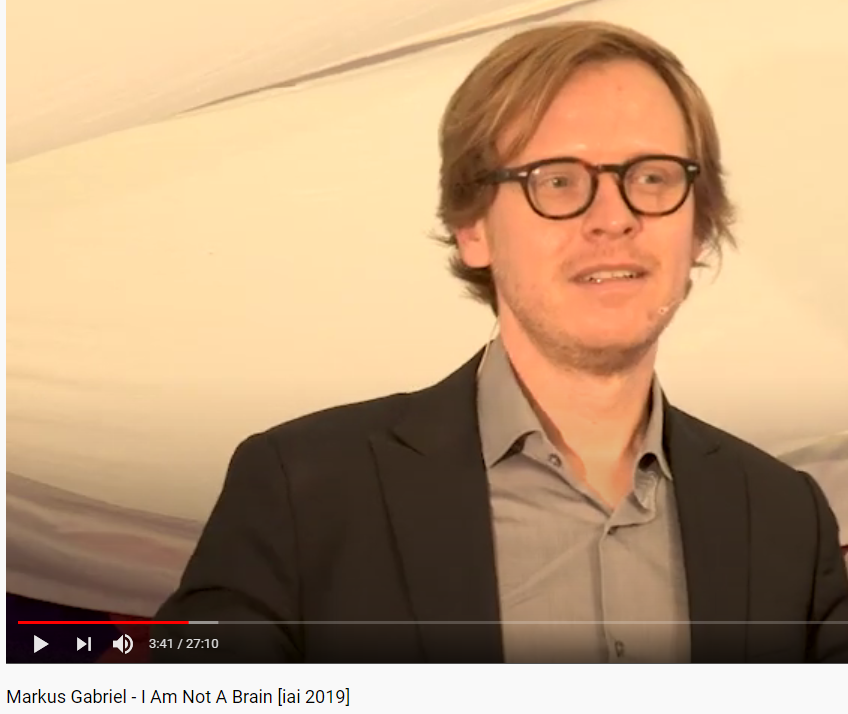
“You are not your brain.” — Markus Gabriel
You Are Not Your Brain: The 4-Step Solution for Changing Bad Habits, Ending Unhealthy Thinking, and Taking Control of Your Life — M.D. Jeffrey M. Schwartz and M.D. Rebecca Gladding

i) Introduction: You are Not Your Brain 
ii) In This World and Out of This World 
iii) Consciousness = An Achievement (Word)
iv) Consciousness is Largely a Matter of Definitions and Stipulations

Introduction: You are Not Your Brain

The American philosopher Alva NoĆ« (1964-) believes that “you are not your brain”.

Did any materialist, neuroscientist, philosopher, etc. ever say that a person (or subject) literally is his or her brain? Or is NoĆ« being somewhat rhetorical here? (I’m sure that if I researched this for long enough I could find at least one person — i.e., other than Francis Crick — who said it.) Indeed it’s difficult to fathom what the words “you are your brain” could even mean. And it will be seen later that NoĆ« himself makes the same mistake with the “is of identity” when it comes to his own position on the nature of consciousness.

Despite all that, Alva NoĆ« does in fact come clean about this. He cites the words of the molecular biologist, biophysicist and neuroscientist Francis Crick (1916–2004) as the inspiration for his own negation of Crick’s position.

Yet I don’t even believe that Francis Crick was being literal when he made his controversial statement. So let’s at least quote Crick’s well-known statement.

In his book The Astonishing Hypothesis: The Scientific Search for the Soul (1994), Crick wrote the following words:

“‘You’, your joys and your sorrows, your memories and your ambitions, your sense of personal identity and free will, are in fact no more than the behavior of a vast assembly of nerve cells and their associated molecules.”

It’s easy to believe that Crick was being wilfully provocative and rhetorical here. Crick was also well aware that when he began studying consciousness he was tackling a subject which, traditionally, had been the sole property of religion and philosophy. Hence the rhetoric. At the same time, Crick may also have been expressing various truths — if only to a degree.

Another point that can be made about Crick’s rhetoric and provocation is that he was simply attempting to get a point across. And the best and simplest way of doing that is to be poetic and rhetorical. After all, strongly-expressed views often attract a larger audience. (For example, take Markus Gabriel’s words “the world does not exist”.) Nonetheless, the extremity of a view doesn’t automatically mean that it’s false — at least not in every respect. Thus perhaps Crick enticed people in and then gave them a broader and more nuanced perspective on his extreme words. That said, it’s of course possible that all this is to give Crick far too much benefit of the doubt.

Despite the opening quote, Crick did get around to expressing the same idea in a slightly less provocative and more technical way. He also wrote:

“A person’s mental activities are entirely due to the behavior of nerve cells, glial cells, and the atoms, ions, and molecules that make them up and influence them.”

Is that any better?

In any case, the very fact that Crick decided to study consciousness in the first place suggests that he couldn’t have been a reductionist in any strict sense. After all, in much psychology, neuroscience/neurobiology and sometimes even in philosophy, consciousness had been reduced to the brain, to behavior or simply ignored. Then again, most of The Astonishing Hypothesis is about neurobiology. Thus, even though the opening quotation is in essence a philosophical position, the philosophical defence and implications of that passage are rarely fully developed in the book itself.

To repeat: stating that “you are your brain” is actually (to quote Wolfgang Pauli’s oft-used phrase) “not even wrong”.

So is the following — put more succinctly and as an identity statement — what NoĆ« protagonists are really meant to have argued? -

a human subject = that subject’s brain

First things first.

What is this “you” that does (or, for that matter, does not) equal the brain? The self? Consciousness? The mind? The mind, body, self and consciousness all together?

Thus, if all these things are believed to be realised by — or instantiated in — the brain, then the self, mind or consciousness (or all these things together) must literally be identical to the brain.

In This World and Out of This World

In the book Out of Our Heads: Why You Are Not Your Brain, and Other Lessons from the Biology of Consciousness, Alva Noƫ succinctly captures the entirety of his philosophical position in these two sentences:

“We are out of our heads. We are in the world and of it.”

This is almost a paraphrase of Hilary Putnam’s well-known statement: “meanings ain’t in the head”. That is, NoĆ« has extended Putnam’s semantic externalism and applied it to consciousness (as a whole), the mind (as a whole) and the self.

Noƫ then continues:

“We are patterns of active engagement with fluid boundaries and changing components. We are distributed.”

Of course the passage above is expressed in a way that isn’t really Putnamesque. In addition, it probably doesn’t express what Putnam himself actually believed.

In any case, of course “we are in the world” — where else could we be? Do (or did) Cartesians — or anyone else — ever actually believe that we are literally out of this world? And does someone believing that the mind is a “non-extended substance” automatically mean that he/she also believes that we are (literally) out of this world?

Basically, even on the spectator theory of knowledge (which can easily be applied to consciousness or mind), isn’t the spectator still “in the world” or part of the world? For example, when you watch a football match, you aren’t part of the actual match but you’re still part of the whole environment which includes that match. Thus being a spectator of the match doesn’t put you in a (as it were) transcendent place outside the world.

So perhaps this football-fan example doesn’t work. (In that case, perhaps the word “spectator” — in the term “spectator theory” — doesn’t work either.) That is, in the Cartesian position, perhaps the subject’s mind is literally out of this world (i.e., unlike the football fan’s mind). That would mean that the Cartesian mind is literally out of this world at the very same time as being a spectator of that very same world. However, did many — or even any — Cartesians ever hold this position? (Perhaps no one is claiming that they did.)

Now let’s quote another passage passage from NoĆ« on the same theme. He writes:

“we need to turn our backs on the orthodox assumption that consciousness is something that happens inside us, like digestion”.

Let’s put it this way. There are certainly many things which “happen[] inside us”. Yet the correctness (or incorrectness) of that statement entirely depends on what NoĆ« means by “inside us”. Still, there are things which happen inside our brains. There are things which happen inside our… (?) minds which other people will never know about. So, on a loose reading, there is indeed an “inside us” which can indeed be distinguished from that which is outside us. Yet it still cannot be said that the mind is outside the world itself.

NoĆ« may also be failing to distinguish the wide contents of consciousness (see here) — and the actions expressed by a (conscious) subject — from narrow contents. That is, the (as it were) sources of the contents of consciousness are the result of what is outside us (as on a wide and/or externalist reading). However, the content is still within us. In other words, content is — or at least can be — both narrow and wide. Of course it can now be argued that if any given content of consciousness/mind can be both wide and narrow, then that — kinda — makes the use of these terms either redundant or even self-contradictory.

In addition, our actions-in-an-environment can either be seen as expressions of consciousness (or mind) or as the actual instantiations (or realisations) of consciousness (or mind).

Consciousness = An Achievement (Word)

Gilbert Ryle

Noƫ claims that

“consciousness is an achievement of the whole animal in its environmental context”.

What is it, exactly, that is being achieved? And what if consciousness (as it were) accompanies the acts of achievement of a human subject? Of course one obvious answer to this question is to argue that such acts of achievement literally are (or constitute/realise) consciousness. Thus:

a subject’s consciousness = the subject’s achievement of x.

Now, of course, we need to know what the content of the symbol x could be. In other words, we’d need an example of what NoĆ« means by the word “achievement”.

So say that a human subject successfully places a cup on a table. Thus this subject achieves the goal of placing a cup on the table. Do we now have the following identity statement? -

the consciousness of subject S at time t = subject S successfully placing a cup on the table at time t

If this identity statement is correct, then this must also mean that

a subject’s consciousness at time t = this subject’s arm/body, the environment (the table, cup and probably much more) and his brain.

As can be seen, NoĆ« stresses action or behaviour — as Gilbert Ryle (1900–1976) did seven decades ago in his book The Concept of Mind (see here). NoĆ« writes:

“It is now clear, as it has not been before, that consciousness, like a work of improvisational music, is achieved in action, by us, thanks to our situation in and access to a world we know around us. We are in the world and of it.”

This may mean that the word “consciousness” is being taken as a verb — “a doing word” (see the qualifications here). We can even say that consciousness = what we do. Or, alternatively, consciousness is instantiated in — or realised by — what we do. Indeed Ryle himself even used the term “achievement word” when he wrote about intelligence (i.e., not about consciousness) in the 1940s. To Ryle, intelligence isn’t a thing (say, a part of the brain) or even an abstract entity. He believed that intelligence is (to use NoĆ«’s own words) “achieved in action”. (NoĆ«’s position also chimes in with much of Heidegger’s philosophy. See this paper.)

The second clause of the first sentence (i.e., “thanks to our situation in and access to a world we know around us”) expresses NoĆ«’s commitment to our situatedness, the embeddedness and embodiment of the mind and the extended nature of the mind.

One obvious problem — or perhaps bonus! - of NoĆ«’s position is that it leaves out qualia (or how experiences seem and feel). NoĆ« sees almost everything about consciousness in terms of action, body and environment — so nothing is (as it were) private. In a sense, then, the “first-person perspective” is irrelevant to NoĆ«’s account of consciousness. And, as stated, that may be viewed as either a problem or a bonus.

(It’s not clear what NoĆ« means by “[i]t is now clear… that consciousness… is achieved in action”. Clear to whom, exactly?)

Consciousness is a Matter of Definitions and Stipulation

When Alva Noƫ states that

“we need to turn our backs on the orthodox assumption that consciousness is something that happens inside us, like digestion”.

one feels that he’s either arguing against straw targets or arguing against positions that haven’t been held by most philosophers for decades. (That said, the American philosopher John Searle (1932-) has compared consciousness to “digestion” — see here.)

Either that, or Noƫ is only aiming his words at laypersons!

So does it all depend on how Noe himself defines “consciousness”?

It can be argued that almost everything will flow from NoĆ«’s own personal definition. In other words, it’s not as if there is a determinate and fixed definition of the word “consciousness” or even a determinate thing that is consciousness. And, as a result, NoĆ«’s definition or thing means that “we” have got consciousness all wrong. (All this applies even if NoĆ« doesn’t see consciousness as a thing but as, say, a process or an action in an environment.)

Now the following (as already quoted) is NoĆ«’s own (personal) take on consciousness:

“[C]onsciousness is an achievement of the whole animal in its environmental context.”

The question is:

Is the above simply Alva NoĆ«’s own (personal) definition of the word “consciousness”?

Or is Noƫ stating that this is what consciousness actually is?

(Of course a person may define a word in a particular way because he believes that his own personal definition unequivocally follows from what that object actually is.)

Again, is all this mainly about words (or technical terms) and how we define them? If that’s the case, then once someone defines the word “consciousness” (or, for that matter, “you”, “self”, “mind”), then we can move on from there. Yet, of course, it has proved to be notoriously difficult to define this word.

This means that if a philosopher like NoĆ« wants to define the word “consciousness” in a way which includes (or involves) the environment, the whole body and the brain, then so be it. He’s free to do so. This is especially the case because there is no consensus definition of “consciousness” in the first place — far from it. This makes it even more acceptable to take a (as it were) stipulational position on consciousness — or on the word “consciousness”. That said, if NoĆ« believes that consciousness includes — or literally is — actions, the body, the brain and the environment, then he may not see it as a (simple) semantic issue of definitions. He may, instead, accept this (ontological) identity statement:

a subject’s consciousness = this subject’s body and brain and his actions within an environment

What does it mean (or what are we achieving) when we take the position (if bluntly put) that a subject’s consciousness = this subject’s actions, environment, body and brain? Indeed it may even follow that if we accept this position it will then be quite acceptable to jettison the word “consciousness” altogether. In other words, we can then stick with descriptions of human actions within an environment.

Yet in order to know that (some or many) neuroscientists, materialists, philosophers, etc. are wrong about consciousness, NoĆ« needs to know what consciousness is. But how can he know that? This would assume that consciousness is a fixed and determinate thing that can be correctly known. This is even the case when NoĆ« stresses processes, actions, the body and the environment. He nonetheless still sees consciousness as a… thing that is fixed and determinate otherwise he wouldn’t — or couldn’t — see other people as being (as he puts it) “profoundly wrong” about it.

Again, what if all this mainly boils down to how NoĆ« and others define the word “consciousness”? That may be the case even if NoĆ« refers to very concrete things like bodies, environments, brains, actions, etc. That is, these are simply the concrete entities NoĆ« uses in his own personal definition of the word “consciousness”. The concreteness of these things doesn’t necessarily pass over to the abstraction that is consciousness itself.

So one can take a similar position on the word “consciousness” as the British philosopher Michael Williams (1947-) does on the words “knowledge” and “truth”.

A History of Stipulations

Michael Williams accepts that

“[w]e can have an account of the use and utility of [the word] ‘know’ without supposing that there is such a thing as human knowledge”.

So perhaps we shouldn’t “suppos[e] that there is such a thing as” consciousness. That said, Williams (again) happily concedes that

“[a] deflationary account of ‘know’ may show how the word is embedded in a teachable and useful linguistic practice”.

Is the same true of the word “consciousness”?

Take the position of the philosopher David Chalmers (1966-) too.

Chalmers often mentions what he calls “stipulation”. The basic point is that if we stipulate what we mean by a particular word or philosophical technical term, then the answers to the questions about facts, data, what something is, etc. must — at least partly — follow from such stipulations. Of course some (or even many) people will be horrified by the argument that acts of stipulation are decisive when it comes to what we take to be (as it were) matters of fact. But it’s not that simple.

Sure, there is also a problem with over-stressing the importance of stipulation; or even with simply emphasising its importance at all. Indeed Chalmers himself sums up this problem with a joke. He writes:

“One might as well define ‘world peace’ as ‘a ham sandwich.’ Achieving world peace becomes much easier, but it is a hollow achievement.”

(Ironically enough, Chalmers only applies his joke to a single case: consciousness.)

Clearly, even someone who argues that stipulation is important won’t also accept that we can define the words “world peace” as “a ham sandwich”. In turn, some philosophers and many laypersons will feel just as strongly about claiming that (to use Chalmers’ own examples) “a computer virus is alive” or that “bacteria learn”. The philosopher P.M.S. Hacker, for example, holds a very strong position on the philosophers and scientists who use such terms (or words) in ways that are radically at odds with everyday usage. (See Hacker’s ‘Languages, Minds and Brain’ in Mindwaves.) Many physicists, on the other hand, are very keen on using old words (or terms) in very different ways.

So it can be argued that NoĆ« is using an old word (i.e., “consciousness”) in a new way. (That’s if we forget 20th century philosophers like Ryle, Heidegger, Dewey, etc.)

As already stated, philosophers and scientists often use old words in new ways. Indeed they often use old words in very peculiar and particular new ways. So think of how scientists use the words “string” (as in string theory), “time”, “particle”, “spin” (as in a particle’s spin), “information”, “wave” (as in wavefunction), “code” (as in the genetic code), “packet” (as in a wave packet), “vacuum”, “beauty”, “proof”, “chaos”, “memory” (as in a computer’s memory) and so on. Now also think of how philosophers (i.e., not laypersons) use the words “truth”, “world”, “existence”, “object”, “representation”, “meaning”, “realism”, “concrete”, “world” and, now… “consciousness”.

(Just yesterday, I came across yet another example of a strange use of an old word. The philosopher Thomas Nagel (1937-), in this case, used the word “facts” not only to refer to things which aren’t at present known or which have never been observed, but also to things which can — in principle — never be known or which can never be observed. See here.)

So if we return to the specific case of consciousness — or to the word “consciousness”.

There’ve been countless definitions of the word “consciousness”. (There have also been hundreds of often mutually-contradictory books on consciousness.) Discussing consciousness can often be pointless because the disputants are nearly always talking about different things when they talk about it. More relevantly, they define the word “consciousness” in very different ways. What’s more, many who talk (or write) about consciousness never actually get around to defining their word “consciousness” at all. True; they may have their own tacit (or unexpressed) pet definitions deep within their minds. However, they rarely explicate (or articulate) such definitions precisely or in any detail.

So perhaps it would be wise to adopt a deflationary view of the word “consciousness” — i.e., as Michael Williams has done with “knowledge” and “truth”. And that’s precisely what the English philosopher Kathleen Wilkes (1946–2003) did when she wrote that

“perhaps ‘consciousness’ is best seen as a sort of dummy-term like ‘thing’, useful for the flexibility that is assured by its lack of specific content”.

We can agree with Wilkes and see the word consciousness as a “dummy-term”. And it is so because it has so many meanings, definitions and connotations.

Conclusion

It follows that the philosophical positions on consciousness are so multifarious and vague precisely because of the non-scientific nature of the subject matter. So if consciousness were as intersubjective a phenomenon as a cat or a neuron, then we wouldn’t have so many multifarious and vague definitions.

Indeed perhaps there wouldn’t even be a thriving consciousness industry in the first place.

Finally, NoĆ« may stress actions, environments, bodies, etc. because he’s attempting to make consciousness more scientific. Yet NoĆ« is — if indirectly — critical of (what many call) “scientism” too. (This is certainly true of many of the people who’ve embraced his ideas.)

And NoĆ« isn’t a fan of (reductive?) “materialism” either (see here).

So Alva NoĆ« may be attempting to provide some kind of midway position between all these gruesome isms. In fact he’s come close to claiming precisely that.

[I can be found on Twitter here.]

Tuesday, 10 August 2021

Michael Williams: There are No Such Things as Knowledge and Truth


i) Introduction
ii) Heat and Knowledge/Truth)
iii) What is Epistemological Realism?
iv) Epistemology and Knowledge
v) Truth
vi) Conclusion: Michael Williams vs. Epistemological Realists

Despite the provocative title of this piece, the British philosopher Michael Williams (1947-) does accept that

“[w]e can have an account of the use and utility of [the word] ‘know’ without supposing that there is such a thing as human knowledge”.

Williams also makes similar claims about truth.

Yet the quote above still seems very radical or even extreme. That is, if we shouldn’t “suppos[e] that there is such a thing as human knowledge”, then that must mean that Williams believes that there is no such thing as human knowledge. That said, Williams (again) happily concedes that

“[a] deflationary account of ‘know’ may show how the word is embedded in a teachable and useful linguistic practice”.

So will that be enough for philosophers and laypersons? Well, as we shall see, it’s certainly not enough for what Williams calls the epistemological realist.

Heat and Knowledge/Truth

Michael Williams compares the philosophical study of truth/knowledge with the study of heat in physics. He writes:

“Naively, we might be inclined to suppose that just as in physics we study the nature of heat, so in philosophy we study the nature of truth. But once plausible deflationary views are on the table, the analogy between truth and things like heat can no longer be treated as unproblematic.”

It must follow that since (many) philosophers do believe that they’re attempting to “study the nature of truth” or the nature of knowledge, then that must mean that there is something to be discovered. What’s more, that something must be (or be seen to be) determinate and fixed. Like heat, then, that something must have a given nature.

Yet even if we do have an unquestioning position on truth and knowledge, then we still can’t see such things as being anything like heat… or water, trees, animals, etc. Thus, in that provisional sense at least, studying the nature of truth and knowledge is very unlike studying the nature of heat. And from that fact, many other things follow.

So why assume that truth and knowledge have determinate and fixed natures?

Surely for that to be the case, almost everyone would agree on what truth and knowledge are (as most people do on, say, what water is). But that’s never been the case — and not just when it comes to philosophers.

What is Epistemological Realism?

Michael Williams emphasises an important terminological distinction. He states that epistemological realism

“is not a position within epistemology…[it is a] realism about the objects of epistemological inquiry”.

In other words, this is realism about epistemology, not realism within epistemology.

This essentially means that although a philosopher may be, say, an anti-realist within epistemology, he may also be — or probably is — a realist towards (or about) epistemology itself. More precisely, he may be anti-realist in that he thinks that we can’t acquire knowledge of an objective, mind-independent reality. However, he may still believe that there are “underlying epistemological structure or principles” common to all epistemological methods.

Moreover, the epistemological realist

“thinks of knowledge in very much the way the scientific realist thinks of heat: beneath the surface diversity there is structural unity”.

This leads the realist to believe that not “everything we call knowledge need be knowledge properly so called”. This means that he also believes that his job is to generalise and extrapolate: i.e., to bring “together the genuine cases into a coherent theoretical kind”. Thus the right kind of, say, justification effectively becomes a natural kind. And so on. And when we bundle all these epistemic things together, then we knowledge as a whole becomes a natural kind.

So what if the world of knowledge and epistemology isn’t like that?

Michael Williams also refers to Thomas Nagel’s realist view of epistemology.

According to Williams, Nagel’s phrase “our knowledge of the world” contains various presuppositions. That’s because it assumes that there is a “genuine totality” to have knowledge of. Nagel’s phrase also assumes that

“there are invariant epistemological constraints underlying the shifting standards of everyday justification”.

Thus it can be said that Nagel sees the universal and general rather than the Wittgensteinian particular.

Williams cites the specific example (among many) of W.V.0. Quine’s own criticisms of the analytic-synthetic distinction.

Here again, many epistemologists have attempted to generalise and perhaps create two natural kinds — the analytic and the synthetic. Yet what if there isn’t a “fixed, objective division between a theory’s meaning postulates and its empirical assumptions”?

Epistemology and Knowledge

Michael Williams also makes a distinction between

1) theories of knowledge

and

2) theories of the concept of knowledge

This is a distinction he also (more or less) makes about truth.

So 2) above can be said to be about the word “knowledge” and how it is used. In addition, it’s also about the concept/s (or meaning/s) “behind” the word “knowledge”.

A theory of knowledge, on the other hand, is about the thing (or property) which is knowledge. This presupposes that there is something above and beyond our words, concepts, practices/usages, methods, etc.

Williams’s position is primarily aimed at what he calls “epistemological realism”.

The epistemological realist believes that there’s a single correct view of justification, a single kind of truth, a single correct method, and so on.

As stated at the beginning, Williams thinks that epistemological realism is very much like scientific realism.

Take the case of the analysis and classification of heat again.

When the physicist or chemist explores the nature of heat he looks for

“some underlying property, or structure of more elementary components, common to [all] hot things”.

Scientific realists (though not necessarily scientists themselves) therefore see heat as a natural kind. In other words, for the scientific realist,

“deep structural features of the elementary components of things determine the boundaries of natural, as opposed to merely nominal or conventional, kinds”.

The epistemological realist attempts to do the same kind of thing with knowledge and also with the methods and means he uses to acquire knowledge. Thus he believes that “there must be underlying epistemological structures or principles”.

Take the specific case of justified true belief.

For a long time many epistemologists argued that knowledge is justified true belief (even if they still had problems describing and/or explaining justification and belief when taken separately). Then along came Edmund Gettier’s demonstration that this analysis of knowledge (to use Williams's word) “fails to state a sufficient condition for knowledge”.

So is that partly — or even largely — because knowledge is not a thing (or property) that can even have a correct analysis in all situations? (This, as Williams argues, isn’t also to argue that there is no such the thing as knowledge.)

Again, Williams makes a connection with analysis in science. He writes:

[W]e might be inclined to suppose that just as in physics we study the nature of heat, so in philosophy we study the nature of truth. But once plausible deflationary views are on the table, the analogy between truth [knowledge] and things like heat can no longer be treated as unproblematic.”

Essentially, then, epistemological realists — and many others — reify truth and knowledge. That is, they turn truth and knowledge into two — perhaps abstract— things or properties.

Now let’s concentrate on truth

Truth

Of course many people do agree on what they take to be true. However, they don’t necessarily also agree on why it is true or on what constitutes its truth.

This means that taking the claim, say, “Water is wet” or “Killing people for fun is wrong” as true is fairly unproblematic. What is problematic is why this statement is true or what constitutes its truth. So it’s not the taking of any given p as being true that’s being discussed here. Countless people take the statement “Cats are animals” or “Killing for fun is wrong” to be true. That isn’t disputed by most people.

Similar points holds for knowledge too.

More specifically in terms of Williams’s own position.

Just as Williams detects realist views about epistemology, so too he detects realist positions when it comes to truth.

Put at its simplest: the problem is that many people take truth to be a thing — even if an abstract thing. Yet Truth may not be a thing at all. And if that’s the case, then perhaps we can never discover its nature.

As a result of all this, Williams doesn’t believe that truth is a “theoretically significant property”. (Perhaps he doesn’t think it’s a property at all.) Thus he cites the case of the deflationary theory of truth.

Thus, to Williams, true sentences are “merely a nominal kind”. That is, all true statements don’t share the same something - viz., the same entity (or same property) truth.

Williams also argues that “there are endlessly many truths, [but] there is no such thing as truth”. (Perhaps we should write “Truth” here instead.)

Realists about truth, on the other hand, believe that truth is a single property — or even a single thing. Therefore, like heat or a cat, it can be analysed and correctly described. Such realists believe that truth is an “important property shared by all true sentences”. That said, the realist needn’t also be obliged to state exactly what truth is. He may offer any one of Williams’s following possibilities:

[C]orrespondence to fact, incorporability in some ideally coherent system of judgements, or goodness in the way of belief.”

It must follow that if one of these accounts is the true way of describing truth, then all true statements will, say, be incorporable into an ideally coherent system, be correspondent with facts, etc.

So the truth realist wants something very substantial. He wants something shared by all true statements. This means, then, that he isn’t interested in the “use of a word” or the “point of the concept”. The realist, instead, believes that

“there is more to understanding truth than appreciating the utility of the truth-predicate”.

Conclusion: Michael Williams vs. Realism

Towards the end of his paper Williams lets an epistemological realist speak for himself. He quotes Thompson Clarke (1928–2012) thus:

“‘Each concept or the conceptual scheme must be divorceable intact from our practices, from whatever constitutes the essential character of the plain…[we] ascertain, when possible, whether items fulfil the conditions legislated by concepts.’”

The above is as strong a statement of metaphysical and epistemological realism as one can imagine. Williams would also no doubt argue that it’s an epistemologically realist position toward (i.e., not within) epistemology (which is of course the main tenor of Williams’s paper).

Williams, on the one hand, stresses the fact that concepts, conceptual schemes, epistemological methods, etc. are determined by the nature of our practices — they have no reality apart from them. Thompson Clarke, on the other hand, argues that the aforementioned can be “[divorced] intact from our practices”. Thus he must believe that there is a right and a wrong about all our concepts. That also means that correct concepts must match the world as it is in itself. Incorrect concepts, however, distort the world’s nature.

Yet Michael Williams himself still believes in the falsity or truth of our concepts. However, their truth or falsehood will be internally determined by our practices. Without practices, there is nothing.

Michael Williams also takes a very Wittgensteinian — as well as a deflationary —position on knowledge and truth.

He argues that a deflationary account of the word “know” may show “how the word is embedded in a teachable and useful linguistic practice”. (Surely this is a meaning-is-use definition of “know”.) In other words, Williams doesn’t suppose that being known to be true “denotes a property that groups propositions into a theoretically significant kind”. Williams nevertheless still accepts that the word “know” (as well as “truth”?) does have utility value. (Perhaps we can say that it works!)

Finally, in opposition to epistemological realism (at least of the kind Williams is talking about) we have Williams’s alternative of “various practices of assessment, perhaps sharing certain formal features”. And that’s all we’ve got. Williams writes:

“It doesn’t follow from this that the various items given a positive rating add up to anything like a natural kind.”

These various practices of assessment may not even be a “surveyable whole” or a “genuine totality rather than a more or less loose aggregate”.

Williams also argues that it’s the topics or subjects we study (with our epistemological hats on) that determine our epistemological methods and — perhaps — our goals too. So it largely depends on the subject we’re studying. That is, we can’t expect — or desire — that there’s “an order of reasons [that operate independently] of all circumstances and all collateral knowledge”. Moreover, every subject doesn’t have the same methodology which is applicable to it. And not even all the sciences use (to take just one example) the hypothetico-deductive method.

[I can be found on Twitter here.]