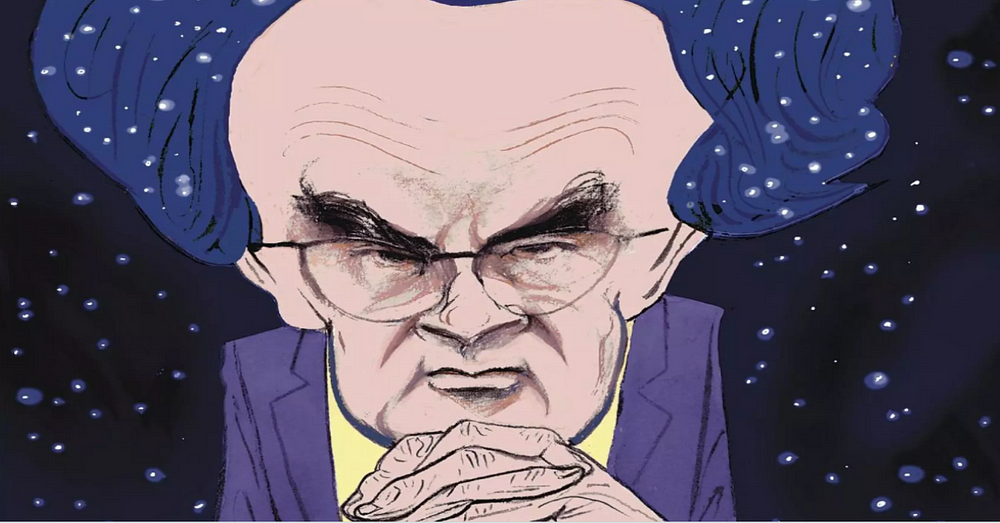
[This essay was written quite some time ago. The style is somewhat rhetorical, literary and (as it were) psychologistic. That said, I still agree with much of its philosophical content. However, if I were to write it today, the style would be a little different. Indeed some (probably many) analytic philosophers would regard this essay as one long ad hominemagainst the American philosopher Thomas Nagel (1937-). Sure; there is an element of the ad hominem in the following. Yet hopefully it will be shown that there’s more to the essay than that.
[In fact I chose to write in a rhetorical and literary style partly in response to the clear and prevalent rhetoric and “psychologising” I found in Thomas Nagel’s own book, The Last Word.
[In addition, the prefix “new” in “new mysterian” is a little dated (i.e., new mysterianism is no longer new) because the term was first coined in 1991by the American philosopherOwen Flanagan (1949-). (See Flanagan’s The Science of the Mind.) What also needs to be said is that I’m using Flanagan’s word “mysterian” more widely and more literally than he does. That is, in Nagel’s case I’m stressing Nagel’s mysterianism and mysticism across the board. Flanagan, on the other hand, only (really?) had mysterian positions on consciousness in mind. That said, the term “new mysterianism” has also been applied to the wider position that there’s far more than one “hard problem” (i.e., the “hard problem of consciousness”). It also includes the belief that science is intrinsically and fundamentally limited in many respects. This is a self-conscious kind of anti-“scientism”.]
**************************
Thomas Nagel on Bad Philosophy
The American philosopherThomas Nagel (1937-) has a high opinion of philosophy itself. Or, it should be said, a high opinion of what he calls “post-positivist” philosophy. Indeed that statement should be qualified too by saying that Nagel has a high opinion of a particular kind of philosophy: i.e., metaphysically realist and ethically realist American philosophy. That is, the kind of philosophy Nagel himself practices.
Yet it’s not only the Derridas, Foucaults and Rortys who don’t match up to Nagel’s high standards: “deflationary metaphilosophical theories like positivism and pragmatism” fail too. This includes the late Wittgenstein, Quine, Putnam, Goodman, Sellars, Churchland…Nagel’s negative list is long!
Of course Nagel could never explicitly say that his brand of analytic philosophy should be both the judge and foundation of all other areas of our culture. However, isn’t that precisely what he does believe (if not state)? And Nagel does so because he believes that others aren’t up to the job. That is, other areas of culture are (to use his own words) “weak”, “decadent” and simply don’t have what it takes — intellectually or morally. Nagel also states that this is the case because of the “extreme intellectual laziness of contemporary culture” in which there is a “collapse of serious argument”.
It has to be said here that in certain sense Quine, Putnam, Sellars, etc. were indeed “deflationary” philosophers. However, did they also lack “serious argument”? And the place where I personally have come across a lack of argumentation is when analytic philosophers like Nagel are talking about Continental and even “deflationary” analytic philosophers. Then the gloves are well and truly off. Indeed Nagel’s book The Last Word is hardly the most argumentatively rigorous book on the market. Nagel also likes the odd burst of what he calls “rhetorical flourish” too. It can also be said that Nagel probably hadn’t read much of Derrida, Foucault and other (what Nagel himself called) “continental usual suspects” when he wrote his last words. (He would have read Rorty, Quine, etc.) That said, he probably had read a few of analytic philosophy’s reviews and criticisms of these philosophers.
Thomas Nagel on Good Philosophy
It would be fair to say that philosophy (at least certain kinds or expression of philosophy) for Thomas Nagel is for all intents and purposes an instinct. That would be a rather innocuous and uncontroversial position if it weren’t for the fact that Nagel also has a very precise idea of what — real? — philosophy actually is. Indeed Nagel believes that there are certain givens of philosophical thought which aren’t culturally or historically variable.
All this seems to be Nagel’s platonic or Cartesian attempt to escape from the contingent and the empirical. Or, less rhetorically, it’s Nagel’s attempt to emphasise necessity and essentiality — a necessity and essentiality that’s been given a hard time (at least according to Nagel) since the works of the logical positivists (e.g., Carnap), late Wittgenstein, Quine and, of course, Nagel’s continental usual suspects.
Nagel also stresses the permanencies of certain philosophical problems and the ahistorical nature of basic concepts and reasonings; along with philosophical “transcendence”.
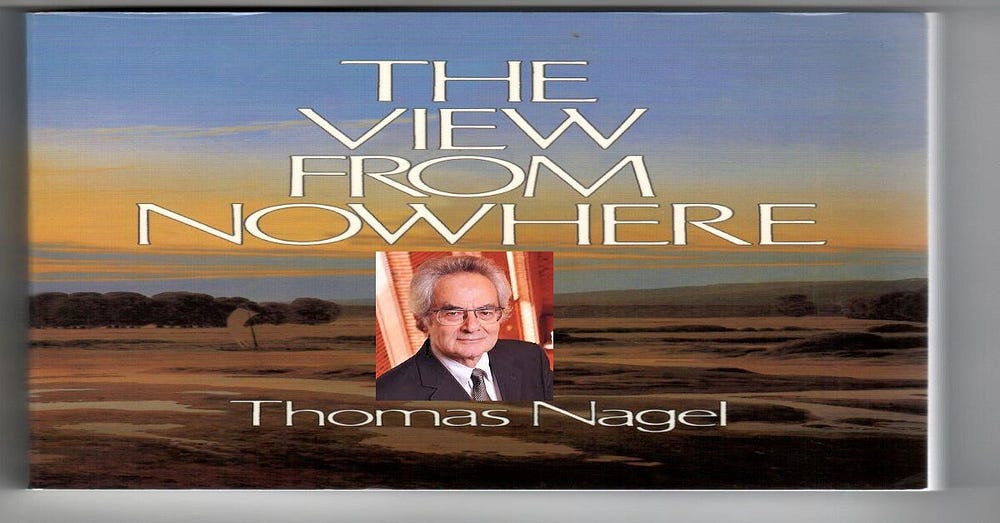
Nagel often uses the word “transcendence” (see definition here) in both The ViewfromNowhere and The Last Word. It’sNagel’s notion of “transcendence” which makes it clear what drives him: the desire to escape from human finitude (especially as it’s represented in language). The British philosopher and literary critic Christopher Norris (1947 — ) neatly sums up Nagel’s belief and desire (though he didn’t have Nagel in mind) that
“reason can somehow dispense with language and arrive at a pure self-authenticating truth or method”.
And thus such Nagelian philosophy “strives to efface its textual or written character”.
All the above ties in with Nagel’s belief that (what he calls) thought can in fact transcend language.
Conclusion: Nagel’s “Concepts” and His Good Philosophy
It’s understandable that if “concepts” (as construed by Nagel) can float free from the empirical world (or at least are not dependent on it - whatever that could possibly mean), it could easily follow that philosophical contemplation does too. This is Nagel inhis own words:
“[T]he sources of philosophy are preverbal and often precultural, and one of its most difficult tasks is to express unformed but intuitively felt problems in language without losing them.”
Nagel never tells us what these “preverbal and often precultural sources of philosophy” are. He doesn’t’ say what he means by “thoughts” or give us any examples. Or at least he certainly doesn’t do so in his book TheLast Word — which is where most of these quotes come from.It doesn’t help either that he doesn’t expand on enigmatic statements such as
“the content of some thoughts transcend every form they can take in the human mind”.
What Nagel appears to be saying (in the above), then, is that we must make a distinction between the necessary and the contingent. Clearly the words and languages we use to express “the sources of philosophy” are contingent. Yet, to Nagel, these very sources appear to be necessary (almost in a quasi-Kantian sense). In other words, Nagel seems to be claiming that all human beings (as human beings) necessarily have a stock of (to use his own words) “intuitively felt problems”. It can also be deduced from this that Nagel believes that these problems are in no way caused by our conceptual/linguistic and historical heritage — or even by our biology and evolution. Language, therefore, is simply the bodysuit that clothes a stock of thoughts which always remains unchanged.
So Nagel believes that these (or his) “concepts” — these “sources of philosophy” — are what are objective. And if they can be tapped into, expressed or seen (in the language-free platonic sense), then objective truth is possible. In other words, Nagel doesn’t want mere “warranted assertibility”, or instrumental or pragmatic truth. He wants a capitalised Truth which outruns all kinds of justification, consensus and even language itself.
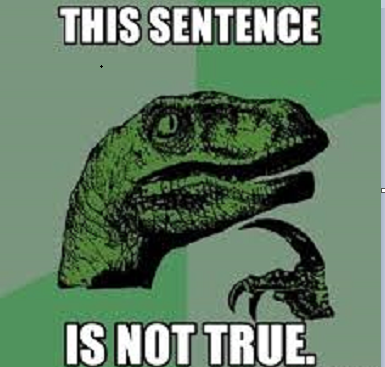
The following is a well-known paradoxical statement:
(A) The sentence A is not true.
That is just one — among many — formal expression of the Liar Paradox.
Yet isn’t it the case that statement A above has no semantic content? In other words, perhaps it’s not a real statement (or proposition) at all. Nonetheless, since many logicians and philosophers don’t take this view, let’s take it as they take it — as being a genuine (if paradoxical) statement.
The first thing to say is that A is self-referential. That is, like all expressions of the Liar Paradox, it’s about itself. (Here’s a list of other self-referential paradoxes.)
So we have the sentence “(A) The sentence A is not true” which includes the symbol A. The symbol Awithin the sentence stands for the sentence it is in (i.e., the words which surround it). In other words, a symbol within a sentence refers to the sentence which it is in.
Now is that acceptable? And is A even meaningful?
Statement (A) Has No Semantic Content
(A) The sentence A is not true.
Now what, precisely, “is not true”?
Sentence A is not true, apparently.
What does sentence A say about itself?
It says that it “is not true” — and that’s it. It doesn’t say its subject term (or phrase) “The sentence A” is “not true”: it says that the entire sentence “is not true”.
So if we take out the symbol A from the whole statement, this is what we’re left with:
The sentence [] is not true.
If the symbol A only refers to the sentence itself, then why can’t we take it out? However, if we do, then what are we left with?
It’s already been said that “The sentence A is not true” is without content: so it’s even more the case that “The sentence [] is not true” is without content.
We can boil this down even more.
The symbol A has been removed — and now we can remove the words “is not true” too. After all, thewords“is not true” are supposed to be applicable to something else. So what are the words “is not true” applicable to? That’s right: they’re applicable to the two words, “The sentence”! This means that those two words are meant to be either true or false. Yet how can those two words alone be either true or false when they say almost — or literally — nothing?
Forget all that!
What Logicians Think About Sentence (A)
Let’s restate the sentence again:
(A) The sentence A is not true.
It’s meant to be the case that A couldn’t be true. Like all expressions of the Liar Paradox, it can’t be true because if what it says were true, then it would be false (i.e., “not true”). Yet if it were false, it must be true because A is saying that it’s not true.
On the other hand (or perhaps not), if we take the above to be false, then it must be true. After all, it it is saying that it isn’t true. That must mean, then, that it’s true. So a statement which says of itself that “it is not true”, is true.
Yet, despite all that, statement A can been rejected because it’s a pseudo statement in that it has no content. We can also say that it’s malignly self-referential. Or, more correctly, that truth can’t be applied (or used) self-referentially — especially when the statement has no content in the first place!
What about a sentence which is both (seemingly) self-referential and which doeshave content?
(S) The sentence “Snow is white” is true if and only if snow is white.
The problem here is that the sentence above isn’t really a single sentence (or statement) at all. It is in fact two statements. That is, we have “Snow is white” as well as “This sentence ‘Snow is white’ is true”. Thus it isn’t self-referential at all. The metalanguage’s “The sentence [] is true” is being applied to the object language’s “Snow is white”. The statement “Snow is white” clearly has content and the whole sentence “The sentence ‘Snow is white’ is true if and only if snow is white”isn’t self-referential either because there’s both a meta-sentence and an object-sentence.
Yet, as stated earlier, many logicians and philosophers defend the “The sentence A is not true” paradox for two main reasons:
1) The words “is true” constitute an acceptable English predicate.
2) The whole sentence (A) is grammatically “unassailable”.
So perhaps it isn’t philosophically acceptable. And we can also reject its (everyday) grammar too.
Again, the argument is that we can grammatically assert the sentence A and also grammatically apply the words “is not true” to it. However, all that depends on what’s meant by the words “we can grammatically assert the sentence”. Can we? Grammar, unlike logic, is largely about what is acceptable to say in order to make sense. Now “This sentence” (or “This sentence A is not true”) isn’t grammatically acceptable for precisely the reasons given. It’s roughly equivalent to saying “I walk down” (or “This is”) — and no teacher of English grammar would accept this locution on its own or without any sentential (or semantic) context. (The words “This is” or “I walk down” could be deemed to be elliptical.)
Conclusion
Of course logicians can — and do — treat statements such as “Bricks have a sense of humour” or “The number 2 is blue” logically. That is, they can assign a truth value to such statements and then treat them as pure syntactic strings — from which they can derive further statements and conclusions. Similarly, we can programme the words “The number 2 is blue” into a computer and then that computer can grind out further statements and indeed even a conclusion (i.e., if it’s programmed in the right way).
So we have statement A, which is seemingly grammatical and literally logical. However it has no semantic content. Indeed it can also be said that we can’t really call it a statement at all. Isn’t it simply an arbitrary string of words which obey a logical or grammatical form and which has then had a truth value assigned to it? (Actually, unlike “The number 2 is blue”, A has contradictory truth values assigned to it!) At most, then, statement A is (merely?) a logical string.
It can be concluded, then, that this is why we have the questions and problems which are highlighted by the philosophy of logic. And the philosophy of logicis over and above pure(or formal) logic.
Does Carlo Rovelli simply invert the “violent hierarchy” of objects-over-relations with that of relations-over-objects?
(i) Introduction
(ii) Relations All the Way Down?
(iii) Carlo Rovelli’s Aristotle
(iv) Interactions
(v) Electrons and Photons
(vi) Kantian Noumena
(vii) Conclusion: Rovelli’s New Hierarchy?
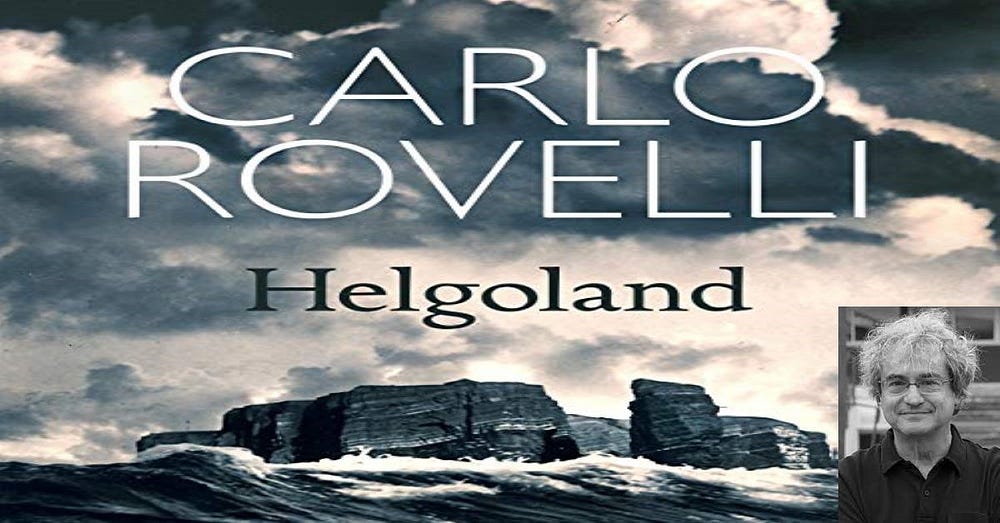
This essay is about Carlo Rovelli’smetaphysical position of relationalism — as it’s defended in his bookHelgoland.(See note at the end: ‘RelationALism or Relationism?’) Rovelli is an Italian theoretical physicist.
At first, Rovelli primarily applied his relationalism to quantum mechanics. However, Rovelli has gone on to apply this metaphysical position to just about every… thing.
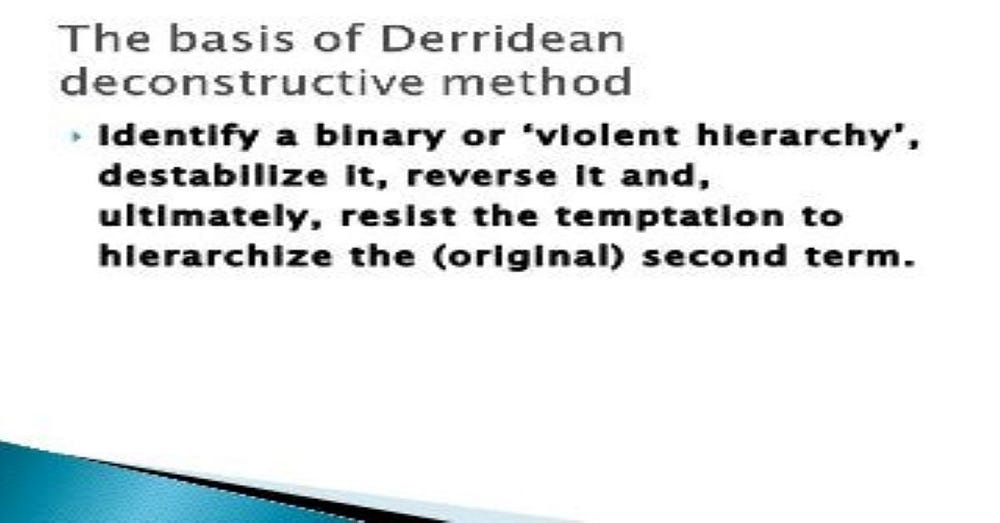
Although the following piece is partly sympathetic to relationalism, the primary criticism which remains is that Rovelli appears to be simply inverting the (to use Derrida’s words) “violent hierarchy” that has (according to Rovelli) been set up between objects (or things) and relations in both Western philosophy and in modern physics. In other words, Rovelli has now placed relations — rather than objects — at the top of the pile.
Relations All the Way Down?
Carlo Rovelli puts the most (if prima facie) extreme expression of relationalism (or, in this case, the related structural realism) into the mouths of three philosophers — Michel Bitbol, Laura Candiotto and Giacomo Pezzano. The following is what Rovelli writes about their own position:
“In analytic philosophy, structural realism is based on the idea that relations come before objects [].”
This encapsulation is very helpful because it puts the philosophical position in its boldest and barest form.
Rovelli also has a lot of back up from other physicists when it comes to his (metaphysical) relationalism. That said, it’s of course the case that such physicists have never actually used the term “relationalism” or put things quite as philosophically as Rovelli himself has . However, they still hold similar positions. Moreover,Rovelli also backs up his relationalist position by tracing it back all the way to the ancient Greeks (e.g., to Heraclitus, etc.).
More recently and concretely, Rovelli traces relationalism back to the Danish physicist Niels Bohr (1885–1962). For example, Rovelli believes that the following words capture “Bohr’s intuition”:
“Whereas previously we thought that the properties of every object could be determined even if we overlooked the interactions occurring between this object and others, quantum physics demonstrates that the interaction is an inseparable part of the phenomenon. The unambiguous description of any phenomenon requires the inclusion of all the objects involved in the interaction in which the phenomenon manifests itself.”
Carlo Rovelli’s Aristotle
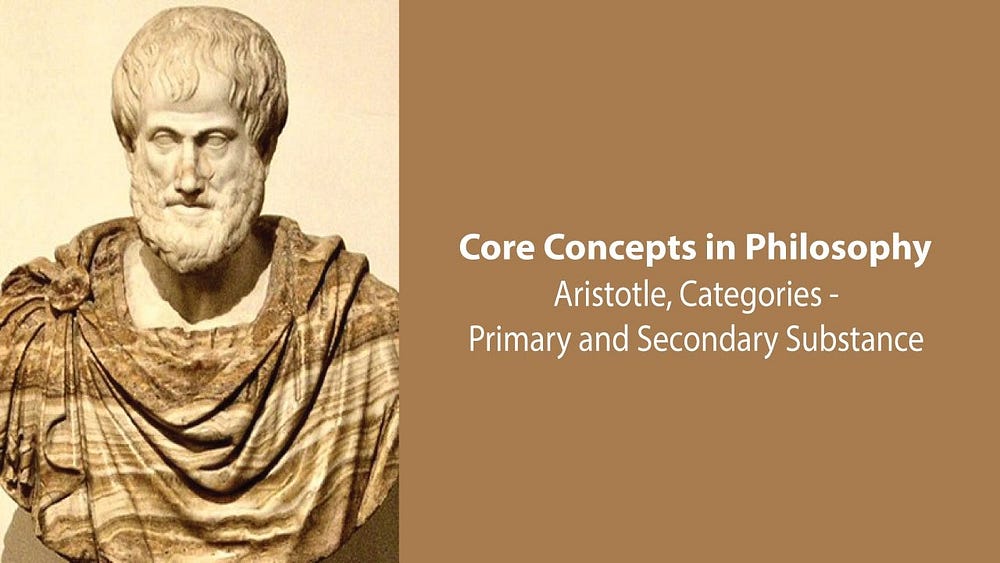
Rovelli allows Aristotle (384–322 BC) to put a position (as paraphrased by Rovelli himself) which seems to be the exact antithesis of his own. Rovelli writes:
“For Aristotle the relation is a property of the substance. It is that belonging to the substance that is towards something else. Among all the categories, for Aristotle, relationality is the one that has ‘least being and reality’. Can we think differently?”
It can be supposed that most laypersons would probably sympathise more with Aristotle’s position than with Rovelli’s own. Indeed isn’t a relation something that has the “least being and reality” when compared to objects or things (if not to “substance”)? What’s more, it’s hard to see a relation as being “a property of the substance” at all. Yet, of course, this issue is largely dependent on how the words “relation” and “object” are defined.
So, again, relations do indeed seem to have the least being and reality in the simple sense that they can’t be observed, touched, smelled, kicked, tested, or experimented upon. The objects which have such relations, on the other hand, might be — or actually are — physical.
Does all that make Rovelli’s relations abstract? Or, if not abstract, then… what?
To move on with Rovelli’s Aristotle.
Where there is (Aristotelian) substance there’s usually an essence — or at least that’s often been the case in Western philosophy. And Rovelli picks up on this too when he writes the following:
“If every metaphysics seeks a primary substance, an essence on which everything may depends [].”
It’s not clear if Rovelli is right to see “substance” and essence” as being (virtual?) synonyms here. Or, if not synonyms, then Rovelli seems to fuse substance and essence together.
Surely there must firstly be a substance in order for it to have any relations whatsoever. Indeed isn’t it the case that there must be objects (if not substances) in order for there to be any relations?
More clearly, surely it can’t be the case that there’s firstly relations and then object O. Surely you first have O itself and then you have its relations. Yet perhaps that’s unless we believe that object O and its relations have always (as it were) belonged together.
That latter possibility is backed up by Rovelli’s own fictional paraphrase of the Indian Buddhist and philosopher Nāgārjuna’s (c. 150 — c. 250 CE) position on structures (i.e., not relations). Rovelli put the following words into Nāgārjuna’s mouth:
“[Structures] are neither precedent to objects; nor not precedent to objects; neither are they both things; nor, ultimately, neither one nor the other thing.”
Thus perhaps there’s never been a time when object O didn’t have any relations. Yet wouldn’t that simply mean that we’d need to take into account all of O’s relations throughout its entire existence? (This is similar to Leibniz's position — see here.)
Of course any given object O will have different relations at different times.
So what of O at all these different times?
What accounts for the very same O having many different relations at many different times?
How do we know, for example, that the same O at t¹ had another set of relations at t²?
Of course we can bite the bullet and argue that O at t² can’t be the same object as ? at t¹. And that would surely mean that we’d need to dispense with the symbol O entirely. Yet taking this nihilist(see metaphysical nihilism) or eliminativistview would also mean that we can’t speak of “the relations of O” either. In other words, relations also need to be factored out if there’s no object O in the first place.
We can move further on Rovelli’s take on Aristotle.
This Aristotelian stress on substance seems to go alongside the stress on the ontological independence of substances or objects — at least according to Rovelli. Indeed Rovelli uses the ideas of the Nāgārjuna again to put his point across. He tells us that Nagarjuna argued that
“it is possible to think of the manifestations of objects without having to ask what the object is in itself, independent from its manifestations”.
That seems plain wrong.
For a start, Rovelli uses the words “the manifestations of objects”. (More specifically, he uses the two words “of objects”.) Clearly objects aren’t factored out of this alternativerelationalistpicture. In other words, if it’s literally all about “manifestations”, then why mention objects at all? So perhaps Rovelli isn’t arguing that it’s literally all about manifestations (or interactions)… Yet it certainly seems that way.
It’s not even clear that many people do believe in the notion of an object “in itself”. Sure, a few (perhaps many) philosophers have done so in the past. However, virtually no laypersons or scientists do so today. Yet Rovelli’s argument is that this way of thinking has been central to all Western thought — not only to the thought of a small group of philosophers. That said, elsewhere Rovelli does state the following:
“In the history of Western philosophy there is a recurrent critique of the notion that ‘entities’ are the foundation of reality. It can be found in widely different philosophical traditions, from the ‘everything flows’ of Heraclitus to the contemporary metaphysics of relations.”
If Rovelli isn’t setting up a straw target here, then we can agree with him and say that it would be difficult — if not impossible — to describe any give object as it isin itself. (That said, I’m sure that some “analytic metaphysicians” could manage it.) Indeed Kantian noumena, for example, are noumena precisely because they can’t be described.
Rovelli then says something similar about the history physics. He writes:
“The discovery that quantities we had thought of as absolute are in fact relative instead is a theme that runs throughout the history of physics. Beyond physics, relational thinking can be found in all the sciences.”
It’s not clear how the words “absolute” and “relative” are being used here. If Rovelli (as a follower of Einstein) is talking about space and time, then he has a strong case. As it is, Rovelli’s not talking exclusively about space and time (or Einstein’s spacetime): he’s talking about literally every… thing.
Interactions
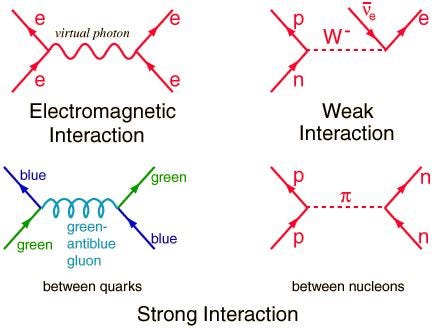
Rovelli stresses what he calls “interactions” as much as he stresses relations. (Interactions can, of course, be seen as a subset of relations.)
Firstly, it can be doubted that any philosopher, physicist or layperson has ever denied the reality — and even importance — of interactions when it comes to what Rovelli calls “individual objects”. Obviously every object (unless it’s an abstract object) interacts with at least something in its entire existence.
So does Rovelli’s stress on interactions (which will be tackled later) somehow play down the nature of objects — or even eliminate them? Perhaps, then, stressing interactions isn’t a means to eliminate objects at all. Perhaps it’s just that — a stress on interactions.
Now let’s requote this earlier passage from Rovelli:
“In analytic philosophy, structural realism is based on the idea that relations come before objects [].”
The simple idea that “relations come before objects” seems obviously false and even outright… impossible.
How can there be relations without something to (as it were) plot the relations? That is, how can there be relations without things (or objects) which have relations to other things (or objects)?
It can be argued, however, that relations only have relations to other relations. But then what point does the (relative?) word “relations” serve?
Alternatively, it can be argued that it is events which have relations, not objects or things. (Rovelli often stresses eventsin Helgoland — see here too.) Yet even here events must ground relations. That is, events surely can’t be deemed to be relations too.
The English philosopher James Ladyman gets around the latter statement by arguing that objects are literally constituted by (their) relations. In Ladyman’s own words:
“There are objects in our metaphysics but they have been purged of their intrinsic natures, identity, and individuality, and they are not metaphysically fundamental.”
Thus, what we take to be an object (or thing) is actually a set (or collection) of relations. And, if that’s the case, then all we really have are relations having relationswith other relationsand nothing (seemingly) to ground those relations… And that’s because (as just stated) the objects (or things) which do the grounding are themselves sets (or collections) of relations…
But what does all that even mean?
What’s more, has anyone ever had a problem with the idea that
“nothing exists in itself, everything exists only through dependence on something else, in relation to something else”.
It depends.
Firstly, if this is an argument for relations all the way down, then the phrases “dependence on something else” and “relation to something else” don’t help very much because one’s first thought is that this something else may well be other objects or things!
In any case, no object (or thing) exists in a literal vacuum. (I’m not sure what physicists would say about this.) Thus every object must have at least some relations with things outside itself. (A human being would certainly cease to exist if there were no other things.) That said, what exactly does the phrase “nothing exists in itself” mean? Does it mean that nothing could be what it is without other…. what?… things or objects?…. also existing? And what kind of “dependence” is Rovelli actually referring to here?
So let’s be more concrete/specific and bring in electrons and photons.
Electrons and Photons
Rovelli puts his own relationalist position at its most pure when he states the following words:
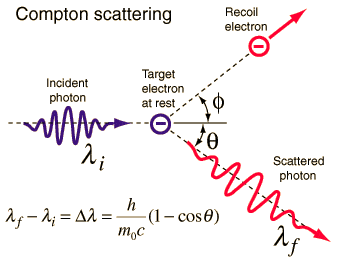
“When the electron does not interact with anything, it has no physical properties. It has no position; it has no velocity.”
One may immediately wonder what physicists will make of Rovelli’s statement. Perhaps most physicists would simply say that such an occasion never occurs… So why worry about it?
In any case, the basic point must be that an electron gains its “physical properties” by virtue of its interactions. That must mean that these properties are (as it were) given to the electron by those things it interacts with — say, forces, fields and other particles. And, in turn, these other forces, fields and particles will be given their properties by yet other forces, fields and particles. (Is this a vicious circle?)
Of course it’s fairly safe to say that there’s never been a case when an electron wasn’t interacting with anything. Indeed it would have needed to be in a literal vacuum for that to have been the case. More accurately, if an electron had been in such a literal vacuum, then it simply wouldn’t have been an electron at all!
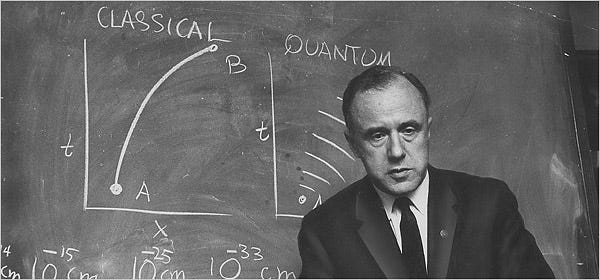
Now take the American theoretical physicist John Archibald Wheeler (1911–2008) saying something similar about a photon.
“An example of the idea of it from bit: when a photon is absorbed, and thereby ‘measured’ — until its absorption, it had no true reality — an unsplittable bit of information is added to what we know about the world, and, at the same time, that bit of information determines the structure of one small part of the world. It creates the reality of the time and place of that photon’s interaction.”
Wheeler seems to be arguing that a photon literally gains its “reality” when it’s “absorbed”. Thus if a particular photon gained its reality only when it was absorbed, then it mustn’t have had any reality before that absorption. Thus surely we must conclude that there simply was no photon before the absorption!
Wheeler also stresses that the reality of absorption can also be seen in informational terms. That is, when Wheeler’s photon was absorbed, then “an unsplittable bit of information is added to what we know about the world”. In other words, only when the photon was absorbed could “we” (i.e., experimental physicists) gain information about it. Before that, the photon had zero reality because we had zero information about it.
It’s also worth saying that Wheeler even uses Rovelli’s favourite word “interaction”. In parallel, Rovelli also stresses the notion of “information”; which is something that Wheeler almost singlehandedly brought into physics (see here).
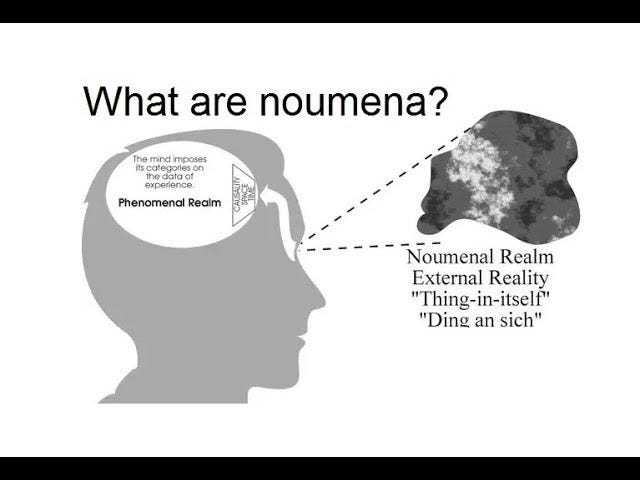
Kantian Noumena?
In the following passage Rovelli seems to be writing about the possibility of Kantian noumena — i.e., not the possibility of everyday objects. He writes:
“Individual objects are the way in which they interact. If there was an object that had no interactions, no effect upon anything, emitted no light, attracted nothing and repelled nothing, was not touched and had no smell… it would be as good as non-existent. To speak of objects that never interact is to speak of something — even if it existed — that could not concern us. It is not even clear what it would mean to say that such objects ‘exist’.”
Most people either reject such Kantian “objects” or have never give them any thought. And, as stated elsewhere, few would deny the importance of interactions — let alone their reality.
So is Rovelli setting up the straw target of Kantian objects to get his point across?
In other words, how does Rovelli’s position relate to objects which do interact and which are known to interact? Do such objects also have a secondary importance — or even secondary existence/reality — when placed against interactions? And why can’t the following be the rather obvious case? -
We have objects and we also have the interactions of those objects.
All that said, Rovelli does then move on from his focus on Kantian objects to the more concrete objects (that’s if we can call them concrete at all ) of quantum physics. He writes:
“An isolated object, taken in itself, independent of every interaction, has no particular state. At most we can attribute to it a kind of probabilistic disposition to manifest itself in one way or another. But even this is only an anticipation of future phenomena, a reflection of phenomena past, and only and always relative to another object.”
Clearly, if any given object were truly “independent of every interaction”, then we wouldn’t know anything about it. That’s primarily because in order to know something about it the experimental physicist would need to interact with it. And that would therefore mean that this object wouldn’t be independent of every interaction. In other words, such an object would be involved in at least one interaction — an interaction with an experimental physicist.
In addition, it’s not clear how such an object can have
“a kind of probabilistic disposition to manifest itself in one way or another”.
How can it be any kind of object at all in this non-interactive situation? In other words, how can a given x which is both “isolated” and “independent of every interaction” have a “probabilistic disposition” of any kind — or even have any kind of existence? Oddly enough, this “isolated object” has effectively become like the Kantian noumenon Rovelli indirectly referred to earlier.
So, again, what is it, exactly, that may “manifest itself in one way or another”? How has the experimental physicist — or anyone else for that matter — got a grip on this supposedly isolated object that’s independent of every interaction? Yet, according to Rovelli, this strange… thing… is still the subject of an attribution of some “kind of probabilistic disposition to manifest itself in one way or another”.
Conclusion: Rovelli’s New Hierarchy?
Theseeming (to use a term from Ferdinand de Saussure)binary opposition between relations and entities (or objects) is given a scientific and historical reading by Rovelli in his following words:
“But physics has long been asked to provide a firm basis on which to place relations: a basic reality underlying and supporting the relational world. Classical physics, with its idea of matter that moves in space, characterized by primary qualities (shape) that come before secondary ones (colour), seemed to be able to play this role [].”
The very phraseology in the above seems odd. Surely no physicist or scientist would ever have thought in terms of a “relational world” at all. So perhaps that’s precisely Rovelli’s point. That is, there is indeed a relational word andphysicists simply haven’t seen things that way. Yet if physicists haven’t seen things this way, then why were they (according to Rovelli himself) “asked to provide a firm basis on which to place relations”?
The odd thing is that a philosopher, scientist or layperson could accept most of what Rovelli argues and still believe that objects (or things) are important or even vital.
So is Rovelli simply inverting what he sees as the violent hierarchy in which a supreme importance was (supposedly) given to objects in Western philosophy and physics? In other words, is Rovelli now simply putting interactions and relations in the place of objects or entities? And, if he is, then why is this clear and blatant reversal a better philosophical position?
To sum up.
Carlo Rovelli's appears to be simply inverting a hierarchy (or opposition) in whichphysicists and philosophers were supposed to have put objects (or “matter”) at the top of the metaphysical pile. And now here’s Rovelli simply reversing matters by placing relations and interactions there instead.
******************************
Note:
(1) Relationism or RelationALism?
There may be a problem in the essay above with the use of the word “relationalist”. That’s because there are two different terms which are often used within this metaphysical context: “relationism” and “relationalism”. These terms seem to denote two (slightly?) different positions. That said, on analysis the distinctions between them appear to break down — at least in certain respects.
This is one definition of the two terms:
“For relationalism, things exist and function only as relational entities. Relationalism may be contrasted with relationism, which tends to emphasize relations per se.”
Relationism is said to simply emphasise the relations between objects: it doesn’t deny that objects exist. With relationalism (i.e., with an added “al”), on the other hand, “things exist and function only as relational entities”. That is, if there were no relations, then there would be no things. Relationism, again, simply notes the importance of relations between things.
Thus relationalism is like ontic structural realism in that the latter eliminates things (as in “every thing must go”). Relationism, on the other hand, simply places relations in an important position in any metaphysics.
Having said all that, it’s hard not to see the importance of relations even if one also accepts the existence of things. One can also see the vital importance of relations when it comes to physics. Yet, on the other hand, one can’t really see how things (or objects) could be entirely eliminated from physics. (This may ultimately depend on how the word “thing” or “object” is defined.)
On the other hand, relationalism can be read as not actually being eliminativist at all. After all, this metaphysical position may simply have it that things (or entities) aren’t what’s called “self-standing”; which isn’t in itself a denial that things exist. Alternatively, we can say that literally all a thing’s properties are relational. That is, it has no intrinsic properties.
Thus, in a weak (or even strong) sense, if all things only have relational properties (and such properties literally constitute all things), then in one sense things are are indeed eliminated from the metaphysical picture. (This, as stated in the essay, seems to be James Ladyman’sposition.) To put that simply: if a thing’s relations (or relational properties) were eliminated, then it would no longer be that thing. Indeed it would no longer even exist!
Despite all the above, it’s still hard to make sense of the idea, to use Lee Smolin’s words, that “the world is made of relations”. What does that mean? How can the world be made of relations alone? The same goes for Smolin’s claim that “all properties are about relations between things”.
Finally, relations and structures may well be of utmost importance in both metaphysics and physics. Nonetheless, surely there are no relations and structures without things or objects.