Monday, 21 March 2022

Does Popper’s Falsification Principle Itself Need to Be Falsifiable?

The logic of homological and heterological statements — as they relate to Popper’s Falsification Principle.
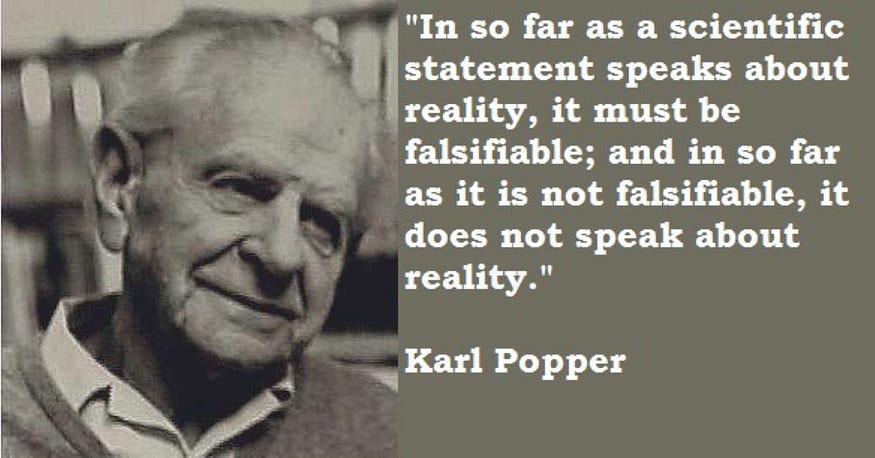
The Falsification Principle was first articulated in Karl Popper’s book The Logic of Scientific Discovery, which was published in 1934. In that book, Popper argued that a scientific theory (or hypothesis) is falsifiable if it can be logically (note that word) contradicted by an empirical test which can be — at least potentially — executed using existing technologies. Thus the main purpose of falsifiability is to make the scientific theory testable and predictive.

Popper used his Falsification Principle against (to cite only two examples) Sigmund Freud’s theories as well as against the claim that there may be — or actually are — infinite universes. Indeed the Principle has now almost become a commonsense theory — at least when used by (some) scientists and those laypersons who’re scientifically-minded.

Introduction


The following isn’t an essay on the nature of science itself or on scientific theories. It deals, instead, with a logical issue. (Perhaps an issue in the philosophy of logic.) This means that it won’t cover the vast tracts of criticism — and also support — of Karl Popper’s falsificationism.

These criticisms of the Falsification Principle are mentioned because many philosophers have taken much delight in “debunking” Popper’s falsificationism. Perhaps this is largely because such — mainly analytic — philosophers don’t care that much about the broad spirit and normative nature of the Principle; and so, instead, they look for “counter-examples”, etc. to it.

In any case, this essay is about the logic of homological and heterological statements; as well as about the relation between first-order statements and second-order (or meta) statements.

But, firstly, let’s get one thing straight out of the way.

Popper’s Principle is Not Itself a Scientific Theory


Popper’s Falsification Principle is… well, a principle, not a theory — and it’s certainly not a scientific theory. This simple fact will impact on the many claims that the Principle is (as one philosopher put it) “self-referentially contradictory and self-defeating”.

This line of attack goes back to the Hungarian philosopher Imre Lakatos (1922–1974), who once asked Popper if his own Principle was itself falsifiable. More precisely, Lakatos asked Popper the following question:

“Under what conditions would you give up your demarcation criterion?”

[See demarcation problem.]

Yet because the Principle is about scientific theories (i.e., the Principle isn’t itself a scientific theory), then claims that it’s self-referentially contradictory and self-defeating may not actually carry much weight. And this, in turn, may mean that these claims against Popper’s Principle are loosely equivalent to arguing that a painter who states that “All composers are evil” must himself be evil.

Indeed the failure to make this kind of distinction is summed up by the science journalist John Horgan when he recalled his own interview with Karl Popper.

Firstly, Horgan quoted Popper when he wrote the following:

[]‘The first thing you do in a philosophy seminar when somebody proposes an idea is to say it doesn’t satisfy its own criteria. It is one of the most idiotic criticisms one can image!’[].”

And then Horgan added his own take on this issue:

“Falsification itself is ‘decidedly unempirical’; it belongs not to science but to philosophy, or ‘metascience’, and it does not apply to all science. Popper was admitting [] that his critics were right: falsification is a mere guideline, a rule of thumb, sometimes helpful and sometimes not.”

Finally, Popper’s Falsification Principle — or its expression as a single statement — can be taken as either being homological or heterological in nature.

Are Second-Order Statements Heterological or Homological?


A homological (in this case) statement is one that applies (or refers) to itself. On the other hand, a heterological statement (or sentence) is one that doesn’t apply (or refer) to itself.

The statement to be considered in the following may well fall into the latter category.

Despite that, Popper’s Principle is still taken (at least provisionally) to be a statement that’s possibly homological (or self-referential) in nature.

Popper’s Falsification Principle states that all scientific theories must be open to (possible) falsification. The obvious question to ask now is:

Can Popper’s Falsification Principle itself be falsified? Indeed is it even falsifiable in principle?

If the Principle can actually be falsified, then isn’t it invalid or simply false? If it’s falsifiable only in principle, then it may simply be self-defeating rather than false. On the other hand, if the Principle can’t be falsified or isn’t even falsifiable in principle, then isn’t it simply self-contradictory?

In addition, if Popper’s Principle can be falsified, this may well mean that there are indeed some scientific theories which can’t be falsified or which aren’t even falsifiable in principle. More clearly, if Popper’s Principle were actually falsified (though, again, Popper demanded falsifiability in principle, rather than an actual falsification), there may be — by implication — genuine scientific theories that are in principle unfalsifiable. On the other hand, if Popper’s Principle weren’t falsifiable, then it would be exempting itself from its own (seemingly) universal claim. Again, in order for Popper’s Principle to be falsifiable in principle, it may imply — or even entail — the existence of at least one genuine scientific theory that’s not falsifiable in principle. Indeed how else would the falsification theory itself be either falsifiable in principle?

Would that mean that if these non-falsifiable and non-falsified scientific theories actually exist, then Popper’s theory would be either useless and/or self-defeating?

If Popper’s Principle were falsified (rather than it being simply falsifiable in principle), then that would mean that it’s (simply) false. (Though, as stated in the section earlier, a normative principle can’t be either true or false.) And if it’s false, then what it claims is also false. And it claims that all genuine scientific theories must be falsifiable in principle. Therefore if what the Principle claims is actually false, then it’s also false that all genuine scientific theories must be — or are — falsifiable in principle. So Popper loses on both counts. If his Principle isn’t falsifiable in principle, then it can be deemed to be self-contradictory. On the other hand, if it can be actually falsified, then what it claims isn’t true.

Nevertheless, is it correct to argue that if Popper’s Falsification Principle can’t itself be falsified, then it must be invalid, self-contradictory and/or self-defeating?

According to Popper himself (though not, however, according to the falsifiability statement alone), no scientific theory is ever completely certain or completely true. Therefore Popper might have happily accepted the limited applicability of his own Principle (despite its seemingly universal nature). Of course Popper’s Principle can be given an absolute or axiomatic (i.e., rather than normative) status. And, if Popper had done so, then he might have allowed his Principle an escape which he denied to all scientific theories.

Conclusion


To recapitulate a little.

Karl Popper argued that scientific theories must allow the possibility of their own falsification; though he never — obviously — demanded their actual falsification.

So is Popper’s Principle of falsifiability itself falsifiable in principle?

If it isn’t, then it may be self-contradictory. On the other hand, if it can actually be falsified, then it may be self-defeating or simply useless.

Moreover, if Popper’s Principle can be falsified (or even if it’s only falsifiable in principle), this would entail the possibility — or even the actuality — that there are at least some genuine scientific theories which can’t be falsified or which aren’t falsifiable in principle. In other words, in order for Popper’s Principle to be open to being shown to be falsifiable in principle, then at least some scientific theories may — or must — be unfalsifiable in principle. On the other hand, if Popper’s Principle isn’t falsifiable in principle, then Popper might have been exempting his own Principle from its own universal claim about all (genuine) scientific theories..

Yet, as stated, the Falsification Principle itself isn’t a member of the set of scientific theories in that it’s a normative principle, not a scientific theory.

Note:

Of course these arguments against the Falsification Principle are similar to those against the Verifiability Principle of the logical positivists. (See my The Verification Principle Is Not Self-Referentially Self-Refuting’.)

[I can be found on Twitter here.]


Saturday, 19 March 2022

Richard Rorty: “We don’t need to define the word ‘truth’.”

“What is truth?” Now take Rorty’s deflation: “The word ‘truth’ is simply a compliment paid to sentences seen to be paying their way.”

“What is truth?”

In response to that question, let me quote the American-English philosopher Gordon Park Baker (1938–2002). In his ‘φιλοσοφια: εικων και ειδος’ (which can be found in Philosophy in Britain Today), Baker wrote:

“We should [] make serious efforts at raising questions about the questions commonly viewed as being genuinely philosophical. Perhaps the proper answers to such questions are often, even if not always, further questions!”

To add something to Baker’s words.

All sorts of (possibly bogus) questions have been deemed to be profound, deep and worthy of very serious thought. However, perhaps it’s just as important — and indeed just as philosophical — to ask questions about these questions. Or as Gordon Baker again put it:

“The unexamined question is not worth answering.”

And Baker added:

“To accept a question as making good sense and embark on building a philosophical theory to answer it is already to make the decisive step in the whole investigation.”

So instead of asking “What is truth?”, perhaps we should really ask this question:

With the ancient question “What is truth?”, is the property (or thing) that is truth simply assumed in the very asking of that question?

What’s more, vast tracts have been written on truth, the “nature of truth” and the word “truth”. Yet the American philosopher Richard Rorty (who died in 2007) appeared to dispatch this endless debate by simply saying that (among other things) the word ‘“true” doesn’t “need[] a definition”.

To conclude this short introduction.

As with literally all philosophical positions and theories, there are, of course, many arguments against Rorty’s general stance on truth (or on the word “true”). Yet it should be noted that this essay is simply an attempt to put his position in both a convincing, critical and fair manner.

William James Defines “True”

The main objective which many 20th century philosophers set themselves was (simply?) to define the word “true”. Yet let’s go back in time here and start with the American philosopher and psychologist William James (1842–1910).

Richard Rorty puts James’s position in the following way:

“If we have the notion of ‘justified’, [then] we don’t need that of ‘truth’.”

Rorty went on to claim that James believed that the word

“‘[t]rue’ must means something like ‘justifiable’”.

So was William James setting up a literal identity between truth and justification? Alternatively, was James arguing that the word “true” means (or is synonymous with) “[that which is] justified”? Perhaps both?

Let’s now spell James’s possible position out:

A true statement is a statement which has been justified (or whose utterance is justifiable).

As can be seen, the statement above is about (other) statements.

So what about the the thing (or the property) truth?

Well, we can bite the bullet and argue that truth is indeed a property; but only a property of certain statements. Yet even this isn’t really the case because the predicate “is true” or the word “true” is (as it were) attached or applied to certain statements — it’s not an actual property of those statements. (This is vaguely equivalent to putting a dress on a mannequin: the mannequin and the particular dress don’t belong together.) Thus outside the context of statements we deem to be true (or which have been justified), there is no property that is truth.

Despite all the above, Rorty believes that James was in “error” when he continued:

“The error is to assume that ‘true’ needs a definition [].”

In other words, Rorty wasn’t taking truth to be a thing or even a property. Instead, “truth” (or “true”) is a word which human beings use about certain statements. So beyond what human beings say about these statements, there is no thing (or property) which is truth.

More precisely, when we say that statement S “is true”, this is simply an affirmation of statement S. That said, we may still believe (to get back to James’s position) that statement S is justified (or justifiable) and therefore we’ll go straight ahead and affirm it..

Yet we needn’t necessarily be committed to James’s stress on justification, let alone be committed to believing that the word “true” can be substituted with the word “justified”.

Rorty then went on to claim that idealists too made a similar (or the same) error about the word “truth” (or the thing/property truth). He wrote:

“This was a form of the idealist error of inferring from

      ‘We can make no sense of the notion of truth as correspondence’

to

     ‘Truth must consist in ideal coherence.’ [].”

Of course, if there’s no thing (or property) truth in the first place, then truth can’t be “ideal coherence” either. And the notion of “truth as correspondence” (which idealists had a problem with) fails too — for exactly the same reason.

So there are two things which should be distinguished here:

(1) It is certain statements (i.e., not facts, properties, things, etc.) that are true. (Truth isn’t a thing or a property separate from certain statements.)
(2) By which criterion (or criteria) do we decide that statements are true — even if we accept that truth is not a thing or a property?

The Deflation of Truth

Despite all the above, Rorty’s point is completely deflationary as regards both truth and philosophy as a whole. He didn’t want a new analysis or definition of the word “truth” (or “true”). And he didn’t want a metaphysical account of truth. Rorty believed all these demands and pursuits had become a waste of time — after all, he was a pragmatist.

Despite that, Rorty did still have a philosophical position. And that position was a fairly old one (if re-expressed by Rorty). Thus:

“Truth is simply a compliment paid to sentences seen to be paying their way.”

Of course Rorty’s position still isn’t really about the property (or thing) that is truth.

So is it simply about the word “truth” (or “true”)?

Yes. It’s (in a strong sense) a sociological and philosophical analysis of how we actually use that word in everyday — and perhaps also esoteric (even technical) — circumstances.

This means that all we need to do is simply account for how people (or communities) use the word “true” (or “truth”) to refer to certain statements in certain circumstances.

Yet can’t we still ask questions about both truth itself?

And can’t we also ask why people (or communities) use the word “true” in such circumstances?

Of course we can.

Thus:

Why does person P (or community C) say that statement S is “true”?

Rorty might well have replied:

That question can easily be answered without assuming that the word “true” (or “truth”) refers to a metaphysical or sematic thing (or property). That is, statement S is deemed to be true by person P (or community C) in this particular circumstance for this or that reason.

In that case, then, the word “true” (or “truth”) isn’t actually being defined at all. Instead, why person P (or community C) is using the word “true” (about statement S) is being explained. So this is a sociological, philosophical and — perhaps partly — psychological explanation as to why person P (or community C) uses the word “true” about statement S.

In other words, the word “true” isn’t being defined at all.

In addition, the existence of a metaphysical or semantic thing (or property) that is truth certainly isn’t being either assumed or accepted by Rorty.

Of course Rorty’s stance on truth (or on the word “truth”) fits very well with the deflationary theory of truth. And in that broad set of theories of truth, it also squares fairly well with the redundancy theory of truth, the performative theory of truth, the consensus theory of truth, the pragmatic theory of truth and with normative theories of truth… But a word of warning here. Before the reader gets too nauseous with all these different theories of truth, it must be noted that not all them are rivals and they don’t all contradict each other. For example, the deflationary theory of truth can sit happily side-by-side with the redundancy theory of truth. And, of course, the consensus theory of truth shares a lot with the pragmatic theory of truth. Indeed it may even be possible to endorse all these theories of truth at one and the same time!

Conclusion

Richard Rorty

So, in all these philosophical definitions of the word “true” (or “truth”), it was always assumed — from the very start — that there is a thing (or a property) that is truth. These philosophers believed that we must get to know what truth is. Alternatively, we must offer a conclusive, definitive and final definition of the word under dispute.

Yet it’s very odd (at least on a Rortian reading) that despite the multitudinous — and often mutually contradictory — definitions of “truth” (or “true) and metaphysical accounts of truth itself, all these philosophers have always simply assumed that truth must have always been there — waiting to be discovered and properly accounted for?

As Gordon Park Barker said at the beginning of this piece: perhaps this philosophical fixation was largely down to the simple fact that the question “What is truth?” has always been a main part of the philosophical diet.

[I can be found on Twitter here.]


Tuesday, 15 March 2022

19th-Century Logic: Augustus De Morgan on Scientific Hypotheses

 Hypotheses as acts of the imagination.

Augustus De Morgan (1806 — 1871) was a British mathematician and logician. He formulated the well-known De Morgan’s laws and introduced the term “mathematical induction”.

De Morgan was influenced Sir William Rowan Hamilton and George Boole. His important work, Formal Logic (1847), developed — among other things — a mathematically precise syllogism.

More relevantly to this piece, De Morgan made contributions (even if neglected later) to the history of science and to explaining the nature of hypotheses.

Scientific Hypotheses and Induction

Augustus De Morgan inverted the first three terms in this image.

The word “hypothesis” comes from the ancient Greek word á½‘πόθεσις, which literally (or etymologically) means “putting [or placing] under” [i.e., for later evaluation]. In this Greek sense, the word “hypothesis” is closely related to the word “supposition”. In everyday terms, a hypothesis is a provisional idea which will need to be evaluated, tested and/or scrutinised at some later point.

As for Augustus De Morgan.

De Morgan believed that hypothesis formation (see also hypothesis) is a creative act. Primarily, it relies on the scientist’s imagination just as much as it relies on logic, facts, observations or data.

(De Morgan even held this view — at least partly — about mathematical reasoning. As quoted in Robert Perceval Graves’ book, The Life of Sir William Rowan Hamilton (1889), De Morgan said: “The moving power of mathematical invention is not reasoning, but imagination.”)

The traditional (or common) view is that a hypothesis is the end result of some kind of inferential and observational process. A process according to which we arrive at a hypothesis which can then work as a basis for further inferences, reasonings or a full-blown scientific theory. (Basically, a scientific theory is very unlike a hypothesis.)

De Morgan, on the other hand, argued (if in circumlocutory 19th-century prose) that hypotheses come before observations, not after. He wrote:

“The question now is, not whether this or that hypothesis is better or worse to the pure thought, but whether it accords with observed phenomena in those consequences which can be shown necessarily to follow from it, if it be true.”

De Morgan is more explicit in his following words:

“Wrong hypotheses, rightly worked from, have produced more useful results than unguided observations.”

Despite the words above, it’s not clear if there can be “unguided observations” in the first place. That’s primarily because genuinely and completely unguided observations wouldn’t really (or actually) be… well, observations. That is, the observer would have literally nothing to go on in order to make his observations. An observational (as it were) blank slate (or tabula rasa) would simply be a stream-of-unrelated-experiences without either definite form or definite content.

To repeat: De Morgan believed that the hypothesis comes at the beginning of all observations and reasonings. (This chicken-and-egg scenario will be tackled in a moment.) This roughly means that his position isn’t the standard (or traditional) account of a hypothesis, as the following definition shows:

“A hypothesis is a proposed explanation for a phenomenon.”

The definition continues:

“Scientists generally base scientific hypotheses on previous observations that cannot satisfactorily be explained with the available scientific theories.”

The problem here is one of distinguishing which came first: the chicken or the egg. That’s because even if a hypothesis (as it were) bounces off “a phenomenon” or off “previous observations” (as in the definition above), then that phenomenon might itself have been singled out because of a previous hypothesis (or, more likely, previous hypotheses). And so on and so on.

In any case, if a hypothesis were a logical result of previous reasonings and previous observations, then according to deductive logic itself, that hypothesis would be at least partly “contained” in the sources of those logical reasonings and observations (i.e., even if the scientist — or whoever — didn’t know this or recognise it to be the case). This means that whatever is derived from such a set of empirical premises and observations must somehow have been there from the very beginning. In this, then, such a logic would be no different to mathematics.

Deductive logic (as already hinted at) has traditionally been seen as more or less the unpacking of what’s already contained in the premises, logical truths, principles, axioms, or laws that one begins one’s logical reasonings with. Or in Platonic terms: the whole of mathematics and deductive logic is already there waiting to be discovered. Thus as many mathematicians have said: if, in any given mathematical system, there is information contained in the derived theorems which isn’t implicitly (or explicitly) contained in the axioms, then the mathematician must have gone wrong somewhere.

A hypothesis, on the other hand, doesn’t articulate what’s already there. It often tells us that if thus and thus is the case, then such-and-such (i.e., the hypothesis) may explain it.

Again, if a hypothesis were just a logical result, then, in a strong sense, science would never have moved forward to new and interesting discoveries.

On the other hand, if the process which resulted in a hypothesis were an inductive inferential process, then the hypothesis would still not be strictly logical in nature. It would be a probable hypothesis (see inductive probability). That is, if induction — at least partly — deals with probabilities, then inductive logic isn’t what has been called a “true logic”. Traditionally, true logic was deemed to deal with truth, certainties and necessities, not with probabilities. And inductive inference may well use necessary and certain truths as its premises, and even the inferences found in deductive logic, but it doesn’t thereby become a deductive logic. That’s primarily because its main task is still to generalise from given phenomena and assert certain probabilities about such phenomena. Thus induction is more a case of if…then…, than it’s a case of this is derivable from that.

Finally, if a hypothesis were certain, necessary or even highly probable, then, by De Morgan’s lights, it wouldn’t thereby be a hypothesis.

[I can be found on Twitter here.]