Saturday, 30 April 2022

Reality is a Metaphor: Bernardo Kastrup on the Vibrations of Cosmic Consciousness

Kastrup believes that “inanimate objects are ‘vibrations’ or ‘ripples’ of consciousness”. What does that mean?
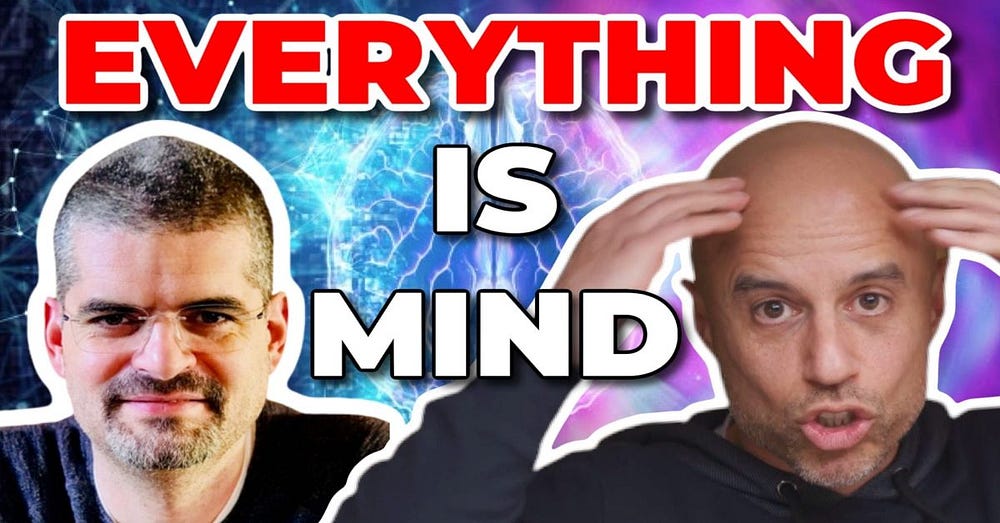
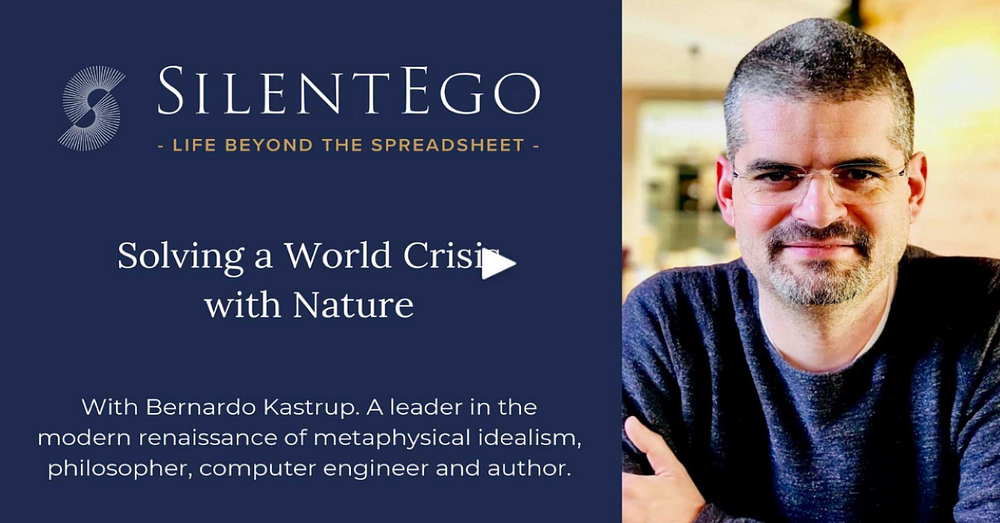
Bernardo Kastrup — as interviewed by Dr. Zubin Damania, MD (or Z Dogg MD) on YouTube.
“Metaphors are powerful tools to paint subtle, complex and nuanced mental landscapes that are difficult or even impossible to communicate literally.”

— — Bernardo Kastrup (see source here)

[Analytic idealism] is a formulation that will appeal to intellectually hard-nosed, left-brained, science-oriented people [].”

— — Bernardo Kastrup (source here)

Reality is a Metaphor: Ripples and Vibrations
“Inanimate objects are simply ‘vibrations’ or ‘ripples’ of consciousness and, ultimately, nothing but consciousness itself [].”

— — Bernardo Kastrup

[See ‘Reality as Metaphor’; which is an extract from Bernardo Kastrup’s book Why Materialism Is Baloney.]

There are indeed fundamental properties and/or entities in physics which are said to “vibrate” and “ripple” (see here and here). However, are Bernardo Kastrup’s own words “vibrations” and “ripples” purely metaphors which can’t really be unpacked because they contain very little (if any) scientific (or even philosophical) content? And even if the words “ripples” and “vibrations” aren’t metaphors, could Kastrup go into any detail about them — as physicists most certainly do when discussing their own ripples or vibrations?

In any case, this means that Kastrup’s version of consciousness (or Cosmic Consciousness) isn’t so fundamental that it can’t vibrate and ripple. Yet usually the things which vibrate and ripple are in some way physical in nature…

Yet, as ever, Kastrup can dodge that particular bullet. And he often does so by simply stating that the physical things which vibrate and ripple are instantiations of consciousness too!

The Brain as a Filter?
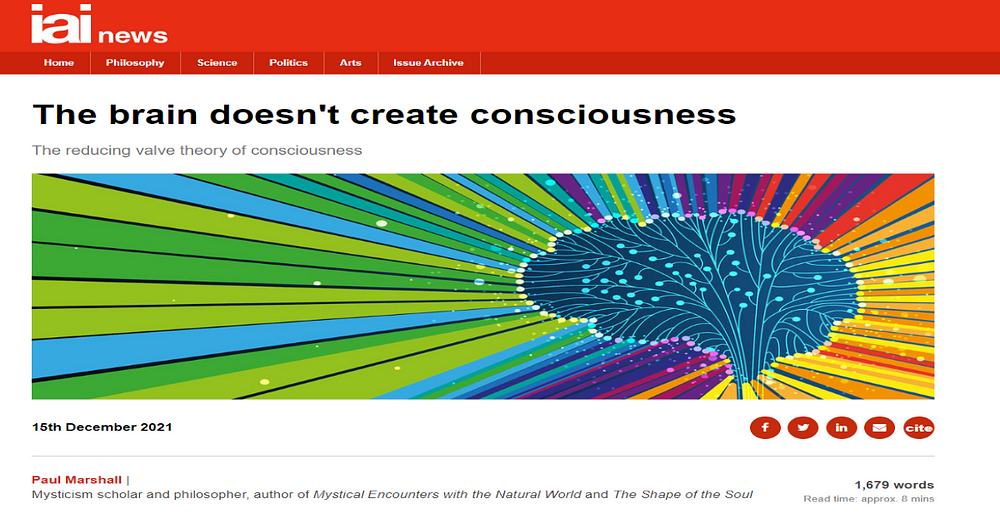
Many (or even all) Cosmic Idealists argue that the human brain is a (to use Kastrup’s own word) “filter” (see here). That is, they argue that the brain is something that consciousness (or Cosmic Consciousness) — which they take to already exists — is filtered through. Thus the biological brain neither produces consciousness nor does consciousness have any necessary link to it. (Except for the extremely strong link that every human case of consciousness — that is, tens of billions of human cases throughout history — has been tied to the biological and physical brain.)…

But we must slow down here!

According to Kastrup himself, “the brain is [also] an image of consciousness”. Thus Kastrup’s warns us about the “filter theory” of consciousness (i.e., despite using the term himself and thinking it a decent “metaphor”). That is, if “all is consciousness”, then how can the brain — which, by definition, must also be consciousness — be seen as a filter of consciousness?

The following passage is Kastrup himself putting his position:

“The idea that the brain does not generate consciousness, but instead limits and filters it down, seems to require dualism and contradict idealism. After all, if all reality exists in consciousness, how can the brain — which is a part of reality — filter down that which gives it its very existence? A water filter is not made of water; a coffee filter is not made of coffee; how can a consciousness filter be made of consciousness? It sounds like a self-referential contradiction.”

[Kastrup also makes his position clear in this YouTube video response to Dr Steve Taylor, who is a “panspiritist”. It begins at 35 minutes and 24 seconds.]

So does Kastrup have his cake and eat it too?

Kastrup’s own Cosmic Idealism, then, is more (as it were) total than some other takes on this ism.

Here is a similar problem; as included in a passage from Gerald R. Baron (see here):

“In these versions consciousness is a universal substrate underlying all reality including the physical world. Some hold that what appears to us as solid matter is actually an illusion and only experience is real (idealism) [].”

Yes; if everything is consciousness, then how can consciousness also be a “substrate”? That is, if consciousness is a substrate, then what is it a substrate of? Is consciousness a substrate for something that isn’t itself consciousness? (That’s problematic for Kastrup’s Cosmic Idealism.) So is consciousness a substrate for… well, consciousness? (Does that even make sense?)

Indeed Kastrup himself uses the word “substrate” here:

[T]he substrate of mind cannot be measured, detected, or analyzed like some kind of stuff, because it is that which measures, detects, and analyzes in the first place.”

[This passage will be tackled in the next section.]

In any case, various Cosmic Idealists continue to reason as follows.

When death arrives, then there is another filter which is Cosmic Consciousness. This is something which human persons can (as it were) use or tap into. More accurately (i.e., in the theology of Cosmic Idealism), the consciousnesses of human persons “return to Cosmic Consciousness”. So, in that literal (or strict) sense, Cosmic Consciousness can’t be seen as a filter if everything is consciousness. (Again, this is similar to Kastrup’s problem with the brain being seen as a filter.)

Here is another writer adding some details to this brain-as-filter position. Manu Herrán states the following:

“A possible explanation here is that our minds are like radio receivers, capable to connect to some emitting ‘station’.”

The passage above has it that it’s not even that our brains are “like radio receivers” — our “minds” are. Yet some Cosmic Idealists argue that an individually embodied brain (in a particular set of physical environments) is like a temporary — physical? — “conduit” into which Cosmic Consciousness (as it were) seeps for a very short duration of time — that is, for a specific person’s lifetime.

Herrán continues:

“The mind, as the radio-receiver, does not generate something new (experiences), but connects to them. [] We can call this the opposite of ‘emergentism’, that is, ‘immersionism’.”

According to the passage above, your experience of, say, a dog having a shit (or a poppy waving in a breezy summer field) is actually your mind connecting to that very same experience as it exists outside of the your brain and the spatiotemporal slice that is the dog having a shit (or a poppy waving in a breezy field). That is, your mind (as “radio-receiver”) is delivered the experiential input (from Cosmic Consciousness) of a dog having a shit (or a poppy waving in a breezy field). So the experience of a dog shitting (or a poppy waving) is what happens when we immerse with Cosmic Consciousness”.

We also have Gerald R. Baron (again) on the same theme here (though he’s not necessarily endorsing these positions):

“The filter model [] describes the role of the brain as a filter or reducing valve that serves to limit and select experiences or thoughts from the source or sources and the perhaps infinity of options available to it. In this case, the brain does not produce the thought as much as receive it, process it and act on it.”

Here again, the brain “select[s]” the “experience[]” of a dog having a shit (or of a poppy waving in a breezy summer meadow) “from the source or sources and the perhaps infinity of options available to it”. Thus the “brain does not produce” the experience of a dog having a shit (or poppy waving) “as much as receive[s] it, process[es] it and act[s] on it”. Of course, on an everyday or non-idealist picture, the brain alone isn’t seen to be solely responsible for the experience of a dog shitting (or of a poppy waving). Something has to occur outside the mind to bring about these experiences. Still, the experience is indeed in the mind — and this acknowledgement provides grist to the idealist’s mill. On the other hand and on this Cosmic Idealist picture, there’s literally nothing outside the individual mind. Alternatively, there’s literally nothing outside Cosmic Consciousness — “the source” of the experience of a dog shitting (or of a poppy waving).

But what the hell does all that mean?

Do any Cosmic Idealists actually go into any detail on all this or is the experience of a dog having a shit (or of a poppy waving) “fundamental”?

So why quote the word “fundamental” here?

Is Consciousness Fundamental?
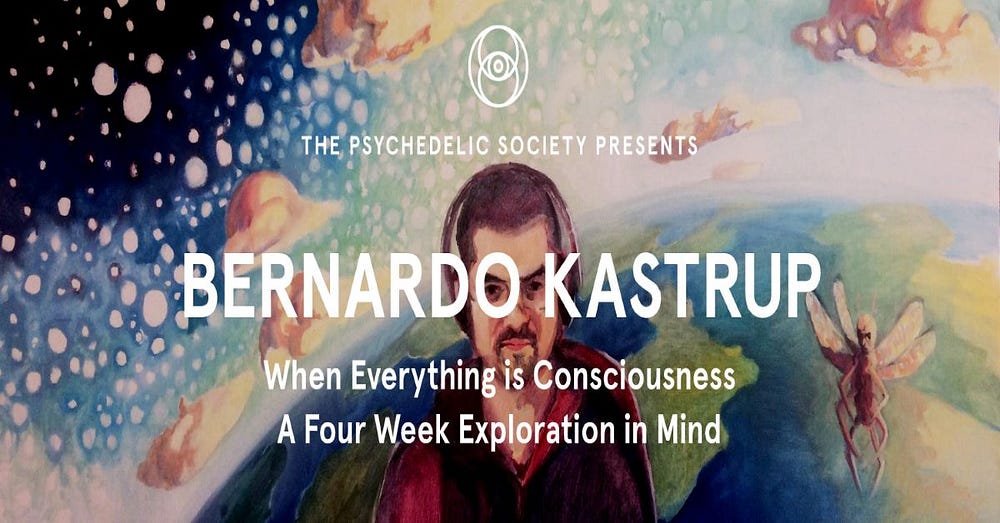
The following passage is Bernardo Kastrup discussing what he calls the “substrate of mind”. He writes:

[T]he substrate of mind cannot be measured, detected, or analyzed like some kind of stuff, because it is that which measures, detects, and analyzes in the first place.”

In another place, his position is expressed in much simpler terms:

“The medium of mind itself cannot be known directly, for it is the knower.”

And here’s another similar passage from Kastrup:

“Mind is an irreducible aspect of nature which itself cannot be explained in terms of anything else.”

Basically, then, Kastrup is arguing that because consciousness is (so) fundamental, then it can’t be “measured, detected, or analyzed”. That’s because if consciousness could be measured, detected and analyzed, then it wouldn’t actually be fundamental at all!

Yet all this is very easy and somewhat cheap.

That’s primarily because almost anything can be deemed to be fundamental — via stipulation. Thus many people may deem an angel to be fundamental. (“So don’t ask me any questions about what it is!”) The experiences of the “afterlife” can be deemed to be fundamental too.

So it can be supposed that if consciousness is truly fundamental , then Kastrup doesn’t need to explain such categorical statements as the following:

“Inanimate objects are simply ‘vibrations’ or ‘ripples’ of consciousness and, ultimately, nothing but consciousness itself [].”

[Philosophers such as David Chalmers and Philip Goff also believe that consciousness is fundamental; though in very different ways to Kastrup — see here and here.]

Kastrup doesn’t need to explain the passage above because that which is fundamental (as already stated) can’t be further explained. Alternatively, consciousness can’t be (in Kastrup’s own words) “measured, detected, or analyzed” either.

Yet if some x were believed to be truly fundamental, then could it also be said to (getting back to an earlier theme) vibrate and ripple?

Kastrup may well admit that these words are simply metaphors. Thus, again, he has his cake and eats it too. On the other hand, mere soulless mortals like me — who’ve been corrupted by “materialist” false consciousness — may not get the deep, complex and profound messages which Kastrup is humbly offering the world (if in the guise of poetic and emotionally-appealing metaphors).

Still, the basic argument must be (again, under the metaphors and technical terms from science and philosophy) that because consciousness is fundamental, then nothing can be said about it.

All this means that Kastrup can make the following statement without fear of embarrassment:

“Idealism proposes that all reality is in mind and, as such, one can say metaphorically that everything is ‘made of’ the substrate of mind.”

So what is the non-metaphorical explanation of all this?

As stated: there isn’t one!

Again, that’s because mind (or consciousness) is fundamental.

Thus all we really have left are Kastrup’s metaphors (all suitably fused with copious technical terms from science, philosophy and Carl Jung).

Indeed Kastrup even rationalises his (over)use of metaphors in the following way (as already quoted at the top):

“Metaphors are powerful tools to paint subtle, complex and nuanced mental landscapes that are difficult or even impossible to communicate literally.”

How does Kastrup know anything at all (or, if not know, then how can he say anything at all) about this these “subtle, complex and nuanced mental landscapes” if they’re also “difficult or even impossible to communicate literally”? (Not that we can be sure what Kastrup means by the words “mental landscapes”.) How does Kastrup even know that these mental landscapes are subtle, complex and nuanced at the very same time as claiming that they’re difficult or even impossible to communicate literally?

So what are these mental landscapes which can’t be communicated literally?

Are they simply intuited? Are they only (as it were) known through the soul or through individual consciousness? (To Kastrup, the individual soul may well be the same as individual consciousness — at least that “egoless” aspect of the mind which is shared with Cosmic Consciousness.)

Admittedly, Kastrup is talking about “mental landscapes” here. Then again, in Kastrup’s Cosmic Idealism the entire Cosmos is mental. Thus the entire Cosmos — and perhaps even the actual position of Cosmic Idealism itself— must also be difficult or even impossible to communicate literally. Hence Kastrup’s many metaphors.

So how neat, tidy and convenient is all that?

And perhaps these speculations are entirely a figment of Kastrup’s ego.

Conclusion

Does all the above mean that Bernardo Kastrup and his fellow Cosmic Idealists can take refuge in such metaphors at the very same time as finding them very emotionally and psychologically appealing?

Finally, just when one thought that the word “consciousness” was already too vague or protean to help within any genuine debate between people with rival views (a view which dates back to the late-19th century and now is often deemed to be a “positivist” position), then along comes Bernardo Kastrup and other Cosmic Idealists to make the situation even worse than it already was.

******************************************************************

(*) See my essays ‘Bernardo Kastrup’s Spiritual Take on Psychedelic Experiences and Cosmic Consciousness’, ‘The Idealist Philosopher Bernardo Kastrup vs. Materialism’ and ‘Bernardo Kastrup (the Well-Known Cosmic Idealist) and His Afterlife’.

[I can be found on Twitter here.]

Thursday, 28 April 2022

Where Do the Logical Rules (or Laws) of Deduction Come From?

How do we know that any given deductive inference is correct or valid?

***********************

The terms “laws” and (less so) “rules” are immediately problematic within the context of logic. After all, logical laws or rules aren’t really like judicial or religious laws. And they aren’t like the rules found in everyday life. Yet, despite that, it’s hard to think of suitable alternative terms. Indeed any alternatives will probably be more problematic, not less so. So that’s why most philosophers and logicians have stuck with the terms “laws” and “rules”.

In addition, the logical laws or rules were once believed to be a consequence of what were deemed to be the laws of thought. And, interestingly enough, that move from the laws of thought to the rules of logic must itself have been — at least partly — logical in nature.

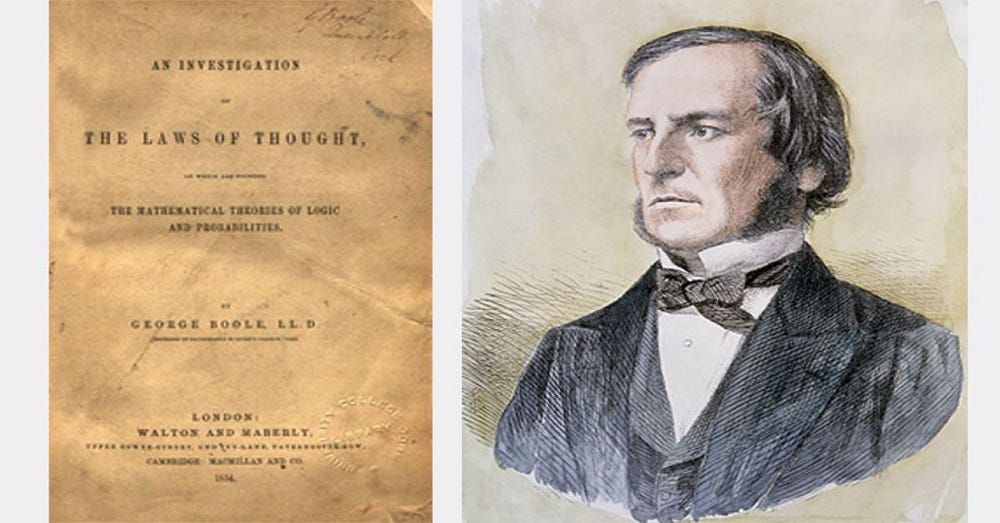
(The actual words “laws of thought” were made popular by the mathematician and logician George Boole in the mid 19th century. This notion was then largely rejected in the early-to-mid 20th century. See later section.)

As it is, this essay won’t deal with these general issues. It will, instead, simply deal with deduction (or deductive inferences) from a largely philosophical (i.e., not purely logical or technical) point of view.

The Rules of Deduction

How do we know that any given deductive inference is correct or valid? (See logical validity.)

Apparently, it’s simple. It’s correct or valid if it abides by a general rule of deductive inference.

This means that if the deductive inference does abide by such a general rule, then it’s believed to be correct or valid. In fact it’s believed to be correct or valid even if the end result of the deduction (i.e., the conclusion) is outrightly false. (Such as: “Swans are fish.”)

Conversely, if the general argument doesn’t abide by the rules of deductive inference, then it’s believed to be invalid or incorrect — even if the end result of the deduction (or the conclusion) is outrightly true. (Such as: “Swans are birds.”)

But where do these laws or rules of deductive inference come from?

What makes them correct or valid themselves?

What makes such things laws or rules in the first place?

And why do we accept these laws or rules and not others?

Perhaps the rules (the word “rules”, rather than “laws”, will be used from now on) of deductive inference depend on other things.

If that is so, then what other things do they depend upon? Do they depend on other rules of deductive inference or simply just on… other things?

Note that the very use of the word “rules” seems to imply (at least to some extent) that deductive rules needn’t — at least not necessarily — depend on anything else. That’s because, in broad terms, logical rules can be deemed to be normative and/or prescriptive in nature — and are therefore (basically) stipulations. (That would still be the case even if the logical rules were based on the laws of thought!) That said, does it follow that because logical rules are normative and/or prescriptive in nature that they needn’t depend on prior (logical?) factors?

It can be concluded, then, that either deductive — and other — logical rules are to some extent arbitrary or that they depend on prior factors. Perhaps both.

So would a rule that’s truly arbitrary be acceptable — or even useful — in logic? Alternatively, if these rules of deductive inference themselves depend on prior (logical?) factors, then what do those prior factors depend on — yet more prior factors? Indeed doesn’t this show us that there’s a clear regress on our hands? And, in turn, doesn’t that regress show us the need to create logical rules in the first place?

In addition to the question of rules, it can be said that an inference (or even a general argument) can be justified by the fact that it abides by the general rules of deductive inference. Yet isn’t justification an epistemological (i.e., not a logical) term? (An epistemological justification usually depends on such things as observation, evidence, memory, testimony, and whatnot — along with logical reasoning.) That said, surely the word “justification” is often used in ways which aren’t — strictly speaking — epistemological.

So in what way is the word “justified” being used here?

Perhaps the argument is justified simply because it abides by the rules of deductive inference. In other words, the fact that it abides by these rules means that it’s justified. And, in turn, it’s justified because it abides by these logical rules.

(Note: The psychological effort — or mental state — required to see whether a deduction or argument abides by logical rules will itself depend on the reasoner’s experiences, memory, knowledge, etc. Of course that would be a point about the reasoner’s psychology, not a point about the logical rules themselves or about the justification of a deduction. In other words, the deduction would stand regardless of a particular reasoner’s — or any reasoner’s — psychological history or character.)

Where Do Logical Laws Come From?

The justification of the rules of deductive inference were mentioned a moment ago. There are various ways in which logical rules (or logical laws) can be justified.

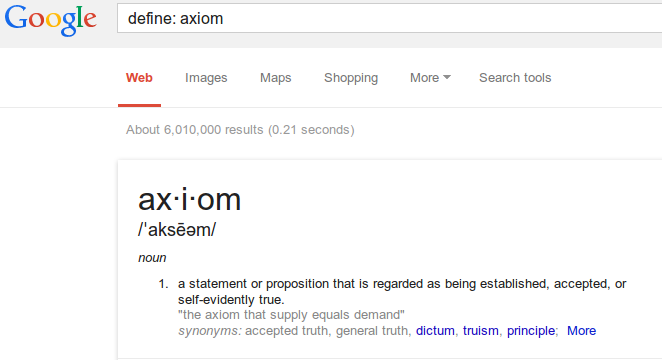
Traditionally, logical rules have been justified by showing that they follow from self-evident axioms. (See also axioms.) These axioms were (or still are) seen to be true simply by virtue of thinking about — and also understanding — them. That is, one needn’t (as it were) go elsewhere to justify such axioms. Indeed it’s even been said — many times — that (only certain?) axioms “justify themselves”.

Of course we need to know how this is possible and be given an example of such a self-evident axiom. We’d also need to know how the the rules of deductive inference follow from such axioms. In other words, just as we need to know (for example) how the premises in an argument (when taken together) lead to a particular conclusion, so we also need to know how the laws of deduction follow from such self-evident axioms — or even from axioms which aren’t self-evident.

One possibility is that these laws or rules of deductive inference are (as it’s often been put in philosophical history) “grounded in the human mind itself”. That is, we can’t help but use them. Either that, or we can’t help but see that they’re correct (or right) when used in particular arguments. This may therefore mean that all rational persons will use the same logical rules or inferences. However, this doesn’t also mean that all reasoners know that they’re using such logical rules. And it certainly doesn’t mean that they can (or could) express (or formulate) them in a technical or symbolic language. Nonetheless, reasoners still follow such rules of deductive inference regardless of their knowledge of formal and informal logic.

The Interplay Between Deductive Inferences and Logical Rules

It was just stated that most reasoners (i.e., not logicians) simply know when they’ve gone wrong in a logical argument.

One way in which both logicians and non-logicians know they’ve used an invalid (or incorrect) rule is when it yields an unacceptable inference or conclusion. That is, if the inference takes you to a conclusion which simply can’t be accepted (either for purely logical reasons or for reasons of truth), then that rule will be rejected.

So what we have here — at least in part — is an interplay between deductive inferences and general rules. That is:

i) Valid deductive inferences are justified by their conformity to general rules.
ii) General rules are justified by their conformity to valid deductive inferences.

Yet aren’t i) and ii) above viciously circular?

That is, isn’t it circular to argue that general rules justify valid deductive inferences and valid deductive inferences justify general rules?

Stephen Stich

The American philosopher Stephen Stich (1943 — ) argues (in his paper ‘The Problem of Cognitive Diversity’) against the viciousness of this logical circle by putting the following two points:

i) A general rule is “amended” if it yields an inference (or conclusion) we are unwilling to accept.
ii) An inference is rejected if it violates a rule we are unwilling to amend.

Both i) and ii) seem psychological in nature. That is, the phrases “unwilling to accept” and “unwilling to amend” are surely psychological (i.e., not logical). This means that — on the surface at least — we aren’t supplied with a logical reason as to why we should amend a general rule (i.e., we’re simply told that it leads to “an inference we are unwilling to accept”). Similarly, we aren’t given a logical reason as to why we should reject a given inference (i.e., even if it does “violate a rule”). However, that may be because we can never really go beyond the interplay — or virtuous circle — between general rules and valid inferences. We can only reject or amend a general rule if it yields an unacceptable inference (or conclusion). And we can on reject an inference if it violates a rule we’re unwilling to amend.

Now all that is indeed logical… at least up to a point.

In these cases, then, logical rules are (as it were) keeping an eye on deductive inferences. Similarly, the deductive inferences are keeping an eye on the logical rules. Yet the psychological nature of our “unwillingness to amend” a rule or our “unwillingness to accept” an inference is set within a logical context. Despite that, logic itself still can’t make that decision for us. (How could it?) The reasoner will still need to decide if an inference violates a rule or if a rule needs to be amended because it yields an inference (or conclusion) he’s unwilling to accept. However, the decision itself will be psychological in nature.

Again, that psychological decision will (or should) be based on the logic of the situation. Yet logic on its own can’t make that decision. That said, logic does (as it were) “tell” the reasoner what’s gone wrong, either in terms of an unacceptable inference or a rule he’s unwilling to amend. Yet it’s up to the reasoner to act on that clash between logical rules and deductive inferences.

[I can be found on Twitter here.]


Monday, 25 April 2022

Bernardo Kastrup (the Well-Known Cosmic Idealist) and His Afterlife

Bernardo Kastrup will still be Bernardo Kastrup when he merges with Cosmic Consciousness in the Afterlife.

The philosopher Bernardo Kastrup believes that it is his “ego” and body which will die, not his consciousness or his “soul”.

Take this passage from Kastrup:

“It is reasonable to assume that the mental process we call physical death ‘makes the unconscious more conscious,’ because it eliminates a source of obfuscation; namely, the egoic loop.”

Kastrup continues:

“The sense of novelty here is merely the illusion of an ego going through dissolution. Once the ego is gone and all is remembered, the sense of novelty will disappear. [] As such, maybe life and death are entirely analogous to dreaming and waking up, respectively.”

So it’s clearly important to note how important what Kastrup calls the “unconscious” is to his Cosmic Idealism; and, more relevantly, to his positions on the afterlife. (Kastrup is much indebted to Carl Jung — see here.) Thus when Kastrup refers to “consciousness”, he’s often actually referring to the (Jungian) unconscious. And that clearly complicates matters.

As it is, in this essay I have no desire to tackle Carl Jung’s psychiatry/psychoanalysis or Kastrup’s 21st-century interpretation of it.

But, firstly, what if there is an afterlife?

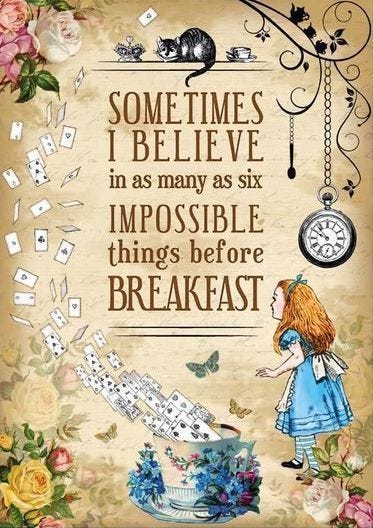
Six Impossible Things Before Breakfast

When it comes to discussions of the afterlife (specifically as it’s supposedly encountered during near-death experiences), one often hears (or reads) the following words (or variations thereon):

“There is more out there than we know.”

The problem here is that people can claim literally anything and then justify their claim by stating: “There is more out there than we know.” So I could claim, for example, that there are green goblins, cats floating around Venus or aliens living in the earth’s core. And then, if someone criticises my claim, I can simply reply: “There is more out there than we know.”

All this may make the people who state “there is more out there than we know” seem open-minded. That’s primarily because such people appear to considering (as it were) “six impossible things before each breakfast”… Except that, more often than not, many of the people who state “there is more out there than we know” aren’t really open-minded at all. That’s primarily because they often artfully select precisely which possibilities to consider. And their very-well-chosen possibilities just happen to be perfectly in tune with their prior “spiritual” beliefs. Thus the possibility of, for example, zombies or mile-high tricycles (to take two possibilities from David Chalmers) are never considered by such people precisely because they don’t serve any spiritual (or personal) purpose.

But what about these six possibilities before each breakfast?

Those who cite possibilities need to supply evidence and arguments for taking each possibility seriously. So considering a possibility is fine — but not when simply stated without much (or even any) detail…

… But there still could be an afterlife.

And there is, indeed, more than we know.

Yet there’s still no reason to believe that the afterlife and many other possibilities are actually real or that the claims about them are true. In other words, there’s often no reason to take them seriously.

In any case, there are literally infinite other possibilities we could — or even should — also consider. But we can’t because we haven’t got the time. And, in most cases, there is no reason why we should anyway.

Ironically, many people do actually believe that they know (if only in a non-strict, non-epistemological sense) about the afterlife. Indeed that’s why they frequently talk about it. In other words, such people do not believe that the afterlife is beyond what we can know.

Of course some people also claim to be (as already stated) “open-minded” about the afterlife. Yet when you read just a couple of their comments, you quickly realise that they do believe in the afterlife. Indeed they seem to believe that they know it exists.

So all this has very little to do with being open-minded.

In any case, it is true that there are obviously many things that we don’t know. And?

Now, if someone says “your consciousness survives” in the afterlife, then what is it that survives?

What Survives Death?

What do the words “our consciousness continues after death” mean?

What is it, exactly, that survives death and how does it do so?

To Bernardo Kastrup, individual consciousnesses are part of Cosmic Consciousness. Yet even if this were true, then surely once we die there is still no “we” (or human persons) left to “survive”.

It is indeed the case that the particles which the physical and biological brains (of dead people) were made up of will (as it were) “survive” — but not individual minds or persons themselves. This is the frequent mistake of conflating the particles, fields and forces which constitute brains with minds — and indeed human persons — themselves surviving. How on earth could persons or minds survive? Such things are embodied in particular brains, bodies and environments. Without those brains, bodies and physical environments, what is this “we” that survives? How can there be persons (or “we”) without memories (see later section), cognitive functions, beliefs, etc. — all of which required physical brains?

So are these claims about the afterlife purely poetic? Are they designed to appeal to the emotions and also appease the intense and omnipresent fear of death which so many people experience? Or are these claims simply religious and therefore based on faith? Perhaps all of these things?

So most — perhaps all — these references to the afterlife (or persons/selves continuing to ? once their bodies and brains die) don’t really explain what exactly it is that survives. At least that’s the case in 9 out of 10 examples of talk of the “afterlife”.

Again, what is this consciousness which survives and why is it a person’s consciousness rather than some abstract or vague input into a “space-time storage bank” (or into Cosmic Consciousness)? How is some individual human person (who had a physical body and brain) still in the universe when he or she has no body and brain? What is left after death? And why is what is left — if anything — still deemed to be “your consciousness” or a human person? Moreover, why is what “survives” death deemed to be exactly the same person (psychologically speaking) than the person who existed when embedded in a particular brain and who had a particular body? What provides this continuity between the person with a body/brain and this “consciousness” in the Cosmos?

More to the point, why are these details very rarely — i.e., virtually never — mentioned by the believers in an afterlife or in Cosmic Consciousness?

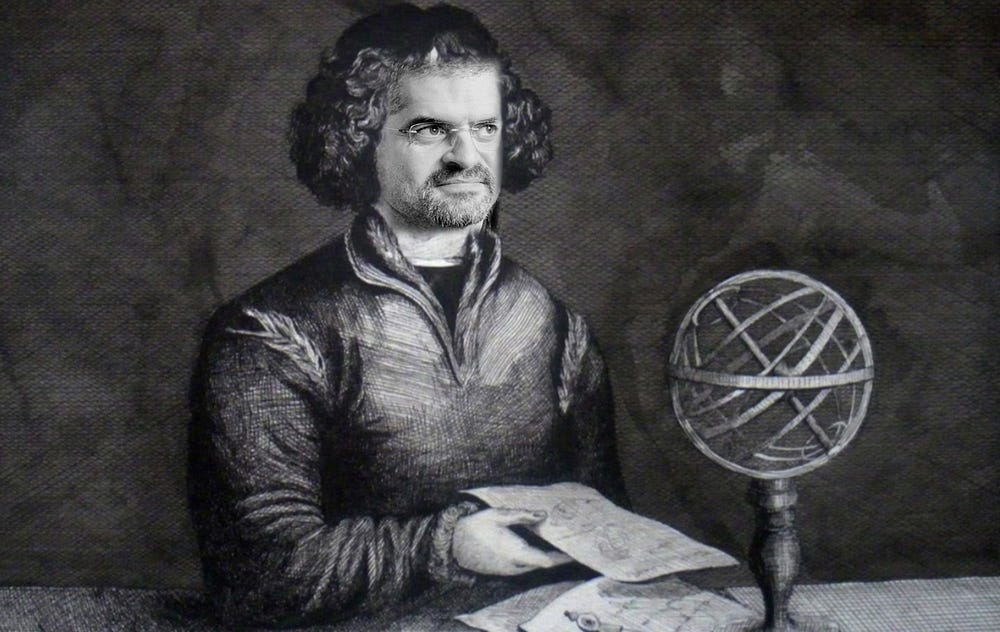
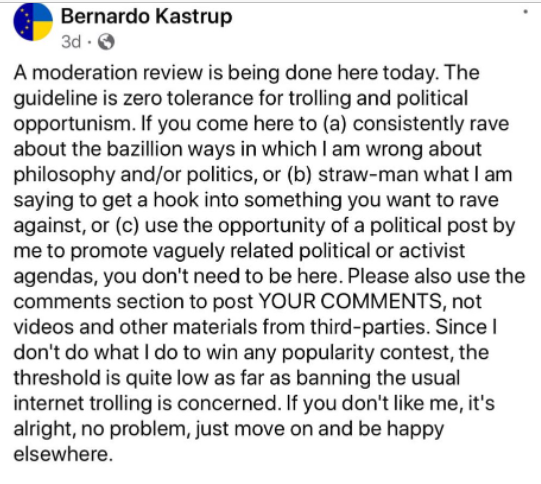
An image from Kastrup’s “fan club”. (See ‘Bernardo Kastrup’s Fan Club’ on Facebook here.)

Now let’s take Kastrup’s own afterlife.

Will Bernardo Kastrup’s consciousness (as it’s put by many Cosmic Idealists) “expand” when he dies?

How will it expand and how will it still remain Kastrup’s consciousness?

If not embodied in a brain, body and in particular physical environments, then how does the non-embodied Kastrup distinguish himself from the rest of the Cosmos (or from Cosmic Consciousness)? In other words, if Kastrup simply “merges with the universe”, then why talk about Kastrup’s — or anyone else’s — “afterlife” at all? Surely merging with the Cosmos is the end of Kastrup and everyone else who dies.

So, in basic terms, all that must happen (at least according to the logic of this theological or spiritual story) is some kind of super-fusion of Kastrup’s mind and billions of other minds into the single melting pot that is both the Cosmos and Cosmic Consciousness.

Now take the very specific case of human memory.

Human Memory

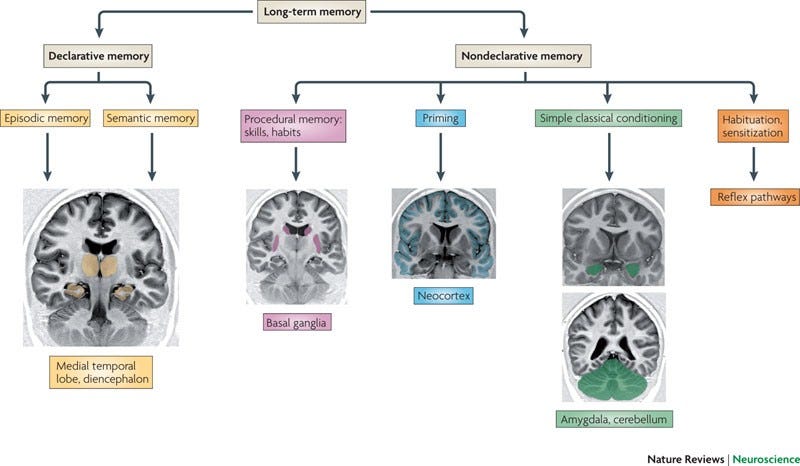
Human memories are literally encoded in the brain (see here and here).

There’s a vast amount of evidence of this and most/all neuroscientists agree. Of course this isn’t an argument that all memories, of all kinds, need to be encoded in human brains. It’s an argument that human memories are encoded in human brains. That is, whenever there has been a human memory since the beginning of our species, that memory has been encoded in brains — tens of billions of times.

And now Cosmic Idealists come along and say otherwise.

So it can be — provisionally — accepted that there may be computer memories or alien memories or even paramecium memories. That said, all these other examples bring up the issue of the precise implementation of these other memories in — some kind of — physical medium. And this is an issue which Cosmic Idealists either bypass or ignore by vaguely talking about “consciousness”. However, sometimes idealists may add a tiny bit more detail when they say that “consciousness is fundamental” (see my next essay).

That’s the issue of memory alone and its (as it were) wetware (see here, here and here).

Now what about the implementation of entire selves or persons?

Memory is also vital for a person to be a person. Thus how is memory encoded when the “mind” leaves the body and “becomes one with the universe”? How is that personhood (or selfhood) established? Is it simply another of the Cosmic Idealists’ fundamental (as it were) facts?

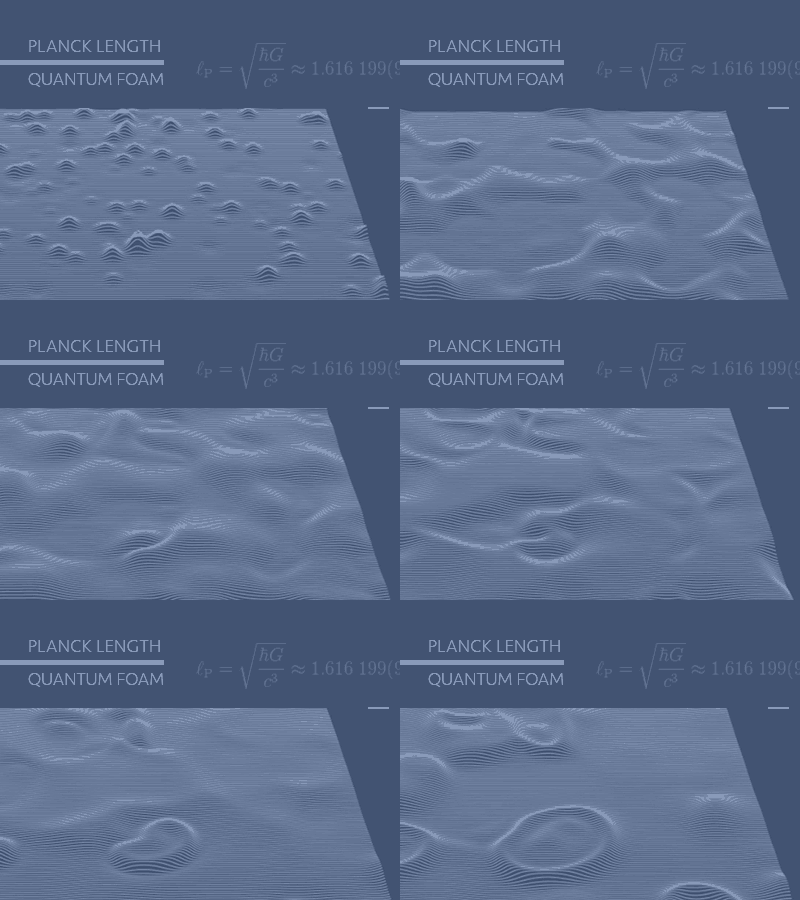
Quantum Foam as a “Soul Vehicle”

It’s worth noting here that some Cosmic Idealists don’t believe that consciousness is fundamental in precisely the same way as Kastrup and others do. Instead, they believe that consciousness is a (as it were) secondary fundamental in that it requires a medium which is even more fundamental.

Take these words from James Vaughn:

[T]he ‘soul vehicle’ is Quantum Foam -which I think represents a fair concept of consciousness being a living yet somehow unquantifiable structure beneath all reality.”

The position — and the others like it — that quantum foam (or spacetime foam) is a “soul vehicle” and therefore fundamental is no better (or no worse) than believing consciousness itself is fundamental.

As with Kastrup’s Cosmic Consciousness, if any given x is truly an “unquantifiable structure”, then how can it be known that it is “beneath all reality”, “a fair concept of consciousness”, “living”, etc? This suggests that a lot is actually known about quantum-foam-as-a-soul-vehicle — and that’s apart from it actually being a soul vehicle!

In any case, how does quantum foam (even if a correct theory in physics) help when it comes to consciousness, the afterlife, etc?

One important point about quantum foam (as well as fields) is that it is taken to be fundamental. (In this case, perhaps the fundamentality of spacetime has been replaced by the fundamentality of quantum foam.) So how does something so basic, so simple, and so fundamental as quantum foam (or spacetime or fields) have any relation whatsoever to human selves or persons surviving in an afterlife as “pure consciousness”? This means that the precise relation between quantum foam (or, for that matter, Cosmic Consciousness) and human persons (or selves) must be explained.

Human persons (or selves) are a product of brains and bodies which exist in particular (physical) environments and have had particular (physical) histories. The creation of what we are (as persons) and what we believe (as persons) occurred because of our brains.

So how does all that connect to quantum foam?

What is the precise tie between something complex and firmly outside of fundamental physics (i.e., human persons and their nature) and something else (i.e., quantum foam) which is firmly within fundamental physics? How can quantum foam (as it were) implement the minds (or consciousnesses) of human persons once they are free of their bodies, brains and physical environments? What are the technical details of this supposed implementation of human persons in quantum foam?

What’s required here is not the detailed physics of quantum foam: what is required is the detailed physics of the precise tie between quantum foam and human persons (as the latter supposedly exist in the afterlife).

Cosmic Idealists: Egos and Spiritual Narcissism

“Ego is able to convert anything to its own use, even spirituality.”

Chögyam Trungpa (source here)

Here we have a problem with the “spiritual” element of Cosmic Idealism, at least as it relates to the afterlife.

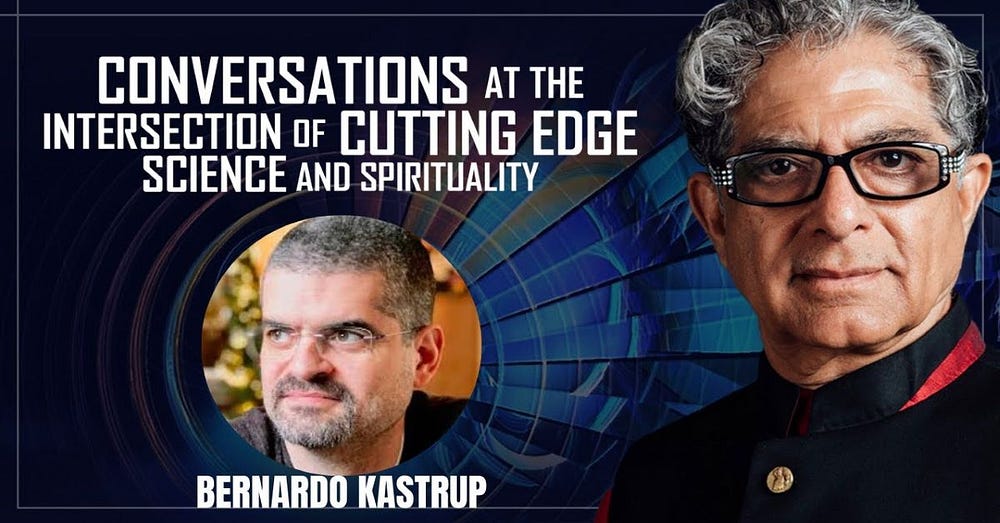
Deepak Chopra and Bernardo Kastrup

On the one hand, the “spiritual” benefits of merging with Cosmic Consciousness are often stressed. On the other hand, it is always very clear that it is individual human persons or selves (such as Kastrup himself) who do the merging. Thus these disembodied persons merge with Cosmic Consciousness at the very same time as keeping their entire identities — along with the memories which aren’t encoded in brains — which just (as it it were) float around in spacetime or the Cosmos. (See note (1).)

To be rhetorical, it is actually the individual egos (such as Kastrup’s own) of Cosmic Idealists that are kept firmly and completely intact when this so-called “oneness with the Cosmos” occurs or is brought about. Thus we have all the grandstanding rhetoric of the Cosmic Idealist being at-one-with-the- Cosmos. Yet in the process most of the Cosmic Idealists you read or listen to (Bernardo Kastrup and Deepak Chopra simply being the most obvious examples) see themselves as becoming superior intellects and more moral persons through such a merging. Thus, after achieving Oneness-With-the-Cosmos, such Cosmic-Idealist egos remain fully intact and, in most cases, actually become more “egotistical” than many non-idealists — and even materialists. Indeed these enlargements of the egos of Cosmic Idealists is a direct consequence of their supposed merging with Cosmic Consciousness. Such things are also, bizarrely enough, a consequence of the (to use Kastrup’s words) “ego dissolution” (or ego death) of Cosmic Idealists! (See note (2).)

So take these words from one of Kastrup’s fellow Cosmic Idealists:

“Some people are stuck only in the body-mind system as they’re are polarized in this way, since they are materialists.”

This is simply an example of spiritual and intellectual grandstanding in the guise of what’s often called “spiritual philosophy”.

****************************

Notes:

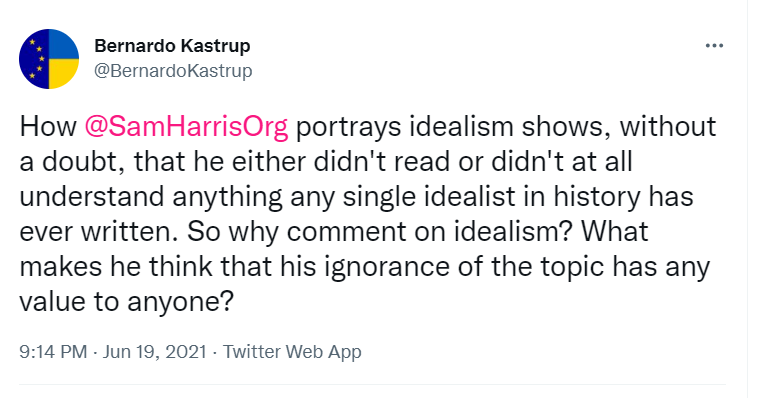
(1) Bernardo Kastrup’s very personal and strong words on just about every person and position he doesn’t fully endorse clearly display his huge ego. Take his highly personalised and very-smug criticisms of Philip Goff (see here and here), Sabine Hossenfelder (see here and here), Sam Harris (see here and here), Massimo Pigliucci (see here and here), all “materialists” (see here and here), “our culture” (see here and here), etc. etc. etc.

(2)

Kastrup appears to an admin in his own “fan club”. See image above and his club here.

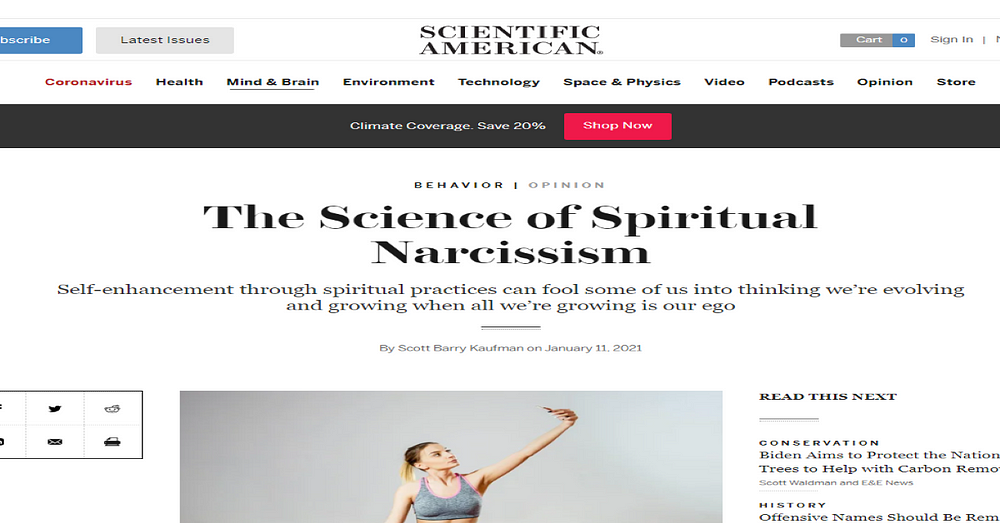
See ‘The Science of Spiritual Narcissism’, at Scientific American. See also a psychologist on “spiritual narcissism” here. Finally, this piece is on the direct link between being supposedly “egoless” and having a huge… well, ego — something that the writer admits to and thinks is a good thing.

(3) See my essays ‘Bernardo Kastrup’s Spiritual Take on Psychedelic Experiences and Cosmic Consciousness’ and ‘The Idealist Philosopher Bernardo Kastrup vs. Materialism’.