Wednesday, 11 October 2023

The Politico-Religious Panpsychism of Philip Goff and Joanna Leidenhag

Philip Goff is a professional philosopher, not a political journalist, politician or activist. So the argument in this essay is that Goff — as a philosopher — is attempting to create a philosophy (in this case, cosmopsychism) that somehow embodies and expresses his prior religious, political and ethical views. Similarly, the self-described “Christian theologian” Joanna Leidenhag (whose views Goff discusses) is attempting to make panpsychism embody and express her prior Christianity… as well as her political views.
(i) Introduction
(ii) Philip Goff’s Political and Religious Views
(iii) Joanna Leidenhag and Philip Goff
(iv) The Politico-Religious Use of Panpsychism
(v) Conclusion

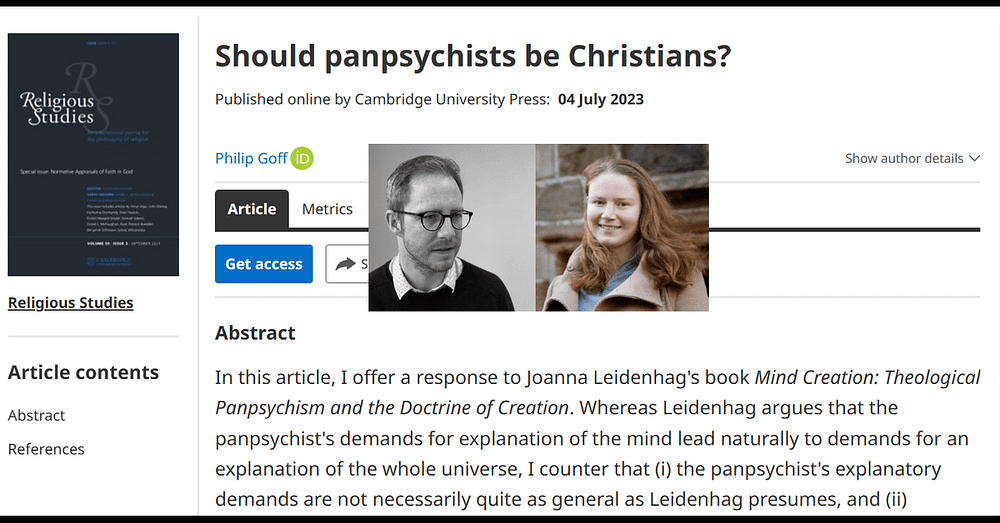
Much of this essay focuses on how the philosopher Philip Goff and Christian theologian Joanna Leidenhag tie (or even fuse) their panpsychism to their political and religious views. Relevantly, how they do so is very clearly shown in Goff’s paper ‘Should panpsychists be Christians?’, which was published in the journal Religious Studies.

There is a technical (as it were) middle section in Goff’s paper, which tackles issues which date back to the ontological argument. I shall ignore this section. Instead, I’ll simply tackle what is original (or peculiar) to Goff himself. [See note 1.]

Philip Goff’s Political and Religious Views
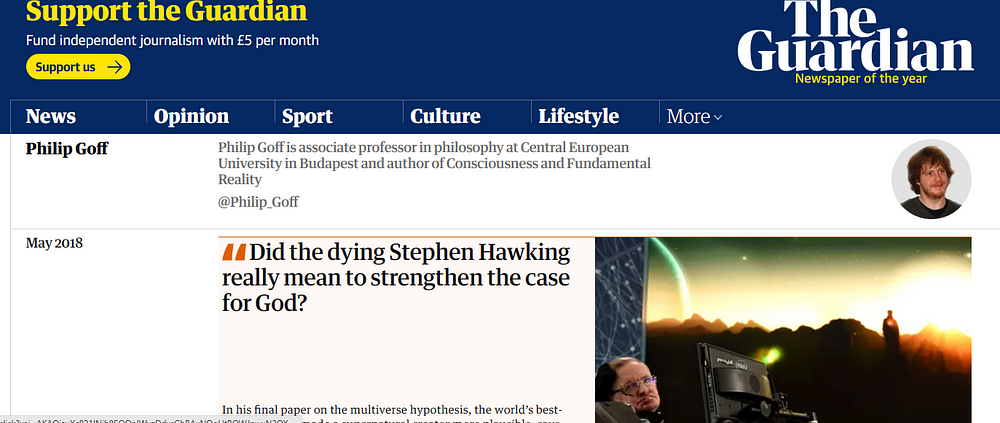
Philip Goff wrote three political articles (see here) for the Guardian newspaper — between 2010 and 2018 — which contain zero philosophy. He also wrote two very-short pieces (which contain philosophy) on Stephen Hawking for the same newspaper. (See screenshot above.) Goff’s other political stuff — including an article for Novara Media — can be found here.

It’s worth saying straight away that readers can (or may) agree with some — or even most — of Goff’s political views and positions. However, the problem here is the artificial — and even dishonest — way these political views and positions are tied to (or even fused with!) two metaphysical positions — i.e., panpsychism and cosmopsychism.

For one, it’s surely possible to be a panpsychist and not hold any of Goff’s political values and views.

On the other hand, people can share Goff’s political values, views and ideas, yet also believe that panpsychism is baloney. (Goff may well argue otherwise.) Indeed, I suspect that most of those who do share Goff’s socialist politics (at least the ones who’ve given panpsychism any thought) do actually believe that panpsychism is baloney. What’s more, some of those people may even believe that a belief in panpsychism is politically counterproductive… or worse.

So what of Goff’s religious views?

The following is an anecdote that Philip Goff has told a couple of times in his books and publications:

“I once asked Chalmers if he had any religious sentiments, to which he replied, ‘Only that the universe is cool.’"

It’s crystal clear that Goff himself has “religious sentiments”…

However, Goff does have problems with what he refers to as the “Omni-God”. [see here.] He also has problems with what he calls “Abrahamic faiths”.

So why isn’t Goff a Christian?

Perhaps the main reason why Goff rejects Christianity is expressed in his own words here:

[T]here are still profound challenges for Christians hoping to circumnavigate the problem of evil [].”

Goff also states the following:

“I personally think evil and suffering constitutes very strong evidence against the Omni-God hypothesis, and hence very strong evidence against any conception of Christianity that involves an Omni-God.”

In his books and elsewhere, Goff has offered his readers various autobiographical details which strongly suggest that his prior politics and ethics are calling the shots when it comes to his metaphysics.

Here’s an example of this as it relates to Goff’s just-stated position on God and evil:

[T]o take the objection of my dad — a lifelong agnostic Catholic — to Christianity. [] Why didn’t Jesus stick around? If satisfactory answers to these questions cannot be given, then we haven’t avoided the problem of evil at all.”

One response here may be to argue that this autobiographical stuff is simply showing us why Goff isn’t a “traditional Christian”, not why he’s a panpsychist. However, since Goff himself ties (or fuses!) religion, politics and philosophy together, it will be shown why this autobiographical passage has been quoted.

There are, of course, other political and ethical reasons as to why Goff rejects Christianity. Yet those other reasons don’t seem to be primarily philosophical, logical and/or scientific either.

In any case, Goff himself tells us that he’s “spiritual”.

Perhaps it can be assumed that most panpsychists are panpsychists for primarily spiritual and/or political reasons too. Goff writes:

[T]here are those such as Hedda Hassel Mørch, Itay Shani, and myself, who do have certain convictions which may be called ‘spiritual,’ or at least which depart more radically from our standard naturalistic picture of reality than bogstandard panpsychism.”

There is a split, however, which Goff himself notes. That split is between spiritual-but-not-religious panpsychists, and (traditionally) religious panpsychists.

Goff, Mørch, Itay Shani, etc. are (as it were) spiritual panpsychists, and Joanna Leidenhag is a Christian panpsychist. (Note that Bernard Kastrup, Deepak Chopra, etc. are spiritual idealists.)

Joanna Leidenhag and Philip Goff
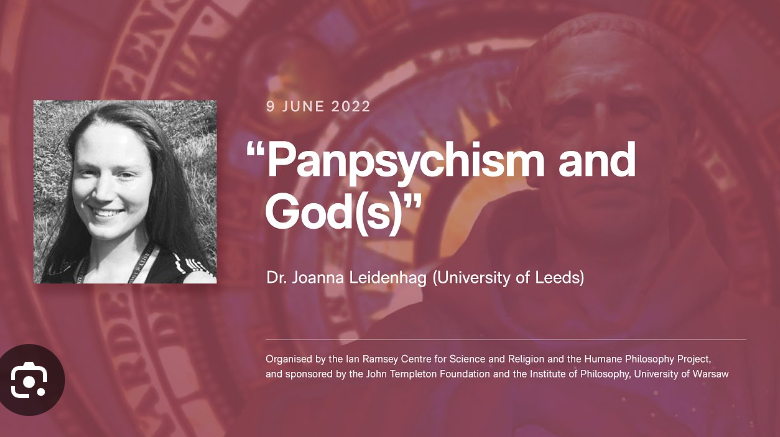
Philip Goff introduces Joanna Leidenhag’s book (Mind Creation: Theological Panpsychism and the Doctrine of Creation) by firstly telling us that “there has not been much work connecting up panpsychism with the Abrahamic faiths”

And that connection is precisely what Leidenhag is attempting to bring about.

Goff continues:

“Leidenhag argues a partnership between panpsychism and Christianity is mutually beneficial for both parties, and outlines a number of ways in which one can be seen to benefit the other.”

So, to Leidenhag, the relationship between Christianity and panpsychism is reciprocal.

Goff also writes:

“Leidenhag also thinks panpsychist eco-philosophy can benefit from Christianity.”

This is an explicit acknowledgement that panpsychism is directly tied to politics. More accurately, both Leidenhag and Goff tie panpsychism to “eco-philosophy”. [See also ‘Ecosophy’.]

So Leidenhag is very much like Goff in that she’s attempting to make a metaphysical position serve religious, political and ethical goals and causes.

According to Goff:

“Leidenhag’s aspires to use panpsychism to construct a conception of Christianity suited for a time of ecological crisis.”

This is exactly what Goff is doing with panpsychism.

In terms of detail.

In the following passage, Leidenhag ties what she calls “the divine mind” to a panpsychist position:

“This metaphysical intimacy between the divine mind and the natural world is easier to make sense of if both are — or are made up of — conscious entities.”

Indeed, even Leidenhag herself (as quoted by Goff) believes that Christianity

“‘is the most anthropocentric religion the world has ever seen’, given ‘man’s effective monopoly on spirit in this world’ in a standard Christian ontology”.

Goff himself can’t square (traditional) Christianity with his own political and ethical views. However, he can square it with his new (as it were) cosmic religion.

The Politico-Religious Use of Panpsychism

The way Philip Goff describes Joanna Leidenhag’s position makes it seem as she too is pragmatically using panpsychism.

For example, Goff writes:

“Leidenhag proposes ways in which adopting panpsychism can be beneficial for Christians."

Indeed.

Leidenhag believes that panpsychism can be “beneficial for Christians”.

So how does Leidenhag want to use panpsychism in beneficial ways?

According to Goff, Leidenhag uses panpsychism to advance Christianity by offering this argument:

[I]f all of the natural world is conscious, suggests Leidenhag, then God can reside within it through the presence of the Holy Spirit within each conscious entity.”

Goff then tells us why Leidenhag (just like himself) doesn’t like what she sees as being the only alternative:

[I]f panpsychism is false, [then] the universe at large is a kind of unfeeling mechanism.”

To Leidenhag (if not Goff), this would result in a situation in which

“it’s perhaps a bit hard to make sense of the Holy Spirit residing within a mechanism”.

This means that most of the above isn’t really about whether the Universe is actually “unfeeling” or feeling: it’s about what is beneficial to believe.

In Goff’s case, it’s mainly about what’s beneficial to his prior political and ethical views. In Leidenhag’s case, it’s mainly about what’s beneficial to her prior Christianity… as well as her politics.

Leidenhag also tells us (as Goff himself often does) that panpsychism

“is a conception of reality more constant with spiritual convictions, including but not limited to Christianity”.

And, yet again, Leidenhag comes clean about her belief that panpsychism can be beneficial to her own Christianity. (The phrase “comes clean” may seem rhetorical. Yet I can’t think of a more accurate way of describing Leidenhag’s own words.) According to Goff:

“By instead adopting panpsychism, we can return to the Christianity of St. Francis of Assisi, in which all things animate and inanimate have intrinsic worth.”
But what of Goff himself?

Leidenhag’s word “beneficial” has just been quoted a couple of times, and Goff also says that

“I agree on the benefit of panpsychism to eco-philosophy, and have in the past made similar arguments”.

Goff’s political and ethical position is made explicit when he continues with these words:

“The terrible mass destruction of forests we witnessed in Brazil in recent years under Bolsonaro, have a different moral character if we see them as the burning of conscious organisms.”

Thus, Goff comes very close indeed to admitting that his use of scientific (or physical) cosmology and theoretical physics (along with panpsychism itself) is simply a tool to advance his politics, ethics and religion.

In other words, Goff is a professional philosopher, not a political journalist, politician or activist. Thus, as a philosopher, he wants to create a philosophy that embodies and expresses his prior politics and ethics.

For example, Goff tells us that

“it would be nice if reality as a whole was unified in a common purpose”.

Goff also believes that what “would be nice” needs to be backed up with some science and some philosophy — otherwise his views may simply come across as being an expression of mere politico-religious sentiment. Thus, Goff continues by saying that

“certain features of reality, such as cosmological fine-tuning and psycho-physical harmony, give us grounds for taking that idea seriously”.

It can be seen that Goff has kept on updating his panpsychism in response to the recent science he’s just read. That may seem like a good thing in that he’s at least taking note of new science. Indeed, it may also seem as if he’s updating his philosophical positions in response to the new science.

However, Goff may simply see such new science as being (to use that word again) beneficial to his prior panpsychism, just as his panpsychism is beneficial to his prior politics.

To justify these claims.

When Goff first discussed panpsychism in his early papers (they date back to 2006), there was very little (if any) science to be found within them. There certainly wasn’t much — or even anything — about physical cosmology and scientific cosmology. This was the case up until around 2017, when Goff started to refer to “cosmopsychism”. Sure, Goff had previously referred to atoms, electrons, etc. in his early papers. However, he did so simply to argue that such things might (or do?) instantiate experience or consciousness.

Then Goff moved on to include spacetime itself within his panpsychism. (Goff wrote: “Spacetime on its own is a simple and ubiquitous experience[].”)

And now, in 2023, Goff states that the “quantum vacuum” may be conscious. Goff tells us that

“it seems to me that the self-explainer might just be the (conscious) universe itself, or perhaps the (conscious) quantum vacuum”.

So it has been argued that Goff has created a philosophy (i.e., panpsychism) that — somehow! - metaphysically embodied and expressed his prior politics and ethics. Similarly, Goff uses recent science to back up both his prior panpsychism and his new cosmopsychism, which is itself (at least in large part) the metaphysical expression of his prior politics and ethics.

Yet Goff seems to present the argumentative (as it were) arrow in reverse.

In other words, Goff hints that he discovered (i.e., through studying science) that the Universe has a “purpose”. Or in his own words:

[A]s I argue in my book Why? The Purpose of the Universe, certain features of reality, such as cosmological fine-tuning and psycho-physical harmony, give us grounds for taking that idea seriously.”

And this, eventually, led to the idea that

“the other has equal worth to yourself is to overcome individualism and ego”.

Apart from this link being fantastically circuitous or tangential (admittedly, I’ve expressed it simply here), it can also be strongly suggested that Goff has inverted this argumentative arrow.

In other words, Goff makes it seem (or he simply hints) that he did his research in physical cosmology and (theoretical) physics, and only then did he come to his conclusion about “the other has equal worth to yourself”. Yet, in actual fact, Goff believed this long before his recent research into scientific/physical cosmology and theoretical physics.

Thus, as a socialist dating back to his teens (according to autobiographical details), Goff believed that that the other has equal worth (arguably, this isn’t necessarily a socialist belief at all). And then, many years later, he began to see if he could justify that belief in metaphysical terms. What’s more, he also came to argue (sometime later still) the equal-worth thesis in scientific and cosmological terms.

So all this is beginning to seem as if Goff is attempting to construct a new religion. Or, at the very least, he’s attempting to construct a complete worldview.

And that at least partly explains why the link between all the science Goff mentions and his just-stated political/ethical belief is just so fantastically tangential and circuitous.

Conclusion

As can be seen, Philip Goff’s and Joanna Leidenhag’s politics and ethics are made explicit by… Goff and Leidenhag themselves.

And that explicit (although sometimes not so explicit) politics/ethics is also tied to (or embodied within) a new ontology — cosmopsychism.

As for religion and God.

Goff keeps on telling us (as does the physicist Paul Davies — see here) that he rejects “the God Hypothesis”…

Except that he doesn’t.

That’s because much of what he says about “cosmic purpose” is more or less (although sometimes precisely!) how many “eastern” and ancient religions have previously described God! [See here.]

All this means that Goff doesn’t, in fact, move away from either God or from religion. He simply moves away from traditional Western religions, and away from the Abrahamic God.


Note:

(1) This middle section (with the title ‘The Self-Explainer Argument’) is philosophically detailed. It’s all about Leibniz’s “Principle of Sufficient Reason”, “emergence”, “fundamental entities”, “self-explaining explainers”, “brute facts”, “seemings”, etc. Indeed, it even includes numbered arguments in the traditional academic-analytic-philosophy style. (The other sections in Goff’s paper are called ‘Does Panpsychism lead to God’, ‘Should Christians be Panpsychists?’ and ‘Panpsychism, Christianity, and Ecology’.)

Yet this technical digression in the middle of Goff’s ‘Should panpsychists be Christians?’ sticks out like a sore thumb. It also comes close to being irrelevant to the political and ethical views Goff wants to advance. (At least parts of it seem irrelevant.) It’s as if Goff is attempting to prove to his readers that he can still do technical analytic philosophy, despite his new found interest in creating a politico-religious philosophy — or even a politico-religious worldview.

Another problem with this technical middle section is that it doesn’t contain anything original to Goff. Indeed, he tackles themes which have been debated in analytic philosophy many times over the last few decades. What’s more, debates about self-explaining explainers (without, of course, that precise term always being used), etc. date back to the Ontological argument in the 11th century (or even further back than that).

More relevantly, nothing in this technical section is directly tied (or even can be directly tied) to Goff’s new cosmic religion or to his politics.

(*) See my ‘Why? The Philosopher Philip Goff’s New Cosmic Religion’.

(**) Other related links: ‘Panpsychist Philip Goff’s Combination Problem: Little Conscious Subjects and Emergence’, ‘Intrinsic Nature: Philosopher Philip Goff on What Physics Leaves Out’, and ‘Professor Philip Goff’s (Panpsychist) Philosophy of Trees’.

(***) In my last essay I noted the strong similarities between the physicist Paul Davies’s views and Philip Goff’s own. See: ‘Physicist Paul Davies’s Deep — or Specious! — Questions About Life, the Universe and Everything’, and ‘Physicist Paul Davies’s Contributions to the Advancement of Religion, As Seen By Father Mariano Artigas’.


Friday, 29 September 2023

Why? The Philosopher Philip Goff’s New Cosmic Religion

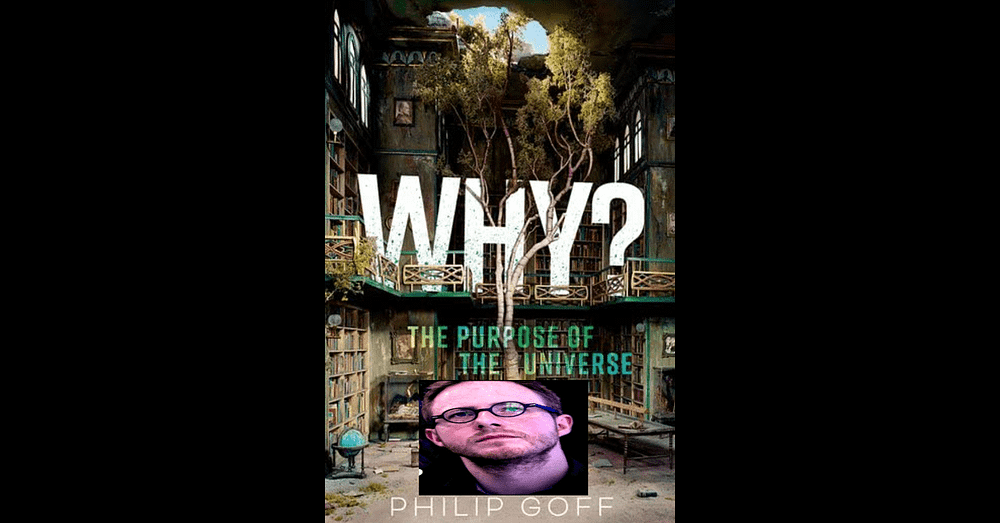
The philosopher Philip Goff has just had a book published called Why? The Purpose of the Universe. According to the writer Philip Pullman, this book is “going to explain the purpose of the universe”. More relevantly, some reviewers have made a point of telling us that Goff’s philosophical speculations have nothing to do with religion. This essay argues that they have almost everything to do with religion. What’s more, Goff’s new cosmic religion is designed to express his prior political views and values.

[This essay isn’t going to tackle the technical details of the new speculations about “cosmic purpose” and suchlike. See the linked essays at the end of this piece for more detailed discussions on these subjects.]

(i) Introduction
(ii) The Politics of Philip Goff’s Cosmic Religion
(iii) Philip Goff’s Non-Traditional Religion
(iv) Philip Goff and the Physicist Paul Davies
(v) Davies and Goff and Their Non-Traditional Religion


In a review of Why? The Purpose of the Universe, the writer Philip Pullman claims that Philip Goff believes that his book is “going to explain the purpose of the universe”. It can be presumed that Goff himself would deny that his new book is so highfalutin. Perhaps, instead, Goff would say that it simply describes and analyses the various options on offer when it comes to explaining the purpose of the universe

But who knows?

In any case, Pullman finds Goff’s “cosmic chutzpah” appealing. Indeed, it “predisposed [him] in its favour before [he] even began to read the text”!

In a similar vein, rather than the Universe itself having a purpose, the professor of philosophy Josh Rasmussen actually states that Goff’s own book

“contributes to the purpose of the universe in a profound and beautiful way”.

Let’s return to Philip Pullman.

It’s worth noting here that Pullman also buys into the political and ethical underpinnings of Goff’s new speculative philosophies. Or, at the least, Pullman tells us that Goff’s new book will help us

“regain that sense of connectedness that’s so important not just to our well-being, but to our very survival”.

To add more academic backing to Goff’s speculations. The British philosopher Michael Tye believes that Goff’s book will (or simply may?) offer an answer to those of us who’ve “ever wondered what the point is in living”.

Philip Goff

… So it is these religious, political and ethical underpinnings of Goff’s philosophies (explicitly referred to by Michael Tye, Philip Pullman and Josh Rasmussen) which will be discussed in this essay. [See note 1 on Goff’s many academic fans.]

Finally, what also needs to be noted in this introduction is that Goff extensively refers to both science and philosophy in his new book.

Yet he’s doing nothing new here.

In fact, many of the followers of traditional religions did exactly the same thing, and they did so for many centuries before Goff was even born.

This means that Goff is simply making his own contribution to this long religious tradition.

The Politics of Philip Goff’s Cosmic Religion

Philip Goff and Rudy Rucker. Rucker, just like Goff, ties panpsychism very strongly to both politics and ethics. Indeed, both Rucker and Goff tie panpsychism to roughly the same political beliefs, values and causes. However, Rucker’s philosophy lacks the philosophical sophistication found in some of Goff’s work. That said, Rucker isn’t a philosopher. He’s a novelist and self-described “cyber punk”.

At least in one introduction, Goff seems to simply assume that there is such a thing as a “cosmic purpose without God”, and only then does he “explore a variety of hypothesis” to explain it.

Which “variety of hypothesis” is that? This variety:

[A] non-standard designer (e.g., a bad designer, a limited designer, or maybe just an ordinary person in the next universe up), teleological laws (laws of nature with purposes built into them), or cosmopsychism (the view that the universe itself is conscious).”

When it comes to Goff’s belief (or his entire belief system) in a “cosmic purpose”, he believes that it must “involv[e] political engagement”.

Indeed, Goff often admits that there are political and ethical motivations and beliefs hiding (or sometimes not actually hiding) underneath the philosophical positions which he does take.

For example, Goff states that

“living in hope of cosmic purpose is a deeply meaningful way of engaging with the world”.

In other words, Goff is stating (if perhaps implicitly) that believing in a cosmic purpose helps us (both politically and ethically) engage with the world. More specifically, Goff argues that a belief in a cosmic purpose helps us (as individuals and as societies) develop a superior political and moral attitude to the world.

Interestingly, the Belgium philosopher Helen De Cruz also believes that seemingly non-ethical philosophical theories should “provide an ethical guide”. Cruz then says that Goff’s book

“outlines an attractive picture of spiritual belonging and practice in a godless world []”.

So is Goff doing what so many poststructuralists, postmodern philosophers and Marxists have done when they placed Politics in the role of First Philosophy? (Such philosophers haven’t — as far as I know — put their own position in this simple way.)

Alternatively, is Goff doing what the French philosopher Emmanuel Levinas did when he placed Ethics in the role of First Philosophy? (Levinas actually put it this way himself. See here.)

Perhaps, instead, both Politics and Ethics together take on the role of First Philosophy in Goff’s philosophy.

Now it’s worth saying here that the very idea of keeping science and philosophy free of politics has been deemed to be naïve and unsophisticated by various Marxists, postmodern philosophers and poststructuralists. (A small number of Marxists don’t take the position that “all science and philosophy is inherently political”.) Consequently, in this Hobbesian world, all scientists — just like all academics — are always involved in a political (to use Antonio Gramsci's terms) “war of position”, as well as a battle for “hegemony”. [See note 2.]

Perhaps Philip Goff believes at least some of this too.

In any case, Goff himself has a fairly long history of admitting (if sometimes in roundabout ways) that politics and ethics are in the driving seat when it comes to at least some — perhaps many — of his philosophies.

Like the scientists and activists of Science for the People who believed that science should serve “radical politics”, or the countless academics who believe that their work should serve very particular political causes and goals, Goff believes that the philosophies he advances should also serve very particular political causes and goals.

This way of looking at science and philosophy has been taken to extreme levels.

For example, the Nazis in the 1930s and the Soviets from the 1920s to the 1950s explicitly and directly tied both science and philosophy to advancing, respectively, Nazi and communist goals and ideas. (Lysenkoism and racial science are just two obvious examples of this.) [See note 3.]

In terms of actual examples of the political and ethical underpinnings of Goff’s philosophies.

We have Goff’s “spiritual” and political takes on panpsychism itself, on the nature of plants, and now we have his political, ethical and religious take on cosmic purpose.

As an example of this, take Goff’s words in his book Galileo’s Error:

“For a child raised in a panpsychist worldview, hugging a conscious tree could be a natural and normal as stroking a cat.”

In the same book, Goff also wrote:

“My hope is that panpsychism can help humans once again to feel that they have a place in the universe. At home in the cosmos, we might begin to dream about — and perhaps make real — a better world.”

And one more passage:

[I]t’s reasonable to suppose that children raised in a panpsychist culture would have a much closer relationship with nature and invest a great deal more value in its continued existence.”

As for plants, Goff wrote:

[W]e now know that plants communicate, learn and remember. I can see no reason other than anthropic prejudice not to ascribe to them a conscious life of their own.”

And now for egalitarian plants:

“The mycorrhiza structures [between tree roots and fungi] allow for a complex system of egalitarian redistribution.”

So does all this mean that Goff’s politics and ethics are wagging the philosophical dog here?

Philip Goff’s Non-Traditional Religion

It can be strongly doubted that what Philip Goff offers us is a “religion without belief”. However, it certainly is a religion.

Some reviewers of Philip Goff’s new book make a point of saying that his philosophical speculations have nothing to do with religion. Or, at the very least, they make the point that Goff’s speculations have nothing to do with traditional religion.

For example, Geraint Lewis (Professor of Astrophysics at the University of Sydney) writes:

“In this new book, Goff explores purpose in the cosmos, not a purpose rooted in religion, but in a conscious fabric of the universe itself.”

This claim (i.e., Goff’s philosophical positions are not “rooted in religion”) will be rejected in this essay. Indeed, it seems obviously false.

It can easily be argued that Goff’s new philosophy is rooted in religion. What’s more, it can be argued that it’s even rooted in (as well as being a reaction to) traditional religion. However, to some readers it may seem otherwise (or it’s made to seem otherwise) simply because Goff is attempting to create a non-traditional religion — a new religion which he also believes is backed up by both science and philosophy.

None of that means that Goff has actually broken free of religion.

Far from it.

After all, a non-traditional religion (even one that refers to science and philosophy) is still a religion.

This is also a non-traditional religion which is perfectly in tune with Goff’s prior politics and ethics. That is, Goff’s new philosophical explorations reach political and ethical conclusions which just happen to perfectly square with what Goff believed well before such explorations. (Goff has provided enough biographical information — over the years — to substantiate this claim.)

Yet the notion of a cosmic purpose may seem like a strange thing to tie directly to politics. However, that’s exactly what Goff does.

Philip Goff and the Physicist Paul Davies

When I read Philip Goff’s own account of his new book, it, at times, seemed as if he was directly quoting the physicist and popular-science writer Paul Davies.

However, it’s not clear how extensively Goff has relied on the books of Davies, or even if he has done so at all. That said, it’s still the case that, at least at times, their mutual philosophical positions are almost identical. (One difference being that Davies’s positions — at least the relevant ones — date back to the 1980s. [See Davies’s God and the New Physics, published in 1983.])

Other commentators have noted these strong similarities too.

For example, Dr. Brandon Rickabaugh wrote the following:

“Goff is not the first to entertain this view. Paul Davies, for example, entertains the hypothesis that ‘the universe has engineered its own self-awareness through quantum backward causation or some other physical mechanism yet to be discovered.’ ‘In this way,’ says Davies, ‘the universe could both create itself and steer itself toward its destiny.’ Goff is, however, the first to develop a detailed defense of such a view.”

Well, Davies is a physicist. This means that he uses a different set of technical terms and modes of expression than those which Goff uses. This may also mean that Goff’s work on these issues isn’t really more (as Rickabaugh puts it) “detailed” than Davies’s own. Indeed, there isn’t really that much — technical — detail in Goff’s books. (There is technical detail in Goff’s academic papers.)

So to get back on track.

If Philip Goff isn’t clear (or perhaps honest) about his religious (as well as political) motivations, then Paul Davies certainly is. Or, at the very least, Davies has, at times, been upfront about all this.

For example, Davies once expressed his own position by using the American theoretical physicist John Archibald Wheeler as a proxy.

Firstly, Davies claims that Wheeler was

“not conventionally religious, but inspired by a reverence for nature and a deep sense that human beings are part of a grand scheme which we glimpse only incompletely”.

So surely it’s not unfair to say that Davies is also talking about himself here.

In any case, Davies finishes off with these words:

“So maybe that is a religious conviction of sorts.”

Elsewhere, Davies also talked in terms of his own “cosmic religious feeling”.

Davies and Goff and Their Non-Traditional Religion

Many people class themselves as “spiritual but not religious”. That’s partly because, like Philip Goff, they have political and ethical problems with traditional religions. There are, of course, other reasons for embracing new (as it were) spiritual religions. Another important reason is that such religions don’t make any demands on the believer. There’s also a strong whiff of narcissism when it comes to many spiritual-but-not-religious people.

Philip Goff is at pains to say that his philosophies aren’t religious. Similarly, Paul Davies is at pains to say that his religion isn’t “conventional”.

Goff states his non-traditional views in the following:

“I don’t believe in the Omni-God (the all-knowing, all-powerful, and perfectly good, creator that Christians, Muslims and Jews believe in) because I don’t think a perfectly good being who could do anything would create a universe with so much suffering.”

Like many people since since the 1960s (and a small amount of people before that), Goff and others may believe that it’s just not acceptable anymore to believe in (as Paul Davies puts it) “conventional religion”. After all, in many people’s eyes — including in Goff’s eyes — traditional religion has a bad history. Indeed, to some people, traditional religion has an evil history.

More relevantly, Goff is completely in tune with Davies when it comes to believing in “a universe with a purpose”. Of course, that purpose isn’t (to use Goff’s words) “driven by an Omni-God”. It’s driven by… well, other things.

Paul Davies put his own teleological position in the following way:

[T]he bio-friendliness of the universe arises from an overarching law or principle that constrains the universe/multiverse to evolve towards life and mind. It has the advantage of ‘taking life seriously’, treating it neither as a completely unexplained bonus [] nor as a mere passive selector [].”

He then continued:

“In short, it builds purpose into the workings of the cosmos at a fundamental (rather than an incidental) level, without positing an unexplained pre-existing purposive agent to inject purpose miraculously.”

[The technical details of this cosmic teleology aren’t going to be discussed in this essay. See links at the end of this essay.]

Goff sees traditional religion as being politically and ethically incorrect. In parallel, Goff’s new cosmic religion is deemed (by Goff himself) to be politically and ethically correct.

Goff expresses his position in the following way:

“Ultimately, I outline a way of living in hope that cosmic purpose is unfolding, involving political engagement and a non-literalist interpretation of traditional religion.”

The upshot here is that if one interprets traditional religion literally, then that will result in politically and ethically incorrect conclusions and beliefs. However, if one interprets traditional religion non-literally, then such interpretations — and traditional religion itself — can be shaped and fashioned into something that’s both politically and ethically correct.

Another way of putting this is to say that Goff’s new cosmic religion perfectly reflects what he takes to be the progressive (see here) values, causes, and beliefs of 2023.

Thus, this is the purest form of religious presentism one can imagine (i.e., in terms of Goff’s judgments about traditional religion).

Goff then gives more details about his non-traditional religion. (Except, of course, he’d argue that it isn’t any kind of religion at all.) He writes:

“Western thought has been dominated by the dichotomy of traditional religion and secular atheism. In Why? The Purpose of the Universe (Oxford University Press), I argue that it’s time to move on from both God and atheism.”

So is it time to “move on” to a non-traditional religion?

Is it time to move on to a religion which also abides by Goff’s own politics and ethics?

It certainly seems that way.

Again elsewhere, Goff distinguishes himself from traditional “religious thinkers” and their “traditional God”. He writes:

“In contrast to religious thinkers, I argue that the traditional God is a bad explanation of cosmic purpose. Instead, I explore a range of alternative possibilities for accounting for cosmic purpose, from the speculation that we live in a computer simulation to the hypothesis that the universe is itself a conscious mind.”

Goff is actually a religious thinker.

Sure, he also sees himself as a critic of traditional religion, and also as a critic of traditional religious thinkers.

So it can be said that Goff’s cosmic religion is very up-to-date. Yes, it’s fashionable and very 2023.

However, Goff believes that his non-traditional cosmic religion still needs the back up of both science and philosophy.

Thus, in the following passage Goff sells his own scientific credentials to his readers:

“Through an exploration of contemporary cosmology and cutting-edge philosophical research on the nature of consciousness, I argue for cosmic purpose: the idea that the universe is directed towards certain goals, such as the emergence of intelligent life.”

Well, at the least, Goff is informing people that he reads scientific literature.

Yet it must immediately be said here that traditional religion also needed the backup (or help) of both science and philosophy!

Or, at the very least, many theologians, philosophers and scientists in the past — and over many centuries — also believed that their own religions needed both scientific and philosophical backup (or help).

Thus, Philip Goff is doing nothing new when he extensively refers to both science and philosophy — while also advocating his new cosmic religion.

Finally, since politics, ethics and religion are in the driving seat here, we can expect no limit to Philip Goff’s future philosophical speculations.


Notes

(1) The abundance of positive reviews of Philip Goff’s new book (as featured in this essay) is partly — or even largely — down to a system of career networking that many academics — especially Goff himself — indulge in on Twitter/X, social media generally, and within the book-selling and seminar circuits. Indeed, I’ve personally seen it occur — many times — in practice. Another way to put that is to say that Goff — just like many other academics — has gone out of his way make many academic and career-related friends on social media, etc.

(2) Antonio Gramsci’s vision is a variation on Thomas Hobbes’s “the war of all against all” (i.e., Gramsci’s “war of position”). However, instead of individuals warring against individuals, we have social groups, political groups or identities warring against other social groups, political groups or identities.

(3) There’s a vast literature on this subject. See Science and technology in Nazi Germany’, and ‘The Soviet Academy of Sciences and the Communist Party’.