Friday, 1 December 2023

My Revised Position on Daniel Dennett’s “Third-Person Absolutism”

Some readers may believe that it’s a little conceited (or at least needlessly autobiographical) to refer back to — and even quote from — my ‘Chalmers’ Naturalistic Dualism vs Dennett’s Third-Person Absolutism’. However, my previous stance on Daniel Dennett’s “third-person absolutism”, alongside my revised stance on the same subject, may be informative. After all, reading both a critical and a positive stance on the same position is always helpful in philosophy. Thus, reading both critical and positive stance on the same position from the very same person — if at different times — may be helpful too.
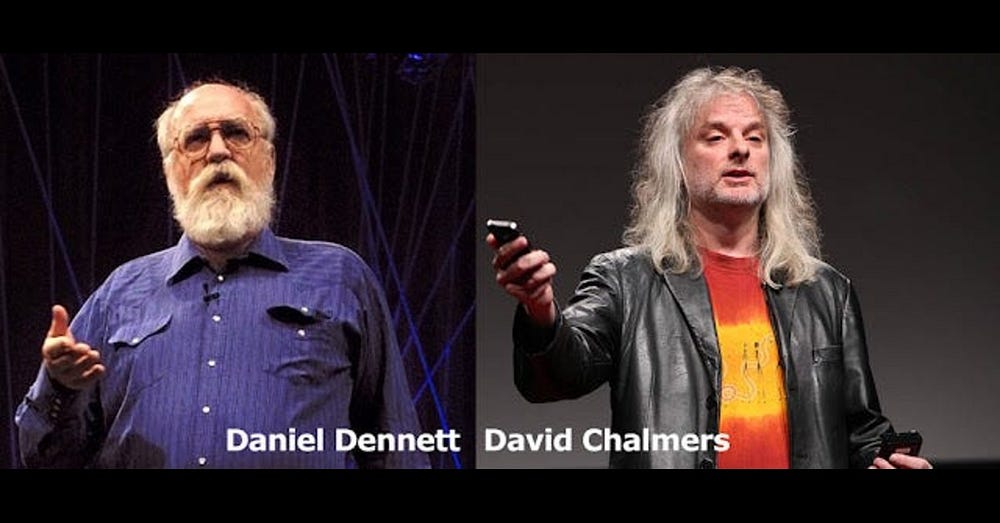
It doesn’t help (or perhaps it does) that the American philosopher Daniel Dennett once referred to his own position as “third-person absolutism”. [Did Dennett actually use these words? See note 1.] That said, wouldn’t a genuine absolutist stay well clear away from advertising the fact that he is one? In other words, perhaps Dennett was simply being ironic and rhetorical when he used that self-description… Sure, perhaps he was being serious too.

Consciousness Explained Away?
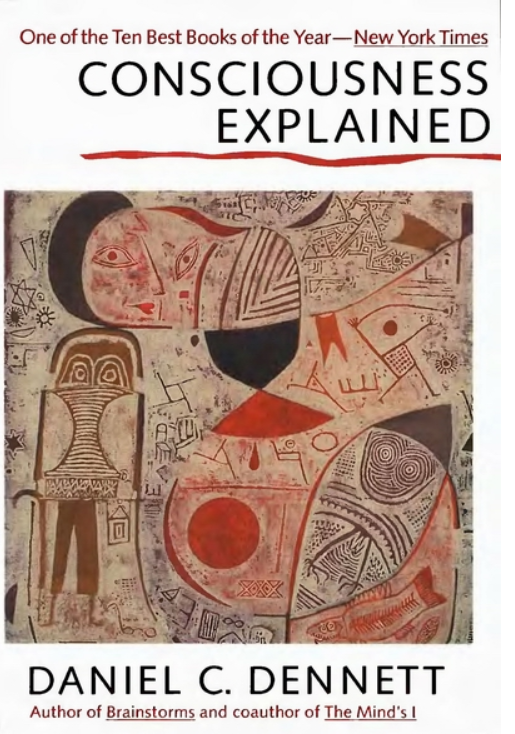
Many philosophers and commentators have been very keen to tell us — and they’ve done so many times — that Dennett’s book Consciousness Explained should really have been called ‘Consciousness Explained Away’ or ‘Consciousness Ignored’.

The Australian philosopher David Chalmers didn’t go that far. However, he did say that what he calls “type-A materialists” (see here) believe that

“there is not even a distinct question of consciousness: once we know about the functions that a system performs, we thereby know everything interesting there is to know”.

According to Chalmers, then, Dennett fits the description above.

Yet when you read Dennett (at least in different passages and at different times), he doesn’t deny consciousness at all. Instead, he simply has his own particular take on it.

Of course, to some (even many) people, Dennett’s particular take does still explain consciousness away.

The American philosopher John Searle, for example, had the following to say on this matter:

“To put it as clearly as I can: in his book, Consciousness Explained, Dennett denies the existence of consciousness. He continues to use the word, but he means something different by it. For him, it refers only to third-person phenomena, not to the first-person conscious feelings and experiences we all have.”

As stated, Chalmers (perhaps unlike Searle) doesn’t state that Dennett denies consciousness outright. Instead, he tells us that Dennett believes that the sum of mind-brain functions, behaviour, “verbal reports” (see here), etc. are what constitute consciousness.

In Chalmers’s own words, when it comes to Dennett’s position,

“there is no interesting fact about the mind, conceptually distinct from the functional facts, that needs to be accommodated in our theories”.

In a previous essay, I too had an absolutist take on the correct definition of the word “consciousness”. Alternatively, I had an absolutist take on what consciousness is. For example, I wrote:

[I]sn’t [Dennett’s position] like someone saying that ‘God exists’, and then it turns out that what he means by the word ‘God’ is ‘The ghost who lives at the bottom of my garden’?”

So, according to some definitions of consciousness, it can be argued that Dennett would say that conscious does not exist. However, according to his own definition (as mentioned by Chalmers above), consciousness does exist.

Thus, perhaps we’re left with a situation in which consciousness exists according to some definitions of the word ‘consciousness’, but not others.

So now take those philosophers and laypeople who stress how things feel (or how things seem) and/or “fundamental and rudimentary” qualia. Most of these people would deem it ridiculous to say that definitions have anything to do with these matters…

But definitions — and the (technical) terms we use — do have a lot to do with the matter of consciousness.

After all, it’s not those (to use Philip Goff’s words) “private seemings” which are the problem, but what we say about them. More relevantly, it’s how we philosophise and theorise about them. Indeed, it’s also about how reading books about consciousness (or seeing the word “qualia” all the time) may influence what we say about consciousness. (Patricia Churchland once said that the word “‘qualia’ is a term of art, which was introduced by philosophers”.)

The English philosopher Philip Goff has also used the following statement a fair amount of times: “Consciousness is a datum in its own right.”

Now how does that “datum” stand within the context of all the books and papers Goff and others have read on the subject of consciousness? What’s more, can any distinction at all be made between such a (supposed?) datum and all the books (or theories) each philosopher and layperson has read about it?

So if (some) readers have read loads of books on consciousness (or read the word ‘qualia’ many times), then surely that will impact on how they describe and/or theorise about any ostensibly private seemings they may have. [See Paul Churchland’s position on a related theme in note 2.]

Chalmers on Dennett’s Third-Person Absolutism
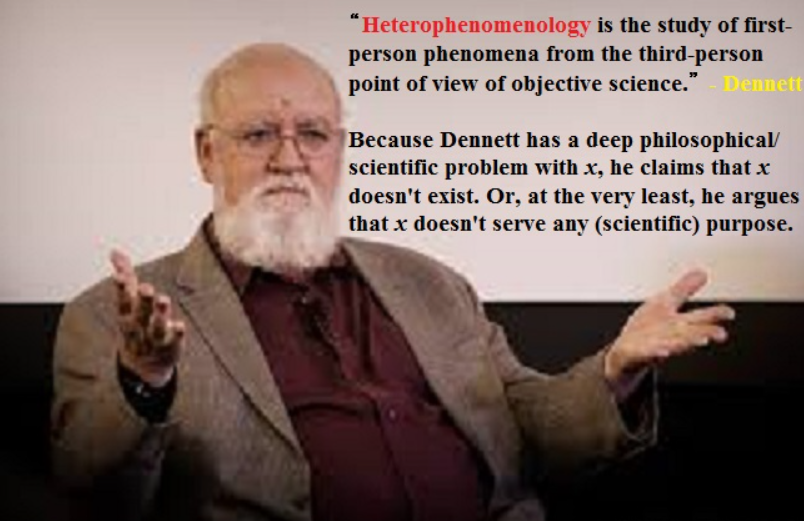
My previous criticisms of Daniel Dennett’s third-person absolutism were perhaps a little too dependent on David Chalmers’ own. That said, I did have problems with Dennett’s positions before looking into what Chalmers — particularly — had to say on the matter.

Chalmers expressed Dennett’s functionalist absolutism by citing the following examples:

[I]t is far from obvious that even all the items on Dennett’s list — ‘feelings of foreboding’, ‘fantasies’, ‘delight and dismay’ — are purely functional matters. [] One’s ‘ability to be moved to tears’ and ‘blithe disregard of perceptual details’ are striking phenomena, but they are far from the most obvious phenomena that I (at least) find when I introspect.”

One of my own responses to this passage from Chalmers was this:

“Prima facie, it does seem amazing that Dennett sees such things as solely functional matters.”

I then added the following words:

[I]t’s hard to understand what it could mean to say that the ‘ability to be moved to tears’ is a purely functional matter. (What’s with the word ‘ability’?)”

Yet it now seems that it’s not that there aren’t any private seemings, but that we can’t do anything with them. That, in itself, isn’t to deny the seemings or the privacy. After all, if the reader thinks to himself a certain thought (say, that elephants are pink and eat marbles), then there’s no way that Dennett — or every scientist on the planet in a group effort— could guess what he or she is thinking. Thus, isn’t that particular thought private?

Chalmers also defined Dennett’s position as the view that “what is not externally verifiable cannot be real”.

It can be presumed that Chalmers was arguing that Dennett’s position is that there must be a fundamental (as well as theoretical) connection between any x being real (or existing), and whether or not we can externally verify it. On this reading of Dennett, then, if we can’t externally verify x, then it doesn’t exist. It’s not real.

Thus, perhaps the aforementioned thought about pink elephants isn’t real.

Yet one wonders if Dennett actually used the word “real” in this context.

Sure, he would have certainly emphasised external verifiability. However, the word “real” seems like Chalmers’ own personal addition.

As for Dennett’s own responses to Chalmers’ criticisms.

It’s not surprising that Dennett asked Chalmers (at least according to Chalmers himself)

“to provide ‘independent’ evidence (presumably behavioral or functional evidence) for the ‘postulation’ of experience”.

That passage neatly expresses Dennett’s (supposed?) third-person absolutism.

Such a position, according to Chalmers, allows and encourages “a third-person perspective on one’s first-person perspective”. (This is an articulation of Dennett’s heterophenomenology.)

Yet Dennett simply seems to be advancing a scientific position on the subject of consciousness…

So where is the absolutism in that?

After all, because Dennett is attempting to make the study of consciousness scientific, then, sure, we can go with Chalmers when he said that (in Dennett’s Consciousness Explained) “heterophenomenology” (like Quine’s position on “overt behaviour” when it came to meaning) is deemed to be “the central source of data”.

In a sense, it can’t be anything else but the main — or even only — source of data. Surely the alternative is taking the words about consciousness, qualia, etc. of all subjects to be gospel. Yet what if such subjects contradict each other on these matters?

Chalmers also tells us that

“the only ‘seemings’ that need explaining are dispositions to react and report”.

Again, this is Dennett’s attempt to make the subject of consciousness scientific.

That’s primarily because even though there are very many philosophical, (purely) phenomenological, and religious (or “spiritual”) accounts of consciousness, these accounts are still endlessly disputed, and of no help to scientists…

Still, Chalmers isn’t happy with Dennett’s position.

He tells us that it’s an “unargued assumption that such reports are all that need explaining”. In other words, Chalmers believes that some things over and above the “reports” also “need explaining”. These things include how things feel (or seem) to the subject, qualia (or phenomenal states), etc… whichever terms or phrases one uses.

All that said, eight years ago I wrote the following:

[] if we follow the logic of Dennett’s behaviourism to its end, can we accept a first-person perspective at all? (That is, even if that perspective is accounted for in third-person terms.) In other words, is there a first-person perspective on anything in Dennett’s scientific book?”

I even became a bit personal with these words:

“Dennett’s language here is ringing with scientific clichés. He talks of ‘independent evidence’ and the ‘postulation of experience’.”

I also stated that “the idea that consciousness is ‘postulated’ is very strange”.

Conclusion: Chalmers’ Stance on Dennett’s Materialism
Chalmers argued (if sometimes implicitly) that Dennett stresses “verbal reports”, etc. because he wants to defend — or even save — what Chalmers calls “materialism”. Thus, Chalmers quoted Dennett saying that

“‘if something more than functions needs explaining, then materialism cannot explain it’”.

Chalmers also said that “the idea that function is all we have access to at the personal level [is] false”. In my other essay, I too wrote: “I would say: obviously false.”

In terms of materialism itself, Chalmers’ said the following:

“What’s controversial about my own view is not so much that I defend the existence of qualia, but that I argue that they are nonphysical.”

If consciousness is “nonphysical”, as Chalmers believes, then of course “materialism cannot explain it”. That’s true by definition.


Notes:

(1) In his paper ‘Moving Forward on the Problem of Consciousness’), David Chalmers claimed that Daniel Dennett used the words “third-person absolutism” about his own position. As it is, I couldn’t find Dennett himself stating these words. The only work by Dennett which Chalmers references (in the paper just mentioned) is ‘Facing Backwards on the Problem of Consciousness’ — and I couldn’t find it there either.

However, for the purpose of this essay, I still happily used the words “third-person absolutism” because they’re so convenient.

(2) The Canadian philosopher Paul Churchland once wrote the following:

“Given a deep and practiced familiarity with the developing idioms of cognitive neurobiology, we might learn to discriminate by introspection the coding vectors in our internal axonal pathways, the activation patterns across salient neural populations, and myriad other things besides.”

Of course, at present it would be (virtually?) impossible (even for a neuroscientist) to describe our (to use Churchland’s own words) “first-person” thoughts, feelings and beliefs in terms of “coding vectors in our internal axonal pathways”, “activation patters across salient neural populations”, etc. It may even be hard to imagine such a state of affairs at present.

Yet Churchland wasn’t talking about the case as it is today. That said, he did explicitly state that

“it is entirely possible for a person or culture to learn and use some other framework in that role”.


Friday, 24 November 2023

Quantum Particles Don’t Spin, Tunnel Through Walls, Or…

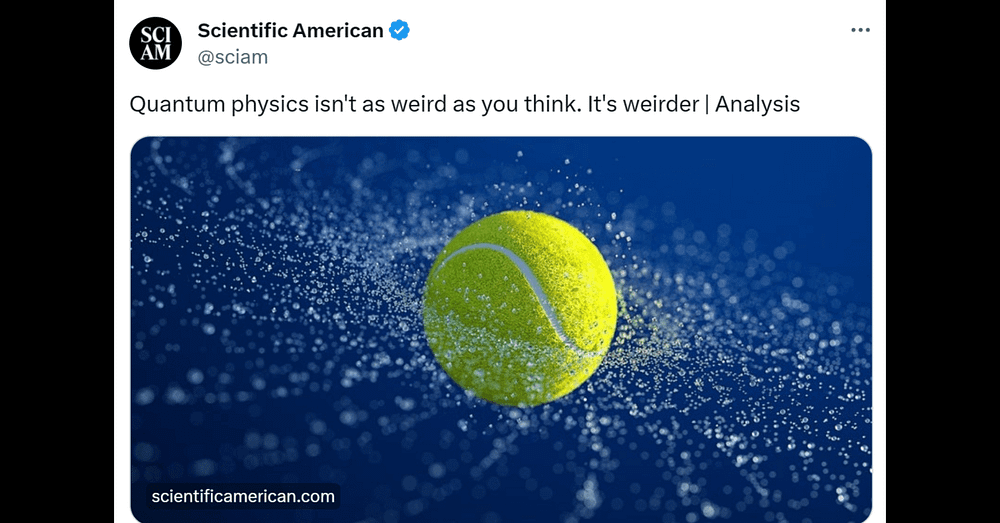
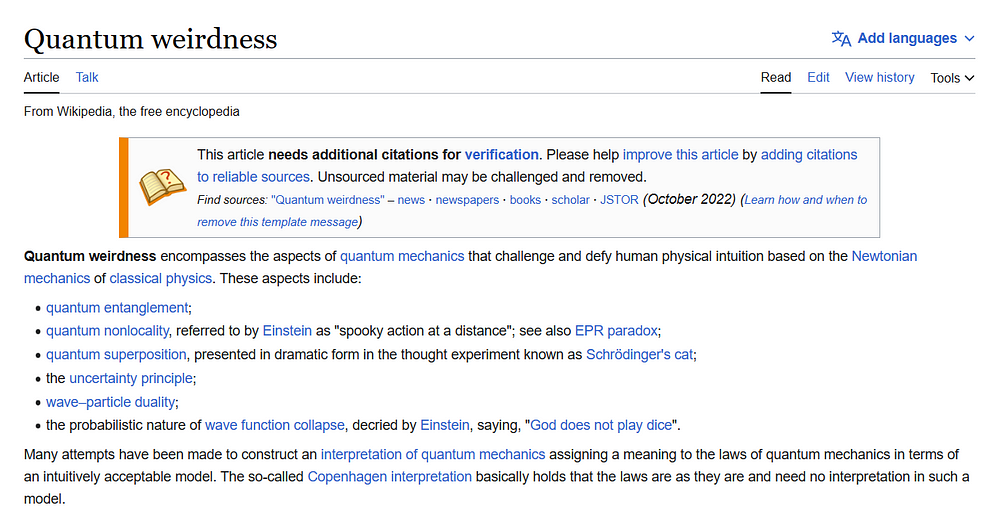
This essay is about how some of some of the analogies used in “popular science” to describe/explain quantum behaviour, events and objects may not actually be taken to be analogies by many — or even most — laypeople. It also argues that even when the analogies are taken to be analogies, then they still may not always be helpful. What’s more, it’s this conflation of analogies with (as it were) realities that’s partly —or even largely — responsible for making quantum events, behaviour and objects “weirder than you think”.

This Scientific American article is behind a paywall. So I haven’t actually read it. I’ve simply used the title and image from it — for reasons which will become obvious. [Also, see note 1.]
Not
‘here is a particle, there is a wave’
but
‘if we measure things like this, the quantum object behaves in a manner we associate with particles; but if we measure it like that, it behaves as if it’s a wave’
Not
‘the particle is in two states at once’
but
‘if we measure it, we will detect this state with probability X, and that state with probability Y’.”

— Philip Ball. [This passage can be found here.]


(i) Introduction
(ii) The Film Tenet Takes Scientific Liberties
(iii) Jim Al-Khalili on Why Electrons Aren’t Weird
(iv) Jim Al-Khalili on Quantum Tunnelling
(v) Conclusion: Quantum Weirdness Still Remains

Theoretical physicist and broadcaster Jim Al-Khalili spends some time telling his readers (in his book Life on the Edge: The Coming of Age of Quantum Biology) that particles aren’t like “billiard balls”, or that particle “spin” isn’t like, say, a spinning top. Yet he then uses words like “weird” and “counterintuitive” when describing the very same quantum events (or “behaviour”) and objects.

The argument in this essay is that the weirdness and counter-intuitiveness are at least partly a result of seeing quantum phenomena in these (analogical) ways.

As another example of this, it’s odd that immediately after Al-Khalili questions — and even rejects — the belief that electrons are “tiny classical particles”, he then states that

“if you behave like an atomic nucleus, then you would sometimes be able to pass, ghostlike, straight through a solid wall”.

Of course, there are no solid walls at the subatomic scale, and “you” could never “behave like an atomic nucleus”. Indeed, even when the words “solid wall”, “you”, and “ghostlike” are used in a purely analogical way, that usage may still be unhelpful. Or, at the very least, the analogies need to be taken for what they truly are — i.e., simply analogies.

All that said, perhaps I’m being too precious here.

Perhaps laypeople (at least the ones who that think about these things) don’t take these analogies to be anything other than… analogies.

So it can be admitted that there’s a danger of going farther and farther down a linguistic rabbit hole when discussing even the more careful descriptions of quantum phenomena (i.e., all those descriptions which exclude the mathematics). Indeed, all descriptions may — or even must — still include classical terms, analogies, metaphors, etc.

The Film Tenet Takes Scientific Liberties

Despite that qualification, after watching the film Tenet, I realised that even a director and writer who knows some science can still take liberties.

To offer one example.

Christopher Nolan conflates the abstract mathematics of “backwards causation” (as used in quantum mechanics) with human beings, etc. moving backward — and forward — in time.

In other words, Nolan applies what is true at the quantum scale to the classical scale. More correctly, the mathematics used at the quantum scale is then (as it were) made real at the classical scale. However, Jim Al-Khalili himself makes it clear (in various places) that he’s using analogies in his book. In the Nolan film, on the other hand, that isn’t the case. [See note 2.]

Yet it must be noted here that Christopher Nolan did admit to taking scientific liberties, despite having worked with the theoretical physicist Kip Thorne. (Thorne had previously offered advice on Nolan’s film Interstellar.) More relevantly, Nolan himself has said that

“Kip Thorne read the script and he helped me out with some of the concepts, though we’re not going to make any case for this being scientifically accurate”.

Of course, there’s been a long-running debate about whether or not there’s a firm (as the physicist Brian Greene put it) “line in the sand” which can be drawn between the quantum world and the classical world. Indeed, Jim Al-Khalil’s book, Life on the Edge: The Coming of Age of Quantum Biology (which is quoted later in this essay), is largely devoted to questioning this line in the sand as it has been set up between the wet science of biology and the hard science of quantum mechanics.

However, that isn’t really the issue here.

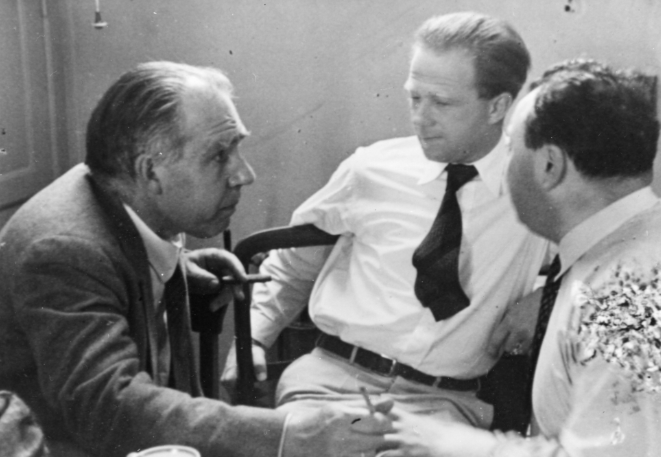
So are we back to Niels Bohr’s position?

Niels Bohr, Werner Heisenberg and Wolfgang Pauli.

The Danish physicist once wrote:

“It is decisive to recognize that, however far the phenomena transcend the scope of classical physical explanation, the account of all evidence must be expressed in classical terms. The argument is simply that by the word ‘experiment’ we refer to a situation where we can tell to others what we have done and what we have learned and that, therefore, the account of the experimental arrangement and of the results of the observations must be expressed in unambiguous language with suitable application of the terminology of classical physics.”

Bohr appears to have been arguing that we have no choice but to use classical terms in our descriptions and explanations of quantum phenomena.

Thus, Bohr’s words above seems to be a simple account of his more technical correspondence principle. This principle states (broadly speaking) that the behavior of systems described by quantum mechanics reproduce classical physics when it comes to large (what’s called) quantum numbers.

However, there’s a distinction to be made here between Bohr’s idea that (as it were) everything becomes classical when enough quantum numbers are involved, and using classical terms to refer to purely quantum phenomena. In Bohr’s case, then, things become classical when enough quantum numbers are involved. In the case of this essay, however, the central theme has nothing to do with quantum numbers or quantum phenomena becoming classical phenomena. It’s mainly about classical terms and analogies being used to refer to purely (purely?) quantum phenomena (i.e., phenomena with “small quantum numbers”).

Having said all that, the quote from Bohr above doesn’t itself seem to be a very particular (or technical) expression of the correspondence principle. Or at least Bohr didn’t explicitly — or even implicitly — refer to the importance and relevance of “large quantum numbers”. Instead, he appears to stick to more general announcements about the need for a “classical physical explanation”. Indeed, Bohr also stated that observations “must be expressed in unambiguous language with suitable application of the terminology of classical physics”.

So perhaps Bohr’s overall message was that even trained physicists (i.e., those who’re adept at the mathematics) still need “classical pictures” in order to understand what’s going on. And that may be because in physics it’s almost (or even literally) impossible to rely entirely on the mathematics.

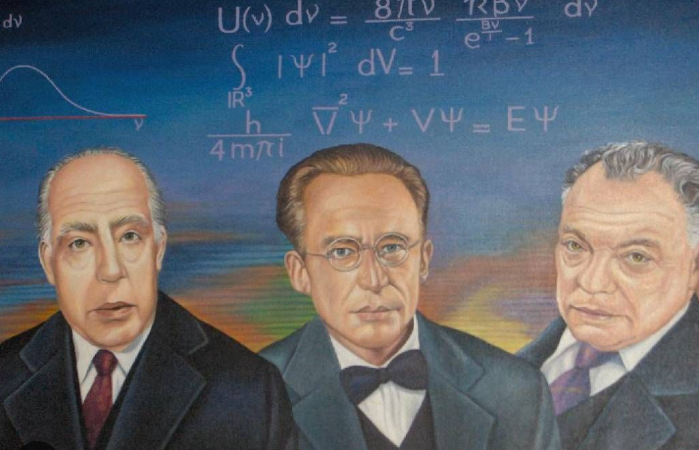
In any case, since Bohr has just been mentioned, let’s now cite a counterblast… if not against Bohr’s own (as it were) classicism, then against Schrödinger’s.

Niels Bohr, Erwin Schrödinger and Wolfgang Pauli.

Werner Heisenberg once appeared to argue (some nine decades ago) that no classical words, descriptions or visualisations will ever accurately (or even at all) capture quantum phenomena.

In even stronger terms, this is what Heisenberg once wrote in a 1926 letter:

“The more I think of the physical part of the Schrödinger theory, the more detestable I find it. What Schrödinger writes about visualization makes scarcely any sense, in other words, I think it is shit.”

That passage is from a letter to Wolfgang Pauli. Pauli is also relevant here when it comes to his take (at least at one point in his career) on “spin” .

According to the philosopher Michela Massimi:

“People who came after [Wolfgang Pauli] introduced the term electro-spin. A young PhD student from Columbia called Ralph Kronig said that maybe we can interpret the two-valuedness by thinking of the electron as a spinning top that can be spun clockwise or anti-clockwise, and that gives the two values, plus one half and minus one half. Pauli, we heard, dismissed that idea as witty nonsense but, soon afterwards, two Dutch-American physicists, George Uhlenbeck and Samuel Goudsmit, published a paper introducing the idea of the electro-spin.”

The important words in the passage above are the following: “Ralph Kronig said that maybe we can interpret the two-valuedness by thinking of the electron as a spinning top [].” More precisely, the important word is “interpret”. Thus, even though Wolfgang Pauli said that such an “idea” is “witty nonsense”, that didn’t mean — even at this point in his career — that he also believed the term “spin” didn’t have a use in physics.

Jim Al-Khalili on Why Electrons Aren’t Weird

Jim Al-Khalili, in the following passage, tells us why the behaviour of electrons is not weird:

[Electrons] should not therefore be regarded as moving and bouncing about like tiny classical particles, despite the fact that they are still treated this way in many standard biochemistry texts that continue to use the ‘solar system’ model of the atom.”

Al-Khalili then cites his own (or simply one) alternative “representation of electrons in an atom”. That is one of a

“spread-out, wavy cloud of ‘electronness’ surround[ing] the tiny nucleus, the ‘cloud of probability’ []”.

What Al-Khalili then concludes seems almost obvious.

He tells us that

[i]t is perhaps not surprising [] electron waves [i.e., not particle-like electrons] should be passing through walls”.

It may seem odd that “standard biochemistry texts continue to use the the ‘solar system’ model of the atom”. However, that oddness may depend on various things.

Since the late 1920s, that solar (or Bohr) model has been largely rejected — at least by physicists. (Even school kids are warned about the model here.) Yet many of the very same scientists who reject its (as it were) literal truth may still be happy to use it in order to help visualisation and/or understanding.

In terms of “a spread-out, wavy cloud of ‘electronness’”, and also the “‘cloud of probability’”.

It may be hard for many laypersons to make sense of these statements. What’s more, how is moving from classical terms such as “particle” and “solar system” to the classical term “cloud” any better?

It’s also odd that immediately after Al-Khalili questions — and even rejects — the idea that electrons are “tiny classical particles”, he then uses the problematic word “barrier” in the context of quantum tunneling. (It is here that the linguistic rabbit hole arises again.)

More particularly, what is the physical reality of this cloud of probability and electronness? Indeed, is there any physical reality here at all? Alternatively, are we talking purely about (abstract) mathematics?

Surely that latter option can’t be the case.

It would mean that the maths is all about the maths .

Alternatively put, it would mean that the maths isn’t about — or a description of — anything that isn’t itself maths.

Jim Al-Khalili on Quantum Tunnelling

Jim Al-Khalili also offers his readers a similar warning about quantum tunnelling. He writes:

“Although it would be wrong to think that quantum tunnelling entails the leaking through barriers of physical waves; rather, it is due to abstract mathematical waves that provide us with the probability of instantaneously finding the quantum particle on the other side of the barrier.”

Yes, Al-Khalili explicitly states that “it would be wrong to think that quantum tunnelling entails the leaking through barriers of physical waves”.

So does that mean that there’s no literal tunnelling at all?

Alternatively and at the very least, is Al-Khalili basically stating that there’s nothing equivalent to tunnelling (as it would occur at the “classical” scale) that’s going on at the quantum scale? In other words, is there no equivalent of, say, tunnelling through a six-foot-thick gold wall with a wooden spoon — despite the hype? Less dramatically, is there even an equivalent of simply tunnelling through the ground with a wooden spoon into your next-door-neighbour’s living room?

In technical terms.

It’s certainly the case that when tackling quantum tunnelling, what we’re partially (or even mainly) dealing with is probability — or what’s called a probability wave. Thus, on this reading at least, the wave is literally abstract — i.e., not a wave at all! Thus, the word “wave” is a colourful way of describing an abstract mathematical function.

Basically, these particles (or waves) — unlike snooker balls, etc. — can, with a small probability, tunnel to the other side of a “barrier”.

The important point here is that we’re dealing with quantum waves or particles. Or, at the very least, waves or particles as they’re seen in quantum mechanics. Thus, because we’re dealing with waves or particles (though perhaps not only because), then no probability of a particle or wave tunnelling across a barrier can ever be zero.

So, in the concrete terms of quantum tunnelling, the probability of a given particle (or wave) being “found” on the opposite side of a given barrier is not zero.

It could happen.

Indeed, it often does.

(Actually, isn’t it possible that a snooker ball could do so too?)

Conclusion: Quantum Weirdness Still Remains

It can be freely admitted that quantum (to use classical words) objects and events are “weird” in their own unique ways. However, they aren’t weird simply because they do things that classical objects don’t do.

Readers shouldn’t expect quantum events and objects to behave like classical objects and events. However, when people do attempt to squeeze quantum square shapes into classical round holes (or vice versa), then, sure, things do indeed get weird!

To put that another way.

When we use the same words we use to describe, say, playing snooker to describe what happens at the quantum scale, then no wonder things become weird. Indeed, this is almost like expecting a lice or virus to behave (entirely) like a dog — or even like a human being.

In addition. Although this issue isn’t all about size, it must be stated that particles at the quantum scale are at a level that is fantastically smaller than our snooker ball. In terms of detail, a sheet of paper is about six orders of magnitude thicker than an atom. Now think about how much “thicker” a snooker ball is to a sheet of paper. (100,000,000 atoms would stretch along the width of your fingernail.)

As for Al-Khalili’s barrier through which the particle/wave tunnels.

Usually, this tunneling only happens when it comes to barriers of thickness around nth nanometres or smaller. (A nanometre is equal to one billionth of a metre.)

To sum up.

Let’s happily accept weirdness in the sense that weird things really do happen in the quantum “world”. However, let’s not make things even weirder (or weird in the wrong ways) by expecting apples to be oranges.


Notes:

(1) Regarding the main image which opens this essay. Many physicists and other scientists emphasise the “weirdness” of quantum mechanics in order to sell their subject to the general public. They believe that most people won’t be interested in physics if they don’t “sex it up”. They may be right. They may also sex up their own work in order to sell more copies of their articles and books.

(2) The processes or events involving subatomic particles, their interactions, etc. within a specific experiment (or within a given sample space) can be reversed. However, if a football match were to be reversed, then things would be very different. Yet even though viewers would quickly note the time reversal of a football match (i.e., if that reversed match were ever made real), then it still wouldn’t go against any of the laws of physics.

In the film Tenet, “time travel” is tied to entropy.

The problem (or simple fact) is that although a fridge does “reverse entropy” (or ‘Negentropy’), it only does so in a “local” or insulted environment (i.e., within an enclosed system). In other words, a refrigerator alone — and even every fridge on the planet — can’t reverse the entropy of the Universe or even a space larger than the refrigerator itself. And neither does a single fridge — even in its own local space — make time run backwards.

That said, this entirely depends on what we take time to be in the first place.

Saturday, 18 November 2023

Physicist Paul Davies States: “This universe is either a mystery, or it’s absurd.”

In his popular books, the physicist Paul Davies uses various rhetorical and/or vague words and phrases in philosophically-important contexts. This essay argues that such words and phrases actually help generate and publicise his own theory of cosmic “purpose”. They also help generate the scientific and philosophical problems Davies believes both he and his opponents must tackle.

(i) Introduction
(ii) Pedantry?
(iii) Examples of Paul Davies’s Rhetoric, Etc.
(iv) Our Universe Must Produce Life and Mind?

In basic terms, the main problem with Paul Davies’s claims and positions (or, more particularly, his belief in a cosmic “purpose”) is that he uses various words and phrases loosely, vaguely and/or rhetorically in philosophically-important contexts. These are words and phrases he’d never use in his technical physics papers.

Perhaps Davies would freely admit this. After all, he knows that he’s writing what’s called “popular science”.

In any case, in the books in which Davies discusses (cosmic) “purpose”, it can be assumed that he’d never claim to be doing actual physics. Instead, he may claim to be doing two things:

(1) Writing about physics and cosmology. 
(2) Philosophising
about physics and cosmology.

To spell things out.

Writing about physics isn’t physics. And philosophising about physics isn’t physics either. (Again, there’s a good chance that Davies would accept these statements — at least to some degree.)

So there’s no problem at all with Davies philosophising about physics and cosmology. That’s what (obviously) philosophers also do. Indeed, there’s no problem with scientists themselves doing philosophy either. (The problem often works in the opposite direction when scientists claim — if sometimes implicitly — that there aren’t any philosophical components to their scientific theories and statements at all.)

One other problem is that because Davies is a physicist, then that may mean that many of his readers (especially those who’re sympathetic to his views) will take all the words in his popular books to be actual physics. Yet, again, his books are mainly about physics and physical cosmology. And they also include a certain amount of philosophising about physics and physical cosmology.

So it must be said here that this essay isn’t an attempt to go through Davies’s books looking for rhetoric, vagueness, etc. (I use rhetoric myself.) Instead, the argument here is that such rhetorical, vague and loose words and phrases are vital to Davies’s overall philosophical position.

Pedantry?

It can be freely admitted that there is a problem with focussing too much on the actual (or precise) words Paul Davies uses. Specifically, there’s a danger of being “pedantic”. Worse, there’s a danger of being like those “boring” Oxbridge linguistic philosophers of the 1950s. [See here.]

It also needs to be said that many of those scientists who take diametrically opposed views to Davies’s own also use rhetorical and vague terms and phrases in their popular books. (Again, terms they’d never use in their physics papers.)

Take, for example, the following passage from the American theoretical physicist and Nobel laureate Steven Weinberg (1933–2021):

“It is almost irresistible for humans to believe that we have some special relation to the universe, that human life is not just a more-or-less farcical outcome of a chain of accidents reaching back to the first three minutes, but that we were somehow built in from the beginning [].”

[These words can be found in Weinberg’s book The First Three Minutes. See also my Life and the Universe are Neither Meaningless nor Meaningful’.]

Without spoon-feeding the reader, the relevant words above are “farcical outcome”. Indeed, Weinberg then goes on to state that the universe is “hostile”.

Interestingly enough, the passage above comes immediately before Weinberg expressed his very-often-quoted view that

[t]he more the universe seems comprehensible, the more it also seems pointless”.

Here the relevant word is “pointless”.

So isn’t Weinberg himself falling into the same trap as those religious people he’s arguing against? That is, why accept the binary opposition set up between the universe being “comprehensible” and the universe being “pointless” at all?

Actually, Weinberg inverts the religious argument here.

In other words, the religious argument has it that because the Universe is comprehensible, then surely that must be because God has made it so. More correctly, God is responsible for the (human) minds that do the comprehending.

Alternatively, Paul Davies himself believes that the Universe is comprehensible primarily because it has a “purpose”.

Weinberg, on the other hand, believes that the Universe's comprehensibility makes it (only seem?) pointless

It’s worth saying here that Weinberg explained (in the book Dreams of a Final Theory) his earlier controversial statement in the following way:

“As we have discovered more and more fundamental physical principles, they seem to have less and less to do with us.”

Yet Davies (despite him playing down his own anthropocentrism) wants cosmology to have more and more “to do with us”.

Weinberg, on the other hand, seems to be arguing that physics — even theoretical physics — should do the job of making things less profound and mysterious, not more so.

Weinberg also wrote the following:

“As long as we don’t know the fundamental rules, we can hope that we’ll find something like a concern for human beings, say, or some guiding divine plan built into the fundamental rules.”

However:

[W]hen we find out that the fundamental rules of quantum mechanics and some symmetry principles are very impersonal and cold, then it’ll have a very demystifying effect.”

Ironically, Weinberg referred to the time when Davies received a million-dollar prize for “advancing the public understanding of God and spirituality” from the John Templeton Foundation. [See my ‘Physicist Paul Davies’s Contributions to the Advancement of Religion, As Seen By Father Mariano Artigas Weinberg’.] Weinberg said:

“I was thinking of cabling [Paul] Davies and saying, ‘Do you know of any organization that is willing to offer a million-dollar prize for work showing that there is no divine plan?’”

Anyway, to get back on the track of those loose, vague and/or rhetorical words and phrases.

Examples of Paul Davies’s Rhetoric, Etc.

Surely Paul Davies stating that “the existence of this particular universe is either a mystery, or it is absurd” is a silly binary opposition. That said, if readers do accept this opposition in the first place, then much else of what Davies states may well follow.

(The binary opposition is elsewhere spelled out as the claim that the universe is either “absurd” or it has a “purpose”.)

When talking about the Universe, Davies also says that it is (or it at least it may be) “self-explaining” and a “self-creating system”. Clearly (at least to me), these words don’t belong to physics or to physical cosmology. Indeed, even if one accepts the arguments that Davies has offered his readers, then many of his statements and words still wouldn’t belong to physics and physical cosmology.

Another example from Davies is the statement that “perhaps existence doesn’t get bestowed from the outside”.

This is a very odd reference to existence.

Existence and the nature of existence are usually deemed to be ontological issues. More particularly, you certainly won’t find the word “existence” used in physics papers — at least not in Davies’s philosophically heavy sense.

Here’s another rhetorical statement.

Davies tells us that “some minds are capable of understanding the universe”. He then adds that other people (i.e., his “atheists”) take this understanding to be “yet another fluke”…

Well, that depends.

If the word “fluke” means not by God’s arrangement, then “some minds” understanding the universe surely must be a “fluke”. (That’s the outright monotheistic position.)

However, Davies’s doesn’t believe in what he calls the “Abrahamic God”. So, on his own terms, if such an understanding isn’t the result of some (non-monotheistic) cosmic purpose, then, again, it must be a fluke.

Yet the word “fluke” is very much like Davies’ other rhetorical word (which he uses a lot) “absurd”. (This word has already been mentioned.)

So do the words “fluke” and “absurd” mean “not necessary” in Davies’s eyes?

If that’s the case, then what would it be for “life and mind” to be necessary?

Is it that we have flukes and absurdities by virtue of the fact that there is no God? Alternatively, do we have flukes and absurdities if we don’t accept Davies’s cosmic purpose?

Of course, some physicists have noted the possibility (or reality) that the laws, constants, etc. we have are the only ones that could bring bring about our Universe. [See here.] Indeed, Davies himself speaks about the Universe’s “self-explanation” and “self-creation”. So perhaps it is in these places where we can find the necessity that Davies is looking (or yearning) for.

Let’s go into a little detail here.

Our Universe Must Produce Life and Mind?

Paul Davies states the following words:

“In this theory [actually, Davies accepts this theory], the bio-friendliness of the universe arises from an overarching law or principle that constrains the universe/multiverse to evolve towards life and mind. It has the advantage of ‘taking life seriously’ [].”

There’s a problem with knowing what the words “an overarching law or principle that constrains the universe/multiverse to evolve towards life and mind” mean. Some readers may believe that Davies has gone into detail elsewhere. However, that’s not really the case. (Not that I’ve read everything Davies has written.)

Grammatically, the words “constrains the universe to evolve towards” are problematic or at least vague.

Does they mean that the universe must evolve toward “life and mind”?

Alternatively, could these words mean that the universe is (as it were) free not to evolve toward life and mind? That is, even though the Universe has all the ingredients required to evolve toward life and mind, then it still might not have done so.

Anthropically, the Universe obviously must have all the ingredients required to evolve toward life and mind!

More particularly, even if the Universe does have all these necessary(?) ingredients, then it still needn’t have led to the minds of, specifically(!), Homo sapiens — or even to the minds of any species (or beings) around today.

Similarly with life.

Even if the Universe has always had all the ingredients required to bring about life (which, by definition or anthropically, it must have!), then the life it could have evolved to might have been very different to life as it is.

To repeat. Wasn’t it possible that even if the Universe has always had all the ingredients needed to move toward life and mind, then it still might not have done so?

After all, for over 3 billion years, the Universe hadn’t evolved toward life. As for mind, it took billions of years longer (i.e., at least if life and mind on earth are taken to be unique).

Consequently, doesn’t this (seemingly?) extreme contingency work against any religious interpretation of these facts?

What’s more, these possibilities seem to make Davies’s ideas less highfalutin and grand. And, indeed, surely they should make Davies’s views less appealing to those people who have religious views and proclivities.

To sum up.

If we accept the extreme contingency of life and mind (alongside happily accepting that the Universe must still have had all the ingredients needed for life and mind from the very beginning), then is there still something more to all this? More relevantly, is there still something genuinely purposeful in the Universe or nature?


Note

(1) Paul Davies is not a Christian. He’s not a follower of any other (to use his own words) “conventional religion” either. Indeed, Davies even says that his belief in a “directional principle” is a “far cry from the God of traditional monotheism”. However, Davies is still religious. Thus, Davies’s cosmic purpose may well be a far cry from the Abrahamic God, but it’s not a far cry from other notions of God, or from the beliefs of other religions dating back well over two thousand years. All this must mean that Davies is still betting on a non-Abrahamic horse in the very same religious race. [See my ‘Physicist Paul Davies’s Contributions to the Advancement of Religion, As Seen By Father Mariano Artigas’.]