Friday, 12 July 2024

Sexy Popular Science: The Multiverse, Many Worlds, and Quantum Stuff


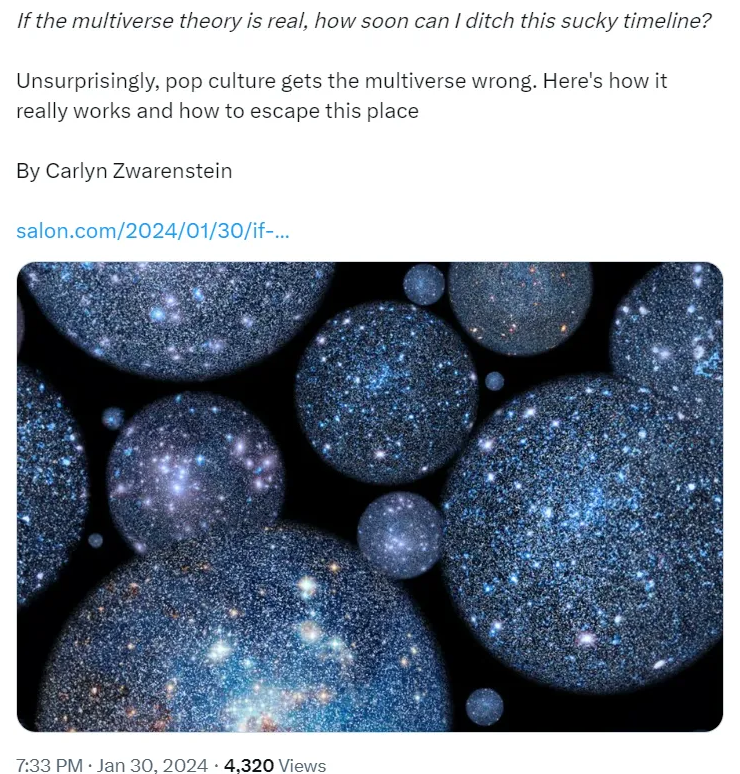
“Unsurprisingly, pop culture gets the multiverse wrong.”

(i) Introduction
(ii) The Sexy Multiverse
(iii) Sexy and Weird Quantum Mechanics
(iv) Schrödinger’s Sexy Cat


Pop culture often gets these things wrong partly — or even largely — because of what physicists themselves write and say. More accurately, it gets things wrong because of what physicists write in their “popular science” books.

So perhaps this is what Carlyn Zwarenstein means by “pop culture” — stuff that includes books and articles written by professional scientists. (She mentions the science writer and physics professor Paul Halpern later.)

In the case of the tweet above, why is there an assumption here that pop culture is getting things wrong when it comes to (what she calls) “multiverse theory”? After all, lots of theoretical physicists, physicists generally, philosophers, etc. have a serious problem with this theory too. They also disagree a lot on this subject.

The other thing about this tweet is that it also assumes that there’s a single pop-culture view of the multiverse.

So perhaps all this boils down to the vagueness (or inaccuracy) of that very term — “pop culture”.

All this has also got a lot to do with scientists (i.e., not pop culture!) attempting to make their scientific specialisms and interests sexy.

There are two main reasons why such scientists tart up (their?) science:

(1) In order to get more people interested in science.
(2) To help sell more of their own books.

Of course, there’s nothing wrong with simplifying science for a general audience. (I myself rely on such simplifications.) However, there is something wrong with attempting to make things sexier than they actually are. More importantly, there is a problem if the sexed-up science is actually misleading — or even downright false!

Take the case of the multiverse, as referred to in Carlyn Zwarenstein’s tweet.

The Sexy Multiverse

Firstly, I’m aware that many-worlds theory and ideas about a multiverse are very different. (There are even many different accounts of the multiverse, what it is, and how it came about. See note 1.) However, the existence of many worlds and the multiverse are both deemed to be equally sexy.

I’m also more than willing to accept that it’s possible that there are many worlds, or that there’s a multiverse. I’m even willing to accept that many worlds actually exist. However, I’m not willing to accept the titillating, sexy and self-obsessive crap that’s said about them by… scientists.
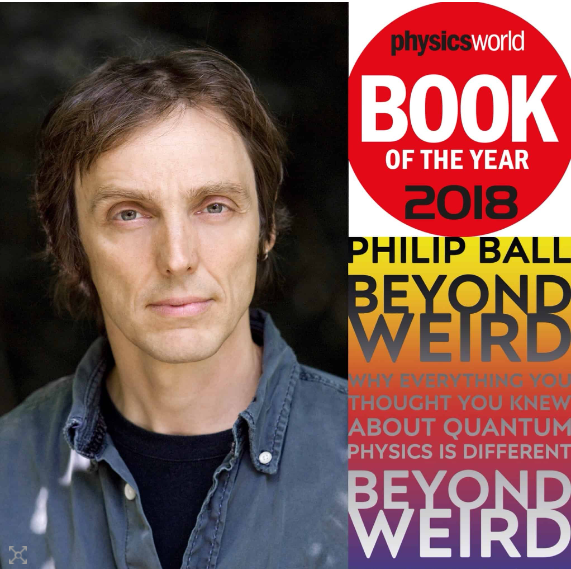
The science writer Philip Ball tells us why many people find many-worlds theory (or, more accurately, the many-worlds interpretation) appealing. He writes:

“Alternative realities hold an irresistible allure. Whether it’s Dickens’ A Christmas Carol, Frank Capra’s It’s a Wonderful Life, or the quantum-computed parallel universes of Alex Garland’s recent TV series Devs, the possible lives that we can imagine having led but did not lead offer a stage for acting out our fears and fantasies.”

Ball then ties all that to the science… or, more precisely, to the interpretations of the science. He continues:

“It is no surprise, then, that the Many Worlds interpretation (MWI) of quantum mechanics seems to hold such attraction. Even though most physicists dismiss or even deride it, it is often eagerly embraced by physics popularizers and their audiences. Yet it can be hard to figure out how seriously some of its advocates really take it. I believe some physicists genuinely see it as an elegant solution to deep conundrums of the notoriously mind-bending quantum theory, and I sympathize with some of their reasoning. But when they start talking about ‘quantum brothers’ (and presumably sisters, though Many Worlds has curiously few female advocates) [] I have to wonder whether, indifferent to the philosophical complications, they are just enjoying the fantasy.”

Note the words “[j]ust enjoying the fantasy”.

And what’s wrong with that?

Nothing... at least outside of any context.

As long as we all realise that’s precisely what it is: people just enjoying the fantasy.

What’s more, it’s not as if Philip Ball has just made all this stuff up either. For example, according to the science writer John Gribbin, “[t]here really is [] a Wuthering Heights world (but not a Harry Potter world)”.

Interestingly enough, Carlyn Zwarenstein (i.e., the author of the opening tweet above) also touches on this issue in the following passage:

“‘Forward time travel is possible if you can approach the speed of light,’ says Paul Halpern [], a physics professor and prolific science writer whose book about the concept of the multiverse, The Allure of the Multiverse: Extra Dimensions, Other Worlds, and Parallel Universes, was just published.
“Yesssss! That’s more like it.
“But as usual, science is out to burst this writer’s bubble. As it turns out, you can’t approach the speed of light. (Well, not with that attitude).”

Readers will have noted the words “The Allure of the Multiverse”!

If we return to Philip Ball. He’s not alone on this “postmodern science” bonanza. Take the following critical views of the multiverse theory… and string theory.

Firstly, here’s the science journalist John Horgan:

[S]cience that is not experimentally testable or resolvable even in principle and therefore is not science in the strict sense at all. Its primary function is to keep us awestruck before the mystery of the cosmos.”

And now for Jim Holt:

“For the first time in its history, theory has caught up with experiment. In the absence of new data, physicists must steer by something other than hard empirical evidence in their quest for a final theory.”

Perhaps Horgan and Holt are themselves part of the “pop culture” referred to in the opening tweet. That said, I’ve already made the point that there are plenty of professional physicists who’re critical of the multiverse, many worlds, etc.

Now Take the word “weird”, which is relentlessly used when it comes to quantum mechanics.

Sexy and Weird Quantum Mechanics

As a starter, click the words “Quantum mechanics is weird” as they’re fed into Google search. You’ll get hundreds — possibly thousands — of entries and links which take you to films, books, articles, papers and documentaries.

Here again, it’s often physicists themselves who stress the “weirdness” of quantum mechanics, not pop culture. And I suspect that many physicists do so in order to entice laypersons into (their?) physics.

In any case, I have backup here.

In 2018, the science writer Philip Ball had a book published called Beyond Weird: Why Everything You Thought You Knew About Quantum Mechanics is Different. In that book he downplays the “weirdness” of quantum mechanics, at the same time as he stresses new approaches to its interpretation.

The physicist Christopher Fuchs (as quoted by Ball) also expresses the problem with quantum mechanics in terms of “all the posturing and grimacing over [its] paradoxes and mysteries”. In other words, for many laypersons and popular-science writers especially, that posturing and grimacing seems to have become the very essence of quantum mechanics.

Philip Ball also cites Richard Feynman’s often-quoted words:

“I think I can safely say that no one understands quantum mechanics.”

Thus, from the line “quantum mechanics is weird”, there follows the no-one-understands-quantum-mechanics mantra.

Ball picks up on the bizarre nature of Feynman’s statement when he says that

[a]t that point, no one alive knew more than Richard Feynman about quantum mechanics”.

He concludes: “What hope is there, then, for the rest of us?”

To be honest, I find Feynman’s remark rhetorical, as I suspect Ball does too. After all, it’s fairly well-known that Feynman didn’t have too much time for the interpretations of quantum mechanics, let alone for the philosophy of quantum mechanics. In other words, Feynman knew all (or at least most) of the relevant mathematics. “The trouble was”, as Ball puts it, “that’s all he could do.”

Philip Ball then applies more or less the same arguments found above to the specific and well-known case of Schrödinger’s cat.

Schrödinger’s Sexy Cat
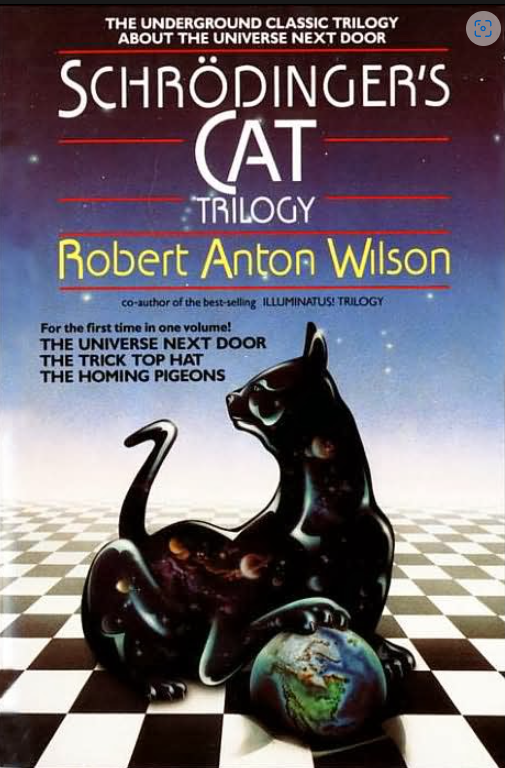
First of all, Philip Ball tells us that

“in neither the Copenhagen nor the Many Worlds interpretation is the cat ‘simultaneously alive and dead’”.

In more detail, Ball also writes:

“I think Bohr might have said something along the lines that ‘Observation allows us to speak about the classical state of the cat. And look, it is a dead one!’.”

In other words, until we get information about the cat, we don’t know if it’s alive or dead. It’s not the case that it’s both alive and dead at one and the same time (i.e., before we gain that information). However, until we get that information, the cat may as well be both alive and dead…

But only in a manner of speaking!

Ball then offers up a more original take on this sexy-cat scenario.

Basically, why the hell are we talking about an alive and dead cat in the first place?

Sure, this was meant to be a colourful thought-experiment (i.e., against a certain take on quantum mechanics). However, it’s a thought-experiment which many people don’t actually take to be a thought-experiment at all. In Ball’s own words:

“In order to be able to talk about the [cat] scenario in quantum terms, we need to be able to express it in quantum terms. But we can’t, because ‘live cat’ and ‘dead cat’ are not well-defined quantum states.”

I don’t know about “well-defined quantum states”: a live cat and a dead cat (both together or separately) don’t seem to be quantum states at all. Perhaps that doesn’t matter. After all, what’s happening here is that we’re applying a quantum-mechanical situation (or possibility) to the “real world” — to a cat!

One problem here is thinking of quantum particles as classical particles which nonetheless behave in very non-classical ways. (Alternatively, the problem is thinking of quantum particles as being what Michael Brooks calls “objects” in the first place.) Many of the examples of quantum “weirdness” stem from that situation — at least those weird things which belong to the many and various interpretations of quantum mechanics. Yet whatever it is that quantum physicists deal with, it isn’t equivalent to classical objects. It’s not even equivalent — or similar — to particles of dust, sand or glass. [Here’s Carlo Rovelli playing down quantum weirdness.]

Thus, why should it be weird that a quantum x doesn’t behave like a classical object or even a classical particle? In reverse, if a classical object were to behave like a quantum x, then that would be weird…

So many people believe that quantum phenomena are weird mainly because they see them as being classical phenomena which nonetheless behave in very non-classical ways. Yet, in actual fact, we only have quantum phenomena behaving in quantum ways — just as classical phenomena behave in classical ways.

Of course, now there’s the problem of the Heisenberg cut. There’s also much dispute as to whether there is such a neat and tidy (to use the words of the physicist and science writer Brian Greene)“line in the sand” between the quantum realm and the classical realm.

But that’s another subject entirely…


Note:

(1) Talking about “pop culture”…

In Christopher Nolan’s film Tenet, the character Neil mentions “parallel worlds”. So it’s worth making a distinction here between other dimensions, parallel worlds, and Hugh Everett’s many worlds.

Other dimensions are dimensions of our universe. (This is a fundamental part of string theory.) Parallel worlds, on the other hand, may be completely separate from our world.

So can there be “causal contact” between parallel worlds and our world?

This must surely mean that the only possibility that Tenet can have in mind is parallel dimensions, not parallel worlds. Indeed, when it comes to parallel worlds, it’s hard to make sense of the word “parallel” at all. These worlds simply can’t be parallel to our world.

So perhaps no one is expected to take the word “parallel” literally.

And just as a distinction has just been made between parallel dimensions and parallel worlds, so a distinction can also be made between the many worlds (i.e., of many-worlds theory) and the other “universes” of a multiverse. In the many-worlds interpretation, the possibility of causal — or other kinds of — contact between our world and other worlds is accepted — at least by some scientists. [See also brane cosmology.] However, when it comes to our universe and another universe (or a “bubble universe”) in a multiverse, that isn’t usually accepted by scientists. (Although there is some talk of “colliding” universes, etc.)


Thursday, 4 July 2024

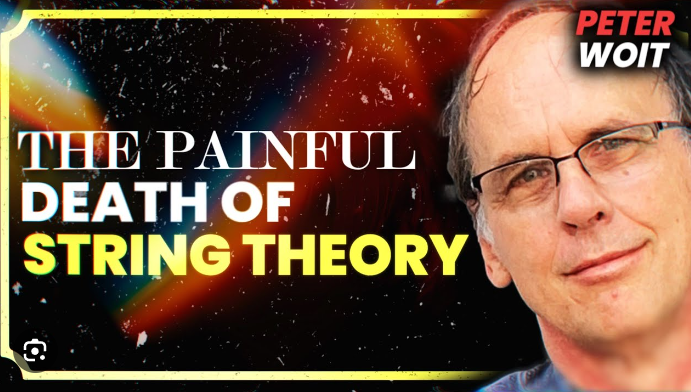
Physicist Peter Woit on the Sociology of String Theory

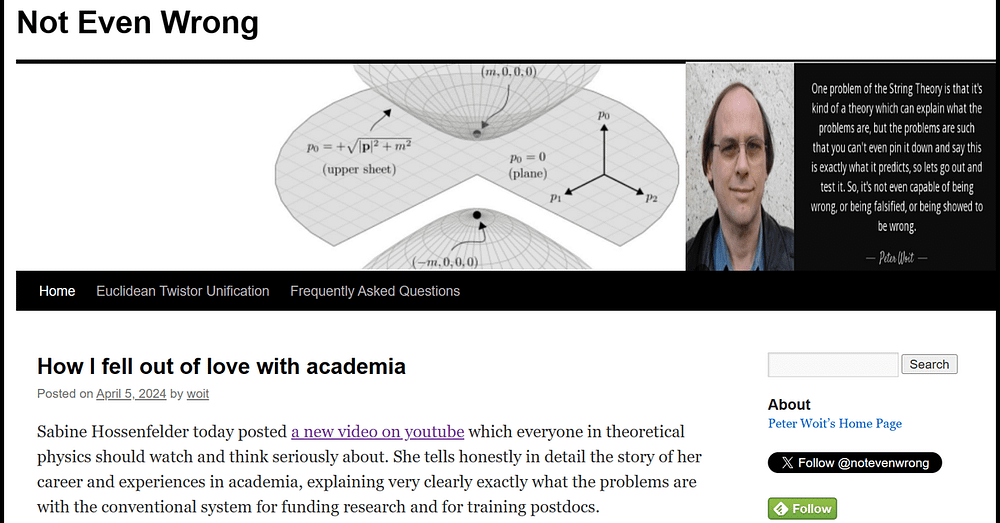
The following piece is on Peter Woit’s strong stance against string theory. It focusses on Woit’s sociological analysis of string theory, as found in his blog post ‘20 Years of Not Even Wrong’. This was posted on March the 18th, 2024.

(i) Peter Woit on the Sociology of String Theory
(ii) Sheldon Cooper on the Sociology of String Theory
(iii) Lee Smolin on the Sociology of String Theory
(iv) Woit’s and Smolin’s Non-Sociological Criticisms of String Theory


Peter Woit is an American theoretical physicist. He’s also a senior lecturer in the Mathematics Department at Columbia University.

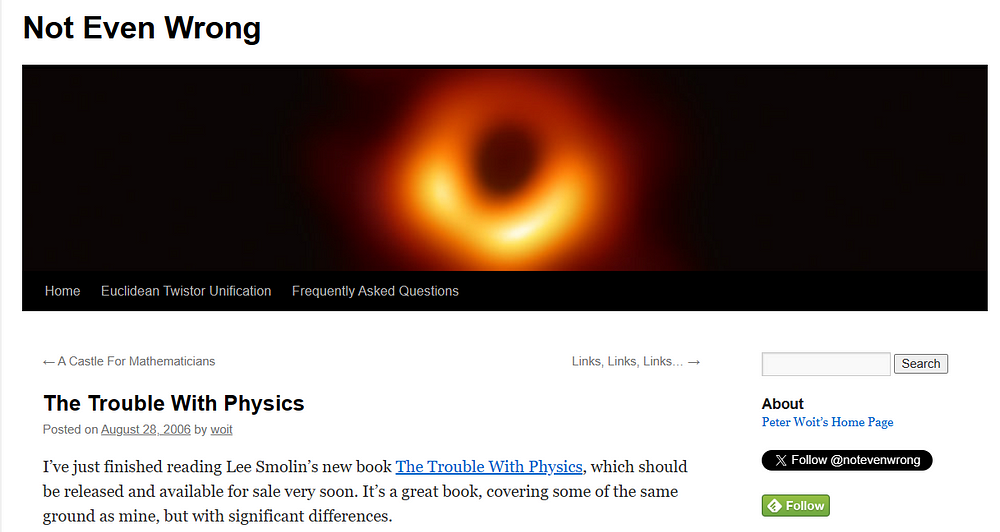
An important source of Woit’s criticisms of string theory can be found in his book Not Even Wrong: The Failure of String Theory and the Search for Unity in Physical Law, which was published in 2006. He runs a blog that’s also called Not Even Wrong. (Woit tells us that the “first entry on this blog was 20 years ago yesterday” — that is, in 2004.)

Peter Woit on the Sociology of String Theory

Peter Woit’s overall position is on the academic and intellectual hegemony (a word he doesn’t actually use) of string theory. He sees this as being bad news for the future of fundamental physics.

Woit argues that string theory’s popularity was at least partly a result of the financial and political nature of academia. More specifically, this hegemony of string theory was also down to the mad academic competition for scarce resources.

The following passage is Woit on string theory:

“In 2004 I was looking at nearly twenty years of domination of fundamental theory by a speculative idea that to me had never looked promising and by then was clearly a failure. 20 years later this story has become highly disturbing. The refusal to admit failure and move on has to a large degree killed off the field as a serious science.”

If we take Woit’s word for things, then it truly is amazing that a “speculative idea” should dominate theoretical physics for such a long time. Indeed, we will see that in certain strong respects, string theory is speculative, and it has dominated theoretical physics for over three decades.

But has string theory also failed?

Well, that depends…

Woit then offers us more on the politics and sociology of string theory:

“My background has been at the elite institutions that are supposed to be providing this kind of training and working environment. Harvard and Princeton gave me this sort of training in 1975–1984 and I think did a good job of it at the time, but from what I can tell things are now quite different. 40 years of training generations of students in a failed research program has taken its toll on the subject.

He continues:

“I remember well what it was like to be an ambitious student at these places, determined to get as quickly as possible to the frontiers of knowledge, which in those times meant learning gauge field theory. These days it unfortunately means putting a lot of effort into reading Polchinski, and becoming expert in the technology of failed ideas.”

All that is strong stuff.

Mathematical physicist Roger Penrose too (in his book The Road to Reality) also had something similar to say on this subject. He wrote:

“The often frantic competitiveness that this ease of communication engenders leads to bandwagon effects, where researchers fear to be left behind if they do not join in.”

According to Woit’s account, string theorists have gained a hegemonic position despite the fact that string theory has no independent (or unique) evidence on its side. Or, in Woit’s own words, despite the fact that string theory is a “failed research program”.

And, like other hegemonies, those in control of this research program (or those who benefit from it) “will never admit what has happened, no matter how bad it gets”.

Another question is the following:

Why has there been “excessive media attention and funding” of string theory?

This hints at a political, and not just a sociological, answer.

Indeed, it surely must be political.

Although string theory is speculative, it’s been heavily funded, and it has sustained countless careers over the last three decades or more. That can’t help but have at least some political implications and explanations.

Of course, Peter Woit is not on his own on all this. Take the following words from the science writer John Horgan:

[S]cience that is not experimentally testable or resolvable even in principle and therefore is not science in the strict sense at all. Its primary function is to keep us awestruck before the mystery of the cosmos.”

Horgan calls this ironic science”.

Interestingly enough, all this needn’t be seen as hinting at a negative state of affairs. So now take the words of another science writer, Jim Holt, who put the situation in this way:

“For the first time in its history, theory has caught up with experiment. In the absence of new data, physicists must steer by something other than hard empirical evidence in their quest for a final theory.”

Here we’re being told that string theorists have fully (even happily) accepted this lack of “new data”. Indeed, that’s precisely why “theory has caught up with experiment”. In other words, string theory can hardly have failed to have caught up with experiment if there were no new experiments to catch up with in the first place.

Let’s get back to the sociology of string theory.

The fictional character Sheldon Cooper (of The Big Bang Theory) also experienced the sociology of string theory.

Sheldon Cooper on the Sociology of String Theory

Sheldon Cooper gave his friends the following retrospective account of his youthful conversion to string theory:

“String theory seemed so elegant at the time, but now I realize I was just a simple country boy seduced by a big city theory with variables in all the right places.”

[These words are from ‘The Relationship Diremption’ episode of The Big Bang Theory, in which Sheldon experiences a reverse Damascene conversion.]

The quote above chimes in with what many theoretical physicists have themselves stated over the last couple of decades.

Sociologically, it was indeed the case that in the 1980s (although Sheldon himself wasn’t born until 1980) many talented young physicists were encouraged (by their professors and teachers) to take up string theory.

Relevantly enough, Sheldon’s equally-fictional rival, Barry Kripke, classed himself (in the same episode) as a “stwing pwagmatist”.

What on earth is that?

Barry Kripke explained:

“I say I’m gonna pwove something that cannot be pwoved, I appwy for gwant money, and then I spend it on wiquor and bwoads.”

To which Sheldon responded:

“Do you think he is right? Am I wasting my life on a theory which can never be proven?”

All this happened largely as a result of the monumental claims and grand promises of string theory.

And now those formerly-young physicists are middle-aged (or older) tenured professors who’ve spent their entire professional lives devoted to string theory. (This is unlike Sheldon Cooper himself, who was about 33 — looking about 6 — in this 2014 episode.)

So what else could these professors now do? And if they were to do something else, then would they still be able to pay their mortgages, go on as many holidays, send their kids to good schools, etc?

Lee Smolin on the Sociology of String Theory

Some of these sociological and political issues tackled by Peter Woit can also be found in Lee Smolin’s 2006 book The Trouble with Physics: The Rise of String Theory, the Fall of a Science, and What Comes Next. Specifically, this book contains a chapter called ‘How Do You Fight Sociology?’, which is very relevant here.

In a blog post called ‘Response to Criticism’, Smolin also wrote the following words:

“To discuss some sociological issues in contemporary academic science which I argue are slowing the progress of science, and to propose solutions to them.”

In The Problem With Physics itself, Smolin wrote:

“String theory is a powerful, well-motivated idea and deserves much of the work that has been devoted to it. [] The real question is not why we have expended so much energy on string theory but why we haven’t expended nearly enough on alternative approaches.”

It’s worth noting here that Smolin’s (as it were) sociological view of string theory isn’t original: it dates back to at least 1987. In that year, American theoretical physicist and string theorist David Gross made the following controversial comments (as quoted by Peter Woit) about some of the reasons for the popularity of string theory:

“The most important [reason] is that there are no other good ideas around. That’s what gets most people into it. When people started to get interested in string theory they didn’t know anything about it. [] So I think the real reason why people have got attracted by it is because there is no other game in town. All other approaches of constructing grand unified theories, which were more conservative to begin with, and only gradually became more and more radical, have failed, and this game hasn’t failed yet.”

Of course, there have been other games in town. However, David Gross believed that they weren’t worth playing. Either that, or they didn’t offer the same totalist vision that string theory does.

Woit’s and Smolin’s Non-Sociological Criticisms of String Theory

Peter Woit’s comments on Lee Smolin’s book The Trouble With Physics.

To a non-physicist, Peter Woit’s following critique of string theory certainly seems convincing:

“For the last eighteen years particle theory has been dominated by a single approach to the unification of the Standard Model interactions and quantum gravity. This line of thought has hardened into a new orthodoxy that postulates an unknown fundamental supersymmetric theory involving strings and other degrees of freedom with characteristic scale around the Planck length. […]

Of course, no such supersymmetries have been found. [See here.) Indeed, strings themselves have never actually been found either. And that’s because they’re theoretical posits.

Then we have more criticism from Woit:

“It is a striking fact that there is absolutely no evidence whatsoever for this complex and unattractive conjectural theory. There is not even a serious proposal for what the dynamics of the fundamental ‘M-theory’ is supposed to be or any reason at all to believe that its dynamics would produce a vacuum state with the desired properties. The sole argument generally given to justify this picture of the world is that perturbative string theories have a massless spin two mode and thus could provide an explanation of gravity, if one ever managed to find an underlying theory for which perturbative string theory is the perturbative expansion.[5]

I used the words “to a non-physicist” just before I quoted the long passages above. I’m not saying that all readers need to be professional physicists in order to make sense of the scientific parts. However, I certainly don’t feel qualified enough to come down either way on some of Woit’s pronouncements.

[See my next article on testimony as it’s discussed in philosophical literature, and as it directly relates to the (educated) layperson’s relation to science, and to string theory specifically.]

If we return to Lee Smolin .

Smolin (like Woit himself) wouldn’t have offered us his sociological analysis of string theory if it weren’t for his prior scientific and philosophical problems with it.

So now let’s tackle them, if only for a short while.

Smolin (in his book The Trouble With Physics) quotes string theorists talking about the beauty of the theory (or theories) in the following:

[] ‘How can you not see the beauty of the theory? How could a theory do all this and not be true?’ say the string theorists.”

Here it’s being said (if not explicitly) that to string theorists (mathematical) beauty trumps evidence, experiments, data, observations, etc. In other words, string theory is truly Pythagorean in nature.

Smolin also used the words “postmodern physics” when he wrote the following:

“The feeling was that there could be only one consistent theory that unified all of physics, and since string theory appeared to do that, it had to be right. No more reliance on experiment to check our theories. That was the stuff of Galileo. Mathematics [alone] now sufficed to explore the laws of nature. We had entered the period of postmodern physics.”

Smolin’s description of string theory, and his uses of the words “postmodern physics”, aren’t really (or even at all) references to philosophical postmodernism in the sense practised by philosophers like Jean Baudrillard, Jean-François Lyotard, etc. Smolin simply meant after modern physics by his term “postmodern physics”. (Of course, Smolin must have also been aware of the philosophical associations of this term.) More specifically, Smolin believed that this is how physics — at least as carried out by certain theoretical physicists — came to be done when string theory arrived on the scene.

In conclusion.

Perhaps it was precisely the postmodern nature of string theory that allowed — and enabled — it to establish its hegemony, and then to sustain that hegemony for over three decades. After all, if in string theory there really is (to quote Smolin again) “no more reliance on experiment”, then what on earth could have stopped its almost-total dominance of theoretical physics?


Sunday, 23 June 2024

Why Study Philosophy If It’s Already Dead?

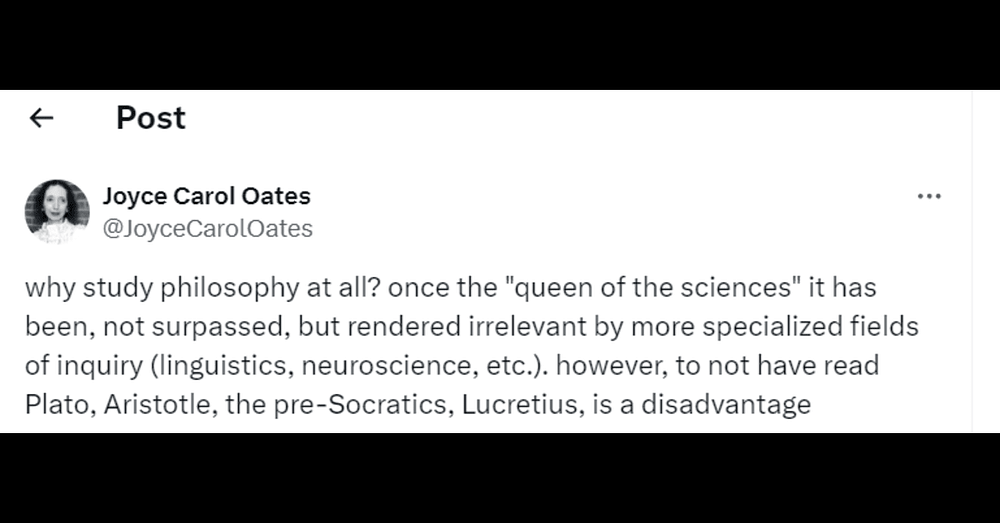
The American writer Joyce Carol Oates offers her ‘Followers’ (on X) the words in the screenshot below. They seem to be a variation on Stephen Hawking’s often-quoted “philosophy is dead” mantra.

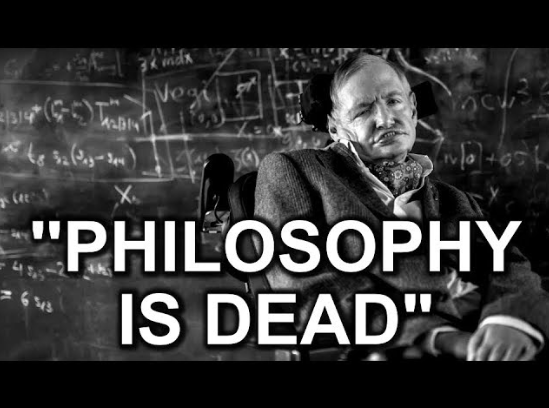
Why did Stephen Hawking believe that philosophy is dead?

He did so mainly because he believed that “philosophers haven’t kept up with physics”. The following is the passage in full:

“Traditionally these are questions for philosophy, but philosophy is dead. Philosophy has not kept up with modern developments in science, particularly physics. Scientists have become the bearers of the torch of discovery in our quest for knowledge.”

For a start. Philosophy isn’t just about “our quest for knowledge”. (If by “knowledge” Hawking meant data, facts, evidence, tests, experiments, “empirical theories”, etc.) Philosophers are just as likely to ask the following question: “What is knowledge?” In other words, philosophers are just as likely to ask questions about knowledge than offer an endless array of (as it were) scraps of knowledge.

Oddly enough, the above also means that in order for physicists — as well as scientists generally — to justifiably claim that “philosophy doesn’t add any knowledge to the world”, then they must do some philosophising themselves:

i) Such scientists need to explain what they mean by “knowledge”.
ii) Such scientists need to tell us why philosophical claims aren’t examples of knowledge.
iii) Such scientists need to tell us why scientific knowledge is the only kind of knowledge.
iv) And such scientists need to tell us why they give scientific knowledge (or science itself) such a preeminent status.

None of the positive or negative responses to those statements will be scientific in nature.

One would hope, then, that scientists will never argue that such questions shouldn’t even be asked. However, if any scientists did argue (or simply believe) that such questions shouldn’t be so much as asked, then that extreme position itself would need to be philosophically defended. And if such scientists didn’t defend it (or if they believe that they aren’t required to defend it), then that somewhat elitist and arrogant stance will itself — again — need a philosophical defence.

It’s also worth noting here that it’s often been said that “philosophers don’t add any knowledge to the world”.

Indeed, it’s been said since at least the 1920s.

Ironically, it was philosophers themselves (e.g., the logical positivists and Ludwig Wittgenstein — see here) who first made precisely that point!

In any case, Stephen Hawking is actually a bad example of an anti-philosopher. That’s primarily because Hawking himself offered the world his very own philosophical position on physics, which he called model-dependent realism

Now how perverse is that?

So here’s a taster of Hawking’s own philosophy:

“There is no picture- or theory-independent concept of reality. Instead we will adopt a view that we will call model-dependent realism: the idea that a physical theory or world picture is a model (generally of a mathematical nature) and a set of rules that connect the elements of the model to observations. This provides a framework with which to interpret modern science.”

Sure, it might have been the case that Hawking didn’t see his model-dependent realism as being a philosophical position. He might have seen it as a simple description of the (as it were) facts and methodologies of physics.

However, that too would have been monumentally naïve.

In addition, since Hawking classed himself as “a positivist”, then his rejection of philosophy is even more ridiculous and/or naïve than it may at first seem.

But it wasn’t just Hawking who took a naive and critical philosophical view of philosophy, so too did the well-known biologist and naturalist Edward O. Wilson.

Wilson once stated almost exactly the same things as Hawking in the following passage:

“It appears to me that professional philosophers have not kept up with the foundational disciplines of neuroscience, behavioural genetics, and evolutionary biology, and as a result they have surrendered their franchise to the scientists. The scientists, not the philosophers, now address most effectively the great questions of existence, the mind, and the meaning of the human condition. This surrender seems to be permanent, and professional philosophers have begun a diaspora into other vital and challenging disciplines that include theoretical neuroscience, evolutionary theory, intellectual history and bioethics.”

Of course, I could be biased in that I read philosophy, and write on philosophy. Then again, I read a lot of scientific stuff too.

Did Hawking and Wilson read a lot of contemporary philosophical stuff?…

Oh!

Why should they have even bothered?

After all, “philosophy is dead”… remember?

In terms of detail. There’s evidence that Hawking never really got passed Karl Popper when it came to 20th century philosophy. He certainly never quoted (or even paraphrased) any contemporary philosophers — at least as far as I’m aware. Indeed, if Hawking had read contemporary philosophers, then he’d have quickly realised that many of them have (to quote his own words) “kept up with modern developments in science, particularly physics”.

Joyce Carol Oates

Joyce Carol Oates
There’s no shortage of prophetic and sexy statements like this.

The American writer Joyce Carol Oates too could do with studying more contemporary philosophy.

For a start. She doesn’t even bother telling her followers why philosophy has been “rendered irrelevant by more specialized fields of inquiry”. In fact, at face value at least, it’s hard to know what that even means. It’s almost like saying that tennis has been rendered irrelevant by rugby.

Joyce Oates actually seems to be criticising philosophy for not being science. Or, to cite her own examples, she seems to be criticising philosophy for not being “linguistics, neuroscience, etc.”.

What’s more, most philosophers themselves haven’t read Lucretius — at least not in any detail. So that Roman philosopher is an oddly personal choice on Oates’s part…

As for the “pre-Socratics”…

So is Joyce Carol Oates simply attempting to show her followers how widely read she is in philosophy — i.e., in order to lend credence to her categorical and vague pronouncements about philosophy (as it is today?!) being “surpassed”?…

Sure, in Oates’s own favour, it’s only a tweet, not a paper or article.

The thing is, many other tweeters don’t go much further than such slogan-filled posts either.