(ii) Doubt: Laypersons, Science, and Wittgenstein’s Doubts About Doubt
(iii) Albert Einstein’s Determinism or Fatalism?
(iv) Timothy Williamson’s Lectures
(v) Don’t Eat Blueberries… or Cashew Nuts!
(vi) Academics Are Human Beings
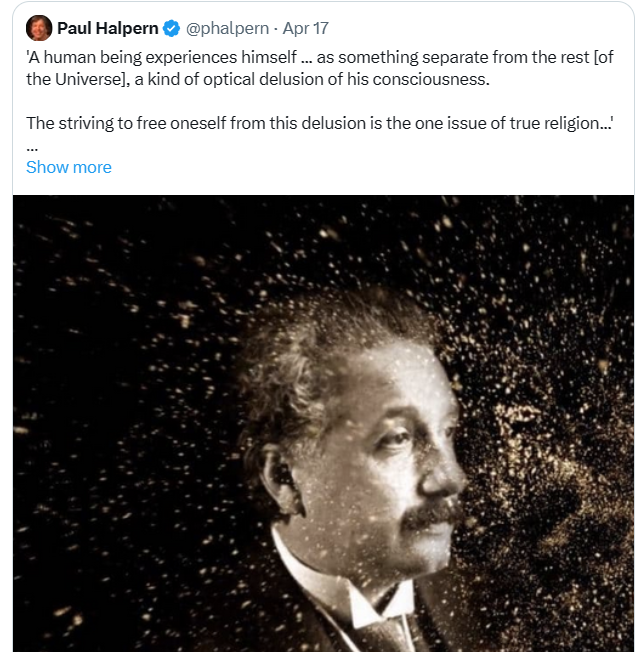
(vii) “We Are All One” — Albert Einstein Said So!
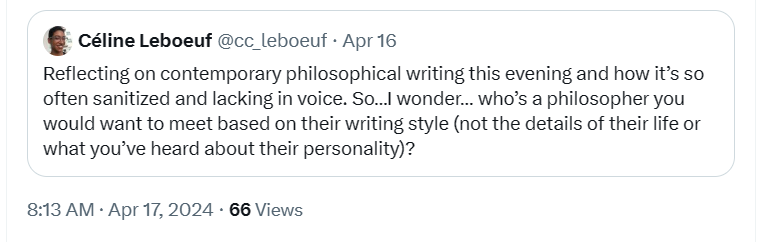
(viii) Philosophical Writing Styles
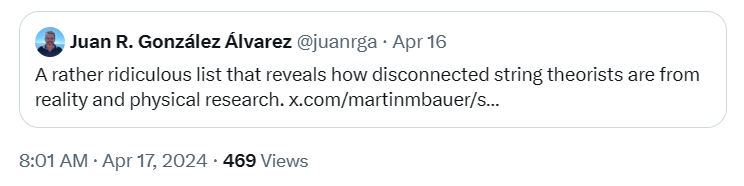
(ix)) Are String Theorists Insane?
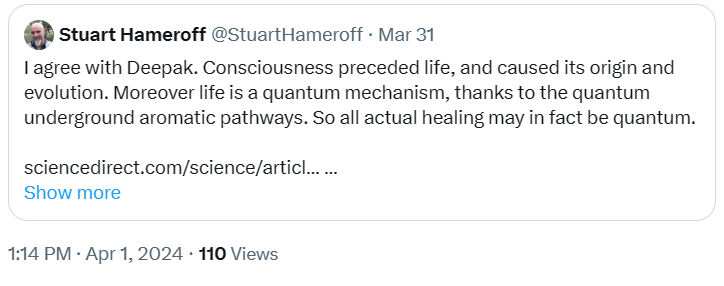
(x) Stuart Hameroff Praises Deepak Chopra
Daniel Dennett
Like Richard Dawkins, Daniel Dennett received a lot of vitriolic abuse because of his views. But he argued his case. And he even engaged with many of his (fierce) critics. This is true of Dawkins too.
So even though many people may take Dennett’s views to be extreme in various ways, at least argument and data were of supreme importance to him. (I never agreed with everything he wrote.) Many (i.e., not all) of his critics, on the other hand, seem to glide on their visceral hatred of his views.
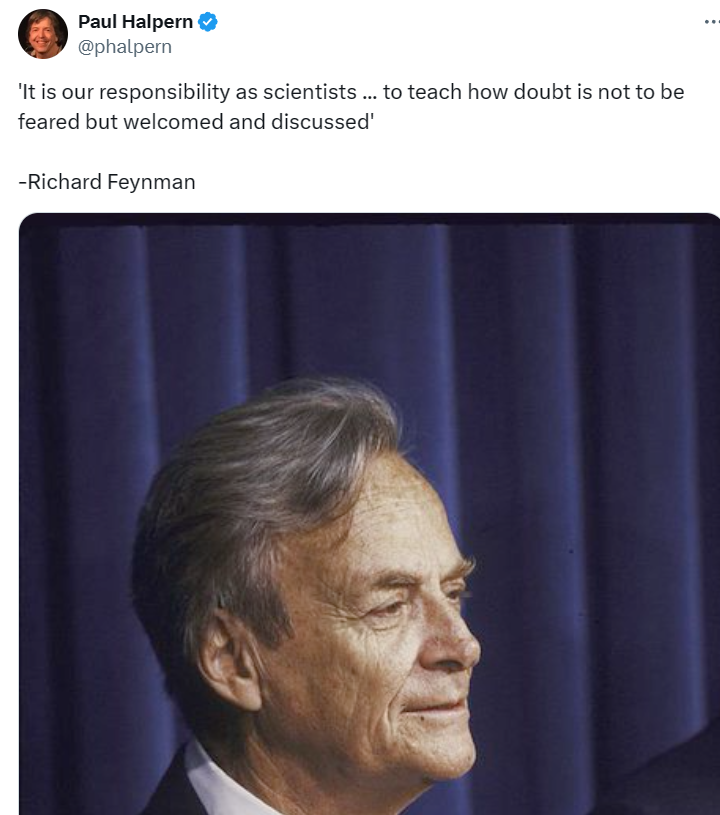
Doubt: Laypersons, Science, and Wittgenstein’s Doubts About Doubt
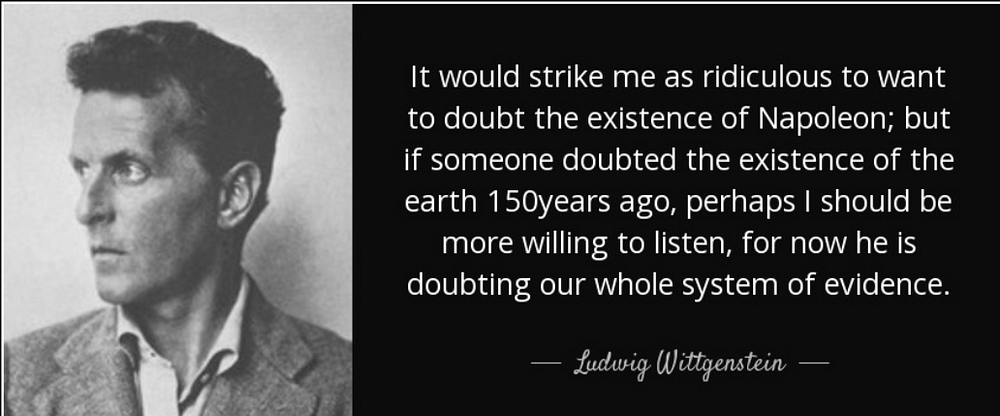
Didn’t Ludwig Wittgenstein have doubts about doubt? Or, at the very least, he was certainly very dismissive of global doubt (or global scepticism).
Also, aren’t many scientists highly suspicious when laypersons doubt their own claims and theories? What’s more, laypersons largely rely on testimony when it comes to (most) science. In other words, this is the exact opposite of doubting scientific statements and theories. [See my ‘When It Comes to Science, Non-Scientists Rely on Testimony’.]
Perhaps one can get around all this and say that Richard Feynman wasn’t using the word “doubt” in this philosophical(?) way.
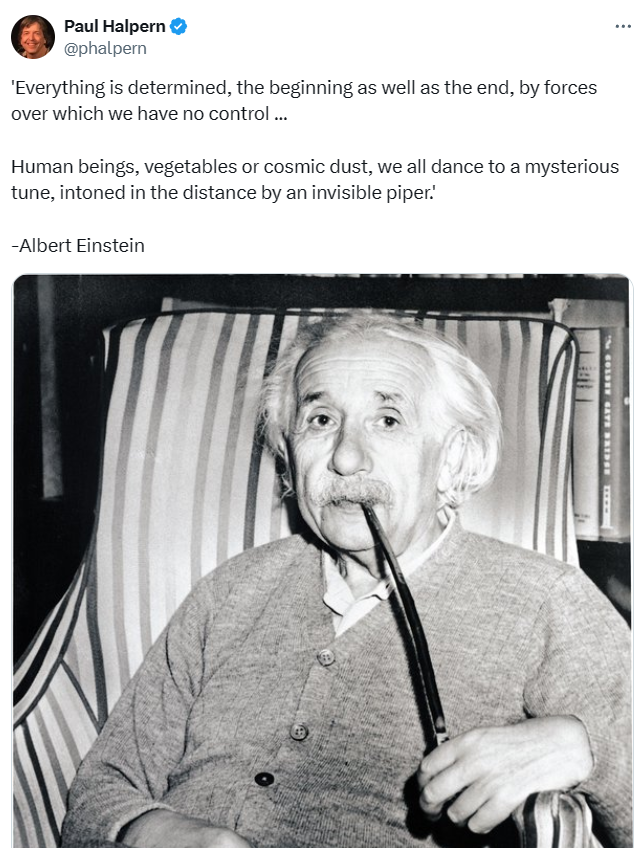
Albert Einstein’s Determinism or Fatalism?
This is something I’ve never understood. “Spiritual” and religious people quote Einstein left, right, and centre in order to get him on board their own spiritual/religious trains. Yet doesn’t this quote (below) work against the free will which most spiritual and religious people champion? (Yes, non-religious people believe in free will too.)
I suppose, however, that Einstein’s words can be squared with certain brands of religious fatalism.
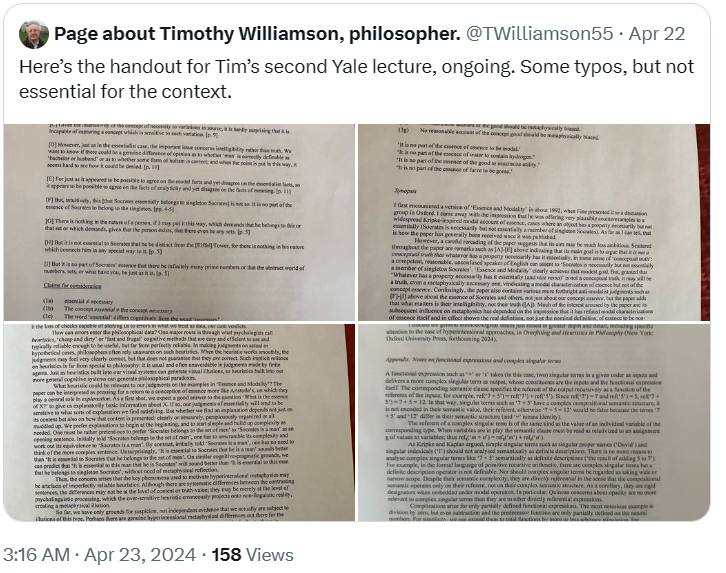
Timothy Williamson’s Lectures
The English philosopher Timothy Williamson’s lectures are usually brilliant. (Well, all the ones I’ve watched on YouTube are.) No one does them the way he does. They are clear and unpretentious. They’re also very forceful… And I say all that even though I don’t agree with many of his positions.
For example, I broadly see myself as being a naturalist. However, Williamson’s lecture on naturalism (on YouTube) really got me thinking. Not that he’s entirely critical of naturalism. Yet he does spot some fundamental problems. (That said, all philosophical isms have their own problems too.)
Also check out his debate (on YouTube) with Paul Horwich on Wittgenstein. Broadly speaking, I take Williamson’s “side” on this issue.
Don’t Eat Blueberries… or Cashew Nuts!
Literally all medicines have contraindications and warnings attached to them. I also suspect that all foods have at least some negative aspects — when it comes to some people at some points in time.
I eat a hell of a lot of cashew nuts. However, when checking up on them, I was deluged by warnings about doing so. (Perhaps I’m dying without knowing it.)
So there are scientific papers which say X. And then there are scientific papers which say not-X…
What can a layperson do?
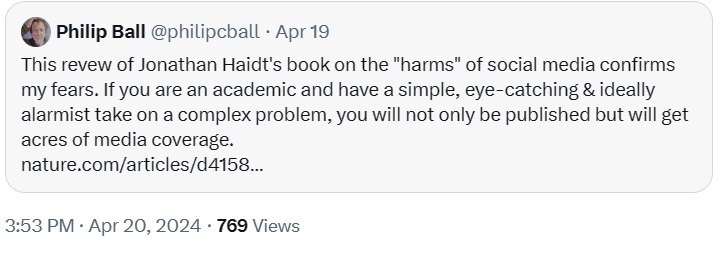
Academics Are Human Beings
Academics are prone to all the human vices we lowly laypersons are prone too. Indeed, why should that be a surprise? Academics are biological, psychological and social beings, after all…
By the way, my next paper is called ‘My Ego Is the World and Nothing Else Exists’. This paper instantiates in conjunction with my ‘The World Will End Next Thursday’.
“We Are All One” — Albert Einstein Said So!
Albert Einstein was a physicist... Yes? So why are nearly all the words he ever uttered frequently quoted and turned into portentous memes?
Sure, some of his non-physics-based words are okay. Others are fairly banal, truistic or borrowed. None of his own is particularly brilliant.
The quote above certainly isn’t physics. I would argue that it’s not even philosophy. Being a German living mainly in the first half of the 20th century, it's precisely the kind of indebtedness to “eastern religion” you’d expect from a highly-educated German scientist or intellectual at that time. There are other German and Austrian physicists who, at that point in history, said fairly similar things. It was in the air at that short(ish) moment in history.
Philosophical Writing Styles
Personally, I believe that more analytic philosophers should find an appropriate middle way between the soulless and dry style of their very self-conscious academese, and the opposing literary philosophical styles which are primarily designed to appeal to feelings, emotions and prior tribal (or psychological) loyalties. (Literary styles that when unpacked, are often quite empty of philosophical content, argument and data.)
Are String Theorists Insane?
Yes! But the maths of string theory is truly “beautiful” and “consistent”. As some string theorist put it: “How can something so beautiful be false?” This is what non-scientists (or laypersons) are told by string theorists and (some) popular-science writers.
Now think of theself-consistent madman who creates a perfectly logical and self-consistent belief-system (or worldview). All the parts of that system fit together perfectly. However, all his beliefs are false. They bear no relation to reality. [See my ‘A Coherent Madman and His Little Self-referential Problem’.]
Stuart Hameroff Praises Deepak Chopra
Is the anesthesiologist Stuart Hameroffbeing surreal or ironic here? Surely that must be the case. Then again, I don’t expect an anesthesiologist to be particularly philosophically literate, or have anything interesting to say when he branches out way way beyond his specialism.
And his New Age soundbites are atrocious… but, again, it could be ironic.
“I am an anesthesiologist interested in how the brain produces consciousness.”
Deepak Chopra is an idealist. He (along with his “spiritual” pals Bernardo Kastrup and Donald Hoffman) believes, and has explicitly stated, that consciousness “produces” the brain . So Hameroff and Chopra can’t be in agreement on everything. Perhaps just on the more sexy New-Age-soundbite stuff.
That said, according to a spiritual idealist, the brain that is an instantiation of consciousness may produce the (to use the terms of Kastrup and Hoffman) “images” or “icons” of the brain, which, in turn, we perceive and mistakenly deem to be physical…
“Another benefit of listening to music while reading is that music can help you retain information. This is because listening to music can activate the left part of your brain and the right part of your brain simultaneously. This allows for increased levels of retention and understanding, which can help you read.”
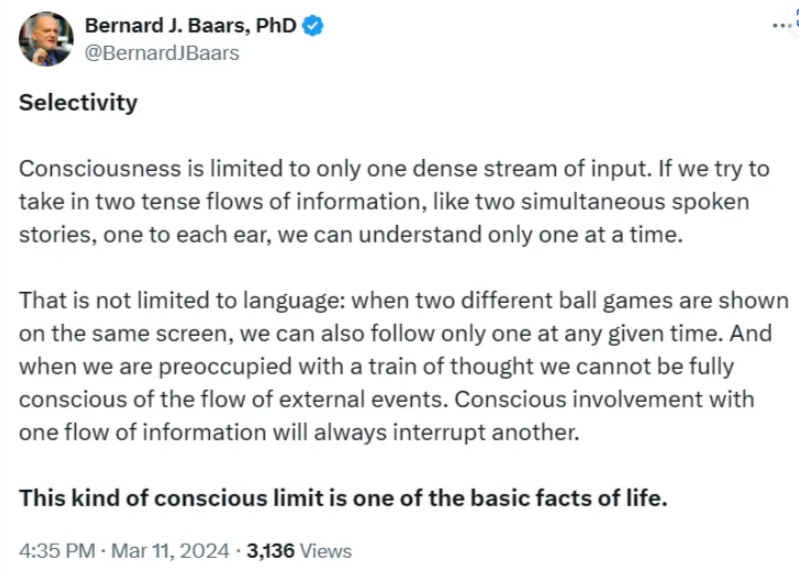
Some readers may wonder how reading (or writing) and simultaneously listening to music fits into Bernard J Baars’s* post above.
Sure, you can’t concentrate as much on the music as you could do if you listened to it exclusively. However, surely these two things do occur together. Indeed, listening to music and reading (or writing) at the same time is a common phenomenon.
Of course, it may be the case that we switch from one to the other. (Baars talks in terms of “once flow of information will always interrupt another”.)
Personally, it’s hard to tell if switching is actually going on.
For example, while writing these very words, I’m aware of the music in the background. I must be! I can note the tunes, the harmonies, and even the moods and emotions the music brings about. What’s more, if something very surprising occurred in the music (or a particularly “catchy” bit came up), then I’d immediately notice that. This strongly suggests that I’m (nearly?) always aware of the music while writing…
Actually, surely I am listening to the music while writing!
So, on the surface at least, there’s no total (or complete) switching betweenwriting and listening to the music. (Again, Baars writes: “Conscious involvement with one flow of information will always interrupt another.”) However, there may well be a lesser degree of switching occurring. In other words, the music is less focussed upon than it would be if I were not writing. However, and as already stated, the music is still being listened to.
Ned Block on Phenomenal Consciousness and Access Consciousness
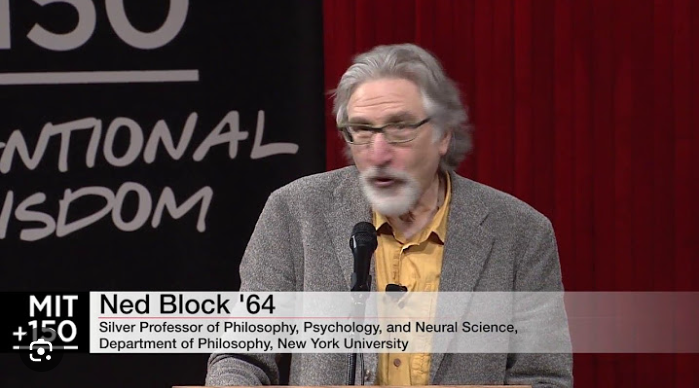
All this reminds me of an example from the American philosopher Ned Block. This is of someone writing (or reading), and all along there’s the sound of church bells coming from outside his home. The reader (or writer) hears the church bells at all times. However, only at a certain time does he actually note (a loose word, admittedly) that it’s church bells that he can hear.
As Block puts it: this person is phenomenally conscious of the church bells all along. However, he becomes access conscious of the bells only at a certain point.
The terms of the trade have it that the hearing of the church bells (though not as church bells) is an example of (according to Block again) “phenomenal consciousness without access-consciousness”. (“Access-consciousness” includes the application of concepts — among other things - to “phenomenal consciousness”.)
To clarify. A person can hear church bells, and not hear them as church bells. In other words, concepts may not be applied to all the sounds a person hears. (This way of putting it doesn’t seem to be as easily applicable to my own writing-while-listening-to-music example.)
Are these examples of experiences in the strict sense?
It could be the case that while these sounds are entering consciousness, the mind is applying concepts to other things instead. So the sensory input from the the church bells (or from the “background music”) are in (as it were) outer consciousness. The sounds aren’t experiences in that the mind doesn’t infer anything from them. They’re not, as Block himself puts it, “poised for reasoning”. And they’re certainly not an epistemological “given” because there’s no cognitive awareness of — or relation to — the sounds.
Thus, these sounds can’t be the ground for inferences, knowledge or anything else.
To sum up. Nothing is derived from the sound of the church bells when they’re not heard as church bells.
The philosopher John Searle clarified things a little here.
Searle argued that we can call the sound of church bells (or the music listened to while writing) an example of what happens in “peripheral consciousness”.
The American philosopher Jennifer Church also cited an example of supposed phenomenal consciousness when she wrotethe following words:
“Consider the example of a noise that I suddenly realise I have been hearing for the last hour. [Ned] Block uses it to show that, prior to my realization, there is phenomenal-consciousness without access-consciousness.”
This would be an example of Searle’s peripheral consciousness. However, Jennifer Church even denied (or doubted) the possibility of true phenomenal consciousness without access consciousness. She continued:
“[I]t seems that I would have accessed it [the noise] sooner had it been a matter of greater importance — and thus it was accessible all along. Finally, it is not even clear that it was not actually accessed all along insofar as it rationally guided my behaviour in causing me to speak louder.”
This is roughly equivalent to my own example of suddenly paying more attention to the music when, say, some catchy tune pops up. (Or perhaps when the internet connection cuts off the music entirely.)
Ned Block himself comes up with an alternative way of describing this putative before-noon pure example of phenomenal consciousness: “P-consciousness without attention.” I would say, perhaps only as a paraphrase, PC with inattentive AC (access consciousness). To use John Searle’s term again, the noise of church bells before noon (or the music in the background) was mainly peripherally conscious, although never an example of pure phenomenal consciousness.
Strangely enough, while writing some of the words above there was a noise outside my own flat. I didn’t pay attention to it. I was inattentive. (The noise was in peripheral consciousness.) However, I knew all along that it was at least a noise. Indeed, perhaps all along I knew that it was a car alarm. After all, if the car alarm had seamlessly turned into a scream (if you can imagine such a thing), then I would have become more attentive to the noise.
Concluding Note: What About the Brain?
Some readers may wonder how the (as it were) facts of the matter would be established in the cases discussed above. After all, the whole thing is dependent upon my own “verbal reports” (or subjective reports) on what’s going on inside my head. My own personal reports could, of course, be correlated with other people’s verbal and subjective reports on the same issue. And much could be concluded from that. However, we’d still only have various verbal reports about subjective experiences.
So some readers may alsowonder (i.e., as non-specialists) what’s going on in the brain to make all this possible. Perhaps neuroscience could provide an answer to the limited scope of all the verbal reports about what subjectively occurs when reading (or writing) and listening to music at the same time.
(*) Bernard J. Baars (born 1946) is a neuroscientist who’s best known as the originator of the global workspace theory. He has worked as a professor of psychology at the State University of New York, Stony Brook.
First things first. Readers should note that the argument being advanced in the following essay isn’t that all scientists utter the absolute truth every time they open their mouths. (Thus, that we should believe literally everything scientists say.) And neither is it being put forward that all non-scientists know nothing much about any scientific subject. (In certain cases, non-scientists may actually know more than professional scientists when it comes to specific issues or subjects.)
Still, scientific testimony is a real thing.
And this is certainly more the case when it comes to some scientific subjects (such as mathematical physics generally, or string theory particularly), than when it comes to other scientific subjects.
What’s more, scientists themselves often rely on testimony. Indeed, that’s even the case when it comes to their very own specialisms!
Introduction
In my essay ‘Physicist Peter Woit on the Sociology of String Theory’ I said that, to a non-physicist such as myself, Peter Woit’s criticisms of string theory certainly seem convincing. And then, after quoting Woit’s technical take on this issue, I continued with the following passage:
“I used the words ‘to a non-physicist’ just before I quoted the long passages above. I’m not saying that all readers need to be professional physicists in order to make sense of the scientific parts. However, I certainly don’t feel qualified enough to come down either way on many of Peter Woit’s scientific pronouncements.”
I then promised to go into detail on this.
Scientific Testimony
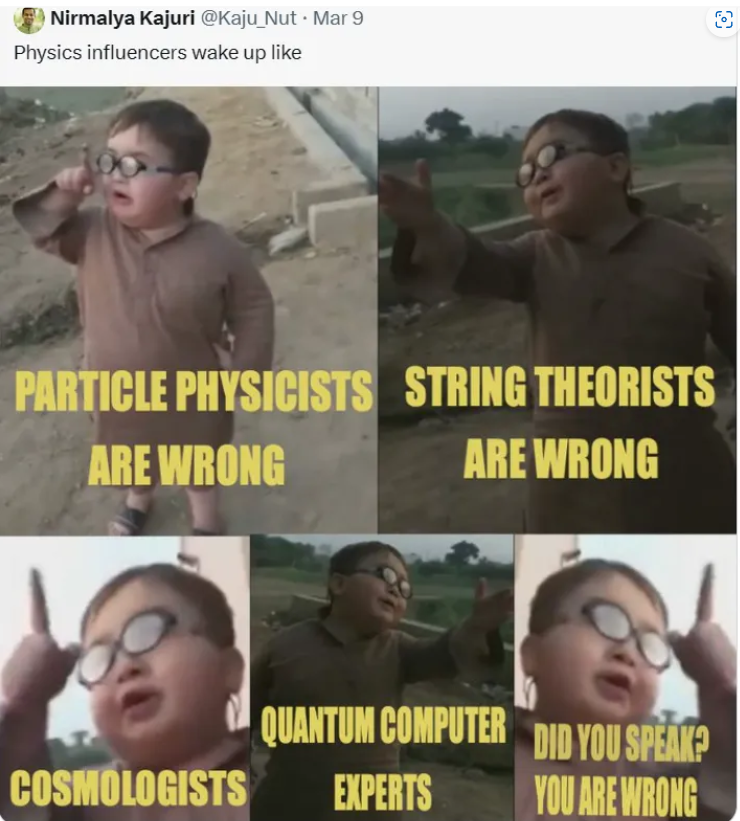
Now takea look at this meme:
There’s an element of truth in the meme above. Personally, I feel like I’m encroaching on sacred territory whenever I comment on physics — especially on string theory. Put simply, I don’t know the maths. Thus, to varying degrees, I must rely on what philosophers call testimony…
Not that any single testimony — even a large scale set — could ever be decisive when its comes to a non-scientist (or a layperson) accepting a scientific idea or theory. After all, the community of physicists itself contains members who often (sometimes strongly) disagree with each other.
And it can’t all be about body counts (i.e., or the “scientific consensus”) either.
The other thing about the meme above is that particle physicists themselves say that other “particle physicists are wrong”. Some physicists say that string theorists are wrong. Indeed, some string theorists say that other string theoristsarewrong— at least on details.
So how does a layperson deal with the claims of scientists?
More specifically, how does a layperson deal with statements about string theory, M-theory, the multiverse, the Big Bang, cosmic inflation, dark matter, black holes, etc?
I’ll come clean here…
Again, when it comes comes to mathematical physics generally, I mainly rely on testimony.
Indeed, when it comes to string theory specifically, what else can I rely on other than testimony?…
I’m not a physicist.
I’m not very good at maths.
Sure, I know a bit about physics, and some basic maths. I also know (or I may know) the non-mathematical parts of the physics I comment upon.
But is all that enough?…
Enough for what?
Well, it depends.
So if we take Peter Woit’s own words on string theory again, then I certainly don’t know all the maths or physics. I probably don’t even know 1% of the maths. (This is, of course, an entirely arbitrarypercentage.)
So where does that leave me?
Indeed, where does it leave other non-scientists (or laypersons)?
It leaves me (if not all other laypersons) with philosophy of science books and papers, as well as popular-science books and articles.
Again, is that enough?…
All that said, many non-physicists certainly do believe that they have enough knowledge and wisdom to come down strongly in favour (or against) string theory, M-theory, the multiverse, the Big Bang, cosmic inflation, dark matter, black holes, the standard model, etc. (Many non-scientists also have an aesthetic taste for particular interpretations of quantum mechanics.)
Yet surely science mustn’t be the sole preserve of professional scientists.
That said, even after reading many introductions to scientific issues, it’s still very difficult for a non-scientist to come down on any side. Or, rather, it isn’t difficult for some laypersons, but it is for others.
In terms of string theory again.
I personally don’t have a firm scientific position on string theory. I certainly don’t adopt any strict scientific position on it. That’s primarily because any position (at least of a scientific nature) on string theory must — almost of necessity — involve complex mathematics, as well as a deep knowledge of mathematical physics generally…
Yet (as already stated) I’m neither a mathematician nor a physicist.
So where does that leave me?
Where does that leave all non-scientists (or laypersons)?
All that said, it’s also the case that nothing advanced in this essay depends on my knowing the complex mathematics required for any scientific theory. Indeed, everything said should stand (or fall!) without such detailed technical knowledge…
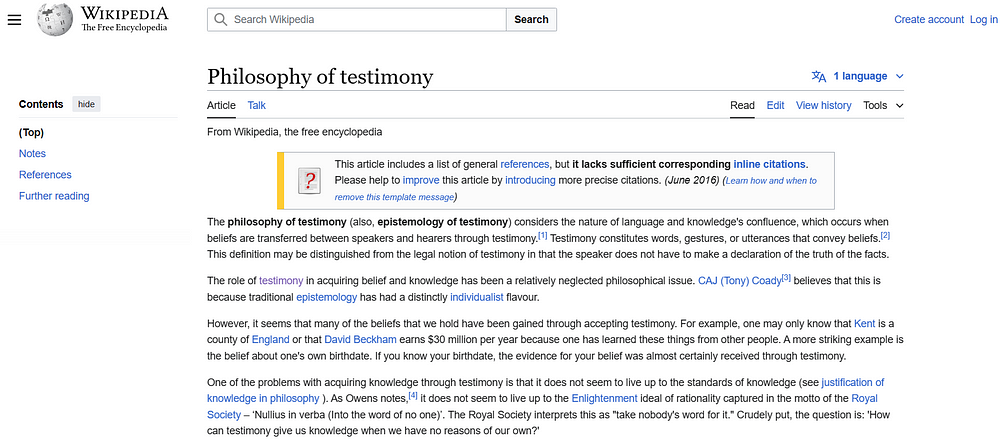
“[I]t seems that many of the beliefs that we hold have been gained through accepting testimony. For example, one may only know that Kent is a county of England or that David Beckham earns $30 million per year because one has learned these things from other people.”
Couldn’t it be argued that most (i.e., not many) “of the beliefs that we hold have been gained through accepting testimony”? That said, individuals hold so many beliefs that it would be almost impossible to quantify, and then answer, this question. In any case, the two examples given in the passage above could be added to indefinitely when it comes to the set of beliefs the average person holds.
When it comes to string theory (or any other complex theory from physics), then isn’t (almost?) everything the layperson holds based on testimony?
“One of the problems with acquiring knowledge through testimony is that it does not seem to live up to the standards of knowledge. As Owens notes, it does not seem to live up to the Enlightenment ideal of rationality captured in the motto of the Royal Society — ‘Nullius in verba (Into the word of no one)’. The Royal Society interprets this as ‘take nobody’s word for it.’"
All this depends on which “standards of knowledge” we have in mind. Perhaps there is no definite article when it comes to the “standards of knowledge”. Or, rather, there may be, but only if we single out (as this writer has done) something like “the Enlightenment ideal of rationality”.
Indeed, we can even question this standard of knowledge (i.e., “take nobody’s word for it”) because it may be impossible to abide by. On a daily practical level, this would certainly be the case. However, even philosophically, it may be too much to ask.
What’s more, if this version of the Enlightenment ideal of rationalityis truly an impossible ideal, then in what sense can we call it a definition of (or take on) rationality at all?
In addition and self-referentially speaking, don’t some of us take it on testimony that this Enlightenment ideal of rationality is itself, in fact, a true or worthy ideal? Moreover, is the aim of knowledge (or rationality) really to “take nobody’s word for”… anything? [This was Descartes’starting point in hisCogito.]
Try it.
Try taking no one's word for anything.
Then see how things turn out.
Thus, this (as it were) radical Enlightenment stance on rationality (or knowledge) may itself need to be accepted on testimony — at least at first.
In any case, the quoted passage from Wikipedia ends with this final question:
“Crudely put, the question is: ‘How can testimony give us knowledge when we have no reasons of our own?’”
Is this correct?
We may have “reasons of our own” for accepting other people’s reasons of their own. After all, accepting only one’s own “word for it” could literally incapacitate us. Thus, knowledge-wise, we’d then possibly be in a worse position than the gullible person who accepts everything everybody says.
Now take Wittgenstein’s case against global scepticism (or against global doubt), and how it can be connected to taking any strong position on testimony.
“The questions that we raise and our doubts depend on the fact that some propositions are exempt from doubt, are as it were like hinges on which those [doubts] turn.
“That is to say, it belongs to the logic of our scientific investigations that certain things are in deed not doubted…
“My life consists in my being content to accept many things.”
We can’t doubt anything without exempting certain others things from doubt. Thus, the basic position here is that even philosophical doubt requires belief. In other words, in order to get the game of doubt under way, certain things must be placed beyond doubt.
In terms of testimony itself, that paragraph directly above can now be rewritten in this way:
We can reject (or doubt) a single case of testimony while also exempting many others cases of testimony from doubt.
The basic position here is that even philosophical doubt about certain cases of testimony requires belief about other cases. In other words, in order to get the game of rejecting (or doubting) testimony under way, certain other examples of testimony must be placed beyond doubt.
To give a mundane example.
Say that you’re doubting a friend’s testimony when it comes to (as it were) the facts of geography. You wouldn’t also thereby doubt the very meanings of your friend’s (non-technical) words.
That would be semantic doubt, not geographical doubt.
Similarly, you wouldn’t contemplate the possibility that your friend’s statements about geography are actually coming from a person, rather than from a robot or an evil demon. That would be a doubt about “other minds”, not a doubt about geographical statements.
So what’s at the heart of these “exemptions from doubt” is the “context” in which each case of testimony takes place. As Wittgenstein (again) put it:
“Without that context, the doubt itself makes no sense: The game of doubting itself presupposes certainty.”
“A doubt without an end is not even a doubt.”
If one rejects (or doubts) every case of testimony, then there’s no sense in rejecting (or doubting) any caseof testimony. Thus, doubts about particular cases of testimony must occur within the context of belief.
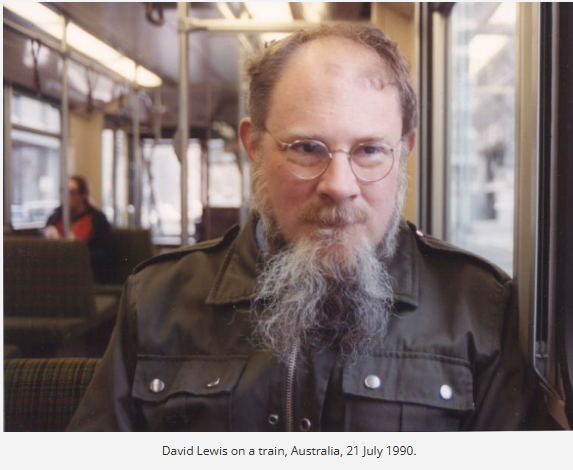
So it’s worth bringing in the American philosopher David Lewis here.
David Lewis on What We Can Properly Ignore
At least within the limited (or strict) domain of epistemology, David Lewis (1941–2001) introduced the notion of what can be “properly ignored”. This is the idea that certain “sceptical possibilities” can be properly ignored if they’re deemed to be irrelevant.
Similarly, one needn’t be sceptical about (or one needn’t question) all cases of testimony.
Strictly speaking, Lewis’s account of the notion of properly ignoring (sceptical) possibilities applies (as with Wittgenstein) only to specific contexts. The following passageis Lewis himself on this matter:
“I may properly ignore some uneliminated possibilities; I may not properly ignore others. Our definition of knowledge requires a sotto voce proviso. S knows that P iff S’s evidence eliminates every possibility in which not-/’ — Psst! — except for those possibilities that we are properly ignoring.”
However, both Lewis himself and other philosophers broadened this notion out to include other cases.
Lewis himself specifically mentioned testimony. He asked his readers the following question:
“What (non-circular) argument supports our reliance on [] testimony?”
Lewis’s point was that Smith’s reliance on testimony (as well as on perception and memory) in the past is believed (by Smith himself) to justify his reliance on testimony in the present…
Yet surely this is acircular position.
In other words, Smith is using his prior reliance on testimony to justify his present reliance on testimony.
What’s more, what if Smith hadn’t even justified his prior reliance on testimony? Would this mean that his present reliance wouldn’t be justified either?
Of course, it might well have been the case that Smith’s prior reliance on testimony was indeed justified. However, do his previous justifications automatically mean that he doesn’t need to (re)justify his present reliance on testimony?…