


I always had a problem with the term “meaningless” as it was used by the logical positivists in the 1920s, 1930s, and 1940s. My problem existed even though I sympathised with (some of) the spirit of logical positivism. (I still do.) It seemed to me that classing statements as “meaningless” is problematic and somewhat pompous. And even when I came to realise that the word “meaningless” had a highly-technical meaning, I still found it suspect.
Still, once the details are out of the way, it can be seen that the use of word “meaningless” is not as problematic as it initially sounds.
Rudolf Carnap’s Position
In his 1932 paper ‘The Elimination of Metaphysics Through Logical Analysis of Language’, Rudolf Carnap wrote the following:
“The metaphysician tells us that empirical truth-conditions [for metaphysical terms such as ‘the absolute’] cannot be specified; if he asserts that nonetheless he ‘means’ something, we show that this is merely an allusion to associated words and feelings, which however, do not bestow a meaning.”
It’s certainly the case that there’s something stipulationary about the passage above.
For a start, there are clearly no “truth-conditions” for countless acceptable statements in the English language (as well as in all languages). That said, the logical positivists only had certain statements in mind. That is, they weren’t referring to exclamations like “Shut that door!” or even value judgments like “Mozart’s 40th Symphony is a great piece of music”. They were referring to what some philosophers call assertoric statements — i.e., those statements which are (seemingly) capable of being either true or false. Thus the positivists argued that such suspect statements assert nothing. That is, they can be neither true nor false. Yet such statements still gave the (as it were) impression of being acceptable statements.
Carnap himself stressed the importance of what he called “empirical truth-conditions”. Such things alone can’t supply the meaning of any statement or sentence. For a start, individual words don’t have truth-conditions. And, arguably, if some of the individual words which make up a statement don’t have truth-conditions (or, more correctly, referents or extensions), then the entire sentence can’t have a truth-condition either.
In any case, Carnap was saying that if a sentence doesn’t have an empirical truth-condition (or an empirical truth-condition that “cannot be specified”), then it can’t have a meaning. Thus empirical truth-conditions were tied to meaning.
It’s also worth noting here that, at one point in his career, Ludwig Wittgenstein expressed virtually the same position as Carnap when he wrote the following words in 1929 (i.e., some three years before Carnap expressed his own position):
“The other conception, the one I want to hold, says, ‘No, if I can never verify the sense of a proposition completely, then I cannot have mean anything by the proposition either. Then the proposition signifies nothing whatsoever. In order to determine the sense of a proposition, I should have to know a very specific procedure for when to count the proposition as verified.”
This is odd really when taken within the context of the hard work the Wittgenstein Interpretation Industry has carried out earnestly attempting to distance Wittgenstein (or at least the Wittgenstein of this particular period) from the logical positivists. Such people are also very keen to stress that the logical positivists didn’t (truly) understand Wittgenstein’s work. However, if we take Wittgenstein’s words above alone (or as they stand), then they almost perfectly square with Carnap’s position.
If we return to Carnap himself.
Carnap also mentioned “associated words and feelings” in the passage above.
Does it follow that because there are associated words and feelings (as it were) attached to a statement, that it can’t also have empirical truth-conditions? That may be the case if the given statement has only associated words and feelings attached to it. But why can’t those associated words indirectly (as it were) supply the empirical truth-conditions?
For example, the statement “God is good” may not have any empirical truth-conditions. However, the words — and arguments — associated with it may well do so. The problem then would be that the statement isn’t taken as it is. That is, we’d need to decipher which other words — and arguments — are associated with it. Having said that, isn’t that also the case with virtually all other statements in a natural langue? In other words, are any statements genuinely freestanding?
And why can’t “feelings” also “bestow a meaning” on a statement?
What I mean by that is this.
What if those feelings are given a linguistic (or verbal) expression? In other words, feelings alone can’t have meanings. However, the sentences which express those feelings may have meanings. Indeed feelings are — at least partly — empirical (i.e., behaviour and physical) phenomena even if they’re not truth-conditions in themselves. This means that if someone says “God is good”, then the feelings associated with that statement can be expressed in words and those words may have meanings. In addition, words can be used to explain why these feelings gave rise to the expression “God is good”. And those words, in turn, may have meanings. Again, the problem here is that we’re moving further and further away from the bare statement “God is good” — even though it’s the empirical truth-conditions of that statement which we’re supposed to be considering (i.e., not the truth-conditions of “associated” words or statements).
Grammar
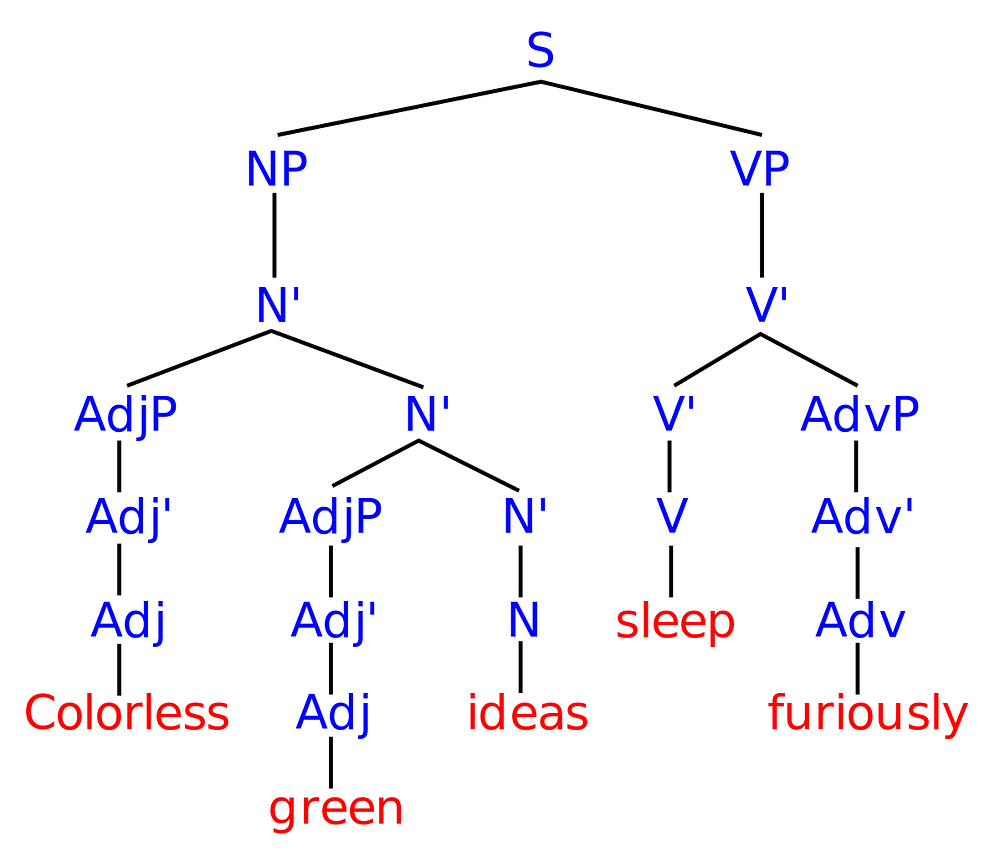
To state what may be obvious: the logical positivists didn’t mean ungrammatical by “meaningless”. Indeed the supposedly meaningless statements they had in mind were perfectly grammatical. Moreover, the perfectly-acceptable grammatical form of these statements was what made them problematic in the first place (at least in part). In addition, it was usually only philosophical (or “metaphysical”) statements which the logical positivists had their eyes on.
So if someone writes (or says) “Cat colours when they are at it bad”, then that’s clearly meaningless. However, the statement “God is perfectly good” is grammatically acceptable. And that (again) is precisely why the logical positivists had a serious problem with it. This means that they believed that many people were (to use Wittgenstein’s words) “misled by the grammar” of such statements.
That said, problems with this logical-positivist position were quickly spotted.
For example, in 1953 the Polish logician Czesław Lejewski wrote the following words about the word “meaningless”:
“One may disagree as to the truth-value of the proposition ‘Pegasus exists’ but one would have to have attained an exceptionally high degree of sophistication to content that the expression was meaningless.”
Lejewski then went on to give an example of this:
“Quine does not think that empty noun-expressions are meaningless just because they do not designate anything. He allows for the use of such words as ‘Pegasus’, ‘Cerberus’, ‘centaur’, etc…”
As can be seen, the words above are actually about W.V.O. Quine’s philosophical position on the the status of “empty noun-expressions” (or non-referring proper names). That said, they’re still perfectly apt for this discussion. Quine himself, however, was never a logical positivist — not even when young. Yet he was indeed influenced by logical positivism and he even attended sessions of the Vienna Circle (see here).
In this specific example, Lejewski (at the very least) disentangled truth from meaning (i.e., without also denying that they’re strongly related to each other).
Put at its most basic: it may seem that the logical positivists — and many others — simply meant false when they used the word “meaningless”. So because they deemed the sentence (say) “God is omnipotent” to be false, then they also deemed it to be meaningless. That is, that statement is meaningless because it is false. But that’s an obvious conflation. In other words, it is false to claim that a false statement must also be meaningless. Indeed even the sentence “The Hobbit is six-miles tall” isn’t meaningless.
It’s not just that the logical positivists — and others — deemed a given statement p to be meaningless because it is false. They also deemed p to be meaningless because their philosophical (or semantic) position — alone — rendered it meaningless. This meant that the statement “God is omnipotent” (or “Pegasus exists”) was only meaningless to someone who’d already adopted a philosophical (or semantic) position that displays (to use Lejewski’s words) “an exceptionally high degree of sophistication”. To put that simply: if a person had no idea whatsoever about the exceptionally-sophisticated philosophical (or semantic) position of the logical positivists, then there was no reason on earth why he should have believed that the statement “Pegasus exists” (or “God exists”) is meaningless. False…perhaps. Meaningless… absolutely not!
In specific reference to Quine’s case (as commented on by Czesław Lejewski).
Empty noun-expressions within a statement don’t render that statement meaningless. They may render it false. However, even that claim is problematic when it comes to statements about fictional characters and situations. As Lejewski himself hints, it’s possible that even statements about fictional characters and situations may be deemed true if they correctly abide by the pre-existing fiction about those characters and situations. (This is another issue entirely!) The relevant point here is that statements about Pegasus (or God) aren’t automatically meaningless simply because there’s never been such a thing as Pegasus (or God) outside of mythology (or religion).
Let’s go back further than the logical positivists of the 1930s. I’ll do so because it can be seen that some of their views (at least in a variant form) had a history dating back to 1918 and probably before that.
Take Bertrand Russell’s position on names.
Russell — in his 1918 paper ‘Existence and Description’ — believed that in order for names to be (genuine) names, then they must name — or refer to — things which exist. Thus Russell’s theory was an attempt to solve that problem by arguing that if a named x doesn’t exist (or have being), then that name of that given x must be a “disguised description”. (In the case of the name “Pegasus”, the description could be “the fictional horse which has such and such characteristics”.)
Now take this remarkable passage from the aforementioned paper:
“The fact that you can discuss the proposition ‘God exists’ is a proof that ‘God’, as used in that proposition, is a description not a name. If ‘God’ were a name, no question as to existence could arise.”
Personally, I don’t have much time for Russell’s argument above. It seems to have the character of a philosophical stipulation — as with the logical positivists’ use of the word “meaningless”! It’s primary purpose is logical and philosophical. At the time Russell was reacting to the “ontological slums” (as Quine later put it) of the Austrian philosopher Alexius Meinong (1853–1920). However, this semantic philosophy (as stated) simply seems like a stipulation (or a normative position) designed to solve various perennial philosophical problems.
As for Quine, he had no problem at all with the naming of non-beings or non-existents (though non-being and non-existence aren’t the same thing). In his 1948 paper, ‘On What There Is’, he dismissed Bertrand Russell’s position. Quine, however, put Russell’s words in the mouth of McX and used the name “Pegasus” rather than the name “God”. Quine wrote:
“He confused the alleged named object Pegasus with the meaning of the word ‘Pegasus’, therefore concluding that Pegasus must be in order that the word have meaning.”
So to sum up: a name — like a statement — can have a “meaning” (or, more accurately, “sense”) without it referring to something which exists (or even something which has being). Quine thus untied meaning from reference; whereas Russell only thought in terms of reference (or, at the least, he tied meaning to reference).
Yes… Logical Positivism’s Self-Referential Self-Destruction
By “empirical truth-conditions” the logical positivists (or at least Carnap) meant that which we experience — or can experience — with our senses.
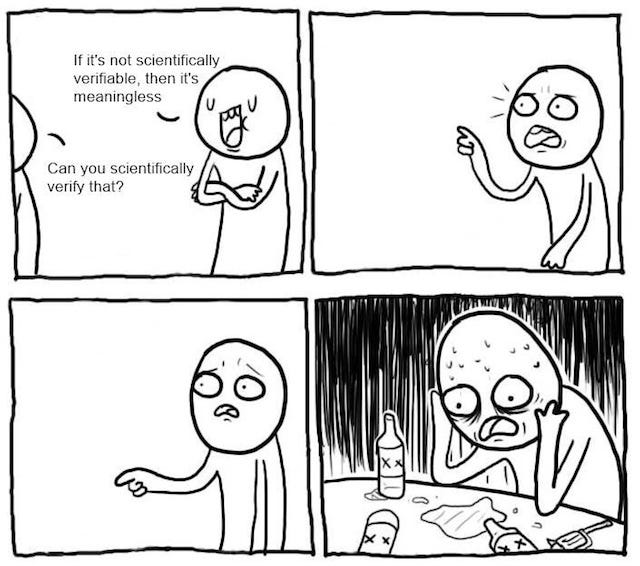
The problem here is the often-commented-upon one of logical positivism’s self-referential self-destruction (which is a mouthful). The American philosopher Peter van Inwagen, for example, puts the point perfectly. Firstly he expresses the logical positivists’ general position:
“The meaning of a statement consists entirely in the predictions it makes about possible experience.”
And then van Inwagen gleefully notes its self-referential flaws:
“Does this statement make any predictions about possible experiences? Could some observation show that this statement is true?… It would seem not… And, therefore, if the statement is true it is meaningless; or, what is the same thing, if it is meaningful, it is false.”
The problem with van Inwagen’s analysis is that although many logical positivists might have accepted the statement “The meaning of a statement consists entirely in the predictions it makes about possible experience”, what van Inwagen says about this statement may still not be the case. Logical positivist might have taken the statement — indeed some did! — as a second-order (or a meta) statement. Either that or as a principle (normative or otherwise). In other words,
“The meaning of a statement consists entirely in the predictions it makes about possible experience”
is a statement about a statement, not a metaphysical statement. That is, it’s not a statement about the nature of the world: it’s a statement about a statement about the world. Another way of putting that is to say that it’s an epistemological take on a statement about the world.
The failure to make this kind of distinction is summed up by the science journalist John Horgan when he recalled an interview with Karl Popper. Firstly Horgan quotes Popper. He writes:
“[]‘The first thing you do in a philosophy seminar when somebody proposes an idea is to say it doesn’t satisfy its own criteria. It is one of the most idiotic criticisms one can image!’[].”
Then Horgan adds his own take:
“Falsification itself is ‘decidedly unempirical’; it belongs not to science but to philosophy, or ‘metascience’, and it does not apply to all science. Popper was admitting… that his critics were right: falsification is a mere guideline, a rule of thumb, sometimes helpful and sometimes not.”
Having said all that, we can now return to Carnap’s own words and apply what’s just been said to them.
Specifically, what sensory experiences (as it were) belong to the following statement?-
What the metaphysician states is merely an allusion to associated words and feelings, which, however, do not bestow a meaning.
Did the logical positivists experience (with their senses) a metaphysician alluding to “associated words and feelings” when he stated something? The logical positivists might well have experienced the metaphysician’s words if he had verbally expressed— or written — the fact that his own words were associated with various other words and feelings. However, what if the metaphysician didn’t do so? If the metaphysician didn’t do so, then the logical positivists weren’t relying exclusively on their own sensory experiences (or on empirical truth-conditions) to state what they stated. In fact they might not really have had any (empirical) idea that the metaphysician was doing any of the things they were (as it were) accusing him of.
In addition, did the logical positivists experience the “bestow[ing] of meaning” on statements? Does the act (if that’s what it is) of bestowing meaning itself have empirical truth-conditions? Indeed even if the logical positivists were correct when they stated that meaning is tied to empirical truth-conditions, is that tie itself empirical? Did the logical positivists experience that tie with their senses? More pedantically, does the word “meaning” have a referent or an extension?
We can also accept the Frege’s context principle is which a word only has a (semantic) place within a sentence. But even then we can still ask what legitimacy the word “meaning” has from an logical positivist point of view.
To change tack.
Is a word, concept or statement automatically “pseudo” if it “asserts nothing”? This might of course be a circular argument. That is, if a word, concept or statement didn’t abide by the rules of logical positivism, then, by definition, logical positivists will have deemed it to be a pseudo word, concept or statement. But no one was ever required to accept the rules of logical positivism. And even if they were required to do so, wasn’t the word “pseudo” — like “meaningless” — still a little rhetorical?

