Thursday, 3 July 2014

Einstein was a Fraud

How a person’s politics can determine his or her positions on scientific theories.
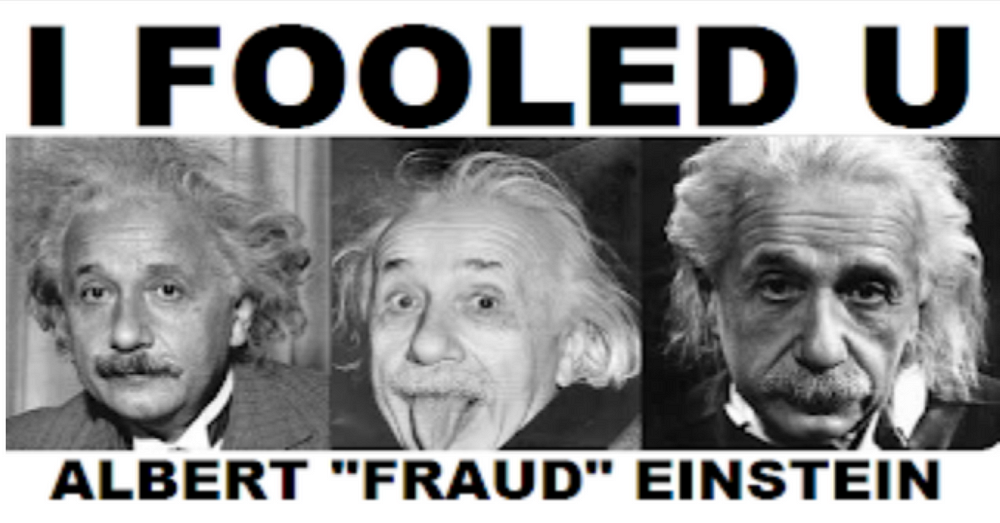
This is my reply to a group of comments I discovered on the Online Philosophy Club’s Discussion Forums. In those comments, a DarwinX articulates views which many people held about Albert Einstein — and what was called “Jewish science” — in the 1920s and beyond. Indeed, as DarwinX will show, some people still hold these views today (see here).

DarwinX’s reasons for arguing that “Einstein was a fraud” are entirely to do with politics and the fact that Einstein was Jewish. That is, his criticisms aren’t in the least bit scientific. However, in order to advance political positions on scientific theories, certain seemingly scientific claims will often need to be advanced — even if in very crude forms. This is as true of certain people on the Left as it is true of certain people on the Right. However, in the case of DarwinX at least, it just happens to be someone on the (Far) Right who’s discussed in this respect.

Some people on both the Left (usually on the Far Left) and Right (usually on the Far Right) argue that this complete separation of science from politics is not only “naive” and “simplistic”: it’s also “dangerous”! I’m willing to accept that in certain respects, it may well be so. However, when people’s prime (or only) concern is politics and various social causes, then such people will hardly consider (even for a single second) a scientific theory without viewing it through their powerful and all-encompassing political prisms. And, I believe, that too is dangerous — as history has shown (e.g., from the Nazis in Germany to the Communists in the Soviet Union to what often still happens today).

In any case, the discussion below can be found here. My own comments can be seen under the name PAM (i.e., Paul Austin Murphy).

******************************

This was DarwinX’s first comment:

“The main reason Einstein was chosen to be the ambassador of physics is because he was Jewish and it would have be considered racist to criticize any of his theories. This is how the system uses political correctness to protect corrupt and deviate theories and ideas. Einstein completely obliterated the use of logic in science by introducing his his crazy ideas of relativity and curved space time which has destroyed logical science to this day.”

I don’t believe that today’s kind of political correctness existed when Albert Einstein first made his name as a great physicist in the early 1920s. However, it can of course be said that some kind of political correctness might have existed — even then.

[The video DarwinX links to mentions Antonio Gramsci, whose work didn’t become known outside Italy until the 1930s and it didn’t become widely influential until much later than that. As for the Frankfurt School, which is also mention: it’s main impact was felt post-1945. Einstein, on the other hand, first became a public figure in 1921 when he won the Nobel Prize.]

So this entirely depends on what the words “political correctness” mean.

Anyway, the idea that people — especially scientists — didn’t criticise Einstein’s theories because he was Jewish is incredible. Science simply doesn’t work like that on the whole — or even at all.

For example, what would have happened if another Jewish scientist produced theories which directly contradicted Einstein on relativity and “curved spacetime”? One can almost guarantee that this happened! (Jewish people are very good at criticising… Jewish people. Then again, non-Jewish people are good at criticising non-Jewish people too.) Would that have meant that, for reasons of “political correctness”, scientists would have had to accept both Einstein’s theories and their contradictions because both scientists were Jewish?

In addition, Einstein based a lot of his theories on previous scientific theories and mathematical work (which he freely admitted) which was created by mathematicians and scientists who weren’t Jewish. Does this mean that these non-Jewish bits of Einstein's work aren’t “corrupt” and the Jewish remainder is (to use your word) “corrupt”?

In any case, what’s intrinsically Jewish about relativity theory?

In 20th century philosophy, for example, Jewish philosophers — from Ludwig Wittgenstein to Thomas Nagel— have advanced theories which directly contradicted each other. Does that mean that both a Jewish theory and its direct contradiction are corrupt and therefore equally Jewish?

And I doubt there have been any scientists — except in someone’s imagination — who would have refrained from criticising Einstein’s theories simply because he was Jewish (especially in the 1920s and before). The stronger possibility is in the reverse direction: that Einstein’s theories would have been criticised simply because they were advanced by a Jewish person... Indeed Einstein’s theories were, in fact, criticised for precisely that reason by Adolf Hitler [see here], the National Socialists [see here] and others.

How can scientific theories be corrupt anyway? They can be false, misguided, not based on good theory or evidence, etc. — but corrupt?

If science isn’t a communal activity, then it’s not science at all. And, as a communal activity, science, on the whole, accepts relativity theory and the Einsteinian spacetime - if under suitable conditions. (This doesn’t mean that they will be accepted — as they are — for all time or that they won’t be adapted in some way.)

As for my own position, I simply don’t know enough about physics myself to offer anything new or original on relativity and Einsteinian spacetime. I certainly don’t know enough to criticise these theories. You would need to be a higher mathematician, an advanced physicist or a cosmologist to offer any justifiable criticisms of relativity theory and spacetime — never mind to offer theories which attempt to “refute” them outright.

DarwinX went on to say:

“Science is not a matter of opinion or consensus. There is only truth and reality. A consensus has nothing to do with truth or reality. Organizing science according to the dictates of consensus leads to corruption and bogus science.”

Saying that science is a communal activity isn’t the same thing as saying that scientific truths (or accurate theories about the world) are determined by the vote or by mindless agreement. The point about a scientific community is that it’s better to trust many workers in the field than to trust some individual scientist (or pseudo-scientist) who comes up with a theory he simply believes to be true.

Science is so complex and intricate that one person could rarely have the whole truth on a single theory or position. Even great and original scientists — such as Newton and, yes, Einstein — worked largely within scientific traditions and communities even if their new theories were indeed original and even revolutionary. (Therefore they weren’t immediately accepted by most scientists.) In any case, despite the originality of such scientists, that originality and accuracy still had to be accepted and agreed upon by the scientific community as a whole — and that happened.

So why should anyone accept the views of a lone scientist if he’s working in complete isolation and with no back up from anyone else other than those who already agree with him (perhaps for political reasons)? This is especially true if those people who agree with a lone “scientist” (on, say, the contradictions of relativity theory) aren’t themselves scientists. This simply leads to the question:

Why are people accepting the theories of these lone (or eccentric) scientists when they aren’t themselves scientists and when most other scientists reject their theories?

All I can say is that there are non-scientific (e.g., political) reasons — not reasons of what DarwinX calls “truth and reality” — which are motivating these agreements with these (as it were) alternative scientists or theories.

Then there was more from DarwinX:

“Don’t be intimidated by science theory. Real science is not difficult to understand. Bogus science tends to be over complicated and confusing, mainly because its main objective is to confuse and complicate simple matters.”

I’ve never heard that said before. Does this mean that science as it’s presented in popular-science books or science as it’s done by scientists themselves? There’s a massive difference between the two.

True; some popular-science writers do a marvellous job of clearly expressing scientific ideas. However, even they wouldn’t argue that “real science is not difficult to understand”. The basics aren’t difficult, sure; though that’s because all the mathematics, specialised technical theory and detail are simply missed out of (most) popular-science books. So popular science books are easy to understand. However, popular (or simplified) expositions of science aren’t themselves science. They are about science.

Everything said about science by DarwinX about Einstein is deeply imbued with his political and racial views on things. (Whether his general political positions are acceptable is irrelevant to that point.) His politics is in the driving seat and it’s completely determining his positions on science. Now that may not be a bad thing in itself. It depends on how much DarwinX really knows about science — not about the popular expositions of science by non-scientists and even sometimes by scientists. Again, his primary concern is politics and race; not science. His politics is being applied across the board so that he even sees politics in everything scientific — and, no doubt, in all things non-scientific too. This means that DarwinX is as ideologically and politically driven and fixated as the “politically correct” people he’s arguing against — perhaps more so.

[I can be found on Twitter here.]

The Being of Man


"The reality of the external world to which science points has no psychic depth, no depth of being. It is a plastic mass of events. When scientists study Man, they want to prove that the mind, the psyche, the being of Man, is the effect of bodily existence and thus an effect of matter. They conclude that if the mind is caused by matter, then it is basically unreal, secondary, not a primary reality." - Granth


I'm not sure if there is such a consensus in science on the mind. Even in the limited domain of 'materialist' philosophers of mind, I don't think that there is such a consensus.

Granth refers to "no psychic depth, no depth of being" of science. These technical terms seem to be taken from a specific philosophical tradition so it will be hard for people unfamiliar with that tradition to know what such locutions mean.

Granth also says that scientists (all of them?)

"want to prove that the mind, the psyche, the being of Man, is the effect of bodily existence and thus an effect of matter. They conclude that if the mind is caused by matter, then it is basically unreal, secondary, not a primary reality".
It doesn't follow that if a scientists argues, or shows, that "the mind is caused by matter" that he also believes that it is "unreal, secondary". A forest fire can be caused by a discarded cigarette but the fire is still real even if it has other causes. The mind and brain can even be acceptably different domains, according to scientists, and it still be the case that the brain, or something larger, is the "cause" of the mind. Scientists, on the whole, are no longer interested in erasing mind or consciousness from the equation. In fact, only a few scientists ever were completely that way inclined.

As for "the Being of man" - that seems to be the technical language of a specific philosophical tradition which, presumably, not all posters on this website will be aware of even if they know much philosophy. What is "the Being of man"?

Frank Ramsey's Paradox of Londoners & Their Hairs


Although Frank Ramsey's proof isn't exactly a paradox, it is worth mentioning anyway.

Ramsey set out to prove that there were exactly two Londoners with exactly the same number of hairs on their heads.

How did he prove that?

Firstly, when Ramsey was writing he noted that there were more than a million Londoners. He also noted - though God knows how - that there were less than a million hairs on any one Londoner's head.

So how do we move from those two truths to the truth that there are at least two Londoners who have exactly the same number of hairs on their heads?

Well, for a start, there are more Londoners than hairs on any single Londoner’s head. That is, there are more than a million Londoners; though no person has more than a million hairs on his or her head. So what? This has been expressed in the following way:

“If there are more pigeons than pigeonholes, then at least two pigeons must share a hole.”

This means that because there are more Londoners than there are hairs on any one individual's head, then at least two Londoners must share the same number of hairs. How does that prove what it claims to prove? And doesn't it depend on how many more (than a million) Londoners there are?
For example, will this proof still work if there were only one million and one Londoners? In addition, what about the possibility of massive coincidence or high proportions with large numbers of hairs or very small numbers of hairs? Doesn't the proof depend on a certain level of statistical balance?
The argument seems to be: 

i) Because there are over a million Londoners,
ii) though only a maximum of a million hairs on any one person's head,
iii) and since there are a million hairs to share between over a million people [eh? that's wrong],
iv) then two persons or more must share the same number of hairs.
Put it this way: if there are ten people in a room who have to share 9 or less apples, then two people will need to share an apple.

Put it another way: if there were a million Londoners and a maximum number of a million hairs on a Londoner’s head, then each Londoner could have hairs ranging from one to one million.

In theory at least, every Londoner could have a different number of hairs on his and her head. But what happens when there are more than a million Londoners but still only a maximum of one million hairs on any one Londoner’s head? It can't be the case that every Londoner will have a different number of hairs – even in theory. This will mean, then, that at least two Londoners will have the same number of hairs.

But there's still something suspect about this proof.

In any case, this doesn't seem to be a paradox, or that complex, or even that interesting; though perhaps I've missed the profound or complex bit.

The Expectancy Paradox


One scientist has a theory that people will countenance - or even commit - cruelty if it's approved by some kind of authority figure. That theory intuitively has a lot of plausibility. However, that's not the point of the paradox.

The said scientist carried out an experiment on ten people (i.e., subjects).

The experiment is to see if the ten subjects will press a button which will deliver an electric shock if ordered to do so by an authority figure (given a suitably rational or “scientific” reason to do so).

However, unbeknownst to him, it's the scientist who's the real subject of the experiment. That is, his ten subjects aren't being tested – he is! In fact the ten subjects know what's going on and are given fake electrical shocks. The scientist, on the other hand, doesn't know what's going on. He only knows about his own experiment; not the experiment upon him.

Again, this paradox isn't about the nature of meta-tests or even about why - or if - people really do commit acts of cruelty when told to do so by authority figures. This paradox is actually about the “fudge factor” or “experimenter bias effect". In other words, the scientist is testing his research students and these meta-testers are testing the scientist who's testing research students.


The phrases “fudge factor” and “experimenter bias effect” actually refer to the fact that when a researcher or scientist expects to “discover” or find a certain result, he's very likely to get that result. (Needless to say, when the research or science involves anything which is in any way political in nature, this is even more likely to be the case.)

In Professor Smith's case, his “experimenter bias” is leading him to expect (or want) his subjects to "turn Nazi” and be all too keen to press the electric shock button. It ends up that most of them do so.

Professor Arse, on the other hand, is expecting (or wanting) his subjects not to turn Nazi by being all too willing to press the electric shock button. Yes, most of the don't!

In other words, each scientist has set up the experiment to get the results he wants (for political, psychological, scientific, etc. reasons). In other words, both scientists are fudging - if at an unconscious level.

This bias (or fudging) is brought about in this case by Professor Smith shouting at his students/subjects to press the button. In other words, he wants them to press the button in order to “prove” his theory. Professor Arse, on the other hand, whispers the command to press the button because he doesn't really want them to.

It's said that neither scientist is aware of what he's doing. However, what they are doing is bringing about a self-fulfilling prophesy. (Despite that, I find it hard to accept that they literally know nothing about what they're doing because if that were truly the case, then they wouldn't be doing what they're doing, surely.)

In any case, these experimental and political biases of the two professors were themselves the subject of an experiment by other (meta) scientists. Yes, you guessed it: if the bias of the two scientists is proven or demonstrated by these meta-scientists, and they've also concluded that such bias is widespread (even) in science, then what of themselves? Are they also biased? Indeed was this experiment itself, on other scientists, a perfect example of the “experimenter bias effect” or the “fudge factor”? Are these meta-scientists as biased (or even more baised) than the scientists they were experimenting upon? And if not, why not?

The point is: just as the object-scientists were trying to do tests on people's reactions to the orders of authority figures; so the meta-scientists were testing the object-scientists in order to elicit the reality or nature of scientific bias. In other words, are these meta-scientists being biased about the nature or reality of scientific bias?

This problem can be put in its logical form:
i) The meta-scientists concluded that much - or all - scientific research or testing involves at least some element of bias.
ii) This piece of meta-science is also a piece or scientific research and testing. Therefore it must have contained at least some element of bias.

Though does scientific bias also mean scientific invalidity? If it does, then this piece of meta-science is scientifically invalid: just as invalid as the tests on the button-pressing subjects.

In addition, if scientific bias means scientific invalidity, does that also mean that scientists, and laypersons, have no reason to believe a word of what these meta-scientists have to say about their meta-scientific test or experiment? The problem is: intuitively both the object-test and the meta-test must contain at least some truth or accuracy! Indeed they may well contain a lot of truth or accuracy. This paradox seems to lead to the result that both tests should be rejected. Yet surely that can't be the case!

The other conclusion is that we must simply learn to live with a certain degree of scientific bias; just as we may well do in all other areas of life. Sure, if the bias is spotted, then rectify it. However, it is both misguided and even illogical to expect zero bias. In fact we may even say that it's unscientific to expect (or want) zero bias in science (or anywhere else for that matter).

William Poundstone suggests making a distinction between falsehood and invalidity. He seems to mean that even if bias is a fact: it's still the case that what the test or theory says in the end is simply either true or false. Or, as he puts it,

“if the experiment is merely invalid (through careless procedure, lack of controls, etc.), its result may be true or false”. (130)

Bias (or invalid procedures) may still lead to truth (just as true conclusion can be the result of bad reasoning or bad science (or no science)).

You can ask, however, that if there is bias (or an invalid procedure,) how could it possibly lead to truth? And if it did lead to truth, surely it would only do so accidentally or coincidentally.

For example, the Pythagoreans believed that the earth was a rotating globe. Though they believed that for all the wrong reasons.

However, we're talking about scientific experiments here, not Pythagorean speculation or philosophy. In a scientific sense, if an invalid procedure or bias leads to truth, that would be of little interest to science or scientists. Indeed typical scientists (if they exist) would be hard-pressed to make sense of an invalid procedure or bias leading to scientific truth. Though perhaps either they too are biased or their stance on science is philosophically naïve.
Poundstone offers two logical alternatives to this paradox.
i) We can assume that the meta-study is valid. (That is, what leads up to the results and the result itself are valid and sound/true.)
ii) Yet if it's true, then all (other) studies/tests are invalid and unsound.
iii) And if all tests are invalid, then this meta-test is also invalid and so can't produce a true result.

In other words, we're lead to the conclusion that we can't see its conclusion as true – even if we wanted to.
Alternatively:

i) We can assume that the meta-test is invalid.
ii) However, even though the meta-test can be seen as invalid, its result can still be seen as true.
iii) And, by inference, if the object-test can also be seen as invalid like the meta-test, then its results can also be seen as true (like the meta-test).

Here, then, we have two cases of invalid procedures leading to true results. Though, as I said earlier, what's the point of having scientifically true results (or theories) alongside scientifically invalid or unsound procedures/experiments/tests? And as I also said, scientists will surely claim that you can't have the mutual pair of invalid or biased procedures/tests alongside true results.... or can you?

Monday, 16 June 2014

Brain Languages/Grammars?


This is the kind of language often used by mind-as-computer-programme philosophers:

grammar : “the set of brain programmes by which sentences are generated...” - J.Z. Young
Immediately it can be seen that grammar is seen as being non-conscious or non-cognitive. That is, J.Z. Young isn't talking out the grammar which kids learn at schools (or don't learn at school). He's talking about grammar that is, as it were, built into the brain. Or grammar that's a result of the human evolution of the brain.

So firstly we have programmes in the plural; and they determine the grammar of the sentences which we speak. (Often from a very young age; which isn't surprising considering what's just been said.) In other words, we speak in the way we do because of the “programmes” which are somehow quite literally in the brain. Our brains literally make us speak in the way we do speak.

The point is that brain-grammar is not always the same as, say, the English grammar found in books and mouths. Nonetheless, it's surely been the case that English grammar has replicated brain-grammar because, after all, they're often, though not always, the same.

Despite all that, some scientists and philosophers argue that nothing purely in the brain (as it were) can be deemed a grammar. The main argument is that grammar, like language itself, is a social phenomenon and also a product of persons, not just of brains.

The mix-up may have come from computer-programme philosophers fusing codes and grammars. Yes, there may well be things which can be deemed as codes within the brain; though not grammars. (Can't a similar - or the same - argument by made for rejecting the notion of codes within the brain? After all, codes are also social and the products of persons, not brains.)

The basic argument is that codes don't have grammars. Therefore brains don't have grammars. However, couldn't a brain-code be the basis for a mind-grammar? That is, we firstly have codes in the brain; then those codes generate spoken- and thought-grammars.

It's argued that codes don't need grammars quite simply because they don't even need words. And words, of course, come along with grammars. (Perhaps even 'Stop!' has a hidden or elliptical grammar of sorts.)

So, on this argument, what is a code if it doesn't have a grammar?

Codes can be seen a ciphers. A code can - or does - encode what something else (say a text) means or says. The codes encodes the basic shape (as it were) of the text it encodes. There is a translation process from the text to the code. The code, no doubt, is simpler than the text.

For example, a code for the sentence “I'm going to kill you” could quite simply be a loud bang on a table. Of course the loud bang doesn't really contain that information. It only does so on the assumption that the interpreter knows what a loud bang means within a certain context. In other words, the code is given a meaning by persons. It only has meaning to those who know the cipher – the decipherers.

One well-known code is Morse code. Now you can put any text into Morse code – at least in principle. Of course only decipherers can decipher the cipher.

The machine that implements the Morse code doesn't understand the messages it's delivering. And neither does the machinery involved in an exchange of a phone-calls know what's being said. Still, that machinery is delivering the message from person A to person B. Everything is contained within the electricity and the machinery – except the understanding.

*) People often talk about anthropomorphism when it comes to animals; though not when it comes to computers. Yet anthropomorphism towards computers may be the cause of many philosophical and even technical problems.

For example, computer scientists talk about programmes “communicating” with with the computer. Roy Harris says that this is equivalent to saying that “I communicate with the light bulb by switching it on”. Yes, something physical and indeed causal has happened – but there has been no genuine communication. (Wouldn't that depend on the semantics of the word 'communication'?) For a start, the light bulb, and the switch, aren't persons. And even if they could use language (like a computer), they would still not be persons engaged in social interaction withing given contexts.

As a result of this anthropomorphism about computers, it follows that computer scientists call FORTRAN, BASIC, etc. “languages”. Though there are no genuine languages and no genuine communication involved, as already argued.

We could say, like John Searle, that it's “all syntax and no semantics”. These computer “languages” are nothing more than sets of rule-governed symbols which generate certain operations within a computer. It can be said that it's the shape, not the meaning/semantics, of those symbols that generates the operations of the computer. Again, there's no genuine semantics or “aboutness”.

Roy Harris puts this all-syntax-though-no-semantics argument (he also argues against Searle's position) by talking about symbols “designating” things. Symbols can only designate things if they have semantics or aboutness (intentionality) Or they only develop a semantics through human interpretation and, before that, programme design. In and of themselves, computer symbols have no semantics – only as-if-semantics (as Searle puts it).

In parentheses I mentioned that Roy Harris isn't happy with Searle's position.

Firstly he says that Searle argues that

“brain programmes are inadequate to explain mental events because the programmes themselves are definable in purely syntactic terms”.
He says that this position is “question-begging” because the same problems would manifest themselves if “programmes were defined in semantic terms too”.

For a start, I don't think Searle is talking about “mental events” generically; just those involving language or those that are about the world. Some mental events may not need a semantics.

To put this another way. A grammar isn't “just any set of rules or procedures”. And if a grammar isn't simply a set a rules, then a language can't be so either. After all, language is (partly) parasitical on grammar.

Basically, there's more to both grammar and language than symbols and rules. If this weren't the case, then computers would be genuine language-speakers. Not only that: analyzing symbols alone, even when encoded electrically (as in a telephone wire), would be enough to make us understand what's being communicated through those telephone wires. We wouldn't actually need to hear the conversation. We would only need to “read”  the electrical currents going through the wire.

*) You can see how far the idea of language/s in the brain has gone when neuroscientists and even philosophers attempt to map brain (or neural) happenings with spoken language or with grammar/parts of speech.

For example, take the sentence

“John hit Bill.”
 
It's quite possible that every time someone utters these words a particular and fully-specifiable neural event occurs. A firing pattern Y in brain area B, for example. (Due to reasons of holism, as well as externalism, it's unlikely that another person's utterance of that exact sentence will result in exactly the same neural pattern. Indeed even the same person uttering the same sentence at a different time may result in a sightly different neural pattern.)

In addition, say that the same person utters

“John didn't hit Bill.”

In that case, the negation of the earlier sentence may well result in the previous neural pattern being reversed. (Although it's hard to understand what that could mean – neurologically.)

Would all that mean that the neuroscienist had discovered the brain-grammar of negation or of the word 'not'? Would the brain be instantiating the logical/grammatical Rule of Negation? No. Why? Because that grammar could only be interpreted by the neuroscientist. And if it could only be interpreted by the neuroscientist, then it couldn't be a grammar at all.

It's often said that "correlation doesn't equal causation". Simply because X and Z often occur together, that doesn't mean that X caused Y or that Y caused X. They simply occur together. (I rise at the same time every morning as John Smith. However, he doesn't cause me to rise at that time and I don't cause him to rise at that time. There are connections, sure; just not causal ones.) Similarly there's a correlation between the uttered sentence “John hit Bill” and a particular neuronal pattern. However, the neural firing doesn't mean “John hit Bill” and it can't even be read as 'saying' the words “John hit Bill”. There is both causation and correlation in this case. (Unlike my rising at the same time as John Smith.) However, causation and correlation still doesn't mean that the neural happenings mean “John hit Bill”. If this were the case, according to Roy Harris, then

“the regular correlation between the states of the electrical device which ensures that the red, amber and green lights of a traffic signal come in the right order and the observable behavior of the traffic when they do so proved that the traffic signal must have internalised rules of the Highway Code” (513).

The basic point is that brains don't understand or even use these neuronal firings – persons do. And when it comes to traffic lights, the colours only have meaning to the persons who interpret or translate the colours. The brain on its own has no grammar or even a language – only persons do. Likewise, traffic lights don't understand signals or colours – pedestrians and car-drivers do.

Roy Harris puts all this in terms of the nature of persons and consequently the social reality of language. And here he sounds very much like the “ordinary language” philosophers who downplayed the previous tradition which believed that language is simply a set of rules or grammars. Here we must include what is called pragmatics and the ideas of philosophers such as J.L. Austin who talked about such things as "performatives” and whatnot. Or as Roy Harris puts it:

“For it is the decision to utter particular words at a particular time in a particular context which is the hallmark of human linguistic ability. And this requires situational judgements, communicative intentions, and self-awareness – all of which are properties of the human being, not of the human brain.” (510)