Thursday, 24 July 2014

Logicism


Frege's prime purpose for writing his well-known and important Foundations of Arithmetic was to show us that mathematics is really analytic; as well as to disprove Kant’s view that it is synthetic a priori. In that, Frege was at one with Hume. This analyticity of mathematics, according to Frege, could only be proved and shown by reducing mathematics to the elementary laws of logic – hence ‘logicism’.


Frege took these logical laws to be more basic than any truths and laws in mathematics because they "must be accepted if there is to be reasoning at all" (385). It can be said, therefore, that Frege’s position on the logical laws is not unlike Aristotle’s on his ‘laws of thought’ which are required in all reasoning, even reasonings which deny their truth or dispute their fundamental nature.


Interestingly enough, Leibniz was basically a proto-logicist. He provides these proofs that arithmetical statements can be expressed logically:


2 = df. 1+1
4 = df. 1+1+1+1
Therefore:
2+2 = df. 1+1+1+1 = 4


As can be seen, however, Leibniz still uses numbers in his ‘logical’ reductions of numbers and arithmetical statements. In a sense, every reductionist logical definition only uses the number 1, along with the equality sign and other operators.


However, surely 4 + 2 = 6 is more illuminating than 1+1+1+1+1+1 = 6 because that too could become 1+1+1+1+1+1 = 1+1+1+1+1+1 and so on.


In one sense Leibniz is also committed to a proto-extensionalist logic in which numerals can be substituted within an arithmetical statement if the substitutions have the same extension – the same number – as its extension.


However, Leibniz’s reduction does not function as correct classical logic because it misses out the brackets needed in his:


2+2 = df. 1+1+1+1


It should be this:


2+2 = df. (1+1) + (1+1)


In other words, without brackets we don't recognise the logical scope of the original arithmetical operators in their statements. That is, 2 = df. (1+1), not 2 = df. 1+1. Similarly, 2 + 2 = df. (1+1) + (1+1), not the initial 2+2 = df. 1+1+1+1.


S puts it this way: "What entitles us to drop the brackets and convert (1+1) + (1+1) into (1+1+1+1)?" (386). The operation + enables us to add 2 + 2, so 1+1+1+1 isn't allowable because it is 2 that is added to 2, not 1 + 1 that is added to 1 + 1. Not only that: these brackets show us the scope of the arithmetical ‘2’ in terms of the operator of addition. So if Leibniz reduces it to 1 + 1+ 1 + 1 only by illicitly or tacitly using a mathematical operator in his ‘reduction’. And if he has done that, then he has not reduced arithmetic or mathematics to logic at all (just as a Tarskian meta-language cannot use terms from the object-language).


Other Reductions


Dedekind, at the end of the 19th century, reduced the basic notions of arithmetic (rational, real and complex numbers) to the theory of natural numbers, if not to logic itself. Of course we need to know what natural numbers are, and how they differ from rational, real and complex numbers.


Peano too reduced arithmetic to a set of axioms. Peano’s ‘postulates’, of course, are far better known than anything offered by Frege or Dedekind, for example. What are Peano’s postulates or axioms? These:


i) 0 is a number.
ii) Every number has at least one and at most one successor which is a number.
iii) 0 is not the successor of any number.
iv) No two numbers have the same successor.
v) Whatever is true of 0, and is also true of the successor of any number when it is true of that number, is true of all numbers.


It can be seen that Peano’s postulates are intuitively acceptable and also very simple in nature. Presumably he said that ‘0 is a number’ because other mathematicians and philosophers didn't actually think this.


In terms of postulate number ii). If every number has one successor, then this by definition seems to create or accept an infinite class of numbers. In addition, if the number 0 is not itself a successor of a number, then Peano must have rejected negative numbers like -1 and -44 and so on. They must have come later, as it were.


However, postulate v) seems to be incorrect. It says that whatever "is true of 0… must be true of all numbers". But postulate iii) has already claimed that "0 is not the successor of any number". Not being a successor, then, is a property of 0, so how can ‘all numbers’ have the same properties as 0? More correctly, how can the statement "whatever is true of 0… is true of all numbers" be true? If not true, then correct according to its other fellow axioms, specifically axiom three.


The last axiom just stated, interestingly enough, is the ‘ell-known axiom of mathematical induction. In other words, we have a strange juxtaposition of induction and a mathematical axiom. This is especially interesting because many philosophers and logicians say that the so-called ‘logical law of induction’ is not a genuine logical law at all, primarily because it deals with probabilities and not necessities and also, for example, because induction is a psychological phenomenon; at least according to Wittgenstein.


Anyway, the fifth axiom is inductive in nature because it "enables us to prove theorems about all the numbers by considering only three of them" (386). In other words, what is said to be the case in three of Peano’s axioms can be used inductively to show why the other two axioms are true, and also true about the nature of all numbers. So the axioms themselves, when taken separately, are themselves a micro-deductive or inductive system in that it has two ‘meta’-axioms, from which two lower axioms, as it were, can be deductively derived. And when we have all Peano’s postulates together, then we can again derive things; though this time theorems, not more axioms. Indeed not only can the axioms engender theorems and also two more axioms, but what is said or stated in them about numbers provides the basis of a mathematical system in which pure numerical axioms can be used to derive more numerical theorems from them (just as logical premises engender conclusions).


According to Peano’s postulates, all of arithmetic can be derived from them.


Are his postulates logical in nature?


In terms of logicism, the logicist seeks to define the three primitive terms – ‘number’, ‘successor’ and ‘0’ – and show that the postulates can be derived by logic from the definitions. So, in that sense, Peano carried on the programme begun by Frege a few decades earlier.


How were the primitive terms shown by Peano and the logicists to be explainable in terms of logic and logical terms?

Propositions, Facts & Sentences


Different Sentences = Same Proposition

The popular and general idea (at least in Anglo-American analytic philosophy) is that if no particular expression of a proposition is identical to that proposition, then the proposition must be distinguishable not only from a specific expression of it, but from all expressions of it. The argument is usually that a proposition is distinguishable from a particular expression of it. However, perhaps the truth is that it's the sum of all possible linguistic expressions of it. That is, when all possible expressions of the proposition are in, then there's nothing left out of the proposition. There's nothing else to say about it. And if there's nothing else to say about the ostensibly expression-independent proposition that hasn't been said by the sum of all its linguistic expressions, then perhaps there's no distinction between them at all.

It's argued that propositions don’t belong to a particular language or even to the set of all languages. I would say that they do belong to the set of all languages (or to language itself). Clearly we can't believe in abstract propositions simply because the French words for "I love apples" or "The day after tomorrow" are different from the English words already given.

Proposition realists ‘explain’ the existence of the fact that "co-referential" sentences may have different truth-values by referring to pre-existent or eternal propositions. However, the only things you can say about these propositions (or the differences they may express which aren't explicit in the sentences themselves) is with yet more sentences (with, perhaps, different truth-values).

Despite the fact that many different sentential expressions can express the same proposition, it's still nevertheless the case that we never actually come across a proposition as it is free from - or independent of - sentential expressions.

We can say that a proposition can indeed be variously expressed by many expressions. It also follows that an expression can also be variously expressed by other expressions. In that sense, E (expression) can take the place of P (proposition). Now we can say that an expression can be variously expressed by various expressions as well as the expression that we initially took to be the proposition. In that sense, the proposition is only an expression that has somehow been given a special status. It can be said that a proposition is the sum of all the possible - and actual - expressions which assert the same thing. However, in principle we could account for all the various expressions of a given statement. Any that go unaccounted for will still be expressions of some kind. In addition, I stress the proposition/expression above precisely because it's an expression (this time) that's been given a special status.

The key question is:


Can the content of a proposition be separated from the form of that expression?

What sort of existence and identity does a proposition have before it finds itself ‘in’ an expression? Do we ever have the content of a statement before the statement itself? 

It can be admitted that what constitutes a proposition (facts, truth-conditions, abstract objects, possible worlds.... take your pick) exist separately from all sentences; though not the proposition itself. Books can exist separately from libraries; though when they're brought together, they constitute a library (but were not themselves libraries before they were brought together).

Many mind-independent things may be necessary for propositions; though only these things plus sentences (or expressions) are sufficient for propositions. This is what makes the proposition-realist make a mistake. Many of the constituents of propositions may indeed be mind-independent (or even abstract) and therefore separate - and separable - from sentences. Many proposition-realists therefore conclude that truth, truth-conditions, propositions etc. are separable from sentences.

The other way to defend to existence of propositions is that the same sentence can state different propositions. Or the same sentence "can have the effect of claiming, stating, or asserting different things". That, in itself, can't be an argument for the existence of propositions. A spoon can be used to eat soap of burn crack. Does that mean that we have two different things rather than one thing used in two different ways?

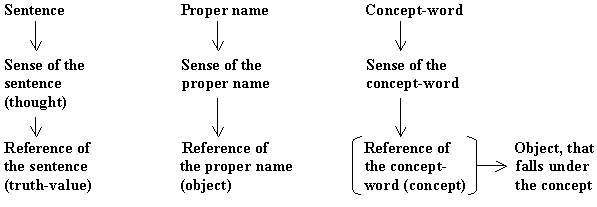
Michael Dummett goes into detail as to why Frege believed that there's such a distinction between a proposition and its linguistic expression – or, in Frege’s case, between a sentence and the "Thought" which it expresses:


"[A thought is] not true for you and false for me, it’s not true at one time and false at another time." 

The idea being expressed here is that it may appear to be the case that a Thought is true for me, though false for you; or true now, though false tomorrow. Yet that's only because its linguistic expression leaves something out. If expressions were more precise and more explicit, such things wouldn't be left out.

This leads us to the conclusion that the Thought itself is precise and explicit.

It's strange that something that is ostensibly completely non-linguistic can be both precise and explicit at all. How can something abstract and non-linguistic be precise and explicit? What does it mean for an abstract Thought or proposition to be precise and explicit? Surely only linguistic expressions can carry the requisite information that will allow a thought to be precise and explicit. How can it be precise and explicit with its – or any – linguistic expression? What would constitute its precision and explicitness?

So despite Dummett’s defence of the existence of abstract propositions, he acknowledges the fact that the proposition/expression dichotomy may not amount to much.

The amounts to the evident point that even if abstract propositions exist, what we say about them (or when we express them) evidently needs to be done with sentences. Thus we must "attach" truth to sentences even if it's really propositions which are the actual "bearers of truth". If it's the case that a sentence expresses a proposition, then it'll still be the case that that proposition will require (or need) a linguistic expression. Thus truth, again, must also be attached to sentences; not just to propositions. (If we can really attach truth to abstract entities at all.) However, Dummett still insists in talking about the "interpretations" of propositions. As I said, the fact of multiple and variable interpretations doesn't lead him away from propositions, but towards them.


Facts aren't Bits of the World

Many people take facts to be bits of the world to which true propositions somehow correspond. Many would disagree with the suggestion that facts are not bits of the world or that they are linguistic or sentential in nature. After all, isn’t it the case the proposition "Gordon Brown is PM" is true because of the bit of the world that is Gordon Brown’s being Prime Minister (among other things)? But facts are not just particulars or bits of world. They're arrangements (as it were) of bits of the world and also what's said about these arrangements. Michael Loux puts this in the following more metaphysical less semantic kind of way. He says that


"we cannot completely and adequately identify that in the world which makes a true proposition true merely by listing the various particulars and attributes (properties, kinds, and relations) that populate the world". 

In that weren't the case, there would literally be an infinity of possible facts. For example, the fact that Paul Murphy is two foot away from that blackboard; the fact that two black shoes are next to two white shoes; Or even that one million planets do not have water on Tuesdays. Indeed it's even a fact that  there are nth amount of specs of dirt on my computer screen; though yesterday there were ten less.

Even this infinity of possible facts inn't the only argument because we can say that despite this possible infinity, they're still nevertheless facts. The factual aspect, however, is more to do with what's said about these bits of the world (whether planets, specs of dirt or blue shoes). In terms of the specs of dirt on my computer screen, we can say that these specs of dirt were indeed bits of the world before anything was said about them; though there were no facts about them until such facts were stated.

Someone may now say that particulars like Gordon Brown aren’t factual on their own. However, we've already referred to the property of his being Prime Minister. Some may say that included in facts are universals, properties and their connections. Particulars, universals and connections on their own don't make facts either. It all boils down to what we say about these particulars, their properties and relations. Or, more specifically, it boils down to the linguistic situation that before we offer up our fact we must state something like: "It is a fact that…" Or: "It is the case that..." This shows us that facts are to do with sentential or mental attitudes towards particulars and their attributes and relations, not just the latter on their own. Particulars, attributes and relations are just bits of the word on their own. They aren't facts, not even when they belong together as bits of the world.


Facts as True Propositions & True Propositions as Facts

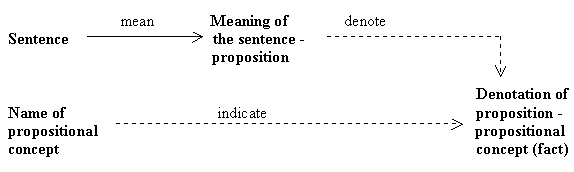
The proposition (or how the proposition is stated) is exactly the same as the fact which is supposed to make it true. Thus we have a kind of tautology (or an actual tautology). Of course the proposition


"Gordon Brown is PM."

is true because of the fact that Gordon Brown is PM.

Or more precisely:


The proposition "Gordon Brown is PM" is true because of it is a fact that Gordon Brown is PM.

Many philosophers actually say that "a fact is a true proposition" (e.g. Dummett). Thus we have this example of circularity:


fact = a true proposition

and


true proposition = a fact

Thus a true proposition just is a fact or a fact just is a true proposition. But facts "are supposed to be entities correspondence to which makes true propositions true" (168). They're supposed to be bits of the world. Thus if facts are true propositions, then either true propositions are bits of the world or facts are - as propositions - not parts of the world. Indeed it's easier, on this view, to accept that facts aren't bits of the world than it is to accept that propositions are bits of the world – which no one accepts. If we correlate facts with true propositions, and true propositions with true sentences, then we can indeed accept that facts aren't (only) bits of the world. (However, in a sense, sentences can be taken to be bits of the world.)

It follows that many will want


"a purchase on the notion of a fact that is independent of our understanding of the concept of a true proposition". 

Put it this way:


Q) What is it to say that this or that is a fact?

A) Is it not just to say it is true?

That is, if facts can be true, then doesn’t that mean that they must be sentential or at least propositional? After all, how can the bit of the world that is Brown’s being PM be true? What is said about Brown can be true; though not only his being PM. That would be like saying that the cup in front of me "is true".

Again:


i) Thus, to say that it is a fact that (or: it is the case that) Brown is PM. 

ii) is to say neither more nor less than that it is true that he is.

Facts are supposed to be what make propositions true. They surely can't be true themselves. If not, the fact that is true is making a proposition or sentence true. This doubling-up effect can be countered by accepting from the beginning that facts are indeed propositional. Or, on this account, that facts are sentential. In that case, if true propositions and true facts are identical, let’s get rid of one of them. Let’s get rid of (true) facts. Now we have true propositions. I take these to be linguistic.

Thus let’s get rid of true propositions. This will leave us with true (or false) sentences or sentential statements. The problem with the linguistic nature of supposedly worldly facts can also be applied to the linguistic nature of abstract propositions. Facts were seen to be linguistic, thus we got rid of them. Abstract propositions also turned out to be linguistic and not abstract at all, thus we got rid of them too. Again, we are now left with true (and false) sentences or statements.

Loux, on the other hand, accepts abstract propositions; though he also accepts that we have a conflation or mix-up between true propositions and facts. He writes:


"... we can hardly claim to have provided an explanation of the truth of that proposition by introducing the fact that he is President. The two are one and the same thing!" 

We can’t say that the statement


"Brown is PM of the UK."

is true by saying


"It is a fact that Brown is PM of the UK."

because the true proposition and the true fact are "one and the same thing!" (168). We think that Brown’s being PM of the UK is a bit of the world; though all it's actually doing is mirroring a true proposition which we have firstly constructed. I would say that the sentence, "Brown is PM of the UK" comes first.


Facts, Propositions and their Linguistic Expressions

We can go so far as to say that we "can only identify a fact through a proposition". This would mean that there are no facts without the propositions which express them.

What if propositions themselves can only be expressed through sentences?

Thus if it's correct to say that facts need propositions to be expressed, then we can also say that propositions require sentences in order to be expressed. Perhaps we can even forgo non-linguistic propositions and settle only with sentences or statements.

Can we also forgo facts?

We can if we've already forgone abstract propositions because, as I’ve said, facts require propositions and propositions require sentences. Thus, without propositions, facts simply require sentences to express them. It is sentences that individuate and determine what are the facts. Facts are as artificial as propositions. Thus all we have left are sentences which individuate and determine the parts of the world we wish to talk about. Without sentences, then, there would be no facts; just as there wouldn't be propositions without their sentential expressions.

Another reason for rejecting propositions is this. We


"can only identify a fact through a proposition: the proposition that my car won’t start, which can be 'nominalised' into the phrase 'my car’s not starting”’.

The problem is that is saying that "my car won’t start" is the same as "my car’s not starting". It is virtually the same sentence. We can see, then, that it's the sentence itself which individuates and determines the fact.

What we have, then, is the far from impressive conclusion that the "proposition that p is true if and only if it corresponds to the fact that p' (100). Surely, then, p is identical to, well, p – especially since they have the same content and are expressed in the same (linguistic) way. This may not be vacuous or contradictory. Perhaps we express what truth is in a way that "has to be that way". (As with Tarski’s T sentences.)

The end result seems to be that 


"it still remains true that to identify the thing that makes a proposition true, we must offer a proposition". 

It's a proposition that makes a thing true. Even if that proposition is abstract, it still requires a linguistic expression. And the linguistic expression we use for the proposition is the same linguistic expression we use to express the fact (or truth-condition) which makes it true!

Despite all that, Roger Scruton, for example, argues (in a realist spirit) that the


"proposition that p might never have been formulated; but still the fact that p would exist".

If proposition p might never have been formulated, that must mean that Scruton believes that it's mind-independent. If it's mind-independent, then it's also abstract and non-spatiotemporal. But the fact that it expresses must also share this property of being abstract and non-spatiotemporal because Scruton says that if the proposition hadn't been formulated, "the fact that p would exist’". Aren’t facts bits of the world? Yes. But I've already said that they're linguistically individuated and determined. Scruton says that they can exist without their propositional expression. If propositional expressions are by nature linguistic in nature, and therefore so too are facts, then how can there be any facts which haven't been given a linguistic expression? There can be no relation between a proposition and a fact that makes it true if that proposition is linguistically expressed in a way that relates to the fact and makes it true.

Scruton then writes that in


"comparing our propositions with the facts, therefore, we are comparing them with something other than themselves". 

Of course there's something other than propositions or statements about this something. However, it is sentences that determine and individuate the shape (as it were) of this something in the world. Only then can we call them ‘facts’. I'm not saying that bits of the world are sentences. Only that sentences determine and individuate what it is we take to be a fact; otherwise we only have a nondescript part of the world which hasn't been individuated or even determined. Thus this non-individuated and non-determined part of the world can't be a fact. It can only be a fact through its determination and individuation by a proposition – therefore by a linguistic expression.

Scruton doesn't accept that propositions are linguistic expressions. Though he does seem to accept that propositions and facts may be identical. He says that


"we seem to have no other way of identifying facts, save through the propositions that they are supposed to anchor". 

I would suggest that the suspicion Scruton shows about any real distinction between facts and propositions can be carried over to a suspicion about any real distinction between propositions and their linguistic expressions. Thus it follows that if we can't have facts without propositions, then neither can we have facts without linguistic expressions.

Scruton asks this about propositions and facts:


"Why are we sure that we have two things, when both are identified in the same way?" 

Now I will ask:


Why are we sure that we have both propositions and their linguistic expressions when both are identified in the same way?

If we can't break off facts from propositions, perhaps we can't break off propositions from their linguistic expressions. Or, more radically, perhaps there are no propositions.

Does this mean that there are no facts?

No, there are facts; though they aren't mind-independent and they're always individuated and determined by linguistic expressions.

In fact we can't even say "by their linguistic expressions" because this would seem to suppose that they somehow exist before their linguistic expression (or their linguistic individuation and determination). Facts, like the numbers of the intuitionists, "spring into existence" when they're linguistically expressed or individuated and determined by linguistic expressions.


Conclusion

Why isn’t the proposition-realist at least a little suspicious of this tight fit between propositions and the sentences which express them?

The realist could say that he must express propositions in some way. And the only way available to him is through sentences. I can still ask:


Yes; though do these sentential expressions of propositions precisely capture or match the propositions which they're expressing?

If his answer is, yes, then I can again ask:


Isn’t this strange – this perfect fit (or match) between propositions and the sentences which express them?

Why is it the case that sentences (or all the sentences which express proposition) can (as it were) miss something out of the proposition they (try to) express? However, this possible ambiguity, vagueness or imprecision of our sentential expressions isn't often acknowledged by proposition-realists. More than that: considering the importance they give to propositions (in terms of truth, certainty and objectivity) these possibilities would be anathema to them and would defeat the object of abstract propositions. That object, historically, has been that propositions are the guarantors of truth, objectivity and certainty.

At the heart of Derrida’s early philosophy of language is the thesis that there's no proposition beyond or behind the sentence – beyond language. Language is the beginning and the end of propositions:


"It [writing] is also to be incapable of making meaning absolutely precede writing…" (‘Force and Signification’, page 10, Writing and Difference, 1967/1978)

According to Derrida, "writing" doesn't simply transcribe something that already exists – a proposition. Propositions can only exist as expressions – in the guise of language:


"To write is to know that what has not yet been produced within literality has no other dwelling place, does not await us as prescription… Meaning must await being said or written in order to inhabit itself..." (1967/78)

Derrida then quotes Merleu-Ponty:


"Communication in literature is not the simple appeal on the part of the writer to meanings which would be part of an a priori of the mind… 'My own words take me by surprise and teach me what I think,' he said elsewhere." 

Propositions have been deemed to be necessary entities that help us secure certainty and absolute correctness. If we tune ourselves into the proposition, then we'll get things right. They help secure us from empirical vicissitudes and uncertainty. They are the "centers" (Derrida, 1967/78) around which all contingent and empirical expressions gravitate (see Dummett).

This is the old Platonic worry.

There must be propositions otherwise we'll succumb to relativism, uncertainty and other such things.

Perhaps it would be nice to have various centers or "sites" of various descriptions. Only then could dispute be stopped.

Abstract propositions, like universals and forms, would supply us with a means to find the correct meanings of our sentences. They would give us something determinate and precise for our contingent statements or sentences to be about. Thus we could find the true and correct answers to numerous philosophical and non-philosophical problems.

Abstract propositions guaranteed truth, correctness and certainty.


Tuesday, 22 July 2014

Vagueness & Ambiguity in Continental Philosophy


Julian Baggini offers some defences of what he calls "vagueness and ambiguity". He says that they could be "actually great virtues in writing because they open up possibilities" (59).


Can’t you ‘open up possibilities’ without ‘vagueness and ambiguity’?


Take the first quantum physicists.


Were they vague and ambiguous in their writings? Was Einstein? Was Gödel? In philosophy, were the radical ideas of Quine expressed vaguely or ambiguously? Of course not. I’m not even sure how vagueness and ambiguity actually ‘open up possibilities’ anyway. What does Baggini mean by this? The other point is this. Are we talking about intentional or unintentional vagueness and ambiguity? I suspect that Alan Sokal’s arguments are against the intentional ambiguities and vaguenesses of writers like Irigaray, Lacan and Delueze. That’s the point! It probably is intentionally vague and ambiguous. Of course vagueness and ambiguity may be a result of the complexity and difficulties of the subject-matter, say, in quantum mechanics again. This may not be the case with the writings Sokal is arguing against. That is, these writers go out of their way to make their writings seem complex and difficult precisely through their vague and ambiguous prose-styles. What about poetry then? –


"Well in poetry it’s a great virtue, in novels it might be a great virtue. But I do think that in analytical writing, whether it’s about physics or biology or history or sociology, the goal should be to remove ambiguity when possible. Of course, natural language is unavoidably ambiguous, but we should do our best." (59)


Perhaps Irigaray, Lacan and Delueze think that their writings are poetry. Or perhaps they think they are poetry and science or poetry and philosophy or poetry and philosophy and science. I don’t think that they do think that their writings are poetry or examples of literature; though Jacques Derrida, for one, might have thought this.


The question is: Is the ‘ambiguity’ an ‘unavoidable’ result of what it is they are writing about or it is the result of the author’s pretentiousness and gimmickry?


As Sokal concedes, "natural language is unavoidably ambiguous" (59) and so too is writing about complex and difficult issues in science, philosophy or wherever. However, do Irigaray, Lacan and Delueze "remove ambiguity when possible" or do they not even attempt to do this? More to the point, do they go out of their way to fabricate ambiguity and vagueness in order to make their writings seem complex, difficult and deep?


Sunday, 20 July 2014

The Meaning of a Sentence, Meaninglessness & Reductive Regress


I think that there’s a problem with your use of the word “meaningless”, as in


“’God exists’…is meaningless."


“God exists” has a meaning; or, at least, it makes sense. You may of course be using the word “meaningless” in a specific and precise technical sense. (Though there are very many rival philosophical conceptual schemes, as you know.)


For example, “God exists” may be meaningless because it can’t be verified (in the language of certain early logical positivists) , or it makes no difference to experience (in the language of certain pragmatists), or it has no observational consequences (in the language of Carnap). In that case, it may be better to say that the expression “God exists” is, at best, philosophically problematic, or, at worst, logically incorrect. Again, I don’t think that it is meaningless.


Some philosophers, for instance, say that


“God exists.”


Is equivalent to or means


“Godhood is instantiated.”


But “God exists” doesn’t seem to mean that at all. It may be the case that the statement “God exists” should be “Godhood is instantiated” if it’s to be philosophically coherent and acceptable. But “God exists” simply doesn’t mean “Godhood is instantiated”. The statement “God exists” means God exists, in a manner of speaking. Similarly, perhaps “Godhood is instantiated” isn’t even the correct “logical form” of the “surface grammar ” either 


The distinction to be made is that when a philosopher says that “Godhood is instantiated” (or another version) is equivalent of or means God exists in correct logical grammar, or that it is equivalent to it, he is doing, alternatively, normative, or stipulative, or revisionary (or even “transcendental”, according to Stephen Yablo) metaphysics. That is, the philosopher who opts for “Godhood is instantiated” rather than “God exits” isn’t doing “descriptive metaphysics”.


These two terms, “descriptive” and “revisionary metaphysics”, are taken from Strawson (though the idea isn’t exclusively his). This is what Strawson himself wrote in his well-known book Individuals:


“Descriptive metaphysics is content to describe the actual content of our thought about the world, revisionary metaphysics is concerned to produce a better structure.” (page 10)


For example, take your reference to “red exists” (seemingly a reference to a universal). We can have


“Red is a colour.”


parsed (or analysed) into the nominalist


“Red things are coloured.”


according to one revisionary metaphysical scheme (to be argued for). Or we can have


“Red is a colour.”


parsed (or analysed) as


“Reds are colour tropes.”


according to another revisionary metaphysical scheme (again, to be argued for).


Though the statement “Red is a colour” doesn’t mean Reds are colour tropes and it isn’t equivalent to “Red things are coloured” either. You could argue for the “Godhood is instantiated” version of “God exists”; though I don’t think that the latter is meaningless.


So I assume that you mentioned “red exists” because it is seemingly a reference to a universal, and is therefore meaningless because universals are deemed to be non-spatiotemporal entities.


The strange thing is that many philosophers have had a problem with the statement “God exists” not because of the proper name “God” (e.g., not referring, etc.); but because the predicate “exists” is, as it were, non-referring or vacuous. That is, the predicate “exists” adds nothing to the subject term “God”.


For example, it's argued that


“Tigers exist.”


has the same grammatical form as


"Tigers are striped.”


though it has a different logical form. That is, according to the revisionary metaphysician (even if he doesn’t accept that description), “Tigers exist” is logically incorrect. That may be the case; though “Tigers exist” is still meaningful – it still makes sense.


Just to set the cat among the pigeons, D. F. Pears not only argued that the statement “God exists” makes sense, that is grammatical sense: it also makes logical and philosophical sense:


“[To say that] the verb ‘exist’ does not add anything to the concept of the subject [e.g., ‘God’ or ‘red’]…is false: for to say that a concept has instances [or is ‘instantiated’] in reality is certainly to add something to it…” (from ‘Is Existence a Predicate?’)


Just to show how reductive the belief in a correct logical form can go, let’s get back to


“God exists.”


this can be said to mean or be equivalent to


“Godhood is instantiated.”


which in turn can be said to mean or be equivalent to


“There is at least one x, such that x instantiates Godhood."


And this can be said to mean or be equivalent to


x (Gx)


So now we have this strange identity statement:


“God exists” = x (Gx)


It could now be said (though I have a feeling it may be wrong) that “God exists” and "x (Gx)" have different Fregean “senses”; though the same “reference”. That is, someone may believe the statement “God exists” is true (or false)though not believe the same of "x (Gx)".


*) Just as some philosophers argue that we can offer the correct logical form of certain contentious - though grammatical - statements; so too could certain grammarians argue that they can offer the correct grammatical form of:


Buffalo Bill’s
defunct
who used to
ride a watersmooth-silver
stallion
and break onetwothreefourfive pigeonsjustlikethat


Jesus
he was a handsome man
and what I want to know is


how do you like your blueeyed boy
Mister Death


(e.e.. cummings, ‘Buffalo Bill’s’)


In this instance, the analysis, interpretation, parsing, etc. of the above may be acceptable. Certain philosophers think that we are capable of giving exact literal equivalents of metaphors and other poeticisms. However, would the poem above mean the same as its interpretation? Would the interpretation be equivalent to the poem? (What would we mean by “equivalent”?) 


Brentano on Mental Acts & Mental Objects


Franz Brentano offers us a view of mental representation that is an example of self-consciousness.


We don't just ‘have a representation’, or ‘see one’, or ‘become aware’ of one, we are also at the same time aware of the representing. Prima facie, it seems strange that Brentano argued that we ‘represented’ a representation to ourselves, rather than simply had one. The way he puts the representing of representations is that it's a cognitive or volitional process. It's often thought to be the case, say, with sense impressions and sense-data that they are just ‘given’ to us without cognitive activity. That is why the term ‘the given’ was so important to 20th century empiricist epistemology. That very term stressed the supposed fact that sense-data aren't the result of any cognitive activity and therefore must be unpolluted by our prior concepts or categories.
 
For instance, when I look at my white fridge, seemingly non-cognitively, white, square (not literally square!), and other kinds of sense-data are just given to me – I simply have them or, in a way, find them in my mind [see Ned Block’s 1992/1997]. All this seems to distinguish sense-data from Brentano’s ‘representation’ because he argued that we cognitively ‘represent’ the representation to ourselves.


Of course we must first ask what it actually means to ‘represent a representation’. Can a representation also represent something or other without our own cognitive representing of the representation that itself represents something external? ‘Representing’ implies that we make some kind of cognitive decision to become aware of a representation that would otherwise be un-cognised (even if an un-cognised representation makes no sense!).


Take the representation of a particular sound. When we have a sound-representation, we don’t just have it, or become aware or conscious of it, there must be a secondary cognitive process that becomes part of the sound-representation and all conscious representations. We must also be conscious of ‘the act of hearing it’. In that case, the sound-representation must come along with what must be another representation or awareness – that of the act of awareness itself. So we now have:


i) the sound-representation


ii) the act-representation (of being conscious of the sound-representation).


In that case, all representations must have binary components. We aren't only conscious of the representation itself: we must also be conscious of the act of representing that representation to ourselves. We can say that the act-representing is of a higher order. And the representation-object of the act is of a lower order. Though, in all genuine representations, that higher-order act must always accompany each conscious representation.


Brentano now stresses the fact that although representations are of this binary nature, each conscious representation doesn't also require two acts. The representation itself is seen as the ‘first object’ by Brentano. And the mental act of representing, or being conscious of representing, is the ‘second object’. The second object, or mental act, can be deemed as ‘reflexive’ in that it's a mental process or act which has its own object, which itself becomes the object of a reflexive act of awareness about the mental act itself. In that case, couldn’t we also become aware not only of the mental act with a representation as its object, but an act which has another mental act, rather than a representation, as its object? This third-level process would include two acts of cognition, where one mental act itself becomes the mental object of a third-level mental act. This process, clearly, could continue indefinitely. However, despite that possible higher level indefinite regress, Brentano himself is aware of the possible lower-level ‘Cartesian presumption’ that would lead to an endless regress of mental acts. This, however, is about the lower-level relation between a conscious act of awareness and a representation not to be deemed a mental act in itself; but only a mental object of various cognitive acts. That is, if the initial representation were itself an act, though still a mental object of a higher mental act, then that representation-act, or mental object-act, would itself have its own mental object or representation. We would have to move one step further beyond what we took to be the pure representation and non-cognitive starting point to its own representation. But if we go further than the initial pure representation, then we could also see the initial representation’s own representation-object as also being a representation-act as well. This process, clearly, could go on indefinitely, just as my higher-level version could.


So the ‘Cartesian presumption’ must be that we must reach the foundation or bedrock of such mental processes at some time. Therefore some representations, or Cartesian ‘ideas’, must be pure representations and not at all representation-acts.


This train of thought is analogous to Wittgenstein’s position in his Tractatus that there must be ‘logically proper names’ that are no longer ‘analysable’ and must therefore be basic and fundamental. (These names too must be seen to halt a similar indefinite regress, just as his ‘simple objects’, the objects of the ‘simple names’, called a halt to a possible ontological and logical indefinite regress.)


However, if we call a halt to the Cartesian indefinite regress by accepting the existence of a pure representation or representation-object, then what of our higher-level case of an indefinite regress of mental acts, or higher-order acts which take lower-order acts as mental objects; though which are in fact still act-objects and never pure representation-objects. In the higher-order case we can have an act of an act of an act… And so on. Just as in the Cartesian case we could have a mental act of a mental act… All this is instead of an act which has as its object a pure representation that is in no way itself a mental act. If we can call a halt by positing a lower-order representation, perhaps in our higher-order version we could take a specific higher-order mental act as the end of a short regress, as it were. The lower-order representation would then therefore be foundational and fundamental, whereas our higher-order mental act would be the end-point or final consequence of a small foundational structure supported by our pure representation.


In the case of the earlier sound-representation, we can take our higher-order approach of taking a possible indefinite regress of mental acts rather than the lower-order Cartesian approach of the indefinite regress of trying to find a representation that isn't also a mental act which has its own object-representation. In terms of being aware of an act rather then of a representation, it would mean that


to be aware of a sound is to be aware of being aware of a sound, and then to be aware of being aware of a sound would involve being aware of that awareness, and so on indefinitely. We can now ask: How do we, or how can we, call a halt to this potential indefinite regress? Would we need to treat a higher-level act in roughly the same way as we treated our foundational representation? Instead of seeing a higher-order mental act as foundational, we could see it as an end-point or some kind of cognitive brick wall which we couldn’t break through.


Brentano himself calls a halt to this potential regress of acts in this way.


Firstly, he rejects the higher-order act of being aware of our awareness of a sound. This means, quite simply, that awareness itself can't be a mental object of another mental act of awareness. In other words, all we really have is a second-order acts and first-order, or foundational, representations. We must stick with this binary relation and not believe that there are also tertiary or yet higher-order cognitive acts which take other cognitive acts as their mental objects. However, at a prima facie level, it does seem possible to be aware of an instance of our awareness, or to take a cognitive act as an object-act, rather than as a pure object or representation.


How does Brentano defend his sudden halt to higher-order acts of awareness?


Brentano argues that this ostensible case of an act of awareness which takes another act of awareness as its cognitive object is in fact a different kind of a mental act from the lower-order act of simply being aware of a sound. So, according to Brentano, the ostensible act of being aware of being aware of a sound is no different to the more basic being aware of a sound. At a prima facie level, again, the third-order awareness of an act of awareness seems possible. How does Brentano actually defend his rejection of third-order acts of awareness?


If we were to ‘observe a mental act’ it would be an attempt to make it an example of Brentano’s ‘first object’. In that case, we would find ourselves with two first objects – the initial pure representation and an act of awareness of that representation which is now itself a ‘first object’ of another mental act of awareness. Clearly, we can't have two first objects. Brentano therefore concludes that an act, rather than a pure representation, could never be taken as a first object but must always be taken as a ‘second object’.


Even though we are talking here about mental acts and mental objects of those acts, Brentano rather strangely brings in the notion of ‘observation’. He makes the point that when we talk of observation we presume a distinction between observer and observed. Clearly, in that case of a pure representation and its act, the representation is analogous to the observed and the act of awareness of that representation is analogous to the observer. What would be an act of awareness of another object? We would therefore have two acts or processes of awareness occurring at the same time, each with its own mental object. If we think in terms of two cognitions or two sub-vocal expressions of two different propositional beliefs occurring at the same time, such scenarios seem even more unlikely. Take two examples:


i) Tony Blair is a liar.


ii) Venus is a planet.


Such sub-vocal expressions could not occur at the same time in the same subject. This becomes even clearer if we say that the various objects, i.e., Tony Blair, Venus, planets, liars, etc. must somehow be cognised at more or less the same time. Not only that: two different mental acts of predication must occur at the same time. We couldn't observe a mental act that is just as much an act or process as the mental observation itself. In this case, an act of observation and an act of awareness must occur at the same time. So an act can't be a first object because it is not in fact a genuine mental object at all – it is a mental act or process. An act or process cannot be the mental object of a further mental act because one act would need to occur at the same time as another mental act.


So we were wrong to see mental acts as becoming the possible mental objects of further mental acts. We assumed that an act or process could itself become the mental object of another mental act. We failed to realise that an act, even as seen as a mental object, must still be a mental act in the scenario of an act of awareness that takes another act of awareness as its mental object or representation. According to the first case, the representation was the observed and the act was the observer. But now we have two acts, even when one act is taken to be a mental object-act. If we have two acts, then we must have two observers and no genuine example of a pure observed representation. Prima facie, the idea of an observer observing an observer seems odd. However, it does actually seem possible, as in the case of a spy of one country spying on a spy of another country. In that scenario, why can’t a mental act take another mental act as its mental object, or even as its quasi-object? Again, an observer can take another observer as his object of observation. So just as an observer can take on two roles, as observer and observed, why can’t a mental act also be a mental object for a further higher-order mental act? However, two cognitive mental acts cannot occur simultaneously. In that case, it's simply incorrect to see a mental act as also a potential mental object of another mental act. Unlike a representation, a mental act is a kind of mental process. A mental process can take a representation as its mental object because the representation is not itself a process. However, in order for a mental act also to become a mental object-act, we would need to accept two simultaneous and different mental processes occurring at the same time in the same mind. Clearly this couldn’t happen. For example, we would need to become aware of a mental act which must also, as a mental process, itself be in the mind if taken as the object-act of a further mental act. It should have been clear that this higher-order mental process would require a mental act, better seen as a temporal mental process, occurring at the same time as a mental act or temporal process in the mind which takes it as its mental object. But that higher-order mental act couldn't take an act as a mental object if that act itself is a temporal process of awareness of a lower-order mental object. And if this higher-order mental act can't actually be a genuine first object, then the yet higher-order mental act we believed took such a lower-order mental act as its mental object couldn't itself be a genuine higher-order mental act simply because it doesn't actually have its own higher-order mental object-act. Such ostensible higher-order mental processes and mental objects would therefore be like a single person playing the piano at the same time as doing a crossword or drinking a cup of tea and a can of lager concurrently. Looking for such higher-order mental objects and mental acts is also like a dog trying to catch its own tail or trying to look at our own eyes without the benefit of a mirror or reflector.


Conclusion: Brentano and Introspection


Finally, there may be a problem with Brentano’s use of the word ‘observation’ to get his arguments across. It depends, however, if he really believed that mental acts effectively - or literally - observe representations, or whether it's just an analogy on his part. Clearly, ‘observation’ is a term connected to the faculty of vision, which couldn't be applicable to any mental process or mental act. If Ryle, amongst others, rejected ‘the eye of the mind’ [Ryle, 1949], or the ‘internal theatre’ [Dennet, 1991], or introspective acts of perception of the mental events and mental objects on the mind’s stage [Davidson, 1980], so we should be equally suspicious of Brentano’s use of the term ‘observation’.


If it's not the case that mental acts observe mental representations, then how, in fact, can we make sense of the relation between an act of awareness and its representation-object, or of any other such introspective processes in the mind for that matter [see also Wittgenstein, 1953/57]? If we deny such quasi-visual metaphors, if they are metaphors in Brentano’s mind, then we may have to give up the notion of introspection itself, and even, as Ryle and Churchland do, the very ‘concept of mind’ as it is - or has been - seen traditionally.


Notes and Further Reading


Block, N – (1992/1997) ‘Begging the Question Against Phenomenal Consciousness’, in The Nature of Consciousness, ed. N. Block, A Bradford Book
Brentano, F – (1874) Psychology from an Empirical Standpoint
 - (1911) On the Classification of Psychical Phenomena
Davidson, D – (1980) ‘Knowing One’s Own Mind’, from his Essays on Actions and Events, Oxford University Press
Dennet, D – (1991) ‘The Cartesian Theatre’, in Consciousness Explained, Boston: Little, Brown, and Co.
 - (1981/1997) ‘Skinner Skinned’, in his Brainstorms, Penguin Books
Ryle, G – (1949) The Concept of Mind, Penguin Books
Wittgenstein, L – (1953/57) Philosophical Investigations