Friday, 1 August 2014

Keith Donnellan on Causal Reference

This essay is mainly about Keith Donnellan’s paper ‘Speaking of Nothing’, and its defence of a causal theory of reference.
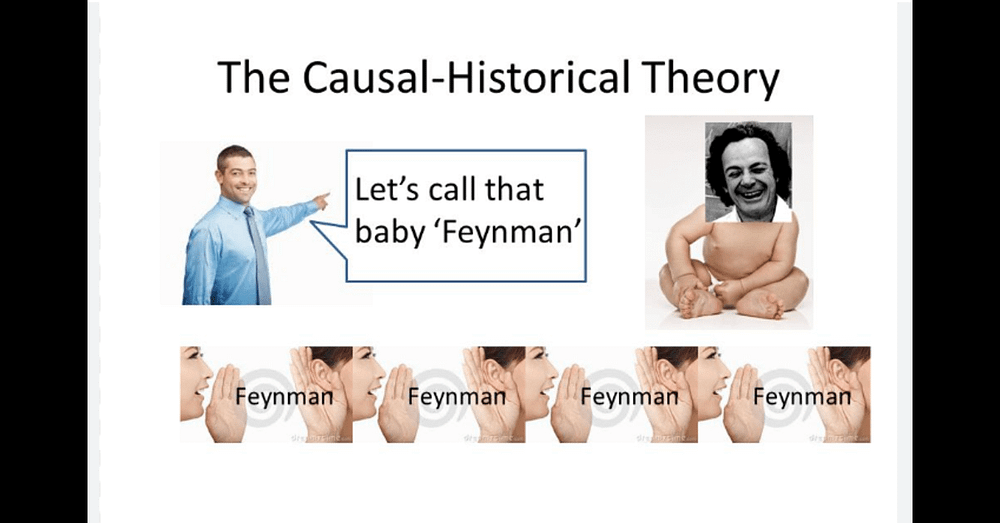
The American philosopher Keith Donnellan (who died in 2015) believed that the statement

“Santa Claus will come tonight.”

isn’t actually a genuine proposition.

Keith Donnellan

In his paper ‘Speaking of Nothing’ (1974), Donnellan asked the following question:

[C]an one even speak and be understood when using a singular expression with no referent?”

However, Donnellan did accept this paraphrase:

“According to the legend, Santa Claus will come tonight.”

Donnellan deemed that statement to be true.

So, according to the legend, Santa will come on that night. However, the legend doesn’t also say, “Santa Claus doesn’t actually exist [or he does exist]”.

At an intuitive level, it’s hard to see what Donnellan’s problem was.

The legend itself doesn’t really have any position on Santa’s actual existence…

But so what?

Why does that make a kid’s statement (i.e., “Santa Claus will come tonight.”) not understandable? Indeed, why does it make it non-propositional? Why impose ontological rectitude onto meaning, and the very acceptance of a proposition qua proposition?

What is the connection here?

Isn’t it only the belief that a non-existent is an existent that’s at fault here? However, does that render this statement itself non-propositional?

So readers should focus again on Donnellan’s idea that the sentence “Santa will not come tonight” isn’t a proposition.

Why?

According to Donnellan, a proper name (in this case, “Santa Clause” or “Santa”) must have one of two things:

(1) It must be causally connected to its referent. 
(2) It must have “descriptive content”.

It seems that Donnellan believed that the name “Santa” has neither. That is, if that scare-quoted “name” has no “historical connection” to its referent (which it can’t have because Santa never existed), then the proposition “Santa will come tonight” can’t be a proposition. And it can’t be a proposition because of the problematic proper name.

Yet isn’t it simply a stipulation (or even a diktat) to argue that “Santa will come tonight” isn’t a proposition?…

In logic, however, all propositions must be either true or false.

Philosophical Realism?
The thing which seemed to be motivating Keith Donnellan was his attempt to save philosophical realism. In other words, if we can have a causal theory of reference which evidently excludes names like “Santa”, then we can distinguish real propositions like “Brad Pitt will come tonight” from “Zeus is angry with us”.

[The statement about Brad Pitt is a future contingent, which is also problematic — if for different reasons.]

There’s another realist move in this game.

Donnellan — and many other philosophers (such as Saul Kripke) — argued that proper names shouldn’t rely on being tied to “descriptive content”. They believed that this would give individual minds (as it were) too much power, and direct causal reference less power.

Associating descriptive content with proper names has also been deemed to be idealist by some philosophers. (“Subjective” is a better term than “idealist” in this context.) A causal connection to Brad Pitt (or the “Brad Pitt” relation to Brad Pitt) is concrete. “The rubbish [or great] actor in Hollywood” is subjective, or at least dependent on an individual mind (or on individual minds in the plural). Similarly, the definite description that I’ve personally tied to the name “Santa” may be very different to the one you’ve personally tied to that name.

So what would secure us an identity of reference here when it comes to the names “Santa” and “Brad Pitt”?

Donnellan’s causal theory of reference (which excludes Santa) is the realist’s way of avoiding not just idealism (or, better, subjectivity), but also relativism.

Conventions, conceptual schemes, identifying descriptions, etc. were also deemed to be “subjective” by Donnellan. Causal processes, on the other hand, impose themselves on us. In other words, they tie us firmly to the world.

Bertrand Russell, God and Sherlock Holmes
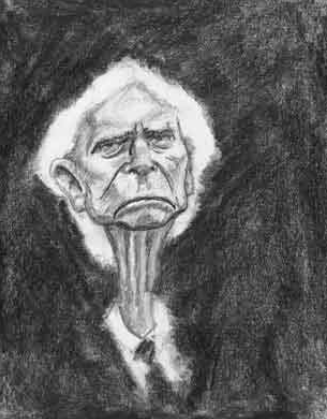
Bertrand Russell

To finish, let’s now agree with Keith Donnellan’s rejection of Bertrand Russell’s view on this matter.

Donnellan argued that the statement

“God does not exist.”

isn’t an abbreviation for Russell’s

“There is no entity such that…”

So why does “failure of a complex reference simply make a proposition false”?

What is a failure of reference?

For example, can’t we refer to something non-spatiotemporal?

Indeed is, say, Santa or Sherlock Holmes really a non-spatiotemporal entity at all?

Perhaps we can say that Santa or Holmes exists in minds, on the page, in letters, on the screen, in pictures, etc. All these are spatiotemporal things.

However, aren’t these examples simply representations of Santa and Holmes?

That would be the case if he were something other than Santa’s or Holmes’s representations.

In any case, in the works of Conan Doyle, Holmes is meant to be… Holmes: he isn’t a representation of Holmes.

So reference needn’t be to something that’s spatiotemporal in the strict sense of Holmes being made of flesh and blood…

We refer to numbers after all.

We refer to the number 2. The number 2 isn’t concrete. It isn’t (on most readings) spatiotemporal .

So is a negative statement like “John is not here” a reference to something spatiotemporal?

Well, in one sense, yes.

Part of the referent is the space not filled by John. In addition, even though John is not there, John himself is still a spatiotemporal entity.

What about the non-spatiotemporal nature of historical facts?

Can we simply say here that at on point historical events were spatiotemporal? So historical facts are parasitical on these past spatiotemporal events.

Peter Strawson on Statements About God
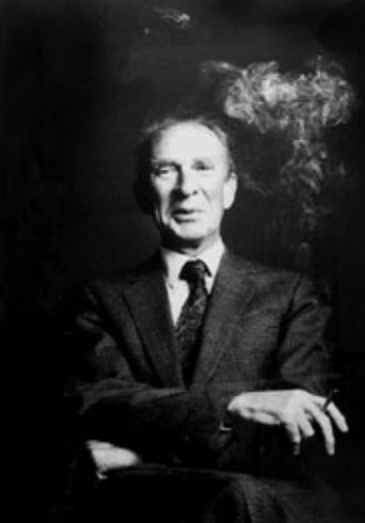
P.F. Strawson

Now take Peter Strawson’s position.

According to Strawson, the statement

“God is in heaven.”

is neither true nor false, because Strawson deemed the statement

“There exists something which is God.”

to be false.

Thus, the statement “God is in heaven” must be neither true nor false because there’s no God to be in heaven… or to be anywhere else. Of course, the statement “There exists something which is God” is making a claim about existence, not about the whereabouts of an existent.

Thus, according to Strawson’s atheistic ontology, the sentence “God is in heaven” is plainly suspect. How can it be true that “God is in heaven” when (it is supposed that) there is no God? Yet how can it be false that “God is in Heaven” for exactly the same reason?

On this picture, then, the subject, God, doesn’t exist. Thus, the predicate phrase, “is in Heaven”, can be neither true nor false of the subject term.

Yet perhaps we can still say that the statement “God is in heaven” is false without indulging in (or adding) existence-claims. If it’s false that there is God (and heaven), then it’s also false that God is in heaven. Thus, the whole statement is false. Or, rather, you can say it’s false (or true) because of one’s prior position on God’s existence. However, you shouldn’t thereby deny its status as a proposition.

If we do deny the propositional status of “God is in heaven”, then perhaps we can also call that sentence meaningless! Indeed, roughly speaking, this was the position of some logical positivists in the 1930s and 1940s. [See my ‘The Logical Positivists’ Use of the Word “Meaningless”: A Retrospective’.]

Yet we can’t allow this for the simple reason that the statement “God is in heaven” isn’t meaningless! It may well be philosophically problematic. However, the statement clearly isn’t without meaning.


Thursday, 31 July 2014

Robert R. Provine's Neo-Behaviourism?


This short essay isn’t really about laughing. It’s about behaviourist explanations of all sorts of different human actions. It’s just that Robert R. Provine is an expert on laughing and he chose that phenomenon to concentrate on.

Is Spontaneous Laugher an Argument for Behaviourism?

Robert R. Provine

Neurobiologist and professor of psychology Robert R. Provine argues — no doubt correctly - that laughing isn’t under our control. However, he concludes that our explanations for why we laugh are “usually wrong”. He even describes them as “confabulations”. Or as “honest but flawed attempts to explain one’s actions”.

That seems to be a false conclusion.

Surely if someone says something funny, and I laugh at it, then even if my laughter is automatic (i.e., not under my consciousness control), then it still doesn’t follow from this that my saying that his joke caused me to laugh is false. Why can’t my automatic response be explained as a reaction to the joke - even if it is automatic?

Is Provine’s position a resurrection of radical behaviourism?

Again, Provine may be correct to argue that “subjects incorrectly presume that laughing is a choice under conscious control”. Sure. However, why does that also mean that saying that I laughed because “she did something funny” (Provine’s example) is a “confabulation”? The laugher was automatic; yet still a response to this person saying something funny.

So because laughing is automatic, Provine concludes that we can’t give a true reason for our laughing. Does that simply mean that we don’t know the unconscious neurobiology (Provine’s other expertise), brain mechanisms, etc. which subserve our laughing (more of which in a moment)?

One other reason Provine gives for this is that when people are asked “to laugh on command, most subjects couldn’t do so”. We can accept that possibility too. Nonetheless, why does it follow from this that our giving a reason for laughing is a confabulation? The joke made us laugh; yet the laughing wasn’t under our control. So?

Neo-Behaviourism?

All this boils down to Provine emphasising unconscious (brain) mechanisms.

Perhaps Provine isn’t a behaviourist. So he’s no doubt correct to argue that “we vastly overestimate the amount of time we are aware of our actions”. However, none of that should lead us to accept his thesis that our reasons for laughing are false. That simply doesn’t follow.

Now it can be provisionally accepted that Provine isn’t an old-style behaviourist (or, alternatively, a denier of consciousness) because he happily limits his position to the following claim:

“The argument is not that we lack consciousness but that we overestimate the conscious control of behaviour.”

Yet perhaps the old-style behaviourists (or some of them) just alluded to might have put the situation that way too. They too might have said this:

Consciousness exists, sure; it’s just that it’s not needed in science precisely because we overestimate the conscious control of behaviour.

In other words, when we explain our behaviour (as in the laughing example), we don’t really know what we’re talking about. Only an observer, a third person or a scientist (like Provine) can know the real sources (or causes) of our behaviour.

Consciousness lies.

Then again, if Provine were to say that “consciousness lies”, then that would be a tacit acceptance that consciousness exists. That, therefore, is a step beyond what some old-style behaviourists might have accepted…

Provine also fleshes out his position by offering a classical position on scientific theories.

Provine claims that his own theory (i.e., we don’t know what causes us to laugh or what causes us to do many of the things we do because they’re out of our “conscious control”) “makes the fewest assumptions”. And, as scientists often tell us, simplicity is a virtue in science (see here).

The complex theory, on the other hand, is an example of what Provine calls the “philosopher’s disease” of

“the inappropriate attribution of rational, conscious control over process that may be irrational and unconscious”.

Well well! Provine clearly hasn’t read many 20th and 21st century philosophers. However, he might well have read many pre-20th century philosophers. Yet even in that case, it’s still a generalisation.

For example, I’ve mentioned scientific behaviourism and that some philosophers of the first half of the 20th century were the fiercest adherents of various forms of behaviourism: from Ludwig Wittgenstein (at least at one point in his career) and Gilbert Ryle to the logical positivists. Indeed many philosophers of the second half of the 20th century were behaviourists too. Not only that: even when they weren’t (strictly speaking) behaviourists, some philosophers strongly played down consciousness. Indeed other philosophers rejected it entirely! So, being a psychologist and neuroscientist, Provine clearly hasn’t had the time to read much — or indeed any — 20th and 21st century philosophy.

Provine carries on with his neo-behaviourist theme (if that’s what it is) by arguing that the

“complex social order of bees, ants, and termites documents what can be achieved with little if any conscious control”.

Yes indeed! That said, it depends on what Provine wants his readers to conclude from this (i.e., that laughter doesn’t need “any conscious control”). What about other aspects of what we do take to be conscious action? Are we confabulating about them too? It can be supposed that it will depend on examples. And because in this piece Provine only gives the example of laughing (which he has studied in much detail), it’s hard to extrapolate from that. Then again, it can be argued that he still makes mistakes in logical reasoning even if his scientific data is perfectly correct.

Crude Anti-Introspectivism

Another of Provine’s arguments — or scientific claims — is that a

“neurological process that governs human behaviour [is] inaccessible to introspection”.

Provine also makes the obvious point that “we are not conscious of our state of unconsciousness”. Here again there’s a logical mistake being made by Provine.

Of course we don’t have introspective access to neuronal (or brain) processes. Yet it doesn’t follow from that that we don’t have introspective awareness of our actions. That’s like saying that because we aren’t fully aware of the internal mechanisms of a coke machine, then we can’t know that when we put money in and press the correct buttons, a coke can will be delivered.

We don’t need to know all — or perhaps even any — of the internal mechanisms of a coke machine. Similarly with our own brains. Nonetheless, when we put money in a coke machine, then we know what usually happens. Similarly, when we decide to do something: we can be in control of what we do regardless of our ignorance of the brain mechanisms which subserve such conscious actions.

All this also partly depends on what exactly Provine means by the word “introspection”. How strongly does he take that word? This is asked because introspection was an important aspect of old-style philosophy of mind in the 19th and 18th centuries and before. Nonetheless, philosophers are much more careful nowadays when they use that word.

Indeed in the first of the 20th century Martin Heidegger and Gilbert Ryle made a distinction between “knowing how” and “knowing that”. The latter requires conscious linguistic expression; whereas it’s argued that the former simply requires “skill”. Regardless of the intricacies of this distinction, both knowing how and knowing that require conscious awareness.

When you hammer with a hammer (Heidegger’s own well-known example) you need to be aware of the hammer even if you aren’t expressing (vocally or sub-vocally) sentences about that hammering. Now is that hammering the same as Provine’s spontaneous laughing? Surely not. There’s nothing spontaneous about picking up a hammer to hammer in a nail and even to carry on hammering. It’s not (in Heidegger’s words) “intellectualist”. But it’s not the equivalent of a spontaneous laugh either. You can’t control laughing. Clearly you can and must control your hammering.

Of course much of this — at least partly — depends on any further examples (i.e., other than the laughing) which Robert R. Provine has in mind when he advances his (what I take to be) neo-behaviourist position.

Reference

This piece is a response to the book What We Believe but Cannot Prove, pages 147 to 149.

[I can be found on Twitter here.]


Tuesday, 29 July 2014

Natural Kinds & Essences


We can ask a simple question about scientific theories. We accept


All ravens are black.


though not


Non-black things are non-ravens.


Why?


They are, after all, logically equivalent.


When we ‘count’ all non-black things and all non-ravens, what are we left with? We are left with black ravens. Thus we arrive back at ‘All ravens are black’. That is why they are equivalent. If something, or anything, is a non-black thing, it can’t be a raven. If anything is a non-raven, then, well, it can’t be a raven. A blue bird is not a raven. A banana (a non-raven) is not a raven.


J.S. Mill believed that the world contains (natural) kinds. We don't compose these kinds. They are there in the world. They are mind-independent. It seems to go against Mill’s empiricism to talk about mind-independence. Perhaps he wouldn’t have used the term ‘mind-independence’ in this context. Perhaps instead he would have talked about his "permanent possibility of sensation" in that if we were to observe a natural kind like a raven, we would observe x, y and z.


What binds a kind together? Its ‘common nature’.


Ravens and other species aren't the only natural kinds. Gold and water are also natural kinds. Though perhaps we should say that H2 O is a natural kind; if ‘water’ refers only to secondary properties or Locke’s ‘nominal essences’. Yes, "we do not create the kind water simply by our classifications" (192). However, we only get to water via our classifications. And if we only get to water via our classifications, then perhaps, in a sense, we do create that natural kind in that we only know it via our classifications and only observe it through our classifications.


Firstly, the ‘nominal essences’ of diamonds. We "pick out diamonds by means of their hardness and transparency" (192). Scientists have no time for these properties. They are not only ‘interest-relative’; but mind- and sense-dependent too. Science discovers what real essences are. Does that automatically mean that such properties will not be ‘interest-relative’ and ‘sense-dependent’? Not according to many philosophers; not least those of whom deny essence altogether.


What is the real essence of diamonds? It is carbon, the very same thing as charcoal.


How can we flesh out this essence of diamonds? By saying that the fact that diamonds are essentially carbon "is another instance of an a posteriori necessary truth" (192) It is necessary that diamonds are carbon. Alternatively, they are carbon at every possible at which they exist. The result of this is that a diamond could lose its "hardness, sheen and transparency – without ceasing to be what it is" (192). Perhaps a diamond wouldn't loose its essence if it lost these contingent’ properties; though but would it still be ‘what it is’? It depends on what it is. And if diamonds are only their essences, then this conclusion follows by definition. Could we still have a diamond without its sheen, transparency, hardness, etc., or would we just have a lump of charcoal? Certainly no layperson would recognise it as a diamond. Why is the layperson’s view of what a diamond is irrelevant? Why are sheen, hardness and transparency irrelevant? Is a lump of charcoal really a lump of diamond?


Natural kinds have become very fashionable in the last, say, fifty years (after a long time of anti-essentialism). Why was this so?


Firstly, "it suggests that science looks for necessary connections" (192). Does this mean necessary connections between natural kinds? Does it mean that that necessary connections between natural kinds are themselves natural kinds? Or does it mean that there are necessary connections between the properties which constitute natural kinds?


Is it really the case that "it is the task of science to discover’ these necessary connections"?


Essences increase the possibility of objectivity in science if we have both natural kinds and necessary connections. In addition, the interest in natural kinds and necessary connections helped "detach it from our observations and attach it to an objective order" (192). Is science really detached from our observations? We know that observations aren’t everything; though surely they account for something – perhaps for much!

Sortal Identity


You can't make any judgements about identity, or even self-identity, unless one uses a sortal concept. When someone asks: 


"Is Jack the same as John?"


We must reply:


"The same what? The same banister?" No? The same man? The same person? Yes. The same official? Perhaps not."


Formally, a can be the same F as b; though not the same G. For example, according to Christian doctrine, Christ is the same substance as God the Father; though not the same person. This is not unlike, then, the substance monism of Spinoza. In that case, the substance would be God, and a mode of that substance would be Christ.


This takes us to Leibniz’s law.


This doctrine can be seen to violate this law and transitivity. 


Is everything true of Christ, also true of God?


For example, God Himself was not crucified on the cross. And Christ didn't have the property omniscience (he had the property, after all, of being a man). If Christ is the same substance as God, then if Christ was crucified, then God was crucified.


David Wiggins had his own take on Peter Geach’s thesis:


"Whenever a is the same as b, there must be a sortal concept, under which a and b both fall, which defines their conditions of identity." (147)


So under which sortal concept do both Christ and God fall? Substance? Is substance a sortal concept?


If Gordon Brown is both the Prime Minister and the husband of Mrs Brown, then both the Prime Minister and the husband of Mrs Brown fall under the concept person – they are both the same person.


Is person a sortal concept?


In the case of Gordon Brown, we have an abundance of sortal concepts under which he could fall (if he’s not careful): man, human being, animal, person, biped, earth-dweller, non-raven, etc. Are all these sortal concepts? Well, you can ‘count’ with all these concepts. You can count human beings and persons. You can even count, in theory, all non-ravens.


The non-raven sortal, if it is a sortal, doesn’t make much sense for the reasons given in Hempel’s paradox. However, we can ask which of these sortals is ‘basic’. Perhaps the most inclusive is the most basic. In that case, more things are human beings than are men. Women are not men. But, then, more things are animals than are human beings. Moreover, more things are non-ravens than are animals! Would that mean that Gordon Brown's being a non-raven is more basic or fundamental than his being an animal or a human being? How would we decide such an issue other than by saying that non-raven is a bogus sortal concept because of its infinite application?


Perhaps Aristotle has the solution.


In his ‘theory of being’ he attempted to find "the ultimate constituents of reality". The things which we "must identify if we are to identify anything" (147). Thus we surely don't require the concept [non-raven].


Isn’t the concept [thing], or [object], necessary in order to identify anything – or any thing? Isn't that a circular conclusion?


We don’t need the concept [animal] to identify anything at all. We don’t even need it to identify animals. We can identify animals as objects or things.


What concept, or constituent of reality, is basic or fundamental? Peter Strawson and Donald Davidson, for example, have said that things, objects or persons are fundamental (as well as 'events') – or ‘medium-sized dry objects’. This was an argument against ontological reductionism which cited particulars like sense-data as the fundamental constituents of reality. Or, on a metaphysical reading, simples or atoms as the fundamentals.


What about the sortals we can apply to ‘artificial kinds’? What about the sortal term ‘table’, as applied to tables?


Is table a the same table as table b?


S argues that table "sorts things relative to a human interest, and touches only superficially on the nature of things" (147). We can ask, here, why are human interests ‘superficial’ at all? They aren't superficial to, well, humans! Yes, human beings create tables for specific purposes. Does that make tables superficial? Again, not to us.


Even natural kinds can be seen ‘relative to human interests’.


For example, horses can be seen as good racers or nice pets. Is the sortal term ‘horse’ really that different? If one believes in God, then didn’t God create horses, at least through evolution? Aren’t horses relative to God’s ‘interests’? S describes the difference between ‘table’ and ‘horse’ thus:


"A horse’s history is determined by the laws of equine nature, and without
reference to human interests." (147)


Are science’s classifications unrelated to the interests of scientists and other human beings? Many philosophers argue that they are.


Our classifications can be wrong.


What about the laws of equine nature: are they relative to the interests of scientists? Perhaps not. Though we might have also have got the laws of equine nature wrong. Even if we have got them right, does that automatically mean that the ways in which these laws are determined, described, measured, classified and tested aren't relative to the interests of horse-scientists?


In any case, when we let George the horse fall under the sortal ‘horse’, we also "avail ourselves of a real criterion of identity; we also say what George fundamentally is" (147). Now we know how to identify George as George and as a horse. How does the sortal ‘horse’ in and of itself give us a criterion of identity? It's just a word or a concept. In order to flesh the concept out we would require descriptive information which would bring on board with it other sortal concepts. Though the word ‘horse’ itself wouldn't be a criterion of identity because it only tells us that a horse is a horse. It doesn’t tell us what a horse is. It doesn’t tell us why George is a horse. And so on. When we say that George is a horse, we are saying that this particular horse in front of us is, well, a horse.


Sunday, 27 July 2014

Bertrand Russell on True Belief & Knowledge


According to Bertrand Russell (at least at one point in his career), not only is a belief not knowledge if it can't be substantiated with arguments, reasons or other beliefs, but it's not knowledge if it is derived from false beliefs which may have acted as reasons for the new belief.

So, in theory, I could derive the true belief that the earth isn't flat from the true belief that most swans are white. Clearly, in this case, there's no clear material connection between the two beliefs. If they weren't connected in some way by the subject, then such connections would have been either bogus or irrelevant – that is, not genuine connections.

This may be why logicians say that "from a true premise anything can be derived". That is, unless we require a material or relevant derivation from the true premise.

A true and materially connected belief for "The earth is not flat" may be "The horizon shows us that the earth is not flat’" Here, of course, there is a material and relevant connection with initial true belief.

Similarly, it's quite possible to deduce a true belief from a false belief. In this case, even if the false belief is somehow materially connected to the true belief, one still can't acceptably deduce a true belief from a false belief.

So, for example, we may derive from ‘Fish can fly’ the true belief that ‘Fish generally have scales’. Here there seems to be some kind of material connection in that both beliefs are about fish. But that isn't enough in this case.

For a start, they are about different aspects of fish. So, in that sense, there is still no genuine material connection. Also, we must repeat that one can't derive a true belief from a false belief.

In all these examples, it's clear that in order to gain knowledge, certain logical principles have to be adhered to. These principles guarantee knowledge.

For example, if the premises are true, then all correct inferences from these true premises must result in true conclusions. These true conclusions, then, would be examples of knowledge within a logical context. Of course the premises and conclusions must have material content and not just be examples of formal logic. That is, the premises must themselves be the conclusions of previous empirical investigation.

To have knowledge, according to the above, seems to mean that some kind of cognitive work has been done in order to reach a belief that is true. That is, Russell’s man is correct to believe that the then Prime Minister’s last name begins with B. However, this is because he thinks that the then Prime Minister was Balfour. In that sense, he was wrong. But he was, after all, only articulating a belief about the first letter of the Prime Minister’s last name. Though if he thought that Balfour is the Prime Minister, and the actual Prime Minister was Bannerman, then he clearly hadn't done any cognitive work to establish the first letter of the last name of the then Prime Minister. His true belief, therefore, was based on false knowledge. That is, he came to that belief for false reasons. Therefore he had no true knowledge.

To put this another way: Russell’s man had no justification for believing what he believed, even though what he believed is true. In a sense, his belief, though true, was based on pure guesswork. Knowledge, on the other hand, requires reasons for believing what one believes.

Though what if he did have reasons? He might have had the wrong reasons for believing his true belief. He might have thought, for example, that it was about time that a Prime Minister’s last name began with ‘B’. After all, up until then, no Prime Minister’s last name had begun with ‘B’. So, on his probabilistic reasoning, it was very likely that the Prime Minister’s last name would begin with ‘B’.

This kind of reasons is of course ridiculous. However, ridiculous or not, he might still have offered us reasons for believing what he believed. The problem is that they were simply bad reasons for believing what he believed. The problem now is: what would constitute, in this case, good reasons for believing what he believed about the then Prime Minister’s last name? This is, of course, another issue.

Does the above amount to saying that a belief can't be true, or can't be true knowledge, if it is believed for the wrong reasons? Similarly, a true belief may not be knowledge if it is produced by the wrong method:

"… a true belief cannot be called knowledge when it is deduced by a fallacious process of reasoning, even if the premises from which it is deduced are true. If I know that all Greeks are men and that Socrates was a man, and I infer that Socrates was a Greek, I cannot be said to know that Socrates was a Greek, because, although my premises and my conclusion are true, the conclusion does not follow from the premises." (131-2, Problems of Philosophy)

Are we to say that nothing is knowledge except what is validly deduced from true premises?

So it's not just false premises or prior beliefs that we need to watch out for; but also fallacious processes of reasoning. That is, there is more to reasoning that true premises and true conclusions. We could go from ‘Most birds fly’ to ‘Snow is white’; though clearly this would not instantiate a correct process of reasoning. However, is relying on the star charts or clairvoyance an example of correct reasoning simply because we take the premises to be true and the conclusion to be true? Russell's own example of faulty reasoning starts off with true premises and ends up with a true conclusion. However, no correct method of inference is used in this example: therefore the conclusion isn't an example of knowledge.

According to David Lewis, we can have examples of knowledge that don't depend on true beliefs, true premises or correct methods of inference. Sometimes we just know something and we don’t know why. For example, when we may have arrived at that piece of knowledge by justificatory reasoning in the past. Now, however, we have completely forgotten these cognitive processes; though we still, nevertheless, have knowledge.

Also, according to Lewis, we may have knowledge even though we haven't eliminated all possibilities of not-P, where P is our piece of knowledge. Lewis simply claims that it's impossible to eliminate all examples of not-P. Primarily because we are simply not aware of all examples of not-P. We couldn't be aware of all examples of not-P. In addition, some examples of not-P must be simply disregarded if we are to get the epistemic ball rolling.

For example, I believe that ‘snow is white’. But is it possible that my sensory receptors have inverted the colours I receive from the world due to a brain damage of some kind? Similarly, and more fashionably, I could be a ‘brain in a vat’ who is being fed sensory distortions care-of a mad scientist. Though I think that Lewis may see here that the brain in a vat hypothesis must be ignored ‘(proper ignoring’) simply because there is no known way of disproving that possibility. (Putnam does claim, however, that it is possible to prove that we aren't brains in a vat.)

There are similar sceptical stratagems that, according to certain epistemologists, we can't disprove. And in many cases, the reality of the sceptical challenge is essentially indistinguishable from the non-occurrence of the sceptical possibility.

Bertrand Russell himself gave the example of the earth being created five minutes ago with all its examples of fossils and remains exactly as they would be if the earth had been had it been around for billions of years. Though because the differences between the sceptical possibility and the present actuality are zero, it's simply counter-productive to take these sceptical challenges seriously. Again, if not-P were taken seriously, we couldn't get going in any epistemic process. Not only is there a possible infinite amount of not-Ps, but some not-Ps are deemed, by some, to be basically nonsensical.