Monday, 4 August 2014

Putnam on Semantic Holism


Hilary Putnam (in this work) isn't talking about what words mean when taken separately from what he calls ‘interpretation’. He isn't even talking about the inferential or otherwise connections of words and their meanings to one another when taken separately from interpretation.

If Putnam is talking about interpretation, he's talking about how individual hearers - or even the sum of hearers or understanders - interpret the meanings of the words or sentences which they hear or read. On this account, then, a word doesn't have a meaning in glorious separation from all acts of interpretation or understanding; which is perhaps the position of Frege and so many other philosophers (perhaps Dummett too). Our interpretation of a word or a sentence will change "when we see more text" (229). Perhaps we couldn't even interpret a word or sentence unless we saw more text or heard more of what the speaker has to say. How could we interpret at all without something to help us with our interpretation? That something else, in Putnam’s words, would be ‘more text’. (It's interesting to see Putnam using Jacques Derrida's term ‘text’ rather than ‘utterance’, ‘word’ or ‘sentence’.)

Not only is the context of the text of importance when it comes to interpretation: we couldn't know what a word means unless we see that word used again and again in other contexts. Perhaps not only by the same speaker or in the same text; but also when used by other speakers and in other texts. After all, if the context of the word is the text in which it is embedded, then perhaps that text also has its context in a sum of other texts (some by the same author and some by other authors). Even if we gain access to the word or sentence’s meaning by hearing more of what the speaker says (or more of what is written in the text in which it is embedded), that greater knowledge will still be ‘finite’ and will thus it won't "infallibly show us what the word means" (229). There's also the possibility (or the likelihood) that the word will have been used "in some additional way that you haven’t taken account of" (229). In fact this is bound to be the case simply because our minds are finite in nature.

However, it's indeed strange that Putnam appears to be suggesting that one is required to know of every usage of a word before one can fully or accurately know that word’s meaning. Surely that can’t be right. Or, instead, we may well know its meaning; though that meaning is neither static nor determinate in that our acquiring new knowledge of other interpretations or usages of the word will have an effect on how we understand it. We don't need to know about every usage or utterance of a word in order to understand what it means. However, when we do acquire such additional knowledge, this will have an effect on how we understand the word. This, again, means that the word’s meaning is neither static in nature nor determinate. This doesn't stop us from using the word accurately or easily; nor does it stop us from understanding its meaning. It only stops us from believing that its meaning is static and determinate. Perhaps we simply don't require a word’s meaning to be static or determinate in order to communicate with ourselves and with others.

Think here of Wittgenstein’s ‘family resemblance’ argument in which he argues that different usages of the word ‘game’ don't all have an essence (as it were). Instead, each game has a family resemblance with each other game without that family resemblance needing to be grounded in an essence of games which must be shared by all games. There's no necessary and sufficient set of conditions that all games must share in order to be games or to be called a ‘game’. However, they may well share something with other games; though not with all other games. Similarly, all the uses of the word ‘game’ (or ‘liberty’ or ‘truth’ for that matter) must share something with at least some other usages of that name. Though it needn't share a determinate or static meaning with all these other usages. As long as it shares something with them - no matter how small.

This is why languages aren't static or determinate; unless they're artificial or Fregean languages! Much of what has just been said also implies that what matters is what we do with words and sentences (how we use them) – not necessarily (or only) what they mean. If that is indeed the case, then we can hardly expect a word to have the same meaning in all contexts or when used at different times and for different purposes.

This is the basic Wittgensteinian insight into words (or their meanings) and it takes us away from the Fregean position in which the sense behind words (or the Thoughts or propositions behind sentences) are both determinate and static. Perhaps only the meanings (if there are meanings at all) of the logical constants and other (logical) primitives are genuinely determinate or static. Though even here we can only define the logical constants in terms of what we can do with them (in the ‘implicit definitions’) and not in terms of their abstract meanings.

Putnam gives his own examples of this lack of determinacy or stasis when it comes to meanings. He says:

"… in American usage an armchair is a chair, but it’s not a chaise in French, it’s a fauteuil and it’s not a Stuhl in German, it’s a Sessel."

Perhaps this is more a question of linguistics or even lexicography than it is a question of semantics. However, Putnam began his career as a linguist so perhaps this connection isn't simply fortuitous. Perhaps the ‘meaning is use’ thesis entails a parallel commitment to the findings of linguistics or even to what the lexicographers say! Putnam himself says:

"One of my three majors in college was in linguistic analysis, it was the first department in the world. … it was a section of the anthropology department…" (229)
Here we don't only have a semantic holism that must incorporate linguistics: perhaps anthropology must be taken into account as well. That is, if we take our holism so far, perhaps we should take it even further into anthropology (as Wittgenstein is said to have done). And then perhaps into culture and history as a whole, as Rorty, Derrida and others have done. We can say, as the enemies of holism often do, that once we commit ourselves to holism (of whatever kind), then one's holism can't help but spread its wings farther and farther until, perhaps, we reach something like the Absolute of the 19th century Idealists. Well, that’s a thought at least.

More specifically, Putnam says that if one studies linguistics and/or anthropology, then "meaning holism is just forced on you" (229). In order to interpret language or words (or utterances) within a language, whether alien or our own, then one must interpret holistically or one can't interpret at all.

What's all this holism opposed to? According to Putnam:

"There are some accounts of meaning such as Fodor’s, according to which each word has one meaning which is fixed by its causal connection with a 'property', but that has nothing to do with the way words behave in a real language." (229)
Perhaps this is because Fodor is a Fregean at heart. Perhaps he too is committed to atomism simply because he believes, like Frege and Dummett, that atomism is the only way we can secure determinacy, the stasis of meaning, as well as its objectivity. That was, after all, precisely what Frege wanted from his semantics and thus from his ‘ideal’ (though artificial) language.

Though, as many philosophers have often said, this Fregean project essentially failed in its objectives; at least as far as the natural languages are concerned. Perhaps it didn't fail when it came to certain artificial languages (as Tarski would have acknowledged). But as Strawson and others have said, such artificial languages are woefully inadequate when it comes to the systematising of natural languages and also when it comes to everything that can be said or done within natural languages. What we are left with is a "mere skeleton of a language" and not a formalisation (or otherwise) of the language/s we use everyday of our lives.

Again, perhaps both Dummett and Fodor have simply not accepted the lessons given to us by the late Wittgenstein when he stressed the ‘meaning is use’ thesis, language-games and the anthropological realities of the natural languages. Indeed Dummett, for one, has often stressed his antipathy towards the late Wittgenstein; especially when it came to the ‘sceptical’ results of the latter’s theories about meaning.

Popper on Causal-Logical Necessity


It's often said that causal connections aren't logically necessary – not even necessary causal connections. This is the central gist of Hume’s position and from which he derived so many of his arguments about causation as a whole. Popper, on the other, did think that causal connections are logically necessary... but not so quick! They're only logically necessary


‘in the sense that they follow deductively once we assert the appropriate natural law’. (11)

If we don't assert the appropriate natural law, or any natural law, then we can't say that they are logically necessary. This is a classic case of the principle that no matter if a logical axiom or premise is true (that is, even if it is false), what follows from it will still follow deductively and validly from it (providing one’s inferences are valid).

Did Popper only mean ‘logically necessary’ in this amended sense? Could he have used the words ‘logically necessary’ in any other way? That is, any logical necessity that causal connections have are simply inherited from the natural laws from which they are derived or deductively inferred. We can't expect anything more about causal logical necessity than this.

Now we can express an example of a scientific law that is expressed in causal terms:

An event of type C has occurred. But whenever an event of type C occurs, an event of type E later occurs.

Again, this will only happen of necessity if we also assert the appropriate natural law relating cause C to effect E. Without that natural law (or its assertion/assumption), an event of type C could be followed by an event of type F, or by anything for that matter!

However, the Humean can still express his problems with Popper’s position. Dale Jacquette writes:

"A defender of Hume on the contingency of causal connections might nevertheless object that although the inference is deductively valid, and to that extent carries necessity from assumptions to conclusion, the conclusion itself is not necessary unless the assumptions are also logically necessary, and that no scientific laws correlating causes to effects are logically necessary." (11)

This means that it doesn't matter if the move from the assumptions to the conclusion is deductively valid if the assumptions themselves aren't logically necessary (they may not even be true to bring about deductively validity). After all, causal matters are about the world. They have nothing to do with deductively validity or deductive inference.

A Humean would argue that although the inference from the assumptions to the conclusion is logically necessary (in that if the assumptions are taken to be true this truth is passed on to the conclusion), the assumptions themselves aren't logically necessary.

Does this mean that the passage from event type C to event type E isn't logically necessary? Or that event type C, taken by itself, isn't logically necessary?

If event type C isn't logically necessary, then how can it pass on logical necessity to event type E?

So now we can say that not even the move from event type C to event type E is logically necessary if event type C isn't itself logically necessary.

Again, we aren't talking about formal or subject-less deductively validity or inference here, but an aspect of the world – causation!

To put the conclusion at its most basic. Hume argued that no scientific laws correlating causes to effects are logically necessary. That is the gist of Hume’s argument. Not that there is no such thing as causation or causal connection. Not even that there are no such things as causal regularities. Of course there are! No. His point is simple. There are no scientific laws correlating causes to effects. A scientific law is required to be both universal and exceptionless. On Hume’s empiricist grounds, we have no way of observing the universal or truly knowing that something is indeed exceptionless. It follows that no causal relation - say between event type C and event type E - can be deemed to be universal and exceptionless. Thus it can't instantiate or fall under a genuine natural scientific law. That is Hume’s point against scientific and rationalist views of necessary causal relations.

Jacquette puts much of the above in the following way:

"Again, it might be questioned whether the logical necessity obtaining between the assumptions and conclusion of a valid inference about real world events necessarily qualifies or attaches to the events themselves… " (11)

What we have here are two things:

i) The logical necessity obtaining between the assumptions and conclusion of a valid inference about real world events.


and

ii) The logical necessity obtaining between events in the real world or between event type C and event type E.

Clearly they aren't the same thing.

We can even say that i) is analogous to a de dicto modality, whereas ii) is analogous to a de re modality. One kind of necessity is about the form of an inference from assumptions to a conclusion. The other kind of necessity is said to obtain between events in the actual world. There is a world of difference between the two. The latter would be metaphysical or ontological necessity, whereas the former would be strict logical necessity. It appears, then, that Popper attempted to fuse logical necessity with metaphysical necessity.

Saturday, 2 August 2014

Syntax as a Basis For Language & General Intelligence


Some say that syntax is the basis of both human intelligence and consciousness itself. Others say that language is the basis of both these things. Yet syntax, of course, is the basis of language.

William H. Calvin describes syntax as “structured stuff”. Syntax is essentially about structure or the juggling about of things (as in sentences and words). His examples of “structured stuff” include “multistage contingent planning [whatever that is!], chains of logic, games with arbitrary rules” and so on.

I mentioned language being syntactical earlier. According to Calvin, language “might make a child better able to perform non-language tasks that also need some structuring”.

In other words, the juggling around of words (i.e, language) helps young children juggle other things around, such as literal physical objects. Thus actions using physical objects may be seen syntactically. 

For example, a child will use the same shapes to create different patterns or even to replicate real objects or animals. In this instance, shapes are like words and the final patterns or objects are like sentences.

The syntactical abilities of infants and young children is detailed by William H. Calvin. He chronicles the growing syntactic abilities this way:


i) “In the first year, an infant is busy creating categories for the speech sounds she hears.”

ii) “By the second year, the toddler is busy picking up new words, each composed of a series of phoneme building blocks.”

iii) “In the third year, she starts picking up on those typical combinations of words we call grammar or syntax.”

iv) “She soon graduates to speaking long structured sentences.”

v) “In the fourth year, she infers a patterning to sentences and starts demanding proper endings for her bedtime stories.”

As for i), I'm not entirely sure what Calvin means by “creating categories for the speech sounds she hears”. Does that simply mean recognising who or what is making the speech sounds? That is, one such “category” will be the mother?

Interestingly enough, even though in iii) it is said that the child picks up “what we call grammar or syntax”, it's clear that even before that (in ii)) that the baby has already become a syntax machine in that it is “picking up new words, each composed of a series of phoneme building blocks”. So, in this case, phonemes are juggled around to create new words; just as later words themselves are juggled around to create sentences (or at least proto-sentences). That means that just as phonemes are to words, so words are to sentences – both are equally syntactic. However, it seems possible from iii) that the child combines words without as yet “speaking the long structured sentences” of iv). That is, perhaps words are combined without thereby creating proper or meaningful sentences. This seems to be a kind of syntactic preparation for those later meaningful sentences.

It would seem to follow from all this that if a being doesn't have language, then there'll be lots of other things it can't do. Indeed that may even be true of language-less human beings.

This appears to have been the case when it came to a young boy who was deaf and who never learned a language – not even Sign Language. According to Oliver Sacks (quoted by Calvin), this boy


“seemed completely literal – unable to juggle images or hypotheses or possibilities, unable to enter an imaginative or figurative realm.... He seemed, like an animal, or an infant, to be stuck in the present, to be confined to literal and immediate perception”.

Clearly, juggling images, contemplating hypotheses and possibilities are all syntactical abilities. That is, one can juggle images one has seen in order to create new images. Similarly, known realities or facts can be juggled around to create possibilities or new hypotheses.

What's more, without syntactical skills, a being would also lack imagination and be unable to think figuratively. In the end, “like an animal, or a infant” (i.e., without syntactical thinking), a being would “be stuck in the present and confined to literal and immediate perception”.

As Calvin says, then, when a child gains syntactic skills, it ends up with the situation in which if it “[i]mprove[s] one”, it “improve[s] them all”.

All this syntactical playing or manipulation has its neurological underpinning, of course. The more the syntax engine of the brain is used, the stronger the neuronal connections which underpin such syntactical manipulations become. 

Calvin says that “prenatal connections” are strengthened or weakened “depending partly on how useful a connection has been so far in life”. The other thing is that the neurological underpinning is as it most “plastic” (or responsive) very early in life (which is why psychologists and behavioural scientists emphasis the importance of education in the early years). However, babies and young children are being well “connected” (neuronally) even if they aren't being stimulated (or educated) by their parents. In a certain sense, babies are programmed to learn.

Friday, 1 August 2014

Rationalism in the 17th Century


What, exactly, was so wrong with reason in the post-Enlightenment era?


It can easily be forgotten (especially by postmodernists) that rationalism was - among other things - a rejection of both tradition and authority. However, perhaps it was indeed the case that many rationalists merely wanted to replace such examples of power and authority with their own power and authority. In that case, rationalists would run the new authorities and the new traditions in a rationalist manner.

But both Descartes and Kant later believed that the mind had been held in tutelage by philosophical tradition and religious authority. That’s why Descartes retreated to the silence and loneliness of his private room to analyse his private mind. He wanted to clear his mind of the fluff and nonsense that emanated from the philosophical tradition and the various secular and religious authorities. He wanted to discover the a priori nature of the mind as it is in itself. As it was before it was encumbered with useless information and unsound philosophical theories. He asked himself this:


What is the mind like, and what can it do, when it is stripped bare of all these external excrescences?

Had the/his mind been led up numerous wrong paths simply because it put its faith in tradition and authority? How would it work, what would it think, and how would it reason if it were not only free of tradition and authority; but also free of the lies that the external world tells it?

So if the philosopher truly “stands alone intellectually”, what prizes would he find that hadn't been found before? Not only that: in such a state of philosophical, and perhaps social, isolation, perhaps the individualistic philosopher could discover the true workings of reason. And only after such a discovery could he make “proper use” of reason.

Here were possible solutions to all those Scholastic perennial philosophical problems and also answers to all those unsolved questions. The solution, in part, was to “overcome the tradition” and start afresh. To begin with utterly new foundations that were themselves the result of the purification of the mind of its weighty - though ultimately useless/ pointless - baggage.

Though why should the mind or reason be perfectly attuned to getting such pure and unadulterated knowledge?

Why should the ability to acquire knowledge be presumed to be built into our brains and minds?

Perhaps we don’t need knowledge of this epistemological variety in order to survive. Perhaps we have permanently hard-wired limitations to what we can truly know. Perhaps the essentials of the mind-brain were not built for context-free knowledge; but for survival and the propagation of the human species.

The world’s “true nature” may be forever beyond us. Or perhaps we're wrong to think in terms of the world’s “true nature” in the first place. The world may have many natures each cognised by different human beings in different ways and by different species in different ways. The “cognitive All” may only be available to God himself. And even then it may make little sense to think in such terms.

And wasn’t all this why Descartes’ own mind attempted to effectively play God way back in the 17th century? To Descartes and other rationalists, our reason is essentially God within us. It was His gift to us. We should, therefore, use it wisely and correctly. And, according to Descartes, the way to do that was to dispense with tradition and authority when it comes to philosophising – that is, to the utilisation of reason.

So through reason we contacted God and His works. Or, in certain extreme cases of rationalism, we become God (or at least gods). The pure a priori workings of reason and the mind were necessary and fundamental. The contents of mind or reason, on the other hand, was purely contingent and in many respects quite arbitrary. What we truly need is what God gave us at birth. Not what the world thought fit to give us throughout our lives.

Like Plato and the Platonists, we were going back to the beginning – to arché. Or, in the colloquial, we must get back to the basics of the mind or reason. That is, what is always there and always has been there within the mind; despite its tempestuous relations with the external world.

Keith Donnellan on Causal Reference

This essay is mainly about Keith Donnellan’s paper ‘Speaking of Nothing’, and its defence of a causal theory of reference.

The American philosopher Keith Donnellan (who died in 2015) believed that the statement

“Santa Claus will come tonight.”

isn’t actually a genuine proposition.

Keith Donnellan

In his paper ‘Speaking of Nothing’ (1974), Donnellan asked the following question:

[C]an one even speak and be understood when using a singular expression with no referent?”

However, Donnellan did accept this paraphrase:

“According to the legend, Santa Claus will come tonight.”

Donnellan deemed that statement to be true.

So, according to the legend, Santa will come on that night. However, the legend doesn’t also say, “Santa Claus doesn’t actually exist [or he does exist]”.

At an intuitive level, it’s hard to see what Donnellan’s problem was.

The legend itself doesn’t really have any position on Santa’s actual existence…

But so what?

Why does that make a kid’s statement (i.e., “Santa Claus will come tonight.”) not understandable? Indeed, why does it make it non-propositional? Why impose ontological rectitude onto meaning, and the very acceptance of a proposition qua proposition?

What is the connection here?

Isn’t it only the belief that a non-existent is an existent that’s at fault here? However, does that render this statement itself non-propositional?

So readers should focus again on Donnellan’s idea that the sentence “Santa will not come tonight” isn’t a proposition.

Why?

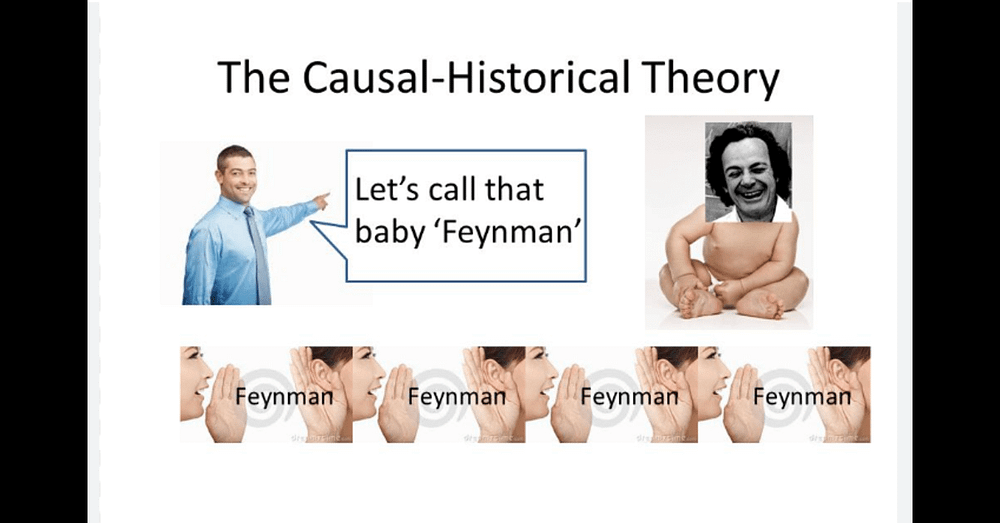
According to Donnellan, a proper name (in this case, “Santa Clause” or “Santa”) must have one of two things:

(1) It must be causally connected to its referent. 
(2) It must have “descriptive content”.

It seems that Donnellan believed that the name “Santa” has neither. That is, if that scare-quoted “name” has no “historical connection” to its referent (which it can’t have because Santa never existed), then the proposition “Santa will come tonight” can’t be a proposition. And it can’t be a proposition because of the problematic proper name.

Yet isn’t it simply a stipulation (or even a diktat) to argue that “Santa will come tonight” isn’t a proposition?…

In logic, however, all propositions must be either true or false.

Philosophical Realism?

The thing which seemed to be motivating Keith Donnellan was his attempt to save philosophical realism. In other words, if we can have a causal theory of reference which evidently excludes names like “Santa”, then we can distinguish real propositions like “Brad Pitt will come tonight” from “Zeus is angry with us”.

[The statement about Brad Pitt is a future contingent, which is also problematic — if for different reasons.]

There’s another realist move in this game.

Donnellan — and many other philosophers (such as Saul Kripke) — argued that proper names shouldn’t rely on being tied to “descriptive content”. They believed that this would give individual minds (as it were) too much power, and direct causal reference less power.

Associating descriptive content with proper names has also been deemed to be idealist by some philosophers. (“Subjective” is a better term than “idealist” in this context.) A causal connection to Brad Pitt (or the “Brad Pitt” relation to Brad Pitt) is concrete. “The rubbish [or great] actor in Hollywood” is subjective, or at least dependent on an individual mind (or on individual minds in the plural). Similarly, the definite description that I’ve personally tied to the name “Santa” may be very different to the one you’ve personally tied to that name.

So what would secure us an identity of reference here when it comes to the names “Santa” and “Brad Pitt”?

Donnellan’s causal theory of reference (which excludes Santa) is the realist’s way of avoiding not just idealism (or, better, subjectivity), but also relativism.

Conventions, conceptual schemes, identifying descriptions, etc. were also deemed to be “subjective” by Donnellan. Causal processes, on the other hand, impose themselves on us. In other words, they tie us firmly to the world.

Bertrand Russell, God and Sherlock Holmes

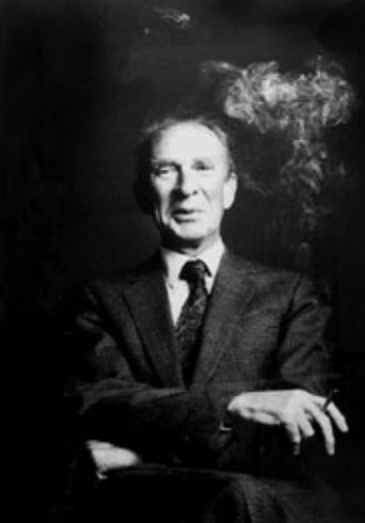
Bertrand Russell

To finish, let’s now agree with Keith Donnellan’s rejection of Bertrand Russell’s view on this matter.

Donnellan argued that the statement

“God does not exist.”

isn’t an abbreviation for Russell’s

“There is no entity such that…”

So why does “failure of a complex reference simply make a proposition false”?

What is a failure of reference?

For example, can’t we refer to something non-spatiotemporal?

Indeed is, say, Santa or Sherlock Holmes really a non-spatiotemporal entity at all?

Perhaps we can say that Santa or Holmes exists in minds, on the page, in letters, on the screen, in pictures, etc. All these are spatiotemporal things.

However, aren’t these examples simply representations of Santa and Holmes?

That would be the case if he were something other than Santa’s or Holmes’s representations.

In any case, in the works of Conan Doyle, Holmes is meant to be… Holmes: he isn’t a representation of Holmes.

So reference needn’t be to something that’s spatiotemporal in the strict sense of Holmes being made of flesh and blood…

We refer to numbers after all.

We refer to the number 2. The number 2 isn’t concrete. It isn’t (on most readings) spatiotemporal .

So is a negative statement like “John is not here” a reference to something spatiotemporal?

Well, in one sense, yes.

Part of the referent is the space not filled by John. In addition, even though John is not there, John himself is still a spatiotemporal entity.

What about the non-spatiotemporal nature of historical facts?

Can we simply say here that at on point historical events were spatiotemporal? So historical facts are parasitical on these past spatiotemporal events.

Peter Strawson on Statements About God

P.F. Strawson

Now take Peter Strawson’s position.

According to Strawson, the statement

“God is in heaven.”

is neither true nor false, because Strawson deemed the statement

“There exists something which is God.”

to be false.

Thus, the statement “God is in heaven” must be neither true nor false because there’s no God to be in heaven… or to be anywhere else. Of course, the statement “There exists something which is God” is making a claim about existence, not about the whereabouts of an existent.

Thus, according to Strawson’s atheistic ontology, the sentence “God is in heaven” is plainly suspect. How can it be true that “God is in heaven” when (it is supposed that) there is no God? Yet how can it be false that “God is in Heaven” for exactly the same reason?

On this picture, then, the subject, God, doesn’t exist. Thus, the predicate phrase, “is in Heaven”, can be neither true nor false of the subject term.

Yet perhaps we can still say that the statement “God is in heaven” is false without indulging in (or adding) existence-claims. If it’s false that there is God (and heaven), then it’s also false that God is in heaven. Thus, the whole statement is false. Or, rather, you can say it’s false (or true) because of one’s prior position on God’s existence. However, you shouldn’t thereby deny its status as a proposition.

If we do deny the propositional status of “God is in heaven”, then perhaps we can also call that sentence meaningless! Indeed, roughly speaking, this was the position of some logical positivists in the 1930s and 1940s. [See my ‘The Logical Positivists’ Use of the Word “Meaningless”: A Retrospective’.]

Yet we can’t allow this for the simple reason that the statement “God is in heaven” isn’t meaningless! It may well be philosophically problematic. However, the statement clearly isn’t without meaning.